

Athlete’s Foot and Nail Fungus: Why They Return and What Actually Clears Them

Key Takeaways
- Trichophyton rubrum causes most athlete's foot and most toenail fungus, so an untreated nail acts as a permanent seed source that reinfects the skin.
- In pooled randomized trials, allylamine creams such as terbinafine cleared athlete's foot slightly more often and faster than azoles, but both beat placebo convincingly.
- Itch fades within days because inflammation settles first; the fungus survives longer, which is why stopping treatment early drives most early relapses.
- Even oral terbinafine, the most effective nail option, produced a completely normal toenail in only about 38 percent of trial patients after a year, though roughly three-quarters tested fungus-free.
- A toenail takes 12 to 18 months to grow out fully, so any nail treatment is judged over a year rather than weeks.
- The first US cases of terbinafine-resistant Trichophyton indotineae were reported by the CDC in May 2023, but as of early 2026 resistance remains uncommon and mainly affects body and groin ringworm.
Athlete's foot is a fungal skin infection of the feet that usually clears with an over-the-counter antifungal cream, spray or powder used for the full time stated on the label, together with keeping feet dry and shoes aired. It returns because the same fungi hide in toenails, damp footwear and shared floors; nail fungus is far slower to treat and typically needs a clinician-guided plan.
Two things pushed athlete’s foot back into the news. The first arrived quietly in May 2023, when the CDC’s weekly report described the first US cases of ringworm caused by Trichophyton indotineae, a fungus that largely shrugs off terbinafine, the drug dermatologists have leaned on for thirty years. Reports have kept trickling in since. The second is louder: as of early 2026, short videos promising to wipe out foot fungus in a weekend with vinegar, bleach or a menthol chest rub are racking up millions of views.
Picture the reader those videos are aimed at. A runner peels off damp socks after a long training block and finds the skin between the fourth and fifth toes white, soggy and split, itching like a mosquito bite that never settles. A cream from the pharmacy calms it in a week. Three months later, it is back.
That loop, not the itch itself, is the real story. Understanding why the fungus keeps returning explains what actually clears it.
What changed recently: resistant ringworm and viral remedies
On May 12, 2023, the CDC’s Morbidity and Mortality Weekly Report published the first two confirmed US infections with Trichophyton indotineae, both in New York City patients seen between December 2021 and March 2023. Neither had traveled to South Asia, where this species had already become the dominant cause of ringworm. Both infections were widespread on the body and groin, and one failed to respond to standard oral terbinafine.
Why does a report about body ringworm matter for feet? The dermatophytes, the family of fungi that feed on keratin in skin, hair and nails, are close cousins. Trichophyton rubrum causes most athlete’s foot and most nail fungus; T. indotineae is a relative that has picked up mutations in the enzyme terbinafine targets. Clinicians in the United States are now asked to consider resistance when an infection that should clear simply does not, and to confirm the species with a laboratory culture rather than assuming.
The honest caveat: as of early 2026, resistant infections remain uncommon in the US and are still overwhelmingly reported on the trunk, thighs and groin rather than between the toes. Ordinary athlete’s foot has not suddenly become untreatable.
The second shift is cultural. Home-remedy content about foot fungus has exploded, and much of it treats the skin infection and the nail infection as one problem with one fix. They are not. The remainder of this article separates them, grades the evidence for each, and explains the unglamorous habits that stop the cycle. Where evidence is thin, it says so.
What is athlete's foot, and how is it linked to nail fungus?
Athlete’s foot, or tinea pedis, is a dermatophyte infection of the skin of the feet. Dermatophytes are fungi that digest keratin, the tough protein that makes up the outer layer of skin, hair and nails. They cannot invade living tissue, so they live in the dead surface layers, which is why the infection itches and flakes rather than spreading into the bloodstream.

The same organisms cause nail fungus, called onychomycosis, when they burrow under the nail’s edge and into the nail bed beneath. Roughly a third of people with athlete’s foot also have fungal toenails, and the two infections feed each other. Skin fungus at the toe tip creeps under the nail; a fungal nail sheds infected fragments back onto the surrounding skin every day.
The scale of the problem is easy to underestimate. Population surveys suggest athlete’s foot affects somewhere between 3 and 15 percent of adults at any moment and up to seven in ten people at some point in life, making it the most common fungal infection of humans. Toenail fungus affects around one in ten adults overall, climbing to roughly one in two in people over 70, because nails grow slower and circulation weakens with age.
Names cause confusion here. Ringworm, jock itch, athlete’s foot and most nail fungus are one biological problem in different neighborhoods. Nothing about worms is involved; the word comes from the ring-shaped rash on the body. A person who repeatedly treats their feet but ignores a crumbling big toenail is, in practical terms, repainting a wall while the roof still leaks.
What triggers athlete's foot? Sweat, shoes and shared floors
Dermatophytes need three things: keratin to eat, moisture, and warmth. A foot sealed inside a shoe for ten hours delivers all three. The space between the toes, particularly the fourth and fifth, is the narrowest and dampest spot on the body’s surface, and it is where most infections begin.
Exposure comes from surfaces. Infected skin sheds microscopic flakes that stay viable on floors and in shoes for weeks or longer. Locker rooms, pool decks, hotel showers, martial arts mats and shared bathrooms are the classic sources, but the household bathroom floor is probably the most common one of all. Studies that culture the floors of swimming pools and changing rooms routinely recover dermatophytes.
Exposure alone rarely produces infection. The skin barrier has to be softened or breached, and several factors do that reliably:
- Occlusive footwear, especially rubber or plastic work boots and non-breathable athletic shoes worn on consecutive days without drying.
- Hyperhidrosis, meaning excessive sweating, which keeps the skin macerated (softened and waterlogged).
- Skin cracks from dryness, eczema or tight toe boxes that squeeze the toes together.
- Reduced circulation or nerve function, common in diabetes and peripheral artery disease, which slows healing and dulls the warning itch.
- Weakened immunity, whether from medicines, HIV or older age.
Men are affected more often than women, and adults more than young children, differences that likely reflect footwear and sweat patterns rather than any innate susceptibility. Family history counts too: some people appear genetically less able to mount an immune response to T. rubrum specifically, which is one reason certain households pass the infection around for decades while a neighbor who uses the same gym never catches it.
What are the symptoms of athlete's foot? Five signs and three patterns
People searching for a short list are usually trying to match what they see. Five symptoms cover most cases: itching or stinging between the toes or on the soles; peeling, cracked or scaly skin; redness (which can look purple or gray on darker skin); small blisters; and a persistent odor from the breakdown of moist skin. Nail fungus adds its own signs, covered later.
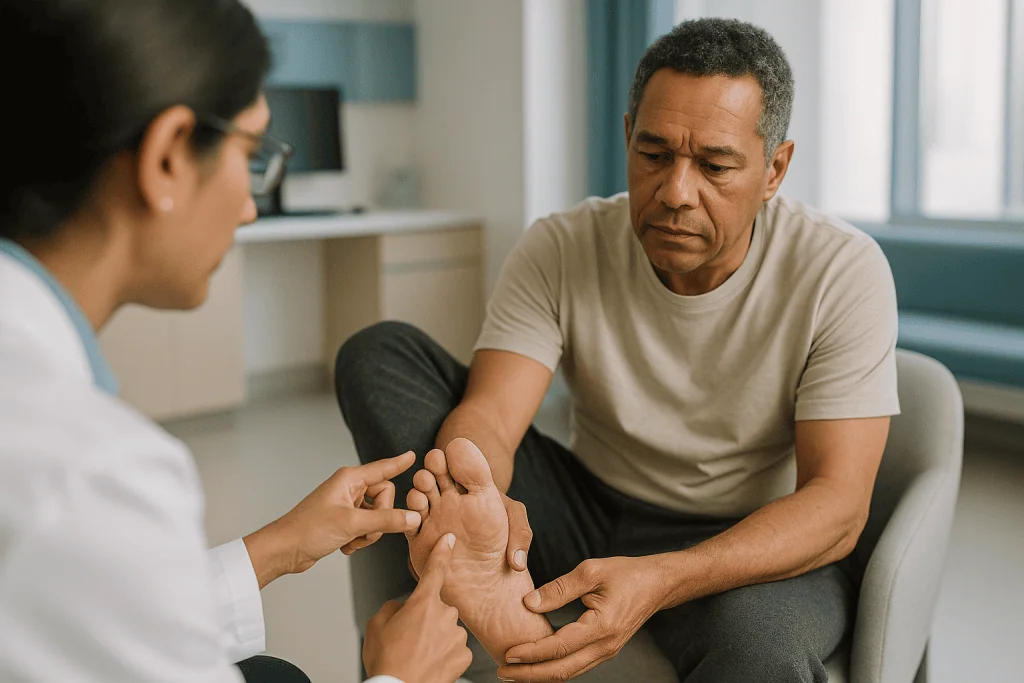
Dermatologists describe three patterns, and knowing which one you have changes expectations.
The interdigital form is the common one: soggy white skin between the toes that splits and peels, often with a musty smell. It itches most after shoes come off, when blood flow to the skin increases.
The moccasin form is subtler and more stubborn. The whole sole and heel become thickened, dry and finely scaly, in the outline of a moccasin slipper. It is frequently mistaken for plain dry skin for years, which is why moisturizer keeps being applied to what is actually an infection. This pattern is the one most tightly linked to nail fungus, because the fungus lives along the entire margin where skin meets nail.
The vesiculobullous form produces sudden clusters of fluid-filled blisters on the arch or sides of the foot. It is the least common and can be confused with contact dermatitis from shoe glue or dye.
One more sign deserves a mention because it is often missed. A rash on the hand, typically one palm, that appears alongside foot symptoms may be the same infection transferred by scratching, a pattern clinicians call two feet, one hand syndrome. Treating only the hand never resolves it.
Does athlete's foot go away by itself?
Occasionally, yes. Mild interdigital infection in someone who switches to sandals for a summer, dries carefully between the toes and lets the skin barrier recover can settle without treatment. The fungus needs sustained moisture, and removing it starves the infection.
Relying on that outcome is a poor bet. Dermatophyte infections are chronic by nature. Untreated athlete’s foot more often smolders for months, flaring when shoes are worn and fading when they are not, spreading slowly along the sole and eventually under a nail. Once it has reached the nail, spontaneous resolution essentially never happens, because the nail plate shelters the fungus from air, immune cells and friction.
There is also a bacterial angle that the do-nothing approach ignores. Cracked, macerated skin between the toes is a doorway. Streptococci and staphylococci that live harmlessly on intact skin can enter through those fissures and cause cellulitis, a spreading bacterial infection of the deeper skin that produces heat, swelling, pain and sometimes fever. Observational studies of patients hospitalized with leg cellulitis repeatedly identify untreated athlete’s foot as one of the most common entry points. For a healthy 30-year-old this is an unlikely complication; for someone with diabetes, lymphedema or poor circulation it is a genuine risk.
The practical reading of the evidence is straightforward. Athlete’s foot is one of the few infections that responds well to products sold without a prescription, treatment is low-risk, and leaving it alone mainly buys time for it to reach places that are much harder to treat. Waiting costs more than it saves.
What gets rid of athlete's foot fast? Tinea pedis treatment that works
Fast, for a fungal infection, means days of relief and a few weeks of treatment. Anything promising overnight results is describing symptom relief, not clearance.
Topical antifungals are the first-line treatment endorsed by every mainstream source, and two chemical families dominate the pharmacy shelf. Allylamines, such as terbinafine (Lamisil) and butenafine, kill the fungus outright. Azoles, such as clotrimazole and miconazole, mostly stop it multiplying and let the skin shed it. Tolnaftate is an older option in a third class. All three work; head-to-head trials pooled in a Cochrane systematic review found allylamines cleared infection slightly more often and somewhat faster than azoles, though both were clearly better than a placebo cream.
Two behaviors matter more than which tube you choose. First, treat beyond the visible edge, roughly a thumb-width around the rash, because the fungus outruns the redness. Second, keep going for the full period printed on the label even after the itch is gone. Itch disappears when the inflammation calms; fungus disappears later. Stopping early is the single most common reason for early relapse.
Formulation is a comfort choice, not an efficacy one. Creams suit dry, scaly soles; sprays and powders suit sweaty spaces between toes and can also be used inside shoes; gels dry quickly.
When topical treatment fails, the clinician’s options widen to oral antifungals such as terbinafine or itraconazole, usually reserved for moccasin-type infection, blistering disease or coexisting nail involvement. These prescription medicines carry interaction and liver considerations that the prescribing clinician weighs individually. They are not a shortcut for an infection that a cream, used properly, would have handled.
Why does athlete's foot keep coming back?
Recurrence is the rule rather than the exception. Depending on the study, between a third and two-thirds of people treated for athlete’s foot have symptoms again within a year. Four mechanisms explain almost all of it.
The nail reservoir comes first. A toenail infected with T. rubrum sheds fungal fragments continuously. Treating the skin around it is like weeding a lawn with a seed head standing in the middle. Any adult with repeated athlete’s foot should look hard at their toenails for thickening, yellow-white streaks or crumbling at the tip.
Footwear comes second. The inside of a shoe worn daily never dries fully, and cultures of shoe linings from people with recurrent infection routinely grow dermatophytes. Putting a treated foot back into a contaminated shoe reintroduces the fungus on day one.
Incomplete treatment comes third, as described above. A rash that stops itching in five days is not a rash that has cleared in five days.
Misdiagnosis comes fourth and is underrated. Eczema, psoriasis and contact dermatitis on the feet all peel, itch and redden, and none respond to antifungals. Someone who has treated the same patch six times with no lasting result may not have athlete’s foot at all. A simple scraping examined under a microscope with potassium hydroxide (a KOH test, which dissolves skin cells and leaves fungal threads visible) settles the question in minutes.
Underneath these sits host susceptibility. People with diabetes, hyperhidrosis, older age or a family tendency will reacquire the fungus more readily, which means for them prevention is a permanent routine rather than a one-time fix.
Nail fungus: why toenail fungus won't go away like skin fungus does
A toenail is a plate of dense keratin, roughly a millimeter thick, growing at about one millimeter a month. Fungus living under it is protected from creams, from immune cells and from the mechanical shedding that clears skin infection. A fully infected big toenail takes 12 to 18 months to grow out completely, so any treatment is judged over a year, not a fortnight.
The signs are distinctive: thickening; yellow, white or brown discoloration; crumbling or ragged edges; separation of the nail from its bed; and debris building up underneath. Pain arrives late, usually when the thickened nail presses against a shoe.
| Feature | Athlete’s foot (skin) | Nail fungus (onychomycosis) |
|---|---|---|
| Where the fungus lives | Outer dead skin layers | Under and within the nail plate |
| First-line treatment | Over-the-counter topical antifungal | Clinician-guided; often oral antifungal, sometimes prescription lacquer |
| Time to judge results | Weeks | Twelve months or more |
| Complete clearance in trials | Majority of treated patients | Oral terbinafine: roughly four in ten fully normal nails; topicals lower |
| Recurrence | Common, often within a year | Common; reported in up to half of cleared cases over several years |
| Diagnosis | Usually clinical, KOH if unsure | Clipping for microscopy, culture or PCR recommended before oral therapy |
Two points from that table shape realistic expectations. Even the most effective option, oral terbinafine, produced a completely normal-looking nail in only around 38 percent of patients in its landmark trial, although about three-quarters had no fungus detectable on testing. And topical nail products such as efinaconazole (Jublia) or ciclopirox lacquer cleared nails completely in a minority, roughly one in six or fewer, over a year of daily application. Nail fungus is treatable and manageable, but it asks for patience and a clinician who confirms the diagnosis first, because a third of thickened, discolored nails turn out not to be fungal at all.
What the evidence actually says, graded by strength
Not every claim about foot fungus rests on the same footing. A rough grading, from strongest to weakest:
Strong evidence (multiple randomized trials, systematic reviews). Topical allylamines and azoles clear tinea pedis far more often than placebo; this is settled science summarized in Cochrane reviews. Oral terbinafine outperforms oral griseofulvin and itraconazole for toenail fungus in randomized comparisons. Confirming the diagnosis by microscopy or culture before oral nail treatment reduces inappropriate prescribing.
Moderate evidence (smaller or shorter trials). Topical efinaconazole and tavaborole for nail fungus beat vehicle in phase 3 trials, with modest absolute clearance. Antifungal powders reduce relapse when used after skin treatment. Terbinafine-resistant T. indotineae responds better to itraconazole in case series, though controlled data are limited.
Weak or observational evidence. Laser devices for nail fungus are cleared by regulators for a temporary increase in clear nail, and published studies are mostly small, uncontrolled and short. Tea tree oil has a handful of small trials with mixed results and frequent skin irritation. Shoe sanitizing with ultraviolet light or antifungal sprays reduces fungal counts in laboratory tests, but no trial shows it prevents reinfection in people.
Expert opinion only. Advice to alternate shoes, wear moisture-wicking socks, dry between the toes and use sandals in shared showers is universal in guidance from the NHS, Mayo Clinic and CDC, and biologically sensible, but it has never been tested in a randomized trial and probably never will be.
Vinegar soaks, bleach, garlic, hydrogen peroxide, essential oil blends and menthol rubs sit below even that line. Claims for them rest on anecdotes and laboratory dish experiments, which say nothing about whether a substance reaches fungus living under a nail in a human foot.
Common myths about athlete's foot and nail fungus, corrected
Myth: a vinegar or bleach soak clears it in days. Diluted vinegar is acidic enough to slow fungal growth in a dish, and bleach kills nearly everything, including skin. Neither penetrates the nail plate, and bleach on cracked skin causes chemical burns that open the door to bacterial infection. No clinical trial supports either.
Myth: a menthol chest rub is a proven nail treatment. A single small uncontrolled study of 18 people reported partial improvement in some nails; a few contained ingredients such as thymol with laboratory antifungal activity. That is a hypothesis, not evidence, and it sits far below what prescription treatments have shown in controlled trials.
Myth: only athletes get it. The name reflects where infection spreads easily, not who is susceptible. Office workers in closed shoes and retirees with slow-growing nails are affected at least as often.
Myth: once the itch stops, the fungus is gone. Itch is inflammation; fungus outlasts it. Stopping at the first calm day is the most reliable way to guarantee a return visit.
Myth: it is a hygiene failure. Scrubbing harder does not help and can worsen cracking. Susceptibility involves genetics, sweat physiology, footwear and age, none of which reflect cleanliness. Shaming language around foot fungus keeps people from seeking treatment.
Myth: a discolored toenail is always fungus. Psoriasis, repeated trauma from running shoes, yeast, mold and simple aging can all mimic it. Treating for months on assumption is why confirming the diagnosis matters.
Myth: antifungal resistance means treatments no longer work. Resistance is real, documented and worth monitoring, but as of early 2026 it remains uncommon in the United States, and alternatives exist under clinician guidance.
How to prevent athlete's foot from returning
Prevention is where evidence thins and common sense takes over, so it is worth being clear about which habits have the strongest rationale.
Drying between the toes after every shower is the single most defensible habit. A towel corner or, for people who struggle to reach, a hair dryer on cool. Dermatophytes cannot establish on dry keratin.
Give shoes a day off. Alternating two pairs lets each dry for 24 hours. Pulling out insoles speeds this up. Storing shoes in a closed gym bag does the opposite.
Choose socks that move moisture: wool blends or synthetic athletic fibers rather than cotton, which soaks and stays wet. Change them midday if feet sweat heavily. Antifungal or absorbent powder in socks and shoes has modest trial support for reducing relapse after treatment.
Wear sandals or flip-flops in communal showers, pool decks and hotel bathrooms. Cleaning studies find dermatophytes on these surfaces regularly, and a thin layer of rubber is an effective barrier.
At home, do not share towels, nail clippers or shoes. Wash socks and bath mats in hot water. Treat the household bathroom floor as a possible source if more than one person is affected.
Tend to the nails. Keep them trimmed straight across and short enough that they do not lift at the tip. Anyone with recurrent skin infection should have thickened or discolored nails assessed, because clearing the skin while leaving an infected nail simply resets the clock.
For people who sweat heavily, addressing hyperhidrosis itself, through antiperspirants formulated for feet or clinician-directed options, removes the fungus’s most important ally. Each of these steps is small. Together they change the environment enough that reinfection stops being inevitable.
Diabetes, older age and weakened immunity: when foot fungus matters more
For most healthy adults, athlete’s foot is an irritation. For three groups it deserves the seriousness usually reserved for bigger problems.
People with diabetes face a combination of reduced sensation, weaker circulation and slower wound healing. A fissure between the toes that a healthy person would notice and treat may go unfelt, deepen, and become an entry point for bacteria. Cellulitis and foot ulcers in diabetes frequently trace back to exactly this kind of break in the skin. Thickened fungal nails add a second hazard: they press on neighboring toes and the nail bed, causing pressure injuries that are hard to see and slow to heal. Diabetes care guidance from major health bodies consistently lists fungal foot infection as something to report to the care team rather than self-manage.
Older adults, especially past 70, carry the highest rates of nail fungus, close to one in two in some surveys. Slower nail growth means longer treatment, more medications mean more potential interactions with oral antifungals, and reduced flexibility makes foot care physically harder. This is the group most likely to have lived with a nail infection for a decade, assuming it was simply age.
People with weakened immunity, from HIV, chemotherapy, organ transplant medicines or long-term steroids, can develop unusually extensive or atypical infection that spreads beyond the feet. Standard over-the-counter approaches may be insufficient, and clinician involvement early is sensible.
In all three groups the message is the same: what would be a wait-and-see problem for someone else becomes a see-someone-now problem. Not because the fungus itself is dangerous, but because of the doors it opens.
Athlete's foot between toes or something else? Getting the diagnosis right
A surprising share of stubborn foot rashes treated as athlete’s foot are not fungal. Getting this right early saves months.
Contact dermatitis from shoe materials, particularly rubber accelerators, chromate-tanned leather and adhesives, produces itchy, scaly patches on the tops and sides of the feet where the shoe touches, often symmetrically. The spaces between the toes are usually spared, the opposite of athlete’s foot.
Dyshidrotic eczema causes intensely itchy small blisters on the soles and sides of the toes, mimicking the blistering form of tinea pedis. It flares with stress and sweating and settles with anti-inflammatory treatment, which would do nothing for fungus.
Psoriasis on the soles gives thick, well-defined plaques with silvery scale, sometimes with pinpoint pits in the nails. It is frequently misdiagnosed as moccasin-type athlete’s foot.
Bacterial overgrowth, particularly erythrasma and pitted keratolysis, produces macerated, malodorous skin between the toes and on the soles that looks fungal but responds to antibacterial treatment.
The tools for sorting these out are simple. A KOH microscopy scraping takes minutes and shows fungal threads directly. A fungal culture takes two to four weeks but identifies the species, which matters when resistance is suspected. PCR testing is faster and increasingly available. A Wood’s lamp, an ultraviolet light, makes erythrasma glow coral-red.
The practical rule: one properly used course of over-the-counter antifungal that fails, or a rash that never fully clears, is enough reason to ask for a scraping rather than reaching for a different tube. Treating an unconfirmed diagnosis for a second, third or fourth time is the most common form of wasted effort in foot care.
When to see a doctor about athlete's foot or nail fungus
Most athlete’s foot can be managed with pharmacy products and the habits above. Certain situations move it into a clinician’s hands, and a few are urgent.
Seek same-day care for red-flag signs of bacterial infection: spreading redness or warmth moving up the foot or leg, swelling, increasing pain, pus or an unpleasant discharge, fever or chills, or a red streak tracking toward the ankle. These suggest cellulitis, which needs antibiotics promptly.
Book an appointment soon if:
- You have diabetes, peripheral artery disease, lymphedema or a weakened immune system and notice any fungal foot infection, however mild.
- A full course of over-the-counter antifungal, used as the label directs, has not cleared the rash, or it returns within weeks.
- Toenails are thickening, discolored, crumbling or lifting, since nail fungus rarely responds to skin products and needs confirmation before treatment.
- Blisters are large, weeping or painful, or the rash has spread to the hands, groin or body.
- The infection recurs more than twice a year despite good foot care.
- You have recently traveled to or have household members from regions where terbinafine-resistant ringworm is common, and an infection is not responding.
Expect the clinician to confirm the diagnosis with a scraping or nail clipping before prescribing oral antifungals. Those medicines are effective but carry potential liver effects and drug interactions, and the decision to start them, the choice of agent, the duration and any blood monitoring belong to the prescribing clinician who knows your full medication list and history. Never stop, extend or combine prescribed treatments on the basis of an online tip. If a treatment is not working, the right move is a follow-up appointment and possibly a culture, not a stronger home remedy.
Frequently asked questions
What gets rid of athlete's foot fast?
An over-the-counter antifungal such as terbinafine, clotrimazole or miconazole, applied to the rash and a thumb-width beyond it for the full period on the label, is the fastest evidence-backed approach. Itch usually eases within days; the fungus takes weeks to clear. Keeping feet dry and alternating shoes speeds recovery and prevents the infection returning.
What triggers athlete's foot?
Athlete’s foot is triggered by contact with fungal skin flakes on floors or in shoes, combined with warm, damp conditions that soften the skin, especially between the toes. Occlusive footwear, heavy sweating, cracked skin, diabetes, weakened immunity and a family tendency all raise the odds that exposure becomes infection.
Does athlete's foot go away by itself?
Mild cases occasionally settle if feet are kept dry and open to air, but athlete’s foot more commonly persists for months, spreads along the sole and eventually reaches the nails, where it will not resolve on its own. Cracked skin can also let bacteria in. Since treatment is low-risk and effective, waiting rarely pays off.
What are 5 symptoms of athlete's foot?
The five most common symptoms are itching or stinging between the toes or on the soles; peeling, scaly or cracked skin; redness, which may look gray or purple on darker skin; small fluid-filled blisters; and a persistent musty odor. A dry, thickened moccasin pattern over the whole sole is often mistaken for ordinary dry skin.
Is nail fungus the same thing as athlete's foot?
Largely yes: the same dermatophyte fungi, chiefly Trichophyton rubrum, cause both. The difference is location. On skin the fungus lives in accessible outer layers and responds to creams; under a toenail it is shielded by the nail plate and usually needs clinician-guided treatment judged over a year, with confirmation of the diagnosis first.
Can I catch athlete's foot from a shower floor or pool deck?
Yes. Infected skin sheds fungal fragments that remain viable on damp floors for weeks, and sampling studies regularly recover dermatophytes from communal showers, pool decks and changing rooms. Wearing sandals in these areas and drying between the toes afterward are the standard, biologically sensible precautions, though they have not been tested in randomized trials.
Why does my athlete's foot keep coming back?
The four usual reasons are an untreated infected toenail seeding the skin, damp shoes that reintroduce the fungus, stopping treatment as soon as itching fades, and a rash that is not actually fungal. Diabetes, heavy sweating and older age add susceptibility. Recurrence more than twice a year is a good reason to have the diagnosis confirmed.
Does vinegar, bleach or a menthol rub treat athlete's foot or nail fungus?
No reliable clinical evidence supports any of them. Vinegar slows fungi in laboratory dishes but not under a nail; bleach damages skin and invites bacterial infection; the menthol rub claim rests on one uncontrolled study of 18 people. Proven topical antifungals are inexpensive to the evidence base in the sense that they have decades of randomized-trial data behind them.
How long does toenail fungus take to clear?
At least a year in most cases, because a toenail grows about a millimeter a month and the infected portion must grow out fully. Trials of oral terbinafine judged results at 48 weeks, when roughly four in ten patients had a completely normal nail. Topical lacquers are assessed over a similar period with lower clearance rates. A clinician sets and monitors the plan.
Is athlete's foot contagious to my family?
Yes, through shared floors, towels, bath mats, nail clippers and shoes. Household bathrooms are a common source when several family members are affected. Not sharing these items, washing socks and mats in hot water, and treating everyone with symptoms at the same time, including any infected toenails, breaks the cycle within a home.
References
- Notes from the Field: First Reported U.S. Cases of Tinea Caused by Trichophyton indotineae: New York City, December 2021–March 2023 (CDC MMWR)
- Athlete's foot (NHS)
- Fungal nail infection (NHS)
- Athlete's foot (MedlinePlus Medical Encyclopedia)
This article is for general information only and is not a substitute for professional medical advice. Please consult a qualified doctor about your individual situation.

More from the Blog
Tick Bites: Safe Removal and the Signs of Infection to Watch For
Tick bites are best handled by removing the tick as soon as you find it: grasp it close to the skin with fine-tipped tweezers,…

Salmonella Infection: When Doctors Order a Stool Test and How the Result Changes Treatment
Doctors usually order a salmonella stool test when diarrhea is severe, bloody, lasting more than a few days, accompanied by high fever, or occurring…

Walking Pneumonia: The Mycoplasma Infection Behind the Lingering Cough
Walking pneumonia is a mild form of pneumonia most often caused by the bacterium Mycoplasma pneumoniae. It typically brings a dry, hacking cough that…

After a Tick Bite: When Doctors Recommend an Evaluation and How Lyme Disease Care Begins
See a doctor after a tick bite if you cannot remove the tick fully, if it was likely attached for 36 hours or more,…

Does Dengue Need Hospital Care? When Fluids and Monitoring Move From the Clinic to a Ward
Most people with dengue recover at home with rest, oral fluids and daily check-ins, because there is no specific antiviral and care is supportive.…

Long COVID Symptoms: The Patterns Doctors Now Recognize and the Tests That Help
Long COVID symptoms are health problems that persist or newly appear at least three months after a COVID-19 infection and last two months or…