

Auditory Rehabilitation After a Cochlear Implant: Why Does Practice Shape the Result?
Key Takeaways
- A cochlear implant bypasses damaged hair cells and stimulates the hearing nerve directly, but the brain must learn to interpret that coarse electrical signal, which is why practice shapes the result.
- Activation usually happens about 2–6 weeks after surgery once the incision has healed, and mechanical or high-pitched speech at switch-on is the expected starting point, not a sign of failure.
- Mapping appointments cluster in the early months because the hearing nerve's responsiveness, the tissue around the electrodes and the person's listening skill all change quickly after activation.
- Duration of deafness before implantation, hearing aid use up to surgery and hours of daily device wear are among the strongest evidence-based predictors of how well speech understanding develops.
- Children born deaf follow a language-acquisition pathway measured in developmental milestones, with therapy delivered through play and heavy involvement of caregivers and school.
- Severe headache with stiff neck and fever, new facial weakness, wound discharge or sudden device silence are red flags that warrant contacting the implant team the same day.
Cochlear implant rehabilitation is the structured program of device programming, listening practice and follow-up that turns the electrical signals from an implant into meaningful sound. The implant bypasses damaged inner-ear cells, but the brain has to learn to interpret an unfamiliar signal, and that learning depends on hours of daily use and guided practice. Progress varies widely, so the implant team tailors the plan and the timeline to each person.
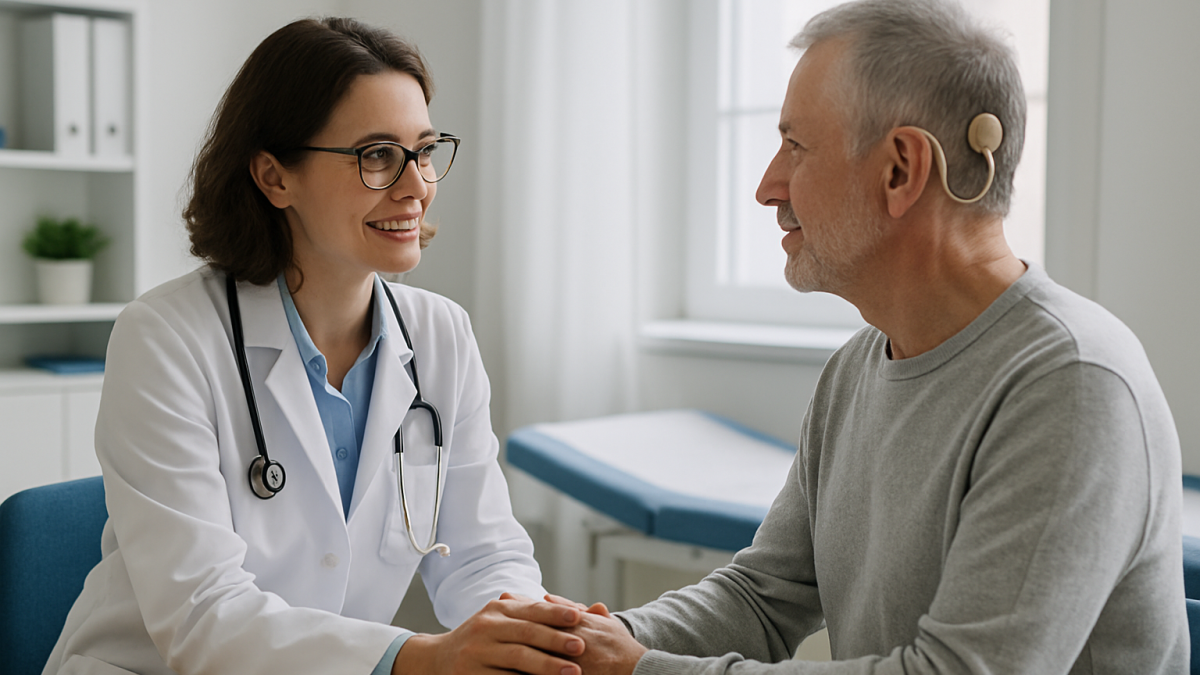
The first voice most people hear through a new implant is not the one they were hoping for. A daughter says hello and it comes out clipped and metallic, somewhere between a cartoon duck and a radio between stations. Some laugh. A few cry, and not always with relief. The audiologist in the room has seen this hundreds of times and says the same thing to almost everyone: this is the starting line, not the verdict.
That gap between what the device delivers and what the brain eventually makes of it is where cochlear implant rehabilitation does its work. The surgery places the hardware. The months that follow, with mapping visits, deliberate listening practice and a lot of ordinary conversation, decide how much of that hardware becomes hearing.
This explainer walks through what happens in those months, why practice carries so much weight, what the evidence can and cannot promise, and the questions worth bringing to your care team.
Why is hearing through a cochlear implant a learned skill?
Start with the part of the ear the implant replaces. The cochlea is the snail-shaped chamber of the inner ear where sound is converted into nerve signals. Lining it are hair cells, tiny sensors that bend in response to vibration and release chemical messengers to the hearing nerve. Most permanent hearing loss involves damage to these cells, and the body does not grow them back.
A cochlear implant steps around the damage. An external sound processor, worn behind the ear or on the head, picks up sound and converts it into digital code. A receiver placed under the skin during surgery relays that code to an electrode array, a slim wire threaded into the cochlea that stimulates the hearing nerve directly with tiny electrical pulses. The National Institute on Deafness and Other Communication Disorders (NIDCD) describes the result plainly: the implant does not restore normal hearing, it gives a useful representation of sound that the brain must learn to use.
Here is the catch. A healthy cochlea uses thousands of finely tuned hair cells to encode pitch and timing. An electrode array uses a small number of contacts spread along the same space. The signal reaching the brain is coarser, like a familiar sentence printed in an unfamiliar font with several letters missing. At first it is noise with a rhythm. With exposure, the auditory cortex, the region of the brain that interprets sound, reorganizes to match the new pattern. Scientists call this capacity neuroplasticity, the brain’s ability to rewire in response to experience.
That rewiring is not automatic. It is driven by input, repetition and attention, which is another way of saying practice. The device supplies the signal; the person supplies the learning.
What is cochlear implant rehabilitation, and who is on the team?
Cochlear implant rehabilitation is the umbrella term for everything that happens after surgery to help a person hear, understand and communicate with the device. It is less a single therapy than a coordinated program with several moving parts, and it usually continues well beyond the first year.
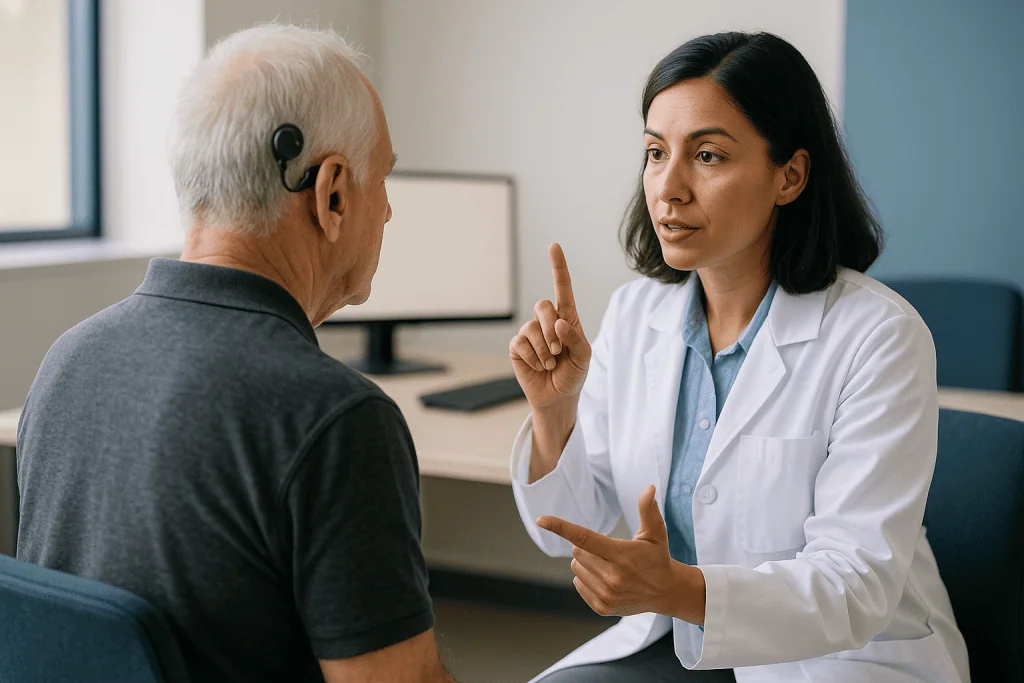
The core team is small. An audiologist, a clinician trained in hearing measurement and device fitting, programs the implant and monitors how the ear and nerve respond. A speech-language pathologist, a therapist specializing in speech, language and listening skills, designs and delivers auditory training. The ear, nose and throat surgeon who placed the device oversees healing and any medical concerns. Depending on the person, the team may widen to include a teacher of the deaf, a psychologist, an occupational therapist or a social worker, and, for children, the whole household.
The program itself typically covers five strands. Device programming, often called mapping, sets how the electrodes deliver sound. Auditory training builds the brain’s skill at detecting, discriminating and understanding speech. Communication strategies teach practical habits such as positioning, lip reading support and repair phrases when something is missed. Counseling addresses expectations, fatigue and the emotional weight of hearing differently. Device management covers batteries, moisture, spare parts and troubleshooting.
Mayo Clinic notes that rehabilitation is essential to learning to interpret the new sounds, and that it involves regular follow-up visits over an extended period. What that means in practice is that a person’s calendar fills with appointments early on and then gradually clears, while the daily work shifts from the clinic to the kitchen table, the car and the phone. The team sets the structure. The person, and often a listening partner at home, does most of the repetitions.
Who is a cochlear implant usually for, and who is usually asked to wait?
Candidacy is a clinical decision, and it rests with the implant team after a full evaluation. Still, the broad outlines are consistent across mainstream guidance.
According to the NIDCD and Mayo Clinic, cochlear implants are generally considered for people with severe to profound sensorineural hearing loss, the type caused by inner-ear or nerve damage, who get limited benefit from properly fitted hearing aids. That includes adults who lost hearing after learning language, adults and children born deaf, and, in some centers, people with profound loss in one ear. Evaluation usually involves hearing tests with and without hearing aids, speech understanding tests, imaging of the inner ear, a medical review and a conversation about goals and expectations.
People are commonly asked to wait, or are guided toward other options, in a few situations. If hearing aids still provide meaningful speech understanding, teams typically recommend continuing with them and reassessing over time. Active middle-ear infection is usually treated before any surgery is scheduled. Imaging that shows an absent or severely malformed cochlea or hearing nerve may make an implant unsuitable, and other approaches are discussed. Medical conditions that raise surgical risk need to be stabilized first. For young children, the timing question is nuanced: teams weigh the child’s hearing aid trial, language progress, family preferences and developmental picture, and the recommended age is a team judgment, not a fixed rule.
Realistic expectations are part of candidacy too. Clinicians look for a person, or a family, who understands that the device is a tool that demands practice rather than a switch that restores hearing. That is not a test to pass; it is a shared starting point, because the rehabilitation that follows only works when everyone is aiming at the same target.
What happens on cochlear implant activation day?
Activation, sometimes called switch-on, is the appointment when the external processor is fitted and the implant delivers sound for the first time. Mayo Clinic describes this happening once the incision has healed, typically about 2–6 weeks after surgery. Until then the internal device sits silent under the skin.
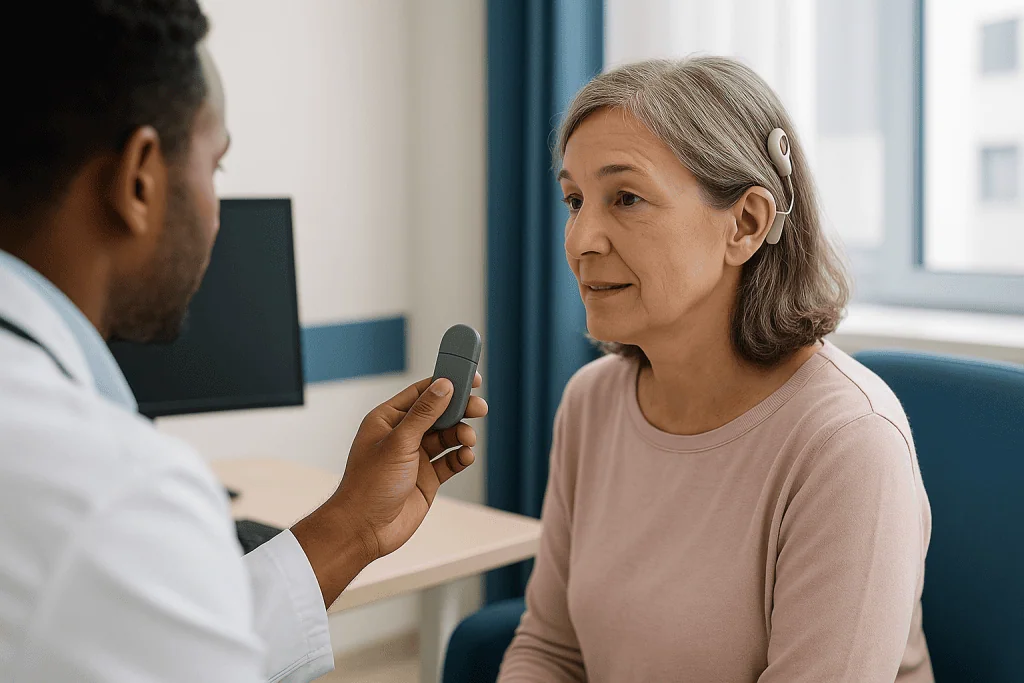
The visit is longer and quieter than most people expect. The audiologist connects the processor to a computer and sends soft pulses to each electrode, asking the person to signal when they notice something and when it becomes comfortably loud. Those two measurements, the softest detectable level and the comfortable maximum, are set for each contact along the array. Only then is the microphone switched on.
What comes next is the moment that gets filmed and shared online, and it rarely matches the video. Voices often sound high-pitched, mechanical or like beeps layered over speech. Some people recognize the rhythm of their own name before they recognize the word. Others hear a door close and startle. Children may cry, freeze or ignore it entirely, all of which are normal first responses to an entirely new sensation. The NIDCD is direct about this: learning to interpret the signals takes time and practice, and initial impressions are not a measure of eventual benefit.
Before leaving, the person usually goes home with several programs stored on the processor, often stepping up in loudness so they can advance over the first days as tolerance grows. Instructions tend to be consistent across teams: wear the device during all waking hours, start in quiet settings, listen to familiar voices, and keep a simple diary of what was heard and what was hard. The first mapping follow-up is often scheduled within days.
What are cochlear implant mapping appointments, and why are there so many?
A map, in implant language, is the personalized program that tells the processor how to convert sound into electrical stimulation across the electrodes. Mapping appointments are the visits where the audiologist adjusts that program. Cleveland Clinic and Mayo Clinic both describe a series of these visits, clustered in the early months and spacing out over the first year and beyond.
Why so many? Three things change after activation. The hearing nerve becomes more responsive with regular stimulation, so levels that felt loud in week one can feel faint by week four. The tissue around the electrodes settles, altering the electrical resistance the audiologist measures at each contact. And the person’s own listening skill improves, which lets the audiologist fine-tune features such as noise handling and frequency emphasis that would have been meaningless at the start.
A typical visit involves re-measuring soft and comfortable levels, checking each electrode’s function, listening tests in quiet and sometimes in noise, and a conversation about real life: which voices are clear, whether the dishwasher is unbearable, how the phone is going. Adjustments are incremental. A good map is not the loudest possible setting; it is the one that makes speech clearest without fatigue.
Skipping these appointments carries a quiet cost. An outdated map can leave speech muffled or sharp, and a person may conclude the implant is underperforming when the program simply has not kept pace with the ear. Bring the diary. Bring the listening partner who notices what you miss. Clinicians consistently say the most useful information in a mapping session comes from specific examples, such as a name that always sounds like another name, rather than a general sense that things are fine.
What does auditory training after a cochlear implant actually involve?
Auditory training is structured listening practice designed to teach the brain to extract meaning from the implant’s signal. Speech-language pathologists often describe it as a ladder with four rungs: detecting that a sound occurred, discriminating that two sounds differ, identifying what a sound or word is, and comprehending connected speech well enough to follow a conversation. Most adults with implants move through all four, but not at the same speed, and not in every listening situation at once.
Early exercises are deliberately simple. A partner reads a short list of words aloud while the person watches the text, then repeats them with the page hidden. Familiar audiobooks paired with the printed book let the brain match a known voice to a known script. Environmental sounds get labeled on purpose: that is the kettle, that is the dog’s collar, that is the turn signal. Children do the same work through play, songs and routines.
As skill grows, the difficulty ratchets up in controlled ways. Unfamiliar voices replace familiar ones. Background noise is added at a low level and raised gradually. Phone calls begin with a scripted partner and a predictable topic. Music, which the coarse signal renders poorly at first, is approached through rhythm and lyrics before melody. Many teams recommend home practice apps or self-guided programs; the evidence for these is encouraging but mixed in quality, and the NIDCD emphasizes that consistent daily use of the device itself remains the foundation on which any training builds.
The thread running through all of it is active attention. Passive exposure, such as a television on in the next room, helps far less than ten minutes of focused listening with feedback. The brain learns what it is asked to notice.
What do the first weeks and months of cochlear implant rehabilitation usually look like?
No two timelines match, and the team adjusts pacing to healing, age, hearing history and life circumstances. The table below describes what mainstream clinical sources commonly describe, not a schedule anyone is promised.
| Phase | What commonly happens | What the person is usually asked to do |
|---|---|---|
| Surgery to activation (about 2–6 weeks, Mayo Clinic) | Incision heals; internal device stays silent; swelling settles | Wound care as instructed; avoid pressure on the site; report any red flags |
| Activation and first weeks | Initial map set; sounds seem mechanical or high-pitched; frequent mapping visits | Wear the processor all waking hours; practice in quiet with familiar voices; keep a listening diary |
| Early months | Levels are raised; speech in quiet becomes clearer; training moves to unfamiliar voices | Daily structured practice; begin phone and small-group listening; attend every mapping visit |
| Later in the first year and beyond | Mapping visits space out; noise, music and phone remain works in progress | Maintain practice in hard settings; annual or team-directed reviews |
Two things in this table deserve emphasis. First, the early cluster of visits is not a sign that something is wrong; it is the period when the ear and the map change fastest, and close follow-up captures that change. Second, the final row has no end date on purpose. Both Mayo Clinic and Cleveland Clinic describe follow-up continuing for life, with periodic checks of the device and the map even after listening has stabilized.
Fatigue deserves a mention too. Listening through an implant is cognitively demanding in the early months, and many people describe needing more rest than usual. That is expected, and it eases as the brain’s processing becomes more automatic.
How long does it take to adjust to a cochlear implant?
This is the question almost everyone asks at the first appointment, and the honest answer has two parts: the biggest changes usually come early, and improvement can continue far longer than people expect.
Mainstream sources agree on the shape of the curve without committing to fixed numbers. The NIDCD states that outcomes vary widely and that learning to interpret the signal requires time and training. Cleveland Clinic describes progress continuing across the first year as the brain adapts and the map is refined. Mayo Clinic frames rehabilitation as an extended process with ongoing follow-up. None of them offer a date by which a person should understand a given percentage of speech, and any clinician who does is speaking beyond the evidence.
What the pattern looks like in practice is a steep early climb followed by a long, gentle slope. Speech in a quiet room with one familiar person tends to come first. Speech in noise, unfamiliar accents, the telephone and music sit further along and may keep improving for years with practice. Some skills, such as locating where a sound is coming from, depend on hearing in both ears and may remain limited for a person with a single implant.
Several factors stretch or compress the timeline. Adults who lost hearing recently and used hearing aids up to surgery often adapt faster than those with decades of profound loss, because their auditory pathways have stayed active. Children born deaf follow a developmental rather than a re-learning trajectory, measured in language milestones rather than weeks. Hours of daily wear matter across every group.
The practical takeaway is to measure progress against your own baseline, not against a stranger’s activation video. Your team will track it with formal tests at intervals, and those numbers, not the calendar, tell the real story.
Which factors shape the result, according to the evidence?
Because outcomes range so widely, researchers have spent decades asking what separates people who understand most conversation from those who gain mainly sound awareness. The NIDCD summarizes the picture without ranking the factors, and the literature it points to identifies a recurring set.
Hearing history sits at the top. Duration of profound deafness before implantation is one of the strongest predictors in adults: the longer the auditory pathways have gone without meaningful input, the more relearning is required. Whether a person lost hearing before or after acquiring spoken language matters enormously, because a brain that once decoded speech has a template to return to. Consistent hearing aid use right up to surgery appears to help by keeping those pathways active.
Device use comes next, and this is the factor most within a person’s control. Modern processors record how many hours a day they are worn, and teams review this data at mapping visits. Clinicians describe the same finding repeatedly: people who wear the device during all waking hours tend to progress faster than those who use it a few hours a day, because the brain needs a steady stream of input to reorganize.
Then come the supporting factors. Regular attendance at mapping and therapy. A communication partner who practices with the person and gives honest feedback. General health, vision and cognition, since listening leans on attention and memory. Motivation and realistic expectations, which keep people practicing through the frustrating middle months. Surgical factors such as electrode placement play a role the person cannot influence after the fact.
Notice what the list does not include: brand of device, a particular clinic or a special technique. The evidence points to biology and behavior. The team manages the biology; practice is the behavior.
How is cochlear implant rehabilitation different for children?
An adult with an implant is relearning a language they already know. A child born deaf is learning language for the first time through a signal that is itself new. That single difference reshapes the entire rehabilitation pathway.
The NIDCD notes that children who receive implants at a young age, followed by intensive therapy, often develop spoken language skills more readily than those implanted later, because the brain’s capacity to acquire language is greatest in early childhood. Timing decisions, however, belong to the implant team and the family together, weighing the hearing aid trial, imaging, health, developmental picture and the family’s communication goals.
Therapy for a child rarely looks like therapy. A speech-language pathologist may spend a session rolling a ball and naming it, singing the same song until the child anticipates the pause, or hiding a squeaky toy and waiting for the head to turn. Parents and caregivers are coached to narrate daily life, to hold the child close when speaking, to reduce background noise at home and to notice when the processor has slipped off. The device is only useful when it is on, and toddlers are inventive about removing it.
School enters the picture early. Teachers of the deaf, classroom acoustics, remote microphone systems that send a teacher’s voice directly to the processor, and regular hearing checks all become part of the plan. Many families also use sign language alongside spoken language; mainstream guidance treats this as a legitimate choice rather than a competing one, and the team should support whichever approach the family chooses.
Comfort matters throughout. Children should be told, in words they understand, what will happen at each visit. Mapping for young children uses play-based responses and objective measurements of the nerve’s activity, so no child is asked to report levels they cannot describe.
What are the risks, limits and alternatives?
Cochlear implantation is a well-established surgery, and MedlinePlus and Mayo Clinic describe serious complications as uncommon. Uncommon is not never, and understanding the risks is part of informed consent.
Surgical risks include bleeding, infection at the incision, temporary or rarely lasting weakness of the facial nerve, which runs close to the surgical path, altered taste on one side of the tongue, dizziness or balance disturbance, and new or worsened tinnitus, the perception of ringing or buzzing without an external sound. Any remaining natural hearing in the implanted ear is usually lost, which is why candidacy hinges on how little useful hearing remains. Rarely, the internal device fails or migrates and needs revision surgery. Meningitis, an infection of the membranes around the brain, is a recognized though rare risk; Mayo Clinic notes that recipients are commonly advised about vaccination, a decision made with the treating clinician.
Limits are worth stating just as plainly. The implant does not restore normal hearing. Speech in noise, music appreciation and locating sounds remain difficult for many people even after years of practice. External parts must be removed for swimming unless a water-resistant accessory is used, and magnetic resonance imaging (MRI) requires specific precautions that depend on the implant model, so the team must be told before any scan.
Alternatives depend on the type and degree of loss. Hearing aids remain the first option when they still provide benefit. Bone conduction devices suit some forms of conductive or single-sided loss. Auditory brainstem implants are considered in rare cases where the hearing nerve itself is absent. Assistive listening technology, captioning and sign language are valid paths on their own or alongside a device. A neutral evaluation should lay out each option, and the choice, including the choice not to implant, rests with the person and the team.
What people often get wrong about cochlear implant rehabilitation
Myths cluster around implants because the activation videos travel further than the follow-up appointments. Here are the misconceptions clinicians correct most often.
“The implant gives you your hearing back.” It gives access to sound through a coarse electrical signal. The NIDCD is explicit that the result is not normal hearing. Understanding grows with practice, and some situations stay hard.
“If it sounds terrible at activation, the surgery failed.” Mechanical, high-pitched or beeping speech at switch-on is the expected starting point, not a sign of failure. The map is set conservatively on day one and the brain has had no time to adapt.
“Older adults are too old to benefit.” Age alone does not exclude someone. Duration of deafness and general health matter more than the number on a birth certificate, and many adults receive implants late in life.
“Wearing it a few hours a day is enough.” Every mainstream source stresses all-waking-hours use. The brain learns from input, and a device in a drawer teaches nothing.
“Rehabilitation is for children; adults just need the device.” Adults need mapping and structured practice too. Those who skip therapy commonly plateau earlier.
“Captions and lip reading will hold you back.” Used deliberately, visual support scaffolds listening. The skill is to lean on it early and then practice without it, not to avoid it.
“Music is impossible with an implant.” Music is harder than speech and pitch is poorly conveyed, but rhythm and lyrics are often accessible, and appreciation frequently improves with targeted listening.
“Once you understand speech, you are done.” Follow-up continues for life. Maps drift, parts wear, and new listening goals appear.
Questions to ask your care team
A good implant team welcomes questions and expects them to change over time. Write them down before each visit; listening fatigue makes it easy to forget what you meant to ask. These are a starting set, grouped by stage.
Before surgery
- Based on my hearing history, what range of outcomes is realistic for me, and what would you consider a good result?
- How much natural hearing do I have in this ear now, and what is likely to happen to it?
- Which vaccinations or medical checks do you recommend before the procedure, and why?
- Are there alternatives you considered for me, and what tipped the decision?
Around activation
- How many mapping appointments should I expect in the first months, and how will we space them later?
- What should I practice at home in the first two weeks, and for how long each day?
- Who do I contact if the processor stops working or sounds change suddenly?
- What should my family or listening partner know about how to talk with me now?
During rehabilitation
- How will you measure my progress, and how often?
- Am I wearing the device enough, according to the usage data?
- Which listening situations should I tackle next, and which can wait?
- What resources exist for auditory training, and which do you think fit my goals?
Long term
- What precautions apply to MRI, air travel security, sports and swimming with my specific implant?
- How often should the internal device and the map be checked once things are stable?
- What symptoms should prompt a call between scheduled visits?
None of these have universal answers. Their value is in the conversation they open, and in making sure the plan reflects your life rather than a generic protocol.
When to call your doctor
Most of the rehabilitation journey is routine, but a few signs warrant a prompt call to the implant team or, in some cases, urgent care. Do not wait for the next scheduled mapping visit if any of the following appear.
Around the surgical site, contact your team the same day for spreading redness, warmth, swelling, pus or fluid leaking from the incision, a wound that opens, or fever after surgery. These can signal infection, which is treated more easily when caught early.
Seek urgent medical care for severe headache with a stiff neck, fever, sensitivity to light, confusion or drowsiness. Mayo Clinic and MedlinePlus list meningitis as a rare but serious complication of cochlear implantation, and these are its warning signs at any point after surgery, not only in the first weeks.
Call the same day for new facial weakness or drooping on the implanted side, facial twitching when the processor is on, sudden severe dizziness or vertigo that does not settle, sudden loss of sound from the device that troubleshooting does not fix, or sharp, painful or unusual sensations when the implant stimulates. Some of these may simply need a map adjustment; others need medical review, and the team should decide which.
Also reach out if tinnitus becomes markedly worse, if the skin over the internal device becomes red, thin or sore, or after a hard blow to the head near the implant, even if the device seems to be working.
Emotional strain counts too. Persistent low mood, withdrawal from conversation or a sense that the effort is not worth it are reasons to tell your team; support and adjustments to the plan are part of rehabilitation, and no one is expected to push through alone. Whatever the symptom, the treating team decides the next step.
Frequently asked questions
What happens on cochlear implant activation day?
The audiologist fits the external processor, measures the softest and comfortably loud level for each electrode, then switches on the microphone so the implant delivers sound for the first time. Voices often sound mechanical or high-pitched at this stage. Mayo Clinic describes activation taking place about 2–6 weeks after surgery, once the incision has healed. People usually leave with several stored programs and instructions to wear the device all waking hours.
How long does it take to adjust to a cochlear implant?
There is no fixed timeline; the NIDCD notes outcomes vary widely and learning requires time and training. The largest changes usually come in the early months as the map is raised and the brain adapts, and clinical sources such as Cleveland Clinic describe improvement continuing across the first year and often beyond. Speech in quiet tends to come first, while noise, phone and music take longer.
Why are there so many cochlear implant mapping appointments?
The program that controls stimulation needs frequent adjustment early on because the hearing nerve becomes more responsive with use, the tissue around the electrodes settles and the person’s listening skill improves. Each visit re-measures comfort levels, checks electrode function and fine-tunes settings based on real-life feedback. Visits are close together at first and then spread out, but periodic checks continue for life.
What does auditory training after a cochlear implant involve?
Structured listening practice that progresses from detecting sounds, to telling them apart, to identifying words, to following conversation. Early exercises use familiar voices and printed text as support; later ones add unfamiliar speakers, background noise, phone calls and music. Speech-language pathologists guide the program, and daily home practice with a partner or app supports it, though consistent device wear remains the foundation.
Can an older adult benefit from cochlear implant rehabilitation?
Age by itself does not exclude someone from candidacy or from progressing with practice. Evidence points to duration of profound deafness, hearing aid use before surgery, general health and hours of daily wear as stronger predictors than age. Older adults may need more time in some listening situations, and the implant team tailors the pace and the therapy plan accordingly.
Does a cochlear implant restore normal hearing?
No. The NIDCD states that an implant does not restore normal hearing but provides a useful representation of sound that the brain learns to interpret. The signal is coarser than natural hearing because a small number of electrodes replace thousands of hair cells. Many people achieve good speech understanding in quiet, while noise, music and locating sounds often remain harder.
How many hours a day should the processor be worn during rehabilitation?
Mainstream guidance recommends wearing the device during all waking hours, because the brain reorganizes in response to steady input and clinicians consistently observe faster progress in people with high daily wear. Modern processors log usage, and audiologists review it at mapping visits. Your team will advise on any exceptions, such as water activities or skin irritation around the site.
How does cochlear implant rehabilitation work for children?
Children born deaf are learning language for the first time, so therapy is play-based and delivered largely through caregivers who narrate daily life, sing, and keep the device on. Speech-language pathologists, teachers of the deaf and school supports such as remote microphones are part of the plan. Progress is measured in language milestones rather than weeks, and families may combine spoken and sign language.
What are the main risks of cochlear implant surgery?
MedlinePlus and Mayo Clinic describe serious complications as uncommon. Risks include infection, bleeding, facial nerve weakness, taste changes, dizziness, tinnitus, loss of remaining natural hearing in the implanted ear, device failure needing revision, and rarely meningitis. Vaccination, MRI precautions and activity restrictions are discussed individually with the treating team before and after surgery.
What if I feel discouraged during cochlear implant rehabilitation?
Frustration in the middle months is common, because effort is high and gains can feel slow. Tell your team; adjustments to the map, the practice plan or the support around you are part of rehabilitation. Persistent low mood or withdrawing from conversation are reasons to reach out between visits. Measuring progress against your own baseline, using formal tests, often shows change that day-to-day listening hides.
References
- Cochlear Implants, National Institute on Deafness and Other Communication Disorders (NIH)
- Cochlear implant, MedlinePlus Medical Encyclopedia
- Cochlear Implants, Cleveland Clinic
- Deafness and hearing loss, World Health Organization
This article is for general information only and is not a substitute for professional medical advice. Please consult a qualified doctor about your individual situation.

More from the Blog

Voice Rest After Vocal Cord Polyp or Nodule Surgery: How Speaking Returns Step by Step
Voice rest after vocal cord surgery usually means a short period of complete silence, often around three to seven days depending on the surgeon's…

What Is Normal After Stapedectomy Surgery, and Which Symptoms Call for a Prompt Check?
After a stapedectomy, a blocked or muffled ear, mild ache, a metallic taste, brief unsteadiness when moving the head and faint blood-tinged discharge are…

Why Do Surgeons Ask for Voice Therapy Before Glottoplasty (Pitch-Raising Surgery)?
Surgeons ask for voice therapy before glottoplasty because surgery changes only one feature of a voice, its pitch, while listeners judge gender from resonance,…

What Results Can You Expect From Sleep Apnea Treatment? Sleep Quality, Energy and Snoring
Effective sleep apnea treatment usually reduces breathing pauses during sleep to a normal range, which in turn tends to improve sleep continuity, daytime alertness…

Nasal Sprays vs Saline Rinses for Sinusitis: Does Your Treatment Plan Need Both?
Saline rinses and nasal sprays treat sinusitis in different ways, so many care plans use both. A saline rinse physically flushes mucus and irritants…
Tympanoplasty Step by Step: How Surgeons Graft a Perforated Eardrum Under the Microscope
Tympanoplasty repairs a perforated eardrum with a small graft of the patient's own tissue, most often thin fascia from above the ear or cartilage…