

Azelaic Acid: What It Treats (Rosacea, Acne, Pigmentation) and How It Sits Alongside Retinoids

Key Takeaways
- Azelaic acid holds formal approval for only two conditions, papulopustular rosacea and mild to moderate acne; melasma and dark-mark use is off-label everywhere.
- A Cochrane systematic review graded the evidence for azelaic acid in rosacea bumps as high quality, making it one of the best-supported topical options for that condition.
- In randomized acne trials it matched benzoyl peroxide and tretinoin on inflamed spots while causing less dryness and peeling, but it works more slowly on blackheads.
- It fades over-pigmented patches by inhibiting tyrosinase selectively in overactive melanocytes, which is why it does not bleach surrounding normal skin.
- Azelaic acid has no trial evidence for wrinkles or collagen, so it cannot replace a retinoid used for anti-aging, though the two combine well for acne and marks.
- Roughly one in three to one in five rosacea trial participants reported early stinging that usually faded within weeks; persistent burning, skin lightening or new wheezing warrant medical review.
Azelaic acid is a topical treatment approved for rosacea and acne, and used off-label for melasma and dark marks left by breakouts. It calms inflammation, reduces acne-causing bacteria and slows excess pigment production. Randomized trials support its use in rosacea and mild to moderate acne; pigmentation evidence is smaller and mixed. It works well alongside retinoids, and any prescription decision belongs to your clinician.
Scroll a skincare feed for five minutes as of September 2026 and you will meet the same claim, delivered by a dozen confident faces: azelaic acid is the gentle ingredient that does everything retinol does, minus the peeling. Videos tagged with its name have quietly piled up hundreds of millions of views, pharmacists report shoppers asking for it by name, and dermatology clinics say the question has shifted from what is it to should I swap my retinoid for it.
The molecule itself is hardly new. It has been in prescription tubes since the mid-1990s, first for acne and then for rosacea, and it has a longer, quieter history in the grains on your breakfast table. What is new is the audience, and the confusion that comes with it.
So this is an attempt to slow the conversation down. What azelaic acid genuinely does, how strong the evidence is for each use, where the viral shortcuts go wrong, and how it sits next to a retinoid rather than in competition with one.
What is azelaic acid, and what will it do for my skin?
Azelaic acid is a dicarboxylic acid, which simply means a small organic molecule with two acid groups at either end. It occurs naturally in wheat, rye and barley, and a yeast that lives on almost everyone’s skin, Malassezia, produces tiny amounts of it too. The version in medicines and cosmetics is made synthetically, but chemically it is the same thing.
Two questions sit behind most searches. The first is what it treats. In the United States it carries approval for two conditions: the red, bumpy form of rosacea known as papulopustular rosacea, and mild to moderate acne. Dermatologists also prescribe it off-label, meaning for a purpose outside its formal approval, for melasma and for the flat brown or grey marks that linger after a pimple heals, called post-inflammatory hyperpigmentation.
The second question is what a person actually notices. Used as directed for two to three months, most people with rosacea see fewer bumps and a modest reduction in background redness. People with acne tend to see fewer inflamed spots and a slow fading of the marks they leave behind. Skin often feels smoother because the acid gently normalizes how surface cells shed. What it will not do is erase broken blood vessels, flatten deep scars, or lighten skin that is not already over-pigmented.
Expect it to be a slow, steady worker rather than a dramatic one. In the trials that earned its approvals, the difference between azelaic acid and a placebo cream widened week by week and was clearest at twelve weeks, not two. That timeline matters because the most common reason people abandon it is deciding at day ten that nothing is happening.
The honest summary: a well-tolerated, multi-purpose topical with real trial evidence in rosacea and acne, plausible but thinner evidence for pigmentation, and a safety record long enough to trust.
How azelaic acid works: four mechanisms in one molecule
Most skincare actives do one thing. Azelaic acid does at least four, which explains why it turns up in three different diagnoses.

First, it is anti-inflammatory. In laboratory studies it lowers the production of reactive oxygen species, unstable molecules released by immune cells that damage surrounding tissue and drive redness. In rosacea specifically, it appears to dampen an overactive skin defense pathway involving an enzyme called kallikrein-5 and an antimicrobial protein called cathelicidin. Rosacea-prone skin makes too much of both, and the excess triggers flushing and inflammation. Azelaic acid nudges that pathway back toward normal.
Second, it is antibacterial. It reduces the population of Cutibacterium acnes, the bacterium that colonizes clogged pores and provokes the inflamed lumps of acne. It does this without the resistance problems that have made topical antibiotics less reliable over the past two decades.
Third, it regulates keratinization, the process by which skin cells mature, flatten and shed. In acne, that process misfires and dead cells stick together inside the pore. Azelaic acid loosens the traffic jam. This is often why people describe their skin texture as smoother, though it is far milder than a true exfoliating acid.
Fourth, and most relevant to pigmentation, it inhibits tyrosinase, the enzyme that melanocytes use to build melanin, the brown pigment in skin. Here is the useful subtlety: it acts preferentially on abnormally overactive melanocytes and has little effect on normally functioning ones. That selectivity is why it fades dark patches without bleaching the surrounding skin, and why it has a reputation for being kinder to darker skin tones than some alternatives.
Each mechanism is supported by cell and tissue studies. What matters clinically is whether they add up to visible change on a real face, and that is where randomized trials come in.
Azelaic acid for rosacea: the strongest case
Rosacea is a long-term inflammatory condition that mostly affects the central face. The NHS describes its hallmarks as flushing, persistent redness, visible blood vessels and, in the papulopustular subtype, red bumps and pus-filled spots that look like acne but behave differently. Azelaic acid targets that last group.
The evidence here is the best of any azelaic acid use. Multiple randomized, vehicle-controlled trials, meaning the treatment was compared against an identical cream without the active ingredient, showed significantly greater reductions in bump counts and in investigator-rated redness over twelve to fifteen weeks. A Cochrane systematic review of rosacea interventions rated the evidence for azelaic acid as high quality for improving papules and pustules, placing it alongside topical metronidazole and topical ivermectin as a first-line option in most guidelines. Head-to-head, it performs at least as well as metronidazole and in some trials slightly better for inflammatory lesions.
Where it disappoints is the redness that comes from dilated blood vessels rather than inflammation. It reduces background erythema modestly but does not constrict vessels, so a person whose main complaint is a persistent flush or visible capillaries will usually need a different approach, discussed with a dermatologist.
A practical note that rarely makes the viral videos: rosacea skin is reactive, and azelaic acid stings more on rosacea than on acne. In trials a meaningful minority reported burning or tingling during the first weeks, usually mild and usually fading. Clinicians often pair it with a plain, fragrance-free moisturizer and advise applying to fully dry skin. Sun protection remains the backbone of rosacea care regardless of what is in the tube, because ultraviolet light is the most consistently reported trigger.
For someone with rosacea bumps who wants a treatment with decades of safety data and a strong trial record, azelaic acid is one of the most defensible choices a prescriber can make. Whether it is the right one for a given face is a decision for that prescriber.
Azelaic acid for acne: where it fits among the classics
Acne has an unusually crowded treatment shelf. Benzoyl peroxide, topical retinoids, topical antibiotics and combination products all have decades of trials behind them. Azelaic acid earned its acne approval in 1995 by proving itself against that field, not just against a placebo.
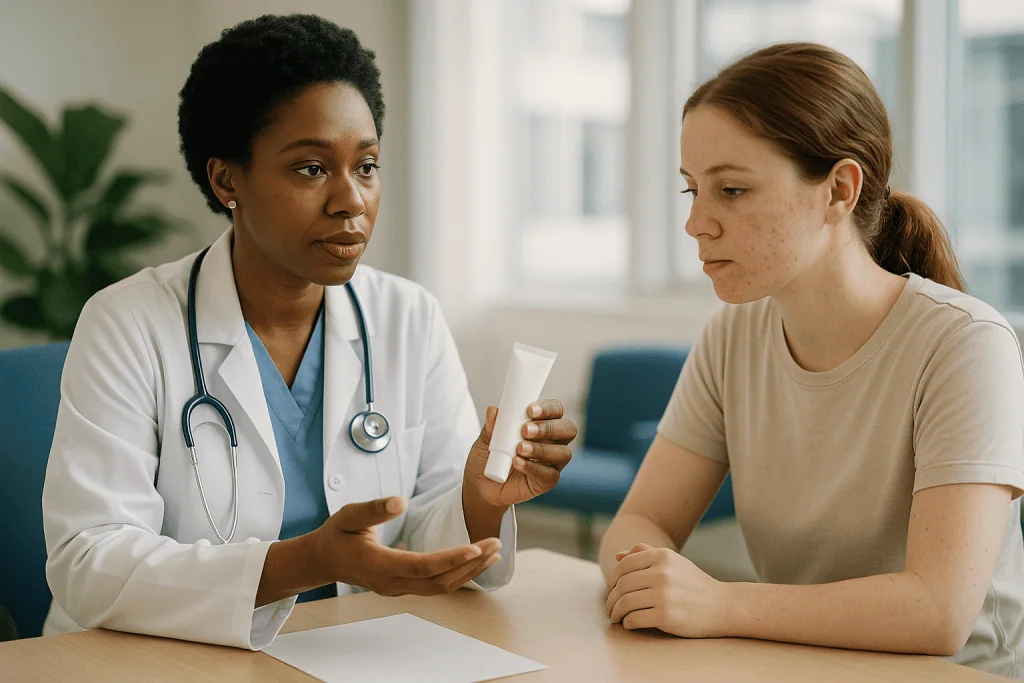
In randomized comparative studies of mild to moderate acne, azelaic acid cream reduced inflamed spots to a degree comparable with benzoyl peroxide and with topical tretinoin, and comparable with oral tetracycline in one older trial. It worked somewhat more slowly than tretinoin on blackheads and whiteheads, the non-inflamed lesions where retinoids excel. The overall grade for acne is moderate-quality evidence of effectiveness, with the consistent finding that it causes less dryness and peeling than retinoids and less bleaching of towels and pillowcases than benzoyl peroxide.
Where does that leave it in practice? Guideline documents from dermatology societies generally position azelaic acid as an alternative first-line or add-on agent, particularly useful when a person cannot tolerate a retinoid, is pregnant or planning pregnancy, or has acne accompanied by dark marks. That last group is where it quietly outperforms many rivals, because it treats the breakout and the pigment it leaves behind with the same application.
It is not the tool for severe or nodular acne. Deep, painful lumps that leave pitted scars respond to systemic treatments, and delaying those in favor of any topical, azelaic acid included, risks permanent scarring. Moderate acne often does best with combinations, and azelaic acid combines well: it is chemically stable next to benzoyl peroxide and retinoids, unlike some vitamin C formulations.
Realistic expectations again matter. Trial participants saw meaningful improvement at eight to twelve weeks. Acne treatments that promise results in days are either exaggerating or describing something other than acne.
Azelaic acid for pigmentation: melasma, dark marks and the off-label question
This is the use that fills social media and the one with the weakest evidence relative to the hype. Two conditions are involved, and they behave differently.
Melasma is a symmetrical brown or grey-brown discoloration, usually on the cheeks, forehead and upper lip, driven by hormones, sunlight and genetics. Cleveland Clinic notes it disproportionately affects women and people with medium to darker skin tones, and that it is notoriously stubborn and prone to recurrence. Azelaic acid is not approved for melasma anywhere, so every prescription is off-label.
The evidence: several randomized trials, most from the 1990s and 2000s, compared prescription-strength azelaic acid with hydroquinone, the long-standing reference lightening agent. Some found equivalent improvement at six months; others found hydroquinone superior. Trial sizes were modest, methods varied, and few were blinded well. The fair grade is low to moderate quality evidence that azelaic acid helps melasma, probably somewhat less effectively than hydroquinone but with a gentler side-effect profile and no risk of ochronosis, the blue-black discoloration that prolonged hydroquinone use can cause.
Post-inflammatory hyperpigmentation, the flat marks after acne, is a different story. Because azelaic acid also treats the acne, it reduces new marks while fading old ones. The direct trial evidence is smaller still, mostly secondary outcomes from acne studies and small comparative trials, but the mechanism is sound and dermatologists use it widely for this purpose, especially in darker skin where more aggressive options carry more risk.
Two caveats. Pigment treatment without daily broad-spectrum sun protection is close to pointless; ultraviolet light restimulates the melanocytes faster than any cream can quiet them. And the decision to use azelaic acid off-label, alone or with other agents, sits with the treating clinician who can examine the pattern and rule out other causes.
What changed recently
Nothing about the molecule changed. What changed is its regulatory footprint over time and, more recently, the way it is being talked about.
The dated facts are these. The US Food and Drug Administration approved a prescription azelaic acid cream for mild to moderate acne in 1995. A prescription gel followed in 2002, approved for the inflammatory papules and pustules of rosacea, and a foam version of the same strength arrived in 2015 for the same indication. Those three approvals remain the only formal ones; every other use, including melasma and post-inflammatory marks, has stayed off-label for three decades. Patient-facing summaries at MedlinePlus and Mayo Clinic still list exactly those two conditions.
The Cochrane Collaboration’s systematic review of rosacea treatments, updated in 2015 and again reflected in subsequent guideline documents, upgraded the evidence for azelaic acid in papulopustular rosacea to high quality. That is the finding most cited when clinicians call it a first-line agent.
What shifted in the 2020s is availability rather than approval. Cosmetic formulations at lower strengths, which fall outside prescription regulation in most countries, multiplied on shelves and online. The NHS rosacea guidance, for its part, continues to list azelaic acid among the prescription creams a GP may offer, with the caveat that it can sting.
Then came the algorithm. Through 2025 and into 2026, short-form video pushed two claims hard: that azelaic acid is a direct substitute for retinol, and that it is a safe pregnancy alternative to everything. The first is an oversimplification addressed later in this article. The second is closer to the truth but still a conversation for a prescriber, not a comment section.
The takeaway from the timeline is reassuring. This is a mature medicine with a thirty-year safety record, not a novel ingredient racing ahead of its evidence. The novelty is entirely in the attention.
What the evidence actually says, graded honestly
Medical evidence comes in tiers. Randomized controlled trials, where people are allocated by chance to treatment or comparison, sit at the top because they minimize bias. Observational studies, which watch what happens without assigning treatment, sit lower. Expert opinion and laboratory findings sit lower still. Here is where each azelaic acid use lands.
Papulopustular rosacea: high-quality evidence. Multiple large randomized vehicle-controlled trials plus a Cochrane systematic review agree. Effect size is moderate, meaning a clear and consistent reduction in bumps but not disappearance, and the benefit for diffuse redness is small.
Mild to moderate acne: moderate-quality evidence. Randomized comparisons show efficacy similar to benzoyl peroxide and tretinoin for inflamed lesions, slightly less for comedones. Trials are older and some used less rigorous designs than modern standards demand, which is why the grade is moderate rather than high.
Melasma: low to moderate quality. A handful of randomized trials with small numbers and mixed results against hydroquinone. Consistent direction of benefit, inconsistent magnitude.
Post-inflammatory hyperpigmentation: low quality. Mostly secondary outcomes and small studies. Mechanism strongly plausible; dedicated trials scarce.
Anti-aging, texture, pore size: very low quality. Essentially anecdote and inference from its mild effect on cell turnover. No randomized trials show azelaic acid reduces wrinkles or stimulates collagen, which is exactly the gap that separates it from retinoids.
Safety: high-quality, long-term. Three decades of prescription use, extensive trial data and post-marketing surveillance show local irritation as the dominant issue, with rare hypopigmentation and rare reports of asthma worsening noted in prescribing information.
Being this precise is not pedantry. A person choosing azelaic acid for rosacea bumps is standing on firm ground. A person choosing it to replace a retinoid for fine lines is standing on a viral video.
Azelaic acid vs retinol: is azelaic acid better than retinol?
The question assumes they are competing for the same job. Mostly, they are not.
Retinoids are the family of vitamin A derivatives that includes prescription tretinoin and adapalene and the weaker over-the-counter retinol. They bind receptors inside skin cells and change how genes are expressed, which is why they do things azelaic acid cannot: accelerate cell turnover substantially, unclog pores at the root, and, over months to years, increase collagen and soften fine lines. That anti-aging effect is supported by randomized trials for tretinoin specifically. No such trials exist for azelaic acid.
Azelaic acid, in turn, does things retinoids do not. It calms rosacea, which retinoids often aggravate. It kills acne bacteria directly. It inhibits pigment production at the enzyme level, where retinoids only speed up the shedding of pigmented cells. And it is far gentler, which is not a footnote: irritation is the main reason people quit retinoids.
| Feature | Azelaic acid | Topical retinoids |
|---|---|---|
| Approved for | Rosacea, acne | Acne; tretinoin also for photoaging |
| Strongest evidence | Rosacea bumps (high quality) | Acne and fine lines (high quality) |
| Effect on pigmentation | Direct, via tyrosinase | Indirect, via turnover |
| Collagen and wrinkles | No trial evidence | Well documented for tretinoin |
| Typical irritation | Mild stinging, usually early | Dryness, peeling, redness, often weeks |
| Rosacea skin | Generally suited | Often poorly tolerated |
| Pregnancy | Often considered acceptable by clinicians | Avoided |
| Time to visible change | Eight to twelve weeks | Eight to twelve weeks; longer for lines |
So the honest answer: better for what? For rosacea, pigmentation and sensitive or pregnant skin, azelaic acid usually wins. For stubborn comedonal acne and visible aging, retinoids win. For inflamed acne, they are roughly even, and many people use both.
How azelaic acid sits alongside retinoids in a real routine
Because they act through different mechanisms and are chemically stable together, azelaic acid and retinoids are natural partners rather than rivals. Dermatologists have combined them for years, and a common clinical logic runs like this.
The retinoid does the structural work, keeping pores clear and, over time, thickening the deeper skin and improving texture. Azelaic acid handles the inflammatory and pigment side, quieting active spots and fading the marks. Together they cover more of the acne process than either alone, and they cover the aftermath too.
The pairing has one real challenge: the retinoid’s irritation. Adding a second active to skin that is already peeling is a reliable way to make someone stop both. Clinicians therefore tend to introduce them in sequence rather than on the same day, settle one before adding the other, and favor timing that keeps each at its best. Many suggest the retinoid at night, where it belongs anyway because sunlight degrades it, and azelaic acid in the morning under sunscreen, or alternating evenings during the adjustment period. Which arrangement suits a given person depends on their skin and their prescriber’s judgment.
A few practical points recur in dermatology guidance. Apply to dry skin, since damp skin absorbs faster and stings more. Use a plain moisturizer without fragrance or exfoliating acids to cushion the combination. Keep everything else in the routine boring for the first two months; this is not the moment to trial a new peel. And wear sunscreen daily, because both actives make results dependent on it and neither works well on skin that is being re-inflamed by ultraviolet light every afternoon.
People sometimes ask whether azelaic acid can let them drop the retinoid altogether. For rosacea, often yes, because the retinoid may never have been right. For acne with dark marks, sometimes. For anyone using a retinoid for its long-term anti-aging effect, no, because azelaic acid has no evidence there. Any change to a prescribed retinoid should be discussed with the person who prescribed it.
Which is better, vitamin C or azelaic acid?
They overlap on one goal, brightening uneven pigment, and diverge everywhere else.
Vitamin C, usually as L-ascorbic acid or one of its more stable derivatives, is an antioxidant. It neutralizes free radicals generated by sunlight and pollution, supports collagen synthesis in laboratory studies, and inhibits tyrosinase like azelaic acid does. The clinical trial evidence for topical vitamin C is thinner than most people assume. Small studies show improvement in photodamage and pigmentation over several months, but many are unblinded, industry-funded or use combination products, so the grade is generally low to moderate. Its biggest practical weakness is instability: L-ascorbic acid oxidizes quickly on exposure to air and light, turning yellow-brown and losing potency, and it needs a low pH to penetrate, which is exactly what makes it sting.
Azelaic acid has no antioxidant reputation to defend and no collagen claims worth making. What it has is stronger trial evidence for two medical conditions, a broader mechanism that includes anti-inflammatory and antibacterial action, better stability, and gentler behavior on reactive skin.
So the decision maps onto the problem. A person with sun-related dullness and early photodamage, without acne or rosacea, is the classic vitamin C candidate, ideally as one layer in a routine anchored by sunscreen. A person with rosacea or acne who also has dark marks is better served by azelaic acid, because it addresses the cause of the marks rather than only their color.
Can they be used together? Chemically there is no conflict, and both inhibit tyrosinase by different routes, so the pairing is popular for pigmentation. The risk is cumulative irritation, particularly with low-pH vitamin C serums on skin that already tingles from azelaic acid. Separating them, one in the morning and one in the evening, is the usual compromise, and stopping the vitamin C is the usual fix if the combination proves too much. Neither should be layered onto broken or actively flaring skin.
What not to mix with azelaic acid
Fewer things than the internet suggests, but not nothing.
Start with what is chemically fine. Azelaic acid is stable alongside benzoyl peroxide, topical retinoids, niacinamide, hyaluronic acid, ceramides and most moisturizers. None of these inactivate it, and several are routinely co-prescribed. Claims that it cancels out niacinamide or that benzoyl peroxide destroys it are not supported by pharmacology.
The genuine caution is about irritation piling up, not chemistry. Three categories deserve care.
- Exfoliating acids. Glycolic, lactic and salicylic acids remove surface cells and lower the skin’s tolerance to anything applied afterward. Using them in the same session as azelaic acid, especially on rosacea-prone skin, is a common route to burning and prolonged redness. Many clinicians advise dropping exfoliating acids entirely during the first two months.
- Physical scrubs, brushes and at-home peels. Same principle, larger effect. Micro-tears in the surface let the acid sting far more.
- Alcohol-heavy toners, astringents and fragranced products. Prescribing information for azelaic acid specifically advises avoiding alcoholic cleansers, tinctures and abrasives on treated areas because they compound irritation.
Vitamin C and retinoids fall into a middle group: compatible in principle, but best introduced one at a time and often on separate schedules, as discussed above.
Two more points that people rarely ask about. Azelaic acid can worsen the sting of any product applied to skin that has just been shaved or waxed, so timing around hair removal matters. And it should not be applied to the eyes, inside the nose, or on the lips, where it burns intensely; if it does get in the eye, rinsing with plenty of water and contacting a clinician if irritation persists is the standard advice.
The overarching rule is simplicity. Azelaic acid delivers its evidence-backed benefits in a routine of cleanser, azelaic acid, moisturizer and sunscreen. Every extra bottle raises the irritation risk without raising the evidence.
Azelaic acid side effects: what is normal and what is not
The safety story here is unusually clean for a medicine used on the face every day for years, but clean is not the same as absent.
The common effects are local and early. Mayo Clinic and MedlinePlus list burning, stinging, tingling, itching, dryness and mild redness at the application site. In rosacea trials, roughly one in three to one in five participants reported some burning or stinging when they started, most rating it mild. It typically peaks in the first two weeks and settles as the skin adjusts. Applying to bone-dry skin, using less product, and layering a bland moisturizer on top all reduce it. Persistent or worsening stinging after a month is a signal to check in with the prescriber rather than push through.
Less common effects include peeling, a feeling of tightness, and occasionally a flare of acne-like bumps in the first weeks that resolves. True allergic contact dermatitis, an immune reaction causing an itchy, spreading rash, is rare but documented.
Two uncommon effects deserve specific attention. Hypopigmentation, patches of skin that lighten beyond the treated dark mark, has been reported, mainly in people with darker skin tones. It is rare and generally reversible, but prescribing information advises monitoring for it and stopping if it appears. Separately, the labeling notes isolated reports of worsening asthma in people using the gel or foam. The mechanism is unclear and the reports are few, but anyone with asthma who notices new wheezing or breathlessness after starting should stop and seek medical advice.
What azelaic acid does not do is worth stating plainly, because the fear circulates. It does not thin the skin, it does not cause sun sensitivity in the way retinoids and exfoliating acids do, it does not bleach normal skin, and there is no evidence of systemic toxicity from topical use; very little is absorbed, and what is absorbed is a molecule the body already encounters in food.
Prescription azelaic acid vs over-the-counter: what actually differs
The same molecule appears on a pharmacy shelf behind the counter and on a cosmetics shelf in front of it, and the viral advice tends to treat them as interchangeable. They are not, in three ways.
Strength. Prescription products are formulated at higher concentrations than cosmetic ones, and every trial supporting the rosacea and acne approvals used those prescription strengths. Lower-strength cosmetic versions have not been tested against those conditions in comparable randomized trials. That does not mean they do nothing; it means their effect on a medical condition is unproven rather than proven.
Formulation. Delivery matters as much as concentration. Prescription gels and foams are engineered so the acid stays dissolved and penetrates; many cosmetic suspensions keep the acid as fine particles, which changes how much reaches the target. Two products with the same percentage on the label can behave differently on skin.
Regulation and claims. A prescription product is approved as a drug on the basis of efficacy and safety data, and its labeling is legally constrained. A cosmetic is regulated for safety but is not permitted to claim to treat disease, which is why the marketing speaks of brightening and evening rather than rosacea or acne. The difference in language is a difference in evidence.
None of this makes cosmetic azelaic acid pointless. For someone with mild uneven tone and no medical diagnosis, a gentle over-the-counter product is a reasonable thing to try, and the safety profile is favorable. The problem arises when a person with genuine rosacea or moderate acne spends six months on a cosmetic version, concludes azelaic acid does not work for them, and never learns that the evidence-backed strength was a prescription away.
If a skin condition has a name, a clinician can decide whether the prescription product fits. If it is simply a wish for more even skin, the cosmetic shelf is where that conversation belongs, with expectations set accordingly.
Azelaic acid in pregnancy, breastfeeding and darker skin tones
Three groups search this ingredient more than any others, and each deserves a precise answer rather than a reassuring one.
Pregnancy. Azelaic acid is widely regarded by dermatologists as one of the more acceptable topical options during pregnancy. The reasoning is that skin absorption is minimal, the molecule is already present in the diet and in the body, and animal studies have not shown harm at exposures far above human use. Human data, as with almost every skin medicine, come from observational experience rather than randomized trials, because pregnant people are excluded from drug trials. The evidence grade is therefore moderate by indirect reasoning and low by direct study. That is a meaningful distinction from retinoids, which are avoided in pregnancy because oral retinoids are known teratogens and topical ones are treated cautiously by extension. Whether to use azelaic acid while pregnant, and for what, remains a decision for the obstetric or dermatology clinician managing that pregnancy.
Breastfeeding. Similar logic applies. Little is absorbed, and the amount that could reach milk is negligible. Standard advice is to avoid applying it to the chest area where an infant might contact it. Again, the treating clinician makes the call.
Darker skin tones. Here azelaic acid has a genuine advantage and one specific caution. The advantage is its selective action on overactive melanocytes, which means it fades post-inflammatory marks and melasma with a lower risk of the halo of over-lightening that stronger agents can produce, and it does not carry the ochronosis risk of prolonged hydroquinone. Because post-inflammatory hyperpigmentation is more common and more persistent in skin of color, this makes it a frequent first choice. The caution is the rare hypopigmentation noted earlier, which has been reported disproportionately in darker skin; anyone who notices a treated area becoming lighter than the surrounding skin should stop and be seen. Sunscreen remains essential, since ultraviolet light drives melasma in every skin tone.
Common myths about azelaic acid, corrected
The viral version of azelaic acid contains a few durable errors. Each is worth unpicking.
It is a chemical exfoliant like glycolic acid. Not in any meaningful sense. Glycolic and lactic acids dissolve the bonds between surface cells and visibly peel. Azelaic acid has a mild normalizing effect on cell maturation but does not exfoliate the surface, which is precisely why it can be used on rosacea when exfoliants cannot. Treating it as a peel leads people to skip moisturizer and over-apply.
It replaces retinol. For rosacea and pigmentation, it may indeed be the better tool. For fine lines, collagen and photoaging it has no trial evidence at all, while tretinoin has decades of it. Substituting one for the other should follow the problem, not the trend.
It bleaches skin. It lightens over-pigmented patches by inhibiting tyrosinase in overactive melanocytes and leaves normal pigment essentially alone. It is not a skin-whitening agent and will not change a person’s overall complexion.
You cannot use it with retinoids or vitamin C. Chemically it is compatible with both. The only issue is cumulative irritation, managed by timing and gradual introduction.
It works within days. Trials show benefit accumulating over eight to twelve weeks. Anyone reporting transformation in a week is describing something else, usually reduced dryness from a new moisturizer.
Over-the-counter and prescription versions are the same. Same molecule, different strength, formulation and evidence base. The trials were done with prescription products.
It is natural, so it has no side effects. It occurs in grains, and it also stings, itches, occasionally causes contact allergy, rarely causes hypopigmentation, and has isolated reports of asthma worsening. Natural origin says nothing about tolerability.
Stinging means it is working. Stinging means the skin barrier is reacting. Mild early tingling is common and usually fades; persistent burning is a reason to review the plan with a clinician, not evidence of efficacy.
When to see a doctor
Azelaic acid is safe enough that many people start it without medical input, which is exactly why the moments that do need a clinician get overlooked. Here is where a conversation becomes necessary rather than optional.
Before starting, see a doctor if:
- You have facial redness, bumps or flushing that has never been formally diagnosed. Rosacea, acne, seborrheic dermatitis and lupus can look alike and are treated differently.
- Your acne is deep, painful or leaving indented scars. Topical treatments alone are not enough for nodular acne, and delay risks permanent marks.
- You have a brown or grey patch that is new, asymmetric, changing in size, shape or color, or bleeding. Pigment changes are usually benign, but a clinician needs to examine anything evolving before it is treated as cosmetic.
- You are pregnant, planning pregnancy or breastfeeding and want guidance on which topicals fit your situation.
- You have asthma, given the rare reports of worsening with azelaic acid gel and foam.
Stop and seek prompt medical advice if you develop:
- Swelling of the face, lips, tongue or eyelids, hives, or difficulty breathing after application, which can signal a serious allergic reaction.
- New or worsening wheezing or shortness of breath.
- Blistering, crusting, weeping or intense burning that does not settle within minutes of application.
- Patches of skin turning lighter than the surrounding skin.
- Eye symptoms alongside rosacea, such as gritty, red, watery or light-sensitive eyes, which suggest ocular rosacea and need separate treatment.
Book a routine review if: stinging or redness persists beyond the first month, you have used it faithfully for twelve weeks with no change, or you want to combine it with a retinoid, hydroquinone or other prescription and are unsure how.
Every decision about starting, stopping, combining or changing azelaic acid, or any prescribed skin medicine, belongs to the clinician who knows your history and can examine your skin in person. An article, this one included, can explain the evidence. It cannot look at your face.
Frequently asked questions
What will azelaic acid do for my skin?
Over eight to twelve weeks it typically reduces the red bumps of rosacea, lowers the number of inflamed acne spots and gradually fades flat dark marks left by breakouts or melasma. Skin often feels smoother because it gently normalizes cell shedding. It will not remove broken blood vessels, fill scars, lighten normally pigmented skin or reduce wrinkles, and results depend heavily on daily sun protection.
What not to pair with azelaic acid?
Avoid using it in the same session as glycolic, lactic or salicylic acid, physical scrubs, at-home peels, and alcohol-based toners or astringents, because these raise irritation without adding benefit. Retinoids, vitamin C, benzoyl peroxide and niacinamide are chemically compatible but are best introduced one at a time and often on separate schedules. Keep it away from the eyes, nostrils and lips.
Which is better, vitamin C or azelaic acid?
It depends on the problem. Azelaic acid has stronger randomized-trial evidence and treats rosacea and acne as well as pigmentation, so it suits people whose dark marks come from breakouts or inflammation. Vitamin C is an antioxidant with modest evidence for sun-related dullness and photodamage but none for acne or rosacea. Both inhibit pigment production and can be combined if irritation allows.
Is azelaic acid better than retinol?
Azelaic acid is usually the better choice for rosacea, pigmentation and sensitive or pregnant skin, because it is gentler and directly reduces inflammation and melanin production. Retinoids are better for comedonal acne and for fine lines and photoaging, where tretinoin has strong trial evidence and azelaic acid has none. For inflamed acne they perform similarly, and many clinicians combine them.
How long does azelaic acid take to work for rosacea?
In the randomized trials that support its approval, improvement in rosacea bumps became noticeable after about four weeks and continued to increase through twelve to fifteen weeks. Background redness improves more modestly and more slowly. Most dermatologists suggest committing to at least three months before judging it, and continuing use is generally needed to maintain results, since rosacea is a chronic condition.
Can I use azelaic acid and a retinoid on the same night?
Chemically yes, but many people find the combined irritation too much at first. Clinicians commonly advise applying the retinoid at night and azelaic acid in the morning under sunscreen, or alternating evenings during the first weeks, then moving closer together once the skin tolerates both. The right arrangement depends on your skin and should follow the advice of whoever prescribed the retinoid.
What are the main azelaic acid side effects?
The most common are burning, stinging, tingling, itching and mild dryness where it is applied, usually in the first two weeks and usually mild. Less common effects include peeling, temporary breakouts and allergic contact dermatitis. Rarely, patches of skin may lighten, particularly in darker skin tones, and isolated reports of worsening asthma exist. It does not cause sun sensitivity or thin the skin.
Is azelaic acid safe during pregnancy?
Dermatologists widely regard azelaic acid as one of the more acceptable topical options in pregnancy, because very little is absorbed, the molecule occurs naturally in food and the body, and animal studies have not shown harm. Direct human trial data do not exist, as with most skin medicines. Whether and how to use it while pregnant or breastfeeding is a decision for your obstetric or dermatology clinician.
Does azelaic acid help melasma?
Several small randomized trials suggest prescription-strength azelaic acid improves melasma, with some finding it comparable to hydroquinone and others finding hydroquinone more effective. The evidence is low to moderate quality, and this use is off-label. It has the advantage of not causing the blue-black ochronosis linked to long-term hydroquinone. Strict daily sun protection is essential, and treatment choice belongs to the prescribing clinician.
Is over-the-counter azelaic acid as effective as prescription?
Not proven. The trials supporting rosacea and acne treatment used prescription-strength gels, creams and foams, and lower-strength cosmetic versions have not been tested against those conditions in comparable randomized studies. Formulation also affects how much acid reaches the skin. Cosmetic products may reasonably be tried for mild uneven tone, but a diagnosed skin condition is a reason to discuss the prescription version with a clinician.
References
- Azelaic Acid Topical: MedlinePlus Drug Information
- Rosacea: NHS
- Melasma: Cleveland Clinic
- Acne: MedlinePlus
This article is for general information only and is not a substitute for professional medical advice. Please consult a qualified doctor about your individual situation.

More from the Blog

Benzoyl Peroxide: How It Works, the Concentration Question and the Bleaching Problem
Benzoyl peroxide is an over-the-counter acne treatment that releases oxygen into the pore, killing acne bacteria without breeding resistance and loosening the plugs that…
Sun Protection With Vitiligo: Why Depigmented Skin Burns Faster and How to Care for It Daily
People with vitiligo sunburn faster because depigmented patches have lost melanocytes, the cells that make melanin, the pigment that absorbs ultraviolet light before it…
Does Seborrheic Dermatitis Cause Hair Loss?
Seborrheic dermatitis does not usually destroy hair follicles, so it is not a classic cause of permanent hair loss. It can, however, trigger temporary…

Why Dandruff Treatment Takes Time to Work and Why Stopping Early Brings the Flakes Back
Dandruff treatment usually takes several weeks to show a clear difference, because medicated shampoos slow the yeast and skin-cell buildup that create flakes rather…

When Hives Come With Lip, Tongue or Throat Swelling: Why It Is Treated as Urgent
Hives with lip swelling mean the reaction has moved from the skin surface into deeper tissue, a process called angioedema. Most episodes settle on…
Is Laser Hair Removal Permanent? What Permanent Reduction Really Means
Laser hair removal is not fully permanent for most people. It delivers long-term hair reduction: after a full course, typically four to six sessions,…