

Back Acne and Body Acne: Why They Differ From Facial Acne and How They Are Treated

Key Takeaways
- Roughly half of people with facial acne also have acne on the back, chest or shoulders, yet the trunk is examined and treated far less often.
- Back skin is several times thicker than facial skin and carries some of the body's largest oil glands, which is why back acne tends toward deep nodules rather than blackheads.
- The 2024 acne guideline update gave strong recommendations to benzoyl peroxide, topical retinoids and fixed-dose combinations, and reinforced that oral antibiotics should be time-limited and paired with benzoyl peroxide.
- Trifarotene is the only topical retinoid tested in large randomized trials that measured chest and back lesions directly, and it showed significant improvement over vehicle.
- Dozens of uniform, intensely itchy small bumps with no blackheads suggest Malassezia (yeast) folliculitis rather than acne, a distinction a clinician can confirm with a simple skin scraping.
- The chest, shoulders and upper back are the body's most keloid-prone zones, which is the main evidence-based argument for treating moderate back acne early rather than waiting it out.
Back acne is the same disease as facial acne, driven by oil, clogged follicles, bacteria and inflammation, but it behaves differently because back skin is thicker, has large oil glands, sits under sweaty clothing and friction, and is hard to reach. Lesions tend to be deeper and scar more. Treatment follows the same evidence-based ladder, from medicated washes and topical retinoids to prescription tablets, chosen with a clinician.
Every late summer the search graphs tell the same story. Months of heat, gym sessions and damp shirts pass, and then, as of September 2026, queries for back acne climb to their yearly peak. This year the spike has an extra push: a wave of viral videos insisting that most bumps on the back are not acne at all but a yeast problem, fixable with dandruff shampoo. Some of that is true. Much of it is not, and the gap matters.
Dermatologists have a name for acne on the back, chest and shoulders: truncal acne. Roughly half of people with facial acne have it too, yet it is examined less, treated later and talked about less because the person living with it often cannot even see it. Shirts hide it. Mirrors miss it. Partners notice it.
This guide explains what makes back and body acne different, what the 2024 acne guideline update changed, what the trials actually show, and where the viral claims go wrong.
What is back acne, and why does it behave differently from facial acne?
Acne starts inside a hair follicle, the tiny tube that holds a hair and the oil gland feeding it. Four things go wrong at once: the gland makes extra oil (sebum), dead skin cells stick together and plug the opening, a normal skin bacterium called Cutibacterium acnes multiplies in the trapped oil, and the immune system responds with inflammation. That sequence is identical on the back and on the face. The setting is not.
Back skin is among the thickest on the body, several times thicker than eyelid skin and noticeably thicker than the cheek. The follicles are larger, and the oil glands on the upper back and chest are some of the biggest anywhere. A plug forming deep in a wide follicle under thick skin produces a different kind of lesion: firmer, deeper, slower to surface and slower to settle. That is why back acne skews toward tender nodules rather than the fine blackheads common across a nose.
Then there is the environment. The face meets open air; the back spends the day under fabric, pressed against a chair, a car seat or a backpack strap, often damp. Occlusion and friction trap heat and sweat against follicle openings and encourage plugging. Dermatologists call this friction-driven variant acne mechanica.
Reach is the final difference. A person can wash, inspect and treat a chin in seconds. The space between the shoulder blades is a blind spot that most hands cannot comfortably cover, so treatment is applied unevenly or not at all. Put thick skin, big glands, occlusion and poor access together, and you have a form of acne that is medically the same but practically harder, with a higher chance of leaving marks behind.
What causes acne on the back and shoulders?
Hormones set the stage. Androgens, the group of hormones that includes testosterone and that both men and women make, enlarge oil glands and increase sebum output. This is why acne arrives with puberty and why truncal acne is more common in teenage boys and young men than in any other group. In women, androgen-sensitive acne often flares in the week before a period and can be a feature of polycystic ovary syndrome, a hormonal condition that also affects cycles and hair growth.

Genetics matter more than most people assume. Twin studies attribute a large share of acne risk to inherited factors, including how sensitive glands are to normal hormone levels and how readily follicle cells clump. If a parent had back acne that scarred, the odds are higher.
Everyday mechanics add a second layer specific to the back and shoulders:
- Pressure and rubbing from backpack straps, sports pads, bra bands and tight synthetic workout tops.
- Sweat held against the skin for hours by clothing that does not breathe.
- Hair conditioners and styling products that run down the back during rinsing and leave an oily film at the follicle openings.
- Heavy, greasy body lotions or oils that occlude follicles.
Certain medicines can trigger or worsen acne-like eruptions, among them corticosteroids, some anti-seizure drugs, lithium and anabolic steroids. The pattern tends to be sudden, uniform bumps across the chest and back. Anyone who suspects a medicine is involved should raise it with the prescriber rather than stopping treatment on their own.
Diet sits at the uncertain edge. Observational studies link high glycemic-load eating and skim milk with more acne, but randomized evidence is limited and inconsistent, and no food has been shown to cause acne outright. Sweat itself does not cause acne; sweat trapped under fabric for hours is the more plausible contributor.
What changed recently in how back acne is treated
Three developments explain why this topic is being searched differently than it was five years ago.
In January 2024 the American Academy of Dermatology published updated guidelines of care for acne vulgaris, the first full revision since 2016. The document, indexed on PubMed, gave strong recommendations to benzoyl peroxide, topical retinoids and fixed-dose combination products as foundation treatments, and reinforced earlier advice that oral antibiotics should be time-limited and always paired with benzoyl peroxide to blunt bacterial resistance. It also discussed newer options, including the topical retinoid trifarotene, which is notable here because it was the first topical acne medicine studied in large randomized trials specifically on the chest and back, not only the face.
A second shift is evidential. A Cochrane systematic review published in 2020 pooled dozens of randomized trials of topical benzoyl peroxide and concluded that it reduces acne lesions compared with placebo, with skin irritation as the main trade-off. That review has become the anchor many clinicians use when recommending medicated washes for body acne, where leave-on products are hard to apply.
The third development is cultural rather than scientific. Short-form videos about so-called fungal acne pushed the term Malassezia folliculitis into everyday vocabulary. Malassezia is a yeast that lives on everyone’s skin; when it overgrows inside follicles it produces small, itchy, uniform bumps that mimic acne. Awareness is useful. The viral extension, that most body acne is fungal and can be self-treated with antidandruff shampoo, is not supported by clinic data, where ordinary acne remains far more common.
One housekeeping note from the same period: US regulators tested benzoyl peroxide products for benzene, a contaminant that can form when some formulations are stored at high heat, and a small number were voluntarily recalled. The practical advice that followed was simple and unglamorous: keep acne products at room temperature, away from hot cars and steamy windowsills.
What are the 7 types of acne, and which ones show up on the back?
The popular “7 types” framing is a simplification of how dermatologists grade lesions, but it is a useful map. Each type reflects how deep the blockage sits and how much inflammation surrounds it.
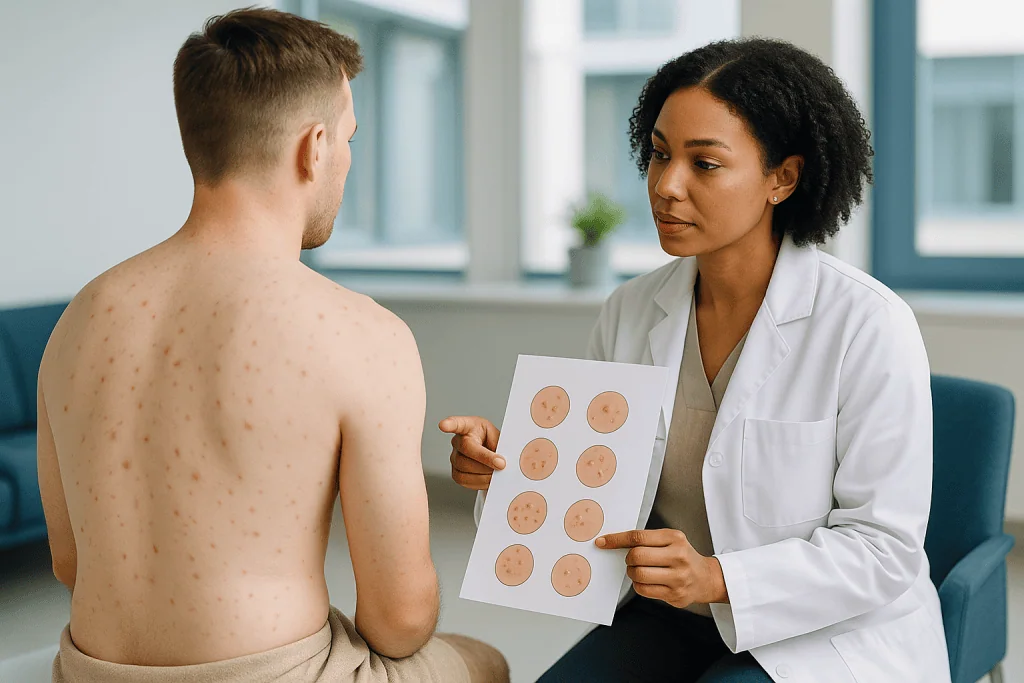
- Blackheads (open comedones): a plug of oil and dead cells with an open top that darkens on contact with air. Common on the face, less dominant on the back.
- Whiteheads (closed comedones): the same plug under a thin skin roof, appearing as small skin-colored bumps.
- Papules: small, firm, red bumps where the follicle wall has begun to inflame.
- Pustules: papules with a visible white or yellow center of pus.
- Nodules: larger, hard, painful lumps rooted deep in the skin.
- Cysts: deep, soft, pus-filled lesions that can merge and leave scars. Many clinicians group nodules and cysts together as nodulocystic acne.
- Acne conglobata: a rare, severe form with interconnected nodules and draining tracts, most often on the back, chest and buttocks of young men.
The back’s thick skin and large follicles tilt the mix toward the deeper end of this list. A typical case of moderate back acne shows scattered papules and pustules across the shoulders with a few tender nodules between the shoulder blades, and relatively few comedones. That distribution has treatment consequences. Comedone-heavy acne responds well to retinoids that unplug follicles; nodule-heavy acne usually needs anti-inflammatory and systemic approaches, because a topical cream struggles to reach a lesion sitting deep in thick tissue.
Knowing the type also tempers expectations. A pustule may clear in days; a nodule can take weeks and leave a mark for months. Grading lesions honestly, ideally with a clinician’s eye on the areas you cannot see, is the first real step toward choosing treatment that fits.
Body acne or something else? Fungal folliculitis and other look-alikes
Not every red bump on the trunk is acne, and the viral conversation has at least made that point loudly. Several conditions share the territory.
Malassezia folliculitis is the one dominating social media. The yeast behind it thrives in oil, heat and humidity, so it favors the upper back, chest and shoulders of people who sweat heavily or wear occlusive clothing. The clues that distinguish it from acne are consistency and itch: dozens of near-identical small pink bumps and pustules, no blackheads, often intensely itchy, and sometimes appearing after a course of antibiotics or in warm climates. It typically does not improve with standard acne treatment and may worsen with antibiotics, which is exactly why a correct label matters. Diagnosis can be confirmed with a simple skin scraping examined under a microscope.
Bacterial folliculitis, usually from Staphylococcus, produces tender pustules around hairs and can follow shaving, hot tubs or tight clothing. Keratosis pilaris causes rough, dry, flesh-colored bumps on the upper arms and sometimes the back; it is a keratin plugging problem without inflammation or pus. Hidradenitis suppurativa creates painful, recurring boils in skin folds and can extend to the buttocks and under the breasts; it is often misread as cystic acne for years. Miliaria, or heat rash, appears as tiny clear or red bumps after heavy sweating and settles when the skin cools.
Why does this matter for anyone searching for body acne solutions? Because treatments diverge. Antifungal approaches help yeast folliculitis and do nothing for true acne. Retinoids help acne and irritate heat rash. A clinician can usually tell these apart in minutes by looking at lesion shape, distribution and symptoms; a bathroom mirror and a camera phone rarely can.
What causes itchy back acne?
Ordinary acne is usually sore rather than itchy. When itch is the headline symptom, it is a signal to look harder at both the diagnosis and the surroundings.
The most common explanation is inflammation itself. As a follicle wall breaks down and immune cells flood in, they release chemicals such as histamine that stimulate nerve endings. Lesions in the healing phase can itch too, in the same way a scab does. Dryness compounds this. Many acne treatments, especially benzoyl peroxide and retinoids, strip surface oils, and the back is often washed with harsh soaps and hot water, so the skin barrier weakens and itch follows.
Sweat is a frequent trigger. It contains salts and urea that irritate already inflamed skin, and when it evaporates under fabric it leaves residue behind. Fabric itself can contribute: rough seams, wool, and detergents or fabric softeners with fragrance can provoke low-grade contact dermatitis, a rash from skin irritation or allergy, layered on top of acne.
Then there is the diagnostic flag. Marked itch with uniform small bumps points toward Malassezia folliculitis rather than acne, as described above. Itch with intense redness and scaling can suggest eczema or a reaction to a topical product. Itch with new, grouped bumps along a waistband or shoulder strap suggests friction or an allergic response to a dye or metal in clothing.
Scratching makes everything worse. Fingernails break pustules, spread bacteria across neighboring follicles and increase the chance of dark marks and scars. Gentle measures that help in the meantime include cooling the skin, wearing soft breathable fabrics, switching to fragrance-free detergent and using a bland fragrance-free moisturizer on treated areas. Persistent itch that does not track with these changes deserves a clinical look rather than a stronger scrub.
What the evidence actually says about treating back acne
Acne is one of the better-studied conditions in dermatology, but most trials recruit by facial lesion counts. Evidence specific to the trunk is thinner, so it helps to grade claims honestly.
Strong evidence (multiple randomized controlled trials, systematic reviews). Topical benzoyl peroxide reduces inflammatory and non-inflammatory lesions versus placebo, with irritation as the main side effect, according to a 2020 Cochrane review of dozens of trials. Topical retinoids (adapalene, tretinoin, tazarotene, trifarotene) reduce comedones and inflammatory lesions; trifarotene was tested in two large phase 3 trials that measured chest and back lesions directly and showed significant improvement over vehicle. Fixed combinations of a retinoid or antibiotic with benzoyl peroxide outperform either agent alone. Oral isotretinoin produces the largest and most durable reductions in severe nodular acne, supported by decades of trials and long-term follow-up.
Moderate evidence (randomized trials, some limitations or indirectness). Oral tetracycline-class antibiotics reduce inflammatory lesions over a few months; most data come from facial acne and resistance concerns limit duration. Spironolactone, a tablet that blocks androgen effects, improved acne in women in a 2023 UK randomized trial, again judged mainly on the face. Combined oral contraceptives reduce acne in women across several trials.
Limited evidence (small trials, observational data or expert opinion). Short-contact benzoyl peroxide washes for the trunk, where leave-on products are impractical. Chemical peels and light-based or laser treatments, which show benefit in small studies but lack large trials. Diet modification, where associations are observational. Tea tree oil, where a few small trials suggest modest benefit with notable irritation.
Insufficient or contradicted. Toothpaste, lemon juice, baking soda, apple cider vinegar and sun exposure, none of which has credible trial support and several of which cause documented harm.
The honest summary: the backbone treatments are well proven, the trunk-specific data are catching up, and most “overnight” claims live entirely outside the evidence.
Back acne treatment options compared
The table below summarizes how the main approaches fit truncal acne. It is a map for a conversation with a clinician, not a prescription, and strengths, durations and combinations are decisions that belong to the person prescribing.
| Approach | How it works | Best suited to | Evidence strength | Common trade-offs |
|---|---|---|---|---|
| Benzoyl peroxide wash or leave-on | Kills C. acnes, mild peeling | Mild to moderate body acne; partner to antibiotics | Strong | Dryness, irritation, bleaches fabric |
| Salicylic acid wash | Loosens dead-cell plugs | Mild comedonal acne, oily skin | Moderate | Dryness; modest effect alone |
| Topical retinoid | Normalizes follicle cell turnover, anti-inflammatory | Mild to moderate acne, maintenance | Strong (trunk data for trifarotene) | Irritation, sun sensitivity; hard to reach the back |
| Topical antibiotic plus benzoyl peroxide | Reduces bacteria and inflammation | Inflammatory papules and pustules | Strong | Should not be used alone long term |
| Oral tetracycline-class antibiotic | Systemic anti-inflammatory and antibacterial | Moderate to severe, widespread lesions | Moderate | Time-limited; sun sensitivity; resistance |
| Hormonal therapy (women) | Reduces androgen effect on glands | Cycle-linked or jawline-and-trunk acne in women | Moderate | Not suitable for everyone; prescriber-led |
| Oral isotretinoin | Shrinks oil glands, resets follicle behavior | Severe nodular or scarring acne | Strong | Dryness, monitoring, strict pregnancy prevention |
| Procedures (peels, light, laser) | Exfoliation or targeting bacteria and glands | Adjunct or scar management | Limited | Multiple sessions; variable results |
Two patterns stand out. First, almost every effective regimen includes benzoyl peroxide somewhere, because it reduces bacterial load without breeding resistance. Second, the deeper and more widespread the lesions, the more likely a systemic option is needed, because topical products struggle with thick skin and large surface areas. Guidelines recommend reassessing any regimen after roughly two to three months, since acne treatments work slowly and early judgment leads to needless switching.
How body acne is treated at home: washes, leave-ons and realistic timelines
For mild to moderate body acne, guidelines place medicated washes and over-the-counter topicals at the first step, and a pharmacist or clinician can help match a product to your skin. The logic is practical: a wash can cover the whole back in the shower without a contortion act, and the trunk tolerates active ingredients better than the face because the skin is thicker.
Benzoyl peroxide washes are the workhorse. Small studies suggest leaving the lather on the skin for a short while before rinsing improves the effect, since the ingredient needs contact time to work. Salicylic acid washes dissolve the dead-cell glue in follicle openings and suit oilier, comedone-prone skin. Both can dry the skin, so a bland, fragrance-free, non-comedogenic moisturizer afterward is sensible, not indulgent.
Over-the-counter adapalene, a topical retinoid, is an option for leave-on treatment where you can reach, such as shoulders and upper chest. Retinoids take time, usually eight to twelve weeks, and often cause a few weeks of redness and peeling first. Starting slowly, under a clinician’s guidance on frequency, reduces that.
Expectations matter more than ingredients. Acne lesions take weeks to form, so a product cannot be judged in days. Dermatology guidance consistently asks for about two to three months before deciding a routine has failed. Over-washing, scrubbing with loofahs or combining several actives at once tends to inflame the skin without speeding results.
Spot tests help. Benzoyl peroxide bleaches towels, sheets and clothing, so white linens and old shirts are the pragmatic choice during treatment. Products should be stored at room temperature. If a routine causes significant stinging, swelling or hives, that is a reason to stop and seek advice, not to push through.
Prescription treatments for back and body acne
When lesions are deep, widespread or scarring, or when three months of over-the-counter care has changed little, prescription options come into play. Every choice below is made by the treating clinician, who weighs lesion type, skin tone, sex, pregnancy plans and medical history.
Prescription topicals. Stronger retinoids and fixed-dose combinations pair a retinoid or clindamycin with benzoyl peroxide in one product, which improves adherence when the target is a hard-to-reach back. Trifarotene is the retinoid with dedicated truncal trial data. Topical antibiotics are not used alone for long because C. acnes develops resistance quickly; benzoyl peroxide alongside prevents that.
Oral antibiotics. Doxycycline and minocycline, both tetracycline-class drugs, calm inflammation as much as they kill bacteria. Guidelines recommend limiting courses to a few months and overlapping them with a topical regimen that continues afterward, so improvement is maintained without indefinite antibiotic exposure. Sun sensitivity is a common side effect, relevant for shoulders in summer.
Hormonal therapy. For women whose acne tracks their cycle or affects the jawline and trunk, combined oral contraceptives and spironolactone reduce androgen drive on oil glands. These are not suitable for everyone, and the prescriber will screen for contraindications.
Isotretinoin. For severe nodular or scarring acne, isotretinoin remains the most effective treatment studied. It shrinks oil glands and alters follicle behavior, and many people achieve long remissions after a single course. It requires blood monitoring, causes predictable dryness and carries a serious risk of birth defects, so strict pregnancy prevention programs are mandatory. Mood changes have been reported and are discussed openly during treatment. Because back acne scars readily, dermatologists often reach for isotretinoin earlier for the trunk than they might for the face.
None of these should be started, stopped or adjusted without the prescriber. Acne treatments work slowly, and the most common reason they fail is abandonment at week four.
Sweat, showers, laundry and backpacks: habits that influence back acne
Lifestyle measures do not replace medicine, but they remove the friction, literally, that keeps back acne flaring. The evidence here is mostly observational and mechanistic rather than trial-based, so treat it as sensible rather than proven.
Rinse soon after sweating. Sweat is not the enemy; sweat drying under a shirt for three hours is. Showering or at least changing into a dry top soon after exercise limits the time follicle openings sit in a warm, salty film.
Rethink fabric. Tight synthetic tops hold heat and rub. Looser, moisture-wicking or breathable cotton layers for workouts and sleep reduce occlusion. Laundering workout clothing after every wear, with fragrance-free detergent and no fabric softener, cuts both bacterial load and irritant residue.
Reorder the shower. Conditioner rinsed down the back deposits oils and silicones exactly where follicles are largest. Washing hair first, clipping it up, then cleansing the back last is a small sequencing change that many dermatologists suggest.
Lighten the load. Backpacks, heavy shoulder bags, sports pads and guitar straps concentrate pressure on the shoulders and upper back. Padding straps, switching shoulders, choosing a backpack over a single-strap bag, and wearing a clean cotton layer under equipment all reduce acne mechanica.
Choose products by label. Body lotions, sunscreens and massage oils should be labeled non-comedogenic or oil-free for acne-prone skin. Coconut oil and cocoa butter, popular on social media for back skin, are notably occlusive.
Leave lesions alone. Squeezing a back lesion, usually done blind by someone else, pushes contents deeper into thick skin and markedly raises the chance of a nodule and a scar.
Diet remains the open question. If you notice a consistent pattern with sugary drinks or large amounts of skim milk, trimming them is low risk. Cutting entire food groups for acne is not supported and can create new problems.
Scars and dark marks from back acne: why the trunk is different
The back pays a higher price for every lesion than the face does. Three reasons explain it.
First, depth. Nodules and cysts destroy collagen in the deeper dermis, and the back’s lesions sit deep. Second, tension. Skin over the shoulders and upper back is under constant stretch from movement, which encourages wound edges to over-heal. Third, biology. The chest, shoulders and upper back are the body’s most keloid-prone zones; a keloid is a raised scar that grows beyond the original wound, and it is more common in people with darker skin tones and a family history.
Not every mark is a scar. Post-inflammatory hyperpigmentation is a flat brown or gray-brown patch left when inflammation stimulates pigment cells; it fades over months and responds to sun protection and time. Post-inflammatory erythema is a flat pink or red mark from dilated blood vessels, more visible in lighter skin, which also fades. Atrophic scars are indentations where collagen was lost. Hypertrophic scars are raised but stay within the lesion’s footprint, while keloids spread beyond it.
Prevention is the strongest intervention. Every inflammatory lesion that is treated early, not squeezed, and protected from sun is a mark that may never form. This is the main argument dermatologists make for treating moderate back acne promptly rather than waiting it out.
For established scars, the evidence base is mostly small studies and expert opinion. Flat marks improve with time, sun protection and, under guidance, topical agents that slow pigment production. Indented scars may respond to procedures such as microneedling, chemical peels or laser resurfacing. Raised scars and keloids are often managed with injections into the scar, silicone sheets or pressure, with surgery reserved and combined with other measures because keloids tend to return. Results on the trunk are more variable than on the face, so realistic goals, set with a dermatologist, matter.
Common myths about body acne, including the overnight remedy question
The most searched phrase in this topic is a version of “best home remedy for acne overnight.” The honest answer is that no remedy clears acne overnight, because a pimple is the visible end of a process that began weeks earlier inside the follicle. What follows are the claims that travel fastest and what the evidence says about each.
“Toothpaste dries out a pimple overnight.” Toothpaste contains fluoride, flavoring and detergents designed for enamel, not skin. It causes irritation and chemical burns in reported cases and has no trial support.
“Lemon juice or apple cider vinegar clears acne.” Both are acidic enough to irritate and can cause phytophotodermatitis, a blistering reaction when citrus residue meets sunlight. No controlled evidence supports them.
“Sun or tanning beds help.” Ultraviolet light may temporarily dull redness, but it thickens the outer skin layer, worsens plugging, darkens post-inflammatory marks and raises skin cancer risk. Dermatology guidance is uniformly against it.
“Most back acne is fungal; dandruff shampoo fixes it.” Malassezia folliculitis exists and antidandruff shampoos containing antifungal agents are a recognized approach for it, under guidance. But in clinic series ordinary acne is far more common on the trunk, and antifungal washes do nothing for it. Self-labeling delays the right treatment.
“Dirty skin causes back acne, so scrub harder.” Acne begins inside the follicle, below where scrubbing reaches. Abrasive loofahs and exfoliating gloves inflame skin and spread bacteria. Gentle cleansing wins in every guideline.
“Chlorine from pools clears it.” Pool water dries skin and may briefly reduce surface bacteria; it does not treat follicular plugging and often worsens irritation.
“It will clear when the teenage years end.” For many it does. For a meaningful share of adults, especially women, truncal acne persists into the thirties and forties. Waiting carries the cost of scarring that treatment could have reduced.
When to see a doctor about back acne
Mild body acne with a few papules and pustules can reasonably start with gentle cleansing and over-the-counter care chosen with a pharmacist. A clinical visit is warranted sooner than many people expect, partly because back acne scars readily and partly because you cannot see what you are treating.
Book an appointment if any of the following apply:
- Painful nodules or cysts, or lesions that leave pits, raised scars or lasting dark marks.
- Acne across a large area of the back, chest and shoulders rather than a few scattered spots.
- No meaningful improvement after about three months of consistent over-the-counter treatment.
- Intense itch, uniform small bumps, or a flare after antibiotics, which raise the possibility of yeast folliculitis or another look-alike.
- Recurring painful boils in the armpits, groin, buttocks or under the breasts, which suggest hidradenitis suppurativa rather than acne.
- Acne that appeared suddenly after starting a new medicine or supplement, including anabolic steroids or high-dose vitamin B supplements.
- In women, acne with irregular periods, excess facial or body hair, or hair thinning on the scalp, which may point to a hormonal cause worth evaluating.
- Acne that is affecting mood, sleep, relationships or willingness to exercise or undress; this is a legitimate medical reason to seek help.
Seek urgent care the same day for red-flag signs: a rapidly enlarging, hot, hard area of skin with fever or chills, which can indicate a spreading skin infection; a sudden widespread rash with facial swelling or breathing difficulty after a new topical or oral medicine; or severe pain in a lesion far out of proportion to its size.
Anyone already on prescription treatment who develops new symptoms, including mood changes on isotretinoin, severe sun reactions on tetracyclines or dizziness on spironolactone, should contact the prescriber rather than stopping on their own. A dermatologist or primary care clinician can confirm the diagnosis, grade severity on the parts of your back you cannot see, and build a plan with a realistic timeline.
Frequently asked questions
What causes acne on the back and shoulders?
Back and shoulder acne is caused by the same four factors as facial acne: excess oil driven by androgen hormones, dead skin cells plugging follicles, overgrowth of Cutibacterium acnes bacteria, and inflammation. The trunk adds thick skin, large oil glands, sweat trapped under clothing, and friction from backpack straps, bra bands or sports gear. Hair conditioner residue and occlusive lotions contribute, and genetics shape how strongly glands respond to normal hormone levels.
What is the difference between back acne and body acne?
They overlap. Body acne is the broad term for acne anywhere below the neck, most often the chest, back, shoulders, upper arms and buttocks. Back acne refers specifically to the back and is the most common and most visible form of body acne. Dermatologists call acne of the chest, back and shoulders truncal acne. The causes, lesion types and treatment ladder are essentially the same across these areas.
What are the 7 types of acne?
The seven commonly listed types are blackheads, whiteheads, papules, pustules, nodules, cysts and acne conglobata. Blackheads and whiteheads are non-inflamed plugs. Papules and pustules are inflamed bumps, with or without pus. Nodules and cysts are deep, painful lesions that scar. Acne conglobata is a rare severe form with interconnected nodules, most often on the back and chest. Back acne tends toward the deeper, inflammatory end of this list.
What is the best home remedy for acne that works overnight?
No home remedy clears acne overnight, because a visible lesion is the end of a process that started inside the follicle weeks earlier. Popular overnight fixes such as toothpaste, lemon juice, baking soda and apple cider vinegar have no trial evidence and can burn or irritate skin. Evidence-based options like benzoyl peroxide and retinoids take weeks to work. Cooling the area and leaving the lesion alone is the only safe overnight step.
What causes itchy back acne?
Itch in back acne usually comes from inflammation releasing histamine, from dryness caused by harsh washes or acne treatments, or from sweat and fabric irritating inflamed skin. Marked itch with many uniform small bumps and no blackheads is a clue to Malassezia folliculitis, a yeast overgrowth that mimics acne and needs different treatment. Persistent itch despite gentle cleansing, breathable fabrics and fragrance-free detergent deserves a clinical assessment.
Is back acne really fungal acne?
Usually not. Malassezia folliculitis, often called fungal acne, is real and does favor the upper back and chest, but in clinic series ordinary acne remains far more common on the trunk. The yeast form tends to be itchy, with dozens of near-identical small bumps and no blackheads, and may flare after antibiotics. Because treatments differ, a clinician can confirm the diagnosis with a skin scraping rather than relying on a self-assigned label.
Does sweat cause back acne?
Sweat itself does not cause acne, but sweat trapped under tight or non-breathable clothing for hours creates the warm, damp, occluded environment that encourages follicle plugging and bacterial growth. Showering or changing into a dry top soon after exercise, choosing breathable or moisture-wicking fabrics, and washing workout clothes after each wear reduce this contribution. These measures support treatment but do not replace evidence-based medicines for established acne.
How long does back acne treatment take to work?
Most acne treatments need about eight to twelve weeks of consistent use before results can be fairly judged, and dermatology guidelines recommend reassessing after roughly two to three months rather than switching early. Retinoids often cause a few weeks of redness and peeling first. Deep nodules take longer to settle than pustules, and dark marks can persist for months after lesions clear. The prescribing clinician sets the timeline and any adjustments.
Why does back acne scar more than facial acne?
Back acne lesions sit deeper in thicker skin, so they destroy more collagen. The skin over the shoulders and upper back is under constant tension from movement, which encourages over-healing. The chest, shoulders and upper back are also the most keloid-prone areas of the body, especially in people with darker skin tones or a family history of keloids. Early treatment and not squeezing lesions are the strongest scar-prevention measures.
Can adults get body acne, or is it only a teenage problem?
Adults get body acne too. While truncal acne peaks in teenage boys and young men, a meaningful share of people, particularly women, continue to have back and chest acne into their thirties and forties. In women it often tracks the menstrual cycle or accompanies polycystic ovary syndrome. Certain medicines, anabolic steroids and some supplements can trigger acne-like eruptions at any age. Persistent adult body acne is worth evaluating with a clinician.
References
This article is for general information only and is not a substitute for professional medical advice. Please consult a qualified doctor about your individual situation.

More from the Blog

Face Taping and Face Yoga: Do the Viral Wrinkle Hacks Work?
Face yoga has weak but real evidence: one small 2018 study with no control group found slightly fuller cheeks and a modest drop in…
Skin Barrier Repair: What a Damaged Barrier Looks Like and the Ingredients That Rebuild It
Skin barrier repair means restoring the outermost skin layer so it holds water in and keeps irritants out. A damaged barrier typically feels tight,…
LED Masks and Red Light Masks: What Home Devices Can Do, According to Trials
A red light mask is a home LED device that shines red and sometimes near-infrared or blue light onto the face. Small randomized trials…
Skin Flooding and Glass Skin: The Trends Explained, and What Hydration Layers Really Do
Glass skin is a cosmetic look of smooth, even-toned, well-hydrated skin that reflects light, and skin flooding is a method of layering water-based humectants…

Is Your Vitiligo Active or Stable? How the Answer Shapes the Treatment Plan
Active vitiligo means patches are still appearing, spreading, or changing, which tells the dermatologist the immune process is ongoing; stable vitiligo means the pattern…

What Cellulitis Recovery Looks Like Day by Day: The First Days on Antibiotics and Beyond
Cellulitis recovery day by day usually means the redness may look slightly larger and the skin hotter during the first 24 to 48 hours…