

BBL Safety Explained: Why Fat Placement Depth Matters and How Surgeons Reduce the Risk

Key Takeaways
- The deaths that made the BBL notorious share one mechanism: fat placed within or beneath the gluteal muscle tearing wide gluteal veins and traveling to the lungs, which is why subcutaneous-only placement is the single most important safety change.
- The NHS puts the risk of death from a Brazilian butt lift at about 1 in 4,000, the highest of any cosmetic procedure, while later surgeon surveys indexed on PubMed suggest the rate has fallen considerably where safety recommendations are followed.
- Rigid, larger-diameter cannulas, an upward or parallel injection angle, injecting only while moving and real-time ultrasound all exist for one purpose: keeping the cannula tip above the fascia.
- Transferred fat that survives is living tissue and follows your weight exactly as the donor site would, so long-term shape depends more on weight stability than on the operation itself.
- Beyond embolism, the common complications are blood clots, infection, fat necrosis, seroma and asymmetry, and the CDC identifies surgery plus immobility as a leading trigger for deep vein thrombosis.
- The NHS advises avoiding direct pressure on the buttocks for a few weeks and describes roughly six weeks to recover, with the final shape becoming clear only after several months as surviving fat settles.
A Brazilian butt lift (BBL) is safest when fat is placed only in the subcutaneous layer above the gluteal muscle. Fat injected into or beneath the muscle can enter the large gluteal veins and travel to the lungs, causing a fatal fat embolism. Surgeons lower the risk with larger rigid cannulas, upward-angled injection, real-time ultrasound and careful patient selection, yet the procedure still carries a higher death risk than most cosmetic operations.
The consultation is booked for Thursday. Between now and then she has read the same three articles four times, and one sentence keeps snagging: “highest death rate of any cosmetic procedure.” Her sister sends a link with no comment attached. A friend who had the surgery says she felt fine by week three. Neither of those things answers the real question, which is not whether a Brazilian butt lift can go wrong, but why it does, and whether the why has changed.
BBL safety is, unusually for cosmetic surgery, a story about anatomy rather than equipment. The danger sits in one specific place, a few centimeters beneath the skin, where wide veins drain the buttock muscle toward the heart. Almost everything surgeons have changed in recent years comes down to staying out of that place.
What follows is the mechanism, the numbers as they actually exist, and the questions worth carrying into that Thursday appointment.
What is a BBL, and what actually happens in the operating room?
A Brazilian butt lift is not a lift in the surgical sense; nothing is cut away or hoisted. It is a fat transfer, sometimes called lipofilling: fat is removed from one part of the body by liposuction and injected into the buttocks to change their shape and volume. Liposuction means suctioning fat out through a cannula, a thin hollow tube passed under the skin.
The operation has three stages. First, the surgeon harvests fat, usually from the abdomen, flanks or thighs. Second, the collected fat is processed to separate living fat cells from blood, fluid and the numbing solution used during liposuction. Third, the purified fat is injected into the buttocks through small incisions, a little at a time, in many passes.
That third stage is where the whole safety conversation lives. Beneath the skin of the buttock lie three layers: a fat layer directly under the skin (the subcutaneous layer), a tough membrane called the fascia, and below that the gluteus maximus muscle. Within and beneath the muscle run the superior and inferior gluteal veins, wide, thin-walled vessels that drain straight toward the heart.
Current guidance, reflected on the NHS pages for buttock lift and fat transfer and in surgical task-force reports, is that fat should stay in the subcutaneous layer and never pass the fascia. Fat placed there picks up a blood supply from neighboring vessels over the following weeks; a proportion is reabsorbed, which is why the NHS notes that fat transfer sometimes needs repeating. Fat placed deeper can survive too, which is exactly why older techniques favored it. It also sits beside the veins that make the procedure dangerous.
The NHS describes the operation as taking a few hours under general anesthetic. Anesthesia choices, positioning and how much fat is moved are decisions for the surgical team, not options on a menu.
Is BBL safe? What the evidence actually shows about the BBL death rate
Honest answer first: a BBL is safer than it used to be, and it remains riskier than most cosmetic operations. Both halves are true, and the evidence supports both.

The NHS states plainly that Brazilian butt lifts have the highest death rate of all cosmetic procedures, and puts the risk of death at about 1 in 4,000. That estimate traces back to a survey of plastic surgeons published in the Aesthetic Surgery Journal by an international task force, which gathered reports of deaths from gluteal fat grafting and reviewed autopsy findings. The pattern was strikingly consistent: fat found inside or beneath the gluteal muscle, and torn gluteal veins.
A follow-up survey by the same group, conducted after safety recommendations had been published, estimated a considerably lower rate, on the order of one death in roughly fifteen thousand procedures. A separate review of medical examiner records from a single US region reported a fall in deaths after a state medical board required subcutaneous-only placement. Both papers are indexed on PubMed under gluteal fat grafting mortality.
Surveys have limits, and this is where a careful reader should slow down. They depend on surgeons reporting their own complications and estimating their own case volumes, so they can undercount deaths and overcount procedures. Deaths in unlicensed settings are nearly impossible to capture. The direction of travel is encouraging; the precision is not.
Put differently, even the improved estimates would leave this among the higher-risk elective cosmetic operations, which is why professional surgical bodies in some countries have at times asked their members to pause the procedure entirely, a stance the NHS page records. The MedlinePlus overview of plastic and cosmetic surgery is a reminder that every operation carries anesthetic, bleeding and clot risks. A BBL adds one more, very specific mechanism on top.
BBL fat embolism: why placement depth is the heart of BBL safety
A fat embolism is a plug of fat traveling through the bloodstream until it lodges somewhere it blocks flow. In a BBL the pathway is short and brutal. If the tip of the injection cannula passes through the fascia and pierces a gluteal vein, fat can be pushed directly into the vein or drawn in by the vein’s low pressure. From there it rides the venous system to the right side of the heart and into the pulmonary arteries, the vessels carrying blood to the lungs.
MedlinePlus describes a pulmonary embolus as a blockage in a lung artery, most often from a blood clot but also from fat or other material. When the blocking material is a large volume of fat, the effect can be sudden: oxygen levels fall, blood pressure collapses, and the heart struggles against a blocked outflow. Autopsy reports reviewed by the task force found fat in the lungs and, in some cases, in the heart itself.
Two features make this different from the fat embolism syndrome sometimes seen after long-bone fractures. That syndrome is microscopic and delayed, developing over a day or two. The BBL version is macroscopic, meaning visible globules rather than droplets, and it tends to happen during the operation or within hours of it, often before the patient has left the recovery area.
Why depth matters so much comes down to geography. The subcutaneous layer contains small vessels, and fat injected there has nowhere large to escape into. The gluteal veins are wide enough to accept a bolus of fat and lie in a plane the cannula should never reach. Autopsy findings placed the torn veins beneath or within the muscle, not above the fascia. Stay above the fascia and the mechanism essentially has no route.
How surgeons reduce the risk: technique, tools and real-time imaging
Once the mechanism was understood, the fixes followed logically. None of them is exotic; together they change what the cannula can do.
Placement plane comes first. Task-force recommendations, echoed by the NHS, call for fat to be injected only into the subcutaneous layer, with no intentional deep or intramuscular placement. Some regulators have written this into rules that govern licensed surgeons.
Cannula design comes next. A thin, flexible cannula bends as it is pushed through tissue, and a bent tip can dive deeper than the surgeon’s hand suggests. Recommendations favor a larger-diameter, rigid cannula that stays where it is pointed. A wider tip is also harder to slip inside a vein.
Angle and motion matter. Surgeons are advised to keep the cannula roughly parallel to the skin or angled slightly upward, never tilted downward toward the pelvis, and to inject only while the cannula is moving. A stationary tip delivering fat in one spot is the situation most likely to fill a vein if one has been breached. Keeping the non-dominant hand on the skin to feel the tip adds a second check.
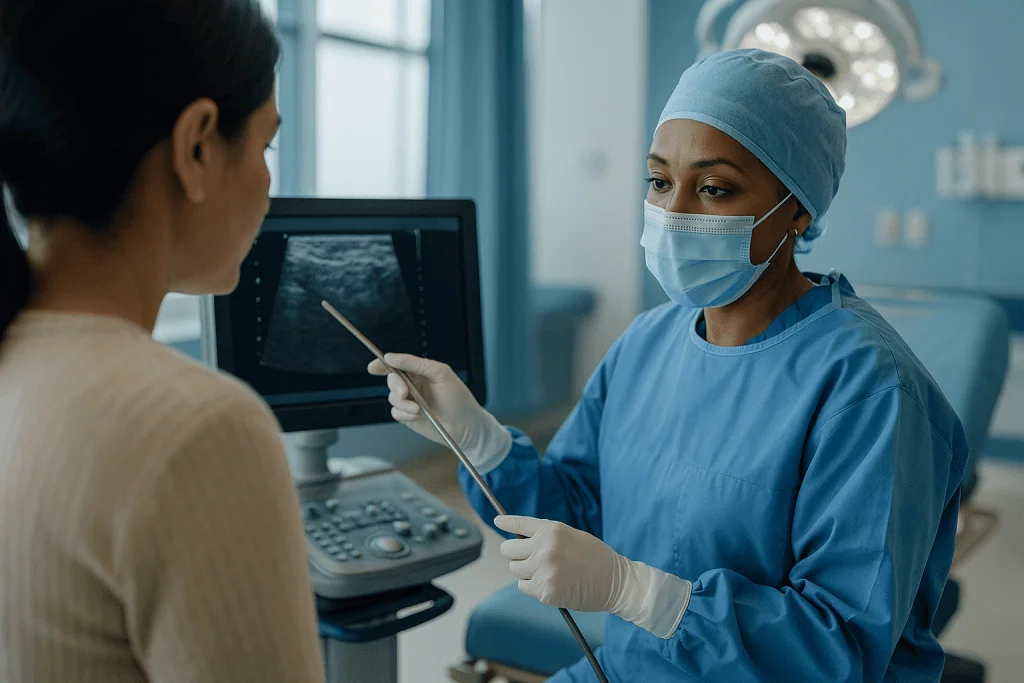
Real-time ultrasound is the newest layer. Ultrasound uses sound waves to show a live image of tissue. Held over the buttock during injection, it lets the surgeon watch the cannula tip and confirm it sits above the bright line of the fascia. Some US state medical boards now require it for this procedure.
Finally, workload. Fatigue erodes precision, and several regulators have capped the number of these operations a surgeon may perform in a day. The follow-up survey indexed on PubMed associated adoption of these measures with the lower mortality estimate, though survey data cannot prove which element did the most work.
BBL safety measures at a glance
The table below gathers the main safety measures, what each is meant to prevent, and how strong the supporting evidence is. Notice that nearly every row targets the same thing: keeping the cannula tip above the fascia.
| Measure | What it targets | What the evidence shows |
|---|---|---|
| Subcutaneous-only fat placement | Contact with gluteal veins beneath the fascia | Autopsy series in task-force reports consistently found fat below the fascia in deaths; core recommendation of the NHS and surgical bodies |
| Larger, rigid injection cannula | Tip bending unexpectedly into deep tissue | Expert consensus based on mechanism; no randomized trial, which would be unethical to run |
| Upward or parallel cannula angle, inject only while moving | Depositing a bolus of fat into a torn vein | Expert consensus; supported by anatomical and cadaver studies indexed on PubMed |
| Real-time ultrasound guidance | Uncertainty about tip depth | Growing case series; required by some regulators; long-term comparative data still limited |
| Limits on procedures per surgeon per day | Fatigue-related error | Adopted by some regulators after mortality clusters; direct outcome data are observational |
| Patient selection and clot prevention | Anesthetic risk, deep vein thrombosis, pulmonary embolism | General surgical evidence summarized by the CDC and MedlinePlus, not BBL-specific trials |
Two honest caveats. The measures were adopted together, so nobody can say with confidence how much each contributes on its own. And the evidence is observational: surveys, medical examiner records and anatomical studies rather than controlled trials. That is a reasonable evidence base for a safety practice grounded in a clear mechanism, but it is not the same as proof, and a surgeon who tells you the risk has been eliminated is overstating what anyone knows.
Who a BBL is usually for, and who is usually asked to wait
Surgeons think about candidacy in two directions at once: is there a realistic goal this operation can serve, and does this person’s body tolerate a long procedure under general anesthetic with a specific added risk?
The people for whom a BBL is usually considered are adults in stable general health, at a weight they have held for some months, with enough fat elsewhere to harvest. That last point surprises people. A very lean person may simply not have enough donor fat, and the NHS fat transfer page notes that results depend on how much fat survives, so starting with little leaves little to work with.
Those usually asked to wait, or steered toward alternatives, include:
- Anyone still losing or gaining weight, since transferred fat behaves like native fat and will follow those swings.
- People who are pregnant, breastfeeding or planning a pregnancy soon.
- Those with a personal or family history of blood clots, or a known clotting disorder, because the CDC lists surgery and reduced mobility among the strongest triggers for deep vein thrombosis.
- People with uncontrolled diabetes, active infection, poorly controlled heart or lung disease, or a very high body mass index, all of which raise anesthetic and wound risks.
- Smokers who are not yet able to stop, as nicotine narrows the small vessels the grafted fat depends on.
- Anyone under 18, and anyone whose distress about their body suggests that surgery is unlikely to relieve it.
None of these is a moral judgment. They are the ordinary questions of any pre-operative assessment, with the fat-graft biology layered on. The NHS recommends a consultation with the operating surgeon before committing, and it is entirely reasonable to expect that surgeon to explain why you are, or are not, a candidate today. The decision, either way, sits with the treating team.
BBL risks and complications beyond embolism
Fat embolism dominates the headlines because it kills, but most people who have a difficult recovery are dealing with something less dramatic. Knowing the full list helps you weigh the operation honestly.
Blood clots come first. A deep vein thrombosis is a clot in a deep leg vein; the CDC notes that surgery, hours of immobility and general anesthesia all raise the risk, and that a clot breaking free can travel to the lungs as a pulmonary embolism. A BBL involves a long operation, several days of restricted movement and, in some cases, travel afterward, a combination clinicians take seriously. Compression, early walking and, where prescribed, anticlotting medicine are standard prevention; the choice rests with the surgical team.
Infection can occur at either the liposuction sites or the injection sites. The NHS lists it among the recognized risks of both liposuction and fat transfer.
Fat necrosis is what happens when transferred fat dies rather than picking up a blood supply. Dead fat can liquefy into an oil cyst, harden into a firm lump, or drain through the skin. These lumps can be alarming but are usually benign; imaging can distinguish them from anything else.
A seroma is a pocket of clear fluid that gathers under the skin, common after liposuction and sometimes needing drainage.
Asymmetry and contour irregularity are the aesthetic risks. Fat is reabsorbed unevenly, and the donor site can end up wavy or hollow. The NHS notes that fat transfer results can be unpredictable and that some people need a second procedure.
Numbness, bruising, scarring, fluid shifts affecting blood pressure, and the general risks of anesthesia round out the list. Every one of these should appear on the consent form you are asked to sign.
BBL recovery time: what the first days and weeks usually look like
Recovery from a BBL is shaped by one awkward fact: the part of the body that most needs rest is the part you sit on.
In the first two or three days, expect to be tired, bruised across the liposuction areas and swollen at the buttocks. Most people go home the same day or after one night. A compression garment, a tight elastic suit worn over the liposuction sites, helps control swelling and is typically worn for several weeks. Some surgeons place small drains; others do not.
Pressure on the buttocks is the defining restriction. Freshly transferred fat has no blood supply of its own and depends on tiny vessels growing into it; sustained pressure can starve it. The NHS advises avoiding sitting directly on the buttocks for a few weeks, and surgeons commonly recommend lying on the stomach or side, and using a cushion that lifts the buttocks off the seat when sitting is unavoidable. Your surgeon’s timeline is the one to follow.
Walking, by contrast, is encouraged early and often. Short walks around the house from the first day keep blood moving in the legs, which the CDC identifies as a basic defense against clots after surgery.
Swelling and bruising settle over weeks. The NHS suggests that full recovery from a buttock lift takes around six weeks, and that the final shape becomes clear only after several months, once swelling has gone and the fat that will survive has done so. Some volume loss in this period is expected, not a failure.
Follow-up appointments matter more here than for many cosmetic procedures, because early complications such as clots and infection are treatable when caught. Arrange them before the operation, and make sure someone can drive you to them.
Do BBLs smell after 2 years?
This question is asked often enough to deserve a straight answer. Living fat does not smell. Fat that has been transferred and has picked up a blood supply is ordinary body tissue, the same as the fat you were born with. There is no built-in expiry after which a BBL begins to give off an odor.
So where does the belief come from? A few real situations sit behind it.
Fat necrosis, described earlier, can leave pockets of dead fat that liquefy. If one of those pockets tracks to the skin and drains, the discharge can have an unpleasant smell. That is a complication, usually appearing in the first months rather than years later, and it is treatable.
Infection, whether early or delayed, can produce discharge and odor. Any new warmth, redness or drainage from a healed area is a reason to be seen.
The third cause is not a complication at all. Larger buttocks create deeper skin folds, and skin folds trap sweat and bacteria. The same is true of any body shape with more fold area, and it responds to ordinary washing and drying.
What the evidence actually shows is thinner than the internet suggests. There are case reports of late infection and fat necrosis after fat grafting indexed on PubMed, but no study documents an inherent odor from a healed BBL at two years or any other point. If someone reports a persistent smell years after surgery, the useful response is a clinical examination and, where needed, imaging to look for a fluid collection, not a shrug about the procedure.
A myth-busting note: this belief is often repeated with a tone of mockery. People considering or living with this surgery deserve accurate information, not ridicule.
What happens 10 years after a BBL?
Nobody can promise what a body will look like a decade from now, and the honest starting point is that long-term studies of BBL outcomes are limited. Most published follow-up covers months to a few years. What can be said rests on the biology of transferred fat, which is well understood.
Fat that survives the first few months is permanent in the sense that it is living tissue with its own blood supply. It does not dissolve on a schedule. It does, however, behave exactly like the fat it came from. The NHS fat transfer page makes this point directly: if you gain weight, the transferred fat can enlarge; if you lose weight, it can shrink. A person who harvested from the abdomen carries abdominal fat cells in their buttocks, and those cells keep responding to weight change the way abdominal fat does.
Aging adds a second layer. Skin loses elasticity over decades regardless of surgery, and gravity acts on added volume as it does on native volume. A projection that looked lifted at thirty may sit lower at forty. This is not a complication; it is the same process happening to everyone.
Hard lumps from fat necrosis, if present, tend to stabilize and sometimes calcify. They can show up on imaging done for unrelated reasons, so it is worth telling any future clinician that you had fat grafting, so a scan is read in context.
Pregnancy, menopause and significant illness all shift fat distribution and may change the result in ways no one can forecast.
The practical takeaway is modest: the operation changes shape, not the rules your body plays by. Stable weight and general health are the strongest predictors of a result that ages gracefully, and those are the same factors that mattered on day one.
Is a BBL worth the risk? How to think it through
No article can answer this for you, and any article that tries is selling something. What it can do is lay out how clinicians and ethicists frame a decision like this, so that yours is made with clear eyes.
Start with the magnitude. The NHS estimate of about 1 in 4,000 deaths is small in absolute terms and large relative to other cosmetic procedures. Newer surveys indexed on PubMed suggest the figure has fallen where safety recommendations are followed, but those figures come with the survey limitations described earlier. You are choosing an operation whose most serious risk is rare, catastrophic and largely dependent on technique.
Then weigh the certain costs. Several weeks of restricted sitting, a long recovery, visible scars at donor sites and the real possibility of asymmetry or a second procedure are not risks; they are expected features, and the NHS lists them as such.
Ask what the alternatives are. Gluteal implants carry their own risks and are a different operation. Targeted strength training changes muscle rather than fat and cannot replicate a fat graft, but it also carries none of these risks. Doing nothing is always an option, and a legitimate one.
Look hardest at the setting. The mortality clusters that prompted regulatory action were concentrated in settings where technique and oversight were poor. Licensed surgeons practicing subcutaneous-only placement, using ultrasound where required, working in accredited facilities with anesthesia support and clear follow-up arrangements describe a very different risk environment from the one the worst numbers came from. Ask about all of it.
Finally, sit with the question of what you expect to change. Surgery can alter shape. It has never been shown to alter how a person feels about themselves in any durable way, and honest surgeons say so.
What people often get wrong about BBL safety
Some misconceptions are harmless. Several of these are not, because they steer people toward or away from the choices that actually change risk.
“The danger is the anesthesia.” General anesthesia carries risk in any operation, but the deaths that gave the BBL its reputation were caused by fat entering veins, a mechanical event during injection. The anesthetic is not what makes this procedure unusual.
“It is fat, so it is natural, so it is safe.” Fat is only safe in the wrong place if it stays there. In a vein, it is as dangerous as any embolus. Using your own tissue removes rejection as a concern; it does nothing for placement risk.
“Deeper placement gives better results, so good surgeons go deep.” Older technique did favor intramuscular placement for fat survival. The autopsy evidence reviewed by the task force is exactly why that technique has been abandoned by mainstream surgical bodies. A surgeon who describes intramuscular placement as a selling point is describing the mechanism of death.
“The risk has been eliminated.” It has been reduced, according to survey data indexed on PubMed, in settings that adopted the recommendations. Reduced is not eliminated, and surveys cannot see what happens in unregulated settings.
“More fat means a better outcome.” Large volumes stretch the subcutaneous space and tempt deeper placement. The NHS notes that fat transfer results are unpredictable and sometimes need repeating; staging is a safety strategy, not a failure of ambition.
“A quick recovery means everything went well.” Clots can form in the first weeks and fat necrosis can surface months later. Feeling well early is good news, not a discharge from follow-up.
“The scary numbers are old, so they no longer apply.” They apply wherever the technique that produced them is still used. Ask about technique, not about the calendar.
Questions to ask your care team
A good consultation is a conversation, and the quality of the answers tells you as much as their content. These questions go to the heart of BBL safety and recovery; a surgeon who welcomes them is telling you something.
- Into which layer will you place the fat, and will any be placed in or under the muscle? The answer you are looking for is subcutaneous only, without hesitation.
- Do you use ultrasound during injection to confirm the cannula stays above the fascia? If not, how do you confirm depth?
- What size and type of cannula do you use for injection, and why?
- How many of these procedures do you perform in a typical week, and how many in a single day?
- Where will the operation take place, is the facility accredited, and who will provide the anesthesia?
- How do you assess my clot risk, and what will be done before, during and after surgery to lower it?
- Given my body and donor fat, what result is realistic, and what would you consider too much fat to place in one operation?
- What proportion of transferred fat typically survives in your experience, and how would a second procedure be decided?
- What is your plan if a complication develops after hours, and who exactly do I call?
- What follow-up schedule do you expect, and how long should I stay near the facility before traveling any distance?
- What are the alternatives, including doing nothing, and why do you think this operation suits me rather than one of them?
Write the answers down or bring someone who will. The NHS recommends taking time to consider any cosmetic operation rather than deciding at the first meeting, and a surgeon who pressures you toward a date is giving you useful information about how decisions are made in that practice.
When to call your doctor
Most recoveries are uncomfortable rather than dangerous, but a small number of problems need urgent attention, and the ones that matter most tend to announce themselves clearly. If you have had a BBL, or are caring for someone who has, treat the following as reasons to act now rather than wait for a scheduled appointment.
Call emergency services immediately for any of these, which can signal a pulmonary embolism or another life-threatening event as described by MedlinePlus and the CDC:
- Sudden shortness of breath, or breathing that feels harder than it did an hour ago.
- Chest pain, especially pain that sharpens when you breathe in.
- Coughing up blood.
- Fainting, near-fainting, a racing heartbeat, or blue-tinged lips or fingertips.
- Confusion or unusual drowsiness that is not explained by prescribed medicine.
Contact your surgical team the same day for signs of a deep vein thrombosis or infection:
- Swelling, pain, warmth or a change in color in one leg, particularly the calf.
- Fever, or chills and shaking.
- Spreading redness, increasing pain or heat at any incision or over the buttocks.
- Cloudy, foul-smelling or increasing discharge from a wound.
- Bleeding that soaks through dressings.
- Severe or worsening pain that your prescribed pain plan does not touch.
- Feeling faint when standing, or passing very little urine, which can indicate fluid shifts after liposuction.
Later on, a new firm lump, a fluid-filled swelling, or an area that opens and drains months after surgery should be assessed rather than watched indefinitely. These are often fat necrosis or a seroma, and both are manageable when seen.
Your surgical team should have given you a direct number for after-hours concerns. If you cannot reach them and any of the urgent signs above is present, go to the nearest emergency department and tell the staff you have recently had fat grafting to the buttocks; that single sentence changes how they assess you.
Frequently asked questions
How safe is BBL now?
Safer than it was, and still among the riskier cosmetic operations. The NHS estimates the risk of death at about 1 in 4,000, the highest of any cosmetic procedure. Later surveys of surgeons indexed on PubMed report a much lower rate where subcutaneous-only placement and related measures are used, though surveys can undercount deaths and cannot capture unregulated settings. Technique and setting, not the calendar, determine the risk you actually face.
Is BBL safe if the fat is placed only under the skin?
Subcutaneous placement removes the main route for a fatal fat embolism, because the small vessels above the fascia cannot carry a bolus of fat the way the gluteal veins can. It does not remove the general risks of a long operation under anesthesia, including blood clots, infection and fat necrosis. Autopsy series reviewed by surgical task forces found fat below the fascia in deaths, which is why this single change matters so much.
What is the BBL death rate compared with other cosmetic surgery?
The NHS describes the BBL as having the highest death rate of all cosmetic procedures, around 1 in 4,000. Follow-up surveys published in the Aesthetic Surgery Journal and indexed on PubMed estimated roughly one death in fifteen thousand procedures after safety recommendations spread. Both figures come from surgeon self-reporting, so they are best read as a range and a direction rather than a precise number for any individual surgeon or facility.
What exactly is a BBL fat embolism?
It is fat entering a torn vein during injection and traveling to the heart and lungs, where it blocks blood flow. MedlinePlus describes a pulmonary embolus as a blockage in a lung artery, most often a clot but sometimes fat. In a BBL the fat is macroscopic and the collapse can happen within minutes to hours, unlike the delayed, microscopic fat embolism syndrome seen after fractures. Keeping the cannula above the fascia is the primary defense.
Do BBLs stink after 2 years?
No. Healed, living fat has no odor and does not deteriorate on a schedule. A smell usually points to something specific: drainage from a pocket of dead fat (fat necrosis), an infection, or ordinary sweat and bacteria trapped in deeper skin folds. The first two are complications that deserve a clinical examination, and often imaging; the third responds to routine hygiene. No study documents an inherent odor from a healed BBL.
What happens 10 years after a BBL?
Long-term studies are limited, but the biology is clear. Fat that survived the first months is permanent living tissue that follows weight change exactly as the donor area would, as the NHS fat transfer page notes. Skin laxity and gravity act on it as they do on native tissue, so the shape may settle lower with age. Any firm lumps from fat necrosis tend to stabilize and can appear on later imaging, so mention the surgery to future clinicians.
Is BBL worth the risk?
That is a personal judgment no article can make for you. The framework clinicians use is to weigh a rare but catastrophic risk that depends heavily on technique against certain costs: weeks of restricted sitting, donor-site scars, possible asymmetry and a possible second procedure. Alternatives, including doing nothing, belong in the comparison. The setting and the surgeon’s placement technique change the risk more than anything else you can choose.
How long is BBL recovery time, and when can I sit?
The NHS advises avoiding sitting directly on the buttocks for a few weeks and describes about six weeks to recover from a buttock lift, with swelling settling over that period and the final shape emerging over several months. Your surgeon sets the exact timeline based on how much fat was moved and how you are healing. Short walks from the first day are encouraged, because the CDC lists immobility after surgery as a major clot risk.
What are the BBL risks and complications besides fat embolism?
Blood clots in the legs that can travel to the lungs, infection at donor or injection sites, fat necrosis producing lumps or oil cysts, seroma (a pocket of fluid), asymmetry, contour irregularity where fat was harvested, numbness, scarring and the general risks of anesthesia. The NHS lists most of these for both liposuction and fat transfer. Many are manageable when caught early, which is why follow-up appointments matter more than for most cosmetic procedures.
Should I fly home soon after a BBL?
Long journeys shortly after a long operation combine two clot risks the CDC highlights: surgery and prolonged immobility. Most surgical teams ask patients to remain nearby until early follow-up has confirmed there is no infection, clot or fluid collection, and to keep moving, stay hydrated and avoid pressure on the buttocks during any travel. The right interval is a decision for your surgeon, made before you book anything, not after.
References
- PubMed, gluteal fat grafting mortality (task force and medical examiner studies)
- MedlinePlus: Pulmonary embolus
- CDC: About Blood Clots
- MedlinePlus: Plastic and Cosmetic Surgery
This article is for general information only and is not a substitute for professional medical advice. Please consult a qualified doctor about your individual situation.

More from the Blog

How Lipedema Is Diagnosed: The Exam, Imaging and Staging That Shape a Treatment Plan
Lipedema is diagnosed clinically. A clinician takes a detailed history of when the fat pattern began, examines the limbs for symmetrical, tender, easily bruised…

HD Liposculpture Results: Why Definition Takes Months to Appear and How Weight Changes It
HD liposculpture results usually take months to fully appear because swelling, bruising and early healing tissue hide the thin, sculpted fat layer that creates…

Preparing for Vaginoplasty: The Pelvic Exam, Blood Work and Habits to Pause Beforehand
Preparing for vaginoplasty usually involves a pelvic and genital examination, routine blood tests such as a blood count, kidney and liver measures, blood sugar…

Is Tumescent Liposuction Right for You? Small Areas, Stable Weight and Honest Limits
Tumescent liposuction is usually considered for adults at or near a stable, healthy weight who have a few well-defined fat pockets that have not…

Is Classic Liposuction Right for You? Skin Elasticity, Stable Weight and Realistic Areas
A typical classic liposuction candidate is an adult at or near a stable weight for several months, with localized fat pockets that resist diet…

What the Tumescent Solution Does in Tumescent Liposuction: Bleeding, Bruising and Comfort
Tumescent solution is a large volume of very dilute salt water carrying a local anesthetic and epinephrine, infused into the fat before liposuction. It…