

Before Clear Aligners Start: Digital Scans, Cavities to Treat and the Aligner Plan

Key Takeaways
- Clear aligners generate force only while in the mouth, which is why NHS guidance describes wear of around 22 hours a day rather than overnight use alone.
- Cavities are filled before the final scan because a snug tray traps acid against enamel and a filling placed afterward can stop the tray from seating.
- Gingivitis is reversible and must be resolved and re-checked before tooth movement begins, since inflamed bone is not a safe foundation for orthodontics.
- The intraoral scan maps only crowns and gums; a panoramic X-ray is still needed to see roots, bone and unerupted teeth that can change the plan.
- The on-screen simulation is a clinician-edited plan, not a forecast, and many cases include a refinement scan and supplementary trays partway through.
- Orthodontic treatment typically runs 18–24 months with check-ups about every 6–8 weeks, and retainers are needed long-term afterward to prevent teeth drifting back.
Before starting clear aligners, an orthodontist or dentist usually completes a full dental exam, X-rays, photographs and a digital scan of both jaws. Any active cavities, gum inflammation or failing fillings are treated first, because aligners cover the teeth for most of the day. The scan then becomes a staged digital plan showing predicted tooth movements, which the clinician reviews and adjusts before the first set is manufactured.
The wand looks like an electric toothbrush with a camera where the bristles should be. It hums quietly as the assistant traces it along the back of your lower molars, and on the screen beside the chair a three-dimensional version of your mouth assembles itself, tooth by tooth, in a slightly unsettling shade of pale gray. You came in expecting to be handed a set of plastic trays. Instead, you are being told about a filling that needs replacing, a bit of gum bleeding that should settle first, and something called a treatment simulation that will take a week or two to build.
This is the part of orthodontics that nobody photographs for social media. Yet the weeks before starting clear aligners often decide how smoothly the following year goes. A rushed start on a mouth with an untreated cavity or inflamed gums is a common reason plans stall.
Here is what actually happens in that gap, why each step exists, and which questions are worth asking before the first tray goes in.
What happens at a clear aligner consultation before starting clear aligners?
The first visit is mostly looking, measuring and listening. A clinician examines every tooth, checks how the upper and lower teeth meet when you bite, and asks what bothers you: crowding, spacing, a tooth that catches when you chew, a bite that has shifted since your teens. The technical word for a misaligned bite is malocclusion, which simply means the teeth do not fit together as they should.
Expect a gum assessment with a slim probe that measures the depth of the pocket between gum and tooth. Expect a check of every existing filling and crown, because a restoration that is chipped or leaking can change shape once the tooth around it starts to move. And expect a conversation about habits: clenching, grinding, nail biting, thumb sucking in younger patients. Each can affect how teeth respond to pressure.
MedlinePlus notes that most malocclusion is mild and needs no treatment at all, and that the decision to treat rests on function and the person’s own concerns as much as on appearance. A good consultation therefore ends with a frank discussion of whether aligners are the right tool for your particular bite, whether fixed braces might do a specific job better, or whether the sensible answer is to do nothing.
You will usually leave with a rough sense of the likely timeline. NHS guidance describes orthodontic treatment as typically taking 18–24 months, though simpler alignment cases can be shorter and complex bites longer. Nobody can promise a date at this stage, and a clinician who does is skipping ahead of the evidence.
How do clear aligners actually move teeth?
Teeth are not fixed in bone like fence posts in concrete. Each root sits in a socket lined with a thin, living cushion called the periodontal ligament, which is stitched with blood vessels and nerve fibers. Apply gentle, sustained pressure to one side of a tooth and the ligament on that side compresses; the body responds by dissolving a sliver of bone there. On the opposite side the ligament stretches, and new bone is laid down to fill the gap. The tooth drifts a fraction of a millimeter, and the socket rebuilds itself around the new position.

Fixed braces create that pressure through a wire threaded through brackets. Clear aligners create it by being deliberately the wrong shape. Each tray is manufactured to match not where your teeth are, but where the plan wants them to be a small step later. When you seat a new tray it fits tightly and pushes back; over the following days the teeth yield, the tray relaxes, and the next one in the sequence takes over.
Because the force comes from the plastic itself, the trays only work while they are in your mouth. NHS guidance on orthodontics notes that removable aligners need to be worn for around 22 hours a day, which leaves roughly two hours for eating, drinking anything other than water, and cleaning. That single number explains most of what follows in this article, from why cavities must be sorted first to why the first week feels strange.
Small tooth-colored bumps of composite, called attachments, are often bonded to certain teeth so the tray can grip and rotate them. Some plans also shave a hair’s breadth of enamel between crowded teeth, a step known as interproximal reduction, to create room. Both are decided during planning, not on the day.
What is a digital scan for aligners, and why has it replaced putty impressions?
The intraoral scanner is a handheld camera that captures thousands of overlapping images per second and stitches them into a three-dimensional model of your teeth and gums. The whole mouth usually takes a few minutes. There is no tray of cold putty, no gagging, and no waiting for a plaster model to set.
Accuracy matters more than comfort here. An aligner that is off by even a small margin will either fail to seat or press in the wrong place. Digital models can be checked on screen, re-scanned in seconds if a patch is blurred, and sent to the laboratory without the shrinkage or distortion that physical impressions can suffer in transit.
The scan does three separate jobs. First, it is the record of your starting point, filed alongside photographs and X-rays so progress can be measured rather than guessed. Second, it is the raw material for the treatment simulation, in which software proposes a sequence of tooth positions that the clinician then edits. Third, it is the template from which each tray is eventually manufactured, whether by printing a model and forming plastic over it or by other methods.
Two points are worth knowing. The scanner shows the crowns of the teeth and the gum surface, not the roots or the bone, which is why X-rays are still needed. And the simulation you are shown on screen is a projection of intended movement, not a guarantee of the final result. Bone density, root shape, how consistently the trays are worn and how the bite settles all influence what actually happens. A clinician who describes the simulation as a plan rather than a promise is speaking accurately.
Which X-rays and photographs are taken before aligners begin?
A panoramic radiograph, a single wide X-ray that sweeps around the jaw, shows every tooth root, the bone that supports it, unerupted teeth, and the joints where the lower jaw hinges. It reveals things a scan cannot: a root that is unusually short, a wisdom tooth angled into its neighbor, or a shadow suggesting infection at a root tip. Any of these can change the plan.

Many clinicians also take small bitewing X-rays, which look between the back teeth where cavities hide from both mirror and scanner. MedlinePlus describes dental X-rays as the standard way to detect decay in these hidden surfaces before it is visible or painful.
Some cases call for a lateral cephalogram, a side-on X-ray of the skull that lets the orthodontist measure how the jaws relate to each other and to the face. It is more common where the bite problem involves jaw position rather than crooked teeth alone. Three-dimensional cone-beam imaging is reserved for specific questions, such as locating an impacted tooth, because it involves a higher radiation dose and is not routine.
Photographs round out the record: a set of extraoral shots of the face at rest and smiling, and intraoral views from the front and both sides and of each biting surface. They may feel like an odd photo shoot, with cheek retractors and a mirror in your mouth, but they are how your team documents what is changing and what is not.
Radiation exposure from dental imaging is low, and clinicians follow the principle of taking only the images that will alter decisions. If you are pregnant or think you may be, say so before any X-ray; non-urgent imaging can often be deferred.
Why cavities need treating before starting clear aligners
A cavity is a hole in the tooth made by acid. Bacteria in plaque feed on sugars and starches, produce acid, and that acid dissolves the mineral in enamel. The Mayo Clinic describes the process as beginning with a white or brown spot, progressing through the enamel into the softer dentin beneath, and eventually reaching the pulp where the nerve sits. It does not stop on its own.
Aligners make that process worse in two ways if decay is left untreated. The tray forms a snug seal over the teeth, so any sugar or acid trapped underneath sits in contact with enamel for hours rather than being washed away by saliva. And because you wear the trays for around 22 hours a day, the teeth spend most of their time in that sealed environment. A small cavity that might have progressed slowly in an open mouth can advance quickly under plastic.
The second problem is shape. A filling placed after the scan alters the contour of the tooth, and a tray manufactured to the old contour may no longer seat properly. Treating decay first, then scanning, means the plan is built on a stable surface.
There is also a practical argument. Once you are changing trays on a fixed schedule, an unexpected filling appointment, or worse a root treatment, interrupts the sequence. Clinicians would rather clear the decks.
Early enamel lesions, the white spots the Mayo Clinic mentions, do not always need drilling. Fluoride and improved cleaning can help the surface remineralize, and your dentist may choose to monitor them. Whether a given spot is filled, sealed or watched is a judgment for the treating team, made tooth by tooth.
Gum health first: why bleeding gums pause the plan
Teeth move through bone, and bone that is actively being lost to gum disease is not a safe foundation. This is the reason a bit of bleeding when you brush, which many people dismiss, can delay the start of aligners by weeks.
Gingivitis is the early stage: plaque along the gumline irritates the tissue, which becomes red, puffy and prone to bleeding. The NHS notes that most adults have some degree of gum disease and that gingivitis is reversible with thorough cleaning. Periodontitis is the later stage, in which the inflammation spreads below the gumline and begins to destroy the ligament and bone holding the tooth. The Cleveland Clinic describes the pockets that form between gum and tooth as the key sign clinicians measure, because deeper pockets mean more support has been lost.
Moving a tooth with active periodontitis risks accelerating that loss. So most orthodontists will not begin aligners until gums are stable: no active bleeding on probing, pocket depths that are not deepening, and a cleaning routine you have demonstrated you can maintain. For gingivitis that usually means a professional scale and polish plus a few weeks of daily flossing and careful brushing, then a re-check. For periodontitis it may mean a course of deep cleaning with a periodontist and a longer period of monitoring before orthodontics is reconsidered.
Aligners can then become an ally rather than a hazard. Unlike fixed braces, they come out for brushing and flossing, and the trays hold any fluoride from toothpaste against the enamel. That advantage only exists, though, for someone who actually cleans before putting the trays back in. The pre-treatment weeks are a rehearsal for that habit.
Who clear aligners are usually for, and what disqualifies you from clear aligners
Aligners suit mild to moderate crowding, spacing, and many cases of relapse after earlier braces where teeth have drifted. Adults and older teenagers with all their permanent teeth are the typical candidates, partly because the trays depend on a mouth that is not still changing shape.
Certain situations lead clinicians to recommend a different route, or to ask you to wait. None is a permanent bar; each is a reason the trays are not the right tool right now.
- Active decay or gum disease. As described above, these are treated first.
- Severe bite problems. Large jaw discrepancies, deep overbites requiring substantial vertical movement, or teeth that need to be pulled down from high in the gum often respond better to fixed appliances, sometimes combined with jaw surgery. MedlinePlus lists surgery among the options for malocclusion caused by jaw position rather than tooth position alone.
- Unerupted or impacted teeth. A tooth still buried in bone cannot be gripped by a tray.
- Growing children. Younger patients are more often assessed for interceptive treatment or fixed braces, since the timing of jaw growth matters.
- Unreliable wear. Someone who knows they will not manage around 22 hours a day, whether for work, health or lifestyle reasons, is usually steered toward braces that cannot be removed.
- Multiple crowns, bridges or implants. Implants do not move because they fuse to bone; bridges lock several teeth together. The plan must work around them, and sometimes cannot.
Pregnancy is not in itself a barrier, though gum inflammation is more common and X-rays may be deferred. Uncontrolled diabetes, some bone conditions and certain medications that affect bone turnover can also prompt a pause or a specialist opinion. The decision in every case sits with the treating team, weighing your bite, your health and your goals together.
The pre-treatment checklist at a glance
Every practice organizes these steps slightly differently, and some can be completed in a single visit while others need a return appointment. The table shows what is typically done, why it matters, and what commonly delays the start.
| Step | What it involves | Why it is done | Typical reason for delay |
|---|---|---|---|
| Clinical exam | Tooth-by-tooth check, bite assessment, jaw joint check | Confirms aligners suit your malocclusion | Complex bite needing fixed braces or surgical opinion |
| Gum assessment | Probing pocket depths, checking for bleeding | Teeth should not move through inflamed or receding bone | Gingivitis or periodontitis needing cleaning and re-check |
| X-rays | Panoramic film, bitewings, sometimes side skull view | Shows roots, bone, hidden decay, unerupted teeth | Root infection or impacted tooth requiring treatment first |
| Restorative work | Fillings, replacing failing restorations, crowns | Stable tooth shape before scanning; no decay under trays | Several teeth needing work, or a root treatment |
| Digital scan | Handheld camera maps both arches and the bite | Starting record; basis for simulation and manufacture | Repeated if restorations change tooth contours |
| Photographs | Face and intraoral views | Baseline for tracking change | Rarely a delay |
| Plan review | Clinician edits the software proposal, sets attachments and any enamel reshaping | Converts a simulation into a clinical plan | Laboratory turnaround; revisions after review |
| Consent discussion | Risks, alternatives, wear time, retention afterward | Informed agreement before trays are made | Patient wishes to consider options |
Two observations from this table deserve emphasis. Dental health steps sit above orthodontic ones in the order of priority, not below them. And the scan is deliberately placed after restorative work, because a tray built on a tooth that is about to be reshaped is a tray that will not fit.
What is the aligner plan, and how do you read it?
A week or two after the scan you will usually be shown a treatment simulation: an animated model of your teeth sliding from their current positions to a proposed end point, stage by stage. Each stage corresponds to one tray. Underneath the animation sits a good deal of clinical decision-making that is worth understanding.
The software proposes; the clinician disposes. Automated planning tends to produce idealized alignment that may ask too much of a particular root or ignore how the bite will actually close. An experienced orthodontist edits the sequence, slows movements that are biologically risky, decides which teeth need attachments and where, and specifies any interproximal reduction down to fractions of a millimeter. Ask to see what was changed from the first draft; the answer tells you a lot about how carefully your case was considered.
Look for the number of stages and the planned interval between them, which is set by your clinician rather than by the packaging. Look for whether elastics will be used, small rubber bands hooked between upper and lower trays to correct the bite, because they add a layer of daily routine. Look for whether a mid-course scan and refinement set is anticipated; most plans include the possibility, since teeth do not always follow the animation exactly.
Ask, too, what happens at the end. NHS guidance is unambiguous that teeth tend to drift back after any orthodontic treatment and that retainers are needed long-term to hold the result. A plan that stops at the last active tray is incomplete.
Finally, treat the animation’s endpoint as the intended target, not a forecast. The scan showed crowns, not roots; the simulation models plastic, not ligament. Your teeth will have their own opinion, and refinements exist for exactly that reason.
What is the 30 minute rule for clear aligners?
Search this phrase and you will find at least three different rules wearing the same name, none of which appears in any clinical guideline. Sorting them out is worth a few paragraphs, because each contains a grain of sense.
The first version says: do not leave the trays out for more than about 30 minutes at a time. This is a practical translation of the 22-hour target the NHS describes. If you remove trays for three meals and two snacks, each stretched to an hour, you have used five hours and the plan falls behind. Keeping meals brisk and reinserting promptly is the underlying advice; the exact minute count is folklore.
The second version says: wait about 30 minutes after eating or drinking anything acidic before brushing. Acid softens enamel temporarily, and brushing immediately can abrade the softened surface. This is general dental advice that predates aligners. The tension is obvious: waiting to brush means either waiting to reinsert trays or reinserting over unbrushed teeth. Most clinicians suggest rinsing thoroughly with water straight after eating, reinserting, and doing the full brush at the next convenient point. Ask your own team which compromise they prefer.
The third version says: after seating a new tray, keep it in for at least 30 minutes so it fully engages before you next remove it. This is a habit tip rather than a biological threshold. New trays are tightest in the first hours, and frequent removal can loosen the fit before the teeth have begun to respond.
None of these is a rule in the sense that breaking it once causes harm. Think of them as three reminders that the trays only work while they are in, that enamel needs protecting, and that consistency beats precision.
How do I survive the first week of clear aligners?
Day one is mostly sensory. The trays feel bulkier than they look, your tongue explores every edge, and your speech may pick up a faint lisp on s sounds. Saliva flow often increases for a day or two. All of this typically fades as the mouth adapts, usually within the first week or so, though the exact time varies from person to person.
Pressure is the point, so expect some. Most people describe a dull ache or tenderness when biting, strongest in the first two or three days after each new tray and easing as the teeth move into the new position. It is not the sharp, localized pain of a cavity or an ulcer. If your clinician has discussed pain relief with you, follow their advice; the decision about any medicine belongs to them, not to an article.
Edges are the other common complaint. A tray margin that rubs the tongue or cheek can produce a sore spot within hours. Orthodontic wax pressed over the offending edge is the usual first aid, and a clinician can smooth a persistent edge in seconds with a small file. Do not trim trays yourself.
Removing the first trays is often harder than expected. Attachments grip the plastic, and tight new trays resist. Starting at the back on one side and working forward, using a fingernail or a small hook tool if your team provides one, is easier than pulling from the front teeth. The technique becomes second nature within days.
Eating changes shape. With trays out for meals and cleaning, many people find they snack less, simply because every snack now costs a brushing session. Water is the only drink that goes with trays in. Hot drinks warp plastic, and colored or sugary drinks pool against enamel.
By the end of the week, most people report that inserting, removing and cleaning have become routine. The trays are still noticed, but no longer the main event.
What I wish I knew before getting clear aligners: the realities nobody mentions
Ask people a few months into treatment what surprised them and the answers are remarkably consistent. None is a reason to avoid aligners, but each is easier to live with when expected.
The attachments are visible. Small as they are, the composite bumps catch light and can collect stain from coffee, tea or turmeric. The trays are far less noticeable than braces, but a completely invisible mouth is not what most people get, and for people who chose aligners for discretion this can be a jolt.
The trays get cloudy and smell if you do not clean them. Saliva proteins and plaque build up on plastic just as on teeth. A soft brush with clear soap or plain toothpaste, morning and night, is the usual routine. Hot water is the one thing to avoid, because it can distort the fit.
Your bite may feel wrong partway through. As some teeth move ahead of others, you might find that only a couple of teeth touch when you close. This is often a normal phase of the plan, but it is worth mentioning at the next visit so the clinician can confirm it matches the simulation.
Refinements are normal, not failure. When teeth lag behind the plan, a new scan and a supplementary set of trays are made. Many plans budget for at least one round. The disappointment comes from expecting the original stage count to be final.
Retainers are forever, in practice. NHS guidance states plainly that teeth can move back without long-term retention, and that retainers are part of treatment rather than an optional extra. Budget the habit, not just the trays.
Check-ups continue throughout. NHS orthodontic guidance describes appointments roughly every 6–8 weeks during active treatment to check progress; skipping them because the trays seem fine is a common way for small problems to become large ones.
What people often get wrong before starting clear aligners
Myth: aligners are only cosmetic. Crowded teeth are harder to clean, and some bite problems wear enamel or strain jaw joints. MedlinePlus lists chewing difficulty and speech problems among the reasons malocclusion is treated. Appearance is a valid motive, but not the only one.
Myth: the simulation shows the guaranteed result. It shows the intended result. Roots, bone and wear consistency all shape the outcome, and refinements exist because the animation is a plan, not a prophecy.
Myth: a quick cleaning is enough before starting. Gingivitis needs to be resolved and re-checked, not just polished over on the day. Bone that is inflamed is not a safe medium for tooth movement.
Myth: cavities can wait until after treatment. Decay accelerates under a sealed tray, and a filling placed after the scan can ruin the fit. Dentists treat first for good reason.
Myth: if a tray feels loose, skip to the next one. The next tray is manufactured for teeth that have completed the previous movement. Jumping ahead can stall or mis-direct progress. Follow the interval your clinician set.
Myth: aligners work while you sleep, so daytime wear is optional. Around 22 hours a day is the figure NHS guidance quotes for a reason; eight hours in bed is barely a third of it.
Myth: adults are too old. Tooth movement happens through bone remodeling at any age, though it may be slower in adults and depends on healthy gums. Age alone is not a barrier.
Myth: once the last tray is done, you are finished. Retention is the final phase of every orthodontic plan, and the one most often neglected.
Myth: a mail-order scan and trays without an examination are equivalent. Without X-rays and a gum assessment, hidden decay, short roots and bone loss go undetected. The pre-treatment steps in this article are the safety net, not an upsell.
Questions to ask your care team before the first tray
Bring a list. The planning visit is the one moment when everything is still adjustable, and good clinicians welcome specific questions. These are the ones that tend to change decisions rather than just fill silence.
- What exactly is my diagnosis, in plain terms? Which teeth are moving, and in which directions?
- Did you change the software’s first proposal, and if so, what did you alter and why?
- Which teeth will have attachments, and will any enamel be reshaped between teeth? How much?
- Are elastics part of the plan? When would they start?
- How many stages are planned, and what interval between trays have you set for me?
- How likely is a refinement round in a case like mine, and how would that be handled?
- Is there any dental work you want completed before you take the final scan?
- How are my gums right now, and what do you want to see at the re-check before we begin?
- What would make you recommend fixed braces instead, and is that something we should discuss for part of my treatment?
- What are the specific risks in my case? Root shortening, gum recession, changes to how my back teeth meet?
- How often will you see me during treatment, and what should I contact you about between visits?
- What is the retention plan afterward: fixed retainer, removable, or both, and for how long?
- Who do I call if a tray cracks, an attachment falls off, or I am away from home?
- If I have crowns, implants or missing teeth, how does the plan account for them?
Write down the answers, or ask whether the plan can be sent to you in writing. Treatment that runs for a year or more is easier to follow when the original reasoning is on paper. And if an answer is a promise rather than a range, ask what the range actually is.
When to call your doctor or dentist
Aligner treatment is generally uneventful, and most discomfort is the expected kind: dull pressure for a few days after each new tray, a sore spot from an edge, a slight lisp that fades. Some signs, though, need a call rather than a wait for the next scheduled visit.
Contact your dental or orthodontic team promptly if you notice any of the following:
- Sharp, throbbing or persistent pain in a single tooth, especially if it wakes you or worsens with hot or cold. This is not aligner pressure and may indicate decay or infection reaching the nerve.
- Swelling of the gum, face or jaw, a bad taste, or a pimple-like bump on the gum, which can signal an abscess.
- A tooth that feels noticeably loose or has visibly shifted out of line with its neighbors, beyond the gradual movement the plan predicts.
- Gums that bleed heavily, recede visibly from a tooth, or become painful and swollen despite good cleaning.
- A tray that no longer seats, has cracked, or was lost, leaving you without an appliance for more than a day or two. Teeth can drift quickly at the start of a stage.
- An attachment that has come off, particularly early in a stage.
- New or worsening jaw joint pain, clicking with locking, or difficulty opening your mouth.
- Any allergic-type reaction such as persistent mouth or lip swelling, rash or breathing difficulty after wearing the trays. Seek urgent care for breathing problems.
- Fever alongside dental pain or swelling.
For anything less dramatic that still worries you, a photograph sent to the practice or a quick phone description is usually enough to decide whether you need to be seen. Do not adjust your own tray schedule, skip stages or trim plastic to solve a problem. The plan was built by your treating team, and every change to it should go back through them.
Frequently asked questions
What is the 30 minute rule for clear aligners?
There is no official 30-minute rule; the phrase covers three informal tips. Keep trays out for no more than roughly half an hour at a time so daily wear stays near the 22-hour target the NHS describes. Wait a while after acidic food before brushing to protect softened enamel. And leave a freshly seated tray in for a stretch before removing it so the fit engages.
What disqualifies you from clear aligners?
Active decay, untreated gum disease, impacted or unerupted teeth, severe jaw discrepancies, and an inability to wear trays for most of the day are the usual reasons a clinician recommends waiting or choosing fixed braces. Several implants or bridges can also limit what trays can move. None is permanent in most cases; the treating team decides after examining your bite, gums and X-rays.
What should I expect at a clear aligner consultation?
Expect a full dental and gum examination, photographs, X-rays, a discussion of your concerns and a frank assessment of whether aligners suit your bite. A digital scan may be taken the same day or after any dental work is completed. You should leave understanding what would need treating first, the rough timeline, and what alternatives exist, including doing nothing.
Do I need a digital scan for aligners, or will impressions work?
Either can produce a usable model, but most practices now use a handheld intraoral scanner because it is quicker, avoids gagging, and can be checked and repeated on screen immediately. The scan also becomes the basis of the treatment simulation. It does not show roots or bone, so X-rays are still taken alongside it.
Why do cavities have to be filled before starting clear aligners?
Because aligners seal over the teeth for around 22 hours a day, trapping sugars and acid against enamel, decay can progress faster under a tray. A filling placed after the scan also changes the tooth’s contour, so the manufactured trays may no longer fit. Treating decay first, then scanning, avoids both problems.
How do I survive the first week of clear aligners?
Expect pressure and tenderness for the first few days, a temporary lisp and extra saliva, all of which usually ease as the mouth adapts. Use orthodontic wax on any edge that rubs, remove trays from the back teeth forward, drink only water with trays in, and keep meals brisk so wear time stays high. Contact your team about anything sharp or persistent.
What do people wish they knew before getting clear aligners?
Common surprises include visible attachments that can stain, trays that cloud without daily cleaning, a bite that feels uneven partway through, and the likelihood of a refinement round with extra trays. Most of all, people underestimate retention: NHS guidance is clear that retainers are needed long-term to stop teeth drifting back.
How long does clear aligner treatment usually take?
NHS guidance describes orthodontic treatment as typically taking 18–24 months, while MedlinePlus gives a range from about six months to two years or more depending on complexity. Simple alignment may be shorter; bite correction takes longer. Your clinician can give a range for your case, but no exact date can be promised, and refinements can extend the timeline.
Can I have clear aligners if I have crowns, implants or missing teeth?
Often yes, but the plan must account for them. Implants fuse to bone and cannot move, bridges lock teeth together, and crowns may need special attachment techniques. Missing teeth can sometimes be used as space for alignment or held for a later implant. Your orthodontist will decide what is feasible after reviewing your scan and X-rays.
What happens if I have gingivitis at my aligner assessment?
Treatment usually pauses until the gums are stable. Gingivitis is reversible with professional cleaning and consistent daily brushing and flossing, and your dentist will typically re-check bleeding and pocket depths after a few weeks before scanning for trays. If periodontitis is found, a longer period of gum treatment and monitoring comes first, because moving teeth through inflamed bone can worsen bone loss.
References
This article is for general information only and is not a substitute for professional medical advice. Please consult a qualified doctor about your individual situation.

More from the Blog
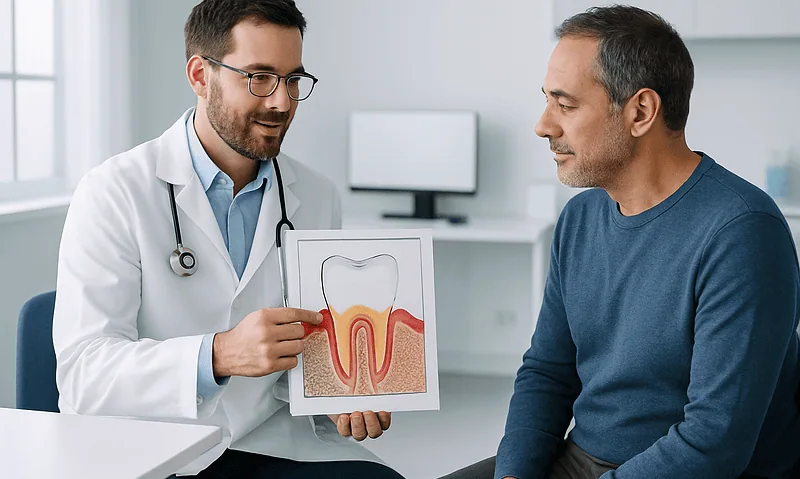
How Periodontal Disease Develops Below the Gumline and Why SRP Deep Cleaning Is Planned
Periodontal disease begins when bacterial plaque collects along the gumline, inflames the gums (gingivitis) and, if it persists, spreads below the gum to destroy…

Canker Sore vs Cold Sore: How to Tell Them Apart in Ten Seconds
Location is the fastest clue. Canker sores are shallow, round ulcers with a white or yellow center that form inside the mouth, on the…
Is a Dental Spa Right for Anxious Patients? Comfort Care Without Cutting Corners
A dental spa can suit many anxious patients when the comfort features sit on top of standard clinical care rather than replacing it. Warm…
Simple vs Surgical Tooth Extraction: How the Two Procedures and Recoveries Differ
A simple extraction removes a tooth that is fully visible above the gum, using an elevator and forceps, and usually heals within days. A…

Root Canal Recovery: What the First Days Feel Like and When to Check In
Most people recover from a root canal within a few days. Mild soreness or tenderness when biting typically peaks in the first 24 to…
Simple vs Surgical Wisdom Teeth Removal: How the Approach Depends on the Tooth’s Position
A simple wisdom tooth extraction is used when the tooth has fully erupted and can be loosened and lifted out with hand instruments. A…