

Invisalign in Turkey: Clear Aligners, Timeline, Cost and Care
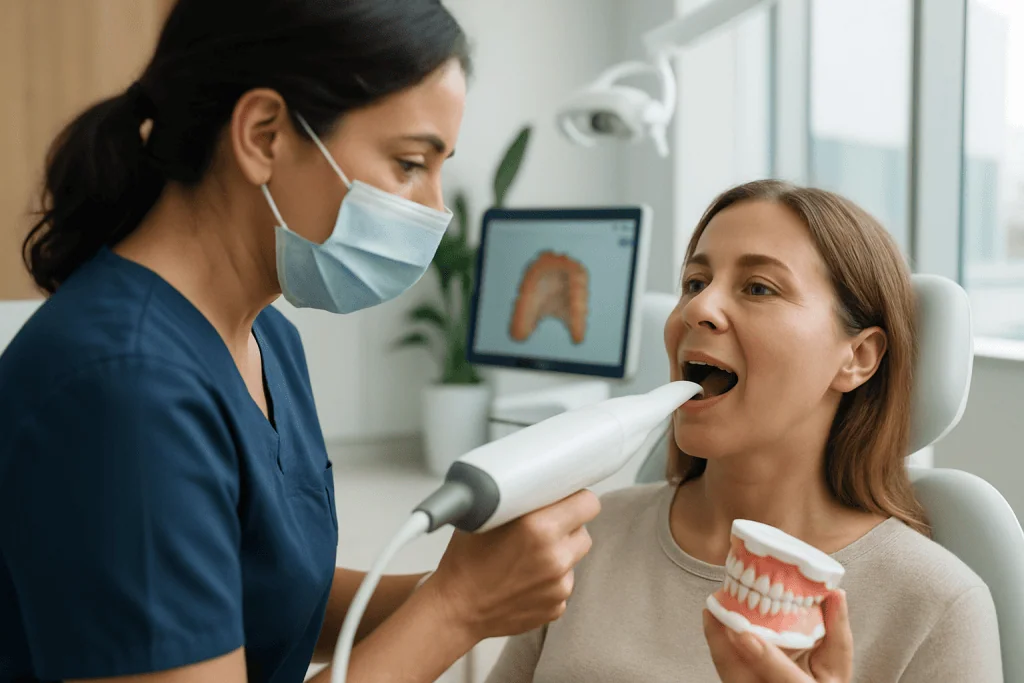
Invisalign in Turkey attracts adults from the UK who want straighter teeth without fixed metal braces and who are weighing a treatment that is planned digitally, delivered in stages and, for much of its course, worn at home. Because clear aligners are removable and the active treatment consists of changing aligners on a schedule, the model lends itself to a small number of well planned visits to Istanbul combined with monitoring in between.
This page describes what Invisalign is, who it suits and who it does not, how the pathway with Acıbadem works from the first remote review to follow-up after you return home, what the 6 to 18 month timeline involves, and how the UK and US pathways compare with Türkiye. It also sets out the practical questions about travel, insurance and continuity of care that any adult should settle before committing to orthodontic treatment abroad.
What Invisalign is and who it suits
Invisalign uses a series of custom clear aligners to move teeth gradually into a planned position without fixed metal braces. Each aligner is made from a digital model of your mouth and is worn for a set period before you change to the next one in the sequence. The aligners are removable, which is why they are often described as a discreet orthodontic option, and the whole plan is designed from a digital dental assessment rather than from impressions and guesswork.
Who is usually a candidate
- Adults and older teenagers with mild to moderate crowding, spacing or rotation of teeth.
- People whose gums and supporting bone are healthy, with no untreated decay or active gum disease.
- Patients who can commit to wearing aligners for 20 to 22 hours a day for the full course.
- Those who prefer a removable appliance for work, social or hygiene reasons.
Who should not have it, or should pause first
- Anyone with untreated cavities, gum disease or other dental problems: these should be treated before starting Invisalign.
- Patients with complex bite or jaw discrepancies that may need fixed braces, other appliances or a combined surgical approach; a dentist decides this case by case.
- People who are not confident they can wear aligners consistently, because the plan only works when the aligners are in place.
- Patients with significant restorations, implants or missing teeth where tooth movement may be limited; these cases need individual planning.
Clear aligners and conventional braces treat many of the same problems, and the right choice depends on how far and in which direction teeth need to move, not on preference alone. The preparation stage, described below, is where that decision is made.
Why patients from the UK and the US travel to Turkey for Invisalign
Orthodontic treatment for adults in the UK is almost always self-funded, and in the US it sits outside most dental cover once you are past childhood. Patients who compare their options often look at Türkiye because the same aligner system is available within a hospital-based dental service, planned and supervised by orthodontists rather than delivered as a stand-alone retail product.
Several practical reasons come up repeatedly:
- Hospital medicine, not a high-street model. At Acıbadem, dental and orthodontic care sits inside a hospital network with 7 JCI-accredited hospitals among more than 20, and 3,300+ physicians across specialties. Imaging, anaesthesia services and intensive care are on the same campus, which matters most for patients who also need preparatory dental work or who have medical conditions that warrant closer oversight.
- JCI accreditation. Joint Commission International standards cover infection control, patient identification, record keeping and clinical governance, and are audited independently. For a treatment that spans many months and several appointments, consistent records matter.
- Experience with international patients. Coordinators, translated records, scheduling around flights and remote review of scans are routine rather than exceptional, and English-speaking clinical staff are the norm in the international service.
- No waiting list. Assessment and the start of treatment can be scheduled around your own calendar rather than a clinic’s backlog.
- Combined care. Patients who need fillings, gum treatment or a dental check before aligners can often complete that preparation in the same building during the same trip.
Cost is part of the decision for most people, and the verified price band below shows how UK, US and Turkish figures compare. The clinical reasons above are what should shape the choice; the price band should confirm it rather than drive it.
How Invisalign with Acıbadem works, step by step
Because active Invisalign treatment lasts 6 to 18 months, the pathway is designed around a small number of planned visits and structured monitoring in between. The stages are broadly as follows.
- Remote medical review. You submit recent dental photographs, any existing X-rays or scans, a description of what concerns you and a short medical history. An orthodontist reviews them and indicates whether clear aligners are a realistic option or whether braces or another approach look more appropriate.
- Personal plan. If you are a likely candidate, you receive an outline plan: what would be assessed on arrival, how many visits are anticipated, how long the first stay should be, and a personal quote that follows the free medical review.
- Arrival and coordinator. A patient coordinator meets you, confirms appointments and remains your single point of contact for scheduling and documents during your stay.
- Consultation and pre-treatment tests. The dentist evaluates tooth alignment, bite, gum health and overall oral condition. Digital scans, photographs and X-rays may be taken to design the aligner plan. Any cavities, gum disease or other dental issues are treated before Invisalign begins.
- The treatment. Once the digital plan is approved, aligners are manufactured. At a fitting visit, attachments are placed where needed, the first aligners are checked for fit and you are shown how to wear, remove and clean them.
- Between visits. You change aligners at home on the agreed schedule. Progress is reviewed at intervals, and the team explains how those reviews are organised for patients who live abroad, including what to photograph and when to report a problem.
- Follow-up after returning home. Review visits in Istanbul are timed to your travel, and your own dentist can be kept informed through shared records. At the end of active treatment, retainers are provided and a retention plan is agreed.
The procedure: clear aligners in Istanbul, and how they differ from braces
Invisalign is a non-surgical treatment. No anaesthesia is used, there is no hospital stay, and the appointments themselves are outpatient dental visits within a hospital campus such as Acibadem Maslak Hospital.
Technique
The core of the method is digital planning. A scan of your teeth is used to model the intended movement in stages, and a sequence of aligners is manufactured to match each stage. Small tooth-coloured attachments may be bonded to certain teeth to give the aligners grip for particular movements, and in some plans the dentist creates tiny spaces between teeth to allow them to move. Each aligner is worn for the prescribed period, typically 20 to 22 hours a day, then replaced by the next.
Duration
The active course runs from roughly 6 to 18 months depending on how far the teeth need to move and how consistently the aligners are worn. Mild cases sit towards the shorter end; more crowding or bite correction takes longer. The dentist gives an estimate at the planning stage and revises it as progress is reviewed.
Clear aligners compared with braces
- Visibility: aligners are near transparent; fixed braces use brackets and wires, although ceramic options are less visible.
- Removability: aligners come out for eating and cleaning; braces stay on throughout.
- Control: fixed braces can achieve some complex movements more predictably, which is why the dentist may recommend them for certain cases.
- Compliance: aligners depend on the patient wearing them; braces do not.
Both options are offered within the same orthodontic service, and the recommendation follows the assessment rather than the patient’s initial preference.
Recovery and aftercare timeline
There is no downtime with Invisalign. You can return to work and normal activities the same day as your fitting. What patients notice instead is a pattern of mild tooth pressure that lasts a few days after each aligner change, easing as the teeth settle into the new position.
The first days
- Expect mild pressure or tenderness, usually most noticeable when biting; it typically settles within a few days.
- Speech may feel slightly different for a short period as the tongue adapts to the aligner edges.
- Remove aligners only for eating, drinking anything other than water, and oral hygiene; put them back promptly.
Each aligner change
- Change to the next aligner on the schedule you were given, and expect the same brief pressure each time.
- Brush and floss before reinserting aligners, and clean the aligners themselves regularly; trapped food and sugary drinks are the main cause of decay and staining during treatment.
- Keep the previous aligner until the new one is confirmed comfortable in case you need to step back briefly.
Scheduled follow-up
Progress is monitored at scheduled follow-up visits. For patients living abroad, the team agrees in advance how many of those reviews happen in Istanbul and how progress is checked between them. If an aligner cracks, does not seat properly or a tooth appears to be lagging behind the plan, report it early rather than waiting for the next visit.
After treatment
Once the active course ends, retainers are typically needed to maintain the new tooth position. Teeth drift back without them, so the retention plan is as much a part of the treatment as the aligners were. Your dentist explains how many hours a day to wear the retainer and for how long.
What it costs: UK, US and Türkiye
Typical self-pay ranges from the Turkey Medical Price Index. Türkiye figures are guide ranges for hospital treatment; your personal quote follows a free medical review.
Source: Turkey Medical Price Index (quarterly edition). Ranges depend on the extent of treatment, materials and hospital stay; they are not a quote.
Safety and risks
Invisalign is a low-risk, non-surgical treatment, but it is still orthodontics: it moves teeth through bone, and it is only safe when the mouth is healthy to begin with and the plan is properly supervised.
Who is not suitable
Patients with untreated decay, active gum disease, loose teeth or uncontrolled medical conditions that affect the gums should have those addressed first. Complex jaw or bite discrepancies may need a different appliance. Anyone unwilling to wear aligners consistently is likely to end with an incomplete result.
Complications that can occur
- Temporary discomfort or soreness after aligner changes.
- Irritation of the gums, cheeks or tongue from aligner edges.
- Teeth not tracking to the plan, which may require refinement aligners and extend the timeline.
- Decay or gum inflammation if hygiene lapses while aligners are worn.
- Root shortening or changes in the bite, uncommon and monitored through imaging and review.
- Relapse if retainers are not worn after treatment.
What cases that go wrong abroad usually share
The problems that reach UK dentists tend to have common features: aligners started without a proper clinical examination or X-rays, existing decay or gum disease left untreated, no clear plan for review between visits, and no one to contact when something did not fit. Rushed planning and the absence of follow-up cause more harm than the aligners themselves.
How a hospital setting changes that
Within a JCI-accredited hospital network, the assessment, imaging, preparatory dental work and orthodontic planning are documented in one record and reviewed by clinicians who remain responsible for the case. There is a defined route for reporting problems, scheduled follow-up written into the plan, and medical backup on site for patients with health conditions that complicate dental care. None of this removes the need for your own diligence, but it does remove the gaps in which most complications develop.
UK and US vs Türkiye: how the Invisalign pathway differs
The aligner system is the same wherever it is delivered. What differs is how you access it, how you pay for it and how continuity of care is organised.
Waiting lists and access
Adult orthodontics is not routinely available on the NHS, so UK patients are largely in the private market with variable waits for assessment. In the US, adult orthodontic treatment is usually self-pay or partially covered by dental plans with annual limits. In Türkiye, assessment and the start of treatment are scheduled to your timetable.
Self-pay and what the lower cost means
The price band below shows the verified UK, US and Türkiye figures. The difference reflects lower salaries and overheads, local operating costs and the exchange rate, not a different product. The aligners, the digital planning and the clinical standards of the orthodontist are what should be compared, and those are the same materials and methods. A lower figure does not mean fewer aligners or a shorter plan; equally, it does not include your travel, accommodation or time away from work, which you should add when comparing like for like.
Aftercare and travel
The genuine trade-off is geography. A UK or US orthodontist can see you at short notice for a lost aligner or a poorly fitting tray; a treatment planned in Istanbul relies on a defined monitoring arrangement and a small number of return visits. That is workable for many adults, but it favours patients who can travel when needed and who have a local dentist willing to help with routine checks.
What to compare like for like
- Whether the plan includes refinements if teeth do not track as expected.
- Number and timing of visits, and how monitoring works in between.
- Whether retainers and the retention plan are included.
- Who you contact if something breaks, and how quickly a replacement is arranged.
- Whether preparatory dental work is part of the quote or separate.
Planning your trip for Invisalign in Istanbul
Istanbul is roughly 4 hours by air from London and about 10 hours from New York. Because Invisalign involves more than one visit, it is worth planning the pattern of trips at the outset rather than one at a time.
Documents and entry
- A passport valid for your stay. UK, Irish, US, Canadian and Australian passport holders enter Türkiye visa-free for up to 90 days; check current rules before travel.
- Copies of any dental records, X-rays or previous orthodontic notes from your own dentist.
- A list of medications and any medical conditions, particularly those affecting bleeding, healing or gum health.
How long to stay
The first visit is the longest. Allow time for the full assessment, imaging, any preparatory dental treatment and, where aligners are manufactured after the scan, the fitting appointment; your coordinator confirms the realistic number of days once the plan is agreed. Later visits are shorter review appointments and can often be combined with a weekend.
Companion
A companion is not clinically necessary for a non-surgical treatment with no anaesthesia, but many patients prefer company for a first trip. If you are also having other dental work, ask whether anything planned would change that advice.
Travel insurance
Standard travel insurance usually excludes planned medical or dental treatment abroad. Look for a policy that specifically covers elective treatment, or a medical travel policy, and read the exclusions on complications. Keep your usual travel cover for the rest of the trip.
What to bring
- Your dental records and any previous retainers or appliances.
- A toothbrush, floss and a small case for aligners; you leave with instructions for their care.
- Comfortable clothing for appointment days and a note of your coordinator’s contact details.
Back home: your GP, your dentist and insurance
Most of an Invisalign course happens at home, so continuity of care after you return matters as much as the visits themselves.
Follow-up with your own dentist
Tell your UK or US dentist before you start treatment abroad, not afterwards. Ask whether they are willing to carry out routine hygiene checks during the course and to contact the treating team if they see anything of concern. Share the digital records, X-rays and the written plan you receive in Istanbul so that anyone who examines you understands what stage you are at. Keep your regular dental check-ups throughout; aligners do not replace them.
When to seek help
- Persistent pain that does not ease within a few days of an aligner change.
- Swelling, bleeding gums or a loose tooth.
- An aligner that no longer seats fully, or a tooth clearly out of step with the plan.
- A cracked or lost aligner: contact the treating team the same day for instructions rather than skipping ahead.
- Any sign of infection or dental abscess: see a local dentist or, if unwell, your GP promptly.
Insurance, NHS and your own doctor
Private medical and dental insurance rarely covers elective treatment abroad, so assume the aligner course is self-funded unless your provider confirms otherwise in writing. The NHS treats complications as it would for any other patient, but it does not carry out or complete cosmetic or elective orthodontics started elsewhere, and any private correction is at your own cost; check with your provider before travelling. For US readers, HSA and FSA eligibility for treatment abroad and the scope of travel-medical policies vary between plans, so confirm with your administrator. Your GP remains your first contact for anything affecting your general health.
Questions to ask before deciding on Invisalign in Turkey
A good orthodontic service expects these questions and answers them plainly. Use the list as a checklist during your remote review and first consultation.
About your suitability
- Are clear aligners the right appliance for my case, or would fixed braces achieve the movement more predictably?
- Do I have any decay or gum problems that need treating first, and is that included in the plan?
- How many aligners are anticipated, and what is the expected duration for my case within the 6 to 18 month range?
About the plan and monitoring
- How many visits to Istanbul are expected, how long is each, and when should they fall?
- How is progress monitored between visits, and what should I send and how often?
- Who do I contact if an aligner breaks or does not fit, and how quickly is a replacement arranged?
- Are refinement aligners included if teeth do not track as planned?
About the end of treatment
- Are retainers included, and what retention schedule should I expect afterwards?
- What records will I receive, and in what format can they be shared with my own dentist?
About the practical side
- What exactly does the quote cover, and what sits outside it?
- Which hospital or clinic within the network will see me, and who is the responsible orthodontist?
- What is the cancellation or postponement policy if I cannot travel?
Write down the answers and compare them with what a UK or US orthodontist tells you; the comparison is more useful than any single figure. Whether Invisalign, braces or another approach is appropriate for you is determined by a physician’s evaluation.
How much does Invisalign cost in Turkey compared with the UK?
The verified UK, US and Türkiye figures are shown in the price band below rather than in the text. The difference reflects lower salaries and overheads in Türkiye, not a different aligner system or a shorter plan. Add travel, accommodation and time away from work when comparing, and ask what the quote includes, particularly refinements and retainers. A personal quote follows a free medical review of your records.
How many times do I need to travel to Istanbul for Invisalign?
Active treatment lasts 6 to 18 months, so the pathway is built around a first, longer visit for assessment, imaging, any preparatory dental work and the fitting, followed by a small number of review visits. The exact number depends on the complexity of your case and how monitoring between visits is arranged. Your coordinator confirms the anticipated pattern of trips before you commit.
Are clear aligners in Turkey the same product as Invisalign in the UK?
Invisalign is a single branded aligner system, and the planning software and manufacturing are the same wherever the treatment is prescribed. What varies is the clinical setting, the orthodontist's assessment and how follow-up is organised. Within Acıbadem's hospital network the treatment is planned and supervised by orthodontists with imaging on site.
Should I choose braces or Invisalign in Turkey?
Both are offered within the same orthodontic service, and the recommendation follows your assessment. Clear aligners suit mild to moderate crowding and spacing in patients who can wear them 20 to 22 hours a day. Fixed braces may be advised for complex bite problems or movements that aligners handle less predictably. The dentist explains which applies to you.
Does Invisalign hurt, and is any anaesthesia used?
No anaesthesia is used because the treatment is non-surgical. Most patients feel mild tooth pressure for a few days after each aligner change, which eases as the teeth settle. There is no downtime, and you can work and travel as normal throughout the course.
What happens if an aligner breaks while I am back in the UK?
Contact the treating team the same day for instructions; they may advise wearing the previous aligner or moving to the next, depending on where you are in the plan, and arrange a replacement. Do not skip ahead without advice, as this can affect how teeth track. Agree the reporting route and expected response time before you start.
Will I need retainers after Invisalign?
Yes. After active treatment, retainers are typically needed to maintain the new tooth position, because teeth drift back without them. Your dentist sets out how many hours a day to wear them and for how long. Ask whether retainers and the retention plan are included in your quote.
Can my own dentist in the UK or US help during treatment?
Many dentists are willing to carry out routine hygiene checks and to report concerns to the treating team if they are told in advance and given your records. Discuss this before you start rather than after. Keep your regular dental check-ups throughout the course, and see your GP for anything affecting your general health.
Your care team
Physicians of the Acıbadem network who perform this treatment in Istanbul.
 Where it is performed Acibadem Maslak Hospital İstanbul · JCI-accredited hospitals

Clinical guide & data
The evidence-based pages behind this guide.