

All-on-4 Turkey Guide: Who It Suits, All-on-6 and Timeline
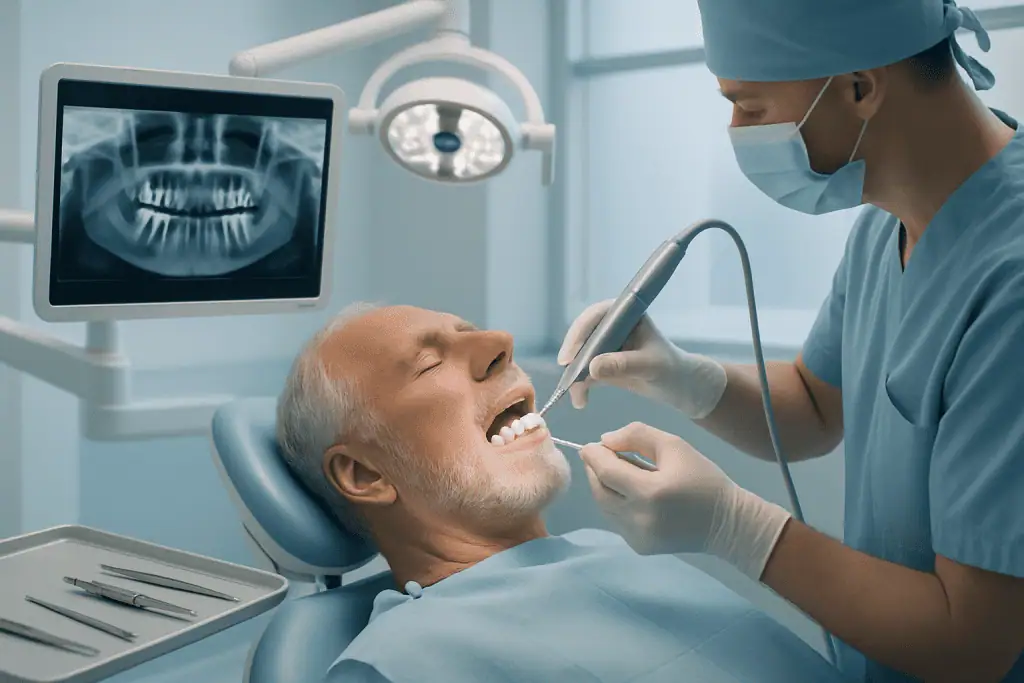
All on 4 in Turkey is one of the most commonly researched dental treatments among adults in the United Kingdom who have lost most or all of their teeth and want a fixed alternative to removable dentures. The technique places four implants in the jaw and attaches a fixed temporary prosthesis to them, so that a full arch of teeth is supported without an implant for every missing tooth. This guide explains who the treatment suits, how All-on-4 compares with All-on-6, what the two-visit timeline typically looks like, how recovery unfolds, and how the pathway in a Turkish hospital differs from the one you may be offered at home.
It is written for people weighing up full mouth dental implants in Turkey with a cautious eye: what the procedure involves, what can go wrong, and what questions to ask before committing. Nothing here replaces an examination by your own dentist or a formal clinical assessment, and the verified price band appears beneath these sections in the Price Index.
What All-on-4 is and who it suits
All-on-4 is a full-arch dental implant technique. Instead of replacing each tooth with its own implant, the surgeon places four implants in the upper or lower jaw and fixes a temporary full-arch prosthesis to them. The prosthesis is not removed at night and is designed to restore both chewing function and appearance while the implants integrate with the bone. A final prosthesis is planned once healing is complete.
Who is usually a candidate
- Adults who have lost most or all of the teeth in one or both jaws.
- People whose remaining teeth are failing and cannot reasonably be saved.
- Long-term denture wearers who find their dentures loose, uncomfortable or limiting.
- Patients in reasonably good general health who can undergo a surgical procedure under local anaesthesia.
Who may not be suitable
Some conditions make the treatment less predictable or unsafe. Active gum infection or other untreated oral health problems generally need to be addressed first. Medical history matters too: uncontrolled diabetes, certain medications that affect bone or healing, and heavy smoking can all affect whether implants integrate successfully. Smoking status is specifically reviewed during planning for this reason. People with insufficient bone may need a different plan or an alternative approach, which is why panoramic X-ray or 3D imaging is part of the assessment.
Candidacy is not a tick-box exercise. The dental examination, imaging and bite assessment are carried out to decide whether four implants per arch is the right design for your jaw, and the outcome of that review may be a different recommendation altogether. A good pathway is one in which “not suitable” or “not yet” remains a possible answer.
Why patients from the UK and the US travel to Türkiye for full-arch implants
Full mouth dental implants in Turkey are usually sought for three practical reasons: access, setting and coordination. In the UK, implant-based full-arch treatment is almost always self-funded and often involves a long sequence of appointments spread over many months. In the US, the same treatment can be difficult to fit into dental insurance limits. Patients therefore look abroad for a pathway that can be planned around a fixed period of travel.
Hospital medicine rather than a standalone clinic
The distinction that matters most is where the treatment happens. Within the Acıbadem network, All-on-4 is performed in hospital-based dental departments, not in an isolated cosmetic clinic. The network includes 7 JCI-accredited hospitals within a group of more than 20 hospitals, with over 3,300 physicians across specialties. In practice this means anaesthesia services, intensive care, laboratory medicine and advanced imaging are on the same site as the dental team. For a surgical procedure in patients who may have other medical conditions, that back-up changes the risk profile even when the treatment itself is done under local anaesthesia.
Experience with international patients
Hospitals such as Acibadem Maslak Hospital have established international patient departments that handle medical records, interpretation, scheduling and coordination between the surgeon, the prosthodontic team and the laboratory. English-speaking coordinators are the norm rather than the exception.
No waiting list
Because the pathway begins with a remote medical review and is then scheduled around your travel dates, there is no waiting list in the sense familiar to NHS patients. Timing is dictated by clinical readiness and the healing period between visits, not by queue position.
How All-on-4 works with Acıbadem, step by step
The pathway is designed so that the clinical decisions are made before you travel, and the visits in Istanbul are used for treatment and review rather than for discovering surprises.
- Remote medical review. You share recent dental records, any X-rays or scans you already have, a list of medications and allergies, your medical history and your smoking status. A dentist reviews these and indicates whether All-on-4 appears appropriate or whether an alternative such as All-on-6 or a different design should be considered.
- Personal plan and quote. Once the review is complete, you receive a provisional treatment plan describing the proposed approach, the expected number of visits and the anticipated timeline. A personal quote follows this free medical review; the general price band is shown beneath these sections.
- Arrival and coordinator. On arrival in Istanbul, a coordinator from the international patient department meets you and manages appointments, transport between hotel and hospital and interpretation where needed.
- Consultation and pre-operative tests. The in-person dental examination, panoramic X-ray or 3D imaging and bite assessment are carried out to confirm and finalise implant positions. Any active gum infection or other oral problem identified at this stage may need treatment first.
- The treatment. Implants are placed under local anaesthesia, typically 2 to 4 hours per arch, and the fixed temporary prosthesis is attached. There is no overnight stay.
- Recovery in Istanbul. You remain nearby for the initial healing period so that the surgical team can check swelling, bite and comfort before you fly home.
- Follow-up after returning home. Remote check-ins continue, and the second visit for the final prosthesis is planned once implant integration is confirmed, usually after 3 to 6 months.
The procedure: All-on-4 dental implants in Turkey and how All-on-6 differs
All-on-4 is a surgical procedure performed under local anaesthesia. Four implants are placed in the jaw in positions chosen from the imaging and bite assessment, and a fixed temporary full-arch prosthesis is secured to them. Treating one arch takes around 2 to 4 hours; if both arches are treated, the total time is correspondingly longer and is planned in advance with the surgeon. No overnight stay is required, and you return to your accommodation the same day.
Anaesthesia and comfort
Local anaesthesia numbs the treatment area while you remain awake. Because the procedure is carried out in a hospital, anaesthesiology services are available on site should the clinical team decide they are needed for a particular patient. Any additional sedation or anaesthesia is a clinical decision made during planning and is not part of the standard description of the procedure.
All-on-4 versus All-on-6
All-on-6 follows the same principle but uses six implants per arch rather than four. The choice between them is made by the treating team on the basis of bone quality and quantity, jaw anatomy, bite forces and the design of the prosthesis. Neither is universally superior; the number of implants is a means to a stable, well-distributed support for the arch, and the right number is the one the imaging supports. If you have been quoted All-on-6 at home and All-on-4 abroad, or the reverse, ask each team to explain the anatomical reasoning rather than treating it as a matter of preference.
The two-visit structure
Most patients complete treatment over two visits: the first for implant placement and the temporary prosthesis, the second for the final prosthesis after the 3 to 6 month integration period. Your plan confirms whether this applies to you.
Recovery and aftercare timeline
Recovery has two distinct phases: the initial surgical healing and the longer period during which the implants integrate with the bone. Understanding both helps you plan travel realistically.
The first few days
Mild swelling, bruising and discomfort are common and are managed with prescribed medication and cold compresses. Most patients find that initial healing settles over 3 to 7 days. During this time the surgical team reviews you before you are cleared to fly.
The first weeks
- A soft-food diet is usually followed while the implants heal; the temporary prosthesis is fixed but is not designed for hard or sticky foods in this period.
- Careful oral hygiene around the prosthesis and gums is essential, and you are shown how to clean effectively before you leave.
- Smoking is discouraged because of its effect on healing.
Three to six months
Full implant integration takes 3 to 6 months. Follow-up visits are needed to monitor healing and to plan the final prosthesis. Some of this monitoring can be done remotely with photographs and, where appropriate, imaging arranged locally; the second in-person visit is then scheduled for fitting the final prosthesis once integration is confirmed.
What to report promptly
Persistent or worsening pain, swelling that increases after the first few days, bleeding that does not settle, a loose or fractured prosthesis, fever, or numbness that does not resolve should all be reported to the treating team without delay, and to your own dentist or GP if you are already home. Early contact allows problems to be assessed while they are still simple to manage.
What it costs: UK, US and Türkiye
Typical self-pay ranges from the Turkey Medical Price Index. Türkiye figures are guide ranges for hospital treatment; your personal quote follows a free medical review.
Source: Turkey Medical Price Index (quarterly edition). Ranges depend on the extent of treatment, materials and hospital stay; they are not a quote.
Safety and risks
All-on-4 is an established surgical treatment, but it is surgery, and honest planning includes an honest account of what can go wrong.
Who is not suitable
Patients with active gum infection, untreated oral disease, insufficient bone that cannot be addressed, poorly controlled systemic conditions or medications that impair bone healing may be advised against the procedure or towards a different plan. Heavy smokers are counselled specifically because smoking affects integration.
Complications
- Infection at the implant site.
- Failure of one or more implants to integrate, which may require removal and, after healing, a revised plan.
- Bleeding, swelling or bruising beyond the expected range.
- Nerve irritation or altered sensation, particularly in the lower jaw.
- Sinus involvement in the upper jaw.
- Fracture or loosening of the temporary prosthesis before the final one is fitted.
- Longer-term bone loss around implants if hygiene and follow-up are neglected.
What cases that go wrong abroad tend to share
Reports of poor outcomes after dental treatment abroad rarely turn on a single technical error. They usually share a pattern: planning compressed into a day or two on arrival with no prior review of records; treatment performed in a setting without medical back-up when a patient had an unrecognised medical risk; and no structured follow-up once the patient flew home, so that early problems were discovered late.
How a hospital setting changes that
A hospital pathway addresses each of these points directly. The remote review happens before travel, so unsuitable candidates are identified early. Imaging, laboratory tests and anaesthesia services are on site if a patient’s medical situation requires them. Follow-up is scheduled as part of the plan rather than left to chance. None of this removes risk, but it changes how risk is anticipated and managed, which is the realistic goal of any surgical pathway.
UK and US vs Türkiye: how the All-on-4 pathway and cost compare
Many readers arrive at this page asking about All on 4 Turkey cost. The verified UK, US and Türkiye figures are shown in the price band below, drawn from the Price Index, so this section deals with what those figures mean and how to compare fairly.
How the pathway differs
In the UK, full-arch implant treatment is almost never available on the NHS and is therefore self-funded in private practice, often across many appointments over a year or more. In the US, dental insurance rarely covers the full course, and patients frequently self-fund as well. In Türkiye the treatment is also self-funded, but the two-visit structure is planned around travel, and consultation, imaging, surgery and laboratory work are coordinated within a single hospital network rather than across separate providers.
What the lower cost does and does not mean
The difference in price reflects lower salaries, lower property and staffing overheads and a different cost of living. It does not, in a hospital setting, reflect different materials: implant systems and prosthetic components come from the same international manufacturers used in the UK and the US, and you should be told which system is proposed for you. A lower figure is not evidence of lower quality, but neither is it evidence of quality; the setting, the planning and the follow-up are what to examine.
What to compare like for like
- Number of arches and number of implants per arch.
- Whether the temporary and final prostheses are both included.
- The implant system and prosthesis materials named in writing.
- Imaging, consultations and follow-up visits included in the plan.
- Travel, accommodation and time away from work for two visits.
- How complications and remedial work are handled.
Planning the trip to Istanbul
The practical side of All-on-4 in Turkey is straightforward once the treatment plan is fixed, but it rewards early preparation.
Passport and entry
UK, Irish, US, Canadian and Australian passport holders can currently enter Türkiye visa-free for up to 90 days. Rules can change, so check the current requirements before booking. Your passport should be valid well beyond your planned dates.
Getting there
Istanbul is roughly 4 hours by air from London and around 10 hours from New York, with frequent direct flights. Your coordinator can advise on arrival times that fit your first appointment.
How long to stay
For the first visit, plan to remain in Istanbul through the initial healing period of 3 to 7 days so that the surgical team can review you before you fly. The second visit, for the final prosthesis, is usually shorter; its length depends on your plan and is confirmed in advance. Building in a day or two of flexibility is sensible.
Companion
A companion is not clinically required for a procedure under local anaesthesia, but many patients appreciate support in the first days when eating is restricted and swelling is at its peak.
Travel insurance
Standard travel insurance usually excludes planned medical treatment and its complications. Look for a policy that specifically covers elective treatment abroad, and read the exclusions carefully.
What to bring
- Existing dental records, X-rays or scans.
- A current list of medications, allergies and medical conditions.
- Contact details for your GP and dentist at home.
- Soft, easy foods for the first days, or knowledge of where to buy them.
- Comfortable clothing and anything that makes rest easier.
Back home: follow-up, records and when to seek help
Treatment does not finish when you land. The months between the first and second visit are when integration happens, and they need active attention from you and from the clinicians at home and in Istanbul.
Follow-up with your GP or own dentist
Tell your own dentist that you have had implants placed abroad and share the discharge summary, implant details and imaging. Most dentists are willing to keep an eye on healing even if they did not perform the surgery, and having the records makes that far easier. Keep your scheduled remote check-ins with the treating team and report anything unexpected.
When to seek help
Contact the treating team and your own dentist if you notice increasing pain or swelling after the first week, bleeding, a loose or fractured prosthesis, fever, or persistent numbness. If you develop signs of a spreading infection, difficulty breathing or swallowing, or severe uncontrolled pain, seek urgent care where you are; do not wait for a remote appointment.
Insurance, NHS and your own doctor
Private medical insurance in the UK rarely covers elective treatment abroad, and dental cover is usually limited. The NHS treats complications from treatment abroad as it would any other patient who presents unwell, but it does not fund remedial cosmetic or restorative work; check with your provider before you travel so that expectations are clear. For US readers, HSA and FSA eligibility for dental treatment abroad and the terms of travel-medical policies vary considerably, so confirm the position with your plan administrator in writing. Whatever your funding arrangement, your own doctor and dentist remain part of your care and should be kept informed.
Questions to ask before deciding on All-on-4 or All-on-6
A calm decision is easier with a written list. Ask these questions of any provider, at home or abroad, and compare the answers side by side.
About the plan
- Why is All-on-4 rather than All-on-6, or another design, proposed for my jaw, and what in my imaging supports that?
- Which implant system and which prosthesis materials are proposed, and can that be confirmed in writing?
- Do I need any treatment for gum infection or other problems before the implants can be placed?
- How many visits are expected, how long is each, and what happens at each one?
About the setting and the team
- Is the treatment performed in a hospital with anaesthesia, imaging and emergency services on site?
- Who places the implants and who designs the prosthesis, and how do they communicate with each other?
- How is my medical history reviewed, and by whom, before I travel?
About aftercare
- How is follow-up handled between visits, and who do I contact if something feels wrong?
- What happens if an implant fails to integrate or the temporary prosthesis breaks?
- What records do I receive to share with my own dentist and GP?
- What is included in the quote, and what would fall outside it?
Written answers to these questions form the basis of a fair comparison between providers and give your own dentist something concrete to comment on. Suitability for All-on-4 or All-on-6 is determined by a physician’s evaluation.
What is All-on-4 and how is it different from ordinary dental implants?
All-on-4 replaces a full arch of teeth using four implants that support one fixed temporary prosthesis, rather than placing an individual implant for each missing tooth. It is intended for people who have lost most or all of the teeth in a jaw. A final prosthesis is planned once the implants have integrated with the bone.
Is All-on-4 in Turkey done under general anaesthesia?
The standard procedure is performed under local anaesthesia, so you are awake but the treatment area is numbed. Because it takes place in a hospital, anaesthesiology services are available on site if the clinical team decides a particular patient needs more than local anaesthesia. Any such decision is made during planning and discussed with you.
How long does All-on-4 take and do I stay in hospital overnight?
Treating one arch typically takes 2 to 4 hours, and both arches take correspondingly longer. There is no overnight stay; you return to your accommodation the same day. You are asked to remain in Istanbul for the initial healing period of 3 to 7 days so the team can review you before you fly.
Should I choose All-on-4 or All-on-6 in Turkey?
The number of implants is chosen from your imaging, bone quality and bite, not from preference. All-on-6 uses six implants per arch and may be recommended where the surgeon judges that additional support is appropriate. Ask any provider to explain the anatomical reasoning behind their recommendation, and expect that reasoning to be consistent with your scans.
How many trips to Turkey does full-arch implant treatment need?
Most patients make two visits. The first covers examination, imaging, implant placement and the fixed temporary prosthesis, followed by 3 to 7 days of initial healing before flying. The second, after the 3 to 6 month integration period, is for fitting the final prosthesis. Your personal plan confirms whether this structure applies to you.
What does All-on-4 in Turkey cost compared with the UK?
Verified UK, US and Türkiye figures are shown in the price band beneath this article, drawn from the Price Index. The difference reflects lower salaries and overheads rather than different implant systems or materials. A personal quote is provided after a free remote medical review of your records and imaging.
What are the main risks of All-on-4 dental implants?
Risks include infection, failure of an implant to integrate, bleeding, swelling, altered sensation in the jaw, sinus involvement in the upper jaw and damage to the temporary prosthesis. Active gum disease, uncontrolled medical conditions and smoking increase these risks. Planning before travel, treatment in a hospital setting and structured follow-up are how those risks are anticipated and managed.
Will my NHS dentist or GP look after me when I get home?
The NHS treats complications as it would for any patient who presents unwell, but it does not fund remedial restorative work after private treatment abroad. Share your discharge summary, implant details and imaging with your own dentist so they can monitor healing. Keep your remote check-ins with the treating team and report any concerns to both.
Your care team
Physicians of the Acıbadem network who perform this treatment in Istanbul.
 Where it is performed Acibadem Maslak Hospital İstanbul · JCI-accredited hospitals

Clinical guide & data
The evidence-based pages behind this guide.
Read this treatment guide in your language
Planning tools for this treatment
Indicative figures for orientation only: your written plan and quote follow a free medical review.