

Best Exercises for Posture: Undoing the Desk, One Rep at a Time
Key Takeaways
- An adult head weighs about 10 to 11 pounds, and every inch it drifts forward of the shoulders forces neck muscles to work against a longer lever all day.
- Small controlled studies show six to eight weeks of scapular strengthening plus chest stretching measurably reduces rounded-shoulder and forward-head posture, one week does not.
- Stretching alone doesn't durably change posture; the programs that worked paired stretches like the doorway pec stretch with pulling exercises such as rows.
- The chin tuck trains the deep neck flexors in under two minutes and works best done in short sets scattered through the workday rather than one long session.
- There is no single 'perfect' sitting position, clinicians increasingly emphasize changing positions roughly every 30 minutes over holding any one alignment.
- Posture strength work done two to three days a week also fulfills the American Heart Association's recommendation for muscle-strengthening activity on at least two days weekly.
The best exercises for posture strengthen the muscles a desk lets go quiet: chin tucks for the deep neck, rows and band pull-aparts for the upper back, planks and dead bugs for the core, and glute bridges for the hips, paired with doorway and hip flexor stretches. Small studies suggest practicing most days for six to eight weeks produces measurable change; a single session will not.
There’s a particular moment most office workers know: you catch your own thumbnail on a video call at 3 p.m. and barely recognize the silhouette. Head craned toward the screen, shoulders curled like parentheses, chin leading the way. You sit up instantly. By 3:04, you’ve melted back down.
That reflex, straighten, forget, slump, is exactly why willpower alone doesn’t fix posture. Your body isn’t being lazy. It’s being efficient, settling into whatever shape you feed it for eight hours a day. Muscles adapt to the demands placed on them, and a chair makes very few demands.
The good news hides in the same principle. Tissue that adapted into a slouch can adapt out of one, provided you give it a reason. Here’s what the research actually supports, which movements earn their reputation, and an honest timeline, because no, it doesn’t happen in a week.
What eight hours in a chair actually does to your body
Sitting isn’t dangerous the way a fall is dangerous. It’s persuasive. Hold any position long enough and your soft tissue starts treating it as the default. In a chair, that means hip flexors resting in a shortened range, glutes pressed flat and largely silent, chest muscles drawn inward as your hands reach for a keyboard, and the muscles between your shoulder blades held on a long, low-grade stretch.
Then there’s your head. An adult head weighs roughly 10 to 11 pounds, about a bowling ball. Balanced directly over the spine, that load is easy to carry. Drift it forward an inch or two toward a monitor and the muscles along the back of your neck must work continuously against a longer lever, like holding that bowling ball at arm’s length instead of against your chest. That end-of-day ache between the shoulder blades is often just those muscles clocking overtime.
Here’s the part worth underlining: in an otherwise healthy spine, none of this is permanent damage. It’s adaptation, stiff where you never move, weak where you never load. The National Library of Medicine’s plain-language guidance on posture describes it as a habit of muscles and joints, not a fixed structure. Habits, unlike fractures, respond to training. The rest of this article is essentially a plan for out-arguing your chair.
Does posture really matter? The honest evidence
Let’s clear the air before the exercises, because posture writing is thick with exaggeration. The research linking a specific sitting shape to back pain is weaker than most headlines suggest. Plenty of people slouch comfortably for decades; plenty of people with textbook alignment still hurt. There is no single “perfect” posture that guarantees a pain-free spine, and reputable sources, Harvard Health among them, are increasingly candid about that.
So why bother? Three reasons the evidence does support.
- Sustained positions cause discomfort. Whatever the shape, holding it for hours fatigues the tissues doing the holding. Forward-head and rounded-shoulder positions are consistently associated with neck and shoulder complaints in desk workers.
- Strength and mobility work helps. Small controlled studies show that six to eight weeks of scapular strengthening and chest stretching measurably reduces rounded-shoulder and forward-head positioning. The exercises work even when the “posture causes pain” story is oversimplified.
- Stiffness compounds. A mid-back that never extends pushes the neck and lower back to compensate, and posture tends to become less flexible with age: Harvard notes that age-related muscle loss and stiffening make the slouch harder to reverse the longer it’s rehearsed.
The honest framing: posture exercises won’t cure anything, and they don’t need to. They build capacity: a body strong and mobile enough that no single position, including slouching, gets to run the show.
What are four signs of poor posture?
You don’t need a clinic to spot the pattern. Have someone photograph you from the side while you stand naturally, not posed, just how you’d wait for coffee, and look for these four markers.
- Forward head. Your ear canal should sit roughly over the middle of your shoulder. If your ear is clearly ahead of it, your neck muscles are carrying that bowling ball on a lever all day.
- Rounded shoulders. Stand relaxed with arms at your sides. If your palms face backward instead of toward your thighs, your shoulders have rotated inward: a classic keyboard adaptation.
- A changed lower-back curve. The lumbar spine should have a gentle inward curve. An exaggerated arch with the pelvis tipped forward, or a flattened, tucked-under look, both signal that hips and core have stopped sharing the load.
- Asymmetry. One shoulder or hip riding visibly higher than the other, or a head that tilts habitually to one side. Mild unevenness is common and usually harmless; a pronounced or new asymmetry is worth a professional look, especially in adolescents.
A quick self-test: stand with your heels, buttocks, and upper back against a wall. If touching the back of your head to the wall requires tilting your chin toward the ceiling, your head has migrated forward. Note how far: it becomes a useful progress marker over the coming weeks.
The chin tuck: the smallest exercise with the biggest payoff
If you learn one movement from this article, make it this one. The chin tuck targets the deep neck flexors, small muscles along the front of the cervical spine that act like guy-wires keeping your head stacked over your shoulders. Hours of screen time let them go slack while the bigger muscles at the back of the neck grind away, and research on desk workers with neck discomfort consistently features deep neck flexor training in the programs that helped.
The technique is subtle, which is why people get it wrong. Sit or stand tall. Without tilting your head up or down, glide it straight back, as if making a gentle double chin. Imagine your head sliding backward on a rail, not nodding. You should feel a mild stretch at the base of the skull and light effort at the front of the throat.
Hold five seconds. Repeat eight to ten times. That’s one set, and it takes under two minutes.
Two coaching notes. First, gentle wins: this is a postural endurance muscle, not a bicep, and straining defeats the purpose. Second, frequency beats intensity: three short sets scattered through the workday outperform one heroic session, because each set also interrupts the forward drift you’d otherwise hold for hours. Tie it to a trigger, every time you send an email, or at the top of each hour, and it becomes automatic within weeks.
Wall angels: a lie detector for stiff shoulders
Wall angels look easy in videos and humble almost everyone on the first attempt. That’s precisely their value: the exercise doubles as an assessment, exposing exactly where your shoulders and mid-back have stiffened.
Stand with your back against a wall, feet a few inches out, lower back gently in contact. Press the back of your head to the wall (chin level: that chin tuck again). Raise your arms into a goalpost shape, elbows bent to 90 degrees, and try to keep wrists, elbows, and head touching the wall. Now slide your arms slowly up toward a Y and back down, without anything peeling away and without your ribs flaring off the wall.
Most desk workers discover their wrists hover an inch or more off the surface, or their lower back arches dramatically to compensate. Don’t force it. Work within the range where contact is honest, and let the range grow.
What’s happening under the hood: the movement stretches the chest and lat muscles that have shortened, while asking the lower trapezius, a key shoulder-blade stabilizer that sitting puts to sleep, to work through its full range. Two or three sets of eight slow reps, a few times a week, is plenty. Your progress metric is simple and satisfying: how much of your arm touches the wall this month versus last.
Rows and band pull-aparts: strengthen what the desk weakens
Stretching a rounded shoulder open feels good for about twenty minutes. Making it stay open requires strength in the muscles that pull the shoulder blades back and down: the rhomboids and middle and lower trapezius. This is where rows come in, and it’s why nearly every credible posture program is built around pulling movements.
The logic is a simple audit. Daily life at a desk is dominated by reaching forward: typing, mousing, phone-scrolling, driving. Almost nothing in a modern day asks you to pull. Rows restore the balance sheet.
- Band pull-aparts. Hold a light resistance band at shoulder height, arms extended. Pull it apart until it touches your chest, squeezing the shoulder blades together, then return with control. Ten to fifteen slow reps.
- Seated or bent-over rows. With a band anchored in front of you or a light weight in hand, pull your elbows back past your ribs, blades gliding toward each other. Think “put your shoulder blades in your back pockets”, down and back, not shrugged toward your ears.
Two or three sessions a week fits neatly inside the American Heart Association’s recommendation of muscle-strengthening activity on at least two days weekly, so this work pays a cardiovascular-health dividend on top of the postural one. Expect the first change within a month, not a new silhouette yet, but rows of stairs and grocery bags feeling noticeably lighter across the upper back.
The doorway stretch: open the front so the back can work
Here’s a mechanical truth that saves people months of frustration: you cannot strengthen your upper back into a position your chest won’t allow. When the pectoral muscles adaptively shorten from years of forward reaching, they act like a too-tight jacket zipped across your front. The rhomboids can pull all they like; the jacket wins.
The doorway stretch unzips it. Stand in a doorway and place your forearm against the frame, elbow bent at 90 degrees and positioned at shoulder height. Step forward gently with the same-side foot until you feel a stretch across your chest and the front of your shoulder: a clear pull, never a pinch or tingling. Hold about 30 seconds, then switch sides. Raising or lowering the elbow slightly shifts which fibers of the chest get the stretch, so vary the angle across sets.
Two rounds per side, once or twice a day, is a realistic dose. The best timing is right before your rowing or wall-angel work: stretch the front, then immediately strengthen the back, so your nervous system practices using the new range rather than just visiting it.
A note on expectations, because the evidence is clear on this point: stretching alone does not durably change posture. Studies that moved the needle on rounded shoulders paired chest stretching with scapular strengthening. Think of the doorway stretch as opening the door: the rows are what walk through it.
Dead bugs and planks: the core's quiet contribution
Posture problems get blamed on the neck and shoulders because that’s where they’re visible. But your ribcage sits on your spine like a lampshade on a stand, and the muscles that keep it stacked over your pelvis are the deep core, not the six-pack you crunch into existence, but the endurance layer underneath. When that layer fatigues, the whole tower sags, and the neck simply follows the ribcage down.
Two exercises train it without wrecking your lower back.
- Dead bug. Lie on your back, arms reaching toward the ceiling, hips and knees bent to 90 degrees. Slowly lower your right arm overhead and extend your left leg toward the floor, while keeping your lower back gently pressed down, ribs heavy. Return and switch. If your back arches off the floor, shorten the range. Eight slow reps per side.
- Front plank. Forearms down, body in one line from ears to ankles, glutes and abs lightly braced. The goal is quality time, not record time: three holds of 20 to 30 seconds with perfect alignment beat a single trembling two-minute effort, because posture is an endurance event.
The carryover shows up in odd places first. People notice they can sit through a long meeting without progressively wilting, or that standing in line no longer means shifting weight hip to hip every minute. That’s core endurance doing its unglamorous job.
Glute bridges: waking up the muscles you sit on
Your glutes have an ironic occupational hazard: the more you sit on them, the less they participate in anything. Hours of compression and inactivity teach these powerful hip extenders to defer to the lower back and hamstrings, and a pelvis without engaged glutes tends to tip forward, dragging the lumbar spine into an exaggerated arch, or slumping the other way entirely.
The glute bridge is the re-hiring interview. Lie on your back, knees bent, feet flat and hip-width apart, heels close enough to graze with your fingertips. Press through your heels and lift your hips until your body forms a straight line from knees to shoulders. Squeeze the glutes deliberately at the top for two full seconds, this pause is the entire point, then lower with control. Ten to twelve reps, two or three sets.
Common faults are worth naming because they’re nearly universal. Arching the lower back to gain height (keep ribs down; the lift should come from the hips), pushing through the toes (drives the hamstrings instead), and rushing (momentum lets the glutes keep loafing).
Once twelve slow reps feel easy, progress to single-leg bridges, same setup, one knee hugged toward the chest. The single-leg version also exposes side-to-side differences, which is useful intelligence: an asymmetry you can see is an asymmetry you can train, and evening it out often quietly improves that uneven-hips finding from your posture photo.
Thoracic extension: unlocking the stiff middle back
The thoracic spine, the twelve vertebrae behind your ribcage, is the region a chair stiffens most and posture advice mentions least. That’s a costly omission. When the mid-back loses its ability to extend, the body still finds a way to look up at a monitor: it hinges at the neck and cranks the lower back. Much of what people experience as a neck problem is a middle-back problem wearing a disguise.
Two drills restore the motion.
- Foam roller extension. Lie with a foam roller horizontally under your mid-back (shoulder-blade level, never the lower back or neck), hands supporting your head, knees bent. Gently arch backward over the roller, exhale, hold two or three seconds, return. Move the roller an inch and repeat, covering the mid-back in five or six positions. It should feel like a satisfying stretch, not a crunch.
- Cat-cow. On hands and knees, alternate slowly between rounding the spine toward the ceiling and letting it sink into an arch, leading each direction with the breastbone. Eight to ten unhurried cycles make an ideal warm-up before wall angels or rows.
People often feel this one immediately: a sense of standing an inch taller afterward. That sensation is temporary, but it’s an honest preview: it demonstrates the extension range your spine already owns and your habits have simply stopped using. The strengthening work is what makes the preview permanent.
Hip flexor stretches: undoing the chair from the hips down
Everything above the waist gets the posture headlines, but the chair does some of its most stubborn work at the front of your hips. The hip flexors, chiefly the iliopsoas, running from the lumbar spine across the pelvis to the thigh, spend every seated hour in a shortened position. Adaptively tight hip flexors then tug the pelvis into a forward tilt when you stand, which exaggerates the lower-back arch and forces the spine above it to compensate. Fix the shoulders while ignoring the hips and you’re painting over a crooked wall.
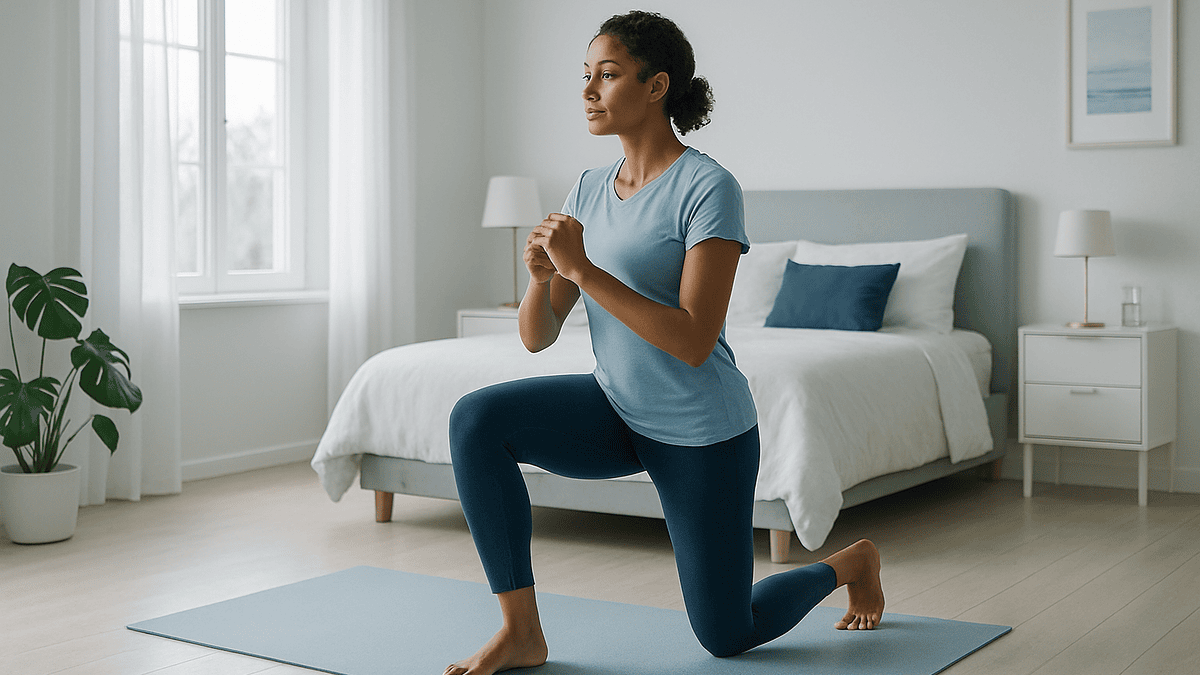
The half-kneeling stretch is the gold standard because it’s hard to cheat. Kneel on one knee (a folded towel underneath helps), the other foot planted in front, both knees at roughly 90 degrees. Now the two details that make or break it: tuck your pelvis slightly under, as if starting to tip your belt buckle toward your chin, and squeeze the glute on the kneeling side. Then shift your weight gently forward an inch or two. Done correctly, a clear stretch blooms across the front of the kneeling-side hip, with almost no visible movement.
If you feel it in your lower back instead, you’ve arched rather than stretched; reset the pelvic tuck. Hold 30 seconds, twice per side, daily if you sit for a living. Pair it with the glute bridges above, one lengthens the front of the hip, the other strengthens the back of it, and posture is always a two-party negotiation.
A realistic weekly posture routine
Programs fail from ambition more often than laziness. A 45-minute posture workout gets skipped by Thursday; a 12-minute one survives the month. The routine below covers every pattern discussed here and fits inside a lunch break, and its total strength volume satisfies the AHA’s two-days-per-week muscle-strengthening guidance along the way.
| Exercise | How much | How often | What it targets |
|---|---|---|---|
| Chin tucks | 8–10 reps, 5-second holds | 2–3 short sets daily | Deep neck flexors, forward head |
| Doorway stretch | 30 seconds per side, 2 rounds | Daily | Shortened chest muscles |
| Band pull-aparts | 2–3 sets of 10–15 | 3 days/week | Rear shoulders, mid-back |
| Rows | 2–3 sets of 10–12 | 2–3 days/week | Rhomboids, mid/lower traps |
| Wall angels | 2 sets of 8 slow reps | 3 days/week | Shoulder mobility, lower traps |
| Dead bugs | 2 sets of 8 per side | 3 days/week | Deep core endurance |
| Glute bridges | 2–3 sets of 10–12 | 3 days/week | Glutes, pelvic position |
| Foam roller extension | 5–6 positions, 3 breaths each | Daily or as needed | Thoracic mobility |
| Half-kneeling hip stretch | 30 seconds per side, twice | Daily | Hip flexors, pelvic tilt |
Sequence matters slightly: mobility first (roller, doorway, hip stretch), strength second (rows, pull-aparts, bridges, dead bugs), so you load the range you just opened. Mark completed sessions on a calendar, at six weeks, retake that side-view photo and compare. The camera is more honest than the mirror.
Can you correct years of bad posture, and can you do it in 7 days?
Take the second question first, because the internet keeps promising it: no, you cannot meaningfully correct posture in seven days. Muscle strengthens on a timeline of weeks: the earliest gains, in the first two to four weeks, are mostly your nervous system learning to recruit muscle more efficiently, with genuine tissue change following after. Shortened muscles lengthen gradually with consistent stretching. What a week can deliver is real and worth having: sharply improved awareness, less end-of-day stiffness from the mobility drills, and a habit loop taking root. That’s a foundation, not a fix.
Now the bigger question. Years of slouching are substantially correctable in most healthy adults, and that’s not optimism: the small trials on rounded-shoulder and forward-head posture recruited people who’d held those patterns for years, and six-to-eight-week programs still produced measurable improvement. Muscle and connective tissue remain adaptable across the lifespan.
Honesty requires the caveats, too. Some structural changes don’t fully reverse with exercise: a fixed increase in mid-back curvature, spinal changes related to bone loss in older adults, or developmental conditions affecting vertebral shape. In those cases exercise still earns its keep, improving strength, mobility, comfort, and slowing progression, but the goal shifts from “undo” to “optimize.” If your rounding feels rigid rather than merely habitual, or worsened noticeably over a short period, that’s a conversation for a clinician, not a foam roller.
Reasonable expectations: feel different at two weeks, measure differently at six to eight, and look different in photos around three months.
Why the best posture is the next posture
Here’s the mindset shift that separates people who improve from people who buy another ergonomic gadget: stop hunting for the perfect position and start changing positions more often. Clinicians increasingly summarize it in five words: the best posture is the next posture. Even ideal alignment becomes uncomfortable when held for two unbroken hours, because tissue health depends on movement and variety, not statues.
Practical translation for a desk day:
- Break the hold every 30 minutes or so. Stand, roll your shoulders, walk to refill water. Thirty seconds is enough to reset the clock; the goal is interrupting the position, not exercising.
- Make your setup stop fighting you. Mayo Clinic’s ergonomics guidance is refreshingly simple: monitor top at or slightly below eye level about an arm’s length away, elbows near 90 degrees, feet flat, chair supporting the lower-back curve. A screen six inches too low will out-argue any exercise program, because it applies its argument eight hours a day.
- Attach micro-drills to existing habits. Chin tucks while the kettle boils. A doorway stretch every time you pass an actual doorway. Habit-stacking beats scheduling for exercises this small.
- Vary the sitting itself. Perch forward, sit back, cross ankles, uncross them. Fidgeting, it turns out, was never the character flaw teachers claimed.
The exercises build the capacity; movement variety spends it wisely. You need both: a strong upper back that still holds one position all day will ache like a weak one.
When to see a doctor about your posture
Most desk-born slouching is a training problem, not a medical one. But some signals mean you should put the resistance band down and book an appointment first.
- Pain that persists or worsens despite several weeks of sensible exercise and activity changes, or pain that wakes you from sleep.
- Numbness, tingling, or weakness radiating into the arms or legs: these suggest nerve involvement, which deserves evaluation rather than stretching.
- A sudden or rapidly progressing change in posture, especially new rounding of the upper back in an older adult, which can accompany bone-density changes in the spine.
- Pronounced asymmetryone shoulder, shoulder blade, or hip sitting clearly higher, particularly in children and adolescents, where curvature of the spine is typically screened during growth years.
- Posture changes after an injury, a fall, or a car accident, even a seemingly minor one.
- Accompanying red flags such as unexplained weight loss, fever, or loss of bladder or bowel control alongside back symptoms, seek care promptly.
None of this is cause for alarm-reading your own reflection; it’s simply triage. A clinician can rule out structural contributors, and a physical therapist can tailor the very exercises in this article to your specific pattern, often adjusting a detail or two that transforms a drill from decorative to effective. For everyone else: the wall test, the camera, the band, and six honest weeks.
Frequently asked questions
Can you correct years of bad posture?
In most healthy adults, yes, substantially. Muscle and connective tissue stay adaptable throughout life, and studies improving rounded shoulders recruited people who had held those patterns for years. Expect feel-it changes in about two weeks, measurable changes at six to eight, and visible ones around three months. The exceptions are structural: fixed spinal curvature or bone-density-related changes may not fully reverse, though exercise still improves strength, mobility, and comfort.
How can I correct my posture in 7 days?
You can’t meaningfully change posture in a week, muscle strengthens over weeks, not days, and no credible evidence supports seven-day fixes. What a week can genuinely deliver: much better awareness of your habits, less stiffness from daily mobility drills like doorway stretches and thoracic extensions, and an established routine of chin tucks and rows. Treat week one as the foundation; the measurable change arrives around weeks six to eight.
What are four signs of poor posture?
The four most common are a forward head (your ear sits ahead of your shoulder in a side-view photo), rounded shoulders (palms face backward when your arms hang relaxed), an altered lower-back curve (exaggerated arch or flattened tuck), and visible asymmetry, such as one shoulder or hip riding higher. End-of-day neck and upper-back aching often accompanies them. A quick check: standing against a wall, note whether your head touches without tilting your chin up.
How do you reverse slouching posture?
Combine three things: stretch what’s short (chest via doorway stretches, hip flexors via half-kneeling stretches), strengthen what’s weak (rows, band pull-aparts, chin tucks, glute bridges, dead bugs), and break up long static sitting every 30 minutes or so. Research suggests the stretch-plus-strengthen combination is what actually moves the needle, stretching alone feels good but doesn’t hold. Consistency over six to eight weeks matters more than any single perfect workout.
What is the single best exercise for posture?
If forced to pick one, the chin tuck: it targets the deep neck flexors that keep your head stacked over your shoulders, takes under two minutes, and can be repeated at your desk all day. For rounded shoulders specifically, rows or band pull-aparts are the strongest single choice. Realistically, posture is a whole-chain pattern, so a short routine covering neck, upper back, core, and hips outperforms any solo movement.
How long should I do posture exercises each day?
About 10 to 15 minutes covers a complete routine: mobility first (foam roller extension, doorway and hip flexor stretches), then strength (rows, wall angels, dead bugs, glute bridges) two to three days per week. Chin tucks work best as multiple two-minute sets sprinkled through the day. Frequency beats duration here, short daily doses that also interrupt long sitting are more effective than one long weekly session.
Do posture correctors and braces actually work?
The evidence is thin. A brace can increase short-term awareness by making slouching physically noticeable, but it doesn’t strengthen the muscles that hold you upright, and worn constantly, it may let those muscles do even less work. If you use one, treat it as a temporary reminder for limited periods, not a solution, and pair it with strengthening exercises like rows and chin tucks, which is where the research support actually lies.
Is bad posture causing my back pain?
Possibly, but the link is weaker than commonly claimed. Research hasn’t found one posture that reliably predicts pain, some slouchers feel fine, some upright sitters hurt. What’s better supported: holding any single position for hours fatigues tissue and causes discomfort, and forward-head positioning is associated with neck complaints in desk workers. If pain persists beyond a few weeks, radiates into limbs, or wakes you at night, see a clinician rather than self-treating.
Can posture exercises make you taller?
They can’t lengthen your bones, but they can help you reclaim height you’re currently folding away. A forward head, rounded upper back, and tilted pelvis can visibly compress your standing profile; restoring thoracic extension, core endurance, and hip position lets you stand at your actual skeletal height. Many people notice they measure or appear slightly taller after weeks of consistent work: that’s posture recovered, not new growth.
Is there a perfect way to sit at a desk?
No single position is perfect, and clinicians increasingly emphasize variety over any one alignment: the best posture is the next posture. A sensible baseline helps, though: monitor top at or slightly below eye level about an arm’s length away, elbows near 90 degrees, feet flat on the floor, and lower back supported. From that baseline, shift positions freely and stand or move briefly every 30 minutes or so.
This article is for general information only and is not a substitute for professional medical advice. Please consult a qualified doctor about your individual situation.

More from the Blog

DOMS: Why Muscles Hurt Two Days Later and What Actually Speeds Recovery
DOMS, or delayed onset muscle soreness, is muscle pain that peaks 24–72 hours after unfamiliar or intense exercise, especially movements that lengthen a muscle…

How to Do a Pull-Up: A Progression That Works for Beginners
To do a pull-up, hang from a bar with palms facing away and hands slightly wider than your shoulders, pull your shoulder blades down…

Calisthenics: How Bodyweight Training Builds Strength, and Where It Hits a Ceiling
Calisthenics builds strength by loading muscles with your own body weight and progressing through harder leverage, such as moving from incline push-ups to full…

Romanian Deadlift Form: The Hip Hinge That Protects Your Back When Done Right
A Romanian deadlift is a hip-hinge exercise: you hold a barbell or dumbbells, keep knees slightly bent and back neutral, and push your hips…

Walking Pads and Incline Walking: What Desk-Walking Does for Steps, Blood Sugar and Backs
A walking pad is a slim, low-speed treadmill built for slow walking under a standing desk. Used consistently, it adds real steps and light…

Zone 2 Cardio: The Easy-Pace Training Everyone Suddenly Swears By
Zone 2 cardio is steady, easy-pace aerobic exercise done at roughly 60 to 70 percent of your maximum heart rate: a pace where you…