

Swimming for Health: Joints, Heart, Lungs and Who Benefits Most

Key Takeaways
- Neck-deep water supports about 90 percent of body weight, which is why a 100 kg person loads a sore knee with roughly 10 kg in the pool instead of 100 kg on land.
- Randomised trials pooled by Cochrane show water-based exercise gives small to moderate short-term reductions in pain and gains in function for knee and hip osteoarthritis.
- Thirty minutes of continuous moderate swimming on five days meets the WHO adult target of 150 minutes a week, but minutes spent resting on the wall do not count.
- Swimming does not target belly fat and, in several small studies, increases post-exercise hunger more than land exercise because cool water blunts the appetite-suppressing rise in body temperature.
- Lifelong swimmers have bone density similar to sedentary adults in several studies, so two short weight-bearing sessions a week are needed to protect the hips and spine.
- The CDC recorded more than 4,500 US drowning deaths a year in 2020–2022, about 500 more than in 2019, and roughly 15 percent of American adults say they cannot swim.
Swimming benefits come from exercising in a medium that supports about 90 percent of body weight while resisting every movement. Randomised trials show water-based exercise eases pain and improves function in knee and hip osteoarthritis, and regular lap swimming improves aerobic fitness and modestly lowers blood pressure. It does not target belly fat or build bone density. People with joint pain, higher body weight, or pregnancy tend to gain the most.
At 6:40 on a weekday morning the slow lane at a public pool holds a retired plumber with two artificial hips, a nurse coming off a night shift, and a teenager rehabbing a soccer knee. None of them is training for anything. They are there because the water lets them move in ways the pavement no longer does.
That scene explains why swimming benefits are climbing the search charts as of September 2026. Three currents are pushing at once: record summer heat that makes outdoor running miserable, a wave of short videos promising that a few lengths a day will “melt” abdominal fat, and fresh World Health Organization data showing that nearly a third of adults worldwide do not move enough to protect their hearts.
The heat is real and the inactivity numbers are real. The fat-melting claim is not. This piece separates what the trials show from what the clips assert, and names who stands to gain the most from getting wet.
Why are swimming benefits trending right now?
Search interest in swimming tends to rise every summer, then fade by October. This year the curve is steeper and it has not fallen. Part of the explanation is weather. Prolonged heat waves across North America and southern Europe have pushed many habitual walkers and runners indoors or into water, where the body sheds heat far faster than it does in air. Water conducts heat roughly 25 times more efficiently than air, which is why a 27°C pool feels refreshing while 27°C air feels warm.
A second driver is social media. Clips tagged with phrases such as “swimmer’s body in 30 days” or “swim off the belly” have collected hundreds of millions of views. They often pair footage of elite athletes with before-and-after photos that have nothing to do with the pool. People watch, feel hopeful, and type their questions into a search bar.
The third driver is the one that matters most for health. In its 2024 update on physical activity, the WHO reported that about 31 percent of adults, roughly 1.8 billion people, did not meet the minimum weekly movement target in 2022, and projected that figure could reach 35 percent by 2030. Public health agencies have responded by pointing to activities that people can sustain for decades, and swimming sits near the top of that list because it is gentle on joints, cool in hot weather, and possible well into the ninth decade of life.
So the trend is a mix of a real problem, a real solution, and some marketing noise. The sections that follow keep the first two and clear away the third.
What changed recently
Nothing about water has changed. What has shifted is how clearly health authorities now describe the dose of movement that protects health, and how loudly they warn about the one serious risk that comes with it.

In November 2020 the WHO released updated physical activity guidelines recommending 150–300 minutes of moderate aerobic activity, or 75–150 minutes of vigorous activity, each week for adults, plus muscle-strengthening work on two or more days. Moderate activity means you can talk but not sing; vigorous means you can manage only a few words at a time. Those guidelines explicitly count swimming, and they dropped the old requirement that activity be done in ten-minute blocks, which means even a brisk eight-minute swim contributes.
In June 2024 the WHO published the inactivity figures cited above, and that report is what put the “sustainable exercise” conversation back into news feeds. The NHS, in its swimming guidance, frames the activity as one of the few that works the whole body while placing minimal strain on bones and joints, language that has been widely quoted this year.
The CDC added a sobering counterweight. Its May 2024 report on drowning found that more than 4,500 people in the United States died from drowning each year between 2020 and 2022, around 500 more per year than in 2019. The agency also noted that about 40 million US adults, roughly 15 percent, report they do not know how to swim, and that over half have never taken a lesson.
Put together, the recent shifts are a clearer prescription, a louder alarm about inactivity, and a reminder that the first swimming benefit anyone should pursue is the ability to swim safely at all.
What the evidence actually says about swimming benefits
Health claims deserve grades, so here is a sorting of the main ones by strength of evidence.
Strong, from randomised trials. Water-based exercise for osteoarthritis, the wear-and-tear form of joint disease, has been tested in multiple randomised controlled trials. A trial randomly assigns people to an intervention or a comparison group so that the two groups differ only by the thing being tested. A Cochrane review pooling these trials found moderate-quality evidence that aquatic exercise produces small to moderate short-term improvements in pain, physical function, and quality of life in people with knee or hip osteoarthritis. The effect is real but not dramatic, and it is best documented over about three months.
Moderate, from smaller trials. Several randomised trials in adults over 50 with raised blood pressure have found that regular swimming over 8–12 weeks lowers systolic pressure, the top number, by a clinically meaningful amount. Trials in children with asthma show swimming programs improve aerobic fitness and lung-function measurements without triggering more attacks than other sports, though the effect on everyday symptoms is inconsistent.
Observational. Cohort studies that follow large groups over years suggest swimmers have lower death rates than non-exercisers and similar or lower rates than walkers and runners. These studies cannot prove swimming caused the difference, because people who swim regularly may differ in income, diet, or baseline health.
Expert opinion or extrapolation. Claims about a specific “swimmer’s physique,” dramatic posture correction, or fat loss concentrated at the waist rest on anecdote and on general exercise physiology, not on swimming-specific trials.
The honest summary: swimming is a well-supported way to meet activity guidelines and to manage joint pain. Its heart and lung effects are credible and probably comparable to other aerobic exercise. Its body-shaping powers are mostly folklore.
How water changes the workout: buoyancy, resistance, and pressure
Three physical properties explain almost every swimming benefit, and none of them requires belief.
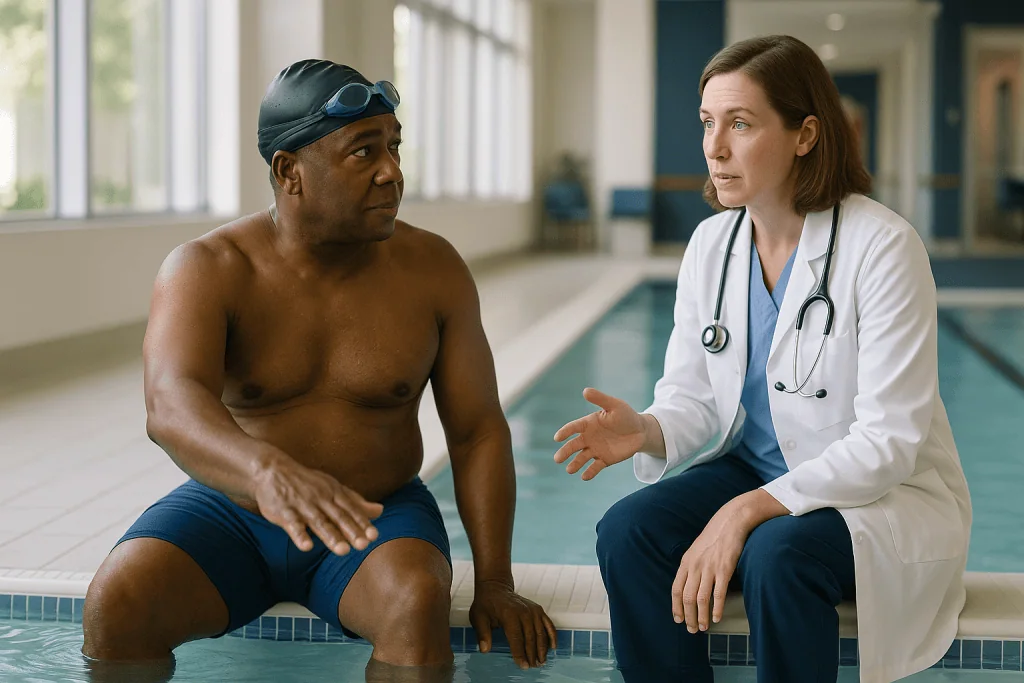
Buoyancy is the upward push that water exerts on a submerged body. Standing in chest-deep water unloads roughly 70 percent of body weight from the legs; neck-deep water removes about 90 percent. For a person who weighs 100 kg, that is the difference between landing 100 kg on a sore knee with every step and landing 10 kg. Cartilage does not have pain nerves, but the bone underneath and the surrounding ligaments do, and those tissues register the relief immediately.
Resistance works in the opposite direction. Water is about 800 times denser than air, so every arm pull and leg kick meets drag from all sides. Drag rises with the square of speed, which means swimming twice as fast demands roughly four times the force. The practical result is that water provides strength training and aerobic training in the same session, with the load automatically scaled to how hard you push. The NHS highlights this dual effect as one reason swimming works most major muscle groups at once.
Hydrostatic pressure is the squeeze of water on the body, increasing with depth. At chest depth it compresses the veins in the legs and abdomen, pushing blood toward the heart and increasing the volume pumped with each beat. This is why resting heart rate in water is typically 10–15 beats per minute lower than on land at the same effort, and why heart-rate targets from running do not transfer directly to the pool.
Horizontal posture matters too. Lying flat removes the gravitational load on the spine and lets the hips and shoulders move through fuller arcs than most people use all day at a desk. Cooling is the final piece: water pulls heat away so efficiently that overheating during moderate exercise is rare, which lets people who struggle in warm gyms work longer.
Swimming benefits for joints: arthritis, back pain, and recovery
Ask physiotherapists where they would send a patient with painful knees who still needs aerobic exercise, and the pool comes up within the first sentence. The joint case for swimming is the strongest one in the whole evidence base.
For knee and hip osteoarthritis, the randomised trials summarised above show reductions in pain and improvements in walking and stair-climbing after 8–12 weeks of water exercise two or three times a week. The programs studied were usually a mix of walking in water, leg movements against resistance, and gentle swimming, so the benefit is really a water-exercise benefit rather than a freestyle-only one. Mayo Clinic’s guidance on aquatic exercise makes the same point: the water allows a range of motion that would be painful on land.
Rheumatoid arthritis, the autoimmune form in which the immune system attacks joint linings, responds similarly in smaller trials, with improvements in function and fewer tender joints. People in a flare should check with their rheumatology team before starting.
For chronic low back pain, trials of aquatic exercise show pain and disability improvements that are comparable to land-based exercise, not clearly superior. The appeal is adherence: people with back pain often tolerate the pool when they cannot tolerate a treadmill, and the exercise that gets done beats the exercise that gets skipped. Backstroke and gentle freestyle keep the spine neutral; butterfly and an aggressive breaststroke kick can aggravate some backs and knees, so stroke choice is part of the prescription.
After joint replacement, pools are commonly used once the surgical wound has fully healed, because the water lets the new joint move under load before the muscles can support it on land. The timing of that return is a surgeon’s call, not a general rule.
Is swimming good for your heart and blood pressure?
The heart does not know what medium the body is moving through. It responds to sustained demand for oxygen, and swimming supplies that demand reliably. A 30-minute continuous swim at a conversational pace is moderate aerobic exercise under the WHO definition; hard interval laps are vigorous. Either counts toward the weekly target that the American Heart Association and WHO associate with lower rates of heart disease, stroke, and type 2 diabetes.
Blood pressure deserves a specific mention because the pool evidence is unusually direct. In randomised trials of sedentary adults over 50 with elevated or mildly high blood pressure, three to four swimming sessions a week for about 12 weeks lowered systolic pressure by an amount similar to that seen with walking or cycling programs, and improved the flexibility of the carotid arteries, the large vessels in the neck that stiffen with age. Arterial stiffness is a marker of cardiovascular risk, so softer arteries are good news.
Aerobic fitness, usually measured as VO2 max, the maximum rate at which the body can use oxygen, rises with regular swimming in people who start out unfit. Among already trained athletes, swimming-specific fitness and running-specific fitness do not transfer completely, which is why marathoners gasp in the pool and swimmers feel heavy on a track. For health purposes that cross-training gap is irrelevant; for a swimmer the heart is doing its job.
Two cautions. Hydrostatic pressure increases the volume of blood returning to the heart, which is fine for a healthy heart and usually fine for a stable one, but people with heart failure or recent cardiac events should get individual clearance. Cold water triggers a gasp reflex and a surge in heart rate and blood pressure within the first minute of immersion, which is the reason open-water and cold-plunge swimming carry risks that a warm indoor pool does not.
Lungs, breathing control, and asthma: what swimming can and cannot do
Swimming is the only mainstream aerobic sport in which you cannot breathe whenever you like. That constraint teaches a rhythm of deep inhalation and controlled, prolonged exhalation that most land exercise never demands, and it is the basis for the lung claims.
What the evidence supports: regular swimming in children and adults improves measures of lung function such as forced vital capacity, the total volume of air exhaled after a full breath, and increases respiratory muscle strength. Competitive swimmers have larger lung volumes than age-matched peers. Whether training causes the extra capacity or whether large-lunged people gravitate toward swimming is not fully resolved, but the training effect on breathing muscles is consistent.
For asthma, a chronic condition in which airways narrow and inflame, randomised trials in children show that swimming programs improve fitness and lung-function scores, cause no more flare-ups than other exercise, and are well tolerated. Warm, humid air over a pool is less likely to trigger exercise-induced narrowing than cold dry air on a winter field. What the trials do not show is a reliable reduction in day-to-day symptoms or medication need. Swimming helps people with asthma stay fit; it does not treat the underlying inflammation, and prescribed inhalers remain the prescribing clinician’s domain.
One wrinkle is chlorine. Chloramines, the compounds formed when chlorine reacts with sweat and urine, irritate airways. Studies in elite swimmers show higher rates of airway hyper-reactivity than in other athletes, likely from years of heavy exposure. For a recreational swimmer at a well-ventilated, well-maintained pool, the irritant effect is minor, and the fitness gains outweigh it. If the pool smells strongly of “chlorine,” that odour is actually chloramine, a sign the water needs attention rather than more chemical.
Is 30 minutes of swimming a day enough?
For general health, yes, and probably more than enough. Thirty minutes of continuous, moderate-effort swimming on five days a week adds up to 150 minutes, exactly the lower end of the WHO adult target. Push the pace to vigorous intervals and three sessions of 30 minutes already cross the 75-minute vigorous threshold. The guidelines also recommend muscle-strengthening on two days, and because water resistance loads the arms, back, and core, a swimmer can reasonably count part of that requirement as covered.
The catch is the word continuous. A 30-minute pool visit that includes ten minutes of hanging on the wall and chatting is a 20-minute workout. A useful self-check is the talk test described earlier: if you could sing between lengths, the effort is light; if you can speak in short sentences, it is moderate; if a few words are all you can manage, it is vigorous.
Beginners should not start at 30 minutes. Most adults returning to the water after years away find that four to six lengths of a 25-metre pool leave them breathless, not because they are unfit but because inefficient technique wastes energy. A sensible early pattern is swimming one length, resting for the time it took, and repeating for 15–20 minutes, then extending the swim segments weekly. Within six to eight weeks most people can hold a steady 20–30 minutes.
Daily swimming is fine for joints because of the low impact, but shoulders are the exception. The shoulder is the most mobile and least stable joint in the body, and repetitive overhead strokes can inflame the tendons of the rotator cuff. Alternating strokes, mixing in kick sets, and keeping two rest days early on protect the shoulders while the rest of the body adapts.
Swimming for weight loss: does swimming reduce belly fat or change body shape?
The viral claim says a few lengths a day will flatten the stomach. The physiology says something less tidy but more useful.
Energy use first. Swimming at a moderate pace burns roughly 200–300 calories per 30 minutes for an average-sized adult, and hard laps can reach 350–450, figures comparable to jogging. Heavier people burn more because they move more mass through the water. That makes swimming a legitimate component of a weight-management plan, with the advantage that it does not pound the knees of someone carrying extra weight.
Spot reduction, the idea that exercising a body region burns the fat over it, has been tested repeatedly and does not hold. Fat is mobilised from stores across the body according to hormones and genetics, not according to which muscle is working. Swimming uses the abdominal muscles heavily to hold a streamlined position, which can firm the muscle layer, but it does not preferentially shrink the fat layer above it. Belly fat falls when overall body fat falls, and that depends on a sustained energy deficit from diet plus movement, not on stroke choice.
There is one swimming-specific quirk worth knowing. Several small studies have found that people feel hungrier after swimming than after equivalent land exercise, probably because cool water blunts the appetite-suppressing rise in body temperature that follows a run. A post-swim appetite surge can quietly erase the session’s calorie deficit, so planning the after-swim meal matters more than it does after a jog.
As for body shape, regular swimming does build the latissimus dorsi, the broad back muscles, and the shoulders, which can make a torso look wider and more tapered over months. The dramatic “swimmer’s body” of broadcast finals reflects thousands of hours plus the genetics that selected those athletes in the first place. Expect better posture and firmer shoulders; do not expect a new skeleton.
Swimming vs running and walking: how the benefits compare
The most common follow-up question is whether the pool can replace land exercise entirely. For most goals it can; for one it cannot.
| Factor | Swimming | Running | Brisk walking |
|---|---|---|---|
| Impact on knees and hips | Very low (90% of weight supported) | High (2–3 times body weight per stride) | Low to moderate (about 1.2 times body weight) |
| Heart and lung fitness | Strong improvement | Strong improvement | Moderate improvement |
| Bone density | No meaningful stimulus | Strong stimulus in hips and spine | Mild stimulus |
| Upper-body strength | Significant | Minimal | Minimal |
| Calories per 30 min, moderate effort | About 200–300 | About 300–400 | About 120–180 |
| Heat tolerance | Excellent | Poor in heat | Fair |
| Main injury site | Shoulder | Knee, shin, Achilles | Foot, hip |
| Access barrier | Pool and basic skill | Shoes and a route | Almost none |
The gap that matters is bone. Bone builds in response to impact and to muscle pulling against gravity. Because water removes both, lifelong swimmers have bone density similar to sedentary people in several studies, and lower than runners of the same age. This is not a reason to avoid the pool; it is a reason to pair it with something weight-bearing. Two short sessions a week of stair climbing, brisk walking, or resistance training fill the gap, and the WHO guidelines already ask for muscle-strengthening on two days.
For heart, lungs, and weight management, the pool and the pavement are roughly interchangeable at matched effort. For joints and heat, the pool wins outright. For bones and for convenience, the pavement wins. A seasoned clinician usually recommends whichever one a patient will actually keep doing, then adds the missing piece.
Who benefits most? Swimming for older adults, pregnancy, and higher body weight
Every form of exercise helps nearly everyone. The interesting question is for whom swimming offers something the alternatives cannot.
Older adults sit at the top of the list. After about 60, osteoarthritis, balance problems, and fear of falling push many people away from land exercise just when they need it most. In the pool, buoyancy removes the fall risk, warm water eases stiff joints, and resistance maintains muscle mass that otherwise declines by around 1 percent a year. Observational data from large cohorts show older swimmers have lower rates of falls and better preserved walking ability. The one gap, bone density, should be covered with a short weight-bearing routine on dry days.
Pregnancy is the second group. Both the NHS and major obstetric bodies list swimming among the safest exercises throughout a healthy pregnancy. Water supports the extra weight, reduces ankle swelling through hydrostatic pressure, and keeps core temperature stable, which matters because overheating is a concern in early pregnancy. Swimmers should avoid diving and breath-holding games, and anyone with a complicated pregnancy should get individual advice from their maternity team.
People living with obesity gain from the same mechanics. A body that struggles to walk a kilometre on land can often swim or water-walk for 30 minutes, which makes the pool the place where aerobic fitness and confidence are rebuilt before land exercise becomes comfortable. Weight stigma at pools is a genuine barrier, and many facilities now run dedicated sessions for exactly this reason.
Smaller groups with specific gains include people with multiple sclerosis, for whom cool water reduces the heat-triggered worsening of symptoms; people with fibromyalgia, where warm-water exercise trials show reductions in pain and fatigue; and anyone recovering from a lower-limb injury who needs to maintain fitness without loading the healing tissue.
Risks and safety: drowning, cold water, skin, and ears
Swimming’s risk profile is unusual: everyday injuries are rare, but the rare event is catastrophic. The CDC’s 2024 data counts drowning as the leading cause of death for US children aged 1–4 and the second leading cause of unintentional injury death for ages 5–14. Among adults, alcohol is involved in a large share of drownings, and most adult drownings occur in natural water rather than pools. The agency’s advice is blunt: learn to swim, swim where lifeguards are present, never swim alone, and skip alcohol before and during.
Cold water deserves its own line. Sudden immersion below about 15°C triggers an involuntary gasp and rapid breathing for one to two minutes. If the face is underwater during that gasp, drowning can follow even in a strong swimmer. Entering slowly, keeping the head above water for the first minute, and wearing a bright swim cap and tow float in open water reduce the danger. People with heart conditions should treat cold-water swimming as a decision to make with their cardiologist.
Everyday nuisances are manageable. Swimmer’s ear, an infection of the outer ear canal, follows water trapped against the skin; drying the ears and tilting the head after each swim prevents most cases. Chlorine dries skin and can irritate eczema; a rinse and moisturiser afterward usually suffices. Goggles protect eyes from red, stinging conjunctivitis caused by chloramines. Recreational water illnesses, mostly diarrhoea from swallowing contaminated water, are prevented by not swimming with diarrhoea and by not swallowing pool water.
Shoulder tendon overload is the main musculoskeletal risk and responds to technique correction and stroke variety. Knee pain from breaststroke kick and lower-back strain from butterfly are both signals to change stroke rather than to stop swimming.
Common myths about swimming benefits
Viral claims travel faster than Cochrane reviews. Here are the ones currently circulating, and what the evidence says.
“Swimming melts belly fat.” No exercise targets fat at one location. Swimming contributes to overall fat loss through energy expenditure, and strong core engagement can firm the abdominal wall, but a visible change at the waist depends on total body fat falling, which is driven mainly by diet over months.
“Swimming is the perfect exercise because it has zero downsides.” It has one real gap, bone density, and one real hazard, drowning. Both are easily addressed, but “perfect” is marketing language, not a finding.
“Swimmers have the lowest death rates of any athletes.” A well-known cohort study did find lower mortality in swimmers than in walkers and sedentary adults, and rates similar to or lower than runners. It was observational, so it shows association, not cause, and swimmers in the study differed in other ways from the comparison groups.
“Swimming fixes asthma.” Trials show swimmers with asthma get fitter and tolerate the activity well. They do not show reduced need for prescribed treatment. Inhalers stay as prescribed.
“Cold-water swimming boosts immunity and treats depression.” Small studies report mood lifts after cold immersion and some changes in immune markers, but the trials are tiny, short, and often uncontrolled. The cardiovascular risks of cold shock are well documented. Enthusiasm outruns evidence here.
“You cannot sweat in water, so you do not lose fluid.” Swimmers sweat; the water simply hides it. Dehydration during long sessions is real and a water bottle at the pool end is sensible.
“Babies must start lessons in the first months to be safe.” The American Academy of Pediatrics supports lessons from around age one for most children, with earlier water-familiarisation as a family choice rather than a safety requirement. No lesson makes a toddler drown-proof; supervision does the protecting.
When to see a doctor before or because of swimming
Most healthy adults can start swimming without a medical check. Some situations call for a conversation first, and a few symptoms during or after a swim call for prompt attention.
Get individual clearance before starting if you have heart failure, a recent heart attack or heart procedure, an irregular heart rhythm, uncontrolled high blood pressure, poorly controlled asthma, a seizure disorder, insulin-treated diabetes, a healing surgical wound, or a complicated pregnancy. People with an implanted cardiac device, a tracheostomy, or an active skin infection also need specific guidance. None of these is an automatic no; most are a yes with conditions, and only the treating clinician can set those conditions.
Stop and seek urgent care if, during or shortly after swimming, you experience chest pain or pressure, pain spreading to the arm, neck, or jaw, sudden severe breathlessness, a fainting episode or near-faint, a racing or irregular heartbeat that does not settle within minutes, sudden weakness or numbness on one side, confusion, or coughing up pink frothy sputum. This last sign can indicate swimming-induced pulmonary oedema, a rare condition in which fluid enters the lungs during exertion in water, most often in cold open water.
Book a routine appointment if shoulder pain lasts more than two weeks or wakes you at night, if ear pain or discharge develops, if asthma symptoms worsen after pool sessions, if an eczema flare does not settle with moisturiser, or if you notice persistent unexplained fatigue or breathlessness that was not present before you began swimming.
Anyone taking prescribed medicines should keep taking them exactly as directed. Swimming may improve blood pressure or blood glucose over time, and that is a reason to tell the prescribing clinician so that monitoring can be adjusted, never a reason to change a dose independently. Every decision about medicines belongs with the person who prescribed them.
Frequently asked questions
What are the 10 benefits of swimming?
The best-supported benefits are: lower joint load, reduced arthritis pain, improved aerobic fitness, lower blood pressure, stronger breathing muscles, whole-body muscle work, better heat tolerance, support for weight management, safe exercise in pregnancy, and a mood lift common to all aerobic exercise. Evidence is strongest for joints and heart; body-shape claims rest mostly on anecdote.
Is 30 minutes of swimming a day enough?
Yes, for general health. Thirty minutes of continuous moderate swimming on five days reaches the WHO target of 150 minutes a week, and vigorous laps need only three sessions. Beginners should build up from shorter swim-and-rest intervals over six to eight weeks, and shoulders benefit from a couple of rest days early on.
Does swimming reduce belly fat?
Not specifically. Spot reduction does not occur in any exercise; fat is drawn from stores across the body as total body fat falls. Swimming burns roughly 200–450 calories per 30 minutes depending on effort and body size, which supports overall fat loss, but a smaller waist depends on a sustained energy deficit from diet and total activity.
Will swimming change my body shape?
Modestly, over months. Regular swimming builds the broad back muscles and shoulders and firms the core, so posture improves and the torso may look more tapered. The dramatic physiques of elite swimmers reflect thousands of training hours plus genetic selection, not something a recreational program produces.
Is swimming a full body workout?
Largely, yes. Water’s density, about 800 times that of air, resists every movement, so arms, back, core, hips, and legs all work against load during a continuous swim. The NHS describes swimming as one of the few activities that exercises most major muscle groups at once. The exception is bone-building impact, which the water removes.
Swimming vs running: which is better for health?
At matched effort they deliver similar heart, lung, and calorie benefits. Swimming wins on joint protection, upper-body strength, and heat tolerance; running wins on bone density and convenience. Observational studies show similar long-term mortality in regular swimmers and runners. The better choice is the one you will sustain, with the missing element added.
Is swimming good for older adults with arthritis?
It is one of the best-evidenced options. Randomised trials show water exercise reduces pain and improves walking and stair-climbing in knee and hip osteoarthritis, and buoyancy removes the fall risk that limits land exercise. Older swimmers should add short weight-bearing sessions on dry days because swimming does not maintain bone density.
Can swimming help asthma?
It helps fitness, not the disease itself. Trials in children with asthma show swimming improves aerobic capacity and lung-function scores without triggering more attacks than other sports, partly because warm humid pool air is a gentler environment. Daily symptoms and inhaler needs do not reliably fall, so prescribed treatment continues exactly as directed.
Is cold-water swimming good for you?
The evidence is thin. Small, mostly uncontrolled studies report short-term mood improvements and changes in immune markers after cold immersion. The risks are better documented: sudden immersion triggers a gasp reflex and sharp rises in heart rate and blood pressure. People with heart conditions should discuss it with their clinician, and nobody should cold-swim alone.
Is swimming safe during pregnancy?
For a healthy pregnancy, swimming is among the safest forms of exercise and is endorsed by the NHS and major obstetric bodies. Water supports the extra weight, eases ankle swelling, and keeps core temperature stable. Avoid diving and breath-holding, and anyone with pregnancy complications should get individual advice from their maternity team first.
References
This article is for general information only and is not a substitute for professional medical advice. Please consult a qualified doctor about your individual situation.

More from the Blog

How Often Should You Work Out, and How Long Until You See Results?
Most adults benefit from moving on most days: at least 150 minutes of moderate aerobic activity per week plus two or more strength sessions,…

Couch to 5K: How the Famous Beginner Plan Works
Couch to 5K is a nine-week beginner running plan that alternates short jogging intervals with walking breaks, three days a week, gradually building to…

The Sit-to-Stand Test: What It Predicts About Longevity and How to Score Yourself
The sit to stand test measures how easily you lower to the floor and rise again, or how many times you can stand from…

Active Recovery and Overtraining: How to Know When Rest Beats Another Session
Active recovery means gentle, low-intensity movement such as easy walking, cycling or mobility work on the days between harder sessions. Evidence shows it clears…
Best Exercises for Abs: What Actually Trains Your Core and What Wastes Time
The most effective abdominal exercises make your core resist movement rather than create it: planks and side planks, dead bugs, bird dogs, anti-rotation presses,…
Best Exercises for Mobility: A Realistic Routine for Stiff Bodies
The best mobility exercises pair gentle movement with control: cat-cow for the spine, 90/90 hip switches, a half-kneeling hip flexor stretch, open-book thoracic rotations,…