

Bleeding Gums Myths: Stopping Brushing, Harder Brushing and Other Habits to Unlearn

Key Takeaways
- Bleeding gums almost always signal gingivitis, plaque-driven inflammation that is fully reversible at this stage because no bone has yet been lost.
- Pausing brushing lets plaque thicken within hours and typically makes bleeding worse within days, while scrubbing harder adds permanent gum recession without removing more plaque.
- Healthy gums do not bleed during routine brushing or flossing, so a recurring streak of blood is an early warning rather than a normal feature of cleaning.
- Vitamin C deficiency can cause bleeding gums but is rare in developed countries and usually requires about a month of very low intake, according to the NIH Office of Dietary Supplements.
- CDC data show roughly 47 percent of US adults aged 30 and older have some form of periodontal disease, and smokers carry about twice the risk while often bleeding less because nicotine constricts gum vessels.
- With gentle twice-daily brushing and daily cleaning between teeth, mild gingivitis typically shows visible improvement within one to three weeks; bleeding that persists beyond that needs a dental assessment.
Bleeding gums are usually a sign of gingivitis, early gum inflammation caused by plaque, not a reason to stop brushing or to scrub harder. Gentle, thorough cleaning twice a day with a soft brush, plus daily cleaning between teeth, typically settles the bleeding over days to a few weeks. Bleeding that persists, worsens, or comes with loose teeth or receding gums should be checked by a dentist.
It happens in the quiet half-minute before bed. You rinse, glance at the sink, and there it is: a pink swirl against the white porcelain. Most people respond in one of two ways. Some back off, brushing more lightly or skipping the sore patch altogether for a few days. Others bear down, convinced a firmer scrub will clear whatever is going on. Both reactions feel sensible in the moment. Both are among the most common bleeding gums myths dentists spend their days gently correcting.
The gum is one of the few places in the body where you can watch inflammation up close, every day, in a mirror. That makes it an unusually honest messenger. It also makes it a magnet for folklore, from grandmother’s salt rinses to the idea that a little blood is simply what gums do.
This explainer separates what the evidence actually shows from what gets passed around at the dinner table, and it is clear about where the evidence runs thin.
What do bleeding gums signify?
In the great majority of cases, bleeding gums signify gingivitis. Gingivitis is inflammation of the gum tissue, almost always triggered by plaque, the soft, sticky film of bacteria that forms on teeth within hours of cleaning. When plaque sits along the gumline for more than a day or two, the body sends immune cells to the area. Blood vessels in the gum widen and become leaky, the tissue swells and turns from pale coral pink to a darker red, and the surface becomes fragile enough to bleed at the touch of a bristle or a piece of floss.
That sequence matters because it reframes the blood. It is not damage caused by the toothbrush. It is evidence that the toothbrush has not been reaching the plaque, and the inflamed tissue is now reacting to even light contact. MedlinePlus lists plaque buildup at the gumline as the most common cause of bleeding gums, well ahead of every other explanation.
Gingivitis is also remarkably common. According to CDC estimates, roughly 47 percent of US adults aged 30 and older have some form of periodontal disease, the broader term for gum disease that includes both early gingivitis and the deeper, bone-affecting stage called periodontitis. That proportion rises with age.
Less often, bleeding gums point somewhere else: a medicine that thins the blood, hormonal shifts in pregnancy, poorly controlled diabetes, a bleeding disorder, or, rarely, a nutritional deficiency. The pattern usually gives it away. Plaque-related bleeding clusters at the gumline, follows brushing, and improves within a couple of weeks of better cleaning. Bleeding that appears without any trigger, soaks a tissue, or arrives alongside bruising elsewhere deserves a different kind of attention, which the final section covers.
What actually happens inside an inflamed gum
Picture the junction where tooth meets gum. In health, a thin cuff of gum tissue hugs the tooth, with a shallow groove, called the sulcus, between them. It is a sheltered space, and bacteria love it. Left undisturbed, the plaque film there thickens and matures into a more organized community that scientists call a biofilm: bacteria living together in a protective matrix that resists being rinsed away.
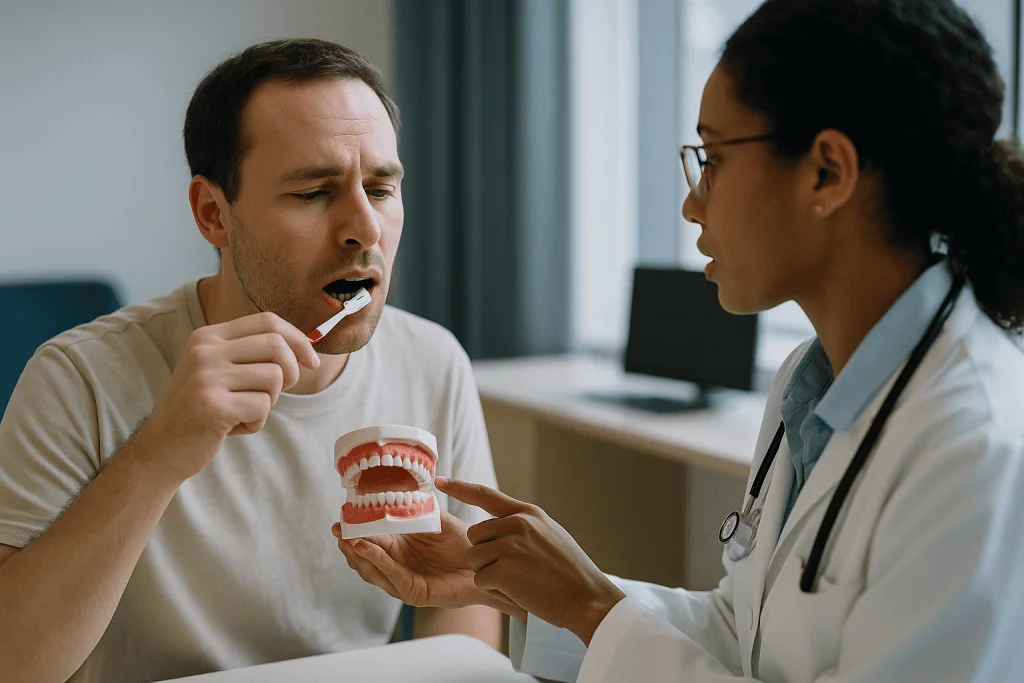
The gum does not ignore this. Within a few days, immune cells migrate into the tissue and release signaling chemicals that make the tiny blood vessels, the capillaries, dilate and leak fluid. The result is the classic triad you can see in the mirror: redness, puffiness, and a shiny rather than stippled surface. Those engorged, thin-walled vessels sit much closer to the surface than in healthy tissue, which is why a soft bristle can release a bead of blood that would never appear in a healthy mouth.
Here is the encouraging part. At the gingivitis stage, nothing permanent has happened. The bone and the fibers that anchor the tooth are intact. Remove the plaque consistently and the immune response quiets, the vessels shrink back, and the surface toughens. Mayo Clinic describes gingivitis as reversible with professional cleaning and good daily home care.
If plaque is left in place for months to years, the inflammation can creep deeper. The gum pulls away from the tooth, forming a pocket that is harder to clean, and the bone supporting the tooth begins to dissolve. That is periodontitis, and the lost bone does not grow back on its own. Catching the process while it is still just bleeding, before it becomes looseness, is the whole point of taking the pink swirl seriously.
Bleeding gums myths, part one: "stop brushing until it heals"
This is the most instinctive mistake and the most counterproductive. If a cut on your hand bled when you touched it, leaving it alone would be reasonable. Gum tissue does not follow that logic, because the irritant is not the touch. It is the plaque, and plaque re-forms within hours. Stop brushing and the biofilm thickens, the inflammation deepens, and the bleeding worsens, usually within days. People who back off then conclude their gums are “too sensitive to brush,” and the cycle locks in.
The NHS advice for gum disease is the opposite of resting the area: keep cleaning, twice a day for about two minutes with a fluoride toothpaste, and clean between the teeth daily with floss or interdental brushes. Fluoride is a mineral that strengthens tooth enamel; it does not treat the gum directly, but the brushing that delivers it is what matters here.
A related version of this myth says to avoid the bleeding spot and brush around it. That spot is precisely where the plaque has accumulated. Gentle attention there, not avoidance, is what calms it.
What about tenderness? Inflamed gums can genuinely feel sore. The answer is technique rather than abstinence: a soft-bristled brush, small circular or short back-and-forth movements, and bristles angled toward the gumline at roughly 45 degrees so they sweep the sulcus rather than skid over it. Many people find the discomfort eases within a few days once the tissue begins to settle.
One honest caveat: if brushing has been painful for weeks despite a soft brush and gentle technique, or if bleeding is heavy rather than a streak, that is no longer a hygiene question. It is a reason to be examined, not a reason to stop.
Why do my gums bleed when I brush? The "brush harder" myth
If stopping is the first wrong turn, scrubbing is the second. The reasoning feels sound: plaque is the problem, so apply more force. But plaque is soft. It comes away with light pressure and the right angle. Force adds nothing to plaque removal and quite a lot to collateral damage.
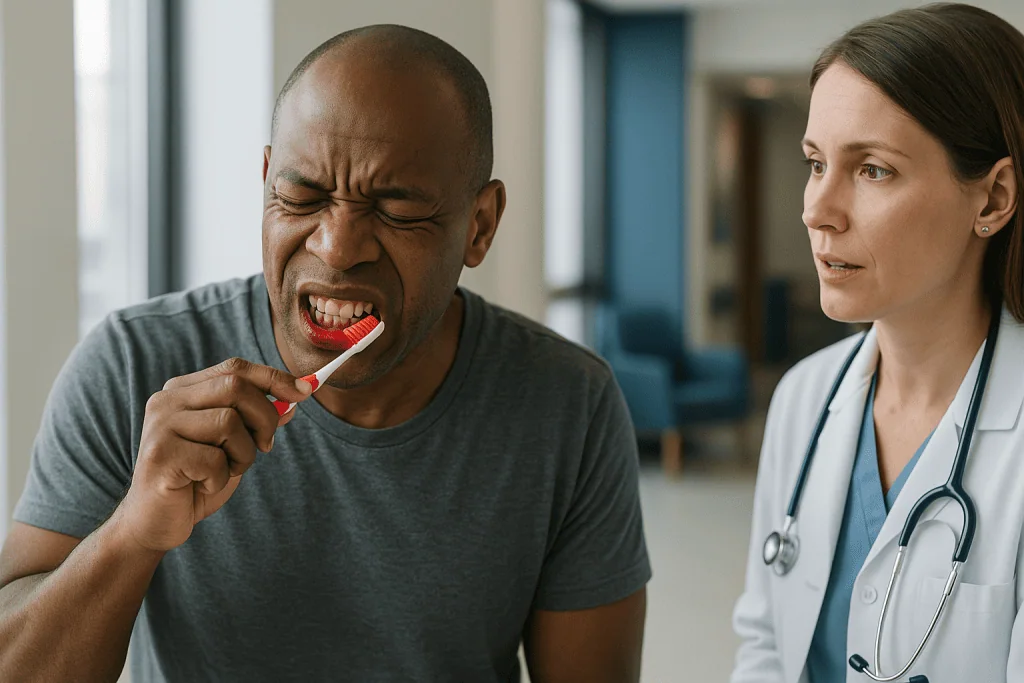
Aggressive brushing, especially with medium or hard bristles, can wear a notch into the tooth near the gumline and push the gum itself downward, a process called recession. Receded gum does not grow back, and the exposed root surface beneath it is softer than enamel and prone to sensitivity to cold. Mayo Clinic specifically recommends a soft-bristled brush and notes that brushing too hard can damage gums and enamel. So the hard-brush approach can leave someone with the original inflammation plus a second, permanent problem.
The question in this section’s heading, why do my gums bleed when I brush, has a precise answer: because the tissue is already inflamed before the brush arrives. The brush reveals the bleeding; it does not create it. Healthy gums tolerate normal brushing without bleeding, which is why bleeding is such a useful early-warning sign.
A few practical markers of over-brushing: bristles splayed outward within weeks of buying a brush, a sense that teeth near the gumline are sensitive to cold, and gums that look pale or thin rather than red and puffy. Mayo Clinic suggests replacing a brush every three to four months or sooner once bristles fray, and frayed bristles well before that point usually mean too much pressure.
Powered toothbrushes with pressure sensors can help people who find it hard to lighten their grip, though the evidence does not show that any particular device is essential. Technique and consistency do most of the work.
Can bleeding gums be healthy? The "a little blood is normal" myth
People often ask whether bleeding gums can be healthy, usually because theirs have bled on and off for years without anything dramatic happening. The straightforward answer from mainstream dental guidance is no. Healthy gum tissue does not bleed during ordinary brushing or flossing. A streak of blood is a sign, not a quirk, and it is listed by MedlinePlus, the NHS and Mayo Clinic alike as a symptom of gum disease.
Why does the “normal” idea persist? Partly because gingivitis is so widespread that bleeding feels like the default. Partly because it rarely hurts. Gum inflammation is a slow, mostly painless process, and the absence of pain is easily mistaken for the absence of a problem. And partly because the consequences, if they come, arrive years later and are blamed on age rather than on decades of low-grade inflammation.
Two nuances are worth keeping. First, a single episode of bleeding after an unusually vigorous floss, or when a new interdental brush is slightly too large for the gap, can happen in a healthy mouth and should not recur with gentler use. Second, in people taking anticoagulant medicines, drugs that reduce the blood’s ability to clot, gums may bleed more readily and for longer than they otherwise would. That bleeding still usually has plaque as its trigger; the medicine amplifies the response rather than causing it on its own.
So the framing to adopt is this: bleeding is common, bleeding is reversible at the early stage, and bleeding is never the goal. Treating it as an ordinary feature of brushing means missing the one window in which gum disease can be fully turned around at home, with no instruments and no appointments beyond routine check-ups.
Bleeding gums vitamin deficiency: which deficiency leads to gum bleeding?
Searches for bleeding gums vitamin deficiency spike every winter, and the question behind them is a fair one: which deficiency leads to gum bleeding? The textbook answer is vitamin C. Vitamin C is needed to build collagen, the protein that gives gum tissue and blood vessel walls their strength. In severe, prolonged deficiency, a condition called scurvy, those walls weaken, and the gums become swollen, purplish and spongy, bleeding easily and sometimes loosening around the teeth.
The important detail is how uncommon that is. The NIH Office of Dietary Supplements notes that scurvy is rare in developed countries and that symptoms generally appear only after about a month of very low or absent vitamin C intake. It is most often seen in people with highly restricted diets, severe food insecurity, alcohol dependence, or certain malabsorption conditions. Smokers have higher requirements because tobacco smoke increases oxidative stress, which is one of several reasons smoking and gum problems travel together.
What this means for most readers: if you eat even a modest amount of fruit or vegetables, vitamin C deficiency is very unlikely to be the reason your gums bleed. Plaque is. Reaching for a supplement while leaving the plaque in place addresses a cause you probably do not have and leaves untouched the one you almost certainly do. The evidence does not show that extra vitamin C beyond normal dietary needs improves bleeding in people who are not deficient.
Vitamin K, which the body uses to make clotting proteins, is sometimes mentioned too. Deficiency is rare in healthy adults and tends to cause bleeding in several places at once, not just the gums. If a nutritional cause is genuinely suspected, a clinician can confirm it with a blood test and advise on diet; it is not something to self-diagnose from a bathroom mirror.
Mouthwash, flossing and the shortcut myths
Two shortcuts circulate widely, and they pull in opposite directions. The first says a good mouthwash can stand in for brushing and flossing. The second says flossing itself causes bleeding, so it is better left alone. Neither holds up.
Mouthwash cannot replace mechanical cleaning. Plaque is a biofilm stuck to the tooth surface; a liquid swished for thirty seconds does not dislodge it, any more than rinsing a greasy pan under the tap removes the grease. Some rinses contain antibacterial agents that can reduce the bacterial load as an addition to brushing, and a dentist may suggest one for a specific reason. The NHS lists mouthwash as an optional extra, never a substitute, and advises against rinsing immediately after brushing because it washes away the fluoride left on the teeth.
Flossing is where the inflammation story becomes personal. When someone with gingivitis starts cleaning between their teeth after a long gap, the gums usually bleed, sometimes noticeably. This is often read as proof that floss is harmful. It is the reverse: those spaces have been harboring plaque that the brush never reached, and the tissue there is inflamed. Continue gentle daily cleaning between the teeth and the bleeding typically eases over one to two weeks as the inflammation resolves, a timeline consistent with how clinical sources describe gingivitis reversing.
Technique matters here as well. Floss should curve in a C shape around each tooth and slide gently below the gumline, not snap down into the gum. Interdental brushes, small bristled brushes designed for the gaps between teeth, are a well-supported alternative that many people find easier, provided the size fits the space without forcing.
The honest summary: there is no rinse, gum or spray that does what two minutes of brushing and a minute of interdental cleaning do.
Who is usually told to act now, and who can give home care a few weeks
Dental guidance sorts bleeding gums into two broad groups, and knowing which you fall into saves both worry and wasted time.
Most adults with mild, gumline bleeding that appears during brushing or flossing, with no other symptoms, are generally reasonable candidates to improve home care first. That means two minutes of gentle brushing twice daily with a soft brush, daily cleaning between teeth, and no smoking. The NHS describes mild gum disease as usually manageable by keeping the teeth and gums clean, with a dental check-up to confirm the picture and remove any hardened plaque, called tartar or calculus, that a brush cannot shift. Giving diligent home care two to three weeks before judging the result is a sensible test; if the bleeding fades, the diagnosis was gingivitis and the treatment worked.
Other people are usually asked not to wait. Anyone whose gums bleed spontaneously, without brushing, belongs here. So does anyone with gums that have visibly receded, teeth that feel loose or have shifted, persistent bad breath that does not clear with cleaning, pus at the gumline, or pain. These can indicate periodontitis, where bone is already being lost and home care alone will not reach the pockets involved. People with diabetes, those who are pregnant, those taking anticoagulant medicines, and those with known bleeding disorders or immune suppression are also generally encouraged to have bleeding gums assessed sooner rather than later, because the underlying condition changes both the risk and the response.
A third, smaller group is sometimes asked to wait in a different sense: someone in the middle of orthodontic treatment, recovering from a recent extraction, or with a mouth ulcer near the gum may be advised to let that settle before the gum itself is evaluated. In every case, the sequencing is a decision for the dental team examining the mouth, not a rule to apply from a website.
Smoking, pregnancy, diabetes and medicines: the hidden drivers
Plaque is the spark, but several conditions decide how fiercely the gum reacts to it. Four come up again and again in clinical guidance.
Smoking is the one with the strongest evidence. The CDC reports that people who smoke have roughly twice the risk of gum disease compared with non-smokers, and the risk climbs with how much and how long someone has smoked. Tobacco impairs blood flow and immune function in the gum, which has a paradoxical effect: smokers’ gums often bleed less than expected despite worse disease, because the vessels are constricted. The absence of bleeding in a smoker is therefore not reassurance. Smoking also makes gum treatment less effective, which is why quitting is part of nearly every periodontal care plan.
Pregnancy raises progesterone and estrogen, hormones that increase blood flow to gum tissue and heighten its sensitivity to plaque. MedlinePlus lists hormonal changes in pregnancy among recognized causes of bleeding gums. The practical implication is not that pregnancy damages teeth, a myth in its own right, but that the same plaque produces more inflammation, so cleaning becomes more important rather than less. Routine dental care is considered safe in pregnancy.
Diabetes, particularly when blood glucose is poorly controlled, impairs the body’s ability to fight infection and heal, and gum disease is recognized as a common complication. The relationship appears to run both ways: untreated gum inflammation can make glucose harder to manage.
Medicines matter in two ways. Anticoagulants and antiplatelet drugs, which reduce clotting, make existing gum bleeding more noticeable and longer-lasting. Separately, certain medicines for blood pressure, epilepsy and transplant rejection can cause the gum to overgrow, trapping plaque. In neither case should anyone stop or adjust a prescribed medicine because of gum bleeding; the right step is to mention it to the prescribing clinician and the dentist, who can coordinate.
Bleeding gums myths vs the evidence: a summary table
The myths in this article share a pattern: each one takes a real observation, draws the wrong conclusion, and recommends an action that makes the underlying inflammation worse or leaves it untouched. The table below puts them side by side with what mainstream dental guidance actually says.
| Common belief | What the evidence shows | Habit to adopt instead |
|---|---|---|
| Stop brushing until the gums heal | Plaque re-forms within hours; pausing worsens inflammation and bleeding | Keep brushing twice daily, gently, including the sore area |
| Brush harder to scrub away the problem | Plaque is soft and lifts with light pressure; force causes recession and enamel wear | Soft bristles, 45-degree angle at the gumline, light grip |
| A little bleeding is normal | Healthy gums do not bleed during routine cleaning; bleeding signals gingivitis | Treat bleeding as an early warning and respond with better cleaning |
| It must be a vitamin deficiency | Vitamin C deficiency can cause bleeding gums but is rare; plaque is far more likely | Eat a varied diet; ask a clinician if deficiency is genuinely suspected |
| Mouthwash replaces brushing | Rinses cannot remove biofilm; they are an optional add-on only | Brush and clean between teeth first; rinse only if advised |
| Flossing causes bleeding, so skip it | Bleeding reveals pre-existing inflammation between teeth; it usually eases within 1–2 weeks of daily cleaning | Floss or use interdental brushes daily with gentle technique |
| Smokers’ gums are fine because they do not bleed | Nicotine constricts vessels, masking bleeding despite roughly double the disease risk (CDC) | Do not rely on bleeding as a gauge; have gums checked and seek support to quit |
The thread running through the right-hand column is consistency rather than intensity. None of the corrective habits requires special products, and none requires force. What they require is doing the same gentle, thorough routine every day and letting the tissue respond on its own schedule.
What the first days and weeks usually look like
People who commit to better cleaning often want to know when the mirror will show a difference. The honest answer is that the timeline is typical rather than guaranteed, and it depends on how long the inflammation has been building.
In the first two or three days, bleeding frequently seems worse. Gaps that were never flossed are being cleaned for the first time, and inflamed tissue bleeds at the slightest touch. This is the point at which many people conclude the new routine is harming them and give up. It is also the point at which persistence pays most.
By the end of the first week, most people with straightforward gingivitis notice less blood on the brush and in the sink. The gums may still look slightly red and rounded at the edges, but tenderness tends to ease. By the second week, the color often shifts back toward a paler pink and the puffy margin starts to tighten against the teeth. Mayo Clinic and the NHS describe gingivitis as reversible with consistent professional and home care, and clinical experience places visible improvement in the range of one to three weeks for most mild cases.
If bleeding has not clearly improved after about three weeks of diligent cleaning, something else is likely at play: hardened tartar below the gumline that only a professional cleaning can remove, deeper pockets that signal periodontitis, a medicine effect, or a general health factor. That is the moment to book an assessment rather than extend the experiment.
After a dental cleaning, gums can feel tender and bleed slightly for a few days as the irritated tissue recovers, then typically settle. Sensitivity to cold sometimes appears once tartar is removed from previously covered root surfaces and usually diminishes over a few weeks. Ongoing maintenance is lifelong, not a one-time fix: the plaque never stops forming, so the routine never stops either.
What people often get wrong about bleeding gums
Beyond the headline myths, a cluster of smaller misunderstandings shapes how people react to blood in the sink.
“It means infection, so I need antibiotics.” Gingivitis is inflammation driven by plaque bacteria, but it is not an infection that antibiotics are designed to treat. Removing the plaque mechanically is the treatment. Antibiotics are reserved for specific, clinician-diagnosed situations such as an abscess or certain forms of aggressive periodontitis, and their use is a decision for the treating dentist.
“Salt water will fix it.” A warm salt-water rinse is soothing and widely recommended for temporary comfort after dental work or with a mouth ulcer. There is no good evidence that it resolves gingivitis on its own, because it does not remove plaque. Used alongside brushing, it does no harm; used instead of brushing, it changes nothing.
“Bleeding gums mean I am losing my teeth.” At the gingivitis stage, nothing is lost. Tooth loss follows years of untreated periodontitis, and even then it is not inevitable with treatment. Bleeding is the early, reversible signal, which is good news rather than a verdict.
“It is a spiritual sign or stress leaving the body.” People do search for a spiritual meaning behind bleeding gums. There is no medical evidence for one. Stress can, however, play a real physiological role: it weakens immune responses and often disrupts routines, so brushing lapses during difficult periods. The sign is physical, and so is the remedy.
“Whitening made my gums bleed.” Peroxide-based whitening can irritate gums if it contacts them, producing temporary soreness or blanching. It does not cause gingivitis. Bleeding that persists after whitening usually reflects plaque that was already there.
“Children’s gums bleeding is just teething.” Teething can make gums sore, but bleeding at the gumline in a child with teeth usually means plaque, often where a parent’s brushing cannot reach. Gentle supervised brushing twice a day is the standard advice.
Questions to ask your care team
A dental visit for bleeding gums moves quickly, and it helps to arrive with the questions that will shape your care rather than trying to recall them afterward. The following are the ones patients most often wish they had asked.
- Is this gingivitis, or has it progressed to periodontitis? The distinction decides everything: whether home care alone is likely to resolve it, and whether deeper cleaning or a specialist referral is being considered.
- What are my pocket depths? During a periodontal examination, the dentist or hygienist slides a thin measuring probe into the groove around each tooth. Shallow readings suggest health; deeper ones indicate tissue detachment. Asking for the numbers gives you a baseline to track.
- Is there tartar below the gumline, and how will it be removed? Scaling, the removal of hardened plaque from tooth and root surfaces, may be done in one visit or several, sometimes with local anesthetic. Knowing the plan reduces surprise.
- Can you watch me brush and floss? A two-minute demonstration with feedback often reveals the missed spot or heavy hand behind months of bleeding. Most hygienists welcome the request.
- Which interdental tool and size fits my gaps? The right size matters: too small cleans nothing, too large forces the gum.
- Do any of my medicines or health conditions change the picture? Mention anticoagulants, diabetes, pregnancy, and anything for blood pressure or epilepsy. Ask whether the dental team should coordinate with your prescribing clinician; do not change any medicine yourself.
- What should improvement look like, and by when should I come back? A concrete review interval turns “keep an eye on it” into a plan.
- If I smoke, what support is available to stop? Quitting is the single lifestyle change with the strongest evidence for gum health.
Write the answers down. Pocket depths, in particular, are easy to forget and valuable to compare at the next visit.
When to call your doctor
Most bleeding gums belong with a dentist, and a routine appointment is the right next step for persistent gumline bleeding that has not eased after about three weeks of careful home care. Some patterns, though, warrant a prompter call to a dentist or physician, because they can point beyond plaque.
Seek an assessment soon if your gums bleed on their own, without brushing or flossing, or if the bleeding is heavy enough to tint saliva red or soak a tissue rather than leaving a streak. Do the same if gums are visibly swollen, purplish or growing over the teeth; if teeth feel loose, have shifted, or no longer meet the way they used to; or if there is pus, a bad taste, or persistent bad breath that cleaning does not clear. A gum that is painful, hot and swollen on one side, particularly with facial swelling or fever, can indicate an abscess and should be seen the same day.
Contact a physician rather than waiting for a dental slot if gum bleeding appears alongside bleeding or bruising elsewhere: frequent nosebleeds, blood in urine or stool, unexplained bruises, or heavy menstrual bleeding. That combination can reflect a clotting problem, a medicine effect, or occasionally a blood disorder, and it is evaluated with a blood test rather than a dental probe. Anyone taking anticoagulant medicines whose gum bleeding is new or clearly heavier than before should inform the prescribing clinician; the medicine should not be stopped or adjusted without that conversation.
Finally, bleeding gums together with unexplained fatigue, fever, weight loss, or recurrent infections should be reported promptly to a doctor. These are uncommon associations, and the great majority of bleeding gums have an ordinary explanation, but they are the signs that justify looking wider. In every case, what the bleeding means, and what to do about it, is a judgment for the clinician who examines you.
Frequently asked questions
What do bleeding gums signify?
Bleeding gums most often signify gingivitis, early gum inflammation caused by plaque sitting along the gumline. The inflamed tissue has swollen, fragile blood vessels close to the surface that bleed at light contact. Less commonly, bleeding reflects anticoagulant medicines, pregnancy hormones, poorly controlled diabetes, a bleeding disorder, or a rare nutritional deficiency. Bleeding that occurs without any trigger or alongside bruising elsewhere should be assessed by a clinician.
Can bleeding gums be healthy?
No. Healthy gum tissue does not bleed during ordinary brushing or flossing. Bleeding is listed by MedlinePlus, the NHS and Mayo Clinic as a symptom of gum disease. A one-off streak after an unusually vigorous floss can happen, but it should not recur with gentler technique. Recurrent bleeding is an early, reversible sign that plaque is not being fully removed, and responding to it promptly is what prevents progression.
Which deficiency leads to gum bleeding?
Vitamin C deficiency is the classic nutritional cause, because vitamin C is needed to build collagen in gum tissue and vessel walls. In severe, prolonged deficiency, called scurvy, gums become swollen, spongy and bleed easily. The NIH Office of Dietary Supplements notes scurvy is rare in developed countries and generally appears only after about a month of very low intake. For most people, plaque, not diet, is the cause.
What does bleeding gums mean spiritually?
There is no medical evidence that bleeding gums carry a spiritual meaning. The sign is physical: inflamed gum tissue reacting to plaque, or less often to a medicine or health condition. Stress can contribute in a real, physiological way by weakening immune responses and disrupting daily brushing routines, which may be why bleeding seems to arrive during difficult periods. The remedy is practical cleaning and, when needed, a dental check.
Why do my gums bleed when I brush but not at other times?
Because the tissue is already inflamed before the brush touches it. Gingivitis makes the capillaries in the gum dilate and sit closer to the surface, so even soft bristles release a bead of blood. The brush reveals the inflammation rather than causing it. Bleeding only on brushing, concentrated at the gumline, is the typical pattern of plaque-related gingivitis and usually eases within one to three weeks of consistent gentle cleaning.
Should I stop brushing if my gums bleed?
No. Stopping is one of the most counterproductive responses, because plaque re-forms within hours and the inflammation deepens, usually making bleeding worse within days. The NHS advises continuing to brush twice daily for about two minutes with fluoride toothpaste and cleaning between teeth daily. Use a soft brush and light pressure, include the sore area, and expect the bleeding to lessen as the tissue settles. Persistent heavy bleeding needs a dental assessment, not a pause.
Does brushing harder stop bleeding gums?
No, and it can cause lasting harm. Plaque is soft and lifts with light pressure at the right angle; force does not remove more of it. Hard scrubbing, especially with medium or firm bristles, can push the gum downward, a permanent change called recession, and wear notches into enamel near the gumline. Mayo Clinic recommends a soft-bristled brush and replacing it every three to four months or sooner if bristles fray.
Does flossing cause bleeding gums?
Flossing reveals bleeding rather than causing it. When someone starts cleaning between teeth after a long gap, the gums there are often inflamed because plaque has gone undisturbed, and they bleed at first contact. With gentle daily flossing or interdental brushing, that bleeding typically fades over one to two weeks as the inflammation resolves. Snapping floss down into the gum can cause minor injury, so curve it around each tooth and slide gently.
How long do bleeding gums take to improve with better brushing?
Most mild gingivitis shows visible improvement within about one to three weeks of consistent, gentle twice-daily brushing and daily cleaning between teeth, a timeline consistent with how Mayo Clinic and the NHS describe gingivitis as reversible with good care. Bleeding often seems worse in the first few days before easing. If there is no clear improvement after roughly three weeks, tartar below the gumline, deeper pockets or a general health factor may be involved and a dental assessment is advisable.
Can blood thinners make gums bleed?
Yes. Anticoagulant and antiplatelet medicines reduce the blood’s ability to clot, so gums that are even mildly inflamed bleed more readily and for longer. The medicine amplifies bleeding that plaque has triggered rather than causing it alone, so good cleaning still helps. Never stop or adjust a prescribed blood thinner because of gum bleeding; tell the prescribing clinician and your dentist, who can coordinate care and decide whether anything needs to change.
References
- NHS: Gum disease
- MedlinePlus: Bleeding gums
- CDC: About Periodontal (Gum) Disease
- NIH National Institute of Dental and Craniofacial Research: Periodontal (Gum) Disease
This article is for general information only and is not a substitute for professional medical advice. Please consult a qualified doctor about your individual situation.

More from the Blog

Recovering From Jaw Cyst Removal: Swelling, Cold Compresses and Monitoring the Bone
Jaw cyst surgery recovery usually happens in two stages. Soft tissue swelling and soreness are typically worst in the first two to three days,…

How Dental Lasers Work: What Focused Light Changes for Gum Treatment and Small Cavities
Dental lasers work by emitting a single wavelength of light that particular tissues absorb: water inside enamel and dentin for hard-tissue lasers, and pigment…
Who May Not Suit Teeth Whitening? Crowns, Gum Disease, Pregnancy and Grey Discoloration
People usually asked to wait or skip teeth whitening include anyone with untreated gum disease, cavities or cracked teeth, those who are pregnant or…

What Happens at a Composite Bonding Appointment: Shade Matching, Layering and Polishing
A composite bonding procedure usually takes 30 to 60 minutes per tooth and rarely needs an injection. The dentist selects a resin shade against…

Bleeding Gums and Blood Thinners: What Your Dentist Checks Before Gum Treatment
Blood thinners do not cause gum disease, but they can make inflamed gums bleed longer and more visibly. Before gum treatment, a dentist reviews…

Clear Aligner Problems to Watch: Tracking Issues, Sore Spots and Gum Irritation
Most clear aligner problems are minor and fixable: trays that stop fitting usually reflect too few hours of wear, sore spots come from pressure…