

Who May Not Suit Teeth Whitening? Crowns, Gum Disease, Pregnancy and Grey Discoloration
Key Takeaways
- Peroxide whitening only changes natural tooth tissue, so crowns, veneers and fillings keep their original shade and can look darker next to lightened enamel.
- Yellow and light brown staining from age, diet and tobacco usually responds to whitening, while grey tetracycline or trauma staining is deep, mineral-bound and often resists it.
- Active gum disease, cavities, cracks and exposed roots are reasons to treat first and whiten later, because peroxide reaches the nerve through any gap in the enamel.
- No trials have tested whitening in pregnancy or breastfeeding, so guidance such as the NHS advises postponing it as a precaution while routine dental care continues.
- The NHS notes whitening results are not permanent and can last up to about three years, with shorter duration for smokers and heavy coffee or tea drinkers.
- Banana peel, lemon juice, baking soda and charcoal have no evidence of whitening inside the tooth, and the acid or abrasion can thin enamel and increase sensitivity.
People usually asked to wait or skip teeth whitening include anyone with untreated gum disease, cavities or cracked teeth, those who are pregnant or breastfeeding, children and teenagers, and people with crowns, veneers or fillings on front teeth, because those materials do not lighten. Grey or tetracycline-stained teeth often respond poorly. A dentist's examination decides suitability, not a shade chart or an online quiz.
The wedding is in six weeks, the invitations are out, and the person in the bathroom mirror is tilting their head under the light, counting the years of coffee on their front teeth. The question that follows is rarely “does whitening work?” It is “will it work for me, and is it a good idea at all?”
That second question deserves a better answer than most online quizzes give. Knowing who is not suitable for teeth whitening matters more than knowing the latest kit, because the same peroxide gel that lightens one person’s smile can leave another with a patchwork of mismatched shades, sore gums or a tooth that aches when the air hits it.
This guide walks through the groups dentists most often ask to wait or choose a different route: people with crowns or veneers on visible teeth, anyone with gum disease, people who are pregnant, and those whose discoloration is grey rather than yellow. The reasons are mechanical and chemical, not cosmetic snobbery, and once they are clear the decision becomes far easier to talk through with your own dental team.
How teeth whitening actually works, and why it has limits
Every professional whitening product relies on the same chemistry. The active ingredient is a peroxide, either hydrogen peroxide itself or carbamide peroxide, a compound that breaks down into hydrogen peroxide once it meets saliva. Peroxide releases reactive oxygen that seeps through the enamel, the hard outer shell of the tooth, into the softer, yellower layer beneath called dentin. There it snaps large, dark pigment molecules into smaller fragments that reflect light differently and look paler.
Two details explain almost every limitation. First, enamel is semi-translucent; much of a tooth’s colour comes from the dentin behind it, so whitening is really lightening the inside of the tooth, not painting the surface. Second, the reaction only happens in living tooth tissue. Porcelain, metal and composite resin have no pigment molecules for oxygen to break, so they stay the shade they were made.
Stains also come in two families. Extrinsic stains from coffee, tea, red wine and tobacco sit on the surface and often lift with professional cleaning alone. Intrinsic stains are locked inside the enamel or dentin, from ageing, certain antibiotics taken in childhood, excess fluoride during tooth development or an injury that caused bleeding inside the tooth. Peroxide reaches intrinsic stains, but how well it works depends on what the pigment is made of.
Time is the other variable. The NHS describes dentist-supervised whitening as a process of several weeks when custom trays are worn at home, with faster chairside options also available, and notes that results are not permanent; it suggests the effect can last up to about three years, shorter for smokers and heavy coffee or tea drinkers. Nothing in that chemistry is instant, and nothing in it is forever.
Who is not suitable for teeth whitening? What a dentist checks first
Before any gel touches a tooth, a dentist is running a quiet checklist, and most of it has nothing to do with how yellow the teeth are. The examination looks for the conditions that turn a routine cosmetic procedure into a painful or disappointing one.
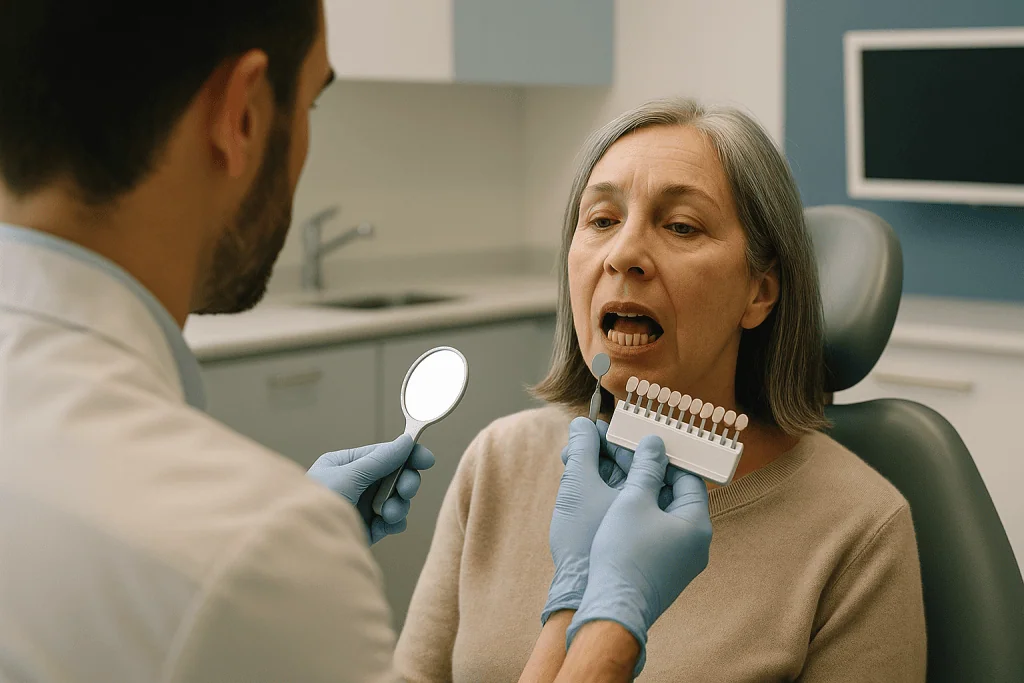
Whitening is usually considered for adults whose teeth and gums are healthy, whose front teeth are natural rather than restored, and whose discoloration is the yellow or light brown type that comes with age, diet and tobacco. Those people tend to see a predictable, even change in shade.
The groups most often asked to wait or to consider another approach are:
- People with active gum disease, untreated cavities or cracked teeth, because peroxide can reach the nerve through any gap in the enamel.
- Anyone who is pregnant or breastfeeding, where the evidence simply has not been gathered and a cosmetic procedure can wait.
- Children and teenagers, whose teeth have larger nerve chambers and are still maturing.
- People with crowns, veneers, bridges or tooth-coloured fillings on the teeth that show when they smile.
- People whose discoloration is grey, banded or caused by a single tooth that has died after an injury.
- People with exposed root surfaces, severe sensitivity or a known reaction to peroxide products.
A tooth can also look fine and still be unsuitable. Worn enamel, small enamel defects and old leaking fillings are invisible to the owner but obvious on an X-ray or under a dental light. Mayo Clinic’s advice is blunt on this point: talk to a dentist before whitening, especially with many fillings, crowns or very dark stains. The rest of this article explains why each group lands on that list.
Teeth whitening with crowns, veneers and fillings: why they will not match
Picture a row of six front teeth, four natural and two capped years ago with porcelain crowns. The crowns were colour-matched to the teeth as they were at the time. Whiten the row today and the four natural teeth lift two or three shades while the crowns sit exactly where they started. The result is not whiter; it is uneven, and the eye is drawn to the mismatch far more than it ever was to the overall colour.
Both Mayo Clinic and the NHS make the same point: whitening does not work on crowns, veneers, bridges, dentures or fillings. Porcelain is a glass-like ceramic. Composite resin is a plastic packed with glass particles. Neither contains the organic pigment molecules that peroxide dismantles, so the chemistry has nothing to act on. Metal restorations are even further out of reach.
This does not mean restorations rule out whitening altogether. It changes the order of operations. A common sequence is to whiten the natural teeth first, allow the new shade to settle, then have any visible restorations remade to match. Whitening after the fact locks in a mismatch; whitening before gives the dentist a stable target shade to work to. The timing of replacement is a clinical judgement, because freshly bleached teeth can look slightly lighter immediately after treatment and then settle.
Small fillings on back teeth rarely matter, since they are not seen. Front-tooth composites, large white fillings along the gumline and veneers are the real issue. A good consultation includes a mirror and an honest conversation about which teeth will change and which will not, so the person leaves knowing what the finished picture should look like before committing to anything.
Teeth whitening and gum disease: why the gums come first
Gum disease begins as gingivitis, inflammation of the gum edge caused by plaque, the sticky film of bacteria that forms on teeth. Left alone it can progress to periodontitis, where the inflammation damages the bone and fibres that hold teeth in place and the gums begin to pull away. The NHS lists bleeding when brushing, redness, swelling and bad breath among the common signs, and notes that treatment starts with professional cleaning and a change in daily plaque control.
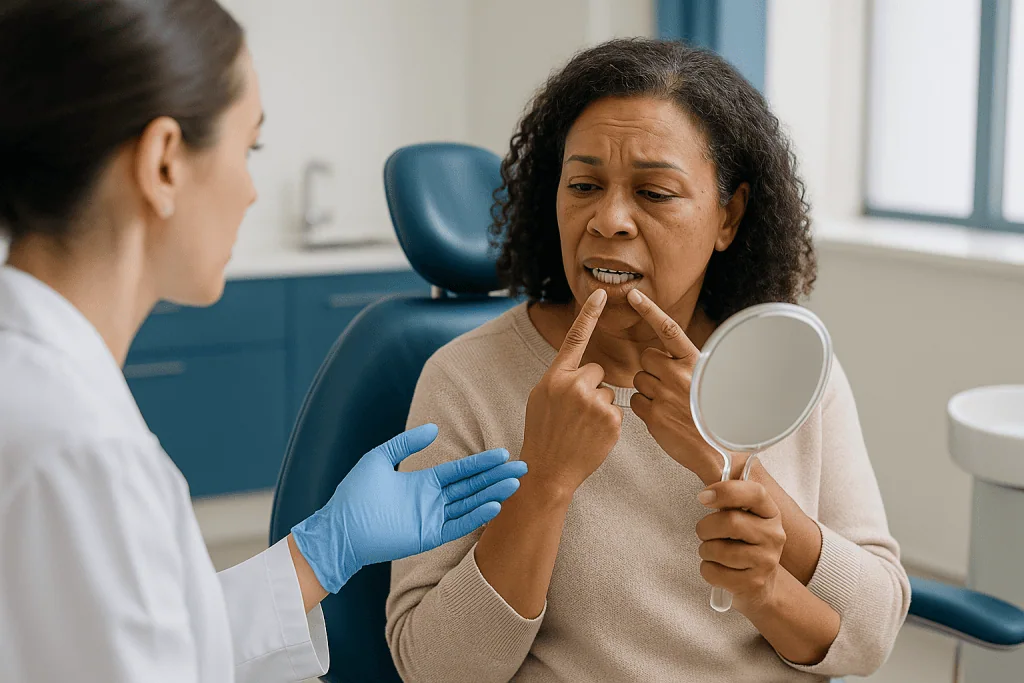
Peroxide and inflamed gum tissue are a poor combination for three reasons. Inflamed gums are already fragile, so the gel’s chemical irritation is felt more sharply and heals more slowly. Gums that have receded expose the root surface, which has no enamel at all, only a thin covering called cementum over the dentin; peroxide on exposed dentin is a direct line to the nerve and a classic cause of sharp, lingering sensitivity. Deeper pockets between gum and tooth can also trap gel where it was never meant to sit.
There is a less obvious reason too. Bleeding gums and heavy plaque mean the stain a person sees is often partly a thick layer of calculus (hardened plaque) and surface deposits. Clearing that with a professional cleaning can change the colour more than expected, and it changes the starting point for any decision about whitening.
So the usual advice is sequence, not refusal. Treat the gum disease, let the tissue settle, review the shade, and only then discuss whitening. People with periodontitis who have recession and sensitive root surfaces may still be advised against peroxide, or towards gentler, slower approaches under supervision. That judgement belongs to the dentist who has looked at the pockets and the X-rays, not to a kit’s instruction leaflet.
Teeth whitening while pregnant or breastfeeding: what the evidence shows
Here the honest answer is about absence rather than danger. There are no good-quality trials of peroxide tooth whitening in pregnant or breastfeeding people, because ethically no one would run them for a purely cosmetic benefit. Without that evidence, dental guidance in several countries, including the NHS, takes the precautionary route and advises postponing whitening until after pregnancy and breastfeeding.
Several practical points support waiting even without a proven harm. A small amount of gel is inevitably swallowed during tray-based or chairside whitening. Pregnancy also changes the mouth itself: hormonal shifts make the gums more prone to swelling and bleeding, a condition often called pregnancy gingivitis, and inflamed gums are exactly the tissue most irritated by peroxide. Nausea and acid reflux, common in early pregnancy, soften enamel temporarily, and softened enamel is more sensitive to any chemical treatment.
None of this means teeth need to be neglected for nine months. Routine dental check-ups and professional cleaning during pregnancy are considered safe and are encouraged, since untreated gum inflammation is the bigger oral health concern. A cleaning alone often brightens teeth by removing surface stain, which is a reasonable interim step.
The same logic extends to breastfeeding: no evidence of harm, no evidence of safety, and a procedure that loses nothing by waiting a few months. People who are trying to conceive sometimes ask whether to whiten beforehand. That is a reasonable conversation to have with a dentist, who can check the gums and any restorations and advise on timing.
What the evidence shows, then, is a gap. Filling that gap with reassurance would be dishonest; filling it with alarm would be equally so. The guideline-level position is simply to wait, and to keep up the ordinary dental care that matters far more.
Why grey teeth respond differently from yellow teeth
Colour tells a dentist a great deal about where a stain came from, and that history predicts how whitening will go. MedlinePlus groups abnormal tooth colour by cause: diet, tobacco and poor plaque control for surface stain; ageing, certain antibiotics taken while teeth were forming, excess fluoride, inherited enamel conditions and dental injury for colour locked inside the tooth. Mayo Clinic adds the clinical rule of thumb that yellowish teeth tend to respond well to whitening, while grey or brownish teeth may not lighten as expected.
The reason is chemical. Yellow and light brown pigments are mostly organic molecules from food, drink and age-related dentin changes, and peroxide breaks them readily. Grey discoloration often comes from something else: tetracycline antibiotics incorporated into the dentin as it mineralised in childhood, producing a grey or blue-grey tint, sometimes in horizontal bands; or blood pigments from a tooth whose nerve died after a knock. These pigments sit deep, are bound into the mineral, and are far more resistant to oxygen.
| Type of discoloration | Typical cause | Usual response to peroxide whitening |
|---|---|---|
| Yellow or light brown, even | Age, coffee, tea, wine, tobacco | Generally responds well |
| Grey or blue-grey, often banded | Tetracycline during tooth development | Limited and slow; banding may persist |
| Single dark grey tooth | Nerve death after injury | External whitening does little; internal bleaching may be considered |
| White or brown patches | Fluorosis, enamel defects | Background may lighten but patches can become more visible |
| Colour on crowns or fillings | Restorative materials | No change |
The table is a guide, not a verdict. Grey teeth are not automatically excluded, but the person should expect a longer course, a smaller change and the real possibility that veneers or bonding will be suggested instead. Being told that at the first visit is far kinder than discovering it after weeks in trays.
Cavities, cracks, exposed roots and sensitive teeth: why dentists ask you to wait
A tooth with an untreated cavity is a tooth with a hole in its armour. Peroxide placed on that surface does not stop at the enamel; it travels straight through the softened, decayed dentin towards the pulp, the living tissue at the tooth’s centre that holds its nerve and blood supply. The result can be intense pain during treatment and inflammation afterwards. The same applies to cracked teeth, chipped enamel and fillings that have begun to leak at their edges. Every one of these is a reason to fix first and whiten later.
Exposed root surfaces deserve their own mention. When gums recede, from gum disease, from years of hard brushing or simply with age, the root loses its covering and the dentin underneath is left bare. Dentin is riddled with microscopic tubules that run towards the nerve, which is why cold drinks already sting on those surfaces. Peroxide on exposed dentin is a predictable trigger for sharp sensitivity, and whitening does nothing to lighten roots, which are naturally darker than enamel anyway.
Enamel that is thin, worn or developmentally weak is another flag. Acid erosion from reflux or frequent fizzy drinks, heavy grinding at night and inherited enamel conditions all leave less barrier between the gel and the pulp. These teeth often look translucent or slightly grey at the edges, and they are the ones most likely to hurt.
People who already live with sensitive teeth are not necessarily excluded. Cleveland Clinic describes sensitivity as the most common side effect of whitening and notes that it is usually temporary. Dentists frequently suggest a desensitising toothpaste in the weeks beforehand, shorter wear times or a slower schedule. The decision rests on how severe the sensitivity is and what is causing it, which is exactly what the examination is for.
Teenagers and the single dark tooth after an injury: two special cases
Teenagers ask about whitening more than any other group and are, in most settings, the group most often told no. In the UK, the NHS notes that whitening is not legally available to under-18s except where a dentist judges there is a clinical reason, and professional bodies elsewhere take a similarly cautious line. The biology explains why. Young permanent teeth have a larger pulp chamber relative to the tooth, so the nerve sits closer to the surface and reacts more strongly to peroxide. Enamel continues to mature for some years after a tooth erupts. Several adult teeth may not yet be fully in place, making an even result unlikely. None of this is a judgement on how a teenager feels about their smile; it is a statement about tooth anatomy at that age.
The single dark tooth is a different problem with a different solution. A front tooth knocked in a fall or a sports collision can lose its blood supply, sometimes months or years later, and as the pulp breaks down, blood pigments stain the dentin from the inside, turning the tooth grey or brown while its neighbours stay pale. Painting peroxide on the outside of that tooth barely touches the stain, because the pigment is on the wrong side of the enamel.
What dentists may consider instead is internal bleaching: after root canal treatment to remove the dead tissue, a bleaching agent is sealed inside the empty pulp chamber for a period, then removed and the tooth is filled. The approach treats the stain where it lives. It is only suitable for teeth that have had root canal treatment, carries its own risks that the dentist will explain, and may need repeating over time. For many people it is the difference between one grey tooth and an even smile, but it is a decision for the treating dentist after X-rays, not a cosmetic add-on.
What to avoid during teeth whitening, and what the following days usually look like
Immediately after whitening, enamel is more porous than usual. The peroxide has opened up the surface, and it takes time for saliva to remineralise it. During that window, pigments are absorbed more easily, which is why dentists talk about a “white diet” in the days after each session: foods and drinks that would not stain a white shirt. Coffee, tea, red wine, cola, dark berries, soy sauce, curry and tomato sauces are the usual suspects. Tobacco in any form is the most reliable way to undo the work.
Very hot and very cold drinks are worth avoiding for a different reason. Temperature extremes aggravate the sensitivity that Cleveland Clinic and Mayo Clinic both list as the most common side effect. Acidic foods and drinks, including citrus and sparkling water, soften enamel further and are sensibly limited while the surface recovers.
What people actually experience over the following days is usually mild. Short, sharp twinges to cold are common on the first day or two and typically fade within a few days, according to Cleveland Clinic. Gums that caught a little gel may look pale or feel sore and settle quickly. Teeth often look brightest straight after a session and then relax a fraction as they rehydrate; the shade a week later is the truer one. With tray-based whitening over several weeks, the change is gradual, and the NHS notes the total course commonly runs a few weeks.
A few avoidances apply during the course itself. Do not extend wear times or stack extra sessions to speed things up; more peroxide means more sensitivity, not faster results. Do not whiten over sore gums, and pause and contact the dentist if pain is more than fleeting. Brushing gently with a fluoride toothpaste, as the NHS advises for everyone, supports remineralisation and does more for long-term appearance than any rinse marketed alongside the kit.
Can I whiten my teeth at home safely?
Home whitening covers everything from a dentist-made tray with a prescribed gel to a strip bought at the supermarket, and the safety picture differs sharply across that range. The distinction that matters is not where you sit while the gel is on, but who assessed your teeth before it went there.
Dentist-supervised home whitening starts with an examination that rules out the problems described above, followed by custom trays moulded to your teeth. A well-fitted tray holds the gel against enamel and away from the gums, which is the main reason supervised whitening causes less gum irritation than a loose, one-size tray. The dentist chooses the product strength, sets the schedule and checks progress. The NHS states that in the UK whitening may only legally be carried out by registered dental professionals, and that stronger gels are restricted to them; beauty salons offering it without a dental professional present are acting illegally.
Over-the-counter strips and paint-on gels contain far less peroxide, which is why they are permitted for sale. They can lift mild surface staining, but the lower strength also means a smaller change, and the generic fit means more contact with the gums. The bigger concern is kits bought online from unregulated sellers, which may contain more peroxide than is legal or no meaningful amount at all, with no way for the buyer to tell. Mayo Clinic’s caution applies with full force here: without an examination, no one can know whether a cavity, a crack or a receding gumline is waiting under the gel.
Whitening toothpastes are a separate category. Most work by mild abrasion or by binding surface stain; they do not change the colour inside the tooth. They can help maintain a result after professional whitening but should not be expected to replace it. The safest honest advice is that home whitening is reasonable for suitable adults when a dentist has looked first and remains available if something hurts.
What people often get wrong about who is not suitable for teeth whitening
Myths cluster around whitening because the goal is visible, the chemistry is invisible and the internet rewards shortcuts. A few deserve a direct correction.
“A banana peel will whiten your teeth.” Rubbing the inside of a banana peel on teeth is a popular search, and there is no recipe to give because there is no evidence it works. Banana peel contains minerals and a little organic acid; it contains nothing that breaks down pigment inside dentin. Any perceived change is the result of rubbing away a little surface film, which a toothbrush does better. The same applies to lemon juice and baking soda pastes, where the acid and abrasion can wear enamel, making teeth more sensitive and, over time, yellower as dentin shows through. Activated charcoal has the same abrasion problem and no evidence of true whitening.
“The 2 2 2 rule whitens teeth.” The phrase usually means brushing twice a day for two minutes and avoiding food and drink for two hours afterwards, or visiting the dentist twice a year. The core of it matches NHS guidance to brush for two minutes twice a day with a fluoride toothpaste, last thing at night and once more during the day. That habit keeps surface stain down and gums healthy, which is the foundation for any whitening, but it does not change intrinsic colour.
“If my teeth are healthy, whitening is risk-free.” Sensitivity and gum irritation occur in people with excellent oral health too; they are features of the chemistry, not signs of a bad mouth.
“Whitening damages enamel permanently.” Supervised whitening at legal strengths has not been shown to cause lasting enamel damage; the harm reports come from misuse, unregulated products and abrasive home remedies.
“Grey teeth just need a stronger gel.” Stronger does not change the pigment chemistry. It raises the chance of sensitivity without reliably improving a tetracycline or trauma stain, which is why dentists reach for bonding or veneers instead.
Alternatives when teeth whitening is not suitable
Being unsuitable for peroxide whitening is not the end of the conversation; it is a change of tools, and sometimes the alternative was the better option all along.
Professional cleaning and polishing is the simplest. For many people, particularly smokers and heavy tea drinkers, a large share of what looks like discoloration is surface stain and calculus, and removing it produces a visible change with no chemistry at all. It is also the step that has to happen anyway before whitening, so nothing is lost by starting there.
Composite bonding involves a dentist applying tooth-coloured resin to the front of a tooth, shaping and hardening it. It can mask a single dark tooth, cover fluorosis patches or close a small chip, in one visit, with little or no drilling. The trade-offs are that resin can stain over time and may need repair or replacement.
Veneers are thin shells of porcelain or composite bonded to the front surface. They change colour, shape and alignment together and are often suggested for tetracycline banding or teeth with heavy restorations. Porcelain veneers usually require some enamel to be removed, which is irreversible, so the decision deserves care and a frank discussion of long-term maintenance.
Replacing old restorations can itself brighten a smile when discoloured fillings or ageing crowns are the real culprits. Where a dead tooth is the problem, internal bleaching after root canal treatment, described earlier, addresses the stain at its source.
For someone pregnant or under 18, the alternative is often simply time, with good daily care in the meantime. For someone with gum disease, the alternative is treatment of the gums, which protects the teeth as well as the smile. Each of these routes carries its own risks and limits, and the dentist’s role is to match the option to the cause of the colour rather than to the person’s first request.
Questions to ask your care team before whitening
A good consultation should leave you able to describe, in your own words, what will change, what will not, and what could go wrong. These questions help get there, and the quality of the answers tells you a great deal about the care you are being offered.
- What is causing the discoloration in my case, and is it the type that usually responds to peroxide?
- Have you checked for cavities, cracks, worn enamel, receding gums and leaking fillings, and did anything need treating first?
- Which of my visible teeth have crowns, veneers or fillings, and how will they look next to whitened enamel?
- Do I have any signs of gum disease, and should that be treated before we talk about whitening?
- If I am pregnant, breastfeeding or planning a pregnancy, what would you advise about timing?
- What shade change is realistic for me, and how long do you expect it to take?
- What side effects should I expect in the first few days, and what would make you want to see me again?
- Would a slower schedule or a desensitising toothpaste beforehand make sense for my teeth?
- How long is the result likely to last given my coffee, tea, wine or tobacco habits, and what maintenance is reasonable?
- If whitening is not a good fit, which alternative would you suggest and why?
Ask, too, who will be supervising the treatment and whether they are a registered dental professional. Bring a list of medicines you take and any history of sensitivity, mouth ulcers or allergic reactions. If the answers lean heavily on how dramatic the result will be and lightly on your examination findings, that imbalance is itself useful information. Whitening is a low-stakes procedure for the right person and a frustrating one for the wrong person; the questions above are how you find out which you are before the gel goes on.
When to call your doctor or dentist
Most people who whiten under supervision have nothing more to report than a few days of cold-sensitive teeth. Some symptoms, though, mean the treatment should be paused and a dental professional contacted rather than waited out.
Call your dentist promptly if you notice:
- Tooth pain that is constant, throbbing or wakes you at night, rather than brief twinges triggered by cold; this can signal inflammation of the pulp or a problem such as a cavity or crack that was not visible beforehand.
- Sensitivity that is getting worse day by day instead of easing, or that persists beyond the first week.
- Gums that turn white, blister, bleed or become raw where the gel sat, or ulcers that are not healing.
- A tooth that changes colour unevenly, develops new white or grey patches, or looks translucent at the edges.
- Pain or looseness in a tooth with an existing crown, filling or previous root canal treatment.
- Swelling of the face or gums, a bad taste or discharge, or a fever alongside tooth pain, which can indicate infection and should be assessed the same day.
Seek urgent medical care if whitening gel has been swallowed in quantity, particularly by a child, or if you develop swelling of the lips, tongue or throat, difficulty breathing or widespread rash after using a product; these are signs of a serious allergic reaction. Call emergency services for any breathing difficulty.
Stop using any home kit while you wait to be seen, keep the product packaging so the ingredients can be checked, and avoid hot, cold and acidic foods in the meantime. The person best placed to decide whether to resume, adjust or abandon the treatment is the dentist who examined your teeth before it started. If you used an unsupervised product, a dental visit is still the right first step; the examination that was skipped is the one that now needs to happen.
Frequently asked questions
Why won't my teeth whiten even after treatment?
The most common reasons are that the discoloration is grey or banded from tetracycline or injury, which resists peroxide, or that the visible teeth are crowns, veneers or fillings, which cannot change colour. Thick surface stain or calculus can also mask results until a professional cleaning. A dentist can identify which cause applies and whether a longer course, internal bleaching or bonding is the more realistic route.
What to avoid during teeth whitening?
Avoid staining foods and drinks such as coffee, tea, red wine, cola, berries, curry and soy sauce in the days after each session, because freshly whitened enamel absorbs pigment more easily. Tobacco undoes results fastest. Very hot, cold or acidic drinks aggravate sensitivity. Do not lengthen wear times or add extra sessions, and stop and contact your dentist if pain is more than fleeting.
What is the 2 2 2 rule for teeth?
The 2 2 2 rule is a memory aid for brushing twice a day for two minutes, usually paired with avoiding food and drink for two hours afterwards or seeing a dentist twice a year. Its core matches NHS advice to brush for two minutes twice daily with fluoride toothpaste, last thing at night and once more during the day. It supports healthy gums and reduces surface stain but does not lighten colour inside the tooth.
Can you give me a recipe for whitening teeth using a banana peel?
There is no evidence-based recipe, because banana peel does not whiten teeth. The peel contains minerals and mild organic acids but nothing that breaks down pigment within dentin, which is what whitening actually requires. Any apparent brightening comes from rubbing off surface film, which brushing does more effectively. Home remedies using lemon, vinegar or baking soda can erode enamel and increase sensitivity over time.
How can I whiten my teeth at home safely?
The safest home whitening is dentist-supervised: an examination first, custom-fitted trays that keep gel away from the gums, and a schedule set by the dentist. Over-the-counter strips contain less peroxide and lift only mild surface stain. Avoid unregulated online kits, whose contents cannot be verified. Whitening toothpastes remove surface stain but do not change internal colour, so they are better for maintenance than for whitening.
Can you have teeth whitening with crowns?
Yes, but only the natural teeth will change; crowns, veneers and fillings stay the same shade, as Mayo Clinic and the NHS both note. If the crowns are on visible front teeth, the usual approach is to whiten first, let the new shade settle, then have the restorations remade to match. Whitening after new crowns are fitted locks in a mismatch, so sequencing is worth discussing with your dentist.
Is teeth whitening safe if I have gum disease?
Whitening is usually postponed until gum disease has been treated. Inflamed gums are more easily irritated by peroxide and heal more slowly, and receding gums expose root dentin that has no enamel, which is a direct route to sensitivity. Treating the gums first with professional cleaning and better plaque control, as the NHS describes, often brightens teeth by itself and gives a safer starting point for any later whitening.
Can I whiten my teeth while pregnant?
Most guidance, including the NHS, advises waiting until after pregnancy and breastfeeding. There is no evidence of harm, but there are no studies showing safety either, and some gel is inevitably swallowed. Pregnancy also makes gums more prone to inflammation, which peroxide irritates. Routine check-ups and professional cleaning are encouraged during pregnancy and often improve tooth colour by removing surface stain.
Does teeth whitening damage your enamel?
Supervised whitening at legal strengths has not been shown to cause lasting enamel damage. Enamel becomes temporarily more porous during treatment and remineralises from saliva over the following days, which is why sensitivity and staining risk are highest then. Reports of harm generally involve unregulated high-strength products, overuse, or abrasive and acidic home remedies. Cleveland Clinic describes sensitivity as the most common side effect and notes it is usually temporary.
How long does teeth whitening last?
The NHS notes that whitening is not permanent and that results can last up to about three years, though considerably less for people who smoke or drink a lot of coffee, tea or red wine. Teeth also look brightest immediately after a session and settle slightly as they rehydrate. Maintenance usually means limiting staining habits, brushing twice daily with fluoride toothpaste and occasional supervised top-up treatment agreed with your dentist.
References
This article is for general information only and is not a substitute for professional medical advice. Please consult a qualified doctor about your individual situation.

More from the Blog

Bleeding Gums Myths: Stopping Brushing, Harder Brushing and Other Habits to Unlearn
Bleeding gums are usually a sign of gingivitis, early gum inflammation caused by plaque, not a reason to stop brushing or to scrub harder.…

Recovering From Jaw Cyst Removal: Swelling, Cold Compresses and Monitoring the Bone
Jaw cyst surgery recovery usually happens in two stages. Soft tissue swelling and soreness are typically worst in the first two to three days,…
How Dental Lasers Work: What Focused Light Changes for Gum Treatment and Small Cavities
Dental lasers work by emitting a single wavelength of light that particular tissues absorb: water inside enamel and dentin for hard-tissue lasers, and pigment…
What Happens at a Composite Bonding Appointment: Shade Matching, Layering and Polishing
A composite bonding procedure usually takes 30 to 60 minutes per tooth and rarely needs an injection. The dentist selects a resin shade against…
Bleeding Gums and Blood Thinners: What Your Dentist Checks Before Gum Treatment
Blood thinners do not cause gum disease, but they can make inflamed gums bleed longer and more visibly. Before gum treatment, a dentist reviews…

Clear Aligner Problems to Watch: Tracking Issues, Sore Spots and Gum Irritation
Most clear aligner problems are minor and fixable: trays that stop fitting usually reflect too few hours of wear, sore spots come from pressure…