

Bone Density Exercises: Impact, Resistance and the Program That Builds Bone After 50

Key Takeaways
- In the LIFTMOR randomized trial, eight months of supervised heavy lifting plus impact work raised lumbar spine density by about 2.9 percent in postmenopausal women with low bone mass, while controls lost 1.2 percent.
- A two-footed hop loads the hip at roughly three to four times body weight, and trials show 10–50 jumps a day in short clusters can improve hip density within 6–12 months.
- Balance and strength programs, including tai chi, cut falls by about 20–30 percent in trials, and falls cause more than 95 percent of hip fractures.
- Walking programs produce little or no measurable change in spine density; they belong in a bone plan for fitness and mobility, not as the loading stimulus.
- A T-score of -2.5 or lower on a DXA scan defines osteoporosis, and each whole point lower roughly doubles fracture risk.
- Loaded spinal flexion and twisting, such as sit-ups, toe touches and rounded-back lifting, are the movements most linked to vertebral fractures in people with low bone mass.
Bone density exercises are weight-bearing impact and progressive resistance movements that load the skeleton enough to stimulate new bone. Randomized trials show supervised heavy lifting plus hopping or jumping can raise spine density by roughly 2–3 percent in eight months, while balance work cuts falls. Walking alone preserves little bone. Anyone with osteoporosis should have a program checked by their clinician first.
The clip that keeps surfacing shows a woman in her sixties, hair tied back, pulling a loaded barbell off the floor while a trainer counts quietly beside her. The caption says she was told to stick to swimming. Millions of views later, “bone density exercises” has become one of the fastest-rising health searches, pushed along by viral lifting videos, a wave of gyms selling “osteogenic loading” sessions on branded machines, and a January 2025 update to US osteoporosis screening advice that sent many women over 50 to look up their own risk.
As of March 2026, the question people are really asking is simple: does exercise genuinely build bone after 50, or does it only slow the decline? The honest answer is more encouraging than the swimming advice, and more demanding than a brisk walk.
This explainer separates what has been shown in randomized trials from what is still expert opinion, and sets out a program shape your clinician can adapt to your scan results.
What changed recently to make bone density exercises trend?
Three threads braided together over the past year. The first is scientific and older than the trend: in 2018 the LIFTMOR trial, published in the Journal of Bone and Mineral Research, randomized 101 postmenopausal women with low bone mass to eight months of twice-weekly supervised heavy lifting and impact work or to a gentle home program. The lifting group gained about 2.9 percent at the lumbar spine while the control group lost 1.2 percent, with only one minor adverse event, a mild low back strain. That paper spent years inside academic circles before short-form video found it.
The second thread is policy. In January 2025 the US Preventive Services Task Force reaffirmed bone density screening for all women 65 and older and for younger postmenopausal women at increased risk. More scans mean more people learning they have osteopenia, the stage of lower-than-normal bone density that has not yet reached osteoporosis, and asking what they can do besides wait.
The third is commercial. Franchises offering brief “osteogenic loading” sessions on specialized machines have multiplied, and their marketing often implies that four minutes a week replaces a gym. The evidence behind those devices is thin and largely company-funded, which is one reason clinicians have pushed back online.
Underneath all of it sits a consistent public health message. The CDC’s physical activity guidelines for adults 65 and older still call for at least 150 minutes of moderate aerobic activity a week, muscle-strengthening on two or more days, and activities that improve balance. Nothing in the recent trend changes that framework; what has changed is how specific the bone-building part can now be.
How does exercise actually build bone?
Bone is not scaffolding. It is living tissue that rebuilds itself continuously, with cells called osteoclasts removing old bone and osteoblasts laying down new bone. After about age 30, removal gradually outpaces building, and in the five to seven years after menopause women can lose up to 20 percent of their bone mass as estrogen, which restrains osteoclasts, falls away.
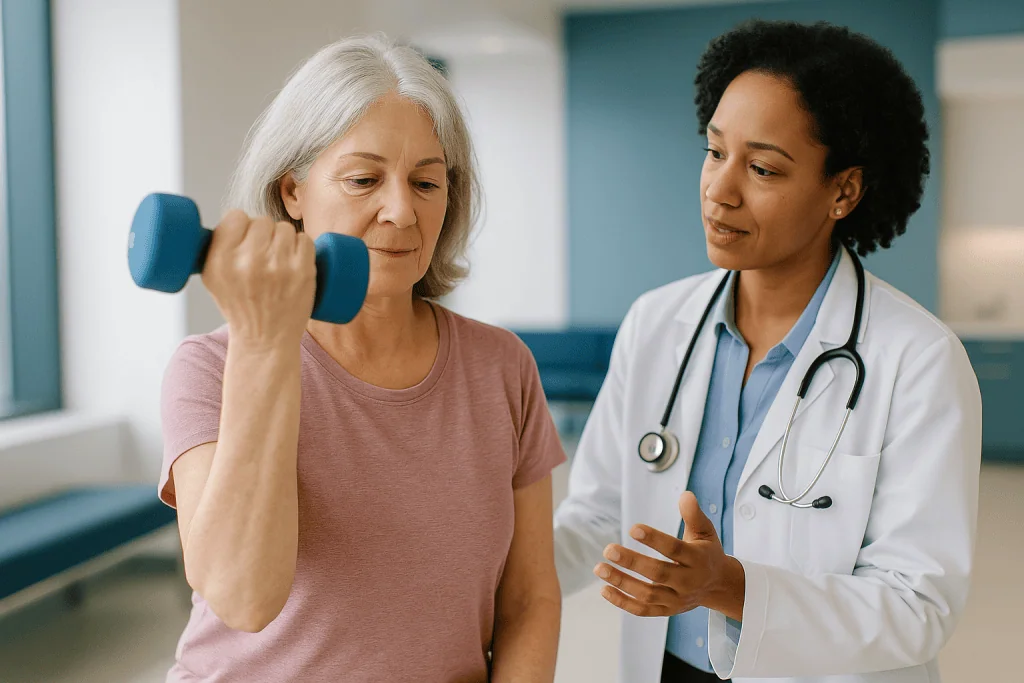
What exercise changes is the signal that tells osteoblasts to get to work. Buried inside bone are osteocytes, sensor cells wired into a network of tiny canals. When a bone bends slightly under load, fluid shifts through those canals and the osteocytes register the strain. Enough strain, applied fast enough, and they release chemical messengers that recruit osteoblasts to that exact spot. Too little strain, as in bed rest or spaceflight, and the same network signals for bone to be removed. Physiologists call this the mechanostat, bone’s internal thermostat for load.
Three features of the mechanostat shape every good program. Bone responds to the magnitude of strain more than to repetition, so a heavy squat beats a thousand light leg lifts. It responds to the rate of loading, which is why a hop stimulates more than a slow step of equal force. And it adapts locally: loading the hips does nothing for the wrists. Tennis players show 10–20 percent more bone in the racket arm than the other, a natural experiment that illustrates the point.
The cells also habituate quickly. Animal and human data suggest osteocytes stop responding after roughly 20–40 loading cycles in a session and need several hours to reset. That is why short, intense, varied bouts spread across the week outperform long monotonous ones, and why this topic is really about physics applied to biology.
What the evidence actually says about bone density exercises
Grading the evidence matters here, because the gap between the strongest and weakest claims is wide.
Strong evidence, from randomized controlled trials: progressive resistance training combined with impact or jumping improves or preserves bone mineral density at the lumbar spine and hip in postmenopausal women and older men. Meta-analyses of dozens of trials find average gains of about 1–3 percent at the spine and roughly 1 percent at the hip over 6–12 months, compared with ongoing losses of 1–2 percent a year in untreated controls. LIFTMOR and its male counterpart, LIFTMOR-M (2020), showed the largest effects when loads were heavy and supervised.
Strong evidence for a different outcome: balance and strength training reduce falls in older adults by around 20–30 percent across many trials, including tai chi programs. Since nine out of ten hip fractures follow a fall, this may be the more important number.
Moderate evidence, from randomized trials and cohorts: exercise improves muscle strength, gait speed and posture in people with osteoporosis, and back extensor strengthening is linked to fewer new vertebral fractures in one long-term follow-up study.
Weak or observational evidence: walking alone, yoga and Pilates show small or inconsistent effects on density. Osteogenic loading machines have small, mostly uncontrolled studies behind them.
Not yet demonstrated: no large trial has proved that exercise alone prevents fractures the way prescription bone medicines have. Trials would need thousands of participants followed for years, and they have not been done. The honest framing: exercise is proven to build measurable bone and to prevent falls, and it is a strongly recommended companion to, not a proven replacement for, medical treatment when a clinician advises it.
Which exercises count as impact training, and how much is enough?
Impact training means movements where the body briefly leaves the ground or lands with force, so that the skeleton absorbs a shock several times body weight. A brisk walk loads the hip at about 1–1.5 times body weight. A jog roughly doubles that. A two-footed hop from standing produces three to four times body weight through the heel, femur and spine in a few milliseconds, exactly the fast, high-magnitude strain osteocytes respond to.
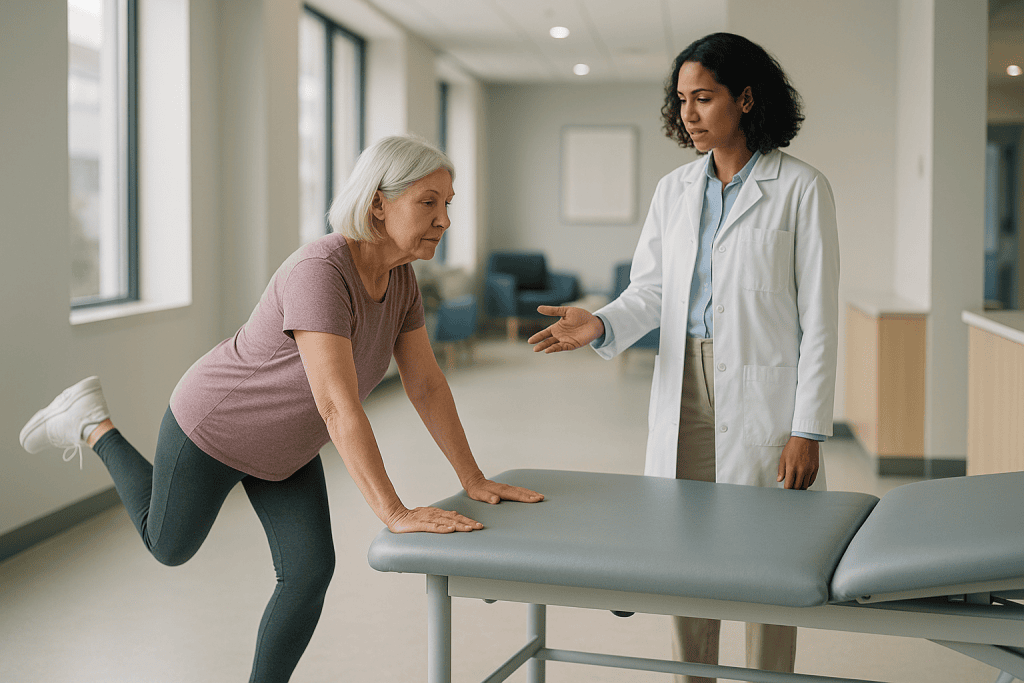
The trial data point to surprisingly small volumes. Studies in premenopausal and postmenopausal women found that 10–50 jumps a day, performed in short clusters with brief rests, improved hip density within 6–12 months. The LIFTMOR protocol used jumping chin-ups with a controlled drop landing, five sets of five, as its only impact element. Nobody in these trials bounced for an hour.
Progression is the part most online videos skip. A sensible ladder, agreed with a clinician if you already have low bone mass, usually runs:
- Heel drops: rise onto the toes and let the heels fall firmly to the floor, 10–20 times.
- Stair stomps and brisk stepping with a deliberate heel strike.
- Small two-footed hops in place, progressing to hops onto a low step.
- Single-leg hops, skipping or short jogging intervals for those cleared for higher impact.
People with diagnosed osteoporosis, a previous spine fracture, significant arthritis or balance problems may be advised to stay at the lower rungs, where heel drops and stomping still deliver a useful signal without a landing to misjudge. Variety also matters: side-to-side and multidirectional hops load the hip from angles that straight-ahead movement never reaches, and bone responds most to strain patterns it has not seen before.
Resistance training for osteoporosis: why the load has to be heavy
Resistance training means working muscles against an external load, whether a barbell, machine, band or body weight. Muscles pull on bone through tendons, and the bigger the pull, the greater the bending strain inside the bone. That mechanical fact explains an uncomfortable finding: low-load, high-repetition routines, the pink-dumbbell approach long recommended to older women, have repeatedly shown little or no effect on density in trials. The bone simply never feels enough strain to change.
Programs that moved the needle shared common features. LIFTMOR participants trained at more than 80 percent of their one-repetition maximum, the heaviest weight they could lift once, in sets of five on three lifts: the deadlift, the back squat and the overhead press. Each session lasted 30 minutes, twice a week, always with a qualified supervisor watching technique. The first month used body weight and light loads purely to learn the movements. Nobody started heavy.
Those three lifts were chosen because they load the two places that fracture most. Squats and deadlifts drive compressive force through the femoral neck and lumbar vertebrae. Overhead pressing loads the spine axially while strengthening the shoulder girdle that keeps posture upright. Rows and back extensions, used in other trials, build the muscles along the spine that resist the forward curve associated with vertebral compression fractures.
Heavy does not mean reckless. Trial safety records are good precisely because loads were individually prescribed and increased slowly, by a few percent when the previous weight became manageable. The practical lesson for a reader over 50 is not to copy a video, but to ask for a supervised introduction to the big compound lifts, start with technique, and treat the last few repetitions of a set as the point where bone adaptation actually begins.
Why balance training matters as much as the density number
A bone density scan measures mineral per square centimeter, but a fracture is an event, and most fractures in later life start with a fall. The CDC reports that about one in four adults aged 65 and older falls each year, and that falls cause more than 95 percent of hip fractures. Improving density by 3 percent while leaving balance untouched addresses the smaller half of the risk equation.
Here the evidence is unusually clear. Systematic reviews of randomized trials show that programs combining balance challenges with lower-body strengthening reduce the rate of falls by roughly a quarter, and reduce falls that cause injury by a similar amount. Tai chi, with its slow weight shifts and single-leg stances, has some of the most consistent results. The effect appears with about three hours of practice a week and grows as the challenge increases.
Balance training works by retraining the systems that keep you upright: the inner ear, vision, pressure sensors in the feet and the fast reflexes of the ankle and hip muscles. Standing on one leg while brushing your teeth, walking heel to toe along a hallway line, stepping over small obstacles and practicing sit-to-stand without using your hands all count. The key is to approach the edge of wobble safely, near a counter or wall, rather than avoiding it.
Reaction training deserves a mention. Trials that taught older adults to take a quick corrective step after a deliberate nudge cut subsequent falls substantially, because the body learns to recover rather than freeze. Any bone program that leaves out this component is, in a real sense, only half finished.
Does walking increase bone density? A comparison of exercise types
Walking is where the hopeful and the honest part company. Pooled trial data in postmenopausal women show that walking programs produce little or no measurable change in spine density and only small, inconsistent benefits at the hip, largely because the forces involved sit close to what the skeleton already experiences every day. Walking remains excellent for the heart, mood, weight control and endurance, and it keeps people active enough to do everything else. As a bone builder on its own, it is close to neutral. The table summarizes how the main options compare.
| Exercise type | Load on bone | Effect on density | Effect on falls | Strength of evidence |
|---|---|---|---|---|
| Heavy resistance training | High, targeted to spine and hip | Gain of about 1–3% at spine, roughly 1% at hip | Moderate reduction | Strong (multiple RCTs) |
| Impact: hopping, jumping, stair stomps | High and fast, 3–4 times body weight | Hip gains of about 1–2% in 6–12 months | Small | Strong to moderate (RCTs) |
| Balance and tai chi | Low | Minimal | Falls reduced by about 20–30% | Strong (many RCTs) |
| Brisk walking | Low to moderate, 1–1.5 times body weight | Little to none at spine, small at hip | Small | Moderate (mixed trials) |
| Yoga and Pilates | Low to moderate | Small or unproven | Moderate for balance-focused forms | Weak |
| Swimming and cycling | Very low, non-weight-bearing | None; possibly lower density in dedicated athletes | None directly | Observational |
The pattern is unmistakable. Density follows load, falls follow balance, and the two together follow a program rather than a single activity.
Is yoga good for osteoporosis?
Yoga is the exercise people most want to be a bone builder, and the evidence is politely unconvinced. The most-cited study, a decade-long project in which participants held a dozen postures daily, reported density gains at the spine and hip, but it had no randomized control group, relied on self-selected volunteers and lost most participants to follow-up. Smaller randomized trials since then have found either no change in density or changes too small to separate from measurement noise. Graded honestly, the density claim rests on weak, observational evidence.
That is not the same as saying yoga is useless for bone health. Standing balance postures such as tree pose and warrior variations train the same stability systems that reduce falls. Gentle back-extension postures strengthen the muscles that hold the spine upright, and programs that improved posture have been associated with fewer vertebral fractures. Flexibility in the hips and ankles makes a protective step easier to take.
The caution is specific and important. Deep forward bends, seated twists and rolling the spine down vertebra by vertebra put the front of the vertebral bodies under compression, which is exactly where osteoporotic spine fractures happen. Case reports have documented fractures in people with low bone mass performing exactly those movements. Many yoga teachers now offer modified classes that keep the spine long, hinge from the hips and avoid loaded flexion, and anyone with a diagnosis should ask for one.
A fair summary: yoga belongs in a bone program as the balance and posture component, not as the load. Pair it with resistance and impact work, choose the modified version if you have osteopenia or osteoporosis, and treat any teacher who promises it will rebuild your spine as selling optimism rather than evidence.
The program that builds bone after 50: a week your clinician can adapt
Trials give the ingredients; the weekly structure below arranges them in the way the mechanostat favors, with heavy loading separated by recovery days and short impact bouts spread out rather than bunched. It is a template for a conversation with a clinician or physical therapist, not a prescription, and the starting level depends on scan results, fracture history and current fitness.
Two resistance days (for example Monday and Thursday). Warm up with five minutes of brisk movement, then perform three to four compound lifts: a squat or leg press, a hinge such as a deadlift or hip hinge with a kettlebell, a row, and an overhead or incline press. Work toward sets of five to eight repetitions at a load where the last repetition is genuinely hard but technique stays clean. Spend the first four to six weeks learning movements with light loads. Progress by adding a little weight when all sets feel controlled. Finish with back extensions on the floor or a bench.
Daily impact clusters. On most days, perform two or three clusters of 10 heel drops, stomps or hops, with a minute of rest between clusters. The total takes under five minutes. Vary direction.
Two or three balance sessions. Ten minutes of single-leg stands, tandem walking, sit-to-stands and step-overs, or a tai chi or modified yoga class.
Aerobic base. Fit in the 150 weekly minutes of moderate activity the CDC recommends; walking counts fully here even though it does not build density.
Expect the bone changes to be invisible for a while. The remodeling cycle takes three to six months to complete, and density differences usually become measurable on a scan only after 6–12 months of consistent training, which is why repeat scans are rarely scheduled sooner.
Osteoporosis exercises to avoid, and the safer swap for each
The movements that hurt osteoporotic bone are not the heavy ones; they are the ones that bend or twist a fragile spine under load, or that set up a fall. Vertebral bodies fail at the front edge when the trunk rounds forward against resistance, so the avoid list is really a list of loaded spinal flexion and rotation.
- Sit-ups, crunches and toe touches. Swap for planks, dead bugs and bird dogs, which train the trunk while the spine stays long.
- Rounded-back lifting of any object, from a barbell to a grandchild. Swap for a hip hinge: bend at the hips and knees, chest up, load close to the body.
- Loaded twists such as Russian twists, golf swings with poor form, or seated twisting machines. Swap for anti-rotation work like a Pallof press with a band.
- Deep forward bends in yoga or Pilates, including the roll-down. Swap for hip-hinge variations with a neutral spine.
- High-risk impact such as trampolines, step aerobics on wet floors or sports with sudden direction changes, if balance is already poor. Swap for heel drops and controlled hops near a stable surface.
Context changes the list. A person with osteopenia and good balance may be cleared for far more than someone with two previous vertebral fractures, and a physical therapist who has seen the scan can draw the line precisely. The general principle from both Mayo Clinic and NHS guidance is that people with osteoporosis should keep exercising, because inactivity accelerates loss, while avoiding spinal flexion under load and situations that invite a fall.
Pain is the signal to respect. Muscle fatigue the day after a session is expected; sharp pain in the mid-back during or after exercise, especially with a feeling of having shrunk or a new stooped posture, is not, and belongs in the next section.
What foods are good for bone strength?
Exercise sends the signal to build; food supplies the bricks. Bone mineral is mostly calcium phosphate laid onto a collagen framework, and the body will quietly draw calcium from the skeleton to keep blood levels steady if intake falls short. The NIH Office of Dietary Supplements lists the recommended daily calcium intake at 1,000 mg for men aged 51–70 and 1,200 mg for women over 50 and men over 70, with vitamin D at 600 IU to age 70 and 800 IU after, because vitamin D governs how much calcium the gut can absorb.
Those targets are reachable from food for most people. A cup of milk or fortified plant milk carries about 300 mg of calcium; a cup of plain yogurt about 400 mg; a serving of canned sardines or salmon eaten with the soft bones roughly 325 mg; a cup of cooked kale or bok choy around 150 mg; tofu set with calcium salts up to 400 mg per half cup. Spinach is often listed but its calcium is poorly absorbed because of oxalate.
Vitamin D is harder to eat. Oily fish, egg yolks and fortified foods help, but skin exposure to sunlight supplies most of it, and that falls off with age, latitude and sunscreen. Whether a supplement is appropriate is a question for a clinician, who may check a blood level first.
Protein matters more than older advice suggested. Observational studies and some trials link adequate protein, around 1–1.2 grams per kilogram of body weight daily in older adults, to higher density and fewer hip fractures, probably because it supports the muscle that loads the bone. Potassium and magnesium from fruit, vegetables, beans and nuts round out the picture. No single superfood stands out in the data; a pattern that resembles a Mediterranean diet with dairy or fortified alternatives is what the evidence supports.
What T-score indicates osteoporosis, and what does it mean for training?
A T-score is the number on a bone density report that compares your result with the average peak bone density of a healthy young adult of the same sex, expressed in standard deviations. The scan itself is a DXA, a low-dose X-ray of the hip and lumbar spine that takes about ten minutes. According to the World Health Organization definitions used by MedlinePlus and Mayo Clinic:
- A T-score of -1.0 or higher is normal.
- A T-score between -1.0 and -2.5 is osteopenia, or low bone mass.
- A T-score of -2.5 or lower is osteoporosis.
- A T-score of -2.5 or lower plus a fragility fracture, one from a fall at standing height or less, is sometimes called severe or established osteoporosis.
Each whole point lower roughly doubles fracture risk, so -3.0 is a meaningfully different situation from -1.5. Reports also show a Z-score, which compares you with people your own age; a very low Z-score prompts a search for other causes such as thyroid or parathyroid disease, celiac disease or long-term steroid use.
The score shapes the exercise conversation in practical ways. Someone in the normal or mild osteopenia range with no fracture history is usually a candidate for the full ladder, including heavier lifting and hopping, with supervision while learning. Someone at -2.5 or below is still strongly encouraged to train, since trials included exactly this group, but with closer attention to spinal alignment, lower-impact options and professional oversight. A previous vertebral fracture tightens the restrictions further.
The T-score also decides something exercise cannot: whether a clinician recommends a prescription bone medicine. That judgment weighs the score together with age, fracture history and a calculated ten-year fracture probability, and the decision belongs to the person and their prescriber. Exercise is part of every one of those plans.
Common myths about bone density exercises, corrected
Myth: heavy weights are dangerous once you have osteoporosis. The randomized trials that produced the largest density gains enrolled women with osteopenia and osteoporosis and reported very few injuries, because loads were supervised and progressed gradually. The danger lies in rounded-back lifting and sudden unsupervised jumps in weight, not in the weight itself.
Myth: four minutes a week on a special machine replaces a program. Osteogenic loading devices have small, mostly uncontrolled, often company-funded studies behind them. No head-to-head randomized trial has shown they match conventional resistance and impact training, and they do nothing for balance or falls.
Myth: walking 10,000 steps protects your bones. Walking protects your heart and keeps you mobile, which matters enormously, but pooled trials show little effect on spine density and only small hip changes. It is the base of the program, not the bone-building part.
Myth: swimming and cycling are the safe way to build bone after 50. Both are excellent for fitness and joint-friendly, but the skeleton is unloaded during both. Elite cyclists and swimmers have, if anything, lower density than sedentary peers in observational studies. Add land-based loading.
Myth: once you are on a bone medicine, exercise no longer matters. Medicines and exercise work through different mechanisms, one slowing removal and the other stimulating building and preventing falls. Guidance from Mayo Clinic, the NHS and MedlinePlus recommends both together. Never adjust a prescribed medicine on your own.
Myth: yoga alone rebuilt someone’s spine, so it will rebuild yours. The headline study had no control group and lost most participants. Yoga earns its place for balance and posture; the density claim remains unproven.
Myth: it is too late after 70. Trials in participants aged into their eighties show strength gains of 30 percent or more and measurable fall reduction. Bone responds more slowly with age, but the fall-prevention benefit arrives within months.
When to see a doctor before or during a bone density exercise program
Most healthy adults over 50 can begin walking, balance drills and light resistance work without a special appointment. A conversation with a clinician first makes sense if you have been told you have osteopenia or osteoporosis, have broken a bone from a minor fall or bump, take long-term corticosteroids or aromatase inhibitors, have lost more than an inch and a half of height, or have heart, lung or joint disease that limits exertion. Ask whether a DXA scan is appropriate; US and UK guidance supports screening for women from 65 and for younger postmenopausal women and men with risk factors. A referral to a physical therapist who works with osteoporosis is the most useful outcome of that visit, because the program can then be matched to your scan.
Seek care promptly, rather than waiting for a routine appointment, if any of the following appears during or after exercise:
- Sudden, sharp pain in the mid or lower back, particularly after lifting, bending or a jolt, which can signal a vertebral compression fracture even without a fall.
- Pain in the groin, hip or thigh that makes weight-bearing difficult, especially after any fall.
- New numbness, tingling, weakness in the legs, or changes in bladder or bowel control.
- A noticeable new stoop or loss of height over weeks.
- Chest pain, unusual breathlessness, dizziness or fainting with exertion.
- A fall that strikes the head, or any fall followed by confusion or persistent pain.
Discuss, rather than decide alone, any question about starting, pausing or changing a prescription bone medicine, calcium or vitamin D supplement, or hormone therapy. These decisions depend on your scan, fracture probability and other conditions, and belong with the prescribing clinician. Exercise is the part of the plan you control; the medical half deserves the same evidence-first attention, in the room with the person who knows your results.
Frequently asked questions
Can you recommend YouTube exercises for osteoporosis?
Rather than a specific channel, look for videos led by a licensed physical therapist or exercise physiologist who states which T-score range the routine suits. Good ones keep the spine neutral, show a hip hinge instead of forward bends, include heel drops or small hops, and add single-leg balance work. Treat any video promising to rebuild bone in minutes a week as entertainment. Ask your clinician or therapist to review your chosen routine.
What foods are good for bone strength?
Dairy or calcium-fortified plant milks, yogurt, canned sardines and salmon with bones, calcium-set tofu, kale and bok choy supply the most absorbable calcium. Oily fish, egg yolks and fortified foods add vitamin D. Adequate protein from fish, poultry, beans and dairy supports the muscle that loads bone, and fruit and vegetables contribute potassium and magnesium. A Mediterranean-style pattern with dairy or fortified alternatives matches the evidence best.
What is the T-score for osteoporosis?
A T-score of -2.5 or lower at the hip or spine on a DXA scan indicates osteoporosis, according to World Health Organization criteria. Scores between -1.0 and -2.5 indicate osteopenia, and -1.0 or higher is normal. The T-score compares your density with a healthy young adult’s; a Z-score compares you with people your own age. Your clinician combines the score with age and fracture history to decide on treatment.
Is yoga for osteoporosis safe and effective?
Yoga is safe and useful for balance and posture when forward bends, loaded twists and spinal roll-downs are removed, which many studios now offer as a modified class. Evidence that it increases bone density is weak, resting largely on an uncontrolled study with heavy dropout. Use it as the balance and posture component of a program alongside resistance and impact work, and tell your teacher about your diagnosis.
Does walking increase bone density after 50?
Not meaningfully. Pooled randomized trials in postmenopausal women show little or no change in spine density from walking programs and only small, inconsistent effects at the hip, because the forces are close to everyday loading. Walking still earns its place for heart health, mood and endurance, and adding brisk heel strikes, stairs or short hop clusters can turn a walk into a modest bone stimulus.
What are the main osteoporosis exercises to avoid?
Avoid movements that round or twist the spine under load: sit-ups, crunches, toe touches, rounded-back lifting, loaded seated twists and deep yoga forward bends. High-fall-risk activities such as trampolines or sudden-direction sports should be approached cautiously if balance is poor. Swap in planks, bird dogs, hip hinges and anti-rotation band work. A physical therapist who has seen your scan can personalize the list.
How long before exercise changes a bone density scan?
Usually 6–12 months of consistent training before a difference becomes measurable, because a full bone remodeling cycle takes three to six months and DXA scans cannot reliably detect changes smaller than about 2–3 percent. Strength and balance improve within weeks, and fall risk drops within a few months. Clinicians rarely repeat a scan sooner than one to two years for this reason.
Can exercise replace osteoporosis medicine?
The evidence does not support that. Exercise builds measurable density and clearly reduces falls, but no large trial has shown it prevents fractures the way prescription bone medicines have in randomized studies. Guidance from Mayo Clinic, the NHS and MedlinePlus recommends exercise alongside, not instead of, medical treatment when a clinician advises it. Any decision to start, pause or change a medicine belongs with your prescriber.
Is jumping safe if I have osteoporosis?
It depends on your scan, fracture history and balance. Trials that improved hip density with jumping included women with low bone mass, but participants were screened and supervised. People with a previous vertebral fracture, severe osteoporosis or poor balance are usually steered toward heel drops and firm stomps, which still deliver a fast loading signal without a landing to misjudge. Ask your clinician or therapist which rung is right for you.
Are swimming and cycling good for bone density?
They are excellent for cardiovascular fitness and gentle on joints, but neither loads the skeleton, so they do not build density; observational studies of dedicated swimmers and cyclists sometimes find lower bone density than in sedentary peers. Keep them for fitness and recovery, and add land-based resistance training, short impact clusters and balance work on other days to cover the bone-building and fall-prevention parts of the program.
References
- NHS: Osteoporosis prevention
- MedlinePlus: Osteoporosis
- CDC: Physical activity guidelines for older adults
This article is for general information only and is not a substitute for professional medical advice. Please consult a qualified doctor about your individual situation.

More from the Blog
What Is Normal After Shoulder Replacement and What Is Not: Stiffness, Swelling and Numbness
After shoulder replacement, stiffness, swelling that drifts down to the hand, bruising, and patches of numbness around the incision are common and usually ease…
Preparing for Knee Replacement: The Tests and Medication Checks Your Team Orders First
To prepare for knee replacement surgery, most teams first order a pre-assessment visit with blood tests (blood count, kidney function, blood sugar, clotting and…
Is the Ponseti Cast Slipping? Toe Checks, Swelling and Problems That Need a Same-Day Call
A Ponseti cast may be slipping if your baby's toes, which were visible at the cast edge, begin disappearing inside it, if the cast…
Why Daily Physical Therapy Matters During Limb Lengthening: Joints, Muscles and Nerves
Physical therapy during limb lengthening matters because the bone is pulled apart roughly a millimeter a day while muscles, tendons, joint capsules and nerves…
Who Is a Good Candidate for Ankle Replacement? Arthritis Type, Alignment and Activity
A good ankle replacement candidate is usually an adult with end-stage ankle arthritis (osteoarthritis, post-traumatic or inflammatory) whose pain persists despite non-surgical care, whose…
Knee Replacement Abroad: The Verification Checklist Before You Book
Knee replacement abroad can be done safely, but only after independent verification: confirm the surgeon's annual case volume and credentials, the implant's track record…