

Calisthenics: How Bodyweight Training Builds Strength, and Where It Hits a Ceiling

Key Takeaways
- The WHO and CDC count bodyweight exercise as muscle-strengthening activity and recommend it on at least two days a week, with no minimum minutes attached.
- In a ten-year study of 1,104 male firefighters, those who could do more than 40 push-ups had a 96 percent lower rate of cardiovascular events than those doing fewer than 10, an association rather than proof of cause.
- Early strength gains, in roughly the first six to eight weeks, come mostly from the nervous system learning the movement, not from muscle growth.
- Body weight is a heavy load for the arms but a light one for the legs, which is why lower-body progress plateaus first in calisthenics-only programs.
- Tendons adapt over months rather than weeks, so jumping leverage rungs faster than connective tissue can follow is the most common route to elbow and shoulder overuse injuries.
- The "80/20 rule" has never been measured in a training trial; what the evidence supports is spending most of your session on compound movements that recruit the most muscle.
Calisthenics builds strength by loading muscles with your own body weight and progressing through harder leverage, such as moving from incline push-ups to full push-ups to one-arm variations. Small randomized trials and larger observational studies show it improves strength, posture and heart-health markers, especially for beginners. Its ceiling appears in the legs and in maximal strength, where adding external weight eventually becomes the simpler way to keep progressing.
On a chilly Saturday, a woman in her sixties hangs from a playground pull-up bar while her grandson counts out loud. She manages one slow, honest repetition, drops to the ground and laughs. Ten yards away a teenager is filming himself attempting a muscle-up for a clip he will post before lunch. Both are doing calisthenics, and, as of early 2026, both are part of the reason the word is climbing search charts.
The trend has a few engines. Short-form videos promising an “80/20 rule” for bodyweight training have gone viral. Pull-up and push-up challenges keep resurfacing. Many people who signed up for gyms after the pandemic are quietly canceling and asking whether a floor and a bar can do the same job.
The honest answer is more interesting than either camp admits. Bodyweight training builds real strength, and the evidence for that is decent. It also runs into a ceiling that no amount of enthusiasm removes. This piece explains both, with the evidence graded rather than cheered.
What are calisthenics workouts, exactly?
Calisthenics is strength and movement training that uses your own body as the load. Push-ups, squats, lunges, pull-ups, dips, planks and their many cousins all qualify. The word comes from the Greek for “beauty” and “strength,” which tells you how long people have been doing this: 19th-century schools taught it in rows, and military physical training has never abandoned it.
What separates calisthenics from simply “moving around” is intent. A calisthenics workout applies progressive overload, which means gradually asking the muscles to do more than they did last time, either through more repetitions, slower tempo, harder leverage or less rest. Without that ratchet, a set of push-ups is exercise but not really training.
Most routines fall into three families:
- Foundational movements: squats, push-ups, rows, hinges and planks that cover the major muscle groups and translate directly to daily life.
- Skill movements: handstands, muscle-ups, front levers and pistol squats, where balance and coordination matter as much as raw strength.
- Conditioning formats: circuits of burpees, jumping jacks and mountain climbers performed for time, which lean toward cardiovascular fitness.
The equipment list is short by design. A floor, a wall and something sturdy to hang from cover almost everything. That accessibility is the reason public-health agencies like it: the World Health Organization and the CDC both recommend muscle-strengthening activity on at least two days a week, and neither specifies that the resistance must come from a barbell. Your body counts. The question, and the reason this article exists, is how far your body alone can take you.
What changed recently: why calisthenics is trending in 2026
Nothing about the human body changed. What changed is the volume and confidence of the claims circulating around it, and a few pieces of evidence that keep getting rediscovered.
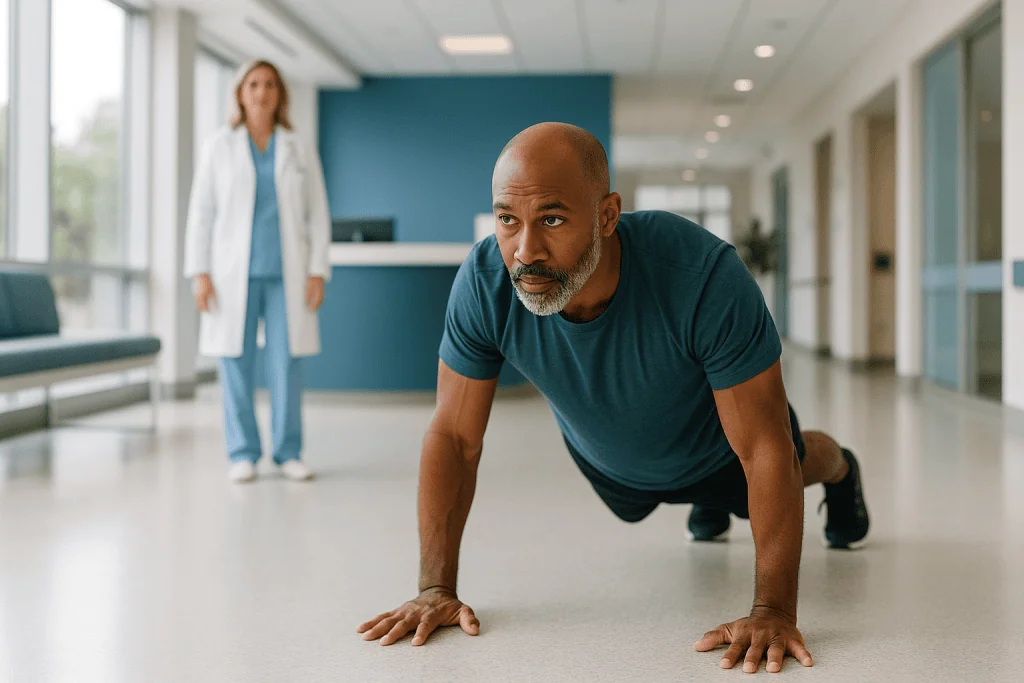
The guideline backdrop was set in November 2020, when the WHO published updated physical activity recommendations: 150 to 300 minutes of moderate aerobic activity weekly, plus muscle-strengthening work on two or more days. The CDC’s adult guidance, built on the 2018 U.S. Physical Activity Guidelines, says the same. Both documents explicitly count bodyweight exercise as muscle-strengthening activity, which gives calisthenics an official seat at the table that it did not have in the same words a generation ago.
The study that fuels the most viral clips appeared in JAMA Network Open in February 2019. Researchers followed 1,104 male firefighters, average age about 40, for ten years. Men who could complete more than 40 push-ups at baseline had a 96 percent lower rate of cardiovascular events than men who managed fewer than 10. That number is real. It is also observational, in men only, and in a physically demanding profession, so it shows an association, not proof that doing push-ups causes the protection. Push-up capacity was probably a proxy for overall fitness, body weight and health habits.
Layered on top are social-media formats: 30-day pull-up challenges, the “80/20 rule” and comparison videos pitting bodyweight athletes against gym lifters. These drive curiosity but not evidence. Where a claim below rests on a randomized trial, an observational study or expert opinion, the text says so, because those three categories deserve very different levels of trust.
How bodyweight training builds strength
Muscle does not know what is pressing on it. It responds to mechanical tension, the force it must generate to move or hold a load, and to how close a set comes to the point where you cannot complete another repetition. A barbell and a push-up can create the same tension; they just get there differently.
Three levers do the work in calisthenics:
- Leverage. Raising your hands on a bench makes a push-up easier because more of your weight rests on your feet. Elevating your feet does the opposite. Shifting the same body along a longer lever is how a bodyweight athlete “adds weight” without a plate.
- Tempo and range. A three-second lowering phase, called an eccentric contraction, recruits muscle differently from a bounce. Pausing at the bottom removes the elastic rebound that makes fast reps easier.
- Volume and density. More total repetitions, or the same repetitions in less time, increase the training stimulus.
Strength itself has two components. Early gains, typically in the first six to eight weeks, come mostly from the nervous system learning to coordinate the movement and recruit more muscle fibers at once. Later gains depend more on hypertrophy, the growth of muscle fibers, which needs sets taken reasonably close to failure and enough weekly volume. Both processes happen with bodyweight loads. The upper body, where push-ups, dips and pull-ups can be made brutally hard, responds especially well.
Bone responds too. Weight-bearing loads and the pull of working muscle on bone stimulate bone-building cells, which is why Mayo Clinic lists strength training among the measures that support bone density. That effect scales with load, a point that returns later, because it is where the ceiling begins.
What the evidence actually says about calisthenics
Grading matters, so here is the evidence sorted by strength.

Randomized and controlled trials (moderate confidence, small samples). Several short trials, mostly eight to twelve weeks and involving a few dozen participants, have compared calisthenics programs with no training or with conventional exercise. They consistently show gains in push-up and pull-up performance, improved posture measures and modest reductions in body fat. The limitations are obvious: small groups, mostly young adults, short durations and outcome measures that are themselves calisthenics exercises, which flatters the intervention.
Randomized trials of resistance training in general (high confidence). Decades of trials show that resistance training improves muscle strength, bone density, blood sugar control and daily function across ages, including adults over 65. Bodyweight exercise is one method within those trials, though usually not isolated, so much of what we know about calisthenics is inferred from this broader base rather than tested directly.
Observational data (moderate confidence for association, low for causation). The firefighter push-up study is the standout. Large cohort studies also link muscle-strengthening activity twice weekly with lower all-cause mortality. These cannot separate the exercise from the kind of person who does it.
Expert consensus (useful, not proof). Guidelines from the WHO, CDC and NHS recommend muscle-strengthening on two or more days weekly and accept bodyweight exercise as a valid form. Harvard Health has described calisthenics as an effective, low-frills way to stay fit, largely on the basis of the evidence above.
The honest summary: strong evidence that resistance training works, moderate evidence that calisthenics delivers it for beginners and intermediates, and thin evidence on long-term outcomes specific to bodyweight-only programs.
Is calisthenics better than gym training with weights?
“Better” hides the real question, which is better for what. The physiology is neutral: a muscle asked to produce high tension near failure adapts, whether the load is iron or you. Where the two approaches differ is in how easily they let you keep raising that demand, and in what else they train along the way.
| Factor | Calisthenics | Free weights / machines |
|---|---|---|
| Progressive overload | Via leverage, tempo and skill; excellent for upper body, limited for legs | Via added load in small increments; straightforward for every muscle group |
| Maximal strength | Plateaus once body weight is no longer a heavy enough load | Essentially unlimited ceiling |
| Balance and coordination | Built into most movements | Present with free weights, minimal with machines |
| Joint and tendon demand | High in advanced skills (levers, one-arm work) | Adjustable; easier to keep loads moderate |
| Access and cost of entry | Floor, wall, bar | Requires equipment or a facility |
| Evidence base | Small trials plus inference from resistance-training literature | Large, decades-long randomized evidence |
For a beginner, the comparison is nearly a draw. For an older adult prioritizing fall prevention, calisthenics offers a real advantage because its movements demand balance in ways a leg-press machine does not. For someone chasing maximal strength or trying to rebuild bone density after a low-density diagnosis, weights let you apply larger loads with less skill and less joint strain.
The most evidence-consistent answer is that the two are not rivals. Many long-term trainees use bodyweight work for the upper body and skills, then add external load for the legs and hinge patterns. Choosing one camp is a cultural decision, not a physiological one.
Is 20 minutes of calisthenics enough?
Enough for what? Twenty focused minutes clears the bar public-health guidelines set for muscle-strengthening activity, which is “two or more days a week” with no minimum duration attached. The WHO and CDC frame strengthening in days, not minutes, because the evidence for a dose threshold is thin. On the aerobic side, 20 minutes on most days gets an adult within range of the 150-minute weekly minimum, provided the effort is genuinely moderate or vigorous.
Where 20 minutes falls short is in what it can carry. The muscles’ response depends on sets performed reasonably close to failure and on total weekly volume. A 20-minute session can hold roughly four to six quality working sets per major movement pattern if rest is short and the exercises are chosen well. That is a respectable stimulus for a beginner and a maintenance dose for an intermediate. It is not a route to advanced skills, which need longer sessions to accommodate warm-up, practice and adequate rest between attempts.
Structure matters more than the clock. Twenty minutes of jumping jacks and high knees is cardiovascular conditioning with little strength benefit; the same 20 minutes spent on slow push-ups, single-leg squats and rows is a strength session. Circuit formats that alternate upper and lower body can compress the work by letting one region recover while the other works.
A practical reading of the evidence: if 20 minutes is what fits, spend it on three or four hard movements rather than a dozen easy ones, keep two to three sessions a week, and treat the total across the week, not the length of any one session, as the number that counts.
What is the 80/20 rule in calisthenics?
The phrase is borrowed from the Pareto principle, the observation that roughly 80 percent of outcomes tend to flow from about 20 percent of inputs. Applied to calisthenics, it is used to mean that a small number of basic movements produce most of the results, and that flashy skills add little for most people. That interpretation is defensible. It aligns with how strength coaches have long prioritized compound movements, meaning exercises that use several joints and large muscle groups at once, over isolated ones.
Two other versions circulate. One holds that training should be 80 percent basics and 20 percent skill work. The other insists that 80 percent of effort should stay well below failure, with only 20 percent pushed hard, an idea imported from endurance sport’s polarized training model. Neither has been tested in a calisthenics trial, and the second version is on shakier ground for strength: the resistance-training literature suggests that sets stopped very far from failure produce smaller hypertrophy gains, particularly with the light relative loads bodyweight often provides.
The kernel worth keeping is the ranking. If time is short, these patterns deliver most of the return:
- A squat or lunge variation for the lower body
- A horizontal push (push-up family)
- A vertical or horizontal pull (pull-ups or rows)
- A hinge such as a single-leg bridge or nordic curl
- A brace such as a plank or hollow hold
Treat the numbers as a memorable slogan rather than a prescription. No study has measured 80 or 20 percent of anything in this context; what the evidence supports is spending most of your training time on movements that recruit the most muscle.
Where calisthenics hits a ceiling: the leg problem
Here is the ceiling in one sentence. Your body weight is a fixed load, and while it is heavy relative to your arms, it is light relative to your legs.
The average adult’s legs and hips can, with training, squat considerably more than body weight. A bodyweight squat quickly becomes a movement you could repeat 50 or 100 times, which trains endurance more than strength. Calisthenics has answers, but each carries a cost:
- Single-leg squats (pistols) roughly double the load per leg but demand ankle mobility and balance that many adults lack, turning a strength exercise into a skill exercise.
- Nordic hamstring curls load the back of the thigh hard and have randomized evidence for reducing hamstring injury in athletes, but they need a partner or an anchor and provoke soreness that limits frequency.
- Plyometrics, meaning jumping and bounding exercises, add force through speed rather than load, and they raise joint stress considerably.
- Slow tempo and pauses extend the challenge but eventually top out as well.
By comparison, adding a small amount of external load to a squat raises the demand in a predictable, adjustable way with no new skill required. This is why trials that show the largest lower-body strength and bone-density gains in older adults typically use added resistance, whether machines, bands or weighted vests, rather than body weight alone.
None of this means bodyweight leg work is useless. For a beginner, deconditioned adult or someone recovering from a long layoff, air squats and step-ups are exactly right, and the balance component earns its keep. The ceiling simply arrives sooner for the legs than anywhere else, often within the first year of consistent training. Recognizing that early prevents months of stalled progress.
The second ceiling: when strength becomes skill
Advanced calisthenics confounds an idea that gym training keeps clean: the separation between how strong a muscle is and how well the nervous system can use it. A front lever, in which the body hangs horizontal under a bar, requires enormous lat, core and shoulder strength. It also requires precise timing, scapular control and tolerance for stress on the elbow and biceps tendons that has little to do with muscle size.
Progress in these skills can stall for months even as the underlying muscles keep growing, because the missing piece is coordination or connective-tissue adaptation, which follows a slower timeline than muscle. Tendons remodel over months to years rather than weeks. Pushing skill work faster than tendons adapt is the classic route to the overuse injuries that show up in sports medicine clinics: elbow tendinopathy, shoulder impingement and wrist pain from handstand volume.
Two further limits deserve naming. The first is measurability. A gym lifter knows the exact load lifted last week. A bodyweight athlete judging a “harder” push-up angle is estimating, which makes fine-tuned progression harder and makes it easier to drift into doing too much or too little. The second is the bone-density question. Strength training supports bone, and the evidence for that is strong, but the largest effects in trials come from higher external loads and impact. Bodyweight-only programs likely help; whether they help as much for someone whose clinician has raised concerns about bone density is not established, and that conversation belongs with the clinician.
The mature view is that calisthenics is exceptional at building relative strength, meaning strength per unit of body weight, along with control and mobility. It is less efficient at building absolute strength or maximal bone loading. Knowing which of those you want tells you when to add a weight.
A beginner bodyweight workout: how to structure a week
The most reliable predictor of results in any training study is adherence, so the best program is one you will actually repeat. The structure below reflects guideline recommendations and the principles above rather than a proprietary system; think of it as a template to adjust, not a prescription.
Frequency. Two full-body sessions a week satisfy public-health guidance. Three lets each movement be practiced more often, which speeds the early nervous-system learning phase.
Session shape. A five-minute warm-up of easy movement, then three to five main exercises, each performed for three sets, with a couple of minutes of rest between sets. Choose a variation of each movement that lets you complete somewhere between eight and fifteen repetitions with the last two feeling genuinely hard.
Movement picks for the first months:
- Squat pattern: box squat or standard squat
- Push: incline push-up on a counter or bench, progressing to the floor
- Pull: inverted row under a sturdy table or low bar
- Hinge: glute bridge, progressing to single leg
- Brace: plank, building toward 45 to 60 seconds
Progress rule. When you can complete the top of your repetition range on all sets with clean form, make the movement harder next session rather than adding more repetitions indefinitely. That single habit is what turns exercise into training.
Recovery. Leave at least one rest day between sessions that hit the same muscles. Soreness that fades within 48 hours is normal; pain that is sharp, one-sided or located in a joint rather than a muscle is not, and the final section covers what to do about it.
Aerobic work still matters. Walking briskly, cycling or a conditioning circuit on other days covers the 150-minute weekly target that strengthening alone does not.
How to progress calisthenics without adding weights
Every bodyweight exercise sits on a ladder. Knowing the rungs is the difference between a program that keeps producing strength for years and one that stalls in a few months.
Push-up ladder. Wall push-up, incline push-up, knee push-up, full push-up, decline push-up with feet elevated, archer push-up (shifting weight toward one arm), then one-arm variations. Each rung roughly increases the fraction of body weight on the arms, from under half to nearly all of it.
Pull ladder. Inverted row at a steep angle, row at a shallow angle, assisted pull-up with a band or feet on a chair, slow negative pull-up (jump up, lower over five seconds), full pull-up, weighted or archer pull-up. The negative rung matters: the eccentric phase is where most people build the strength for their first full repetition.
Squat ladder. Assisted squat holding a support, box squat, full squat, split squat, step-up, Bulgarian split squat with the rear foot elevated, assisted pistol, full pistol.
Between rungs, three dials add difficulty without changing the exercise: slow the lowering phase to three or four seconds, add a pause at the hardest point, or shorten rest. Reaching for these dials before jumping a rung reduces the injury risk that comes from sudden leverage changes.
Two habits keep progression honest. Write down what you did, including the variation and repetitions, because memory flatters. And test rarely rather than constantly; attempting your maximum every session is a skill-sport habit that undermines the steady accumulation strength requires.
When the top rung arrives and the exercise still feels light, or when the top rung demands a skill you cannot safely learn, that is the ceiling. It is also permission, grounded in the evidence on progressive overload, to pick up a weight.
Joints, tendons and the injuries people don't expect
Calisthenics has a reputation as the gentle option. For beginners doing squats and push-ups, that is broadly earned: the loads are moderate and the movements are ones the body performs daily. The picture changes as the leverage climbs.
Muscle adapts to training within weeks. Tendons and ligaments adapt over months, because their blood supply is poorer and their cells turn over slowly. A trainee whose muscles are ready for dips or handstand push-ups may have elbows and shoulders that are not, and the mismatch tends to announce itself as a dull ache that becomes a sharp one. The common sites are the inner and outer elbow, the front of the shoulder, the wrist in handstand work and the lower back in poorly braced leg raises.
Several patterns raise risk, and each has an evidence-informed fix:
- Sudden volume jumps, such as a 30-day challenge that quadruples weekly pull-ups. Increasing weekly volume gradually, by a modest fraction rather than a multiple, is the standard advice in sports-medicine guidance.
- Skipping the intermediate rung. Going from full push-ups to one-arm attempts skips the archer and elevated variations that let tendons catch up.
- Training through pain. Muscle soreness that spreads across a muscle and eases with movement is expected. Pain that localizes to a joint or tendon and worsens with the specific exercise is a signal to modify, not to endure.
- Neglecting the opposite pattern. Heavy pushing with little pulling is associated with the rounded-shoulder posture that calisthenics trials actually show the training can improve when balanced.
Rest days are not lost training. They are when the connective tissue does its slow, unglamorous work.
Common myths about calisthenics
Myth: you cannot build muscle with body weight. False. Muscle responds to tension near failure, and bodyweight exercises can reach that point, especially for the upper body. Small controlled trials show measurable muscle and strength gains. Where the claim has a grain of truth is in the legs, where the load runs out sooner.
Myth: calisthenics is better than weights for “functional” strength. Unproven. “Functional” is rarely defined in the videos that use it. Bodyweight training does load balance and coordination more than machines do, but a well-designed free-weight program does too. No trial has shown one method produces superior everyday function in the general population.
Myth: the push-up study proves push-ups protect your heart. Overstated. The 2019 firefighter study found a strong association between push-up capacity and fewer cardiovascular events over ten years. It was observational, in men in one occupation. Push-up capacity likely stood in for overall fitness and health habits. It is a good reason to be fit, not proof about push-ups specifically.
Myth: the 80/20 rule is a scientific training law. It is a slogan. The idea that basics deliver most results is sound; the specific percentages have never been measured.
Myth: bodyweight training is always joint-friendly. True at the beginner level, misleading at the advanced level. Levers, planches and one-arm work place high loads on elbows and shoulders, and overuse injuries are common when progression outpaces tendon adaptation.
Myth: you need to train every day. Guidelines call for muscle-strengthening on two or more days a week. Daily high-intensity sessions on the same muscles undercut recovery, and there is no evidence that they beat two or three well-structured sessions for most adults.
When to see a doctor before or during calisthenics training
Most adults can start basic bodyweight exercise safely without a medical visit, and both the CDC and NHS say as much. Some situations call for a conversation first, and a few symptoms during training call for stopping and seeking care.
Talk to a clinician before starting if you have heart disease, uncontrolled high blood pressure, diabetes with complications, a recent surgery, a joint replacement, a bone-density diagnosis, are pregnant, or have been largely inactive for years with any chronic condition. A physician or physical therapist can help choose variations that suit your joints and any medication you take, and that decision belongs with them, not with a video.
Stop exercising and seek urgent care if you experience any of these red flags:
- Chest pain, pressure or tightness, or pain spreading to the arm, jaw or back
- Sudden shortness of breath out of proportion to effort
- Fainting, near-fainting or a racing, irregular heartbeat
- A sudden severe headache, confusion, or weakness or numbness on one side
- A pop, snap or sudden loss of strength in a joint or muscle, or a limb that will not bear weight
Book a non-urgent appointment for joint or tendon pain that persists beyond two weeks despite modifying the exercise, swelling that does not settle, numbness or tingling in the hands during pull-ups or handstands, pain that wakes you at night, or exercise that reliably triggers dizziness.
Dark urine with severe muscle pain and weakness after an unusually intense session can signal rhabdomyolysis, a rare breakdown of muscle tissue that needs same-day medical assessment. It is most often reported after extreme first-day efforts, one more argument for progressing gradually.
Calisthenics belongs to a long tradition of low-cost, evidence-supported movement. Used with honest progression and a clear sense of where its ceiling sits, it can carry most adults a long way. Your clinician is the right person to help decide how it fits your health.
Frequently asked questions
What are calisthenics workouts?
Calisthenics workouts are strength and movement sessions that use body weight as the resistance, built from exercises like squats, push-ups, rows, pull-ups, dips and planks. They become training rather than casual exercise when difficulty rises over time through harder leverage, slower tempo, more repetitions or shorter rest. Public-health guidelines count them as muscle-strengthening activity.
Is calisthenics better than gym training?
Neither is universally better; muscle responds to tension, not to the source of load. Calisthenics wins on access, balance and coordination and works well for beginners and upper-body strength. Weights win on adjustable load, maximal strength and lower-body progress, and have a far larger randomized evidence base. Many trainees combine both.
Is 20 minutes of calisthenics enough?
Twenty focused minutes two or three times a week meets guideline recommendations for muscle strengthening and provides a genuine stimulus for beginners. Spend it on three or four hard compound movements rather than many easy ones. It is a maintenance dose for intermediates and insufficient for advanced skill work, and it does not replace weekly aerobic activity.
What is the 80/20 rule in calisthenics?
The 80/20 rule is a slogan borrowed from the Pareto principle, suggesting that a few basic movements produce most of the results. Some versions mean 80 percent basics and 20 percent skills; others mean most sets stopped short of failure. No trial has tested the percentages, but the underlying idea, prioritize compound movements, is consistent with resistance-training evidence.
Can you build muscle with a bodyweight workout alone?
Yes, particularly in the upper body and core, where push-ups, dips and pull-ups can be made hard enough to approach muscular failure. Small controlled trials of eight to twelve weeks show measurable strength and muscle changes. Leg growth is harder because body weight is a light load for the hips and thighs, so progress there slows sooner.
How often should a beginner do calisthenics?
Two full-body sessions a week satisfy WHO and CDC guidance; three sessions speed early learning for most beginners. Leave at least a day between sessions working the same muscles so tendons and muscle can recover. Aerobic activity such as brisk walking on other days covers the separate 150-minute weekly target.
Why does calisthenics stop working for legs?
Trained legs can move well over body weight, so a two-legged squat quickly becomes an endurance exercise rather than a strength one. Single-leg squats and plyometrics raise the challenge but demand balance and mobility and stress joints more. Adding external load raises demand predictably without new skill, which is why lower-body trials favor added resistance.
Is calisthenics safe for older adults?
Basic bodyweight exercise is broadly safe and recommended for older adults, and its balance component supports fall prevention, which the NHS highlights. Anyone with heart disease, a joint replacement, a bone-density diagnosis or long inactivity should discuss variations with a clinician first. Progress slowly and stop for chest pain, dizziness or joint pain that persists.
Does the push-up study prove push-ups protect the heart?
No. The 2019 study found that male firefighters who could do more than 40 push-ups had 96 percent fewer cardiovascular events over ten years than those doing fewer than 10, but it was observational and limited to men in one profession. Push-up capacity probably reflected overall fitness and health habits rather than a protective effect of push-ups themselves.
When should I add weights to calisthenics?
Add weights when you have reached the hardest safe variation of a movement and it still feels easy, when the next rung requires a skill you cannot learn safely, or when your goal shifts toward maximal strength or bone loading. Legs usually reach this point first, often within the first year. A clinician or physical therapist can help if you have joint or bone concerns.
References
- CDC – Adult Activity: An Overview (Physical Activity Guidelines)
- WHO – Physical activity fact sheet
- NHS – Physical activity guidelines for adults aged 19 to 64
This article is for general information only and is not a substitute for professional medical advice. Please consult a qualified doctor about your individual situation.

More from the Blog

DOMS: Why Muscles Hurt Two Days Later and What Actually Speeds Recovery
DOMS, or delayed onset muscle soreness, is muscle pain that peaks 24–72 hours after unfamiliar or intense exercise, especially movements that lengthen a muscle…
How to Do a Pull-Up: A Progression That Works for Beginners
To do a pull-up, hang from a bar with palms facing away and hands slightly wider than your shoulders, pull your shoulder blades down…

Romanian Deadlift Form: The Hip Hinge That Protects Your Back When Done Right
A Romanian deadlift is a hip-hinge exercise: you hold a barbell or dumbbells, keep knees slightly bent and back neutral, and push your hips…

Walking Pads and Incline Walking: What Desk-Walking Does for Steps, Blood Sugar and Backs
A walking pad is a slim, low-speed treadmill built for slow walking under a standing desk. Used consistently, it adds real steps and light…

Zone 2 Cardio: The Easy-Pace Training Everyone Suddenly Swears By
Zone 2 cardio is steady, easy-pace aerobic exercise done at roughly 60 to 70 percent of your maximum heart rate: a pace where you…

Chair Exercises for Seniors: A Full Workout Without Standing Up
Chair exercises for seniors are seated movements, marches, leg extensions, sit-to-stands, arm raises, and gentle twists, that build strength, flexibility, and stamina without requiring…