

Can Laser or Light Treatments Reduce Rosacea Redness? What They Target and Their Limits
Key Takeaways
- Vascular lasers and IPL target hemoglobin inside dilated facial vessels, sealing them with heat while sparing surrounding skin, a principle called selective photothermolysis.
- The one head-to-head trial identified by the Cochrane review found pulsed dye laser and intense pulsed light produced similar improvements in redness, with the overall evidence graded low quality.
- Light treatments do nothing for the bumps, pimples, eye symptoms or flushing reflex of rosacea, which are managed with prescription medicines and trigger control.
- The NHS describes a series of sessions spaced weeks apart rather than a single visit, and the Mayo Clinic notes results can last for years but redness may return as new vessels form.
- Swelling and bruising after treatment typically last a few days according to the Mayo Clinic, while purpuric settings can leave bruises for one to two weeks.
- Darker skin tones face higher risk of burns and pigment change because melanin competes for the light, so tailored wavelengths, lower energy and a test patch are standard.
Vascular lasers and intense pulsed light can reduce the persistent redness and visible blood vessels of rosacea by heating and closing dilated vessels in the skin, usually over a series of sessions. They do not treat the bumps, pimples, eye symptoms or underlying tendency to flush, and redness can return over time. A dermatologist assesses suitability, especially for darker skin tones.
The bathroom mirror at 7 a.m. tells the same story it has told for years: two flushed cheeks that look sunburned in February, a scatter of fine red lines across the nose, and a patch that deepens to purple after a hot shower. Creams have been tried. Sunscreen is a religion. Somebody at work has mentioned that laser treatment for rosacea “got rid of” a cousin’s redness, and the search history now fills with before-and-after photos that look almost too tidy.
Rosacea is a long-term skin condition that mainly affects the central face, and its most stubborn feature is not the occasional pimple but the background redness that never fully leaves. Light-based treatments were built for exactly that problem, which is why they have a real place in dermatology guidance.
The catch sits in the word exactly. These devices are precise tools with a narrow target, and understanding that target is the difference between a satisfied patient and a disappointed one.
What is laser treatment for rosacea actually treating?
Rosacea is not one symptom. The NHS describes a cluster: flushing that comes and goes, persistent redness, visible small blood vessels, bumps and pimples, thickened skin on the nose in some people, and irritated or gritty eyes in others. Each of those features has a different biology, and each responds to different tools.
Laser treatment for rosacea is aimed at the vascular component. Over years of repeated flushing, small blood vessels in the cheeks and nose lose their ability to constrict fully. They sit permanently widened just under the surface, and the blood inside them shows through as a fixed pink or red flush. When individual vessels grow large enough to see as distinct threads, dermatologists call them telangiectasias, a term that simply means dilated surface blood vessels.
Those widened vessels are the target. Nothing else. A vascular laser has no effect on the inflammatory pathway that produces papules (small red bumps) and pustules (pus-filled spots), which is why guidance from the Mayo Clinic pairs light-based treatment with, rather than instead of, prescription creams or tablets when bumps are present.
Think of the face as a lawn with a broken sprinkler system. Medication turns down the water pressure so fewer new leaks appear. A laser seals the pipes that have already burst. Both jobs matter, and neither does the other one’s work.
Keeping this distinction in mind reframes the question in the title. The honest answer is yes, these treatments can reduce redness, and the honest qualifier is that they reduce one specific kind of redness while leaving the rest of the condition to be managed in other ways.
How does laser treatment for rosacea work?
Every light-based skin device relies on a single principle: different structures in the skin absorb different colors of light. Hemoglobin, the oxygen-carrying pigment that makes blood red, absorbs strongly in the yellow and green part of the spectrum. Melanin, the pigment that colors skin and hair, absorbs across a broader range. Water in the skin absorbs infrared.
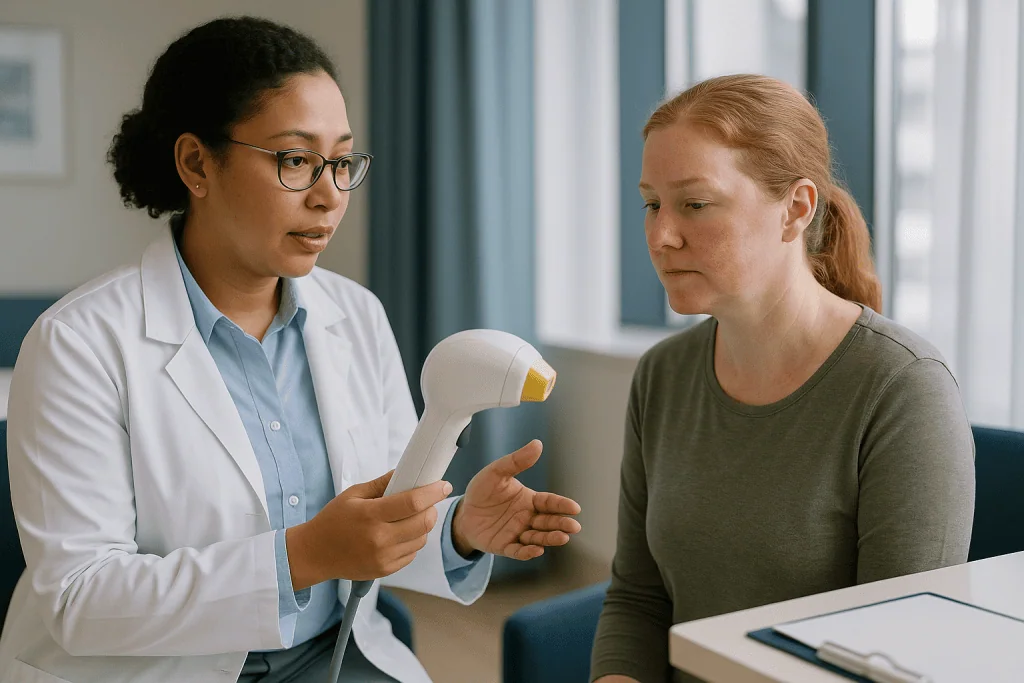
Selective photothermolysis is the technical name for exploiting this. In plain terms, it means choosing a wavelength and pulse length that heat one target while sparing its neighbors. A vascular laser delivers a brief pulse of yellow light. Hemoglobin inside a dilated vessel soaks it up and converts it to heat within thousandths of a second. The vessel wall is damaged, the tiny channel collapses, and the body clears the remnants over the following weeks. Skin cells beside the vessel receive far less energy and recover.
The pulse has to be short enough that the heat stays inside the vessel rather than spreading, and long enough to damage the whole vessel rather than just rupturing it. Get the timing wrong in one direction and the vessel survives; wrong in the other and blood leaks out, producing purpura, a temporary bruise-like purple mark.
Most modern devices also cool the surface, either with a burst of cold spray or a chilled contact plate, in the instant before each pulse. Cooling protects the outer skin and makes the sensation more tolerable. The Cleveland Clinic describes the feeling most people report as similar to a rubber band snapping against the skin.
What the device cannot do is change how blood vessels behave in the future. New vessels can dilate, and the underlying tendency to flush stays. The physics is elegant, but it works on the vessels present that day.
Pulsed dye laser rosacea treatment: what it does best
The pulsed dye laser, often shortened to PDL, is the device most closely associated with rosacea and with facial redness generally. It produces yellow light close to a peak of hemoglobin absorption, which is why it has been used for vascular birthmarks and facial vessels for decades.
Its strength is diffuse redness spread across the cheeks, the kind that has no single vessel to point at but reads as a permanent blush. Because the beam covers a relatively wide spot and is tuned so precisely to blood, it can treat broad areas efficiently. It also handles the fine, thread-like telangiectasias on the nose and cheeks.
Settings determine how the treatment feels afterward. When the pulse is set short and the energy high, the vessel ruptures and the skin shows purpura for a period afterward. Longer pulse settings aim to heat the vessel more gently so that it closes without visible bruising. Dermatologists sometimes describe these as “purpuric” and “sub-purpuric” approaches. The bruising route can clear vessels in fewer visits but demands a week or so of social downtime; the gentler route usually needs more sessions.
What does the evidence say? A Cochrane systematic review of rosacea interventions, indexed on PubMed, found that pulsed dye laser and intense pulsed light both improved redness and telangiectasia, with the available head-to-head trial showing no clear difference between them. The review graded the evidence for light-based treatment as low quality because trials were small and few, a limitation worth remembering when reading confident marketing.
Newer vascular lasers in the green spectrum, such as potassium titanyl phosphate (KTP) devices, work on the same principle and are sometimes preferred for very fine individual vessels. Which device a clinic uses matters less than whether the operator understands rosacea.
Is IPL for rosacea the same thing as a laser?
Patients often use “laser” as a catch-all, but intense pulsed light is a different technology and the distinction affects both results and risk.
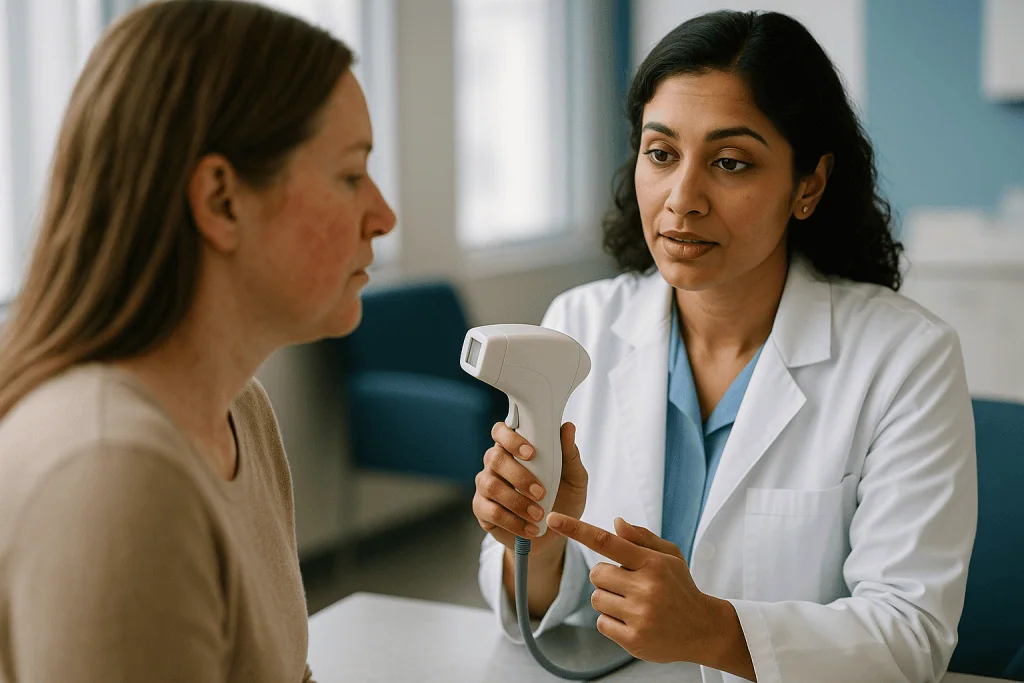
A laser emits a single wavelength, a pure color. IPL emits a broad flash of light spanning many wavelengths at once, from visible through near-infrared, rather like a very powerful camera flash. Filters placed in front of the lamp remove the parts of the spectrum the operator does not want, so a filter that blocks shorter wavelengths might be chosen to reduce absorption by melanin and focus the energy on deeper vessels.
Because IPL delivers a mix of colors, some of its energy is absorbed by hemoglobin and some by melanin. That gives it a dual role: it can fade vessels and, in the same pass, lighten brown sun spots, which is why it is popular for general sun-damage treatment. For someone whose rosacea sits alongside years of sun exposure, that combination can be attractive.
The same broad spectrum is the reason IPL is used more cautiously in darker skin. When more melanin is present, more of the flash is absorbed by the skin’s surface pigment instead of by blood, raising the risk of burns and of dark or light patches afterward. The Mayo Clinic notes that heat-based treatments can cause skin darkening in people with brown or Black skin, and this concern applies more to IPL than to a narrowly tuned vascular laser.
On the core question of redness, the Cochrane review referenced earlier found IPL and pulsed dye laser produced similar improvements in the one trial that compared them directly. Neither has been shown superior. A practical distinction is that IPL sessions typically produce little or no bruising, while some laser settings deliberately do.
The takeaway is that IPL for rosacea is a legitimate option with its own profile, not a discount version of a laser.
What can light treatments not do for rosacea?
A vascular laser is a scalpel for blood vessels, and a scalpel is useless against inflammation. Several features of rosacea fall outside what any light device can reach.
Bumps and pimples come first. The papules and pustules of what dermatologists call papulopustular rosacea arise from immune activity in the skin, possibly involving skin mites and an overactive innate immune response, as the NIH’s National Institute of Arthritis and Musculoskeletal and Skin Diseases summarizes. Sealing vessels does nothing to that process. Prescription topicals such as metronidazole, azelaic acid or ivermectin, and oral tetracycline-class antibiotics used for their anti-inflammatory effect, are the guideline-level tools here. Which one, if any, is a decision for the prescribing clinician.
Flushing episodes are second. The sudden wave of heat and color triggered by wine, spice, exercise or embarrassment is driven by nerves and by vessels that still know how to dilate. A laser removes fixed vessels; it does not retrain the reflex. People sometimes finish a course, look calmer at rest, and then flush just as intensely at the next hot meal. Topical vasoconstrictors, medicines that briefly narrow vessels, exist for this purpose and again sit with the treating team.
Eye involvement is third. Ocular rosacea, which the NHS describes as dry, gritty, red eyes and sometimes swollen eyelids, needs eye-specific care and is not touched by skin treatment.
Thickened skin is the fourth boundary. Rhinophyma, the enlarged, bumpy nose seen in a minority of long-standing cases, is a build-up of tissue and oil glands. Vascular lasers do not reduce bulk; ablative lasers or surgical reshaping are considered instead.
Finally, no light treatment changes the underlying condition. The Mayo Clinic is explicit that rosacea has no permanent fix and that treatment focuses on control. Redness can return, and periodic maintenance is common.
Who is laser treatment usually for, and who is usually asked to wait?
The typical candidate is someone whose main complaint is fixed redness or visible vessels that persist after triggers are managed and after any bumps have settled with medication. Dermatology guidance summarized by the Mayo Clinic and NHS positions light-based treatment for exactly this group, often after other measures have been given time to work.
Skin tone shapes the conversation. Lighter skin tones with high contrast between red vessels and pale surroundings are the easiest to treat safely, because the light finds little competing pigment. Darker skin tones can still be treated, but the device, wavelength and settings need adjusting, and some operators will decline IPL entirely in favor of longer-wavelength lasers. A test patch behind the hairline or under the jaw is a reasonable expectation.
Several situations usually prompt a pause rather than a no:
- An active flare with many pustules, since inflamed skin tolerates heat poorly and the bumps need treating first.
- A recent tan or sunburn, which loads the surface with melanin and raises burn risk; operators generally ask for weeks of strict sun avoidance beforehand.
- Recent use of oral isotretinoin, a vitamin A derivative prescribed for severe cases, because of concerns about healing; timing is a clinician’s call.
- Pregnancy, where most elective skin procedures are deferred out of caution rather than proven harm.
- Active cold sores or skin infection near the area.
- A history of keloid or raised scarring, or of dark marks after minor injuries, which signals higher risk of pigment change.
People taking medicines that make skin photosensitive, or who have conditions such as lupus that can mimic rosacea, need a diagnosis confirmed first. The redness of lupus, seborrheic dermatitis or long-term steroid cream use can look similar, and the NHS notes that rosacea is diagnosed clinically by examining the skin. Treating the wrong condition with a laser wastes effort at best.
How do laser, IPL and medicines compare for rosacea redness?
No single treatment covers every feature of rosacea, which is why the decision is rarely either-or. The table below summarizes what mainstream guidance says each approach targets and what it leaves alone. It is a map, not a recommendation; sequencing and choice sit with the treating dermatologist.
| Approach | Main target | Does not address | Typical pattern of use |
|---|---|---|---|
| Pulsed dye or KTP laser | Fixed redness, visible vessels | Bumps, flushing reflex, eye symptoms, thickened skin | Series of sessions; maintenance as vessels reappear (Mayo Clinic, NHS) |
| Intense pulsed light | Diffuse redness, vessels, brown sun spots | Bumps, flushing reflex; more caution in darker skin | Series of sessions spaced weeks apart (NHS) |
| Topical anti-inflammatories (e.g., metronidazole, azelaic acid, ivermectin) | Papules and pustules | Fixed vessels, background redness | Daily use; improvement generally not noticeable for 2 to 6 weeks (Mayo Clinic) |
| Topical vasoconstrictors (alpha-adrenergic agonists) | Temporary reduction of redness and flushing | Permanent vessels; effect wears off within the day | Applied as needed; rebound redness reported in some (Mayo Clinic) |
| Oral tetracycline-class antibiotics | Moderate to severe bumps, eye involvement | Vessels, fixed redness | Courses over weeks to months under prescription (NHS) |
| Trigger management and sun protection | Frequency of flares, progression | Existing damage | Lifelong; foundation for every other option (NHS, CDC sun safety) |
Reading across the rows, a pattern emerges. Medicines handle the inflammatory and flushing components; light handles the structural vascular component; daily habits protect whatever gains are made. Someone with only fixed redness might reasonably discuss light treatment early. Someone with active bumps usually hears the advice to settle those first.
The Cochrane review adds a humbling footnote: evidence quality for most rosacea treatments, light-based ones included, ranges from low to moderate. Confident comparative claims should be read with that in mind.
What actually happens during a laser session for rosacea?
The appointment is shorter than most people expect. Cleaning the skin, taking photographs for comparison, and marking areas takes longer than the treatment itself, which for full cheeks and nose often runs a matter of minutes.
Preparation begins before the visit. Operators typically ask patients to arrive without makeup, to have avoided sun exposure and tanning products for several weeks, and to have paused retinoid creams or exfoliating acids for a few days, since these can make skin more reactive. Anyone using prescribed medicines should not stop them without checking with the prescriber; the operator and the prescribing clinician can coordinate.
Protective eyewear goes on first, for patient and operator alike. Facial vessels sit close to the eyes, and the light is bright enough to damage the retina. Some clinics apply a numbing cream and wait for it to take effect; others rely on the device’s built-in cooling and skip it, particularly for gentler settings.
The handpiece is then placed against or just above the skin and fired in overlapping spots. Each pulse brings a snap of heat and, with cooling, a simultaneous cold burst. Cheeks and the sides of the nose tend to be more sensitive than the forehead. Most people describe discomfort rather than pain, though the upper lip and nostrils can sting.
Straight afterward the treated skin is usually redder and warmer than before, sometimes with mild swelling that resembles a sunburn. If bruising settings were used, purple dots or patches appear within minutes to hours. A cool compress and a bland moisturizer are the standard immediate care.
Patients often ask whether they can drive home. Unless sedation was used, which is unusual for this procedure, the answer is generally yes. The eyes are unaffected once the goggles come off.
Rosacea laser treatment side effects: what the following days and weeks look like
The first evening tends to feel like a day at the beach without sunscreen: warm, tight, slightly puffy. The Mayo Clinic notes that swelling and bruising after laser treatment for rosacea can last a few days, and that the skin may be tender during that time.
Day two and three are usually the peak for swelling, especially around the eyes and cheeks where tissue is loose. Sleeping with the head raised on an extra pillow is a common suggestion. Makeup is often permitted once any surface crusting has settled, though mineral products are gentler than heavy foundations on healing skin.
If purpuric settings were used, the bruises evolve as any bruise does, from purple through green and yellow, generally fading over one to two weeks. Sub-purpuric laser and IPL sessions typically leave only a day or two of pinkness. Tiny crusts can form where individual vessels were treated on the nose; picking them raises the risk of marks, so they are left to fall away.
The vessels themselves do not disappear on the spot. The body clears the sealed channels gradually, and the redness improvement becomes visible over the following weeks. Photographs at each visit help because day-to-day change is hard to judge in a mirror.
Less common effects include blistering where energy overlapped or the skin was tanned, and changes in pigment. Post-inflammatory hyperpigmentation, a brown mark left after skin inflammation, is more likely in darker skin tones and after sun exposure during healing. Hypopigmentation, a lighter patch, is rarer and can be longer lasting. Scarring is unusual with vascular devices used correctly but is the reason operator experience matters.
Strict sun protection is the one non-negotiable through recovery. The CDC’s sun safety guidance on broad-spectrum sunscreen, shade and hats applies with extra force to freshly treated skin, both to prevent pigment change and to protect the result.
How many laser sessions for rosacea, and how long do results last?
There is no fixed number, and any clinic quoting one before examining the skin is guessing. The NHS states that people may need several sessions of laser or IPL treatment to see an improvement, spaced weeks apart to allow the skin to recover and the treated vessels to clear. Diffuse redness across both cheeks generally needs more sessions than a handful of isolated vessels on the nose.
Three factors drive the count. The first is the extent and depth of the vessels: fine, superficial threads close quickly, while deeper or larger vessels may need repeated passes. The second is the chosen settings: the bruising approach clears more per visit at the cost of downtime. The third is skin tone, because lower energy is used in darker skin to protect pigment, which can mean more visits.
Durability is the question people ask most and the one with the least tidy answer. The Mayo Clinic notes that the effect of laser treatment can last for years in some people, while also stressing that rosacea is a long-term condition and that redness can return. Treated vessels do not reopen; new ones dilate. How fast that happens depends on the same forces that caused the rosacea in the first place: sun exposure, heat, alcohol, spicy food, stress and genetics.
Maintenance is therefore a reasonable expectation rather than a sign of failure. Some people return once a year or less; others more often. Consistent trigger management and daily sunscreen slow the reappearance of vessels and stretch the interval between visits, according to NHS advice on self-care.
One caution on numbers: the Cochrane review found that most trials of light treatments were small and short, so long-term durability has not been rigorously measured. The honest phrase is “often lasts a long time, and usually not forever.”
Does skin tone change the risks of light treatment for rosacea?
Rosacea has long been stereotyped as a condition of fair, Celtic skin, and the NIH notes it is most often diagnosed in people with light skin. It occurs across all skin tones, however, and is likely under-recognized in Black, Asian and Hispanic patients because redness is harder to see against deeper pigment and because clinicians may not look for it.
That under-recognition carries into treatment. The physics of light devices means melanin competes with hemoglobin for every pulse. The more pigment in the epidermis, the outer layer of skin, the more energy is absorbed at the surface rather than in the vessel below. Three consequences follow.
Burns become more likely if settings designed for lighter skin are used unchanged. Pigment disturbances, both darker and lighter patches, become more likely and can outlast the redness they were meant to treat. And the visible contrast between vessel and surrounding skin is lower, so the operator has less to aim at.
None of this makes treatment impossible. Longer-wavelength lasers, which pass through melanin more readily, lower energy, longer pulse durations and aggressive cooling are all used to shift the balance back toward safety. A test spot is standard practice. The Mayo Clinic’s explicit warning that heat-based treatment can cause darkening in brown or Black skin is a reason for tailored settings, not a blanket exclusion.
Diagnosis deserves equal care. In darker skin, rosacea may present more as bumps, warmth, stinging and a dusky rather than pink tone. Light treatment aimed at vessels that are not the main problem will disappoint. A dermatologist experienced in treating a range of skin tones is the reasonable expectation to voice, and asking directly about that experience is not rude.
What people often get wrong about laser treatment for rosacea
Myths cluster around this treatment because the visible results are dramatic enough to invite exaggeration. A few corrections grounded in mainstream guidance:
“One session and the redness is gone.” The NHS and Mayo Clinic both describe a series of sessions, and the Cochrane review found no trial supporting single-visit clearance. Redness fades progressively.
“Laser treatment stops rosacea.” It removes vessels that already exist. The condition, the flushing reflex and the tendency to form new vessels remain. Maintenance is normal.
“If it worked, the pimples would clear too.” Bumps are inflammatory, not vascular. They respond to medication, not to vascular lasers. Someone whose bumps persist after light treatment has not had a failed treatment; they have an untreated component.
“IPL is just a cheap laser.” It is a different technology with a broad spectrum, similar redness results in the limited head-to-head evidence, a bonus effect on sun spots, and more caution needed in darker skin.
“Home light devices do the same thing.” Consumer devices operate at energies far below clinical settings for safety reasons. Evidence for their effect on rosacea vessels is lacking, and using them on inflamed skin can worsen redness.
“Rosacea is caused by alcohol or poor hygiene.” The NIAMS lists genetics, immune response, skin mites and blood vessel abnormalities among likely contributors. Alcohol is a trigger for flushing in some people, not a cause, and the condition affects lifelong teetotalers.
“Once treated, sunscreen is optional.” Ultraviolet exposure is the most consistently reported trigger and drives new vessel formation. Skipping protection is the fastest route back to the starting point.
“Treatment is only for women.” Men develop rosacea too and are more likely to develop the thickened nasal skin of rhinophyma, according to the NHS.
Questions to ask your care team before agreeing to treatment
A good consultation should leave nothing about the plan mysterious. Bringing a written list helps, because the visit moves quickly and the questions that matter most are easy to forget once photographs are being taken.
On diagnosis and fit, start with the basics: Is this definitely rosacea rather than a look-alike such as lupus or seborrheic dermatitis? Which of my features is the treatment expected to change, and which will it leave alone? Should my bumps or flushing be addressed with medication first?
On the device and the operator: Is this a laser or IPL, and why that choice for my skin? How much experience does the person operating it have with rosacea specifically, and with my skin tone? Will a test patch be done first? Who is on site if something goes wrong during the session?
On the process: How many sessions do you anticipate, and how far apart? Will the settings cause bruising, and if so, for how long? What should I stop or avoid beforehand, and do I need to check with whoever prescribes my other medicines?
On recovery and risks: What is the realistic worst case for my skin type in terms of burns or pigment change? What aftercare do you expect me to follow, and for how long? What signs should prompt me to call rather than wait for the next appointment?
On the long view: How long do results typically last in people like me? What maintenance pattern do you see? How will we judge whether it is working, and what would make you recommend stopping?
Notice what is missing from that list: anything about guarantees. A clinician who offers a percentage or a promise of clear skin is speaking beyond the evidence. Guarded, specific answers are the reassuring ones.
When to call your doctor
Most recoveries are uneventful, and mild redness, warmth and swelling in the first days are expected. Certain signs, however, are not part of normal healing and should prompt a same-day call to the clinic that treated you or to your regular doctor.
Seek care promptly if you notice:
- Blistering, open or weeping areas, or skin that looks white, gray or leathery, which can indicate a burn deeper than intended.
- Spreading redness, increasing warmth, pus, yellow crusting or a fever, which may signal infection.
- Pain that worsens after the second day rather than easing.
- Clusters of small fluid-filled blisters, especially near the lips, suggesting a cold sore outbreak triggered by the treatment.
- New dark or pale patches that persist beyond the first weeks, so that pigment change can be assessed early.
- Any change in vision, eye pain or persistent light sensitivity, given how close the treated area sits to the eyes.
Separately from the procedure, some rosacea features warrant medical review on their own. The NHS advises seeing a GP for persistent facial redness that is not explained by sunburn or other causes, and seeking urgent advice for eye symptoms such as pain, blurred vision or sensitivity to light, because ocular rosacea can affect the cornea if left untreated. A rash accompanied by joint pain, mouth ulcers or marked fatigue is a reason to mention lupus as a possibility rather than assume rosacea.
Seek emergency care for signs of a severe allergic reaction to any numbing cream or product used, such as swelling of the lips or tongue, difficulty breathing or widespread hives.
The treating team remains the right first contact for anything that feels wrong after a session. Adjusting settings, pausing a course or adding medication are decisions they are positioned to make with the full picture in front of them.
Frequently asked questions
Does laser treatment for rosacea work?
For the fixed redness and visible blood vessels of rosacea, yes, vascular lasers and IPL are established options recommended in mainstream dermatology guidance. They work by heating and closing dilated vessels over a series of sessions. They do not treat bumps, eye symptoms or the flushing reflex, and the Cochrane review grades the supporting evidence as low quality because trials are small. Results are real but partial and not permanent.
How many laser sessions for rosacea are usually needed?
There is no set number. The NHS describes several sessions spaced weeks apart, and the count depends on how widespread the redness is, whether bruising or gentler settings are used, and skin tone, since darker skin is treated at lower energy. Isolated vessels on the nose usually need fewer visits than diffuse redness across both cheeks. Your clinician can give an estimate only after examining your skin.
What is the difference between pulsed dye laser and IPL for rosacea?
A pulsed dye laser emits one yellow wavelength tuned closely to hemoglobin, making it precise for vessels. IPL emits a broad flash of many wavelengths filtered to suit the target, so it also lightens brown sun spots but is absorbed more by skin pigment, which calls for caution in darker skin. In the limited head-to-head evidence, both improved redness similarly. Neither has proven superior.
What are the most common rosacea laser treatment side effects?
Redness, warmth and swelling resembling a sunburn are expected in the first days, and the Mayo Clinic notes swelling and bruising can last a few days. Purpuric laser settings cause deliberate bruising that fades over one to two weeks. Less common effects include blisters, crusting, and darker or lighter patches, which are more likely in darker skin or after sun exposure. Scarring is rare with correct use.
Can laser treatment make rosacea worse?
Treatment itself does not worsen the underlying condition, but treating skin during an active flare, on tanned skin, or with settings unsuited to a person’s skin tone can cause burns, prolonged redness or pigment change that looks worse than the starting point. This is why clinicians usually settle bumps with medication first, insist on sun avoidance beforehand, and perform a test patch.
How long do laser results for rosacea redness last?
The Mayo Clinic notes the effect can last for years in some people while cautioning that rosacea is long-term and redness may return. Treated vessels do not reopen; new ones dilate over time in response to sun, heat, alcohol and other triggers. Maintenance sessions are common. Long-term durability has not been measured rigorously in trials, so honest expectations are lasting improvement rather than a permanent change.
Is IPL for rosacea safe on darker skin?
It can be used, but with more caution than in lighter skin. Because IPL’s broad spectrum is absorbed by melanin as well as blood, darker skin faces higher risk of burns and dark or light patches. Many clinicians prefer longer-wavelength lasers, lower energy and stronger cooling for deeper skin tones, and a test patch is standard. Choose an operator experienced with a range of skin tones.
Should I stop my rosacea cream or tablets before laser treatment?
Do not stop or change any prescribed medicine on your own. Some clinics ask patients to pause retinoid or exfoliating products for a few days before a session because they increase skin sensitivity, and timing after oral isotretinoin is a specific clinical judgment. These are decisions for your prescribing clinician and the treating team to coordinate, and it is worth raising the question at the consultation.
Will laser treatment help the pimples and bumps of rosacea?
No. The papules and pustules of rosacea arise from inflammation and immune activity, not from dilated vessels, so vascular lasers and IPL leave them unchanged. Guideline-level care for bumps involves prescription topicals such as metronidazole, azelaic acid or ivermectin, or oral tetracycline-class antibiotics, with improvement generally taking weeks according to the Mayo Clinic. Light treatment is usually considered after bumps are under control.
Can I use makeup and go outside after a rosacea laser session?
Makeup is usually permitted once any crusting has settled, often within a day or two for gentler settings, though heavy foundations can irritate healing skin. Going outside is fine, but strict sun protection with broad-spectrum sunscreen, a hat and shade is essential for weeks afterward, because ultraviolet exposure raises the risk of pigment change and drives new vessel formation. Ask your clinic for specific aftercare timing.
References
- NHS: Rosacea
- Cleveland Clinic: Rosacea
- NIH National Institute of Arthritis and Musculoskeletal and Skin Diseases: Rosacea
- CDC: Sun Safety
This article is for general information only and is not a substitute for professional medical advice. Please consult a qualified doctor about your individual situation.

More from the Blog
Does Eczema Go Away? Genetics and the Autoimmune Question
Eczema often improves and can clear completely, but it rarely disappears in a way anyone can guarantee. Many children who develop atopic eczema see…
What Maintenance Treatment for Seborrheic Dermatitis Looks Like: Keeping Flares Away Long Term
Seborrheic dermatitis maintenance means continuing a lighter version of treatment after a flare settles, usually regular use of an antifungal shampoo or wash that…
Sugar, Dairy and Skin: What the Studies Really Show About Diet and Acne
Current evidence links dairy, especially skim milk and whey protein, with modestly higher odds of acne in observational studies, but no randomized trial has…
When Eczema Keeps Flaring Despite Treatment: How Dermatologists Reassess the Plan
When eczema keeps flaring despite treatment, dermatologists usually reassess rather than simply add stronger medicine. They confirm the diagnosis, check how emollients and topical…
Why Does Hair Turn Gray? The Pigment Cells That Clock Out Early
Hair turns gray when melanocytes, the pigment cells inside each hair follicle, produce less melanin and their stem-cell reserves gradually run out. Genetics sets…
What Long-Term Eczema Control Really Means: Fewer Flares, Calmer Skin and Ongoing Care
Long-term eczema control means having fewer and milder flares, skin that feels comfortable most of the time, and a routine you can realistically keep…