

Can You Fly After Tympanoplasty? Cabin Pressure and When Your Surgeon Clears You

Key Takeaways
- Aircraft cabins are pressurized to the equivalent of roughly 6,000–8,000 feet, so the middle ear must equalize on every climb and descent.
- Descent, not takeoff, is when a healing eardrum graft is pulled inward and stressed, because the Eustachian tube must open actively to let air in.
- A tympanoplasty graft is held by packing and clot at first and takes weeks to grow its own blood supply, which is why surgeons speak in weeks rather than days.
- No mainstream guideline sets a fixed no-fly interval after tympanoplasty; most surgeons anchor clearance to an examination of the graft at follow-up rather than to a date.
- A cold or nasal congestion on the day of travel can undo an otherwise reasonable clearance, and forceful nose-blowing or the Valsalva maneuver are usually restricted.
- Sudden pain, fresh bleeding, a hearing drop, vertigo or facial weakness after a flight are reasons to contact the surgical team without waiting for the next appointment.
Most people can fly after tympanoplasty once the surgeon has examined the ear and confirmed the eardrum graft is healing, which usually means waiting several weeks and attending at least one follow-up visit first. The concern is the cabin pressure change during descent, which stresses a fresh repair. No single waiting period applies to everyone; the treating team sets the timing based on the operation performed and how the ear is healing.
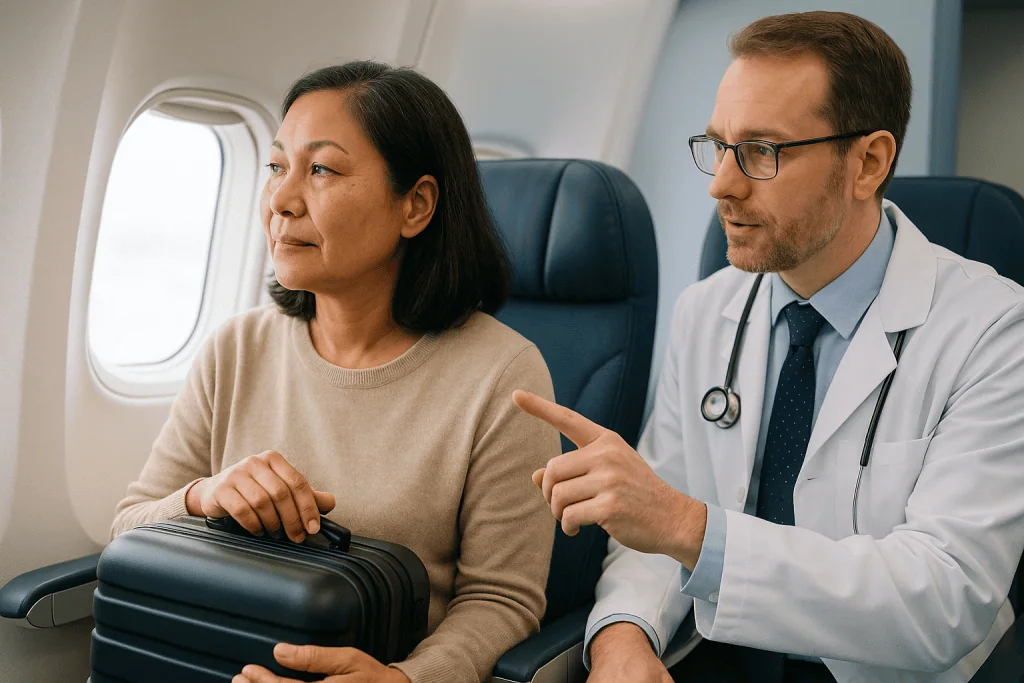
The boarding pass is already on her phone. Six weeks ago she barely thought about it; the trip to see her grandchildren was booked months before the surgeon suggested repairing the hole in her left eardrum. Now the operation is done, the ear is still stuffed with dissolvable packing, and the question that keeps her up at night is not about pain. It is about the moment the cabin crew announce the descent.
Flying after tympanoplasty sits in an odd gap in patient information. Leaflets cover water, nose-blowing and heavy lifting in detail, then say little about the one activity that changes the pressure on both sides of a freshly grafted eardrum within minutes. Patients fill the gap with forum posts and guesswork.
This explainer walks through what cabin pressure actually does to a healing ear, why surgeons talk in weeks rather than days, and which questions turn a vague “ask your doctor” into a clear, personal answer.
What actually happens to your ear when a plane climbs and descends
Behind the eardrum sits a small, air-filled chamber called the middle ear. It holds the three tiny hearing bones and is sealed from the outside world by the eardrum itself, a membrane roughly the size of a pencil eraser. The only route in or out for air is the Eustachian tube, a narrow passage running from the middle ear to the back of the nose.
Aircraft cabins are pressurized, but not to sea level. The CDC notes that most commercial cabins are held at a pressure equivalent to an altitude of about 6,000–8,000 feet, so the air around you thins noticeably during climb and thickens again during descent. Your middle ear has to keep pace.
On the way up, the job is easy. Cabin pressure falls, the air trapped in the middle ear expands, and the excess simply pushes its way out through the Eustachian tube. Most people feel nothing more than a faint pop.
The way down is different. Cabin pressure rises, the middle ear is now at lower pressure than the surroundings, and air has to be drawn back in against a tube that tends to stay closed until you swallow, yawn or chew. If it does not open, the eardrum is pulled inward. MedlinePlus describes this as ear barotrauma: fullness, muffled hearing and, when the pressure difference is large enough, pain, fluid behind the eardrum or a tear.
That asymmetry is the whole story for anyone weighing flying after tympanoplasty. Takeoff asks little of a repaired eardrum. Descent asks it to hold a pressure difference, and a graft that has not yet knitted to the surrounding tissue is poorly equipped to answer.
What tympanoplasty repairs, and why the new eardrum is fragile at first
Tympanoplasty is surgery to close a hole, or perforation, in the eardrum, sometimes combined with rebuilding the small hearing bones behind it. The hole may have come from a middle-ear infection, a blow to the ear, a cotton swab, a loud blast or a previous ear tube. Many perforations mend on their own; the NHS notes that most heal within a few weeks, and Mayo Clinic adds that some take months. Surgery is generally discussed when the hole persists, keeps letting infection in, or is dragging hearing down.

The repair uses a graft, a thin sheet of the patient’s own tissue placed across the hole so new eardrum can grow along it. Common choices are temporalis fascia (the papery covering of the chewing muscle above the ear), cartilage from the outer ear with its thin lining, or fat from the earlobe for very small holes. The surgeon reaches the eardrum either down the ear canal or through a small cut behind the ear, lifts the edges of the perforation, and tucks the graft into position.
Nothing stitches a graft to an eardrum. It is held in place by dissolvable packing, a little dried blood, and the natural stickiness of raw tissue. Over the following weeks, blood vessels grow into it from the edges of the old eardrum and the lining of the ear canal, and it gradually becomes living tissue rather than a patch resting on a wound.
That in-between period is the vulnerable one. The graft is neither loose nor secure. A sudden pressure difference across it can lift an edge, shift it off the perforation or tear the fragile new bridge of cells forming along its border. This is the mechanism surgeons have in mind when they hesitate over a travel date.
Flying after tympanoplasty: why the descent worries surgeons more than takeoff
Put the two previous sections together and the surgeon’s caution stops looking arbitrary. During climb the middle ear vents itself, and a freshly repaired eardrum is pushed gently outward by expanding air, a direction in which the packing behind it gives support and the graft is not levered off its bed. During descent the forces reverse. The eardrum is sucked inward, and the graft, still relying on a clot and a wad of packing rather than its own blood supply, is exactly what stands between the cabin and a low-pressure middle ear.
Three details make this worse in the early weeks. First, the packing itself. Many surgeons fill the middle ear and ear canal with dissolvable material that supports the graft from both sides. While it is still firm, it may keep air from moving freely, which means pressure cannot equalize through the normal route even if the Eustachian tube opens.
Second, the Eustachian tube is often not at its best after ear surgery. Swelling from the operation, mild inflammation in the middle-ear lining and any lingering nasal congestion all make the tube more reluctant to open on command.
Third, the usual rescue maneuvers are partly off limits. Mayo Clinic’s advice for airplane ear includes swallowing, yawning and gently blowing against pinched nostrils, the Valsalva maneuver. Forcing air up the Eustachian tube is precisely what tympanoplasty patients are told not to do while the graft settles, because it can push the graft off the eardrum from behind.
None of this means a flight will definitely damage a repair. It means the margin for error is thinner than usual, and the person best placed to judge that margin is the one who has looked at your eardrum through a microscope.
How long after tympanoplasty can you fly? What the evidence does and does not say
Here the honest answer is that mainstream guidance does not give a single number, and any article that does is quoting a local protocol rather than a trial. Neither the NHS nor Mayo Clinic publishes a fixed no-fly interval for tympanoplasty, and the clinical literature on post-operative air travel consists mostly of expert opinion and small case series rather than randomized studies.
What the evidence does support is the shape of the timeline. Eardrum tissue heals over weeks, not days. The NHS puts spontaneous healing of a perforation at a few weeks in most cases; Mayo Clinic describes healing as taking weeks and sometimes months. A graft that has to become living tissue from scratch is unlikely to be quicker than a small hole closing on its own. That is why surgeons speak in terms of weeks and why “the day after surgery” is not a serious option.
In practice, most surgeons anchor the decision not to a calendar but to an examination. The first post-operative visit is where the packing is checked or removed and the graft is inspected under magnification. If the graft is in place, pink and adhering at its edges, and the ear is dry, many surgeons will discuss travel. If the graft looks pale, has a gap at one edge or the ear is still discharging, they will ask you to wait and look again.
Some surgeons are more conservative than others, and some procedures warrant more caution than others; the next section explains why. If you are given a date, treat it as the earliest the team is comfortable with rather than a guarantee that the ear is ready. If you are given a range, ask which end of it applies to you and what would move you toward the longer end.
Who is usually cleared sooner, and who is usually asked to wait
Clearance is rarely a coin toss. Surgeons weigh a handful of predictable factors, and knowing them helps you understand where you sit.
People who tend to be cleared earlier usually had a small perforation closed with a simple graft through the ear canal, had healthy middle-ear lining at the time of surgery, have a dry ear at follow-up, and have a Eustachian tube that works normally on the other side. A short domestic flight with a gradual descent is an easier ask than a long-haul sector followed by a connection, because the ear faces one pressure cycle rather than two.
People who are usually asked to wait longer include those whose surgery involved the hearing bones, where a prosthesis or repositioned bone sits beneath the graft and a pressure jolt could shift it. Cartilage grafts across large or total perforations often need more time before the surgeon is confident of the seal. Revision surgery after a previous failed repair, chronic Eustachian tube dysfunction, active nasal allergy, a smoker’s airway and children, whose tubes are naturally narrower, all push clearance later.
Surgery that included the mastoid bone behind the ear, or that was done for cholesteatoma (a pocket of skin growing where it should not, which erodes bone), sits in a category of its own. The priority there is control of disease, and the surgeon may want imaging or a second look before endorsing any pressure exposure.
A few situations mean flying should be discussed before it is even considered: an ear that is still discharging, new dizziness, a wound behind the ear that has opened, or any fever. Those are follow-up problems first and travel questions second, and the team may want to see you before it says anything about airports.
Cabin pressure, packing and the Eustachian tube: a phase-by-phase summary
The table below pulls the mechanics together so you can see at a glance where the pressure on a healing graft comes from and why particular phases of a journey attract the most caution. It is a summary of mainstream descriptions of ear barotrauma applied to the post-operative ear, not a tool for deciding when to travel.
| Phase | Cabin pressure | Middle ear response | Why it matters after tympanoplasty |
|---|---|---|---|
| Taxi and takeoff | Sea level, then falling | Air expands and vents passively through the Eustachian tube | Low demand; graft is nudged outward, not pulled inward |
| Cruise | Stable, roughly the equivalent of 6,000–8,000 ft | Pressures equalized; dry cabin air | Little pressure stress; congestion from dry air can make the descent harder |
| Descent and landing | Rising steadily | Middle ear becomes relatively negative; tube must open actively | Highest demand; eardrum pulled inward, graft edges under tension, Valsalva usually restricted |
| Connecting flight | Full cycle repeated | Second equalization challenge, often with tired, congested tubes | Doubles exposure; surgeons often prefer a direct route early on |
| Cold, allergy or infection during travel | Unchanged | Tube lining swollen, opening unreliable | Most common reason an otherwise cleared flight causes trouble |
Two things stand out. Descent carries the load, so a journey with one landing is easier on the ear than one with two. And the state of your nose on the day matters almost as much as the date on the calendar, which is why congestion has its own section below. Neither point replaces the surgeon’s examination; both help you understand what the surgeon is weighing.
Tympanoplasty recovery timeline: what the first days and weeks usually look like
Recovery follows a recognizable arc, though your surgeon’s instructions always take precedence over any general description.
The first few days are usually about a blocked, muffled ear rather than pain. Packing fills the canal, so hearing on that side is dull and sounds may echo. Mild ache, a feeling of fullness and occasional faint clicking are common. A cotton ball in the outer ear catches small amounts of blood-stained fluid. Some people notice a little dizziness or a metallic taste, because the nerve carrying taste from the front of the tongue runs through the middle ear and can be bruised during surgery.
Through the first couple of weeks, the emphasis is protection. Keep the ear dry, avoid blowing the nose, sneeze with the mouth open, skip heavy lifting and straining, and let the packing do its work. If a cut was made behind the ear, it is checked and the dressing or stitches are dealt with in this window.
The first formal look at the graft typically happens at the early post-operative visit, when remaining packing is cleared and the surgeon inspects the repair. This is the appointment that matters for travel. It is also when hearing usually starts to lift as the canal opens up, though the middle ear may still hold fluid or packing residue for a while afterward.
Over the following weeks, the graft consolidates and the eardrum gradually looks more like a normal membrane. Hearing continues to settle, and most restrictions are eased step by step. A hearing test is often repeated once the ear is fully dry and healed. The NHS and Mayo Clinic both describe eardrum healing in terms of weeks to months, a reminder that a good early look does not mean the process is finished.
Can I fly after ear surgery if I have a cold or blocked nose?
Even people with intact eardrums are told to think twice about flying with a heavy cold, and Mayo Clinic lists congestion, sinus infection and allergy among the main risk factors for airplane ear. The reason is mechanical. The Eustachian tube opens at the back of the nose, and when that lining is swollen, the tube’s mouth is narrowed or shut. Swallowing and yawning then move little air, and the middle ear cannot keep up with a descending cabin.
For someone who has just had tympanoplasty, this is the scenario that turns a cleared flight into a problem. The surgeon’s assessment assumed a working Eustachian tube. A cold on the morning of travel removes that assumption, and the extra inward pull on the eardrum during descent lands directly on the graft.
The instinct is to reach for a decongestant. Oral decongestants and decongestant nasal sprays work by narrowing blood vessels in the nasal lining, which shrinks swelling and can help the tube open. Mayo Clinic mentions them as an option some travelers use before a flight. After ear surgery, though, whether they are appropriate depends on your other medicines, your blood pressure and what your surgeon has already prescribed, and some post-operative regimens already include a nasal spray. This is a question for the prescribing clinician, not for the pharmacy aisle on the way to the gate.
Two other points matter. Blowing the nose hard to clear it is usually restricted after tympanoplasty because it forces air up the Eustachian tube and against the back of the graft. And a cold in the days before travel is a legitimate reason to call the surgical team and ask whether the trip should move, even if you were cleared at your last visit. Airlines change plans for weather; ears deserve the same flexibility.
Airplane pressure after eardrum surgery: does the graft type or approach change the advice?
Patients often ask whether the way their operation was done changes the flying advice. To a degree, it does, though the surgeon’s assessment of your specific ear always outweighs generalizations.
Fascia grafts are thin and conform easily to the eardrum, which helps hearing but means they depend heavily on the packing and the surrounding tissue for support in the first weeks. Cartilage grafts are stiffer and more resistant to being sucked inward, which is one reason they are chosen for large perforations, poorly ventilated ears or revision surgery. That stiffness does not make a cartilage repair immune to pressure; its edges still have to heal, and a rigid plate can be levered off a soft bed just as a thin sheet can be pulled through a hole.
Underlay technique, where the graft sits on the middle-ear side of the remaining eardrum, and overlay technique, where it sits on the outer side, distribute pressure differently. A descending cabin pulls an underlay graft toward the old eardrum, which tends to help; it pulls an overlay graft away from it. Surgeons take this into account, and it is one reason two people with similar holes may be given different waiting advice.
Whether the approach was through the canal, sometimes with an endoscope, or through a cut behind the ear matters less for pressure than for wound care. The behind-the-ear incision needs to be checked and kept clean, and a large swelling or fluid collection there is a reason to postpone travel regardless of the eardrum.
If hearing bones were rebuilt, a small prosthesis or reshaped bone may be balanced beneath the graft. Pressure changes that would be trivial for an eardrum alone can shift such a reconstruction, so these patients are usually asked to wait longer and to avoid any pressure maneuver until the surgeon says otherwise.
Tympanoplasty aftercare precautions that matter most on a trip
Once you are cleared, the usual post-tympanoplasty rules still travel with you. Most are simple, and the ones that matter most protect the ear from water and from sudden pressure.
Water is the enemy of a healing graft because it carries bacteria into the middle ear and softens tissue that needs to stay firm. Keep the ear dry in hotel showers, avoid swimming and do not put the head under water in pools or the sea until your surgeon lifts the restriction. A cotton ball lightly coated in petroleum jelly, or an earplug your team has approved, is the usual method.
Nose management continues to matter. Sneeze with the mouth open, dab rather than blow, and avoid the Valsalva maneuver unless your surgeon has specifically told you it is now safe. Dry cabin air thickens mucus, so drink water during the flight and consider a saline nasal spray if your team is happy with it; saline simply moistens the lining and contains no active drug.
During descent, use the gentle methods: swallow repeatedly, yawn, chew or suck a hard candy, and stay awake so you notice pressure building early. Infants and small children are usually encouraged to feed or drink during descent for the same reason.
Ear drops are sometimes prescribed after tympanoplasty, most often an antibiotic drop, occasionally combined with a steroid to reduce swelling. If you have been given drops, carry them in hand luggage with the prescription label, follow the schedule your team set, and do not stop or double up because you are traveling. Any question about drops, decongestants or pain relief belongs with the prescribing clinician.
Carry a brief note from your surgeon describing the operation and its date. Should anything go wrong away from home, it saves a stranger a great deal of guesswork.
If your surgery is far from home: mobility, clots and arranging follow-up
Some people have ear surgery in a city far from where they live, whether because that is where a specialist was available, because of insurance networks, or because the operation was arranged during a longer stay. That situation adds a layer of planning to the flying question. It says nothing about where care is best, and this article makes no such judgment.
The first task is follow-up. A tympanoplasty graft needs to be seen. If the surgeon who operated cannot see you at the usual interval, ask them to arrange, in writing, who will and what they should look for. An ear specialist near home can inspect the graft, remove residual packing and organize a hearing test, but only if they know what was done. A copy of the operation note and any hearing tests should travel with you.
The second task is the flight itself, and here the eardrum is not the only organ to think about. The CDC’s travel guidance notes that immobility on flights lasting longer than about four hours raises the risk of blood clots in the legs, and recent surgery is a recognized additional risk factor. The basics apply to anyone in this position: choose an aisle seat if you can, get up and walk the cabin periodically, flex and stretch the calves while seated, keep well hydrated and go easy on alcohol. Whether compression stockings or any clot-preventing medicine is appropriate is a decision for the surgical team, based on your history.
The third task is timing. Surgery followed within days by a long flight is the combination surgeons like least, because the ear is at its most fragile and the legs at their least mobile. If travel home cannot wait, say so before the operation rather than after, so the team can plan around it or discuss whether the timing of surgery should change.
What people often get wrong about flying after tympanoplasty
“If it does not hurt on the plane, it is fine.” Pain is a late signal. A graft can be lifted or displaced with nothing more than a sense of fullness, and the consequence, a persistent hole, may not be obvious until hearing fails to improve or the ear starts discharging weeks later.
“Takeoff is the dangerous part.” The reverse is true for the ear. MedlinePlus and Mayo Clinic both identify descent as the phase when barotrauma occurs, because the middle ear must actively draw air in against a closed tube.
“Pop your ears hard and you will be safe.” The Valsalva maneuver pushes air against the back of the eardrum, which is the last thing a fresh graft needs. Most surgeons restrict it for weeks. Swallowing, yawning and chewing are the gentle alternatives.
“The packing protects the graft, so flying early is fine.” Packing supports the graft but also blocks the normal path for pressure to equalize. It is a reason early flights are discouraged, not a license for them.
“Earplugs marketed for flying solve the problem.” Filtered earplugs slow the change in pressure reaching the ear canal, which some travelers find comfortable. They do nothing to open the Eustachian tube, and there is no strong evidence that they protect a surgical repair. Use them because your surgeon agreed, not instead of waiting.
“Once the surgeon clears me, the ear is fully healed.” Clearance means the graft looks secure enough to tolerate a pressure cycle. Eardrum healing continues for weeks to months, as both the NHS and Mayo Clinic describe, and water and nose-blowing restrictions may continue long after the first flight.
“Flying is banned after any ear operation.” Not so. Other ear procedures, including ear tube insertion, carry very different advice. Tympanoplasty is specific because a new eardrum is being grown from a graft.
Questions to ask your care team before you book a flight
A short conversation before you book is worth more than any general article. These questions are designed to get a specific answer for your ear rather than a policy statement.
- What exactly was repaired, what graft material was used, and were the hearing bones involved? The answer shapes how conservative the flying advice should be.
- Is my clearance tied to a date or to what you see at follow-up, and when will you look at the graft?
- If I am cleared, is a direct flight preferable to a connection for now, and does the length of the flight matter for my ear?
- Which pressure-equalizing methods may I use on descent, and which are still off limits, including the Valsalva maneuver?
- If I develop a cold or nasal congestion in the days before traveling, should I contact you before flying?
- Do you want me to use any nasal spray or other medicine before the flight, and how does it fit with what I am already taking?
- What signs during or after the flight should prompt me to call you or to seek care where I land?
- Who will check the ear if I am away when the next follow-up is due, and can you provide a written summary for them?
- How long should water, swimming and nose-blowing restrictions continue, and does flying change any of them?
- Will my hearing be retested, and when, so I can plan travel around it?
Write the answers down or ask for them in your discharge paperwork. Travel decisions made weeks after a clinic visit are easier when the details are in front of you rather than half remembered, and a written note also helps any clinician who sees you away from home understand what was done and what your own team expects.
When to call your doctor
Most people who follow their surgeon’s timing fly without incident. The following signs, before, during or after a flight, are reasons to contact the surgical team promptly rather than wait for the next scheduled visit.
- Sudden or worsening ear pain during descent that does not ease within a short time of landing.
- Fresh bleeding from the ear, or a return of discharge after the ear had become dry, especially if it smells or is thick and yellow-green.
- A sudden drop in hearing on the operated side, or a new loud ringing.
- Spinning dizziness, vertigo or unsteadiness that is new or clearly worse than before.
- Weakness or drooping on one side of the face, which is an urgent symptom after any ear surgery.
- Fever, increasing redness, swelling or opening of a wound behind the ear.
- Severe headache, stiff neck or confusion, which require emergency care.
Facial weakness, severe headache with a stiff neck, or vertigo with vomiting warrant emergency assessment wherever you are; do not board a return flight to reach your own team. For the other signs, telephone the surgical department, explain that you had a tympanoplasty and when, and describe what has changed. If you are away from home, a local ear specialist can examine the ear and communicate with your surgeon.
Separately, if the ear looks and feels fine but your hearing has not begun to improve by the time your team said it would, mention it at follow-up. A graft that has quietly failed can often be addressed, but only once someone knows about it. Every decision about further treatment, including whether and when it is safe to fly again, rests with the team that knows your ear.
Frequently asked questions
Can you fly after tympanoplasty?
Yes, in most cases, once the surgeon has examined the graft and is satisfied it is healing. The concern is the pressure change during descent, which pulls a fresh eardrum repair inward before it has developed its own blood supply. Surgeons usually want to inspect the ear at a follow-up visit before discussing travel, and the timing depends on the type of repair and how the ear looks rather than on a fixed rule.
How long after tympanoplasty can I fly?
There is no single number in mainstream guidance. Eardrum tissue heals over weeks, and both the NHS and Mayo Clinic describe perforation healing in weeks to months, so surgeons talk in weeks rather than days. Most tie clearance to what they see at the first post-operative check: a graft that is in place, pink and adhering, with a dry ear, opens the conversation. Your own surgeon sets the timing.
Can I fly after ear surgery the next day if it is a short flight?
This is generally discouraged after tympanoplasty. Even a short flight includes a full descent, and in the first days the graft is held only by packing and clot while the Eustachian tube is often swollen. A short flight is easier on the ear than a long one with a connection, but the distinction matters most once the surgeon has already confirmed the graft is secure.
Does airplane pressure after eardrum surgery always damage the repair?
No. Many people fly after clearance without any problem. The risk lies in flying before the graft has knitted to the surrounding tissue, or flying with a blocked nose that stops the Eustachian tube from equalizing pressure during descent. Both situations increase the inward pull on the eardrum. Following the surgeon’s timing and avoiding travel while congested are the two most effective ways to reduce that risk.
What tympanoplasty aftercare precautions should I take on a plane?
Keep the ear dry, sneeze with the mouth open, avoid blowing the nose or performing the Valsalva maneuver, and use gentle methods such as swallowing, yawning and chewing during descent. Stay hydrated, since dry cabin air thickens mucus, and stay awake for the descent so you notice pressure early. Carry any prescribed ear drops and a brief note from your surgeon describing the operation.
What is the tympanoplasty recovery timeline for hearing?
Hearing is usually muffled at first because packing fills the ear canal. It typically begins to lift when the packing is cleared at an early follow-up visit, then continues to settle over the following weeks as the graft consolidates and any fluid resolves. A formal hearing test is often repeated once the ear is fully healed. Individual results vary, and the surgical team will explain what to expect for your ear.
Can I use decongestants before flying after tympanoplasty?
Only if your surgeon or prescribing clinician agrees. Decongestants narrow blood vessels in the nasal lining, which can help the Eustachian tube open, and Mayo Clinic lists them as an option some travelers use for airplane ear. After surgery, however, their suitability depends on your other medicines, your blood pressure and what has already been prescribed. Ask before the trip rather than deciding at the airport.
Are filtered earplugs helpful after eardrum repair?
Filtered earplugs slow the rate at which pressure changes reach the ear canal, and some travelers find them comfortable. They do not open the Eustachian tube and there is no strong evidence that they protect a surgical graft. They are not a substitute for waiting until the surgeon has confirmed the repair is secure. If you want to use them, mention it at your follow-up.
Is a connecting flight worse than a direct one after tympanoplasty?
It asks more of the ear. Each landing is a full equalization challenge, and by the second descent the Eustachian tube lining may be drier and more congested. Surgeons often prefer a direct route for early travel and may factor the itinerary into their clearance. If a connection is unavoidable, tell your team so they can advise on timing and on what to watch for.
What if I catch a cold before my flight?
Contact the surgical team before you travel, even if you were cleared at your last visit. Congestion swells the lining around the Eustachian tube opening, so the middle ear cannot equalize on descent and the eardrum, and the graft, is pulled inward more forcefully. Mayo Clinic lists colds and allergy among the main risk factors for airplane ear. Postponing may be the safer choice.
References
This article is for general information only and is not a substitute for professional medical advice. Please consult a qualified doctor about your individual situation.

More from the Blog

Preparing for Tympanoplasty: Treating Active Infection, Pausing Medicines and Fasting
Preparing for tympanoplasty usually involves three things: clearing any active ear infection so the ear is dry before graft surgery, reviewing every medicine and…

When Does Sinusitis Need an ENT Specialist Instead of a Wait-and-See Approach?
Most sinus infections are viral and settle within two to three weeks, so waiting is usually appropriate at first. An ENT specialist is usually…

After Mastoid Surgery: Which Symptoms Are Expected and Which Mean It Is Time to Call?
After mastoid surgery, a dull ache, a blocked or muffled ear, mild unsteadiness, numbness behind the ear and a little blood-tinged discharge are usually…

Flying After FESS: How Long International Patients Usually Wait Before Heading Home
Most surgical teams ask patients to remain near the hospital until the first follow-up visit after functional endoscopic sinus surgery, commonly around one to…

When Is a Tonsillectomy Recommended for Recurrent Tonsillitis? What ENT Specialists Weigh
Tonsillectomy is usually considered for recurrent tonsillitis when infections are frequent and disruptive: seven or more episodes in a year, five or more a…

Why Is Vertigo Treated Differently in Older Adults? Fall Risk and Adapted Care
Vertigo in older adults is treated differently mainly because a single fall can cause far more harm than the spinning itself. Clinicians tend to…