

Caring for Someone After a Traumatic Brain Injury: What Families Can Do in the First Weeks

Key Takeaways
- Much of the damage after a head injury develops over the first days from swelling and pressure, which is why a person can look worse on day two or three without anything having gone wrong.
- Severity is graded on the Glasgow Coma Scale from 3 to 15, with 13 to 15 classed as mild, but a mild label describes the first exam, not how the following weeks will feel.
- The NHS says it is fine to sleep after a minor head injury provided a responsible adult is nearby and knows the warning signs; not being able to wake the person is an emergency.
- Current CDC concussion guidance supports a brief rest of a day or two followed by gradual return to light activity, because prolonged total rest tends to lengthen recovery.
- Stress cannot reopen an injury, but raised stress hormones worsen sleep, headache and attention, and in the hospital phase agitation works against the team's efforts to control pressure inside the skull.
- In older adults and anyone on blood thinners, a subdural hematoma can develop slowly and appear days or weeks after a seemingly minor fall, so late confusion or drowsiness needs medical review.
In the first weeks after a traumatic brain injury, families help most by keeping the environment calm and predictable, protecting sleep, speaking slowly in short sentences, tracking symptoms and medicines in a notebook, preventing falls and alcohol, and watching for red flags such as worsening headache, repeated vomiting, new confusion, seizures or unusual drowsiness. Recovery pace varies widely, so every decision stays with the treating team.
The family room outside the intensive care unit has a vending machine that hums, a box of tissues nobody wants to be the first to touch, and a nurse who says the same honest sentence several times a day: “The next few days will tell us more.” Most people who end up caring for someone with traumatic brain injury were not planning to. A phone call, a fall on the stairs, a cycling commute that ended in an ambulance; then suddenly you are learning words like intracranial pressure and wondering whether you are allowed to hold a hand that has a line taped to it.
The questions come in waves. Will they know me? Why are they so angry? Is it safe to let them sleep? Should I talk, or stay quiet? The brain is the one organ that argues back when it is hurt, and that makes caregiving feel personal in a way that a broken leg never does.
This article walks through what the evidence actually supports for those first weeks, what nobody can promise, and the small, specific things that genuinely help.
What actually happens in the brain after a traumatic injury?
A traumatic brain injury (TBI) is damage to the brain caused by an outside force, usually a blow, a jolt or an object entering the skull. Clinicians think about it in two stages, and the second one is the reason the early days matter so much.
The primary injury happens in an instant. The brain, which is soft and sits in fluid, slams against the inside of the skull, and nerve fibers that run between regions can be stretched or torn. When that stretching is widespread, doctors call it diffuse axonal injury, meaning scattered damage to the long wiring of nerve cells. A torn blood vessel can create a hematoma, a collection of blood that presses on nearby tissue.
The secondary injury unfolds over hours and days. Injured tissue swells, and because the skull is rigid, swelling has nowhere to go. Pressure inside the skull rises, blood flow drops, and oxygen-starved cells release chemicals that injure their neighbors. Much of hospital care in the first week is aimed at this second wave: controlling pressure, keeping oxygen and blood pressure steady, and sometimes removing blood or bone to make room.
Severity is graded with the Glasgow Coma Scale, a 3-to-15 score based on eye opening, speech and movement. Scores of 13 to 15 are classed as mild, 9 to 12 as moderate, and 3 to 8 as severe, as Mayo Clinic describes. A “mild” label describes the initial exam, not the experience; a concussion can still unsettle work, mood and memory for weeks.
Why does this matter to a family? Because it explains two things you will see. The person may seem worse on day two or three than on day one, which is the swelling phase rather than a sign that something has gone wrong with care. And the brain’s repair work is metabolically expensive, which is why rest, sleep and a quiet environment are treatments in their own right, not optional comforts.
Caring for someone with traumatic brain injury in the first 72 hours
The first three days usually belong to the hospital team. Scans are repeated to check whether a bleed is growing, sedation may be used to let a swollen brain rest, and in severe cases a small probe measures pressure inside the skull. Families often feel sidelined. In practice, you hold information nobody else has.
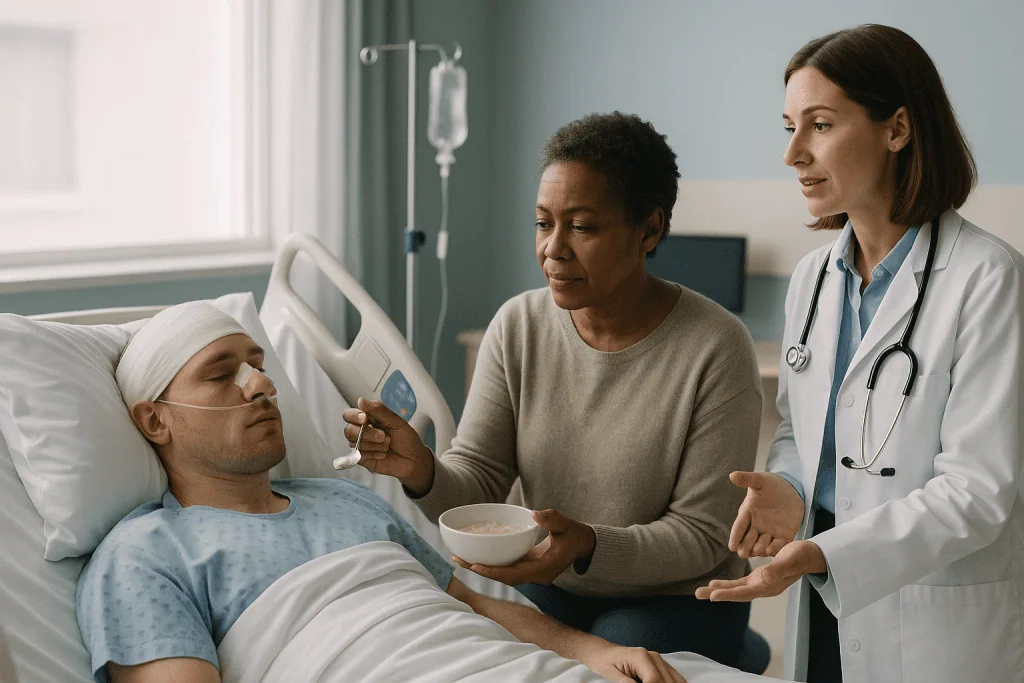
Tell the team exactly what happened and when, every medicine the person normally takes, including blood thinners, supplements and alcohol use, and what they were like before: their memory, mood, hearing, walking. Staff compare everything against this baseline. Write it down once, keep it in your bag, and you will not have to repeat it to each new shift.
Start a notebook on day one. Record who said what, which scan was done, any change you noticed. Brain injury care involves many professionals, and the family notebook is often the only continuous record that moves from the emergency department to the ward to home.
Expect confusion. After a moderate or severe injury, many people pass through post-traumatic amnesia, a period when the brain is not laying down new memories. They may ask the same question every few minutes, not recognize the room, or accuse you of things that never happened. This is injury, not character. Answer calmly, briefly, and as many times as needed. Arguing adds stress and rarely sticks.
Agitation is common in this phase too. Shouting, pulling at lines, trying to climb out of bed. The team may use medicines, mitts or a low bed. Your most useful contribution is a quiet, familiar presence: one voice at a time, few visitors, curtains dimmed, the television off. A favorite song played softly can orient someone when words cannot.
Finally, ask early about who the point of contact is and when rounds happen. Being present for one daily conversation with the senior clinician is worth more than ten hallway updates.
Who usually goes home soon, and who is usually asked to wait?
Discharge after a head injury is not a verdict on how badly someone was hurt; it is a judgment about whether the next 24 to 48 hours are safe to spend away from monitoring.
People with a mild injury and a normal examination are often sent home the same day, sometimes after a scan, sometimes without one if the risk is low. The NHS advises that a responsible adult stay with the person during the first day or two and knows the warning signs that should trigger a return. That adult is now the observer, which is why the discharge sheet matters more than any other paperwork you take home.
People are usually asked to stay when the picture is less settled. Typical reasons include:
- A bleed or bruise visible on the scan that needs a repeat image to confirm it is stable.
- Ongoing confusion, repeated vomiting or a Glasgow Coma Scale score below normal.
- Blood-thinning medicines or a clotting disorder, which raise the chance of delayed bleeding.
- No one available at home to observe them, or a home that is unsafe to navigate.
- Older age, where symptoms can be subtler and slower to appear.
After a moderate or severe injury, the path is often intensive care, then a ward, then inpatient rehabilitation before home. Rehabilitation teams typically look at whether the person can swallow safely, stand and walk without a high fall risk, remember enough to follow simple instructions, and whether seizures are controlled. These are practical safety thresholds, not measures of worth or effort.
Families sometimes push for an early discharge because the hospital feels frightening. It helps to reframe the wait: inpatient rehabilitation delivers daily therapy that is hard to match at home, and the discharge planning meeting is where equipment, home visits and outpatient follow-up get arranged. Ask for that meeting by name. If the person is going home with a disability, ask for an occupational therapy home assessment before, not after, the move.
TBI recovery timeline: what the first weeks at home usually look like
Honest timelines come in ranges, not dates. For concussion and other mild injuries, the NHS notes that most people recover within a few weeks, though headaches, dizziness and difficulty concentrating can linger longer for some. For moderate and severe injuries, the National Institute of Neurological Disorders and Stroke describes recovery as a process that can continue for months and in some cases years, with the fastest change typically early.
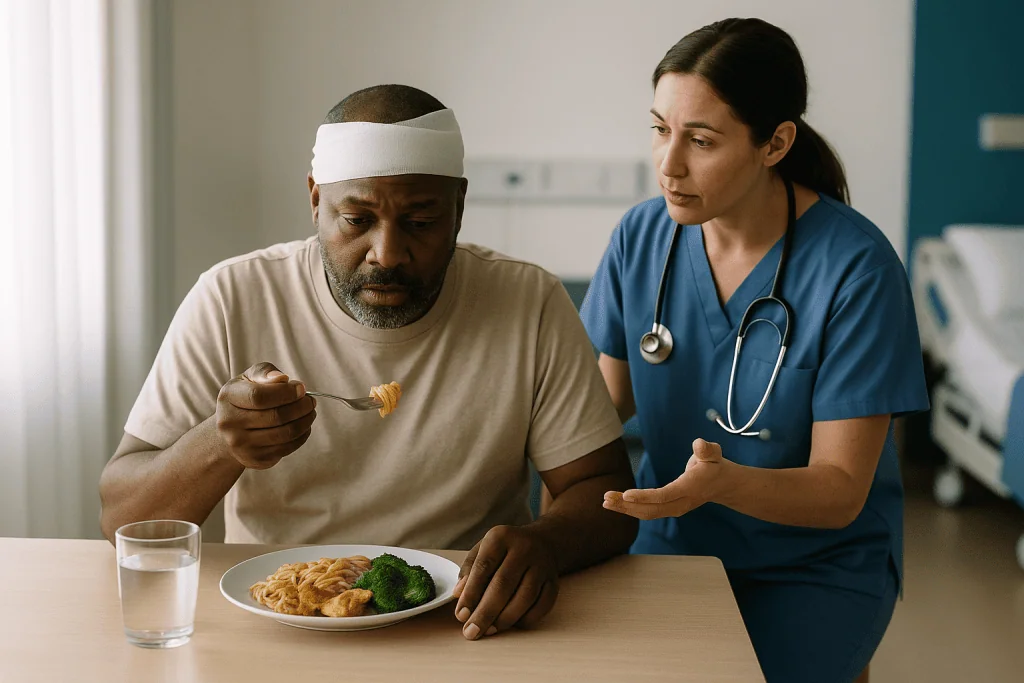
Week one at home tends to be dominated by fatigue. The person may sleep far more than usual, then feel wiped out after a short conversation. Light and noise feel sharper. Headache often sits in the background and spikes with effort. Irritability shows up as snapping at the people closest to them, which is almost always you.
Weeks two to four bring the first attempts at normal life: a short walk, a few emails, a visit from a friend. This is where modern guidance has shifted. The CDC’s concussion advice no longer recommends prolonged total rest. A brief period of relative rest in the first day or two, then gradual return to light activity that does not provoke symptoms, is the current approach. Too little activity can prolong recovery; too much too soon sets it back. The rule of thumb clinicians teach is to stop before symptoms climb, rest, then try again at a slightly lower level.
Through this period you will notice a sawtooth pattern. A good day followed by a bad one does not mean something has gone wrong. Progress in brain injury is measured over weeks, which is one reason the notebook from the hospital earns its keep now: compare this Tuesday with last Tuesday, not with yesterday.
For severe injuries, the home timeline is usually shaped by the rehabilitation plan: physiotherapy for balance and strength, occupational therapy for daily tasks, speech and language therapy for communication and swallowing, and neuropsychology for memory and mood. Keep the appointment list visible on the fridge. Attendance in the first weeks is strongly linked to how useful the later months feel.
Common changes in the first weeks, and what families can do about them
Most of the frightening behaviors families report are predictable consequences of where the brain was hurt. The frontal lobes, which sit behind the forehead and manage judgment, impulse control and planning, are injured in a large share of head trauma simply because of how the skull is shaped. The table below pairs the changes families most often ask about with responses that rehabilitation teams routinely teach.
| What you may notice | Likely reason | What tends to help |
|---|---|---|
| Asks the same question repeatedly | New memories not being stored | Answer briefly and calmly each time; write key facts on a whiteboard |
| Exhausted after minor tasks | Injured brain uses more energy for ordinary processing | Plan one activity per block, schedule rest before fatigue hits |
| Sudden anger or tears | Reduced emotional braking from frontal injury | Lower your voice, reduce stimulation, step away briefly, never take the bait |
| Headache that builds with effort | Common post-injury symptom, worsened by screens and noise | Shorter sessions, dimmer light, report patterns to the clinician |
| Sleeping in the day, awake at night | Disrupted sleep-wake regulation | Daylight in the morning, consistent bedtime, no screens late |
| Coughing or wet voice after drinks | Possible swallowing weakness | Stop and ask for a swallow assessment before continuing |
| Unsteady, bumping into things | Balance, vision or attention changes | Clear floors, good lighting, supervise stairs and showers |
Two principles run through every row. The first is reduce the load: fewer people, fewer decisions, fewer sounds. The second is externalize memory: calendars, labels, alarms and notes carry what the brain temporarily cannot. Families often feel these supports are “giving in.” Rehabilitation evidence points the other way. Scaffolding early lets the person succeed at tasks, and success, not struggle, is what rebuilds confidence and routine.
Report new or escalating changes to the care team rather than managing them alone. A sudden shift in behavior can occasionally signal a medical problem, such as a growing bleed, infection or a medicine side effect, and the team would rather hear about it.
How to talk to someone with a TBI
Conversation after a brain injury is a shared task, and the person without the injury has to do more of the work. Families who learn this early spare themselves a great deal of hurt.
Speak slowly and give one idea per sentence. Processing speed is one of the first things a head injury affects, so a sentence that bundles three thoughts arrives as noise. Pause after you speak, longer than feels natural, and resist filling the silence. Many people with TBI know exactly what they want to say but need extra seconds to retrieve the words. Finishing their sentences, however kindly meant, removes the practice their brain needs.
Offer choices rather than open questions in the early weeks. “Tea or water?” is easier than “What would you like?” Yes-or-no questions work well when fatigue is high. If the person has aphasia, meaning difficulty producing or understanding language because of damage to the brain’s language areas, a speech and language therapist can show you gesture, writing and picture strategies that fit their specific pattern.
Choose your moments. Important conversations go better in the morning, after rest, in a quiet room with the television off. Face the person, keep your own voice calm, and watch for signs of overload: rubbing the eyes, looking away, irritability. Stop before that point and come back later.
Handle false memories gently. The brain fills gaps, so the person may describe events that did not happen or insist you said something you did not. Correcting every detail creates conflict without improving memory. A neutral reply such as “I remember it a bit differently, let’s check the notebook” keeps dignity on both sides.
And talk to them, not about them, even in intensive care. Hearing is often preserved when other responses are not, and NINDS notes that familiar voices can be orienting. Say who you are, what day it is, and what is happening. Short, warm, repeated. That is the whole technique.
Why sleep and fatigue are treatments, not inconveniences
A question families ask constantly in week one is whether it is safe to let the person sleep. The old advice to keep someone awake all night after a head injury has been replaced. The NHS says it is fine to sleep after a minor head injury as long as a responsible adult is nearby and knows the warning signs. What matters is that the person can be roused normally; if they cannot be woken, that is an emergency, not a sign of healing.
Beyond safety, sleep does real work. During sleep the brain clears metabolic waste, consolidates memory and resets the stress hormones that run high after trauma. Excessive sleepiness in the first weeks is one of the most consistent features of TBI described by Mayo Clinic, and it usually reflects the brain’s demand rather than depression or laziness, though both can arrive later and deserve attention.
Fatigue after brain injury behaves differently from ordinary tiredness. It can hit without warning, is not fixed by caffeine, and is triggered by mental effort as much as physical effort. A supermarket, with its light, noise and choices, can be more draining than a walk in the park. Families who plan around this see steadier progress: one demanding activity per morning, rest before lunch, visitors limited to short windows, and a quiet hour before bed.
Practical sleep hygiene for the first weeks is simple and evidence-based:
- Daylight exposure soon after waking, which anchors the body clock.
- A consistent bedtime and wake time, even on weekends.
- Daytime naps kept short and early, so they do not steal nighttime sleep.
- Screens dimmed or off in the hour before bed.
- No alcohol, which fragments sleep and is specifically discouraged after head injury by the NHS.
If insomnia or reversed sleep persists past the first weeks, raise it with the team. Sleep problems after TBI are treatable, and untreated ones feed headache, mood change and poor concentration, which can look like the injury getting worse when it is really the sleep.
Can stress make a head injury worse?
Stress will not reopen a healed blood vessel or tear more nerve fibers. In that strict sense, no. In every practical sense, yes: stress makes the symptoms of a brain injury louder, lasts longer, and makes recovery harder to measure.
The mechanism is ordinary physiology. Stress raises adrenaline and cortisol, the hormones that prepare the body for threat. Those hormones raise heart rate and blood pressure, suppress deep sleep, tighten neck and scalp muscles, and sharpen attention toward danger while narrowing it everywhere else. In a healthy brain this is tolerable. In a brain already struggling with sleep, headache and attention, it is a second injury to the day, if not to the tissue.
There is also a specific early concern. In the hospital phase after severe injury, the team works hard to keep blood pressure and pressure inside the skull steady. Agitation, pain and distress push against that effort, which is one reason staff ask for quiet rooms and limited visitors. It is not bureaucracy. It is pressure management.
Later, in the weeks at home, stress feeds a cycle that clinicians see often. Symptoms cause worry, worry disrupts sleep, poor sleep worsens symptoms, and the person concludes they are getting worse. The CDC’s concussion guidance lists stress and anxiety among the factors that can prolong recovery, and recommends gradual, structured return to activity partly because structure itself lowers anxiety.
What families can realistically do:
- Keep routines boringly predictable: same meal times, same bedtime, same faces.
- Shield the person from decisions that can wait: insurance calls, work negotiations, family disputes.
- Model calm. Emotional tone is contagious, especially for someone whose emotional braking is impaired.
- Name the stress out loud, without blame: “This is a lot. We will take it one thing at a time.”
If low mood, panic or intrusive memories of the accident persist beyond the first weeks, tell the team. Post-traumatic stress and depression after TBI are common, recognized and treatable, and addressing them is part of brain injury care rather than a separate problem.
How long does it take to recover from a brain bleed?
Any honest answer starts with the type of bleed, because the word covers very different injuries. Mayo Clinic and MedlinePlus describe the main kinds by location: an epidural hematoma forms between the skull and the brain’s outer covering, usually from a torn artery and often needing urgent surgery; a subdural hematoma collects between the covering and the brain surface, often from slower venous bleeding; a subarachnoid hemorrhage spreads in the fluid-filled space around the brain; and an intracerebral hemorrhage sits within brain tissue itself.
Small bleeds are frequently managed with observation, repeat scanning and control of blood pressure, and the blood is gradually reabsorbed over weeks. Larger or expanding bleeds may need a craniotomy, an operation that opens a section of skull to remove blood and relieve pressure, or a craniectomy, where the bone section is left out for a time to give a swollen brain room.
Recovery time depends less on the bleed’s name than on how much brain was affected and how long pressure was raised. A person with a small subdural that was watched and reabsorbed may be back at light work within weeks. Someone who needed surgery after a severe injury may spend months in rehabilitation, and NINDS is clear that improvement can continue well beyond the first year. No clinician can give a date in the first week, and anyone who does is guessing.
One pattern deserves a specific warning. In older adults, and in anyone taking blood thinners, a subdural hematoma can develop slowly and show up days or weeks after a fall that seemed trivial. Mayo Clinic notes that symptoms of a chronic subdural, such as worsening headache, confusion, drowsiness or weakness on one side, can appear long after the injury. If your relative had a minor bump and is “not themselves” two or three weeks later, that needs a medical review rather than reassurance.
Ask the team which type of bleed this was, whether it is stable on the latest scan, and what the plan is for the next image. Those three answers tell you more about the likely path than any general timeline.
Medicines after a brain injury: what families should know, and not decide
Medicines in the first weeks after a TBI fall into a few recognizable groups. Understanding what each one is for helps you ask better questions. It does not qualify anyone to change a dose, and nothing here should be read that way.
In hospital, after a moderate or severe injury, teams often use anti-seizure medicines for a short period. Mayo Clinic describes their use during the first week to reduce the risk of early seizures, which can raise pressure and worsen secondary injury. Whether they continue beyond that depends on scans, any seizure that occurred, and the neurologist’s judgment. Stopping them early at home because “nothing happened” is a decision only the prescriber can make.
Osmotic agents and diuretics are sometimes given intravenously to draw fluid out of swollen brain tissue, and sedatives may be used to let a very injured brain rest and to control agitation while pressure is high. These are hospital treatments and generally stop before discharge.
At home, the most common questions concern pain relief and sleep. Headache is expected in the first weeks. The caution is that some over-the-counter painkillers affect clotting, and some sleep aids or sedatives mask the drowsiness that is a warning sign of a growing bleed. The NHS advises people after head injury not to take sleeping tablets or sedatives without medical advice, and to avoid alcohol. The safe approach is simple: use only what the discharge sheet lists, and ring the team before adding anything, including supplements.
If the person was already on blood thinners for a heart condition or previous clot, the team will have weighed the risk of bleeding against the risk of stroke or clot. That balance can shift as scans stabilize. Families sometimes stop these medicines out of fear; that is a known cause of harm. Keep the question on the list for the next review instead.
One more practical point. Memory problems make medicine errors likely. A weekly pill organizer, a written chart ticked after each dose, and one named person responsible for the task prevent most of them.
What are the newest treatments for traumatic brain injury?
Families searching for breakthroughs deserve a straight answer: the treatments with solid evidence are not new, and the new ones mostly lack evidence yet. That is not pessimism. It is the state of the science, and knowing it protects you from spending hope, money and energy on the wrong things.
Established and effective, as summarized by NINDS and Mayo Clinic: rapid transfer to a center that can manage pressure inside the skull, surgery to remove bleeds or relieve pressure when needed, careful control of oxygen, blood pressure and temperature, and early, structured rehabilitation across physical, cognitive and psychological domains. Rehabilitation is the single intervention most families underrate. It is where most measurable gains after a severe injury come from.
Studied, with disappointing results: several approaches that looked promising in animals have not held up in large human trials. Cooling the body to protect the brain has been tested repeatedly without consistent benefit in adults. Hormone treatments aimed at reducing swelling and inflammation did not improve outcomes in large randomized trials. A clot-stabilizing medicine given very early after injury has shown at most a modest effect in some groups, and its role is still being defined by guideline bodies.
Experimental: stem cell therapies, hyperbaric oxygen, and various brain stimulation techniques are under study. None is a proven treatment for acute TBI, and NINDS describes them as areas of research. Clinics offering them as established care, especially outside clinical trials, should be viewed with caution.
Genuinely useful recent shifts are quieter. Blood tests that help decide who needs a CT scan after mild injury, better understanding of why prolonged rest harms rather than helps concussion recovery, and growing recognition that mood, sleep and headache after TBI need active treatment rather than patience.
If you want to explore a trial, ask the team whether any are open and appropriate. Registered trials carry ethical oversight and honest consent forms. That is the right way to be at the frontier.
Brain injury caregiver tips: caring for someone with traumatic brain injury when you are exhausted too
Caregivers after a brain injury have a particular problem: the person they are grieving is still in the room. The body recovered, the laugh is different. Rehabilitation professionals call this ambiguous loss, and naming it is the first useful step. It is normal to feel love, resentment and guilt within the same hour.
The second step is logistics, because exhaustion is mostly a logistics failure. In the first weeks, divide the work into roles rather than hoping it balances itself: one person manages appointments and the notebook, one handles medicines, one handles meals and the house, one is the “relief” who takes an evening. If you are the only person available, ask the hospital social worker or discharge coordinator what respite, home care or community support exists, and ask before discharge rather than after.
Protect your own sleep with the same seriousness you protect theirs. A caregiver running on four hours makes medicine errors, misreads behavior as hostility and cannot judge whether drowsiness is a red flag. If night supervision is needed after a severe injury, it has to be shared or paid for; it cannot be done alone for long.
Say yes to specific offers and convert vague ones. “Let me know if you need anything” becomes “Could you take Thursday afternoon?” People want a task.
Watch your own warning signs: constant irritability, no appetite, tearfulness in the car, thoughts of walking out. These are signals to involve your own doctor, not evidence that you are failing. Caregiver depression after TBI is common and treatable, and untreated it shortens how long you can keep going.
Finally, keep one thread of your own life alive, even thin: a walk, a call with a friend, a book. Families sometimes treat this as selfish. The rehabilitation evidence is consistent that a caregiver who lasts the year is worth more to the injured person than one who burns out in a month. Taking care of yourself is part of caring for someone with traumatic brain injury, not a break from it.
What people often get wrong about caring for someone after a brain injury
“Keep them in a dark room and do nothing for weeks.” This was standard advice and it is now outdated. The CDC’s concussion guidance supports a short period of relative rest in the first day or two, followed by gradual return to light activity. Prolonged inactivity tends to lengthen recovery, worsen mood and deconditioning, and increase anxiety about every symptom.
“A normal CT scan means nothing is wrong.” A CT scan looks for bleeding, skull fracture and swelling. It does not show the stretched nerve fibers that cause most concussion symptoms. A clear scan is reassuring about surgical emergencies and says little about how the next month will feel.
“The anger means they are taking it out on me.” Frontal lobe injury weakens the brakes on emotion. The person is not choosing you; you are simply nearest. That does not mean tolerating harm, and it does mean reporting new aggression to the team rather than absorbing it.
“Recovery should be steady.” It is a sawtooth. Bad days after good ones are the normal texture of brain recovery, as rehabilitation teams routinely explain. Judge by weeks.
“Children bounce back.” Young brains are still developing, and the CDC notes that children and adolescents can take longer to recover from concussion than adults. School should be informed and adjusted, and repeat head injury before full recovery is a specific risk to avoid.
“They should push through to get back to work.” Early return to full cognitive load is a common reason symptoms persist. A phased return, agreed with the employer and the clinician, generally works better than a single heroic Monday.
“One drink won’t hurt.” The NHS specifically advises avoiding alcohol after a head injury. It disturbs sleep, impairs balance, can interact with medicines and makes it harder to tell drowsiness from a warning sign.
“If they were going to get better, it would have happened by now.” NINDS describes recovery continuing for months and sometimes years after severe injury. Early plateaus are common and do not predict the final picture.
Questions to ask your care team before discharge and at follow-up
Families often leave appointments with everything answered except the thing they most wanted to know. Writing questions down beforehand fixes that. These are the ones brain injury teams say they wish families asked more often.
About the injury
- What type and severity of injury is this, and what did the latest scan show?
- Is a repeat scan planned, and what would change the plan?
- Is there a risk of seizures, and what should we do if one happens?
About medicines
- Which medicines are new, what is each one for, and how long is it expected to continue?
- Which usual medicines, especially blood thinners, have been paused or changed, and who will review that?
- What should we avoid, including over-the-counter products and alcohol?
About home safety and daily life
- Can they be left alone, and for how long?
- Is supervision needed for stairs, bathing, cooking or medicines?
- When can they drive, work, study, exercise or fly, and who decides?
- Are there swallowing precautions for food or drink?
About rehabilitation and follow-up
- Which therapies are planned, how often, and who coordinates them?
- Who is our single point of contact, and how do we reach them out of hours?
- What symptoms should prompt a call, and which should prompt an emergency visit?
- Is a neuropsychology assessment appropriate, and when?
About support
- What caregiver, respite or financial support exists, and who helps us apply?
- Is there a brain injury support group or specialist nurse we can contact?
Bring the notebook, bring a second person if you can, and ask the clinician to summarize the plan in a few sentences at the end. Repeating it back in your own words is the quickest way to find the gaps while someone is still in the room to fill them.
When to call your doctor: red-flag signs after a brain injury
Most of the first weeks will be slow and unremarkable, and that is what you want. A small number of signs mean the picture may be changing, and they are the reason a responsible adult is asked to stay close in the early days. Keep this list where everyone in the household can see it.
Call emergency services or go to the emergency department immediately if the person:
- Cannot be woken, or is unusually and increasingly drowsy.
- Has a seizure, a fit, or a period of unresponsiveness.
- Develops a headache that is getting worse rather than better, or is severe and sudden.
- Vomits repeatedly.
- Becomes more confused, agitated or unable to recognize people or places.
- Has new weakness, numbness or loss of coordination in an arm or leg, or a drooping face.
- Has slurred speech, trouble understanding, or new problems with vision, such as double vision.
- Has one pupil larger than the other.
- Has clear fluid or blood coming from the nose or ears.
- Shows unusual behavior that is clearly out of character.
These signs, drawn from NHS and Mayo Clinic guidance, can indicate bleeding, rising pressure or seizure activity, all of which are time-sensitive.
Contact the care team the same day for problems that are not emergencies but should not wait for a scheduled appointment: a headache that is not easing after several days, new dizziness or balance problems causing near-falls, coughing or choking with drinks, a wound that is red, swollen or leaking, persistent low mood or talk of hopelessness, or sleep that has completely reversed.
Two groups need a lower threshold. Older adults and anyone on blood thinners can bleed slowly, and new symptoms two or three weeks after a minor fall warrant review. Children who become unusually quiet, clingy, irritable or sleepy after a head injury should be seen, because they often cannot describe what they feel.
When in doubt, call. Teams would much rather assess a worried family and find nothing than hear about a sign that was watched overnight. The decision about what the symptom means, and what to do next, always belongs to the treating clinicians.
Frequently asked questions
Can stress make a head injury worse?
Stress does not cause new physical damage, but it amplifies the symptoms of a brain injury and can slow recovery. Stress hormones disrupt sleep, raise blood pressure and heart rate, tighten muscles and narrow attention, which worsens headache, fatigue and concentration. The CDC lists stress and anxiety among factors that can prolong concussion recovery. Calm routines, fewer decisions and good sleep reduce the effect. Persistent anxiety or low mood should be raised with the care team.
How do you talk to someone with a TBI?
Speak slowly, one idea per sentence, in a quiet room, and pause longer than feels natural so they have time to process and reply. Offer simple choices rather than open questions, avoid finishing their sentences, and do not argue with false memories; a gentle redirect to a notebook works better. Pick times after rest, watch for signs of overload, and keep talking to the person directly, even in intensive care, since hearing is often preserved.
What are the newest treatments for traumatic brain injury?
The treatments with the strongest evidence are established ones: prompt pressure management, surgery when needed, careful control of oxygen and blood pressure, and early structured rehabilitation. Several newer ideas, including body cooling and hormone-based anti-swelling therapies, did not show benefit in large trials. Stem cells, hyperbaric oxygen and brain stimulation remain experimental according to NINDS. Ask the team about registered clinical trials rather than unproven commercial treatments.
How long does it take to recover from a brain bleed?
It depends on the type, size and location of the bleed and how long pressure inside the skull was raised, so no honest timeline exists in the first week. Small bleeds that are watched may be reabsorbed over weeks, with return to light activity soon after. Bleeds needing surgery after severe injury often involve months of rehabilitation, and NINDS notes improvement can continue beyond a year. Ask the team whether the bleed is stable on the latest scan.
Should I wake someone up during the night after a head injury?
Current NHS guidance says it is fine to let someone sleep after a minor head injury as long as a responsible adult stays with them and knows the warning signs. The hospital may ask you to check that the person can be roused normally during the first night; follow the specific instructions on the discharge sheet. If the person cannot be woken, is unusually drowsy, vomits repeatedly or has a seizure, call emergency services immediately.
What is a typical TBI recovery timeline after a severe injury?
After a severe injury the path usually runs from intensive care to a ward, then inpatient rehabilitation, then home with outpatient therapy. NINDS describes recovery as continuing for months and sometimes years, with the fastest change typically in the early months. Progress is uneven, with good and bad days, so families are encouraged to compare week with week. Specific milestones such as walking, returning to work or driving are set by the rehabilitation team.
Is it normal for personality to change after a brain injury?
Yes, personality and behavior changes are common, especially after injury to the frontal lobes, which manage judgment, impulse control and emotional regulation. Irritability, tearfulness, apathy or impulsiveness in the first weeks usually reflect the injury rather than choice. Many changes ease as swelling settles and rehabilitation progresses, though some persist. Sudden new changes should be reported, because they can occasionally signal a bleed, infection or medicine side effect.
Can someone with a TBI drink alcohol in the first weeks?
The NHS advises avoiding alcohol after a head injury. Alcohol disturbs sleep, impairs balance and increases fall risk, can interact with anti-seizure and pain medicines, and makes it harder to distinguish ordinary drowsiness from a warning sign of bleeding. It can also lower the seizure threshold. When drinking might be safe again is a question for the treating team, and the answer depends on the injury, medicines and recovery.
When can someone drive again after a traumatic brain injury?
Driving should not resume until the treating clinician says it is safe, and in many places there are legal rules requiring notification after a significant head injury or seizure. Reaction time, attention, vision and judgment are all affected by TBI and can seem fine to the person while still impaired. The team may recommend a formal driving assessment. Returning early risks the person, passengers and insurance cover, so treat this as a medical decision.
What brain injury caregiver tips matter most in the first week?
Keep a notebook of symptoms, medicines and what each clinician says; keep the home quiet, predictable and well lit; protect sleep for the injured person and for yourself; limit visitors to short calm windows; follow the discharge sheet exactly and ask before adding any medicine; keep the red-flag list visible; and ask the discharge coordinator what respite and support exist. Sharing tasks across people from day one prevents the exhaustion that undermines later care.
References
- NHS: Severe head injury
- NIH NINDS: Traumatic brain injury (TBI)
- CDC: About traumatic brain injury
- MedlinePlus: Traumatic brain injury
This article is for general information only and is not a substitute for professional medical advice. Please consult a qualified doctor about your individual situation.

More from the Blog

When Is It Time to See a Neurologist for Migraine? How Frequency and Disability Guide It
Consider seeing a neurologist for migraine when attacks occur on about five or more days a month, when they regularly stop you from working…
What Does the Screening Injection Before Baclofen Pump Implantation Show?
A baclofen pump screening trial shows whether a person's spasticity loosens when a small test dose of baclofen is placed directly into the spinal…
Mealtime Support for Someone With Dysphagia: Positioning, Pacing and Swallowing Safety
Mealtime support for dysphagia means helping someone eat and drink in the way their swallowing assessment recommends: sitting fully upright with the head slightly…

What Families Can Do Between Therapy Sessions to Support a Child With Cerebral Palsy
Between therapy sessions, families support a child with cerebral palsy mainly by folding the therapist's goals into daily routines: planned positioning, regular stretching, supported…

Can Cognitive Stimulation and Nutrition Help in Alzheimer’s Disease? What Care Plans Include
Cognitive stimulation, usually delivered as structured group sessions, produces small but measurable gains in thinking and quality of life for people with mild to…

Who Is a Candidate for Deep Brain Stimulation in Parkinson’s Disease? How Teams Decide
A person is usually considered a candidate for deep brain stimulation in Parkinson's disease when the diagnosis is confirmed, symptoms still respond well to…