

Clear Aligner Milestones: Tray Changes, Refinements and the Retainer Phase

Key Takeaways
- Clear aligners are typically worn about 20 to 22 hours a day and changed every one to two weeks, and the total course is the sum of those intervals plus any refinement rounds.
- Teeth move because the periodontal ligament and surrounding bone remodel under gentle pressure, which is why a tray loosens within days but the bone takes longer to consolidate.
- Systematic reviews report that aligners achieve a proportion of the planned movement, especially for rotations and vertical movements, which is why refinement trays are built into most plans.
- The first week of treatment and the first days of each new tray are usually the most uncomfortable, with pressure that eases as tissue adapts.
- A Cochrane review found insufficient evidence to crown one retention regimen as best, so your orthodontist's individualized retainer plan is the one to follow.
- The NHS advises that retainers are usually needed indefinitely because teeth tend to drift back toward their original positions once active treatment ends.
Clear aligner treatment moves through predictable milestones: a digital scan and treatment plan, the first tray and an adjustment week, tray changes roughly every 1 to 2 weeks worn about 20 to 22 hours a day, mid-course checks, often one or more refinement rounds with new trays, and finally the retainer phase, which continues long after active treatment so the teeth do not drift back.
A friend sent me a photo of her bathroom counter: a toothbrush, a little plastic case, and a row of numbered pouches lined up like a calendar. Tray 14 of 32. She was proud of the number, and slightly anxious about it, because she had just been told that 32 might not be the finish line after all.
That mix of pride and uncertainty is the real texture of straightening teeth with removable trays. People expect one long process. What they actually get is a sequence of clear aligner treatment milestones, each with its own rhythm, its own small frustrations and its own quiet wins. Some arrive on schedule. Some do not.
This explainer walks through those milestones in order, from the first scan to the retainer you will still be wearing years from now, with the evidence attached where it exists and honest gaps named where it does not.
What are clear aligner treatment milestones, and why do they matter?
A milestone is simply a point in treatment where something changes: the appliance, the plan or your responsibilities. Thinking in milestones rather than in one long countdown does two useful things. It makes the process easier to live with, and it makes delays easier to interpret, because you can see exactly which stage has slipped.
Clear aligners are thin, removable plastic trays that fit snugly over the teeth and apply gentle, planned pressure. Each tray is shaped slightly differently from the one before, so the teeth are nudged a fraction of a millimeter at a time. Patient-education summaries from Cleveland Clinic describe trays being swapped roughly every one to two weeks and worn around 20 to 22 hours a day, which is the backbone of the whole timeline.
The milestones most people pass through look like this:
- Assessment, imaging and a digital plan that previews the intended movements.
- The first tray, often with small tooth-colored attachments bonded on the same day.
- Regular tray changes, with check-ins to confirm the teeth are following the plan.
- A mid-course or end-of-course review, frequently followed by refinement trays.
- The end of active movement, then retainers that continue indefinitely.
Here is the opinion this article is built around: the final milestone, retention, is the one that most determines whether the result lasts, and it is the one people take least seriously. The NHS is blunt about this, advising that retainers are usually needed indefinitely because teeth tend to drift back toward their original positions. Everything before that is preparation for a habit you keep.
How clear aligners actually move teeth
Teeth are not set in concrete. Each root sits in a socket lined by the periodontal ligament, a thin cushion of fibers that connects tooth to bone. When a tray presses a tooth in one direction, that ligament is squeezed on one side and stretched on the other. Bone cells respond: on the compressed side, specialized cells gradually remove bone; on the stretched side, new bone is laid down. The tooth moves into the space created, and the socket rebuilds behind it.

This biological remodeling is slow by design, which is why a tray that feels tight on day one feels passive by day five or six. Once the tooth has caught up with the shape of the plastic, the tray has done its work and the next one takes over. Push faster than the bone can remodel and you do not get faster results, only more discomfort and a higher risk that the tooth loses its grip on the tray.
Aligners handle some movements better than others. A systematic review in the Angle Orthodontist (Rossini and colleagues) found that aligners are effective at controlling simpler movements such as tipping and closing small spaces, but less predictable for rotations of rounded teeth and for extruding or intruding teeth toward or away from the gum. That is not a flaw in any one product; it reflects how a smooth plastic shell grips a tooth compared with a bracket glued to its surface.
To improve that grip, orthodontists bond attachments, small bumps of tooth-colored filling material, onto selected teeth. They act like handles. Some plans also use elastics hooked between the trays or attachments to correct how the upper and lower teeth meet. Understanding this mechanism explains nearly every milestone that follows, including why refinements are so common.
Who clear aligners are usually for, and who is usually asked to wait
Aligners are generally considered for mild to moderate crowding, spacing and certain bite problems in people whose adult teeth are fully erupted. MedlinePlus describes malocclusion, the clinical term for teeth that do not line up properly, as ranging from minor cosmetic misalignment to significant bite discrepancies, and the orthodontist’s job is to judge where a given mouth sits on that spectrum.
Candidates who tend to do well share three things: healthy gums and bone, movements that aligners handle predictably, and the discipline to wear the trays nearly all day. That third factor is not a throwaway line. Because aligners are removable, the plan assumes you keep them in; fixed braces do not depend on that assumption.
Several groups are often asked to wait or to consider another approach:
- Children and younger teens with baby teeth still present, because moving teeth around an erupting dentition is less predictable.
- People with untreated gum disease, where moving teeth through inflamed, weakened bone can worsen attachment loss until the gums are stabilized.
- Those with extensive untreated decay or failing restorations, since trays trap acids and plaque against the teeth.
- Severe skeletal discrepancies, where the jaws themselves are mismatched and surgery or fixed appliances may be discussed instead.
Age itself is not a barrier; adults account for a large share of aligner wearers. What changes with age is bone density and the pace of remodeling, so timelines may run longer. None of this is a verdict you can reach by looking in a mirror. A clinical examination, radiographs and a scan are how the treating team decides, and a recommendation to wait is often a recommendation to protect the result rather than to deny it.
Milestone one: the scan, the plan and the hardest week
The first appointment is unglamorous and decisive. Photographs, radiographs and a digital scan of both arches are taken, and from these the orthodontist builds a plan that previews each stage of movement. You will likely be shown an animation of your teeth gliding into alignment. Treat it as a map, not a contract. It shows intended positions; biology decides how closely reality follows.
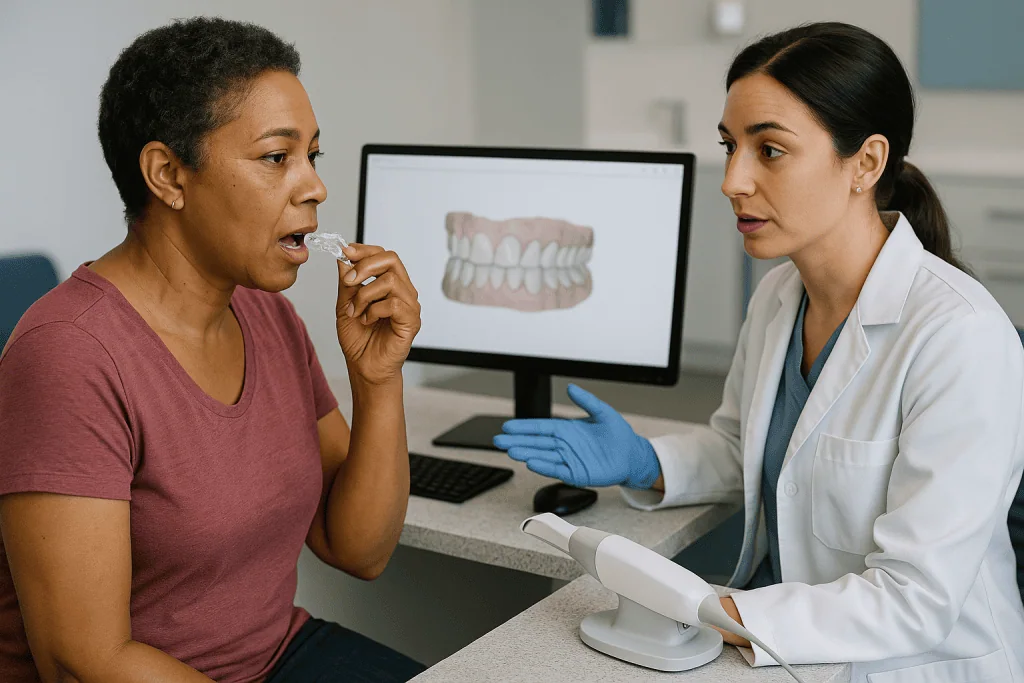
At the fitting visit, attachments are bonded, the first tray is seated, and you are taught the two skills that define the next year: removing the tray without bending it, and seating it fully, usually by biting on a small foam cylinder called a chewie. The first time you take it out in a restaurant you will fumble. Everyone does.
People search for the hardest week, and the honest answer is usually the first one. Pressure on the teeth peaks within hours of a new tray and eases over several days as the ligament and bone adapt. The edges of the plastic can irritate the tongue and cheeks until the soft tissue toughens. Speech can lisp for a few days while the tongue finds new landing spots. Saliva flow increases. None of this is dangerous, and most of it fades before the second tray arrives.
Small, practical measures help: orthodontic wax on a sharp edge, cool water, reading aloud to speed up the speech adjustment, and switching trays at night so the tightest hours pass while you sleep. If an edge is cutting rather than rubbing, the clinic can smooth it in minutes. The first week is a milestone precisely because getting through it teaches you that each new tray is a smaller version of the same curve.
The aligner tray change schedule: what decides one week or two?
Cleveland Clinic’s patient guidance describes trays being changed every one to two weeks, and that range is where most schedules land. The interval is not arbitrary. It is the orthodontist’s estimate of how long your bone needs to remodel enough that the next tray can seat fully without forcing the tooth.
Several factors push a schedule toward the longer end: adult bone that remodels more slowly, trays that program larger or more complex movements such as rotations or root tipping, and any history of trays not seating well. Younger patients with simple crowding are more likely to be given shorter intervals. Some clinicians start everyone on a longer interval, then shorten it once they have seen how a particular mouth responds.
A few rules of thumb keep the schedule honest:
- Changing early because a tray feels loose is not a shortcut; feeling loose means the tooth has caught up to the plastic, not that the bone around it has fully matured.
- Changing late because the tray feels comfortable is rarely harmful, but stacking delays stretches the whole course.
- If a new tray will not seat with firm chewing after a day or two, keep wearing the previous one and contact the clinic rather than forcing it.
Some clinicians use remote monitoring, where you photograph your teeth through an app and the team confirms each change. Others rely on in-person visits every six to ten weeks, handing over the next batch of trays. Either way, the schedule belongs to the treating team. Tray intervals are one of the few levers they can adjust mid-course without reordering the whole set, and they will use that lever based on what your teeth are actually doing.
Wear time and the "30 minute rule" people ask about
Searches for a 30 minute rule reflect a real question: how long can the trays be out before it matters? The number itself comes from patient culture rather than from any published guideline. What the evidence base and clinical guidance agree on is the daily total. Cleveland Clinic advises wearing aligners about 20 to 22 hours a day, removing them only to eat, drink anything other than water, and clean your teeth.
The arithmetic behind that total is more useful than any single rule. Twenty-two hours of wear leaves two hours of removal per day. Three meals of 20 to 30 minutes each, plus brushing, uses most of that window. A leisurely dinner, two coffees and a snack can quietly consume three or four hours, and the trays spend a quarter of the day not working.
The 30 minute idea is best understood as a way to keep individual gaps short. When trays are out for long stretches, the teeth begin to relax back toward their previous positions, and the tray can feel tighter or fail to seat fully when it returns. One long afternoon will not undo weeks of progress; a pattern of long afternoons will.
Habits that protect wear time are mundane but effective: eating within set windows rather than grazing, keeping a travel toothbrush and case in your bag, and never wrapping a tray in a napkin, which is how most lost aligners meet their end. Drinking anything hot or sugary with trays in is a separate problem; heat can warp the plastic and sugar sits trapped against enamel.
Nobody hits 22 hours every single day. The goal is a weekly average that stays near the target, and honesty with your clinician when it does not, because a plan built on assumed wear time cannot be adjusted if the assumption is hidden.
How long does clear aligner treatment take, milestone by milestone?
Time estimates are where marketing and evidence drift furthest apart. Patient-education material from Cleveland Clinic places many aligner courses in the range of roughly 6 to 18 months, with complex cases running longer. The NHS notes that comprehensive orthodontic treatment with fixed braces typically takes 18 to 24 months. Neither figure is a promise for any individual, and planned durations are frequently extended once refinements are added.
Breaking the timeline into stages makes it less abstract. The table below gives typical ranges reported in the cited guidance; your orthodontist’s plan will have its own numbers.
| Milestone | Typical range | What determines it |
|---|---|---|
| Assessment and plan | Days to a few weeks | Imaging, dental health, plan design and approval |
| Adjustment to first tray | About 1 week | Soft-tissue adaptation, speech, pressure easing |
| Each tray | 1–2 weeks | Bone remodeling rate, movement complexity, wear time |
| Visible change | Often within first 2–3 months | Which teeth move first; front teeth show earliest |
| Initial series | Roughly 6–18 months | Severity of crowding or bite problem |
| Refinements | Weeks to several months each | How closely teeth tracked the plan |
| Retention | Indefinite | Natural tendency of teeth to drift back |
The factors that stretch a course are consistent across studies: adult age, movements aligners struggle with, missed wear, and the number of refinement rounds. The factor that shortens it is less exciting than any technology: wearing the trays. If you remember one thing, make it this: the total duration is the sum of your tray intervals plus any refinements, and both are set by how well your teeth follow the plan, not by the date on an animation.
How long until you can see results from clear aligners?
Most people look for change in the mirror long before an orthodontist would look for it on a scan. The front teeth tend to move first in many plans, because they are single-rooted and lighter to move, and because crowding is usually most visible there. Noticeable change in the front six teeth within the first two to three months is common, though not universal, and plans that begin by expanding the arches or moving back teeth may show little visible progress for longer.
Three things create a false sense of no progress. First, movement of a fraction of a millimeter per tray is invisible day to day; it becomes obvious only when you compare photos a month apart. Second, early stages often make the smile look temporarily worse, as teeth are moved out of their locked positions before being brought into line. Third, bite changes are felt rather than seen; molars may stop meeting the way they used to, which is intended but disconcerting.
Photographs are the antidote. Take the same shot in the same light every few weeks and keep them in a single folder. Most people are startled by the comparison at month three. Clinics using remote monitoring effectively do the same thing in a more structured way.
Patience has a clinical justification. The Rossini systematic review noted that aligners achieve certain movements less completely than planned, which is part of why clinicians build in refinement stages rather than expecting the first series to finish the job. Seeing modest early progress is not a sign that treatment is failing; it is the pace at which bone can safely rebuild around a moving root. What would concern an orthodontist is not slow change but a tray that no longer fits, which is the next milestone to understand.
Mid-treatment check-ins: the clear aligner treatment milestones nobody posts about
Between the first tray and the last there is a long middle stretch that generates no celebratory photos. It is also where most treatments quietly succeed or go off course. The key concept is tracking, which simply means the teeth are keeping up with the shape of each tray.
A well-tracking tray sits flush against every tooth with no visible gap at the biting edges. A tray that is not tracking shows a small air space, usually at the edge of a tooth being rotated or pulled downward, and the tray may feel springy rather than snug. Clinicians look for this at each visit or in uploaded photos. You can learn to spot it yourself by checking the incisal edges in a mirror after seating the tray with chewies.
Causes of poor tracking are usually one of four things: wear time below target, an attachment that has fallen off, a tooth that is moving more slowly than planned, or a movement the plastic was never going to manage alone. The remedy depends on which it is. Options the treating team may use include going back one or two trays, extending the interval, replacing a lost attachment, or adding elastics. Occasionally they will stop and reorder trays early rather than continue down a path the teeth are not following.
Check-in visits also serve dental health. Trays hold plaque and acid against enamel for 22 hours a day, so decalcification, the chalky white marks of early enamel loss, is a risk when brushing is rushed. Gum inflammation from trapped debris is another. These visits are the moment to raise anything that has bothered you: a rough edge, a tray that cracks repeatedly, jaw ache, or simply the sense that nothing is happening. The middle of treatment is dull by design. Dull means it is working.
Clear aligner refinements: why a second round is normal, not a failure
A refinement is a new set of trays, made from a fresh scan near the end of the initial series, that corrects the difference between where the teeth were planned to be and where they actually are. People hear the word and assume something went wrong. In practice, refinement is written into most treatment plans before the first tray is worn.
The reason goes back to mechanics. Systematic reviews, including the Rossini review in the Angle Orthodontist, consistently report that aligners achieve a proportion of the planned movement rather than all of it, especially for rotations, extrusions and root torque. Clinicians know this, so the first series is designed to get close, and refinements close the remaining gap with the benefit of seeing how your particular teeth responded.
What refinement involves:
- A new scan and photographs to capture the current position of every tooth.
- A revised digital plan, which you may be shown and asked to approve.
- Removal of some attachments and bonding of new ones in different positions.
- A new set of trays, often fewer than the first, worn on the same daily schedule.
How many refinement rounds you might need cannot be predicted reliably in advance, and no credible guideline publishes a percentage you can hold a clinician to. One round is common; two or more happen when the bite needs detailed finishing or when wear time fell short during the first series. Each round adds weeks to months.
The emotional milestone matters as much as the clinical one. Hearing that tray 32 is not the end can feel like being handed back to the start line. Reframe it: refinement is the stage where the orthodontist stops working from a prediction and starts working from your actual result. It is the most tailored part of the entire process.
Retainers after clear aligners: the milestone that never really ends
When the last tray comes out and the attachments are polished away, treatment feels finished. Biologically, it is not. The bone around each moved root is still immature, the stretched gum fibers are still pulling, and teeth that are not held will begin drifting within days. This drift is called relapse, and it is the reason the NHS advises that retainers are usually worn indefinitely.
Retainers come in two broad types. Removable retainers are clear trays or wire-and-acrylic plates worn full time at first and then at night. Fixed retainers are thin wires bonded behind the front teeth that stay in place permanently. Many people have both: a bonded wire for the lower front teeth, which relapse most readily, plus a removable tray over the top.
Which regimen is best is genuinely uncertain. A Cochrane systematic review (Littlewood and colleagues) concluded that the evidence was insufficient to recommend one retention approach over another, whether fixed versus removable or full-time versus part-time wear. That is worth sitting with. The confident schedules you see online rest on clinical experience rather than strong trials, so your orthodontist’s recommendation, based on your specific movements, is the one to follow.
Practical points that hold regardless of type:
- Removable retainers warp in heat and are lost in napkins exactly as aligners are.
- A fixed wire needs careful flossing with threaders and should be checked at dental visits; a loose end lets individual teeth move.
- Retainers wear out and need replacing; a cracked or ill-fitting one does not hold anything.
- If a retainer feels tight after a lapse, that is teeth moving. Resume wear and tell the clinic.
This phase is where the opinion in this article lands hardest. The active milestones end. The retainer habit is the result.
What people often get wrong about clear aligner timelines
Ask anyone a year into treatment what they wish they had known, and the answers cluster around a handful of myths worth correcting.
“The animation is the schedule.” The digital preview shows planned positions and a planned tray count. It does not show biology. Systematic reviews report that aligners routinely achieve less than the full planned movement, which is why refinements exist and why the real end date is usually later than the first estimate.
“Looser trays mean I can change early.” A tray loosens when the tooth has reached the plastic, not when the bone has consolidated around it. Changing early stacks force on tissue that has not caught up and raises the risk of the next tray failing to seat.
“Aligners are painless.” They are generally gentler than fixed braces, but pressure in the first days of each tray and soft-tissue irritation early on are expected. Painless is a marketing word; manageable is the honest one.
“Eating with trays in saves time.” It cracks plastic, stains it and holds food acids against enamel. Removing trays, eating, and brushing before reinserting is the only approach that protects the teeth.
“Once I finish, I am done.” The NHS guidance on indefinite retainer wear exists because relapse is the default outcome without it. Finishing active treatment is a transition, not an exit.
“Mail-order trays without an examination are the same thing.” Moving teeth without radiographs misses hidden problems such as bone loss or impacted roots, and no one is watching for off-track teeth or damaged enamel. This article cannot judge any specific service, but the clinical principle is clear: tooth movement is a medical procedure that needs supervision.
“Adults cannot do this.” They can and do. Adult bone remodels more slowly, so intervals and totals may be longer, but age alone is not the deciding factor; gum health and the complexity of the bite are.
Questions to ask your care team before the first tray
Good questions turn a timeline you are told into a plan you understand. Bring these to the consultation or the fitting appointment, and write the answers down; the details fade quickly once the trays go in.
- Which of my movements do you expect aligners to handle well, and which are less predictable for this appliance?
- What tray interval are you planning, and what would make you lengthen or shorten it?
- Will I need attachments or elastics, on which teeth, and for how long?
- Is interproximal reduction part of my plan? This is the controlled polishing of a sliver of enamel between teeth to create space, and you should know where and how much is planned.
- How will you monitor tracking between visits: in person, through photographs, or both?
- Have you built a refinement stage into my plan, and how will I know if one is needed?
- What should I do if a tray cracks, an attachment falls off, or I lose a tray while traveling?
- Which retainer type do you recommend for me, how long will I wear it full time, and what does long-term wear look like?
- How will my gums and enamel be checked during treatment, and should I continue routine hygiene visits with my general dentist?
- If I need other dental work during treatment, such as a filling or crown, how does that affect the trays?
Two further questions are rarely asked and often matter most. First, ask how the team will tell you if the plan needs to change; some patients learn about an extension only when the next batch of trays arrives. Second, ask what the plan assumes about your daily wear time, so you know what the schedule actually depends on. A clinician who answers these clearly is giving you the tools to be a partner in the process, which is the one factor in aligner treatment that no scan can measure.
When to call your doctor
Most aligner problems are minor and can wait for the next scheduled visit: a rough edge, a tray that feels tight after a late change, mild gum tenderness in the first days. Some should not wait. Contact your orthodontist or dentist promptly if you notice any of the following.
- Severe or worsening tooth pain that does not ease over several days or wakes you at night; this can signal pulp irritation, a crack or an infection rather than routine pressure.
- A tooth that becomes noticeably loose beyond the slight mobility expected during movement, or a tooth that changes color.
- Swelling of the gum, face or jaw, pus, a bad taste, or fever; these suggest infection and need same-day assessment.
- Gums that bleed heavily, recede visibly or pull away from a tooth during treatment.
- Sharp, persistent jaw pain, clicking with locking, or an inability to close the teeth together comfortably that lasts more than a few days.
- Chalky white or brown spots appearing on enamel at the gum line, the early signs of decalcification.
- A tray that will not seat at all after two or three days of correct wear, or an attachment that has fallen off.
- An allergic-type reaction such as a rash, mouth ulcers that spread, or swelling of the lips or tongue after starting a new tray.
Seek urgent medical care, not just a dental appointment, if swelling makes it difficult to swallow or breathe, if you have a high fever with facial swelling, or if a tray or retainer is inhaled or swallowed and causes coughing, chest pain or breathing difficulty.
Everything described in this article is general information drawn from mainstream clinical guidance. Whether a given symptom is routine or a red flag in your mouth, and what to do about it, is a judgment for the team that examined you and holds your records. When in doubt, a quick message or call to the clinic is never the wrong move.
Frequently asked questions
How long does clear aligner treatment take from start to finish?
Many aligner courses fall roughly within a 6-to-18-month range according to patient-education summaries from Cleveland Clinic, while the NHS notes that comprehensive orthodontic treatment often takes 18 to 24 months. Your actual duration depends on the complexity of the bite, how slowly your bone remodels, how consistently the trays are worn, and how many refinement rounds are needed. Any estimate is a plan, not a promise.
What is the 30 minute rule for clear aligners?
The 30 minute rule is informal patient advice, not a published guideline, suggesting that each removal of the trays should be kept to about half an hour so the daily total of out-of-mouth time stays low. The evidence-based target is the daily total: Cleveland Clinic advises around 20 to 22 hours of wear. Short, planned breaks for meals and brushing keep you near that figure; long, repeated gaps let teeth drift and trays stop fitting.
What is the hardest week of clear aligner treatment?
For most people it is the first week. Pressure peaks within hours of the first tray, cheeks and tongue rub against new edges, speech can lisp, and the routine of removing trays for every meal feels disruptive. All of this eases as tissue adapts and habits form. Later trays bring a smaller version of the same pressure curve for a day or two, which is expected and usually manageable with wax and cool water.
How long does it take to see results from clear aligners?
Visible change in the front teeth often appears within the first two to three months, because these single-rooted teeth tend to move first and crowding is most noticeable there. Plans that start by widening the arches or moving back teeth can look unchanged for longer. Movement per tray is a fraction of a millimeter, so monthly photographs taken in the same light reveal progress that the daily mirror check hides.
What is a clear aligner refinement and does everyone need one?
A refinement is a new set of trays made from a fresh scan near the end of the initial series to correct any gap between planned and actual tooth positions. Systematic reviews show aligners typically achieve part rather than all of the planned movement, so refinements are routine and often built into the plan from the start. Not everyone needs one, and the number cannot be reliably predicted in advance.
What does the aligner tray change schedule depend on?
Cleveland Clinic describes trays being changed every one to two weeks. The interval reflects how long your bone needs to remodel so the next tray seats fully. Adult patients, complex movements such as rotations, and any history of trays not tracking push toward the longer end; simple crowding in younger patients allows shorter intervals. The orthodontist sets and adjusts the schedule, and changing early because a tray feels loose is not recommended.
How long do I need retainers after clear aligners?
Indefinitely, according to NHS guidance, because teeth tend to drift back toward their original positions once active treatment stops. Most regimens begin with full-time wear and move to nights, and some people also have a fixed wire bonded behind the front teeth. A Cochrane review found insufficient evidence to favor one regimen over another, so follow your own orthodontist’s instructions and replace retainers that crack or loosen.
What do people wish they knew before starting clear aligners?
The most common regrets are practical: underestimating how much eating and snacking habits change, losing a tray wrapped in a napkin, not realizing refinements would extend the finish date, and not appreciating that retainers are a permanent habit rather than a short phase. People also wish they had taken monthly photographs from the start, because the slow pace of change is far more encouraging when seen side by side.
Can adults use clear aligners, or is there an age limit?
Adults are regularly treated with clear aligners, and age alone is not a barrier. What matters more is gum and bone health, since moving teeth through inflamed or weakened bone can worsen attachment loss, and the complexity of the bite. Adult bone remodels more slowly than adolescent bone, so tray intervals and total duration may run longer. A clinical examination and radiographs, not a mirror, determine suitability.
What should I do if a new aligner tray does not fit?
Keep wearing the previous tray and contact your clinic rather than forcing the new one. A tray that will not seat after a day or two of correct wear with chewies usually means a tooth is not tracking, an attachment has fallen off, or wear time has slipped. The orthodontist may extend the interval, step back a tray, rebond an attachment, or rescan for new trays. The decision belongs to the treating team.
References
This article is for general information only and is not a substitute for professional medical advice. Please consult a qualified doctor about your individual situation.

More from the Blog
Wisdom Teeth Recovery: A Realistic Day-by-Day Healing Guide
Most people feel the worst of wisdom teeth recovery during the first two to three days, when swelling and soreness peak, then improve steadily.…

How TMJ Disorder Is Diagnosed: Jaw Movement Tests, Bite Checks and When Imaging Is Needed
TMJ disorder is diagnosed mainly by a clinical examination, not a scan. A dentist or doctor takes a detailed history, watches and measures how…

After Fluoride Application: Waiting to Eat, Drink and Brush So the Varnish Can Work
After fluoride varnish, most dental teams ask you to avoid all food and drink for about 30 minutes, then choose soft, cool or lukewarm…
What Happens During a Tooth Extraction? Numbing, Loosening the Tooth and Closing the Socket
A tooth extraction procedure has three stages. First, the dentist numbs the tooth and surrounding gum with a local anesthetic injection, so you feel…
Wisdom Teeth Removal Cost: Simple vs Surgical Extraction Pricing
Surgical wisdom tooth extraction sits at EUR 130-250 per tooth in our guide range for international patients, compared with roughly GBP 250-600 in the…

How Halitosis Is Diagnosed: Breath Assessment, Gum Checks and Finding the Source
Halitosis diagnosis starts with a clinician smelling the breath from the mouth and nose separately and rating it on a standard scale, then examining…