

Cochlear Implants for Adults With Later-Life Hearing Loss: Who Benefits and Why Timing Matters
Key Takeaways
- A cochlear implant bypasses damaged hair cells and stimulates the auditory nerve directly, which is why it can help when louder sound from a hearing aid no longer produces understandable speech.
- Adults are generally considered when severe to profound sensorineural hearing loss persists despite well-fitted hearing aids, and speech-recognition testing with those aids is central to the decision.
- Natural hearing in the implanted ear is usually reduced or lost, so the trade-off is weighed carefully for anyone still getting meaningful help from a hearing aid on that side.
- The device is switched on roughly two to six weeks after surgery, and initial sound is typically distorted; speech understanding builds over months of programming and listening practice.
- Observational evidence links a shorter duration of poorly treated deafness with easier adaptation, and untreated hearing loss with cognitive and social decline, so evaluation should not be postponed once hearing aids clearly stop helping.
- Age alone is not a barrier; fitness for anesthesia, the state of the auditory nerve, and the ability to use the external processor matter more than the number on a birth certificate.
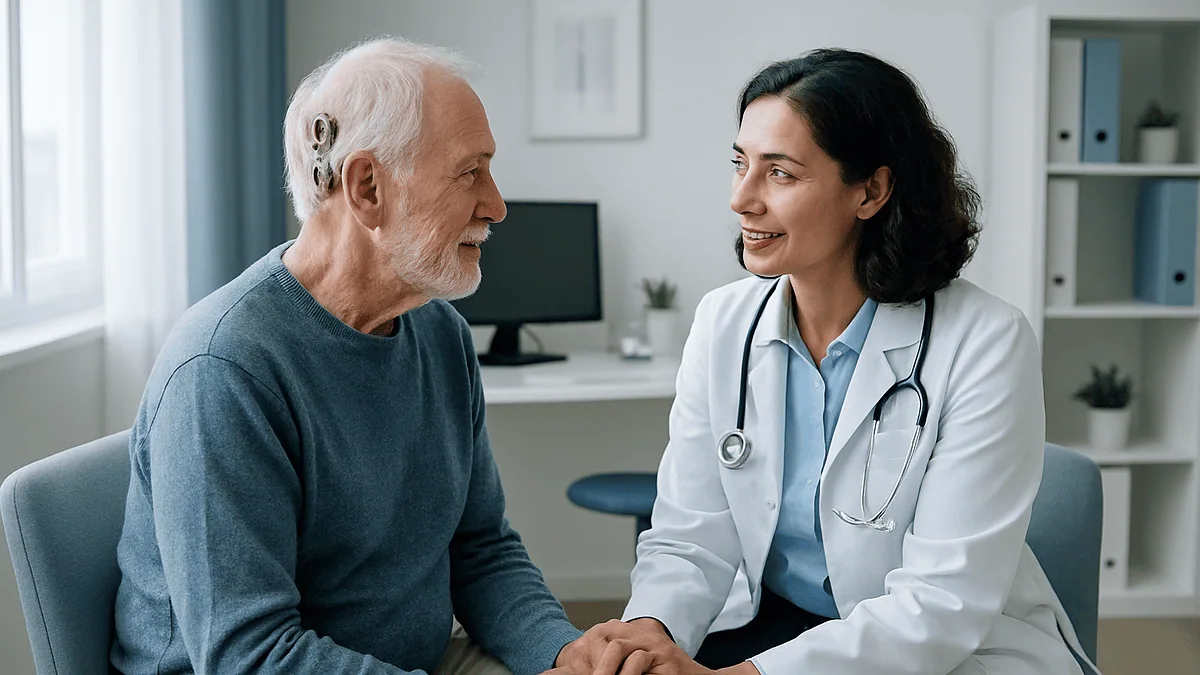
A cochlear implant for adults is a surgically placed device that bypasses damaged inner-ear hair cells and stimulates the hearing nerve directly. It is usually considered when severe to profound sensorineural hearing loss no longer responds well to properly fitted hearing aids. Results vary from person to person; evidence suggests a shorter period of poorly treated deafness generally supports better adaptation, so timely evaluation matters. Candidacy is decided by the treating team.
The moment often arrives at a dinner table. The conversation has become a wall of overlapping sound, someone’s grandchild says something that makes everyone laugh, and the person at the end of the table smiles a half-second late, having caught none of it. The hearing aids are in. The batteries are fresh. They simply are not enough anymore.
That gap, between hearing aids that used to help and a world that now sounds like a poorly tuned radio, is where the question of a cochlear implant for adults usually begins. It rarely starts with a doctor. It starts with a spouse who is tired of repeating things, or a retiree who has quietly stopped answering the phone.
What follows is a plain account of how the device works, who tends to be considered, why audiologists talk so much about timing, and what the weeks after surgery actually look like. Not a sales pitch, and not a promise. Just the evidence, in order.
How does a cochlear implant for adults actually work?
Start with the cochlea itself: a fluid-filled spiral in the inner ear, about the size of a pea, lined with thousands of microscopic hair cells. When sound vibrations reach it, those hair cells convert motion into electrical signals that travel along the auditory nerve to the brain. In most later-life hearing loss, the hair cells wear out or die, and they do not grow back. A hearing aid makes sound louder, but louder sound is of limited use when the cells meant to detect it are largely gone. The National Institute on Deafness and Other Communication Disorders (NIDCD) describes this as sensorineural hearing loss, meaning the damage lies in the inner ear or the nerve rather than the ear canal or middle ear.
A cochlear implant steps around the problem. It has two parts. The external part, a speech processor, sits behind the ear and holds a microphone that captures sound, converts it into digital code, and sends it through the skin to the internal part by a magnetically held coil. The internal part, an implant with a thin electrode array, is placed under the skin behind the ear during surgery, with the array threaded into the cochlea. The electrodes deliver tiny electrical pulses directly to the auditory nerve, which carries them to the brain.
Two points matter for expectations. First, the brain receives a pattern of electrical signals, not natural sound; NIDCD notes that hearing through an implant is different from typical hearing and takes time to learn. Second, the device does not repair the ear. It is a hearing prosthesis, not a treatment for the underlying cell loss. That distinction shapes almost everything else in this article, from who is considered a candidate to why rehabilitation is not optional.
Why later-life hearing loss is different from the loss a hearing aid can fix
Age-related hearing loss, which clinicians call presbycusis, is common enough that it is easy to shrug off. NIDCD estimates that roughly one in three people in the United States between the ages of 65 and 74 has hearing loss, and nearly half of those older than 75 have difficulty hearing. It usually creeps in gradually and affects both ears, and it tends to take the high frequencies first. That is why consonants such as s, f and th vanish before vowels do, and why speech becomes muddy long before it becomes quiet.

In the early and moderate stages, a well-fitted hearing aid does real work. It amplifies the frequencies that have faded and can be tuned to a person’s specific pattern of loss. The NHS advises hearing aids as the first line for most people with sensorineural hearing loss, and many adults do well with them for years.
The trouble comes when the hair-cell population thins to the point where amplification no longer produces a usable signal. Words may be loud yet still unintelligible. People often describe hearing that someone is speaking without being able to tell what they are saying, particularly in restaurants or over the phone. Turning the volume up further tends to add distortion, not clarity.
This is the threshold at which a cochlear implant enters the conversation, because it does not depend on the surviving hair cells at all. The auditory nerve, in most cases of age-related loss, remains intact enough to carry an electrical signal. That is the anatomical reason an adult who gets little from hearing aids can still be a reasonable implant candidate. Whether the nerve and the brain behind it remain ready to use that signal is a separate matter, and it brings us to timing.
Cochlear implant vs hearing aid: what each can and cannot do
People frequently frame this as a choice between two versions of the same thing. They are not the same thing, and the comparison below is meant to clarify roles rather than rank them. Many adults with an implant in one ear continue to wear a hearing aid in the other, an arrangement audiologists call bimodal hearing.
| Feature | Hearing aid | Cochlear implant |
|---|---|---|
| What it does | Amplifies sound for the damaged inner ear to process | Bypasses hair cells and stimulates the auditory nerve electrically |
| Typical use | Mild to severe sensorineural loss | Severe to profound loss with limited benefit from hearing aids |
| Procedure | None; fitted by an audiologist | Surgery under general anesthesia, typically a few hours |
| Sound quality | Natural sound, made louder | Electrical signal the brain learns to interpret over months |
| Reversibility | Fully reversible | Residual natural hearing in that ear is often reduced or lost |
| Ongoing care | Adjustments, battery or charging upkeep | Programming sessions, rehabilitation, external part upkeep |
Sources for this summary: NIDCD, Mayo Clinic and the NHS treatment overview for hearing loss.
The row that most often surprises people is reversibility. Because the electrode array occupies the cochlea, whatever natural hearing remained in that ear is usually diminished, and Mayo Clinic lists loss of residual hearing among the recognized risks. For an adult who still gets meaningful help from a hearing aid, that trade-off matters, and it is one reason the evaluation process is deliberately thorough rather than quick.
The row about sound quality matters just as much. A hearing aid delivers sound that is recognizably sound. An implant delivers something the brain must learn to hear, and how long that learning takes varies widely from one adult to another.
Cochlear implant candidacy criteria: who is usually considered
There is no single number that makes someone a candidate. Clinics apply guideline-based criteria, and the details differ by country and health system, but the common thread is consistent across NIDCD, Mayo Clinic and NHS descriptions. Adults are generally considered when they have severe to profound sensorineural hearing loss in both ears, or in some cases one ear, and when appropriately fitted hearing aids no longer give them adequate understanding of speech.

That second clause carries the weight. An audiologist, a professional trained in measuring hearing and fitting devices, will typically test how well a person recognizes words and sentences while wearing their best-fitted hearing aids, often in quiet and in background noise. A person who hears sound but recognizes very few words in these tests is showing the pattern that candidacy criteria are designed to catch. Someone who scores well is usually advised to continue with hearing aids, because the implant would be unlikely to improve on what they already have and would carry surgical risk.
Other elements of a typical evaluation include:
- Imaging of the inner ear, usually a CT or MRI scan, to confirm the cochlea can accept an electrode array and that the auditory nerve is present.
- A medical review to confirm the person can safely undergo general anesthesia.
- A conversation about expectations, motivation and willingness to attend follow-up programming and rehabilitation.
- An assessment of communication needs at home, at work or in community life.
Mayo Clinic frames candidacy around realistic expectations and commitment to rehabilitation as much as around audiograms, which reflects clinical experience: the device is a tool, and the outcome depends on what the person and the team do with it. None of these criteria is applied by a patient alone. Candidacy is a team judgment, made by an otolaryngologist, a surgeon specializing in ear, nose and throat conditions, together with the audiology team.
Who is usually asked to wait, and why
Being asked to wait is not a rejection. It is usually a statement that the balance of benefit and risk has not yet tipped toward surgery, or that something needs to be sorted out first.
The most common reason is still-useful hearing aids. If word recognition with well-adjusted aids remains reasonably good, most teams will recommend continuing, sometimes with a newer or better-programmed device, and rechecking in a set interval. The NHS pathway explicitly places hearing aids ahead of implants for this reason. Some adults arrive for an implant evaluation with hearing aids that were fitted years ago and never adjusted, and a fresh fitting changes the picture entirely.
A second group has hearing loss caused by something other than inner-ear damage. Wax, fluid behind the eardrum, otosclerosis, a stiffening of the tiny middle-ear bones, or other conductive problems are treated differently, and an implant would not address them. Ruling these out is part of why imaging and a full ear examination precede any decision.
A third group has medical conditions that make general anesthesia riskier at the moment, such as an unstable heart condition or an active infection. The surgery can often be revisited once those are managed.
Less commonly, imaging shows a cochlea that is fully ossified, meaning bone has grown into the spiral, or an auditory nerve that is absent or severely damaged. In those situations an implant may not be feasible, and the team will discuss alternatives.
Finally, some people are asked to wait because they are not yet ready to commit to the months of programming visits and listening practice that follow surgery. That is a legitimate reason to pause, and a good team will say so plainly rather than proceed.
Why timing matters: what the hearing brain does while you wait
Ask an audiologist what single factor they wish patients understood, and many will say the same thing: the ear is only half the system. The other half is a brain that has spent a lifetime learning to decode sound, and that skill does not sit in storage untouched.
When the auditory nerve stops carrying meaningful signals, the parts of the brain that once processed speech receive less input. Over years, those regions can become less efficient at the task and may begin to be recruited for other functions, particularly vision. Neuroscientists call this cross-modal reorganization. It is one reason NIDCD and Mayo Clinic both note that adults who lost their hearing after developing spoken language, and who have not been deaf for long, tend to adapt to an implant more readily than those with many years of profound deafness. The brain still has a working template for what speech is supposed to sound like and can map the new electrical signal onto it.
This does not mean a long-deaf adult cannot benefit. Many do. It means that, all else being equal, a shorter interval between losing useful hearing and receiving stimulation tends to make the learning curve gentler. The evidence here is observational rather than from randomized trials, so it should be read as a consistent pattern, not a rule with a deadline.
There is a second reason clinicians care about time. Johns Hopkins researchers have reported that untreated hearing loss is associated with faster cognitive decline and a higher rate of dementia diagnosis, with the association strengthening as hearing loss worsens. Whether treating hearing loss changes that trajectory is still being studied, and association is not proof of cause. Even so, the direction of the evidence gives little reason to postpone evaluation once hearing aids have clearly stopped helping.
What happens before and during cochlear implant surgery
By the time surgery is scheduled, the evaluation described earlier is complete. In the weeks beforehand, the team typically reviews medications, confirms anesthesia fitness, and discusses vaccination. Mayo Clinic notes that people with cochlear implants have a somewhat higher risk of bacterial meningitis, an infection of the membranes around the brain, and that vaccination against the bacteria most often responsible is generally recommended before the procedure. Which vaccines, and when, is a decision for the treating team.
The operation itself is performed under general anesthesia. MedlinePlus describes the surgeon making an incision behind the ear, opening the mastoid bone, the honeycomb-like bone behind the ear, and creating a small opening into the cochlea. The internal receiver is seated in a shallow bed shaped in the skull bone, and the electrode array is guided gently into the cochlear spiral. The incision is then closed. MedlinePlus and Mayo Clinic describe the surgery as typically lasting a few hours, and many adults go home the same day or after one night, depending on how they recover from anesthesia and on local practice.
A few practical details people often ask about:
- A small area of hair behind the ear may be shaved.
- The internal device is not switched on in the operating room. Nothing is heard on the day of surgery.
- Facial nerve monitoring is standard during the procedure, because the nerve that moves the face runs close to the surgical field.
- A pressure dressing is often placed over the ear for the first day or so.
The surgeon’s notes will describe how far the electrode array was inserted and whether any residual hearing was preserved, information the audiologist later uses when programming the device.
Cochlear implant surgery recovery time: the first days and weeks
The first thing most people notice on waking is that the operated ear sounds, if anything, more blocked than before. That is expected: the ear is swollen, dressed, and the device is off. The second thing is often a sense of unsteadiness. Mayo Clinic lists temporary dizziness and balance problems among the common short-term effects, because the balance organs share the inner ear with the cochlea and are disturbed by the surgery. For most adults this settles over days to a couple of weeks, though the team should hear about anything severe or worsening.
Pain is usually described as soreness or a dull ache at the incision rather than sharp pain, and it is typically managed with the medication plan the surgical team provides. Numbness or altered sensation of the skin around the incision is common and can take weeks to fade. Some people notice a change in taste on one side of the tongue, which MedlinePlus attributes to irritation of a small nerve that runs through the middle ear; it usually improves over time.
Wound care instructions vary, but common themes are keeping the incision dry until cleared, avoiding pressure on the area, and not wearing a hearing aid on that side until the surgeon says so. Heavy lifting, straining and vigorous exercise are usually limited for a period, and driving is deferred until dizziness has resolved and pain relief no longer impairs alertness.
Most adults return to desk-based work within one to two weeks, though this varies with the person and the job, and the surgical team gives individual guidance. A follow-up visit to check the incision usually happens within the first couple of weeks. The main event, activation, waits until the swelling has gone down and the skin has healed enough for the external coil to sit comfortably against it.
Activation day and the months of listening practice that follow
Activation, sometimes called switch-on, is the appointment at which the audiologist fits the external processor and turns the implant on for the first time. Mayo Clinic describes this happening roughly two to six weeks after surgery, once healing allows. It is worth setting expectations carefully, because films of tearful, instantly joyful activations circulate widely and are not the typical experience.
What most adults report on day one is strange: voices that sound robotic, high-pitched, cartoonish, or like a badly tuned radio. Some hear beeps and buzzes before words emerge. This is normal. The brain is receiving a pattern of electrical pulses it has never encountered and has to learn to read it. NIDCD describes hearing through an implant as different from natural hearing and stresses that improvement comes with time and practice.
Programming, which audiologists call mapping, is the process of adjusting each electrode’s stimulation levels so that soft sounds are audible and loud sounds are comfortable. The first map is deliberately conservative. Over the following weeks and months, the audiologist refines it in a series of visits as the person’s tolerance and perception change.
Between visits, the work is listening. Aural rehabilitation, structured practice at understanding sound, might involve reading along with an audiobook, having a family member read sentences aloud, using listening-training apps, or simply wearing the processor all waking hours so the brain gets constant input. People who lost hearing gradually and recently tend to progress faster than those with decades of profound deafness, but the timeline is individual. Speech understanding often improves noticeably over the first several months and can continue to improve for a year or more, according to Mayo Clinic and NIDCD. Music, and speech in noisy rooms, tend to be the last frontiers.
Risks and limitations, stated plainly
Cochlear implantation is an established procedure with a long safety record, and NIDCD notes that hundreds of thousands of devices have been implanted worldwide. That does not make it risk-free, and a neutral account has to include the downsides.
Mayo Clinic and MedlinePlus list the recognized risks. Loss of remaining natural hearing in the implanted ear is common and should be assumed unless the team says otherwise. Balance disturbance is frequent early on and usually temporary. Tinnitus, ringing or buzzing in the ear, may improve, stay the same, or occasionally worsen. Less common risks include wound infection, bleeding, injury to the facial nerve causing weakness on that side of the face, leakage of the fluid surrounding the brain, taste disturbance, and meningitis, which is why vaccination is discussed beforehand. Device failure is uncommon but possible, and a failed internal component requires further surgery to replace.
Then there are the limitations, which are not complications but realities:
- The external processor must be worn to hear anything; remove it for a swim or a shower and that ear is deaf.
- Hearing through an implant is not typical hearing. Some environments, particularly crowded restaurants, remain hard.
- MRI scanning requires precautions or specific device compatibility, and every future imaging team needs to know about the implant.
- Static electricity and contact sports carry small device-related considerations the team will explain.
- The commitment to programming visits and practice is measured in months, not days.
An honest evaluation lays these out before anyone signs a consent form. If the risks are described briskly or the limitations glossed over, it is reasonable to ask for a slower conversation.
Cochlear implants for seniors: does age itself matter?
A question that comes up almost every time an adult in their seventies or eighties considers an implant is whether they are too old. The evidence does not support an age cutoff. What matters is the state of the hearing nerve, the health of the brain’s hearing pathways, general fitness for anesthesia, and the person’s willingness to engage in rehabilitation. Those factors correlate loosely with age, but they are not the same as age.
Mayo Clinic explicitly describes cochlear implants as an option for older adults with severe hearing loss who no longer benefit from hearing aids, and NIDCD’s discussion of adult candidates does not set an upper age limit. Surgical duration is a few hours and the procedure involves no major body cavity, which is part of why it is considered feasible for many older patients whose overall health is stable.
The considerations that do change with age are practical. Anesthesia assessment is more careful when there is heart, lung or kidney disease. Postoperative dizziness may pose a greater fall risk in someone with existing balance problems, so the team may arrange support at home for the first days. Manual dexterity and vision affect how easily a person can handle the external processor, change batteries or charge it, and place the coil, and audiologists often involve a family member in training for this reason.
There is also the matter of what is at stake. Johns Hopkins researchers have highlighted that untreated hearing loss in older adults is associated with social isolation, depression and cognitive decline. Whether an implant alters those risks is not proven, but the observation reframes the question: rather than asking whether someone is too old to benefit, the more evidence-aligned question is whether they can safely undergo the procedure and use the device, and that is one the treating team can answer.
What people often get wrong about cochlear implants
Some misunderstandings surface so regularly in clinic that they deserve direct correction.
“It restores normal hearing.” It does not. It provides an electrical signal the brain learns to interpret. Many adults understand speech well with it; the experience is nonetheless different from natural hearing, and NIDCD says so plainly.
“You hear perfectly the moment it is switched on.” Activation videos give this impression. Most adults hear distorted or mechanical sound at first, and understanding builds over months of practice.
“Implants are only for people born deaf.” Adults who lost hearing later in life are a large and growing group of recipients, and they often adapt well precisely because their brains already know spoken language.
“If hearing aids don’t work, I’m out of options.” Hearing aids failing to help is often the very trigger for an implant evaluation, not the end of the road.
“Waiting a few more years costs nothing.” The observational evidence linking longer duration of deafness with slower adaptation, and untreated hearing loss with cognitive and social decline, suggests waiting is not neutral, even though it does not set a deadline.
“It’s brain surgery.” The internal device sits in bone behind the ear and the electrode enters the inner ear. The brain is not operated on.
“Once I have one, I can’t have an MRI.” Imaging is possible with precautions and depends on the specific device; the team provides documentation and the radiology department follows a protocol.
“Both ears must be done at once.” Many adults have one ear implanted and continue with a hearing aid in the other, and the team decides the approach individually.
Correcting these is not about lowering hopes. It is about aligning them with what the device does, which makes the months of adaptation easier to sustain.
Questions to ask your care team before deciding
A good evaluation is a conversation, and arriving with questions changes its quality. These are drawn from what adults facing this decision most often wish they had asked.
- Based on my tests, how much benefit am I still getting from hearing aids, and has my current fitting been fully optimized?
- Which ear are you proposing to implant, and why that one?
- What did my imaging show about the cochlea and the auditory nerve?
- How much of my remaining natural hearing in that ear is likely to be lost?
- Will I continue to wear a hearing aid in the other ear?
- What vaccinations do you recommend before surgery, and how far ahead?
- How long do you expect me to stay after the operation, and what support will I need at home in the first days?
- When do you expect activation, and how many programming visits are typical in the first year?
- What does the rehabilitation program involve, and who will guide it?
- How will my other conditions, medications or anesthesia history affect the plan?
- What are the specific risks in my case, and what would prompt you to advise against surgery?
- How is the device handled for MRI scans, airport security, or other procedures in future?
- What happens if the internal device fails years from now?
- Can I speak with someone in the program who has been through this at a similar age?
Write the answers down or bring someone who can. Hearing loss makes clinic conversations hard by definition, and many centers will provide a written summary or allow a family member to sit in. The decision remains yours and the team’s to make together; the questions simply make sure it is made with the full picture.
When to call your doctor
Most recovery after cochlear implant surgery is uneventful, and most adaptation after activation is slow rather than alarming. A handful of signs, however, should prompt a same-day call to the surgical team, or emergency care if the team cannot be reached.
Seek urgent attention for any of the following after surgery:
- Fever, stiff neck, severe headache, sensitivity to light, confusion or drowsiness, which can indicate meningitis and are a medical emergency at any time after implantation, not only in the first weeks.
- New weakness or drooping on one side of the face, or difficulty closing the eye on the operated side.
- Clear, watery fluid draining from the ear or nose, which may signal a leak of the fluid surrounding the brain.
- Spreading redness, warmth, swelling, pus or a wound that opens at the incision.
- Bleeding that soaks the dressing.
- Severe or worsening dizziness, vomiting, or dizziness that makes it impossible to stand safely.
- Pain that escalates rather than easing over the first days.
After activation, contact the audiology team promptly if sound becomes suddenly painful or intolerable, if you feel twitching or unusual sensations in the face when the processor is on, if the implant site becomes swollen or tender, or if you experience a sudden, unexplained change in what you hear through the device. These are usually programming or device matters rather than emergencies, but they should not wait for the next scheduled visit.
One further note. If you have a cochlear implant and become unwell with an ear infection or sinus infection in the future, mention the implant to whoever treats you. It changes how carefully infections near the ear are managed, and it is information every clinician you see should have.
Frequently asked questions
What is the difference between a cochlear implant vs hearing aid for an older adult?
A hearing aid amplifies sound for the inner ear to process, while a cochlear implant bypasses the damaged inner ear and stimulates the hearing nerve electrically. Hearing aids suit mild to severe loss; implants are considered for severe to profound loss when aids no longer give adequate speech understanding. Many adults use an implant in one ear and a hearing aid in the other, an approach called bimodal hearing.
What are the cochlear implant candidacy criteria for adults?
Candidacy generally requires severe to profound sensorineural hearing loss and limited benefit from properly fitted hearing aids, confirmed by speech-recognition testing. Imaging must show a cochlea that can accept an electrode array and a functioning auditory nerve, and the person must be fit for general anesthesia and willing to attend programming and rehabilitation. Exact thresholds vary by health system, and the treating team makes the final judgment.
How long is cochlear implant surgery recovery time?
The operation usually lasts a few hours, and many adults go home the same day or after one night. Soreness, numbness and temporary dizziness are common in the first days to weeks. Return to light activity often occurs within one to two weeks, though this varies. The device is typically activated about two to six weeks after surgery, according to Mayo Clinic, and adaptation continues for months afterward.
Are cochlear implants for seniors safe?
There is no upper age limit for cochlear implantation in major clinical guidance, and the procedure is performed in adults well into their eighties and beyond when overall health allows. The key considerations are fitness for general anesthesia, fall risk during early dizziness, and the ability to manage the external processor, which family members can be trained to support. The surgical team assesses these individually.
Will I hear normally with a cochlear implant?
No. The implant delivers an electrical signal that the brain learns to interpret, and NIDCD describes this as different from natural hearing. Many adults come to understand speech well, especially in quiet settings, but noisy rooms and music often remain more challenging. How much someone understands, and how quickly, varies with duration of deafness, nerve health and practice, and cannot be predicted precisely for any individual.
Why does the audiologist say timing matters so much?
The parts of the brain that decode speech become less efficient when they receive little sound input over years, and observational studies consistently find that adults with a shorter period of untreated deafness adapt to an implant more readily. Untreated hearing loss is also associated with faster cognitive decline and social isolation. These are associations rather than proven cause and effect, but they argue against delaying evaluation once hearing aids stop helping.
Will I lose the hearing I still have in the implanted ear?
Usually some or all remaining natural hearing in that ear is lost, because the electrode array occupies the cochlea. Mayo Clinic lists loss of residual hearing as a recognized risk. Surgeons sometimes use techniques intended to preserve low-frequency hearing, but preservation cannot be guaranteed. This is why the team weighs how much useful hearing remains before recommending which ear, if any, to implant.
What does activation day actually feel like?
For most adults, the first sounds are strange rather than joyful: voices may seem robotic, high-pitched or like a distorted radio, and some people hear beeps before words. This is expected. The audiologist sets conservative stimulation levels initially and refines them over subsequent visits. Understanding improves with daily wear and structured listening practice over weeks and months, not within the appointment itself.
Can I have an MRI scan after getting a cochlear implant?
Often yes, but with precautions. Implants contain an internal magnet, so scanning requires either a device rated for the scanner’s strength, specific positioning and bandaging protocols, or in some cases temporary magnet removal. Every future radiology team must know about the implant, and the implant program provides documentation. Discuss this with your surgeon before surgery if you have conditions that require regular MRI monitoring.
Do I need vaccinations before cochlear implant surgery?
People with cochlear implants have a somewhat increased risk of bacterial meningitis, and Mayo Clinic notes that vaccination against the responsible bacteria is generally recommended before the procedure. Which vaccines are appropriate, and the timing relative to surgery, depends on your age and vaccination history and is decided by your treating team. Raise the question early in the evaluation so there is time to complete any recommended schedule.
References
- NIDCD (NIH) – Cochlear Implants
- NIDCD (NIH) – Age-Related Hearing Loss
- MedlinePlus – Cochlear implant
- NHS – Hearing loss: Treatment
This article is for general information only and is not a substitute for professional medical advice. Please consult a qualified doctor about your individual situation.

More from the Blog

ESS vs Balloon Sinus Dilation: What Each Sinus Procedure Can and Cannot Open
Endoscopic sinus surgery removes blocked tissue, bone or polyps under camera guidance and can open every sinus, including the ethmoid cells between the eyes.…

When Can You Exercise After Septoplasty? Light Activity, Gym Sessions and Contact Sports
Most people can walk from the first day after septoplasty, but strenuous exercise is usually put on hold. Mayo Clinic advises avoiding vigorous activity…

Mastoidectomy Explained: How Surgeons Clear Infected Mastoid Air Cells Behind the Ear
A mastoidectomy is an operation that removes infected or diseased bone from the honeycomb of mastoid air cells behind the ear. Surgeons most often…

Sinusitis Treatment When You Also Have Asthma or Allergies: How the Plan Changes
Sinusitis treatment with asthma or allergies follows the same core steps as for anyone else: time, saline rinses, steroid nasal sprays, and antibiotics only…

Voice Rest After Endoscopic Pitch-Raising Surgery: The Silent First Weeks and What Comes Next
Voice rest after glottoplasty means avoiding all speaking, whispering, humming and throat clearing for a surgeon-set period, usually measured in days to a couple…
Bone Conduction Implants Explained: How Implantable Hearing Aids Send Sound Through Bone
A bone conduction hearing implant is a small surgically placed device that turns sound into vibrations and sends them through the skull bone directly…