

Collecting a Urine Sample for Biomarker Testing: Timing, Midstream Technique and Contamination
Key Takeaways
- The first part of the urine stream carries the most skin cells and surface bacteria, which is why every major guideline asks for a midstream catch.
- Laboratories typically need only 30 to 60 milliliters, roughly one to two ounces, so there is no reason to fill the container.
- A sample should reach the laboratory within about an hour at room temperature, or be refrigerated in a sealed bag and delivered within 24 hours.
- In a 24-hour collection, the first morning void on day one is discarded and the first morning void on day two is included, which is the step most often reversed by mistake.
- Strenuous exercise and fever can temporarily raise protein in urine, so a raised albumin result is confirmed only after repeat testing over about three months.
- Squamous epithelial cells under the microscope and mixed bacterial growth on culture are the laboratory's signature signs of a contaminated specimen.
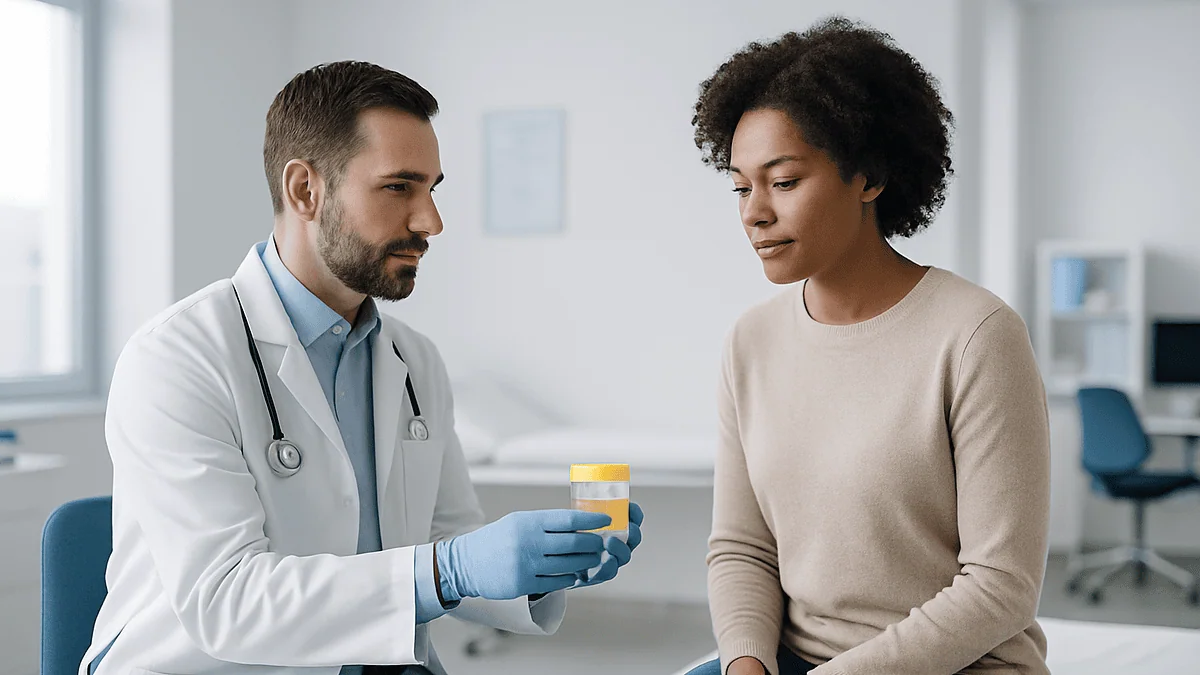
For most urine biomarker tests, collect a midstream sample: wash your hands, clean the genital area with water, pass the first part of the stream into the toilet, then catch the middle portion in the sterile container without touching its inside. Many laboratories prefer a first-morning sample. Hand it in within about an hour or refrigerate it, and follow any timed-collection instructions exactly.
The pot is smaller than you expected. You are standing in a clinic restroom holding a sterile container the size of a shot glass, a printed sheet of instructions balanced on the sink, and a nagging sense that this is the one part of the visit nobody explained. Was it the first bit of the stream they wanted, or the middle? Did the coffee at breakfast matter? Should you have washed first?
Those questions are not trivial. Urine sample collection for biomarker test purposes is one of the few laboratory procedures where the patient, not the technician, controls the quality of the specimen. A rushed catch can carry skin cells and bacteria into the cup, a sample left on a car seat for the afternoon can change its chemistry, and a timed collection missing one void can mislead a kidney specialist.
The good news is that the technique is learnable in five minutes, and the reasons behind each step are far more interesting than the instruction sheet lets on.
What does a biomarker test tell you, and why use urine at all?
A biomarker is a measurable substance in the body that signals what is happening inside an organ or a process. In urine, that might be a protein that should have stayed in the blood, a sugar the kidney could not hold back, or a breakdown product that tells the laboratory how concentrated the sample is. A biomarker test does not, on its own, hand you a diagnosis. It gives your clinician a number, a pattern, or a presence-or-absence result that has to be read alongside your history, your examination, and often a blood test.
Urine is attractive to laboratories for a simple reason: the kidneys act as a filter for roughly the entire blood volume many times a day, and what passes through ends up in the bladder. Sampling it is painless, repeatable, and needs no needle. The Mayo Clinic describes urinalysis as a tool for checking overall health, spotting infection, and monitoring conditions such as kidney disease and diabetes, and notes that it is often part of a routine examination or a pre-surgery work-up.
Urine also has a limitation that makes collection technique so important. Because it sits in the bladder and then passes through the urethra, it picks up whatever is on the way out: skin cells, bacteria from the surrounding area, menstrual blood, or traces of soap. A blood sample drawn cleanly into a tube has none of those problems. So while urine testing is low-risk for the patient, its accuracy leans heavily on how the sample was caught, when, and how quickly it reached the bench.
That is the trade-off worth keeping in mind: convenience in exchange for a little discipline at the collection stage.
What are common urine biomarkers a lab might measure?
A standard urinalysis looks at three things, according to MedlinePlus: the appearance of the urine, its chemistry on a dipstick, and what can be seen under a microscope. The chemical panel covers a surprisingly long list. Protein and specifically albumin flag whether the kidney filter is leaking. Glucose that appears in urine usually means blood sugar has climbed above the kidney’s ability to reabsorb it. Ketones point toward the body burning fat for fuel, as happens in fasting or uncontrolled diabetes. Blood, nitrite, and leukocyte esterase (an enzyme released by white blood cells) together hint at infection or inflammation. Bilirubin and urobilinogen relate to liver and red-cell turnover. The strip also reads pH and specific gravity, the latter being a measure of how concentrated the sample is.
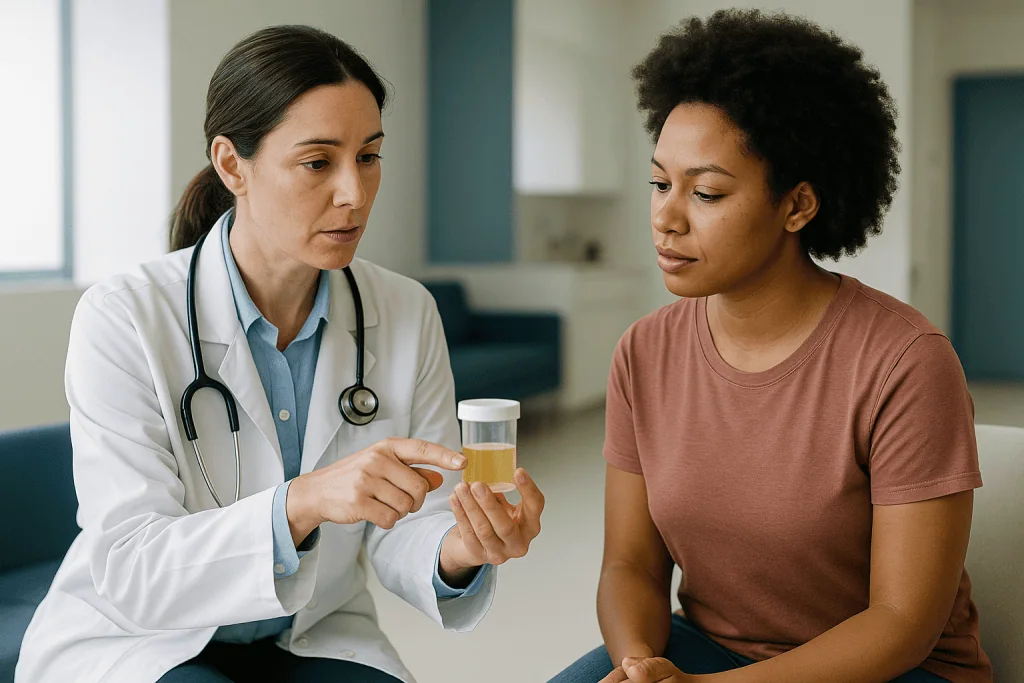
Creatinine, a muscle waste product excreted at a fairly steady rate, deserves special mention. Laboratories use it as a yardstick: dividing the albumin result by the creatinine result produces the albumin-to-creatinine ratio, which the NIH’s kidney institute describes as the preferred way to check for albumin leakage without a full day’s collection.
Beyond the routine panel, targeted tests measure hormones and their breakdown products, minerals such as calcium and oxalate in people who form kidney stones, drug metabolites, and pregnancy hormone. Research laboratories are also studying newer kidney-injury markers, though most of those remain investigational rather than part of everyday care.
The point for you as the sample-giver is that many of these markers are sensitive to concentration and timing. A very dilute sample after two liters of water can push a genuinely abnormal protein level below the strip’s detection range, while a sample collected after a hard workout can transiently raise protein. Knowing which test has been ordered helps you follow the right timing advice.
How urine sample collection for biomarker test actually works
Strip the instruction sheet down to its logic and three ideas remain: catch the right portion, keep it clean, and get it to the laboratory quickly.
The right portion, for most tests, is the middle of the stream. The first few milliliters flush out the urethra and carry the highest load of skin cells and surface bacteria; the stream that follows is closer to what was actually sitting in the bladder. That is why nearly every guideline, from the NHS to the Mayo Clinic, asks for a midstream catch.
Keeping it clean means two things. Hands are washed so nothing transfers from fingers to the container rim, and the genital area is cleaned so that what enters the cup came from the bladder rather than the skin. Equally important is what you do not touch: the inside of the container and the underside of the lid are sterile, and a fingertip on either can seed the sample with organisms that were never in your urinary tract.
Speed matters because urine is not chemically frozen once it leaves the body. Bacteria multiply at room temperature, cells break down, pH drifts, and some markers degrade. The NHS advises handing the sample in within about an hour; if that is not possible, it should go in a sealed bag in the refrigerator and be delivered within 24 hours.
Volume is less of a worry than people fear. The Mayo Clinic notes that laboratories generally need only one to two ounces, around 30 to 60 milliliters. Filling the cup to the brim is unnecessary and makes the lid harder to seal cleanly. Once collected, the container is labeled, sometimes with the time of collection written on, and handed to staff who log it and send it on.
What are the four types of urine collection?
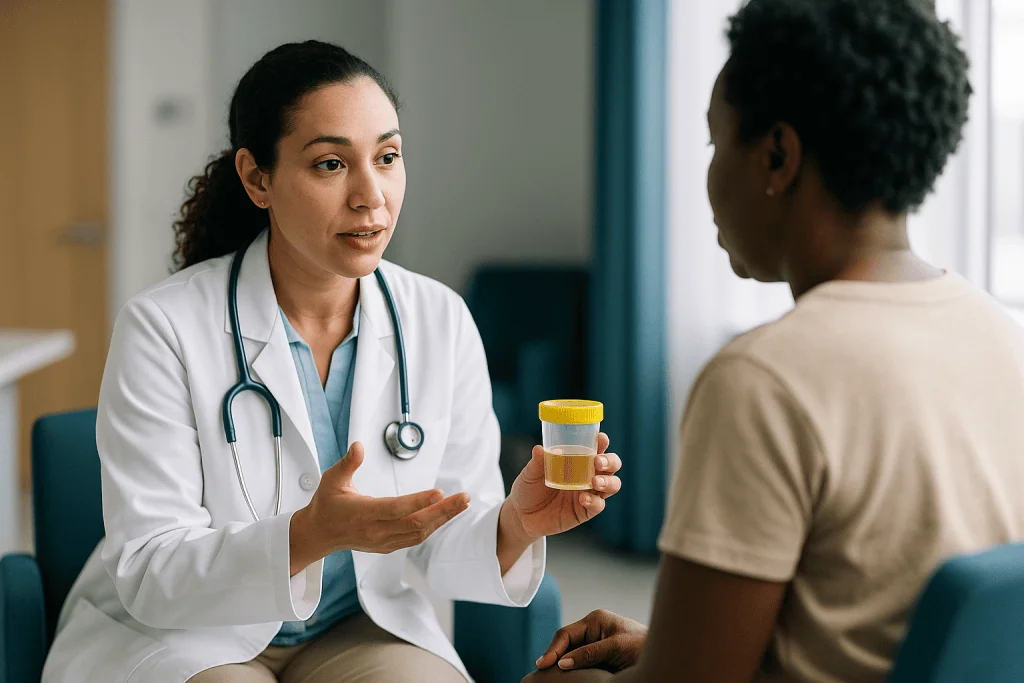
Ask a laboratory scientist and they will usually name four collection methods, each suited to different questions. The random sample is exactly what it sounds like: whenever you happen to go. It is quick and fine for screening dipsticks and many spot ratios, but its concentration varies with fluids and time of day. The first-morning sample is the first void after waking, when urine has pooled overnight and is at its most concentrated. The midstream clean-catch sample, discussed above, is the standard when the laboratory needs to grow bacteria or wants to minimize skin contamination; it can be taken at any time of day, including first thing in the morning. The timed collection, most often over 24 hours, gathers every drop across a set period so that total daily output of a substance can be calculated.
| Collection type | When it is used | Main strength | Main weakness |
|---|---|---|---|
| Random | Routine screening, spot ratios | Convenient, no preparation | Concentration varies with fluids and time |
| First morning | Protein and albumin checks, pregnancy hormone | Most concentrated, fewest exercise effects | Requires planning the night before |
| Midstream clean-catch | Infection testing, any test where contamination matters | Reduces skin cells and bacteria | Technique-dependent |
| Timed (often 24 hours) | Daily output of protein, minerals, hormones | Measures total excretion | Easy to miss a void; cumbersome |
A fifth method exists for people who cannot void on request or when contamination must be eliminated entirely: a sample drawn directly from the bladder via a catheter, performed by clinicians. Most readers will never need it, and the decision always sits with the care team. The clinician ordering your test will name the method they need; if the request form is unclear, ask before you go into the restroom rather than after.
Is a first morning urine sample really better?
For some tests, yes, and the reasons are mechanical rather than mystical. Overnight, most people drink little and produce concentrated urine that has sat in the bladder for several hours. Concentration matters because dipsticks and many assays have detection thresholds; a marker that is genuinely present may read as absent in the dilute urine that follows a morning of coffee and water. The Mayo Clinic notes that a first-morning sample is often preferred because it is more concentrated and therefore more likely to reveal abnormalities.
There is a second, quieter advantage. Physical activity can push small amounts of protein into urine for a few hours, a phenomenon well recognized in clinical teaching. Someone who cycles to the clinic and then produces a sample may show a protein trace that has nothing to do with their kidneys. The first void of the day, produced before any exertion, sidesteps that problem, which is why kidney specialists often request it when albumin is the question.
Not every test benefits, however. Timed collections deliberately exclude the first-morning void of day one and include it on day two, as MedlinePlus describes, so “first morning” has a different meaning there. Infection testing depends far more on clean technique than on the clock. And a random sample is perfectly acceptable for the albumin-to-creatinine ratio in many clinical pathways, precisely because dividing by creatinine corrects for how dilute the sample is.
The practical advice is unglamorous: check what has been ordered. If your clinician asks for a first-morning specimen, collect it at home into the container you were given, keep it cool, and deliver it within the window your laboratory sets. If they have not specified, the middle of the morning after a normal breakfast is usually fine, and a rushed sample is worse than a slightly later one.
How to do a clean catch urine sample, step by step
The clean-catch method, sometimes called midstream, is described in near-identical terms by MedlinePlus, the NHS, and the Mayo Clinic. Here is the sequence, with the reason behind each step.
- Wash your hands with soap and water, then dry them. Fingers touch the container, and the container touches the sample.
- Open the container without touching the inside of the cup or the inner surface of the lid. Set the lid face-up on a clean surface.
- Clean the genital area. Women and girls should separate the labia and wipe from front to back, ideally with water or the towelette provided. Men and boys should retract the foreskin if present and clean the tip. Harsh soaps are not needed and may interfere with some tests.
- Start urinating into the toilet. That first portion clears the urethra of surface cells and bacteria.
- Move the container into the stream and collect the middle portion. Roughly 30 to 60 milliliters is enough, per the Mayo Clinic; the cup does not need to be full.
- Finish urinating into the toilet, then screw the lid on firmly.
- Wipe the outside of the container if needed, label it if asked, and wash your hands again.
Two refinements help. Keeping the labia separated or the foreskin retracted throughout the catch, not just during cleaning, is what actually reduces contamination. And if the stream stops before you reach the cup, do not scrape the toilet or try to “top up”; tell the staff, drink a glass of water, and try again when you are able.
For toddlers who are not toilet-trained, clinics use collection pads or bags; the technique differs and staff will show you. For anyone with limited mobility, a clean collection dish placed in the toilet can be decanted into the container. Ask; staff have seen every variation.
How does a 24 hour urine collection work, and where do people slip up?
A timed collection answers a different question from a spot sample. Instead of asking “how concentrated is this marker right now,” it asks “how much of this substance does the body excrete in a full day.” That is useful for total protein output, for minerals implicated in kidney stones, and for hormones whose levels swing across the day. MedlinePlus sets out the standard procedure, and its logic is worth understanding because the errors are predictable.
On the first morning, you empty your bladder into the toilet and note the time. That void does not count; it contains urine made the previous night. From then on, every drop for the next 24 hours goes into the large container the laboratory supplied, including the first void of the following morning at, or as close as possible to, the recorded start time. The container stays in the refrigerator or a cool place between additions.
Where do people slip up? The most common error is the missed void: one trip to the toilet during the night, or one at work without the jug, and the total is short. If that happens, tell the laboratory; the collection may need to be repeated rather than reported as low. The second error is including the day-one first void, which inflates the result. A third is ignoring the start time and simply collecting “until tomorrow morning,” which can stretch or shorten the window by hours.
Some containers arrive with a preservative already inside. It should never be poured out, and you should avoid splashing it; the laboratory will explain handling. Women who are menstruating are often asked to reschedule, because blood distorts several results. Children and people with incontinence usually need a different approach, decided by the care team. Bring the whole container back on time, even if it looks embarrassingly full or worryingly empty; the laboratory measures the total volume as part of the calculation.
What should you not do before a urine sample?
The list is shorter than folklore suggests, and each item has a mechanism behind it.
Do not drink far more than usual in the hours beforehand. People sometimes flood themselves with water so they can “perform” on demand, and the result is urine so dilute that real abnormalities slip under the detection threshold. Drink normally; a single glass of water shortly before is fine if you are struggling to go.
Do not exercise hard immediately before, especially if protein or albumin is being measured. As noted earlier, strenuous activity can transiently raise urinary protein, and a false signal can trigger repeat testing you did not need.
Do not stop, start, or alter any prescribed medicine on your own. The Mayo Clinic advises telling your clinician about medicines, vitamins, and supplements, because some can affect results; vitamin C in high amounts, for example, is known to interfere with certain dipstick readings. The right response is disclosure, not self-adjustment. Decisions about pausing anything before a test belong to the prescriber.
Do not assume you need to fast. Urine tests alone rarely require it. If blood tests are being drawn at the same visit, the fasting instruction belongs to those, not the urine.
Be aware of strongly colored foods. Beets, blackberries, and rhubarb can tint urine pink or red, which is harmless but can be mistaken for blood by the eye; the dipstick and microscope will distinguish them, but mention it so nobody is alarmed.
Finally, do not use an old jar from the kitchen cupboard. Containers supplied by the laboratory are sterile and sometimes contain preservative; a rinsed jam jar carries sugar residue, soap film, and bacteria. If you have lost the container, ask for another.
How does contamination show up in the laboratory, and why does it matter?
Contamination is not a vague worry; it leaves fingerprints the laboratory can read. Under the microscope, squamous epithelial cells, the flat cells that line the skin and the outer urethra, are the classic tell. A few are normal. Many suggest the sample picked up more from the surface than from the bladder, and a report may carry a comment such as “contaminated specimen” or “squamous cells present.” When bacteria are grown from such a sample, the culture often shows several species at once in low numbers, a pattern described as mixed growth, rather than a single dominant organism typical of true infection.
Why does this matter to you? A contaminated sample can produce two kinds of harm. The first is a false alarm: leukocyte esterase or nitrite on the strip, or a mixed culture, that prompts antibiotic treatment for an infection that was never there. The second is the wasted round-trip: the laboratory rejects the specimen or the clinician cannot interpret it, and you are asked to repeat it, sometimes days later, delaying whatever decision hung on the result.
Contamination is also unequal in its effects across tests. A protein measurement is fairly robust to a few skin cells. A culture is not. A pregnancy hormone test barely notices. A cytology sample looking for abnormal cells can be confounded by inflammatory debris. This is why the same laboratory may accept a casual random sample for one purpose and insist on a meticulous clean-catch for another.
Three habits prevent most of it: cleaning and then keeping the area open during the catch, letting the first part of the stream go, and not touching the inside of the container. Time and temperature do the rest; a clean sample that sits warm for six hours can grow enough bacteria to look contaminated, which is why the NHS’s one-hour-or-refrigerate rule is worth following.
Who is asked to give a sample now, and who is usually asked to wait?
Urine biomarker testing is ordered across almost every specialty. People being screened for kidney disease, often because they live with diabetes or high blood pressure, are asked for an albumin-to-creatinine ratio; the NIH’s kidney institute describes this as a standard part of assessment. People with urinary symptoms provide a clean-catch for dipstick and culture. Pregnant patients give samples at routine visits. People who have formed kidney stones may be asked for a timed collection. Pre-operative checks, workplace screening, and monitoring of certain long-term conditions all draw on the same small cup.
Some people, however, are gently asked to wait or to reschedule. Menstruation is the most common reason: blood in the sample can produce a positive result that has nothing to do with the urinary tract, and clinicians often prefer to test a few days later unless the question is urgent. A recent hard workout, as discussed, is a reason to defer albumin testing to another day or to a first-morning sample. Fever and acute illness can transiently raise protein in urine, so kidney-screening tests are often postponed until you are well; the NIH notes that confirmation of albuminuria requires repeat testing over about three months precisely because single results can be skewed by temporary factors.
People who have just had a catheter removed, undergone a urological procedure, or received contrast dye for imaging may be asked to allow some days before certain tests, depending on the clinician’s judgment. Anyone unable to void on request, or whose sample would be unavoidably contaminated, may be offered an alternative collection method rather than a delay.
None of these are rules you need to apply yourself. Tell the team what is going on, from your period to your morning run, and let them decide whether today’s sample will answer the question they are asking.
What happens after you hand it in, and what the following weeks usually look like
Once labeled, your container is logged and moved to the laboratory. Dipstick chemistry and microscopy are quick; MedlinePlus and the Cleveland Clinic describe urinalysis results as often available within a day or so, sometimes sooner if a point-of-care strip is used in the clinic itself. Cultures take longer because bacteria must be given time to grow, typically a few days. Specialized hormone or mineral assays on timed collections may be sent to a reference laboratory and take longer still; your clinic will tell you the expected turnaround.
What happens next depends on the result and, just as importantly, on the pattern. A single abnormal albumin result does not establish kidney disease. The NIH’s kidney institute explains that albuminuria is confirmed when raised results persist over three months, generally meaning at least two out of three samples, because dehydration, exercise, fever, or contamination can push one reading up. So the weeks after a first abnormal result often involve a repeat sample, sometimes as a first-morning specimen, rather than immediate treatment.
Infection results follow a different rhythm. A positive culture identifies the organism and which antibiotics it responds to, and the prescriber decides whether treatment is warranted based on symptoms as much as the report. A sample flagged as contaminated typically leads to a request for a fresh one collected more carefully.
Normal results usually mean nothing further unless you have a condition being monitored, in which case the next test simply joins the calendar. People with diabetes or high blood pressure are commonly rechecked at intervals set by their clinician, using the same albumin ratio each time so that trends can be compared.
Ask how you will receive results and who to contact if you have not heard within the stated window. A sample that was never processed is not rare, and chasing it early beats discovering the gap months later.
What people often get wrong about urine sample collection for biomarker test purposes
“The first part of the stream is the important bit.” It is the opposite. The first portion carries the most urethral and skin material; the middle portion is closest to bladder urine. Let the beginning go.
“I need to fill the cup.” Laboratories need only around 30 to 60 milliliters, per the Mayo Clinic. Overfilling makes the lid harder to seal and increases the chance of leaks and contamination of the outside of the container.
“Drinking lots of water helps.” It helps you produce a sample; it does not help the sample. Dilution can hide real abnormalities. Drink normally.
“A sample can wait in my bag until this afternoon.” Room temperature changes urine chemistry and lets bacteria multiply. The NHS’s guidance is about an hour at room temperature, or refrigerated and delivered within 24 hours.
“Any clean container will do.” A household jar is not sterile and may carry residues that skew results. Use the container supplied, and ask for another if you have lost it.
“Red urine always means blood.” Beets, some berries, and certain medicines can color urine. The laboratory distinguishes pigment from red cells; mention what you have eaten.
“A positive dipstick means infection.” Leukocyte esterase or nitrite on a strip suggests inflammation or bacteria may be present, but contamination, recent exercise, or other conditions can produce similar readings. Culture and symptoms guide the decision, which belongs to your clinician.
“One abnormal protein result means kidney disease.” Confirmation requires repeat testing over about three months, according to the NIH, because single results can be temporarily raised.
“I should stop my medicines so they don’t interfere.” Never adjust prescribed medicines for a test unless the prescriber tells you to. Disclose what you take and let the team interpret accordingly.
Questions to ask your care team
A two-minute conversation before you head to the restroom can save a repeat visit. These are the questions that most often clear up confusion.
- Which type of collection do you need: random, first morning, midstream clean-catch, or timed?
- What is the test actually looking for, and does that change how I should prepare?
- Should I collect it here or at home, and if at home, how soon must it reach you and how should I store it in between?
- Is there anything I should avoid beforehand, such as strenuous exercise, and does that apply to this specific test?
- Do any of my medicines, vitamins, or supplements affect the result? I would like to list them for you rather than change anything myself.
- I am menstruating, or I have just recovered from a fever; should I still give the sample today?
- For a 24-hour collection: what time should I start, does the container contain a preservative, and what should I do if I miss a void?
- How and when will I get the results, and who do I contact if I have not heard within that time?
- If the result is abnormal, is a repeat sample likely, and would a first-morning specimen be preferred next time?
- What does a “contaminated” comment on a report mean for my care?
Writing the answers on the instruction sheet is worth doing; the details blur quickly once you are back at work. If a question cannot be answered on the spot, ask who can answer it, and whether the sample should wait until it has been. Laboratories and clinicians would rather field one extra query than interpret a specimen collected under the wrong assumptions.
When to call your doctor
Collecting a urine sample is not itself a procedure with risks, but the reasons behind it sometimes are, and a few situations should not wait for a routine result to land in your inbox.
Seek prompt medical advice, or urgent care where appropriate, if you notice visible blood in the urine that is not explained by menstruation or a strongly colored food; if you develop fever, shaking chills, or pain in the flank or lower back alongside urinary symptoms, which can indicate infection spreading toward the kidney; if you are unable to pass urine at all, or pass only tiny amounts with a painfully full bladder; if you experience a sudden, marked drop in urine output over a day or more; or if new swelling of the ankles, legs, or around the eyes appears, which can accompany significant protein loss. People who are pregnant, who have a single kidney, a transplant, or a weakened immune system should have a lower threshold for calling about any new urinary symptom. Severe symptoms warrant emergency services rather than a scheduled call.
Less urgent, but still worth a call: a report you cannot interpret, a result marked contaminated with no instruction to repeat, a 24-hour collection you know was incomplete, or simply not hearing back within the window you were given. None of these are emergencies, yet each is a loose thread that can unravel a diagnostic plan if left.
Whatever the result says, the interpretation and the next step sit with the clinician who ordered the test. A number from a cup is a piece of evidence, not a verdict. Your job is to hand over the best possible piece of evidence and to speak up when something feels wrong; theirs is to weigh it with everything else they know about you.
Frequently asked questions
What are the four types of urine collection?
The four standard methods are the random sample, taken whenever convenient; the first-morning sample, the first void after waking; the midstream clean-catch, where the first part of the stream is discarded and the middle portion collected after cleaning; and the timed collection, usually over 24 hours, gathering every void. A catheter sample drawn by clinicians is a further option when voiding is impossible or contamination must be eliminated. Your clinician specifies which is needed.
What are some common urine biomarkers?
Routine urinalysis measures protein and albumin, glucose, ketones, blood, nitrite, leukocyte esterase, bilirubin, urobilinogen, pH, and specific gravity, and looks at cells and crystals under the microscope. Creatinine is measured to correct for how concentrated the sample is, producing the albumin-to-creatinine ratio used in kidney screening. Targeted tests may add hormones, minerals linked to kidney stones, drug metabolites, and pregnancy hormone. Newer kidney-injury markers remain largely investigational.
What does a biomarker test tell you?
A urine biomarker test tells your clinician whether a particular substance is present, absent, or present in an unusual amount, and sometimes how much is excreted over a day. It does not deliver a diagnosis on its own. Results are interpreted alongside symptoms, examination, and often blood tests, and abnormal findings such as raised albumin are typically repeated before conclusions are drawn. Contamination, dilution, exercise, and illness can all shift a single result.
What should you not do before a urine sample?
Avoid drinking far more than usual, which dilutes the sample and can hide abnormalities, and avoid strenuous exercise beforehand if protein is being measured. Do not stop or change prescribed medicines; instead, tell your clinician about all medicines, vitamins, and supplements, since some, such as high-dose vitamin C, can affect dipstick results. Fasting is not usually required for urine tests alone. Use only the sterile container supplied, never a household jar.
How do I collect a clean catch urine sample at home?
Wash your hands, open the sterile container without touching the inside, and clean the genital area with water, wiping front to back. Begin urinating into the toilet, then move the container into the stream to catch the middle portion, around 30 to 60 milliliters. Finish in the toilet, seal the lid, and label the container if asked. Deliver it within about an hour or refrigerate it in a sealed bag for no more than 24 hours.
Is a first morning urine sample better than one taken later in the day?
Often, for tests where concentration matters, such as protein or albumin checks. Overnight urine is more concentrated and unaffected by the day’s exercise, both of which improve reliability. It is not universally required: infection testing depends more on clean technique, and the albumin-to-creatinine ratio can be done on a random sample because dividing by creatinine corrects for dilution. Follow the specific instruction on your request form.
What happens if I miss a void during a 24 hour urine collection?
Tell the laboratory or your clinician rather than handing in the collection as complete. A missed void makes the total falsely low, which can lead to an incorrect interpretation, so the collection may need to be repeated from the start. The same applies if you accidentally included the first-morning void on day one or stretched the collection well beyond 24 hours. Honest reporting of the gap is far more useful than a quietly incomplete jug.
Why did my urine report say the sample was contaminated?
Laboratories flag contamination when they see many squamous epithelial cells, the flat skin-lining cells, under the microscope, or when a culture grows several bacterial species in low numbers rather than one dominant organism. This usually means surface material entered the cup, often because the first part of the stream was collected or the inside of the container was touched. Your clinician may request a fresh midstream clean-catch sample.
Can I give a urine sample during my period?
You can, but menstrual blood can produce a positive blood result and interfere with other readings, so clinicians often prefer to reschedule non-urgent tests for a few days later. If the test is urgent, tell the staff that you are menstruating; careful cleaning, keeping the labia separated during the catch, and a note on the request form help the laboratory interpret the result. Timed collections are usually postponed.
How long does a urine sample last before it must be tested?
Urine begins to change chemically soon after collection, and bacteria multiply at room temperature. The NHS advises handing the sample in within about an hour if possible. If that is not feasible, seal the container in a plastic bag, refrigerate it, and deliver it within 24 hours at most. Samples left warm for many hours can appear infected or contaminated when they were neither, leading to unnecessary repeat testing.
References
- NHS: How should I collect and store a urine sample?
- MedlinePlus: Clean catch urine sample
- MedlinePlus: 24-hour urine collection
- NIH NIDDK: Chronic Kidney Disease Tests & Diagnosis
This article is for general information only and is not a substitute for professional medical advice. Please consult a qualified doctor about your individual situation.

More from the Blog
Inside the Operating Room for an Adult Circumcision: Technique, Stitches and Dressings
An adult circumcision is usually a day-case operation lasting well under an hour. Under local or general anesthesia, the surgeon marks the skin, removes…

Can a Vasectomy Fail? Recanalization, Repeat Semen Tests and What Happens Next
Yes, a vasectomy can fail, but it is uncommon. Most failures happen in the first months, either because a couple stops other contraception before…

What Long-Term Monitoring Involves With Fabry Nephropathy: Kidneys, Heart and Nerves
Long-term monitoring for Fabry nephropathy usually means repeated blood tests of kidney filtering (eGFR), urine albumin checks and blood pressure readings at least once…
Peyronie’s Disease Surgery Explained: Plication, Grafting and When an Implant Is Discussed
Peyronie's disease surgery falls into three main types. Plication shortens the longer side of the penis with stitches to straighten a curve; grafting cuts…

Packing for Urological Surgery: A Companion’s Checklist for the Ward and the Trip Home
What to pack for urology surgery comes down to three small bags: a document folder (medicine list, allergy card, consent and contact numbers), ward…

Is Minimally Invasive Urology Right for Your Case? What to Ask Before Agreeing to a Plan
Minimally invasive urology, which covers laparoscopic, robotic-assisted and scope-based procedures, suits many kidney, bladder and prostate conditions, but not every case. Whether it is…