

Compression Boots: What Pneumatic Recovery Devices Do, and What Trials Show

Key Takeaways
- Compression boots use intermittent pneumatic compression, inflating chambers in sequence from foot to hip to imitate the calf muscle pump that returns blood toward the heart.
- Randomized crossover trials in athletes show a small, short-lived reduction in perceived soreness and stiffness, but no consistent improvement in next-day sprint, jump or strength performance.
- Blood lactate returns to resting levels within about an hour after exercise on its own, so the claim that boots "flush lactic acid" has no basis in the measured data.
- The strongest evidence for pneumatic compression is medical: preventing deep vein thrombosis in hospitalized patients and managing diagnosed lymphedema within a supervised treatment program.
- Known or suspected blood clots, peripheral artery disease, heart failure, skin infection and loss of sensation in the leg are listed contraindications that consumer packaging rarely emphasizes.
- In the few head-to-head comparisons, a session in the boots performed about as well as a massage or quiet leg elevation of the same length, suggesting pressure and rest are the active ingredients.
Compression boots are inflatable leg sleeves that squeeze the limbs in a rhythmic pattern, a technique called intermittent pneumatic compression. Small randomized trials in athletes show they may modestly reduce perceived soreness and stiffness after hard exercise, but they do not reliably improve performance or speed muscle repair. The strongest evidence supports medical use for lymphedema and hospital clot prevention, not everyday recovery.
Watch the finish area of any big city marathon this spring and you will see the same tableau: a runner slumped in a folding chair, legs zipped into puffy inflatable sleeves up to the hip, phone in hand, filming the slow ripple of air moving from ankle to thigh. As of March 2026, those clips are everywhere. Compression boots have moved from the physiotherapy rooms of professional teams into gyms, hotel lounges and living rooms, and the search traffic has followed.
The viral claim is simple and seductive: twenty minutes in the boots “flushes lactic acid”, “drains the lymphatic system” and leaves you fresh for tomorrow. The devices themselves are not new. Hospitals have used intermittent pneumatic compression for decades to prevent blood clots in people who cannot walk. What is new is the audience, and the gap between what the marketing promises and what controlled trials have actually measured.
This piece walks through the mechanism, the trials, the medical uses that are genuinely well supported, and the people who should keep their legs out of the sleeves altogether.
Why are compression boots trending right now?
Three things collided. First, recovery became a product category in its own right. A generation of exercisers who track sleep, heart-rate variability and training load went looking for something tangible to do on rest days, and a machine that hums and squeezes feels more like effort than lying on a sofa. Second, the devices got cheaper to manufacture and smaller to store, so they stopped being locker-room equipment and became something a recreational runner might keep under the bed. Third, and most powerfully, the boots photograph well. A ninety-second clip of sleeves inflating in sequence, overlaid with a confident voice explaining how your body is being “detoxed”, travels much further than a paragraph about venous return.
The science did not change at the same pace. The research base for athletic recovery remains a cluster of small randomized crossover trials, most involving fewer than 40 participants, and systematic reviews pooling them continue to describe the certainty as low. Meanwhile the medical uses with robust evidence, lymphedema management and clot prevention in hospital, rarely feature in the viral posts.
That mismatch is why the question “Do compression boots actually do anything?” now sits beside “best compression boots for runners” in search results. People want to know whether they are buying a tool or a mood. The honest answer is somewhere in between, and it depends entirely on what you are asking the boots to do. Reduce next-day soreness a little? Plausible. Replace sleep, protein or a sensible training plan? No trial has ever suggested it. Treat a diagnosed circulatory condition at home without supervision? That is where the same technology can cause harm.
What are compression boots and how do pneumatic recovery devices work?
A compression boot is a zip-up sleeve, usually divided into four to eight chambers, connected by a hose to a small air pump. The pump inflates the chambers one after another, typically starting at the foot and moving toward the hip, then releases them. This is intermittent pneumatic compression, or IPC: external pressure applied in cycles rather than held constantly.
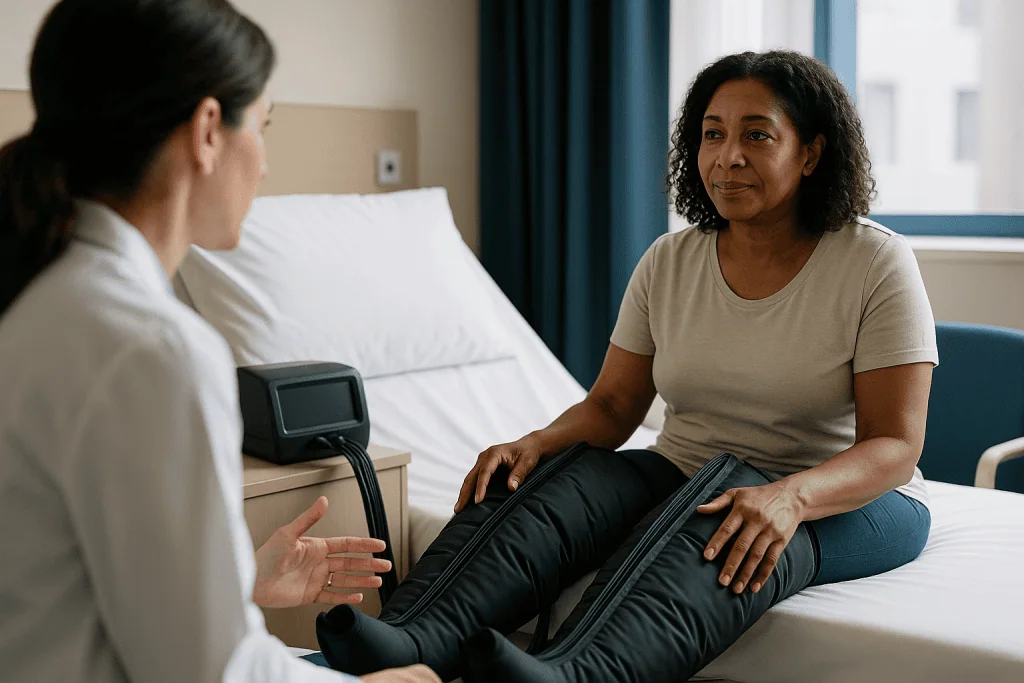
The sequence matters more than the squeeze. Veins in the leg carry blood back toward the heart against gravity, helped by one-way valves and by the calf muscles contracting as you walk. This upward movement of blood is called venous return. When you sit still after a hard session, that muscle pump switches off. Sequential inflation imitates it mechanically, pushing pooled blood and tissue fluid in the direction the valves already allow.
The same squeeze acts on the lymphatic system, a parallel network of thin vessels that collects excess fluid, proteins and cell debris from the spaces between cells and returns them to the bloodstream. Lymph has no central pump of its own; it relies on muscle movement, breathing and the vessels’ own gentle contractions. External pressure can nudge it along.
Consumer devices typically allow users to adjust how hard the chambers inflate, how long each cycle lasts and which zones are active. Hospital units built for clot prevention are calibrated to a narrower, lower pressure range, because their job is simply to keep blood from stagnating in a person lying in bed. Recovery boots often advertise far higher maximum pressures, which is worth remembering when anyone suggests “more is better”. Tissue that is already inflamed from exercise does not necessarily want to be squeezed harder; the trials that found benefits mostly used moderate settings and sessions of around 20 to 30 minutes.
What changed recently
The clearest recent shift is in who uses the devices, not in what the devices can do. Through 2024 and 2025, mainstream clinical references kept their position steady. Mayo Clinic’s lymphedema treatment guidance lists pneumatic compression as one option within a broader program that also includes exercise, manual drainage and fitted garments, and frames it as something a clinician prescribes after assessment. The NHS lymphoedema pages describe the same multi-part approach, called decongestive lymphatic therapy, with compression delivered mainly through bandaging and garments, and pumps reserved for specific cases. Neither source mentions athletic recovery at all.
On the sports side, the peer-reviewed literature grew slowly. Reviews published across the early 2020s, drawing on trials from roughly 2012 onward, continued to reach the same conclusion: small, short-term improvements in how sore or stiff participants felt, inconsistent effects on blood markers of muscle damage, and no dependable improvement in measured performance such as jump height, sprint time or strength. No trial reported serious harm in healthy adults, but almost none included a sham condition, which means the placebo effect has never been properly separated from the mechanical one.
Regulation is another thing that has not changed. In the United States, pneumatic compression devices are cleared as medical devices for indications such as lymphedema, venous insufficiency and prevention of deep vein thrombosis. Recovery and “wellness” are not among the cleared indications for most consumer units; manufacturers describe those uses in marketing language rather than clinical claims. That distinction explains the careful wording on product pages, and it is the single most useful thing a shopper can keep in mind. The boots in a hotel recovery lounge and the sleeves on a post-surgical patient share a mechanism, but only one of those settings has trial evidence behind it.
Does leg compression work? The physiology in plain terms
Yes, in the narrow mechanical sense: leg compression demonstrably moves blood and fluid. Ultrasound studies in healthy volunteers show that sequential inflation increases the speed of blood flow in the deep veins of the leg during the cycle, which is exactly why hospitals use it. The question that matters for recovery is whether moving that fluid faster for twenty minutes translates into any lasting change in a muscle that has just done something hard.
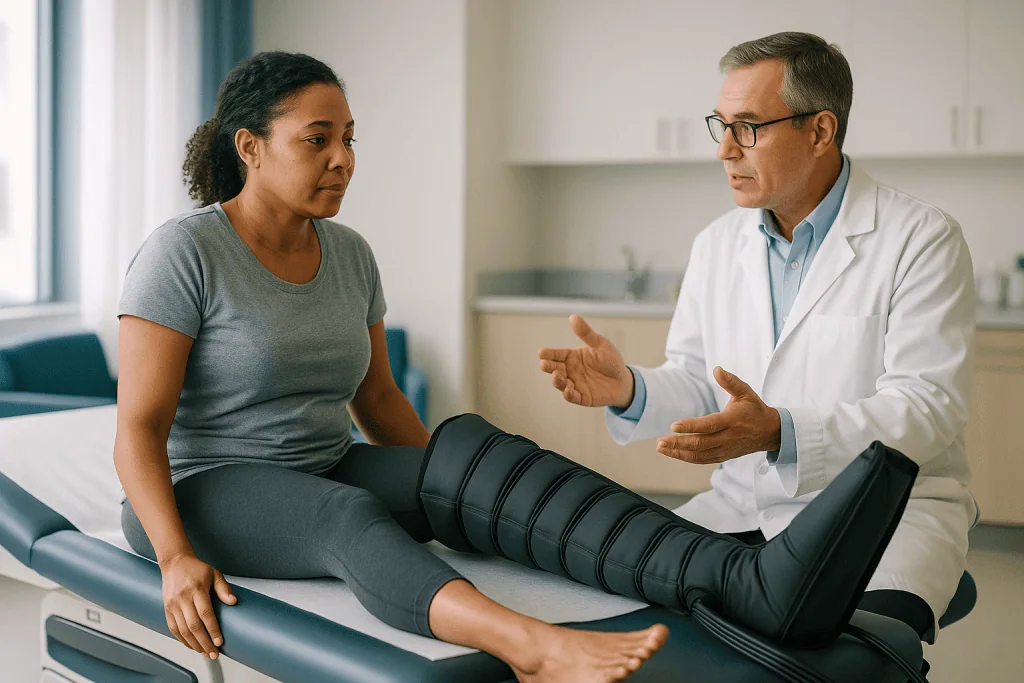
Here the chain of logic gets thinner at each link. After intense exercise, muscle fibers sustain microscopic damage, fluid shifts into the tissue, and the immune system sends in cells to clean up and rebuild. This process is what produces delayed onset muscle soreness, the stiffness that peaks 24 to 72 hours later. It is a repair program, not a waste-disposal problem. Compression can reduce swelling temporarily by pushing fluid out of the tissue, and lower swelling may mean less pressure on pain-sensing nerve endings, which fits with trial participants reporting their legs feel better right after a session.
What compression cannot do is speed up protein synthesis, rebuild damaged fibers or replace the hormonal and sleep-dependent processes that drive adaptation. Nor does it have anything to “flush” when it comes to lactate: blood lactate from a hard effort returns to resting levels within about an hour on its own, long before most people would even zip up a boot. Trials that measured lactate clearance during IPC found differences that were small, inconsistent, and clinically meaningless by the time soreness arrives the next day.
So leg compression works as a fluid pump. Whether that pump does anything your own calf muscles would not do on a 15-minute walk is the fair question, and the trials comparing the two are few and largely neutral.
What the evidence actually says about compression boots
Grading the evidence honestly means separating three claims that often get bundled together.
Reduced soreness and stiffness after exercise. This is the best-supported recovery claim, and it rests on randomized crossover trials, the design in which each participant tries both the boots and a control condition on different occasions. Several such trials in runners, cyclists and strength athletes found lower soreness ratings and better pressure-pain thresholds in the hours after IPC compared with sitting still. Effect sizes were small to moderate. Sample sizes were small, blinding was rarely possible, and few included an active comparison such as a walk or light cycling. Evidence grade: low to moderate certainty for a modest, short-lived subjective benefit.
Faster return of performance. Trials that measured sprint times, vertical jump, strength or time-trial performance the following day mostly found no difference between IPC and passive rest. A handful reported small gains; others reported none or trends in the opposite direction. Pooled, the signal is close to zero. Evidence grade: low certainty, no consistent effect.
Reduced muscle damage or inflammation. Blood markers such as creatine kinase, an enzyme that leaks from damaged muscle, were measured in some studies. Results were mixed and small, and no trial showed structural evidence of faster repair. Evidence grade: very low certainty.
Set against that are the medical indications. For preventing deep vein thrombosis in hospitalized patients who cannot walk, IPC is supported by large randomized trials; one UK study of nearly 2,900 stroke patients found a clear reduction in clots with sleeves versus none. For lymphedema, pneumatic pumps are an established adjunct within supervised programs, supported by smaller trials and long clinical experience. Those are the uses that justify the word “proven”. Athletic recovery is not yet one of them.
Compression boots compared with other recovery tools
Recovery advice is easiest to judge side by side. The table below summarizes what each common strategy is meant to do, how strong the supporting evidence is for healthy adults after exercise, and what a realistic expectation looks like. Grades reflect the balance of randomized trials and reviews from mainstream sources; “strong” means consistent findings across multiple well-designed trials, “moderate” means positive but limited or inconsistent trials, and “weak” means small studies with mixed results.
| Strategy | Intended effect | Evidence for recovery | Realistic expectation |
|---|---|---|---|
| Sleep (7–9 hours) | Hormonal repair, tissue rebuilding, nervous system reset | Strong | Largest single lever; nothing else compensates for its absence |
| Adequate protein and carbohydrate | Supplies building blocks and refills muscle glycogen | Strong | Measurably faster glycogen restoration and muscle repair |
| Active recovery (easy walk or spin) | Uses the muscle pump to clear fluid, maintains blood flow | Moderate | Modestly less stiffness; costs nothing |
| Compression boots (IPC) | Mechanical pumping of blood and lymph | Weak to moderate (subjective soreness only) | Legs feel lighter for a few hours; performance unchanged |
| Compression socks or tights | Sustained graduated pressure during or after exercise | Weak to moderate | Slightly less soreness in some trials; convenient |
| Cold water immersion | Reduces inflammation and tissue temperature | Moderate for soreness; may blunt strength gains if used after every lifting session | Useful between same-day competitions; not for every workout |
| Massage | Mechanical pressure, relaxation | Moderate for soreness | Comparable to boots on soreness in head-to-head trials |
Two patterns stand out. The strategies with the strongest evidence are the unglamorous ones, and the boots sit alongside massage and socks rather than above them. When trials have compared IPC directly with a massage of similar duration, soreness outcomes were about the same, which suggests the common ingredient is pressure and time, not the pump.
Air compression boots benefits: what is realistic after a hard workout
Strip away the hype and the plausible benefits of a session in air compression boots are specific and short-lived. Participants in the better trials consistently reported that their legs felt lighter and less tight immediately afterward, and that this feeling persisted for several hours. Measured limb circumference, a crude index of swelling, sometimes dropped by a few millimeters. Pressure-pain thresholds, the amount of force a tester can apply to a muscle before it hurts, improved slightly in some studies.
Those are not trivial outcomes if your goal is to feel comfortable enough to go about your evening after a long run. Soreness is a real barrier to training consistency, and anything that makes a scheduled recovery day feel less miserable has value, provided it does not displace the things that matter more.
There is also a behavioral benefit that trials cannot capture but coaches notice. A person who sits down for twenty minutes of enforced stillness, with legs elevated and no option to “just do one more thing”, is resting in a way they might otherwise skip. Some of the reported benefit may simply be that. One small study that compared boots with the same period of quiet leg elevation found the gap narrowed considerably, which is a polite way of saying the chair might be doing part of the work.
What the boots do not deliver, on current evidence, is faster strength recovery, faster return of running economy, less muscle damage at the fiber level, or any effect on fitness adaptations. People who expect to train harder tomorrow because of the boots are likely to be disappointed by the data, even if their calves feel pleasant tonight. Expect comfort, not a shortcut.
Compression boots for lymphatic drainage: medical use versus wellness claims
“Lymphatic drainage” has become a wellness phrase detached from its clinical meaning, so a definition helps. Lymphedema is a chronic swelling that develops when lymph vessels or nodes are damaged, removed or malformed, so that fluid collects in a limb. It most often follows cancer surgery or radiotherapy that involved lymph nodes, and it does not resolve on its own. Treating it is a skilled, long-term process.
Pneumatic compression pumps are a genuine part of that process. Mayo Clinic and Johns Hopkins both list them among lymphedema treatment options, used alongside manual lymphatic drainage by a trained therapist, multilayer bandaging, fitted compression garments, skin care and exercise. Clinicians choose the pump’s pressure, chamber sequence and session length, monitor the limb, and adjust as the swelling changes. In that setting the device is supported by controlled trials and decades of experience, and the people using it have a diagnosis.
The leap from there to “everyone’s lymphatic system needs draining” has no evidence behind it. A healthy lymphatic system handles roughly two to three liters of fluid a day without help, driven by ordinary movement and breathing. There is no reservoir of “toxins” in a healthy adult’s legs waiting to be squeezed out, and the trials in athletes did not measure or claim any lymphatic outcome beyond temporary swelling.
There is a serious caution hidden here. Someone with undiagnosed swelling, especially in one leg, should not reach for a consumer boot. One-sided swelling can signal a blood clot, an infection or a blocked lymphatic pathway, and compression in those situations can be dangerous. Anyone searching for the “best compression boots for lymphatic drainage” because a limb has swollen should see a clinician first; the right device, if one is needed, will be chosen for them, not by them.
Compression boots vs compression socks: which does what?
The comparison comes up constantly and the answer is less about which is “better” than about what each is built to do. Graduated compression socks apply steady pressure that is highest at the ankle and decreases up the calf, measured in millimeters of mercury, the same unit as blood pressure. They are passive, worn for hours, and their medical cousins are prescribed for varicose veins, chronic venous insufficiency and clot prevention during long periods of sitting. Boots are active and intermittent: strong pressure for a short session, then nothing.
For recovery after exercise, the research on socks is roughly as thin as the research on boots, and it points the same way. Several randomized trials in runners found slightly lower soreness ratings in the days after a race when participants wore compression garments compared with ordinary clothing, while performance measures were mostly unchanged. Head-to-head comparisons of socks against boots are rare, and the few that exist found no clear winner on soreness.
Where the two differ sharply is practicality and risk profile. Socks can be worn during a flight or a long shift, which is where their best medical evidence lies; a boot session requires sitting still for the duration. Socks exert far lower pressures, so the margin for harm in someone with undiagnosed artery disease is wider, though still not zero. Boots deliver a more intense, more pleasant-feeling squeeze, which many users value regardless of what a trial says about jump height.
A reasonable rule of thumb from the evidence: for comfort after a hard session, either may help a little and neither is necessary; for sitting still for many hours, socks have the relevant data; for diagnosed swelling or circulatory disease, the choice belongs to the clinician managing it.
Who should not use compression boots?
The same mechanical force that makes the boots useful in hospital makes them unsafe for certain people, and consumer packaging does not always spell this out. The following conditions are listed as contraindications or cautions across medical references for intermittent pneumatic compression, and they apply just as much to a boot sold for recovery.
- A known or suspected blood clot in the leg (deep vein thrombosis). Squeezing a leg that contains a clot risks dislodging it toward the lungs. Hospitals screen for this before applying sleeves; home users rarely do.
- Peripheral artery disease. Narrowed leg arteries already struggle to deliver blood; external pressure can reduce flow further. People with leg pain on walking that eases with rest, cold or discolored feet, or wounds that heal slowly should be assessed before using any compression.
- Heart failure or severe fluid overload. Pushing a large volume of fluid back toward the heart can overwhelm a heart that is already struggling.
- Active skin infection, cellulitis, open wounds or recent skin grafts on the leg.
- Severe nerve damage with loss of sensation, because the user cannot feel pressure that is too high.
- Recent leg surgery or fracture unless the surgical team has approved compression.
- Pregnancy with any swelling that has not been checked, because leg swelling in pregnancy occasionally signals a clot or blood pressure complication.
None of these is rare. Peripheral artery disease affects millions of adults over 50, often without symptoms, and smoking, diabetes and high blood pressure all raise the odds. A person who buys boots for “circulation” because their legs feel cold and heavy may be the very person for whom compression is risky. If any item on this list might apply, the sensible sequence is clinician first, boot second.
Common myths about compression boots
“The boots flush out lactic acid.” Lactate is not a waste product; it is a fuel that muscles and the heart burn, and blood levels normalize within about an hour of finishing exercise with or without any device. Next-day soreness is caused by microscopic muscle damage and the repair response, not by leftover lactate. Trials measuring lactate during IPC found differences too small to matter.
“They detox your lymphatic system.” A healthy lymphatic system does not accumulate toxins. Pneumatic pumps have a real role in treating lymphedema, a diagnosed condition, under supervision. For a healthy adult, there is nothing to detox and no trial has shown any lymphatic outcome beyond brief changes in limb size.
“Higher pressure means better recovery.” The trials that found benefits used moderate settings. Hospital clot-prevention devices operate at pressures lower than many consumer boots can reach. Very high pressure on freshly damaged muscle has no supporting evidence and can cause pain, bruising or numbness.
“Professional athletes use them, so they must work.” Professional athletes also use sleep, nutrition staff, physiotherapists and strictly periodized training. Their recovery rooms contain many things of varying evidence quality; usage is not proof. Several elite teams adopted boots because players liked them, and player comfort is a legitimate reason, but it is not a trial result.
“If they don’t speed performance, they’re useless.” This swings too far the other way. Feeling less sore is a real outcome that people value, and the evidence for that modest effect, while limited, is reasonably consistent. The fair position is that boots are a comfort tool with a low-certainty soreness benefit, not a performance device and not a medical treatment unless a clinician says so.
How to use compression boots sensibly if you already own them
For a healthy adult with none of the cautions above, the evidence offers some practical guidance, mostly by describing what the trials actually did rather than what the marketing suggests.
Timing in the better studies was within an hour or two after exercise, with sessions of roughly 20 to 30 minutes. Longer sessions have not been shown to add benefit, and the handful of trials that used very extended protocols found no extra effect on soreness. Pressure was moderate: enough to feel a firm squeeze, never enough to cause pain, tingling or a change in skin color. Any of those signs means stop and reduce the setting, or stop altogether.
Several practical habits reduce the risk of problems. Keep the hose and seams away from the back of the knee, where nerves and vessels run close to the surface. Wear thin leggings or long socks to protect the skin and keep the sleeves clean. Do not use the boots over a cut, a rash, a fresh tattoo or an area that was recently injected or treated. Drink normally; there is no need to “hydrate for the drainage”, a phrase with no physiological basis.
Compare the session honestly with its free alternative. A 15-minute walk or an easy spin on a stationary bike activates the same muscle pump, adds gentle blood flow to the whole body, and in the limited head-to-head data performs about as well for next-day stiffness. If the boots make you rest when you otherwise would not, they have earned their place. If they are replacing a walk, an early night or a proper meal, the trade is a poor one.
Treat the device as a comfort ritual that may take the edge off soreness, keep expectations proportional, and let the fundamentals do the heavy lifting.
When to see a doctor
Most people who try compression boots after a workout will feel nothing more than a pleasant squeeze. A small number will discover, through the device or in spite of it, a problem that needs medical attention. These are the situations that should prompt a conversation with a clinician before using the boots, or an urgent assessment if they arise during or after use.
Seek urgent care the same day if you notice:
- Swelling, warmth, tenderness or redness in one leg, especially the calf, with or without the boots. This pattern can indicate a deep vein thrombosis and compression should not be used until a clot has been ruled out.
- Sudden shortness of breath, chest pain that worsens on breathing in, coughing up blood, or a racing heartbeat, which can signal a clot that has traveled to the lungs. Call emergency services.
- A leg that becomes pale, cold, numb or intensely painful during a session.
Book an appointment before using or continuing to use the boots if you have:
- Leg pain brought on by walking and relieved by rest, slow-healing sores on the feet, or a history of smoking, diabetes or high blood pressure that has never been checked for artery disease.
- Swelling in both legs that is new, worsening or accompanied by weight gain, breathlessness lying flat, or swelling of the abdomen, which can point to heart, kidney or liver causes.
- Persistent swelling in a limb after cancer treatment or surgery involving lymph nodes.
- Numbness, tingling, bruising or skin changes that appeared after using the boots.
- Any prescribed anticoagulant, heart medication or diagnosed circulatory condition. Do not stop or adjust a prescribed medicine because a device feels helpful; that decision belongs to the prescribing clinician.
The boots are low-risk for the right person. The point of this list is to make sure you are that person before the pump starts.
The bottom line: what matters most for recovery
If the evidence had to be reduced to a single sentence, it would be this: compression boots are a reasonable comfort tool with a small, low-certainty effect on how sore your legs feel, built on a mechanism that is genuinely valuable in two medical settings that have nothing to do with marathons.
That framing protects against both kinds of error. The enthusiast who believes the boots are rebuilding muscle or draining toxins is spending time and attention on an effect the trials have not found. The skeptic who dismisses them entirely is ignoring a consistent, if modest, pattern of participants feeling better afterward, and ignoring the value of a ritual that forces twenty minutes of stillness into a day that would otherwise have none.
What actually drives recovery has not changed. Sleep remains the largest lever, with the strongest and most consistent evidence of anything on the table. Food, specifically enough protein spread through the day and enough carbohydrate to refill what training spent, is second. Managing training load so that hard days are followed by easier ones is third. A short walk is a credible fourth. Everything else, boots included, is a rounding error by comparison, though a pleasant one.
For anyone whose interest in the boots began with a swollen leg, cold feet, or a sense that their circulation is “bad”, the device is the wrong starting point. Those are symptoms worth a proper examination, and the trial evidence for pneumatic compression in diagnosed conditions only applies once a clinician has made the diagnosis and chosen the settings. Buy the comfort if you want it. Do not let a recovery gadget stand in for a medical visit, or for an early night.
Frequently asked questions
Does leg compression work?
Leg compression works in the sense that it measurably increases blood flow in the deep veins of the leg while the device is running, which is why hospitals use it to prevent clots. For exercise recovery, small randomized trials show a modest reduction in how sore and stiff the legs feel for a few hours afterward, but no reliable change in muscle damage markers or next-day performance.
Is any brand of compression boot scientifically proven?
No brand has evidence that another brand lacks. Trials of pneumatic recovery boots have used several commercial devices and a few custom units, and the findings are similar across them: a small effect on perceived soreness and little else. The mechanism is the same regardless of the logo. Claims that one product is “clinically proven” for recovery usually point to small studies of comfort or swelling, not performance.
What are people saying about air compression boots sold for home use?
User reports tend to cluster around two themes: legs feel lighter and more relaxed immediately after a session, and the enforced stillness is pleasant. That matches the trial data on subjective soreness. Complaints usually involve noise, bulk and skin irritation from high settings. Neither praise nor complaint tells you anything about muscle repair, which is what the marketing implies and the trials have not shown.
What are the best compression boots for lymphatic drainage?
For a healthy adult there is no lymphatic condition to treat, and no trial supports using boots for “drainage” in that sense. For diagnosed lymphedema, pneumatic compression is a recognized part of supervised treatment, and the device, pressure sequence and session length are chosen by the treating clinician based on the limb and the stage of swelling. Anyone with unexplained swelling should be examined before using any compression device.
How long should a compression boot session last?
The randomized trials that found a benefit mostly used sessions of about 20 to 30 minutes, started within an hour or two of finishing exercise, at moderate pressure. Longer sessions and higher pressures have not been shown to add anything and increase the chance of pain, tingling or bruising. If a clinician has prescribed pneumatic compression for a medical condition, follow their settings rather than general guidance.
Do compression boots help with delayed onset muscle soreness?
Modestly, and mainly in how the legs feel rather than in what is happening inside the muscle. Delayed onset muscle soreness peaks 24 to 72 hours after unaccustomed exercise and reflects microscopic fiber damage and repair. Trials report slightly lower soreness scores and higher pressure-pain thresholds after boots compared with sitting still, with low to moderate certainty, while blood markers of muscle damage were largely unchanged.
Compression boots vs compression socks: which is better after running?
Neither has a clear edge on the limited evidence. Both have small trials showing slightly less soreness in the days after a race compared with ordinary clothing, and performance measures are mostly unchanged for both. Socks apply low, steady pressure and can be worn for hours, which suits long flights or shifts; boots apply stronger intermittent pressure in a short session. The choice is about practicality and comfort.
Can compression boots be dangerous?
For a healthy adult using moderate settings, serious harm has not been reported in trials. The danger lies in using them with an unrecognized condition. Compressing a leg that contains a blood clot can dislodge it; squeezing a leg with narrowed arteries can reduce blood supply; pushing fluid toward a failing heart can overload it. One-sided swelling, leg pain on walking, or numbness are reasons to see a clinician before using the boots.
Do compression boots improve circulation or help varicose veins?
They increase venous blood flow while running, but there is no evidence that short sessions change circulation afterward in healthy people. For varicose veins and chronic venous insufficiency, the established approach is medical-grade graduated compression stockings, movement and clinician-directed treatment; pneumatic devices are sometimes used in specific cases. A recovery boot is not a substitute for assessment of leg pain, heaviness, cold feet or visible vein changes.
Are compression boots worth it compared with a walk or a nap?
On the evidence, a 15-minute easy walk activates the same muscle pump and performs about as well for next-day stiffness, while sleep has far stronger evidence for every aspect of recovery. The boots offer a pleasant, consistent ritual that may take the edge off soreness, which has real value if it makes you rest. They are worth it as a comfort tool, not as a replacement for sleep, food or sensible training load.
References
This article is for general information only and is not a substitute for professional medical advice. Please consult a qualified doctor about your individual situation.

More from the Blog

Dynamic Stretching: Why Warm-Ups Changed and What to Do Now
Dynamic stretching means moving joints and muscles through their range of motion, leg swings, walking lunges, arm circles, instead of holding a stretch in…
Dead Bug and Bird Dog: The Two Core Exercises Physiotherapists Prescribe Most
The dead bug exercise is a floor-based core drill: you lie on your back, arms and knees raised, and slowly lower the opposite arm…

Reformer Pilates vs Mat Pilates vs Yoga: What Each Builds and Who It Suits
Reformer Pilates uses a sliding carriage and adjustable springs to add resistance and support to Pilates movements, so it tends to build more measurable…

Resistance Bands vs Weights: What the Research Says About Building Muscle at Home
Resistance bands can build muscle and strength at home, and the best available evidence, a 2019 meta-analysis of randomized trials, found no significant difference…

Full-Body vs Push-Pull-Legs: Choosing a Training Split by How Often You Can Train
Choose a training split by how many days you can reliably lift. With two or three sessions a week, a full body workout lets…

DOMS: Why Muscles Hurt Two Days Later and What Actually Speeds Recovery
DOMS, or delayed onset muscle soreness, is muscle pain that peaks 24–72 hours after unfamiliar or intense exercise, especially movements that lengthen a muscle…