Chronic Venous Insufficiency
Chronic Venous Insufficiency is poor leg vein blood return causing swelling, skin changes and ulcers. Learn symptoms, diagnosis and treatment.
Quick answer
Chronic venous insufficiency is a condition in which leg veins do not return blood effectively to the heart, causing symptoms such as swelling, pain, heaviness, skin changes, and sometimes ulcers. At Acibadem in Turkey, evaluation focuses on the vein circulation with clinical assessment and imaging, and treatment may include lifestyle measures, compression therapy, medications, and minimally invasive or surgical procedures…
What is chronic venous insufficiency?
Chronic venous insufficiency is a long-term condition in which the veins in the legs have trouble sending blood back up to the heart. Veins are the blood vessels that carry blood toward the heart, and the veins in the legs must work against gravity. To do this, they rely on small one-way valves inside the vein and on the squeezing action of the leg muscles. When these valves become weak or damaged, blood can flow backward and collect, or pool, in the lower legs. Over time, this pooling raises the pressure inside the leg veins, a problem doctors call venous hypertension. That raised pressure is what leads to the swelling, skin changes, and discomfort that many people with this condition experience.
If you have searched for “what is chronic venous insufficiency,” it may help to think of it as a plumbing problem rather than a blockage: the pipes are open, but the valves that should keep the flow moving in one direction are leaking. The condition is classified under the medical code ICD-10 I87.2 and is sometimes grouped with related problems under the broader term chronic venous disease.
Chronic venous insufficiency is common, particularly in adults over the age of 50, and it becomes more frequent with age. It affects both men and women, although women are diagnosed somewhat more often, in part because pregnancy places extra strain on the leg veins. People who stand or sit for long periods at work, people who are overweight, and people who have had a blood clot in a deep leg vein (a condition called deep vein thrombosis) are also more likely to develop it. While the condition is rarely life-threatening on its own, it can significantly affect comfort and quality of life, and in advanced stages it can cause open sores on the skin that are slow to heal. In many hospital systems, including Acibadem, chronic venous insufficiency is evaluated and managed by cardiovascular surgery or vascular medicine departments.
Symptoms of chronic venous insufficiency
Chronic venous insufficiency symptoms usually develop gradually and often worsen over the course of the day, especially after long periods of standing or sitting. Many people notice that their symptoms improve when they lie down and raise their legs, because elevation helps blood drain out of the legs more easily.
Common symptoms include:
- Swelling in the lower legs and ankles (called edema), often worse in the evening
- Aching, heaviness, or tiredness in the legs, particularly after standing
- Cramping in the legs, sometimes at night
- Itching or tingling of the skin on the lower legs
- Varicose veinsenlarged, twisted veins visible under the skin
- Skin changes, such as darkening or a reddish-brown discoloration around the ankles
- Dry, flaky, or inflamed skin on the lower legs (sometimes called stasis dermatitis)
- Hardening or thickening of the skin near the ankles in more advanced disease
- Open sores (venous ulcers), usually near the inner ankle, that heal slowly or keep coming back
Symptoms often follow a rough progression by stage. In early disease, a person may have only small visible veins, such as spider veins, or mild aching and occasional swelling. As the condition progresses, swelling becomes more persistent and skin changes appear: the skin around the ankles may turn a brownish color because of iron pigment left behind when blood pools, and it may become itchy, tight, or fragile. In the most advanced stage, the skin can break down and form a venous ulcer: an open wound that typically develops on the inside of the ankle and can take weeks or months to heal, even with good care.
Doctors often describe the severity of chronic venous insufficiency using a classification system called CEAP, which grades the condition from no visible signs through spider veins, varicose veins, swelling, skin changes, healed ulcers, and active ulcers. You do not need to memorize this system, but knowing that your doctor may refer to a “CEAP class” can make conversations about your care easier to follow.
It is worth noting that the amount of visible vein change does not always match the level of discomfort. Some people with large varicose veins have few symptoms, while others with little to see on the surface have significant aching and swelling. Any new or worsening leg swelling deserves medical attention, because other conditions, including heart, kidney, and liver problems, as well as blood clots, can also cause swollen legs.
Causes and risk factors
The most common chronic venous insufficiency causes involve damage to, or weakening of, the one-way valves inside the leg veins. When these valves no longer close properly, blood leaks backward, a problem called venous reflux, and pressure builds up in the veins of the lower leg.
Several underlying problems can lead to this valve failure:
- Previous deep vein thrombosis (DVT): A blood clot in a deep leg vein can damage the valves as the clot heals. Chronic venous insufficiency that develops after a clot is sometimes called post-thrombotic syndrome.
- Primary valve weakness: In many people, the valves gradually weaken over time without a prior clot, often related to aging or an inherited tendency toward weak vein walls.
- Varicose veins: Long-standing varicose veins reflect and contribute to valve failure in the surface veins.
- Injury or surgery affecting the leg veins.
- Weak calf muscle pump: The calf muscles help push blood upward when you walk. Reduced mobility, paralysis, or conditions that limit ankle movement can impair this pump.
Certain factors raise the likelihood of developing the condition, even though having a risk factor does not mean the disease is inevitable:
- Age: Vein valves tend to weaken over time, so risk rises with age.
- Family history of varicose veins or venous disease.
- Female sex and pregnancy: Hormonal changes and the pressure of pregnancy on pelvic veins increase strain on leg veins; risk tends to rise with multiple pregnancies.
- Excess body weight: Higher weight increases pressure in the leg veins.
- Prolonged standing or sitting: Occupations that require long hours on your feet, or long periods seated without movement, can contribute over time.
- Smoking: Smoking harms blood vessels in general and is associated with poorer vein health and slower wound healing.
- History of blood clots in the legs.
- Lack of regular physical activity, which weakens the calf muscle pump.
Diagnosis
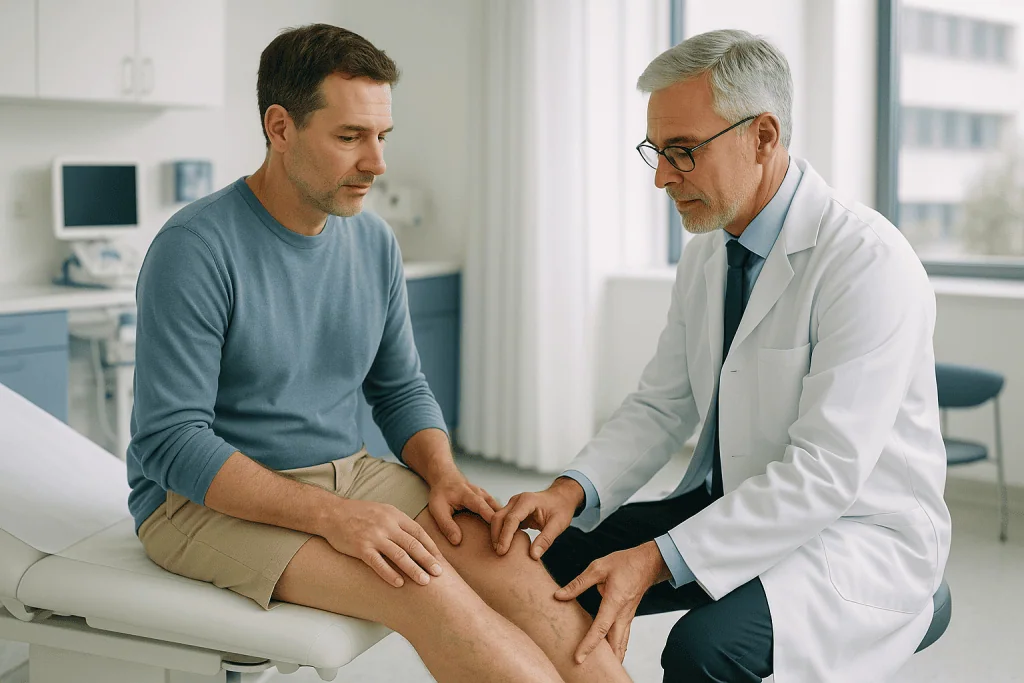
Chronic venous insufficiency diagnosis usually begins with a conversation and a physical examination. Your doctor will ask about your symptoms, when they started, what makes them better or worse, your medical history (especially any past blood clots or pregnancies), your occupation, and your family history of vein problems. During the examination, the doctor will look at your legs while you are standing, since veins fill more and problems are easier to see in that position. They will check for swelling, visible varicose veins, skin discoloration, thickened skin, and any sores or healed ulcer scars.
The key test used to confirm the diagnosis is a duplex ultrasound of the legs. This is a painless, noninvasive scan that uses sound waves to create images of the veins and to measure how blood is flowing through them. It can show whether blood is flowing backward through leaky valves (reflux), how long that backward flow lasts, and whether any veins are narrowed or blocked, for example by an old clot. Duplex ultrasound is typically performed with you standing or tilted upright, because reflux is easier to detect when gravity is acting on the veins.
Depending on your situation, your doctor may also consider:
- Blood tests, mainly to rule out other causes of leg swelling, such as kidney, liver, or thyroid problems, or to check for clotting issues.
- Additional imaging, such as CT venography or MR venography (detailed scans of the veins), if a blockage in the deeper veins of the pelvis or abdomen is suspected. These are not needed for most people.
- An ankle-brachial index, a simple blood pressure comparison between the arm and ankle, to check the arteries. This matters because compression treatment, a mainstay of venous care, may need to be adjusted or avoided if the arteries are also significantly narrowed.
Using the examination and ultrasound findings, your doctor will usually assign a CEAP class to describe how advanced the disease is. This helps guide treatment decisions and allows changes to be tracked over time.
Treatment options
Chronic venous insufficiency treatment aims to reduce symptoms, control swelling, protect the skin, heal any ulcers, and slow the progression of the disease. There is currently no treatment that restores damaged vein valves to normal, so care focuses on managing the condition. The right approach depends on how advanced the disease is, which veins are affected, your overall health, and your preferences.
Conservative (non-procedural) care
For many people, especially in earlier stages, treatment starts with measures you can carry out day to day. Your doctor may recommend a period of conservative care before considering any procedure.
- Compression therapy: Medical compression stockings gently squeeze the legs, tightest at the ankle, to help blood move upward and to limit swelling. Compression is the cornerstone of treatment for most people with this condition. Stockings come in different strengths, and your doctor can advise which grade suits you and whether compression is safe for you (it may not be, for example, if the leg arteries are also diseased).
- Leg elevation: Raising the legs above heart level several times a day helps drain pooled blood and reduce swelling.
- Regular movement and exercise: Walking and exercises that flex the ankle activate the calf muscle pump. Avoiding long unbroken periods of standing or sitting also helps; when sitting is unavoidable, flexing the ankles regularly can assist blood flow.
- Weight management: Reaching or maintaining a healthy weight reduces pressure in the leg veins.
- Skin care: Moisturizing the lower legs and treating any irritation promptly helps protect fragile skin and lower the risk of ulcers.
Medications
Medications play a supporting role. Depending on your circumstances, your doctor may consider a class of drugs called venoactive agents, which in some cases can ease aching and swelling. If you have leg ulcers, medicines that support circulation are sometimes used alongside compression and wound care. If skin inflammation (stasis dermatitis) is present, topical treatments may be prescribed. Diuretics (water pills) are generally not a treatment for venous swelling on their own, though they may be used when other conditions are also contributing. If you have had blood clots, blood-thinning medication may be part of your care to prevent new clots.
Procedures
When conservative care does not control symptoms, or when reflux in specific veins is causing skin damage or ulcers, minimally invasive procedures may be considered. These are usually done through small punctures rather than open incisions, often under local anesthesia:
- Endovenous thermal ablation: A thin tube (catheter) is placed inside the faulty vein and heat, from laser or radiofrequency energy, is used to seal it shut. Blood then reroutes through healthier veins.
- Sclerotherapy: A chemical solution or foam is injected into a faulty vein to close it. This is often used for smaller veins.
- Nonthermal closure techniques: Some faulty veins can be sealed using medical adhesive or mechanochemical methods that do not require heat.
- Venous stenting: If a deep vein in the pelvis is narrowed or blocked, a small mesh tube (stent) may be placed to hold it open in selected cases.
Surgery
Traditional surgery, such as removing a diseased surface vein (vein stripping) or tying it off (ligation), is performed less often today because minimally invasive options are available, but it remains an option in certain situations. For venous ulcers, treatment combines compression, specialized wound care, and, where appropriate, procedures to correct the underlying reflux, since treating the vein problem can help ulcers heal and reduce the chance that they return. Vascular specialists, at Acibadem, typically within the cardiovascular surgery department, assess which combination of options fits each patient.
Living with chronic venous insufficiency and outlook
Chronic venous insufficiency is, as the name suggests, a chronic condition: it usually cannot be fully cured, but in many cases it can be managed well. With consistent use of compression, regular activity, leg elevation, and, when needed, procedures to close faulty veins, most people can control their symptoms and reduce the risk of the disease advancing to skin damage or ulcers.
Living with the condition often means building small habits into daily life: putting on compression stockings in the morning before swelling develops, taking walking breaks during long periods of sitting or standing, elevating the legs in the evening, caring for the skin on your lower legs, and keeping follow-up appointments so your doctor can monitor changes over time. If you have had a venous ulcer, ongoing compression is often recommended to lower the chance of a new ulcer forming, because ulcers can recur even after successful healing.
The outlook varies from person to person. People with mild disease who follow conservative measures often remain stable for many years. Advanced disease with skin changes or ulcers requires more intensive care and closer follow-up, and healing can be slow. No treatment can guarantee that symptoms will not return, but early attention and consistent management generally lead to better outcomes than waiting until skin damage has developed.
Frequently asked questions
What is chronic venous insufficiency in simple terms?
It is a condition in which the one-way valves inside the leg veins no longer close properly, so blood pools in the lower legs instead of flowing efficiently back to the heart. This pooling raises pressure in the veins and can cause swelling, aching, skin changes, and, in advanced cases, open sores near the ankles.
Can chronic venous insufficiency heal on its own?
Generally, no. Once vein valves are damaged, they do not repair themselves, so the condition tends to persist and may slowly progress without management. However, symptoms can often be controlled with compression, exercise, leg elevation, and, where appropriate, procedures that close faulty veins.
How serious is chronic venous insufficiency?
For most people it is not life-threatening, but it can meaningfully affect comfort and daily life, and untreated advanced disease can lead to skin damage and slow-healing venous ulcers. People with venous disease may also have a higher risk of blood clots, so new sudden swelling or pain in one leg should be evaluated promptly.
What are the early chronic venous insufficiency symptoms I should watch for?
Early signs often include legs that feel heavy, tired, or achy by the end of the day, mild swelling around the ankles that improves overnight, night cramps, itching of the lower legs, and visible spider or varicose veins. Because these symptoms overlap with other conditions, a medical evaluation is the reliable way to find the cause.
What is the best chronic venous insufficiency treatment?
There is no single best treatment for everyone. Care usually starts with compression stockings, regular walking, weight management, and leg elevation. If symptoms persist or the disease is more advanced, minimally invasive procedures such as endovenous ablation or sclerotherapy may be recommended. Your doctor will tailor the plan to your ultrasound findings, disease stage, and overall health.
Is walking good for chronic venous insufficiency?
In most cases, yes. Walking activates the calf muscles, which act as a pump that pushes blood up out of the legs, and regular activity is a standard part of managing the condition. If you have leg ulcers, significant pain, or other health conditions, ask your doctor how much and what type of activity is appropriate for you.
How long is recovery after a vein procedure?
Recovery varies by procedure and by person. Minimally invasive treatments such as thermal ablation or sclerotherapy are often done as outpatient procedures, and many people return to light daily activities quickly, though your doctor may advise wearing compression stockings and avoiding strenuous activity for a period afterward. Your care team will give you instructions specific to your situation.
When to see a doctor
Consider making an appointment if you have persistent leg swelling, aching or heaviness that interferes with daily life, visible varicose veins that are worsening, or skin changes such as darkening, itching, or hardening around the ankles. Early evaluation allows treatment to begin before skin damage develops.
Seek urgent medical care if you notice any of the following red-flag warning signs:
- Sudden swelling, pain, or tenderness in one leg, especially the calf: this can signal a deep vein blood clot (deep vein thrombosis).
- Sudden shortness of breath, chest pain, or coughing up bloodpossible signs that a clot has traveled to the lungs (pulmonary embolism), which is a medical emergency.
- An open sore or ulcer on the leg or ankle, particularly one that is not healing or is getting larger.
- Signs of skin infection, such as spreading redness, warmth, increasing pain, pus, or fever.
- Bleeding from a varicose vein that does not stop with firm pressure and elevation.
- A leg that becomes pale, cold, numb, or severely painful, which may point to a problem with the arteries rather than the veins.
If you are unsure whether a symptom is urgent, it is safer to seek medical advice promptly rather than wait, especially with new one-sided leg swelling or any breathing difficulty.
Medically reviewed by the Acıbadem International Medical Board September 2, 2026
See our medical review board →
Update history
- PublishedJune 8, 2026
- Medical review approvedSeptember 2, 2026
- Last content updateSeptember 2, 2026