

Crohn’s vs Ulcerative Colitis: How Treatment Plans Differ Even When Symptoms Overlap

Key Takeaways
- Ulcerative colitis affects only the inner lining of the colon and rectum in a continuous stretch, while Crohn's can inflame any part of the digestive tract, patchily and through the full thickness of the bowel wall.
- Aminosalicylates and rectally delivered medicines are foundations of mild to moderate ulcerative colitis treatment but have little role in Crohn's, where inflammation runs deeper and often sits outside the colon.
- Removing the colon takes away every tissue ulcerative colitis can affect, whereas Crohn's surgery removes or widens a segment and disease can recur elsewhere, so maintenance medicine usually continues afterward.
- The NHS notes immunomodulators such as azathioprine can take two to three months to reach full effect, which is why they are often started alongside a tapering steroid course rather than instead of one.
- Smoking worsens Crohn's disease and raises the chance of flares and surgery, making cessation a genuine part of treatment, while it has no protective role worth pursuing in ulcerative colitis.
- The NHS advises surveillance colonoscopy in ulcerative colitis starting around ten years after symptoms began, repeated every one to five years depending on how much colon is involved, because long-standing inflammation raises colon cancer risk.
Crohn's disease and ulcerative colitis are both forms of inflammatory bowel disease and share many symptoms, but treatment differs because the inflammation sits in different places and different layers of the gut. Ulcerative colitis affects only the colon's inner lining, so topical rectal medicines and colectomy play larger roles. Crohn's can involve any part of the digestive tract full-thickness, so plans focus more on healing deep inflammation and preventing strictures and fistulas.
Two people sit in the same gastroenterology waiting room. Both have spent months with urgent trips to the bathroom, cramping that folds them in half, and a fatigue no amount of sleep touches. Both have lost weight without trying. If you asked them to describe the last year, you might not tell their stories apart. Yet one leaves with a plan built around rectal medicines and a discussion about colon surveillance, and the other with a small-bowel scan booked and a conversation about strictures.
That gap is the heart of the question of Crohn’s vs ulcerative colitis treatment. The two conditions are siblings under the umbrella of inflammatory bowel disease, and the medicine cabinets overlap considerably. What separates the plans is geography and depth: where the inflammation lives and how far into the bowel wall it reaches.
Understanding that logic makes the treatment conversation with your care team far less mysterious, and it explains why a friend’s regimen may look nothing like yours.
Two diseases, one label: what inflammatory bowel disease actually means
Inflammatory bowel disease, usually shortened to IBD, is a plain-language grouping for long-term conditions in which the immune system keeps attacking the lining of the digestive tract. It is not the same thing as irritable bowel syndrome, which causes discomfort without visible inflammation or tissue damage. The two main members of the IBD family are Crohn’s disease and ulcerative colitis, and according to MedlinePlus both tend to run a relapsing course, with flares of active inflammation and quieter stretches called remission.
What they share is considerable. Both are thought to arise from a mix of genetic susceptibility, an overactive immune response, environmental triggers and the gut’s own bacterial population. Both can appear at any age, though they are most often diagnosed in adolescence and early adulthood. Both can spill beyond the gut, inflaming joints, skin and eyes.
Where they differ is the pattern of damage, and that pattern drives nearly every treatment decision that follows. A gastroenterologist looking at colonoscopy pictures and biopsy slides is really asking two questions: how far along the tract does this go, and how deep into the wall does it reach? The answers determine which medicines are likely to reach the inflamed tissue, whether surgery can remove the problem or merely trim it, and what complications need watching.
A small group of people end up with a third label, IBD-unclassified, because early findings genuinely fit neither picture cleanly. The Mayo Clinic notes this label can change as the disease reveals itself over time. That uncertainty is not a failure of diagnosis; it is an honest description of biology that has not yet shown its hand.
What is the difference between Crohn's and colitis, anatomically?
Picture the digestive tract as a long tube from mouth to anus. Ulcerative colitis stays in one region: the colon (large intestine) and the rectum. The NHS describes it as inflammation that begins in the rectum and extends upward in a continuous, unbroken stretch, sometimes only a few centimeters, sometimes the entire colon. Crucially, it involves only the innermost layer, the mucosa, which is the surface lining that touches stool.
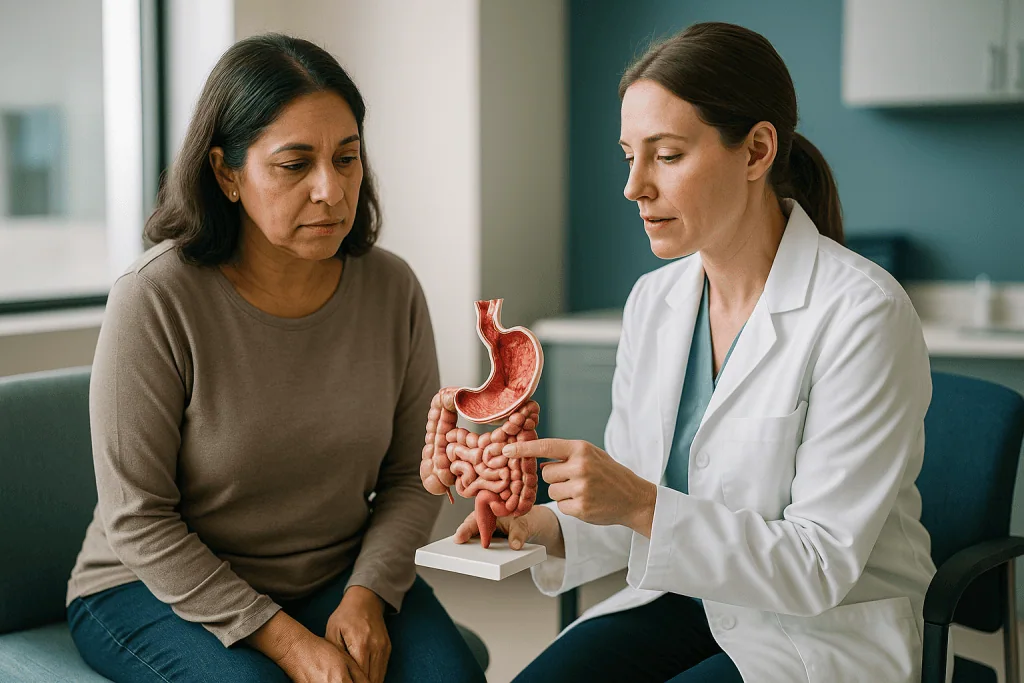
Crohn’s disease has no such boundary. It can appear anywhere along the tube, from mouth ulcers to inflammation around the anus, although the most common site, per the Mayo Clinic, is the end of the small intestine (the terminal ileum) and the start of the colon. It is typically patchy, leaving healthy tissue between inflamed segments, a pattern often called skip lesions. And it is transmural, meaning the inflammation can burrow through every layer of the bowel wall rather than staying on the surface.
Those two words, continuous versus patchy and superficial versus transmural, explain most of the treatment divergence:
- Surface inflammation limited to the rectum can be treated with medicine delivered directly into the rectum. Inflammation deep in the small bowel cannot.
- Removing the colon removes all the tissue ulcerative colitis can affect. Removing a segment of Crohn’s bowel leaves the rest of the tract still able to develop disease.
- Full-thickness inflammation can scar the wall into a narrowing (a stricture) or tunnel into neighboring tissue (a fistula). Surface inflammation rarely does either.
Everything else, from which medicines are favored to how surgery is framed, follows from this map.
Ulcerative colitis vs Crohn's symptoms: why the two feel so similar
The overlap is real and frustrating. Both conditions produce diarrhea, abdominal pain, urgency, fatigue and weight loss, because an inflamed gut absorbs less, moves faster and hurts. That is why symptom stories alone rarely settle the question, and why no one should try to sort themselves into one camp from a list.
There are tendencies rather than rules. Because ulcerative colitis lives in the rectum and colon, bleeding from the ulcerated lining is common; the NHS lists recurring diarrhea containing blood, mucus or pus as a hallmark, alongside a frequent, sometimes false, need to empty the bowels. Pain tends to sit low in the abdomen.
Crohn’s disease, when it involves the small intestine, more often presents with pain in the lower right abdomen, where the terminal ileum sits, and with weight loss or, in children, slowed growth, because the small bowel is where most nutrients are absorbed. Visible blood is less consistent. Mouth ulcers, skin tags or abscesses around the anus, and fevers point toward Crohn’s more than ulcerative colitis, according to the Mayo Clinic.
People often ask what the first signs of Crohn’s were like. In practice, the earliest chapter is frequently vague: months of tiredness, a few pounds lost, cramping that gets blamed on stress or food. The Cleveland Clinic notes that Crohn’s is sometimes diagnosed after a period of symptoms being attributed to other causes, precisely because the opening act can be so nonspecific.
The useful takeaway is that overlapping symptoms are a reason for testing, not a barrier to it. The inside view is what settles the label.
How doctors tell them apart: what actually happens during the workup
The diagnostic path starts simply. Blood tests look for anemia and markers of inflammation. A stool test rules out infection and often measures fecal calprotectin, a protein released by white blood cells that signals gut inflammation; a high level nudges the team toward IBD rather than irritable bowel syndrome.
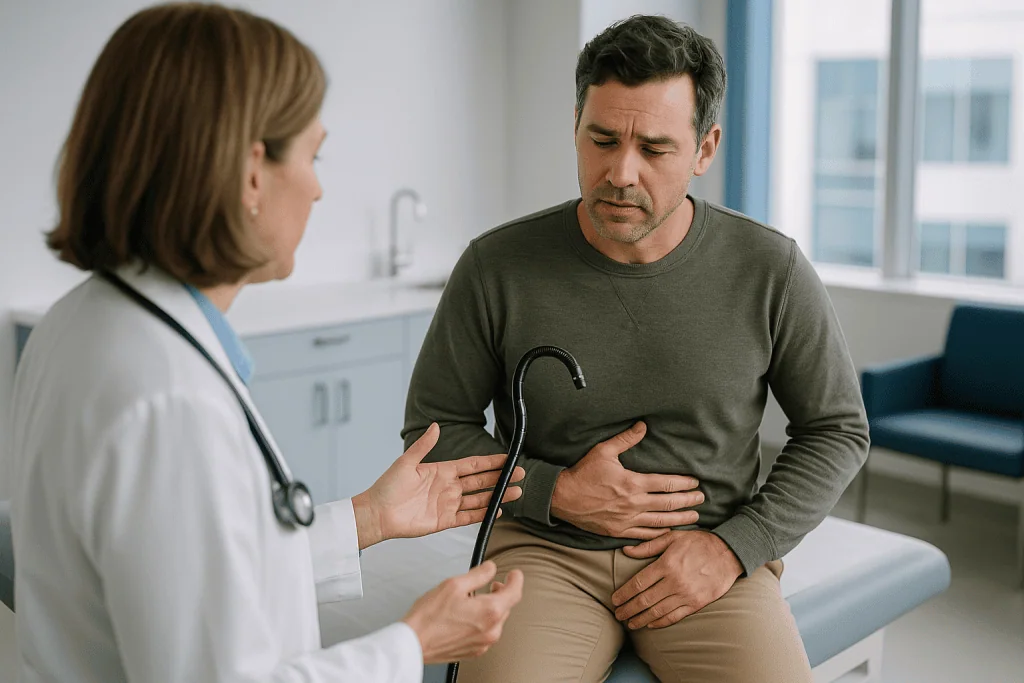
The decisive step is direct viewing. A colonoscopy passes a thin, flexible camera through the entire colon and, usually, into the last part of the small intestine. What the endoscopist sees matters: continuous redness and ulceration starting at the rectum suggests ulcerative colitis; patchy, deep, linear ulcers with normal stretches in between suggest Crohn’s. Small tissue samples (biopsies) go to a pathologist, who looks for architectural changes and, in some Crohn’s cases, tiny clusters of immune cells called granulomas. Granulomas, when present, point firmly toward Crohn’s, though the Mayo Clinic notes many people with Crohn’s never show them.
Because Crohn’s can hide in small bowel that a colonoscope cannot reach, the workup often adds imaging. MR enterography is an MRI scan tailored to the small intestine; CT enterography does the same job with X-rays. A capsule endoscopy, a swallowable camera the size of a large vitamin pill, photographs the small bowel as it passes through. If any of these show inflammation beyond the colon, the answer is Crohn’s regardless of what the colon looked like.
Two practical points follow. First, the tests are staged, so a clear result early may mean fewer later. Second, the label can be revised. Findings that seem to fit ulcerative colitis can, years later, reveal small-bowel involvement that reclassifies the disease. Your team is not changing its mind arbitrarily; it is updating the map.
Crohn's vs ulcerative colitis treatment: the shared toolbox
Before the plans diverge, it helps to see how much they share. Both conditions are treated in two phases that the NHS describes plainly: induction, meaning calming an active flare, and maintenance, meaning keeping the disease quiet for as long as possible. Both use the same broad categories of medicine, and both aim for the same modern target, which is not just feeling better but healing the lining so that a repeat colonoscopy looks calm.
The overlapping categories, described here by class and mechanism rather than as any recommendation, are:
- Corticosteroids dampen inflammation broadly and quickly. Both the NHS and Mayo Clinic describe them as a short-term tool for flares, not a long-term controller, because prolonged use thins bones, raises blood sugar and suppresses adrenal function.
- Immunomodulators such as azathioprine, mercaptopurine and methotrexate lower the immune system’s overall activity. They work slowly and are used for maintenance.
- Biologics are antibody medicines given by injection or infusion that block one specific inflammatory signal, for example tumor necrosis factor (TNF), gut-homing integrins, or interleukin-12/23.
- Small-molecule medicines, such as JAK inhibitors, are tablets that interrupt inflammatory signaling inside immune cells.
Both diseases also share supportive care: iron or vitamin replacement when absorption falls short, bone density checks for anyone with steroid exposure, vaccination reviews before immune-suppressing therapy (live vaccines are generally avoided once on it), and mental health support, since the CDC and others recognize depression and anxiety as common companions of chronic gut disease.
The overlap is why two patients’ medicine lists can look similar. The order, route and emphasis are where they separate.
Crohn's vs ulcerative colitis treatment: where the plans split
Set the two conditions side by side and the divergence is easier to see than to describe.
| Feature | Ulcerative colitis | Crohn’s disease |
|---|---|---|
| Location | Colon and rectum only, continuous | Anywhere mouth to anus, patchy |
| Depth | Inner lining (mucosa) | Full thickness (transmural) |
| Aminosalicylates | Foundation for mild to moderate disease | Limited benefit; rarely central |
| Rectal (topical) therapy | Common for rectum or left-sided disease | Only if rectum involved |
| Antibiotics | Not a routine treatment | Used for abscesses and fistulas |
| Nutritional therapy | Supportive only | Exclusive liquid diet can induce remission, especially in children |
| Role of surgery | Colectomy removes all affected tissue | Resection removes a segment; disease can recur elsewhere |
| Signature complications | Severe bleeding, toxic megacolon, colon cancer risk | Strictures, fistulas, abscesses, malabsorption |
Three rows carry most of the weight. Aminosalicylates, a family that includes mesalamine, act on the surface of the colon lining; the NHS lists them as the usual first step for mild to moderate ulcerative colitis but notes they are much less useful in Crohn’s, where inflammation runs deeper and often sits outside the colon. Rectal therapy, delivered as suppository, foam or enema, reaches only the last portion of the bowel, which happens to be exactly where ulcerative colitis begins.
Antibiotics and nutritional therapy point the other way. Crohn’s fistulas and abscesses harbor bacteria that need treating; ulcerative colitis rarely creates those pockets. And the NHS describes an exclusive liquid formula diet, taken instead of food for several weeks under specialist supervision, as an option to settle Crohn’s inflammation in children while avoiding steroids. It has no equivalent role in ulcerative colitis.
Which of these applies to you is a decision for your prescribing team, based on your own scans, biopsies and priorities.
How the medicines work, and how long each typically takes
Timelines are one of the most common sources of frustration in IBD care, because the medicines that act fastest are the ones nobody wants to stay on, and the ones meant for the long haul are slow to start.
Corticosteroids sit at the fast end. They switch off many inflammatory genes at once, which is why symptoms often ease within days. The NHS describes them as a short-course medicine for flares; the trade-off for speed is that side effects mount with duration, and steroids do not prevent the next flare. A treatment plan that leans on repeated steroid courses is generally a signal to step up maintenance therapy, not a sign the steroids are working well.
Aminosalicylates work at a middle pace on the colon lining, typically over weeks, and in ulcerative colitis they double as maintenance. Immunomodulators are the slow burners: the NHS notes that azathioprine and mercaptopurine can take two to three months to reach full effect, which is why they are sometimes started alongside a steroid course that is then tapered under supervision.
Biologics work by intercepting one inflammatory messenger. Anti-TNF antibodies neutralize tumor necrosis factor, a protein that drives gut inflammation in both diseases. Anti-integrin antibodies stop white blood cells from homing to the gut, an approach that is more gut-selective. Antibodies against interleukin-12 and 23 block signals that ripen inflammatory T cells. Response is typically assessed over weeks after an initial loading period, and the Mayo Clinic notes these medicines require monitoring for infection risk.
JAK inhibitors, taken as tablets, block enzymes inside immune cells and tend to act faster than antibody biologics, with their own monitoring needs. Which agent, in which order, and for how long is a judgment your clinician makes against your disease location, severity and health history.
Who is usually offered advanced therapy early, and who is asked to wait
Guideline thinking has shifted from a strict ladder, in which everyone starts at the bottom, toward matching intensity to risk. The Mayo Clinic frames it as choosing based on disease severity, location and the likelihood of complications.
In ulcerative colitis, someone with inflammation confined to the rectum or the left side of the colon and mild symptoms is commonly started on aminosalicylates, often including a rectal preparation, and asked to see how the lining responds before anything stronger is considered. Extensive disease, frequent flares, steroid dependence or a hospital admission for a severe flare moves the conversation toward immunomodulators, biologics or small molecules sooner.
In Crohn’s disease, the features that push clinicians toward earlier advanced therapy include:
- Deep ulceration seen at colonoscopy
- Disease around the anus, including fistulas
- Involvement of long segments of small bowel
- Diagnosis at a young age, or need for steroids at first presentation
- Early stricturing, since scar tissue does not respond to anti-inflammatory medicine
The reasoning is that transmural inflammation left smoldering causes irreversible damage, so the window for preventing strictures and fistulas is early.
Who is asked to wait? People whose disease is mild, limited and responding to first-line treatment; people with an active infection that must be cleared before immune suppression; people whose vaccinations or tuberculosis and hepatitis screening are still being completed, since the NHS notes these checks come before biologic therapy; and people who are pregnant or planning pregnancy, for whom some medicines are preferred over others and timing is planned deliberately.
Waiting is not neglect. It is a period of active monitoring, and the plan can change at any review.
Crohn's disease treatment options when surgery enters the conversation
Surgery in Crohn’s disease is not a sign that medicines have failed; it is a tool for problems medicines were never built to fix. The Mayo Clinic notes that up to half of people with Crohn’s will need at least one operation over their lifetime, most often for a stricture, a fistula, an abscess or a section of bowel that has stopped responding to treatment.
The common procedures are described here in plain terms:
- Resection removes the diseased segment and joins the healthy ends together. Surgeons aim to take as little bowel as possible, because Crohn’s can recur near the join and each loss of small intestine reduces absorptive capacity.
- Strictureplasty widens a narrowed segment without removing it, preserving length in people with multiple strictures.
- Drainage and seton placement for perianal abscesses and fistulas: an abscess is drained, and a soft thread (seton) may be left in the fistula track to keep it draining while medicines reduce inflammation.
- Temporary or permanent stoma, an opening on the abdomen through which stool passes into a bag, used when the bowel needs to rest or a join would be unsafe.
The defining feature of Crohn’s surgery is that it treats a segment, not the disease. Because inflammation can return in remaining bowel, most people continue or restart maintenance medicine after recovery, and the NHS notes the risk of recurrence after surgery is a key reason smoking cessation is pressed so hard in Crohn’s. A colonoscopy some months after resection is commonly used to look for early recurrence at the join before symptoms return.
Whether and when to operate is a shared decision between gastroenterologist, colorectal surgeon and patient, weighing symptoms, imaging and what the alternatives realistically offer.
Surgery in ulcerative colitis: why removing the colon changes the picture
Here is the most striking asymmetry between the two diseases. Because ulcerative colitis is confined to the colon and rectum, removing those organs removes every tissue the disease can inflame. That does not make surgery casual, but it does change what it means.
The NHS estimates that around 1 in 5 people with ulcerative colitis have severe symptoms that do not settle with medicine, and surgery may then be discussed. Urgent surgery is also considered for the rare emergencies: uncontrolled bleeding, a perforation, or toxic megacolon, a dangerous swelling of the colon during a severe flare.
The standard operation is a colectomy, removal of the colon. What happens next takes one of two forms:
- Ileostomy: the end of the small intestine is brought to an opening on the abdomen, and stool collects in an external bag. It may be permanent or temporary.
- Ileal pouch-anal anastomosis, often called a J-pouch: the surgeon folds the end of the small intestine into a reservoir and connects it to the anus, allowing stool to pass the usual way without a permanent bag. The NHS describes this as typically done in stages, with a temporary ileostomy while the pouch heals.
After colectomy, ulcerative colitis medicines are usually no longer needed for the bowel itself, though extraintestinal problems such as joint or liver inflammation can persist and are managed separately. Pouches carry their own issue: pouchitis, inflammation of the reservoir, which the Mayo Clinic notes is common and is usually treated with a course of antibiotics.
It bears repeating that these are options, not destinations. Many people with ulcerative colitis never need surgery, and the decision rests with the treating team and the person living with the condition.
What the first weeks after a new treatment plan usually look like
A new diagnosis or a change of medicine tends to come with a quiet, practical stretch that no one warns you about. The first fortnight is often about logistics: baseline blood tests, screening for latent tuberculosis and hepatitis before any biologic, a vaccination check, and sometimes a bone density scan if steroids have featured. None of this is treatment, yet it shapes what treatment is safe.
If a steroid course is part of the plan, symptom relief often arrives early, and the temptation is to declare victory. The NHS is explicit that steroids are tapered gradually under supervision rather than stopped abruptly, and that the maintenance medicine started alongside them is the one doing the long-term work. Expect a follow-up blood test schedule with immunomodulators, since they can affect blood counts and liver enzymes, especially in the early months.
With biologics, the first weeks involve loading, meaning closer-spaced initial doses, and a review after a defined period to judge response. Some people feel a shift within days; others notice nothing until the second or third administration. Both are ordinary.
Common early experiences include:
- Mild injection-site soreness or, with infusions, tiredness on the day
- Appetite and energy returning before bowel habit fully settles
- A fecal calprotectin test a few weeks in, to check the lining is calming even if symptoms lag
Most teams offer an IBD nurse line for questions between visits; using it is expected, not an imposition. The first objective marker of success is usually a repeat calprotectin or endoscopy, not a symptom diary, because the Mayo Clinic notes that mucosal healing predicts fewer flares and complications better than feeling well does.
Diet, smoking and everyday habits: what the evidence supports
No food causes Crohn’s disease or ulcerative colitis, and no diet replaces medicine for either. That sentence disappoints many people, but it frees them from blame. What diet can do is ease symptoms during a flare and support nutrition between them.
The Mayo Clinic and NHS offer similar practical guidance: during a flare, many people tolerate smaller, more frequent meals and less insoluble fiber (raw vegetables, nuts, seeds, whole kernels), since bulky residue irritates an inflamed bowel. Once in remission, fiber is generally reintroduced, because a varied diet protects long-term health. Lactose intolerance can develop in Crohn’s when the small bowel is inflamed, so dairy may bother some people some of the time. Fatty and highly spiced foods are common personal triggers, though not universal ones.
The differences between the two conditions here are modest but real. In Crohn’s with small-bowel involvement, absorption of iron, vitamin B12, vitamin D and calcium can fall, and the NHS notes supplements may be advised on blood test results. A stricture calls for a low-residue approach to avoid blockage. In ulcerative colitis, nutritional deficiency is less common outside severe flares, and the emphasis sits on iron replacement when bleeding has caused anemia.
Smoking is the one habit where the two diseases genuinely diverge in the evidence. The NHS states that smoking makes Crohn’s worse and raises the chance of flares and surgery, so stopping is a treatment in itself. In ulcerative colitis, oddly, the disease is more common in ex-smokers and non-smokers, but no guideline suggests smoking as protection; its harms dwarf any effect on the colon.
Alcohol, stress and sleep affect symptoms in both conditions, and a registered dietitian familiar with IBD is the best route to a plan that fits your disease, not a generic list.
What people often get wrong about Crohn's and colitis
“Crohn’s is the serious one; colitis is the mild one.” Both range from mild to life-threatening. Crohn’s carries the risk of strictures, fistulas and malabsorption; ulcerative colitis carries the risk of severe bleeding, toxic megacolon and, over decades, colon cancer, which is why the NHS advises surveillance colonoscopies starting around ten years after symptoms began and repeating every one to five years depending on extent. Severity is individual, not a property of the label.
“It is caused by stress or diet.” Stress and certain foods can worsen symptoms, but MedlinePlus and the CDC describe IBD as an immune-driven disease with genetic and environmental contributors. Nobody eats or worries their way into it.
“Once I feel fine, I can stop the maintenance medicine.” Remission is the medicine working, not the disease leaving. The Mayo Clinic notes that stopping maintenance therapy raises the risk of relapse, and any change should be made with the prescribing clinician, never alone.
“Surgery means treatment failed.” In Crohn’s, surgery fixes structural problems medicines cannot; in ulcerative colitis, it removes the organ the disease inhabits. Both are legitimate parts of care, not consolation prizes.
“Steroids are the real treatment.” They are the fire extinguisher. Needing them repeatedly is the signal to strengthen the plan that prevents fires.
“Probiotics or a special diet can replace medicine.” The evidence for probiotics is limited and inconsistent outside a few narrow situations such as pouchitis, and no exclusion diet has been shown to heal the bowel lining in adults with either disease. They may complement care; they do not substitute for it.
“IBD is the same as IBS.” Irritable bowel syndrome does not inflame or damage the gut. The two can coexist, which is one more reason symptoms alone cannot settle the diagnosis.
Questions to ask your care team
A specialist appointment moves quickly, and the questions that matter most are easy to forget once you are in the chair. These are the ones that tend to unlock the clearest answers, because they track how your team is actually thinking.
- Which parts of my digestive tract are inflamed, and how deep does the inflammation go? Ask to see the diagram or images if that helps you.
- Is my diagnosis firm, or is there any chance the label could change as we learn more?
- Which phase are we in right now, inducing remission or maintaining it, and what does each medicine on my list do?
- How will we know the treatment is working? Is the goal symptom relief, normal blood and stool markers, or a healed lining on repeat colonoscopy?
- What is the typical timeline before we expect this medicine to show an effect, and what happens if it does not?
- What monitoring blood tests will I need, how often, and who reviews the results?
- Which vaccinations should be brought up to date before starting immune-suppressing therapy?
- Are there features in my disease that make you want to treat more aggressively early, or that let us take a stepwise approach?
- Under what circumstances would surgery become part of the discussion, and what would it involve for my type of disease?
- Do I need a bone density scan, iron studies or vitamin checks given my history?
- When should I start surveillance colonoscopy, and how often?
- Is there an IBD nurse or helpline I can contact between visits, and what should prompt me to use it?
- If I am thinking about pregnancy, how does that shape which medicines we choose and when?
Writing the answers down, or bringing someone who can, turns a rushed consultation into a plan you can actually follow.
When to call your doctor
Most of IBD is managed in ordinary daylight hours, through planned reviews and a nurse line. A small set of situations should not wait for the next appointment.
Seek urgent care the same day, or emergency care if severe, for:
- Passing large amounts of blood, or bleeding that does not stop
- Severe or worsening abdominal pain, especially with a hard, swollen or very tender belly
- High fever, shaking chills or feeling faint, particularly while on immune-suppressing medicine, since infection can escalate quickly when the immune system is dampened
- Persistent vomiting, inability to keep fluids down, or signs of dehydration such as very little urine, dizziness on standing or a racing heart
- Signs of bowel obstruction in Crohn’s: cramping waves of pain, a bloated abdomen, vomiting and no stool or wind passing
- A new painful swelling near the anus, or pus draining from the skin, which can signal an abscess or fistula
- Sudden severe eye pain or vision change, or a painful red eye
- A calf that is swollen, warm and painful, or sudden breathlessness, since active IBD raises the risk of blood clots
Contact your care team within a day or two, rather than the emergency department, for a flare that is clearly building despite your usual medicine, for a new or worsening side effect, for a missed dose you are unsure how to handle, or if you have been prescribed a steroid course and symptoms return as it tapers. Never stop or change a prescribed IBD medicine on your own, even when you feel well; the decision, and the timing, belongs with the clinician who knows your case.
The Mayo Clinic and NHS both stress that early contact during a flare usually means a shorter, gentler correction. Waiting to see if it passes tends to cost more than it saves.
Frequently asked questions
Is Crohn's worse than ulcerative colitis?
Neither is reliably worse; both range from mild to life-threatening depending on the person. Crohn’s carries risks of strictures, fistulas and malabsorption because it inflames the full bowel wall anywhere along the tract. Ulcerative colitis carries risks of severe bleeding, toxic megacolon and a raised long-term colon cancer risk. Severity, complications and response to treatment vary far more between individuals than between the two labels.
Can Crohn's disease or ulcerative colitis go away for good?
Both are lifelong conditions, but both can be controlled into long periods of remission where the bowel lining heals and symptoms disappear. Maintenance medicine is usually what keeps remission going, so stopping it because you feel well tends to bring the disease back. In ulcerative colitis, removing the colon removes the tissue the disease affects, though extraintestinal problems can persist. Any change to treatment belongs with your care team.
What are the 6 worst foods for ulcerative colitis?
There is no evidence-based list of six universal culprits; triggers are personal. During a flare, many people find high-insoluble-fiber foods such as raw vegetables, nuts, seeds and popcorn, along with very fatty or heavily spiced meals, caffeine and alcohol, worsen symptoms. Dairy bothers some people, not all. In remission, a varied diet including fiber is encouraged. A dietitian experienced in IBD can help identify your own pattern safely.
What are the first signs of Crohn's disease usually like?
The opening chapter is often vague rather than dramatic: months of fatigue, cramping that comes and goes, gradual weight loss, loose stools and sometimes low-grade fever or mouth ulcers. In children, slowed growth may be the earliest clue. Because these features overlap with many other conditions, the diagnosis rests on stool and blood tests, colonoscopy with biopsies and small-bowel imaging rather than on the symptom story alone.
Are the medicines for Crohn's and ulcerative colitis the same?
Largely, yes, with important differences in emphasis. Both use corticosteroids for flares, immunomodulators for maintenance, biologics and small-molecule tablets for moderate to severe disease. Aminosalicylates and rectal therapies are central in ulcerative colitis but rarely useful in Crohn’s. Antibiotics for abscesses and fistulas, and exclusive liquid nutrition in children, are Crohn’s-specific tools. Your clinician chooses based on disease location, depth and severity.
How does surgery differ between ulcerative colitis and Crohn's?
In ulcerative colitis, removing the colon and rectum takes away all the tissue the disease can affect, followed by either an ileostomy or a J-pouch. In Crohn’s, surgery removes or widens a diseased segment, drains abscesses or manages fistulas, but disease can return in remaining bowel, so maintenance medicine typically continues. Mayo Clinic notes up to half of people with Crohn’s need at least one operation.
Can you have both Crohn's and ulcerative colitis?
Not both at once, but the picture can be unclear. Some people are labeled IBD-unclassified when early findings fit neither pattern cleanly, and a diagnosis of ulcerative colitis is occasionally revised to Crohn’s years later if small-bowel or perianal disease appears. This reflects biology revealing itself over time rather than diagnostic error, and it can change which medicines and surgical options suit you best.
How long does it take for IBD treatment to work?
It depends on the class. Corticosteroids often ease symptoms within days but are a short-term tool. Aminosalicylates typically act over weeks in ulcerative colitis. The NHS notes immunomodulators like azathioprine can take two to three months for full effect. Biologics are assessed over weeks after an initial loading phase. Objective markers such as fecal calprotectin or repeat colonoscopy show whether the lining is healing.
Do steroids control Crohn's or ulcerative colitis long term?
No. Steroids calm flares quickly but do not prevent the next one, and long-term use thins bones, raises blood sugar and increases infection risk, which is why the NHS and Mayo Clinic describe them as short courses that are tapered under supervision. Needing repeated steroid courses is generally a signal for the care team to strengthen maintenance therapy rather than a sign the steroids are working well.
Do I need regular colonoscopies with ulcerative colitis or Crohn's?
Usually yes, for two reasons. Repeat colonoscopy checks whether treatment has healed the lining, which predicts fewer flares. It also screens for colon cancer, since long-standing colonic inflammation raises the risk; the NHS advises surveillance in ulcerative colitis starting around ten years after symptoms began, every one to five years depending on extent. Crohn’s involving much of the colon follows similar surveillance. Your team sets the interval.
References
- NHS: Ulcerative colitis: Treatment
- NHS: Crohn's disease: Treatment
- MedlinePlus: Crohn's Disease
- MedlinePlus: Ulcerative Colitis
This article is for general information only and is not a substitute for professional medical advice. Please consult a qualified doctor about your individual situation.

More from the Blog

Diet During Ulcerative Colitis Treatment: Eating in a Flare vs Eating in Remission
During an ulcerative colitis flare, most guidance favors small, frequent meals, plenty of fluids, and softer, lower-fiber foods while medicines calm the inflamed colon.…
Celiac Disease Myths: Is a Little Gluten Fine, and Does Gluten-Free Mean Healthier?
No, a little gluten is not fine for someone with celiac disease: even crumb-sized amounts can restart the immune attack on the small intestine,…

Food Poisoning Red Flags: The Situations Where Doctors Want to See You the Same Day
Food poisoning red flags that call for same-day medical care include blood in the stool, a fever above 102°F (38.9°C), vomiting that stops you…

Kimchi and Sauerkraut: What Fermented Cabbage Does for the Microbiome
Kimchi and sauerkraut are cabbages preserved by lactic acid bacteria, and eating them regularly appears to nudge the gut microbiome toward greater diversity. A…
Raising the Bed, Timing Meals and Taking Medicine: Daily GERD Care That Backs Up Treatment
GERD lifestyle changes with medication work as a pair rather than as alternatives. Acid-suppressing medicine lowers how much acid the stomach makes, while raising…

How Endoscopic Ablation for Barrett’s Esophagus Is Done and What You Feel Afterwards
A Barrett's esophagus ablation procedure is done during a sedated upper endoscopy: a thin, flexible camera tube passes through the mouth, and a small…