

CT Scans With Contrast: Why the Dye, How Long It Takes, What About Radiation
Key Takeaways
- The iodine contrast used in CT is not radioactive: it blocks X-rays rather than emitting anything, so you expose no one to radiation after the scan.
- Actual scanning takes seconds on modern machines; the 30-to-90-minute appointment is mostly prep, and abdominal scans run longest because oral contrast needs 60–90 minutes to travel through the intestines.
- With healthy kidneys, most IV contrast is filtered into the urine within hours and essentially all of it within about 24 hours, extra water that day is the only real aftercare.
- An abdomen-and-pelvis CT delivers roughly 10 mSv, comparable to about three years of natural background radiation, while a chest X-ray is about 0.1 mSv.
- Severe contrast reactions occur in only a few per 10,000 scans, and the shellfish-allergy connection is a myth, shellfish allergy involves muscle proteins, not iodine.
- You can normally drive yourself home immediately after a contrast CT; the exceptions are sedation or drowsiness-causing pre-medication, both of which are flagged before your appointment.
Quick Answer
A CT scan with contrast uses an iodine-based dye, swallowed or given through an IV, to make blood vessels, organs, and abnormal tissue stand out clearly on the images. The appointment usually takes 30 to 90 minutes, though the scanning itself lasts only minutes. Healthy kidneys clear the dye within about 24 hours, and the radiation dose is roughly comparable to two to three years of natural background exposure.
The technologist will warn you, and it will still surprise you. A few seconds after the injection starts, a wave of warmth rolls from your chest to your pelvis, your mouth tastes faintly of metal, and for one alarming moment you’re certain you’ve wet yourself. You haven’t. Sixty seconds later it’s gone, and the scanner has already captured most of what it came for.
That strange minute is the heart of a contrast-enhanced CT, one of the most commonly ordered imaging tests in modern medicine. It’s also the source of most of the questions patients bring to the appointment: What is this dye? Is it radioactive? Will it hurt my kidneys? Can I drive home afterward?
The honest answers are more reassuring than the internet suggests, and more interesting. Here’s what the evidence actually shows, minute by minute and millisievert by millisievert.
Why would a doctor order a CT scan with contrast?
Because on a plain CT, a lot of the body looks like gray on gray. X-rays pass through soft tissuesliver, pancreas, bowel, blood vessels, tumors, in remarkably similar ways, so structures that matter enormously can blur into their neighbors. Contrast material solves that by temporarily changing how certain tissues absorb X-rays, drawing crisp borders where there were fuzzy ones.
Doctors typically reach for contrast when the question involves blood flow or subtle tissue differences. Common examples, per Mayo Clinic and Cleveland Clinic, include:
- Searching for or characterizing a tumor, since many tumors take up contrast differently than healthy tissue
- Finding infection or an abscess, which often shows a telltale enhancing rim
- Mapping blood vessels, checking for a clot in the lungs, an aneurysm, or narrowed arteries
- Investigating unexplained abdominal pain, where inflamed appendix or bowel becomes far easier to spot
- Evaluating organs like the liver, kidneys, and pancreas in fine detail
The reverse is also true: some questions are answered better without dye. A suspected kidney stone or fresh bleeding in the brain shows up clearly on plain CT, and contrast can actually obscure them. So a doctor’s decision to order contrast isn’t an upgrade or a formality: it’s matched to the specific question being asked of the images.
What is the ‘dye’ actually made of, and how does it work?
Calling it a dye is a small historical fib. Nothing gets stained or colored. CT contrast for injections is a clear liquid built around iodine, an element whose atoms are dense enough to absorb X-rays far more strongly than the water and carbon that make up most of your body.

The physics is straightforward: a CT scanner works by measuring how much of its X-ray beam gets absorbed as it passes through you from hundreds of angles. Wherever the iodine travels, through arteries, into a tumor’s blood supply, along the wall of an inflamed organ, absorption spikes, and those areas appear bright white on the final images. The dye doesn’t treat anything and doesn’t linger; it’s a temporary highlighter carried by your bloodstream.
For scans of the digestive tract, a different compound is often used: a chalky drink containing barium sulfate, or sometimes a diluted iodine solution. Barium is another heavy, X-ray-blocking element, and it coats the inside of the stomach and intestines so radiologists can distinguish bowel loops from everything pressed up against them.
One point worth underlining because it causes so much needless worry: neither iodine contrast nor barium is radioactive. They block radiation; they don’t emit it. The radioactive tracers people sometimes hear about belong to a different family of tests entirelynuclear medicine scans, not CT.
IV, oral, or rectal: three routes to the same goal
How the contrast gets into you depends on what needs highlighting.
Intravenous (IV) is the workhorse. A small catheter goes into a vein, usually at the elbow crease or hand, and a power injector delivers the contrast in a timed burst so the scanner can catch it flowing through arteries, then organs, then veins. Timing matters: radiologists often scan in “phases” seconds apart, because a liver tumor may light up early while a kidney finding declares itself later.
Oral contrast is the drink, typically one to two large cups, sipped over 60 to 90 minutes before an abdominal or pelvic scan so it has time to travel through the stomach and small intestine. The flavor has improved over the years (mildly fruity versions exist), but nobody orders seconds.
Rectal contrast, given by enema, is the least common route, reserved for specific questions about the rectum and lower colon.
Many abdominal scans combine routes: you drink the oral contrast to outline the bowel, then receive IV contrast to light up the organs and vessels around it. That combination is a big part of why abdominal CT appointments run longer than, say, a head CT: the waiting isn’t inefficiency, it’s transit time through roughly twenty feet of intestine.
What happens before the scan: prep, bloodwork, and the questions they’ll ask
Expect a short questionnaire that punches above its weight. The imaging team will ask about previous reactions to contrast, allergies, asthma, kidney disease, diabetes, and whether you might be pregnant. None of these are box-checking; each one changes how the test is run or whether contrast is used at all.

A few specifics worth knowing in advance:
- Fasting is often requested for a few hours before an IV-contrast scan, commonly two to four, mainly to reduce nausea. Clear instructions come with your appointment; follow those over anything you read online, including this.
- Kidney check. Because the kidneys excrete the contrast, many centers require a recent blood test measuring kidney function, especially for people over 60, those with diabetes or high blood pressure, or anyone with known kidney disease. Sometimes it’s done on the spot with a finger-stick.
- Medication review. A widely used class of diabetes medication is sometimes paused around the time of contrast in people with reduced kidney function. Don’t stop anything on your own: the care team will tell you exactly what applies to you.
- Metal off. Jewelry, zippers, underwire, and hearing aids can streak the images, so you may change into a gown.
Total prep rarely takes more than the paperwork plus, for abdominal scans, that hour of contrast-drinking. Bring something to read.
What does the injection actually feel like?
Three sensations, all brief, all normal, and knowing about them ahead of time makes the experience almost boring.
First comes the warm flush. Within seconds of the injection, heat spreads through the chest and abdomen and settles, disconcertingly, in the pelvis and groin. It peaks quickly and fades within a minute or two. Second, a metallic taste, as if you’d licked a coin. Third, and the one nobody forgets, a vivid sensation of needing to urinate, or having urinated. You haven’t. It’s the warmth reaching the pelvic blood vessels, and Cleveland Clinic lists it among the most common (and harmless) effects patients report.
The IV placement itself feels like any blood draw: a quick pinch. During the injection, tell the technologist immediately if you feel sharp pain, stinging, or swelling at the IV sitethat can mean contrast is leaking into the tissue around the vein rather than into it, something the team wants to stop within seconds. It’s uncommon and usually resolves with cold compresses and elevation, but speaking up fast matters.
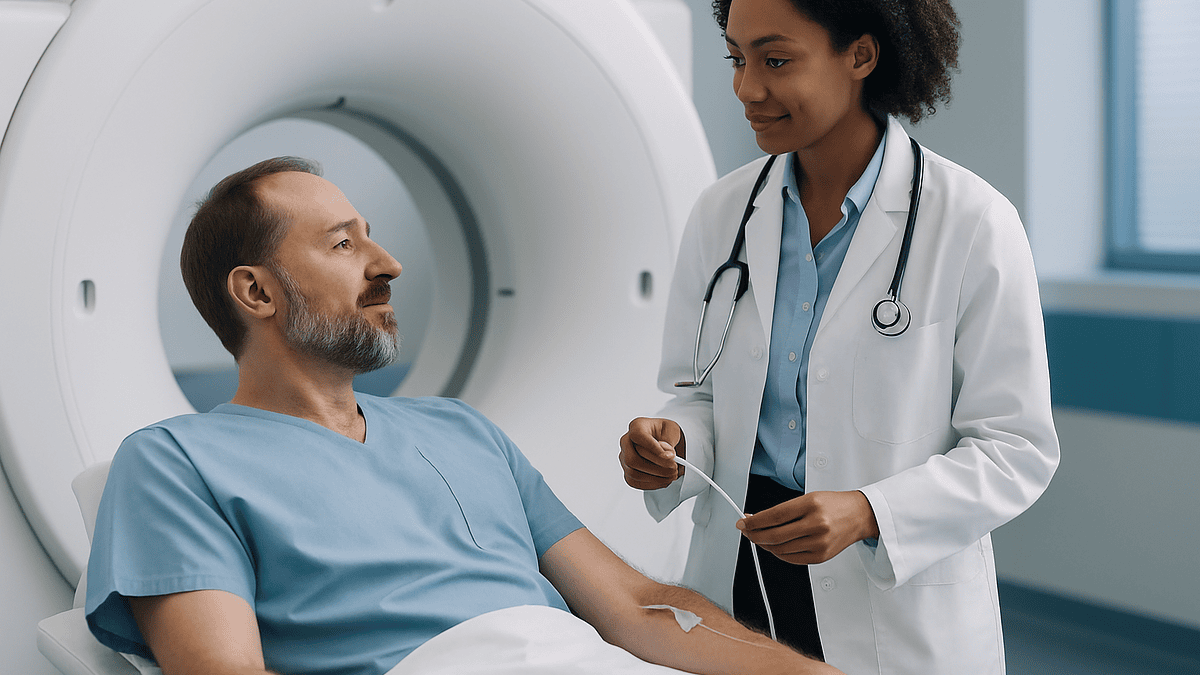
During the scan you’ll hold still on a motorized table that slides through the doughnut-shaped scanner, holding your breath for a few seconds when a recorded voice asks. The machine hums; nothing touches you. Most patients say the hardest part was drinking the barium.
How long does a CT scan with contrast take, start to finish?
Here’s the paradox that surprises most first-timers: the scanning itself often takes less than a minute. Modern multidetector scanners sweep the entire chest or abdomen in a handful of seconds, faster than the breath-hold you’re asked to take. Everything else on the clock is preparation and timing.
A realistic breakdown:
| Step | Typical time |
|---|---|
| Check-in, questionnaire, changing | 10–20 minutes |
| Drinking oral contrast (abdominal scans only) | 60–90 minutes |
| IV placement | 5 minutes |
| Positioning and the scan itself | 10–15 minutes on the table; seconds of actual scanning |
| Brief observation after IV contrast (if requested) | 15–30 minutes |
So a head or chest CT with IV contrast might have you in and out in well under an hour, while an abdomen-and-pelvis study with oral plus IV contrast can stretch to two hours, nearly all of it spent letting the drink work its way through your intestines.
The results take longer than the scan. A radiologist reviews hundreds or thousands of image slices and writes a formal report, which typically reaches the ordering doctor within one to a few days, faster for urgent cases. Ask at checkout how and when to expect yours; “no news” should never be assumed to mean good news.
How long does it take to recover from a CT scan with contrast?
For the large majority of people, there is genuinely nothing to recover from. A contrast CT is not surgery, not sedation, not even particularly tiring. You walk out the way you walked in and can go straight back to work, school, or lunch: Mayo Clinic and the NHS both describe normal activity resuming immediately.
What people usually mean by “recovery” is: how long until the dye is out of me? With normally functioning kidneys, most IV contrast is filtered into the urine within a few hours, and essentially all of it within about 24 hours. You won’t feel it leaving; your urine won’t change color. Drinking extra water that day, a reasonable target is simply more than usual, spread across the day, supports the process, and it’s the one piece of aftercare nearly every imaging center recommends.
Oral barium follows a slower, unglamorous exit through the bowel over a day or two. Expect stools that look pale or chalky, and know that barium can be mildly constipating, another argument for the water bottle.
A small number of people feel queasy or headachy for a few hours, and delayed skin reactions (an itchy rash appearing hours to a few days later) occur occasionally and are usually mild. If “recovery” from your scan feels like more than a slightly odd afternoon, that’s worth a phone call, more on that below.
What should I avoid after a CT scan with contrast?
Surprisingly little, and it’s worth being precise, because vague warnings breed unnecessary anxiety.
There is no list of forbidden foods, no ban on exercise, no need to isolate from children or pregnant family members. You are not radioactive after a CT; the X-rays stopped the instant the scanner did, and the iodine dye emits nothing. That last myth deserves a firm burial: it stems from confusion with nuclear medicine tests, which use a different technology altogether.
The short, honest list of what to actually do and skip:
- Don’t skimp on fluids. Dehydration is the one thing worth actively avoiding, since your kidneys are doing the cleanup work. Water, juice, soup, all count.
- Follow any medication instructions you were given. If the team asked you to pause a specific medicine for 48 hours, that instruction stands until they or your doctor say otherwise. If nobody said anything, nothing changes.
- Watch the IV site. Increasing pain, swelling, or skin changes where the needle went in warrant a call.
- If you drank barium, expect pale stools and lean on fluids and fiber to head off constipation.
Alcohol isn’t formally prohibited after contrast, but it works against hydration, so the sensible move is to let water win the day. Beyond that, live normally. The scan asks almost nothing of you once it’s over.
Can I drive myself home after a CT scan with contrast?
Yes, in nearly all cases. Contrast material is not a sedative, doesn’t impair coordination or judgment, and standard CT protocols involve no medication that affects driving. The NHS and Mayo Clinic both note that people typically resume normal activities, driving included, immediately after the scan.
The exceptions are specific and will be flagged in advance:
- Sedation. A small minority of patients: those with severe claustrophobia, certain children, or people who can’t hold still, receive a sedative. If you do, you cannot drive that day and must arrange a ride. The imaging center will tell you this when booking, not spring it on you afterward.
- Pre-medication for prior contrast reactions. People with a history of allergic-type reactions are sometimes given medication beforehand that can cause drowsiness; ask specifically whether yours affects driving.
- You feel unwell. If you’re nauseated, lightheaded, or otherwise off after the scan, tell the staff and wait it out rather than pushing through. Feeling normal is the green light.
Some centers ask patients who received IV contrast to sit in the waiting area for 15 to 30 minutes before leaving, because the rare serious reactions almost always show themselves within that window. It’s a reasonable precaution, not a sign anyone expects trouble. Once you’re cleared and feel like yourself, the car keys are yours.
How much radiation is in a CT scan, really?
Enough to be worth measuring, and far less than fear suggests. Radiation dose is expressed in millisieverts (mSv), and the most useful yardstick is natural background radiation: the roughly 3 mSv per year every person absorbs from soil, cosmic rays, and even food, per Harvard Health.
| Exam or exposure | Approximate dose | Equivalent background time |
|---|---|---|
| Chest X-ray | 0.1 mSv | ~10 days |
| Head CT | ~2 mSv | ~8 months |
| Chest CT | ~7 mSv | ~2 years |
| Abdomen and pelvis CT | ~10 mSv | ~3 years |
| Yearly natural background (U.S. average) | ~3 mSv |
What does that mean for cancer risk? The honest answer is that any single scan’s added lifetime risk is small, estimates for a typical CT hover in the range of a fraction of a percent, against a baseline lifetime cancer risk of roughly 40 percent. The evidence for harm at these doses is extrapolated from higher exposures, which is why experts describe the risk as small but not zero, rather than pretending certainty in either direction.
Two principles follow. First, a CT your doctor genuinely needs almost always delivers more benefit than risk: a missed appendicitis or pulmonary clot is a far larger danger than 10 mSv. Second, doses add up, so it’s fair and smart to ask, “Is this scan necessary, and is there a lower-radiation alternative?” Good clinicians welcome that question.
Does the contrast dye add radiation? A myth worth retiring
No, and this misconception is common enough to deserve its own space. Iodine contrast and barium are chemically dense, not radioactive. They absorb X-rays generated by the scanner; they produce none of their own. The moment the scanner’s X-ray tube switches off, your radiation exposure ends completely, dye or no dye. You cannot expose family members, pets, or coworkers to anything after a contrast CT.
The confusion likely comes from two directions. One is nuclear medicine, tests like PET scans and bone scans genuinely do use small amounts of radioactive tracer, and patients are sometimes given precautions afterward. Different test, different physics. The other is a grain of truth: contrast studies can involve more scanning. When radiologists need to see contrast at multiple moments, arriving in the arteries, soaking into an organ, draining through the veins, the scanner may pass over the same area two or three times, and each pass carries its own dose. So a multiphase contrast study can deliver more total radiation than a single plain scan of the same region.
That’s not a hidden cost; it’s a deliberate trade radiologists make only when the extra phases answer the clinical question. Modern scanners also use automatic dose-adjustment technology that tailors the X-ray output to your body size, and imaging societies have spent two decades driving doses downward. The dye, though? Blameless. It just sits there being visible.
What about my kidneys? The evidence has evolved
This is the concern patients raise most, and the science here has genuinely shifted, in a reassuring direction. Because the kidneys filter iodine contrast out of the blood, doctors long worried that the dye itself could injure them, a phenomenon called contrast-induced kidney injury. For years, this fear caused clinicians to withhold contrast from patients who arguably needed it.
More recent, better-controlled research suggests the risk was substantially overestimated. Earlier studies often lacked comparison groups; when researchers later compared similar patients who did and didn’t receive contrast, kidney function changes turned out to be far more alike than the old numbers implied, many temporary blips would have happened anyway, driven by illness, dehydration, or blood pressure changes. Today the preferred term is “contrast-associated” kidney injury, an acknowledgment that association isn’t the same as causation.
That said, nobody claims zero risk, particularly for people with significantly reduced kidney function. The sensible modern approach, reflected in how imaging centers actually operate:
- Screening blood tests for patients at higher risk, older adults, people with diabetes, hypertension, or known kidney disease
- Using the lowest contrast volume that answers the question
- Ensuring patients are well hydrated before and after
- Weighing risk against benefit individually, rather than blanket refusals
If you have kidney disease, say so early and clearly. It doesn’t automatically rule out contrast: it triggers a thoughtful conversation about whether the scan’s answer is worth it, and often it is.
Allergic reactions: how common are they, honestly?
Less common than waiting-room folklore suggests, and overwhelmingly mild when they happen. With the modern low-osmolality contrast agents used today, mild reactions: a few hives, itching, brief nausea, a warm flush beyond the expected one, occur in roughly 1 to 3 percent of injections. Severe, allergy-type reactions involving breathing difficulty or dangerous blood pressure drops are rare, on the order of a few per 10,000 scans, which is why staff are trained and equipped for them even though most technologists see them only occasionally in a career.
A few evidence-based clarifications people deserve:
- The shellfish myth is a myth. Shellfish allergy is a reaction to muscle proteins in the shellfish, not to iodine: an element your thyroid requires daily. People with shellfish allergy have a modestly higher reaction rate, but so do people with any allergy or with asthma. There’s nothing uniquely predictive about seafood, and iodine allergy per se doesn’t exist as a true entity.
- The strongest predictor is a previous contrast reaction. If you’ve reacted before, say so, pre-medication and agent-switching strategies exist, and prior reaction doesn’t automatically bar you from future scans.
- Delayed reactions happen. An itchy rash can surface hours to a few days later; these are usually mild and self-limited but worth reporting.
The takeaway: disclose every allergy and prior reaction honestly, then let the odds, which favor you heavily, do their work.
Pregnancy, breastfeeding, and contrast: what the guidance says
If you might be pregnant, say so before the scan is booked. This is the single most important disclosure in imaging, and it changes the conversation in two ways. First, radiation: X-rays can reach a developing fetus, and while a single diagnostic CT delivers a dose well below the levels associated with harm in most studies, doctors avoid unnecessary fetal exposure on principle. Alternatives such as ultrasound or MRI often answer the same question. Second, the contrast itself crosses the placenta; available evidence hasn’t shown harm to the fetus from iodinated contrast, but it’s reserved for situations where the information is genuinely needed. When a pregnant patient has a potentially serious condition, a suspected blood clot in the lungs, for instance, the scan’s benefit usually outweighs these considerations decisively, and radiologists tailor the technique to minimize dose.
Breastfeeding is a happier story than old advice implied. Less than 1 percent of an IV contrast dose ends up in breast milk, and the infant’s gut absorbs less than 1 percent of that, meaning the baby’s effective exposure is a vanishing fraction of the mother’s. Major medical centers, including Mayo Clinic, note that breastfeeding can continue without interruption after iodinated contrast. Parents who nonetheless prefer a pause sometimes pump and discard for 12 to 24 hours; that’s a personal comfort choice, not a medical requirement, and it’s reasonable to say so plainly rather than let outdated caution masquerade as evidence.
When to call a doctor after a CT scan with contrast
Most people finish a contrast CT and never think about it again. But a short mental checklist for the following days is worth carrying home, because the rare problems are far easier to handle early.
Seek emergency care immediatelycall emergency services rather than driving, if you develop:
- Swelling of the face, lips, tongue, or throat
- Difficulty breathing, wheezing, or a tight throat
- Widespread hives with dizziness or faintness
These signal a serious allergic-type reaction. Nearly all occur within the first hour, often within minutes, while you’re still at the imaging center surrounded by people trained for exactly this, but a same-day emergency after leaving deserves the same urgency.
Call your doctor or the imaging center promptly if, over the next few days, you notice:
- A new rash or persistent itching (delayed skin reactions can appear up to about a week later)
- Noticeably reduced urination, new swelling in the legs, or unusual fatigue, possible signs the kidneys are struggling, especially if you have preexisting kidney disease or diabetes
- Increasing pain, swelling, blistering, or skin color changes at the IV site
- Fever, or vomiting that keeps you from holding down fluids
- No bowel movement for more than two days after drinking barium, or severe abdominal pain
One more scenario belongs on this list: if a week passes and nobody has contacted you about results, call. Following up on your own report isn’t pushy: it’s one of the most protective habits a patient can have.
Contrast vs. no contrast: why your last CT may have been different
Patients often notice the inconsistency, “Last year I just lay down and it was over; this time there’s a drink and an IV?”, and wonder whether someone made a mistake. Almost certainly not. The two versions of the test answer different questions, and radiologists match the protocol to the clinical puzzle.
Plain, non-contrast CT excels where the natural density differences are already stark: bone against soft tissue, air against lung, calcium against everything. That’s why suspected kidney stones (dense calcium), fresh brain bleeding (dense blood), fractures, and most lung-nodule checks are done dry. Contrast would add time, a small risk, and, in the case of brain bleeds, could actually camouflage the finding, since both fresh blood and contrast appear bright.
Contrast-enhanced CT wins where blood flow tells the story: tumors, abscesses, vascular clots, organ inflammation, and staging of known cancers. Some studies deliberately combine both, scanning once without contrast and again with it, because the comparison itself is diagnostic: a spot that brightens after injection behaves differently from one that doesn’t.
If you’re unsure why your scan was ordered one way, ask the ordering doctor rather than the front desk; the reasoning lives in the clinical question, not the schedule. And keep your own record of past scans, including where they were done. Prior images are gold to a radiologist: a nodule unchanged for three years is a very different creature from one that appeared last month, and tracking them is a quiet way to reduce repeat scans and repeat radiation alike.
Frequently asked questions
Why would a doctor order a CT scan with contrast?
Contrast is ordered when the clinical question involves blood flow or subtle soft-tissue differences that plain CT can’t resolve, finding or characterizing tumors, detecting abscesses and infection, spotting blood clots in the lungs, mapping aneurysms, or investigating abdominal pain. The iodine-based material makes vessels and abnormal tissue appear bright white, drawing sharp borders between structures that would otherwise blend together. For questions like kidney stones or fresh brain bleeding, doctors deliberately skip contrast because those findings show better without it.
How long does it take to recover from a CT scan with contrast?
For most people, there is essentially no recovery period: you can return to work, driving, and normal meals immediately. The contrast itself is cleared by healthy kidneys into the urine within a few hours, with essentially all of it gone by about 24 hours. Drinking extra water that day supports the process. A minority of people feel briefly nauseated or headachy, and oral barium can cause pale stools and mild constipation for a day or two.
What should I avoid after a CT scan with contrast?
Very little. There are no forbidden foods, no activity restrictions, and no need to avoid other people: you are not radioactive. The main advice is positive rather than restrictive: drink plenty of fluids to help your kidneys flush the contrast, and follow any specific medication-pause instructions your care team gave you. Watch the IV site for increasing pain or swelling, and if you drank barium, use water and fiber to head off constipation.
Can I drive myself home after a CT scan with contrast?
Yes, in nearly all cases. Standard contrast material doesn’t sedate you or impair coordination, and both Mayo Clinic and the NHS note that normal activities resume immediately. The exceptions are people who received sedation for claustrophobia or drowsiness-causing pre-medication for a prior contrast reaction, both situations are identified before the appointment, so you’d know to arrange a ride. Some centers ask you to wait 15 to 30 minutes before leaving as a precaution.
Is the contrast dye radioactive?
No. Iodine-based IV contrast and oral barium are dense compounds that absorb X-rays; they emit no radiation of their own. All radiation in a CT scan comes from the scanner’s X-ray tube and stops the instant the scan ends. The confusion usually comes from nuclear medicine tests like PET scans, which genuinely use small amounts of radioactive tracer: a completely different technology. After a contrast CT, you pose no radiation risk to children, pregnant family members, or anyone else.
What does the contrast injection feel like?
Three brief sensations are nearly universal: a wave of warmth spreading from the chest to the pelvis, a metallic taste in the mouth, and a vivid feeling of needing to urinate, or of having urinated, even though you haven’t. All three peak within seconds and fade within a minute or two. The IV placement feels like a standard blood draw. Sharp pain or swelling at the injection site is not normal and should be reported to the technologist immediately.
How long before the scan do I have to stop eating?
Typically two to four hours before an IV-contrast scan, though instructions vary by imaging center and scan type, so the paperwork from your appointment overrides any general rule. The fasting request exists mainly to reduce nausea from the contrast, not for safety-critical reasons like surgery. Water is often still allowed and even encouraged for kidney hydration. Scans without IV contrast usually require no fasting at all.
Can I breastfeed after a CT scan with contrast?
Yes, current guidance from major medical centers, including Mayo Clinic, supports continuing breastfeeding without interruption after iodinated IV contrast. Less than 1 percent of the dose reaches breast milk, and the infant’s gut absorbs less than 1 percent of that, making the baby’s exposure a vanishing fraction of the mother’s. Some parents still choose to pump and discard milk for 12 to 24 hours for peace of mind; that’s a personal preference, not a medical requirement.
I’m allergic to shellfish, can I still get contrast?
Usually, yes. The idea that shellfish allergy predicts contrast reactions is a persistent myth: shellfish allergy is a response to muscle proteins in the seafood, not to iodine, which is an essential element your body uses daily. People with any allergy or asthma have a modestly higher reaction rate, but shellfish isn’t special. The strongest predictor is a previous reaction to contrast itself. Disclose all allergies honestly and let the imaging team tailor precautions if needed.
How much radiation is a CT with contrast compared to an X-ray?
A typical abdomen-and-pelvis CT delivers roughly 10 millisieverts, versus about 0.1 for a chest X-ray, about a hundredfold difference, equivalent to roughly three years of natural background radiation. The contrast dye itself adds no radiation, though multiphase contrast studies can involve extra scanner passes, each with its own dose. The added lifetime cancer risk from a single scan is estimated to be small, a fraction of a percent, and is generally outweighed by the diagnostic benefit when the scan is medically needed.
References
This article is for general information only and is not a substitute for professional medical advice. Please consult a qualified doctor about your individual situation.

More from the Blog
Recovery After a Stereotactic Biopsy: Headache, Pin-Site Soreness, Driving and Results
Stereotactic biopsy recovery is usually short. After a breast biopsy, most people go home the same day and have bruising or soreness for a…
After a PET-CT Scan: Clearing the Tracer, Contact Precautions and When Results Arrive
After a PET-CT scan, most people go home the same day, drink extra fluids and empty their bladder often to help clear the radioactive…
Preparing for an MRI: Eating, Metal, What to Wear
For most MRI scans you can eat and drink normally beforehand, because the magnet images tissue, not stomach contents. The exceptions are scans of…

What Does a Comprehensive Check-Up Include? Blood Work, Imaging and the Follow-Up Plan
A comprehensive check-up usually includes a medical and family history, a physical examination with blood pressure and body measurements, and blood and urine tests…
What a CT Scan Shows, and Why Doctors Order One
A CT scan shows detailed cross-sectional images of bones, organs, blood vessels and soft tissue by combining many X-ray views into slices. Doctors most…
Can an Ultrasound Detect Cancer? What It Can Show, Its Limits and the Next Steps
An ultrasound can detect abnormal lumps, masses and changes in organs that may be cancer, and it is especially good at telling a fluid-filled…