

Daily Life During Leukemia Treatment: Food Safety, Visitors, Energy and Rest
Key Takeaways
- Chemotherapy for leukemia lowers neutrophils, red cells and platelets, which is why infection, breathlessness and bleeding are the three risks that shape daily rules.
- A temperature of 100.4°F (38°C) or higher during treatment is an emergency that needs a same-hour call to the care team, not a wait-and-see approach.
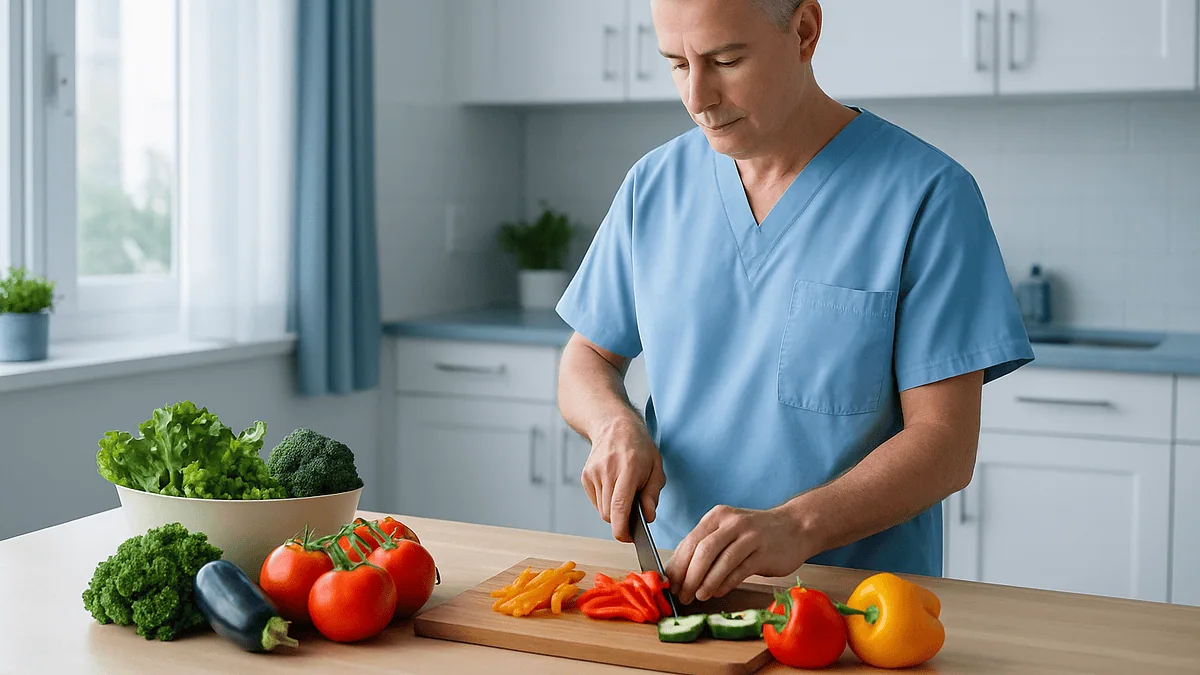
- Safe food handling, cooking thoroughly, chilling promptly and choosing pasteurized products, has better evidence than blanket bans on fresh fruit and vegetables.
- Visitors protect patients by staying away when unwell, washing hands on arrival and keeping their own vaccines current; they do not need to stay away altogether.
- Gentle, regular movement reduces cancer-related fatigue, while prolonged bed rest tends to deepen it, according to Mayo Clinic guidance.
- Palliative care, as defined by the WHO, can run alongside active leukemia treatment from the start to control symptoms and is not a signal that treatment is ending.
Daily life during leukemia treatment is organized around one fact: treatment lowers the blood cells that fight infection, carry oxygen and stop bleeding. Most people manage well by handling food safely, asking unwell visitors to stay away, pacing activity through predictable fatigue, and calling the care team at the first sign of fever. Your treating team's specific instructions always take priority over general guidance.
The kitchen is where it usually lands first. A daughter stands at the counter with a bag of salad, a carton of eggs and a phone full of contradictory advice, and realizes she has no idea what her father is allowed to eat now that chemotherapy has started. Life during leukemia treatment is full of these small, sudden questions: can his grandson visit with a runny nose, why is he wiped out after a shower, is it safe to open a window.
None of these questions are trivial, and most of the answers are less rigid than the internet suggests. Leukemia is a cancer of the blood-forming cells in the bone marrow, and its treatment lowers the very cells that fight infection and carry oxygen. That single fact explains almost every rule you will be handed.
This guide walks through the parts of the day that treatment leaflets skim past: food handling, visitors, energy, rest, mood and the moments when you pick up the phone. It is honest about what the evidence does and does not show. Your treating team’s instructions always come first.
What life during leukemia treatment actually looks like day to day
Ask ten people what a treatment day is like and you will get ten different answers, because leukemia is not one disease. The acute forms (acute myeloid leukemia, or AML, and acute lymphoblastic leukemia, or ALL) develop quickly and are usually treated straight away, often with an initial hospital stay for intensive chemotherapy that the NHS describes as lasting several weeks. The chronic forms (chronic lymphocytic leukemia, or CLL, and chronic myeloid leukemia, or CML) develop slowly; many people take a daily tablet at home or are simply monitored for long stretches.
What the two experiences share is a rhythm set by blood counts. Chemotherapy works by damaging cells that divide rapidly, and the bone marrow is one of the fastest-dividing tissues in the body. So the white cells that fight infection fall, the red cells that carry oxygen fall, and the platelets that plug small bleeds fall. Each of those drops shows up in ordinary life: a fever that arrives out of nowhere, breathlessness on the stairs, a nosebleed that will not stop.
A typical inpatient day might include an early blood draw, a doctor’s round, an infusion running for hours, a walk along the corridor, a nap, and a visit from a dietitian or physiotherapist. A typical outpatient week might be a clinic visit for counts and a transfusion if needed, then days at home where the main jobs are eating enough, moving a little and watching for warning signs.
The honest summary is this: the medicine does the heavy lifting, but the daily habits around it, food handling, hand hygiene, pacing and vigilance, are where patients and families genuinely change the odds of a smooth course. The rest of this article is about those habits.
Why is infection risk the center of everything? Neutropenia, explained
Neutrophils are the white blood cells that arrive first at any site of infection, and neutropenia simply means having too few of them. According to Cleveland Clinic, an absolute neutrophil count below 1,500 cells per microliter is generally considered neutropenia, and a count below 500 is considered severe. At that lower level, bacteria that live harmlessly on your skin or in your gut can cause serious illness within hours, and the usual signs of infection, redness, pus, swelling, may never appear because there are not enough cells to produce them.
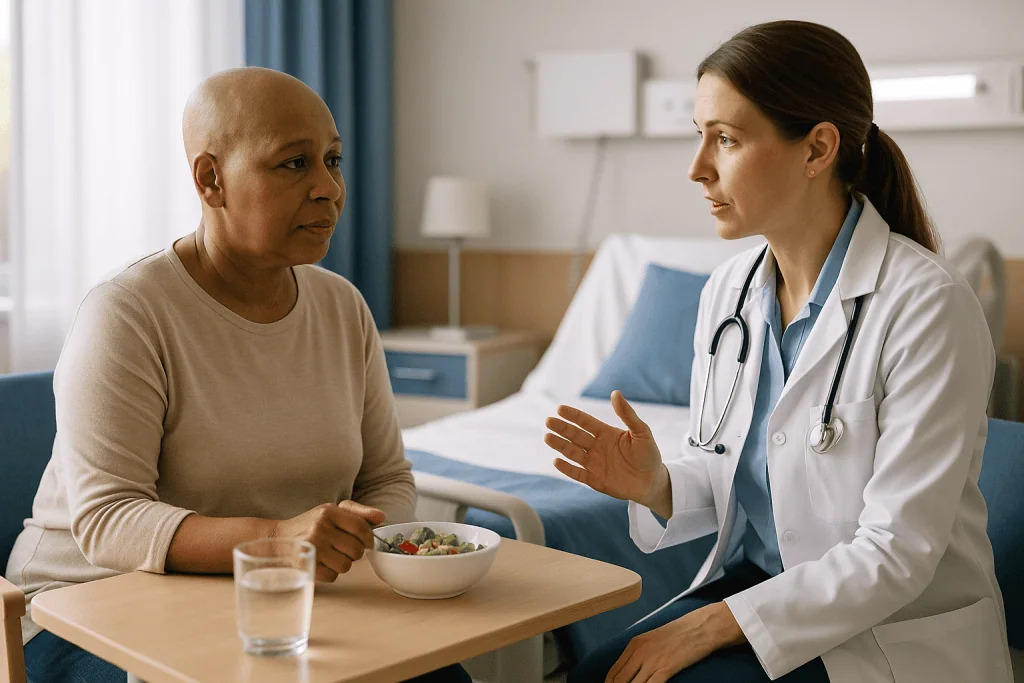
This is why fever is treated as an emergency during treatment rather than an inconvenience. The National Cancer Institute advises people receiving chemotherapy to contact their care team right away for a temperature of 100.4°F (38°C) or higher, even if they feel reasonably well. Fever may be the only clue.
Counts do not fall immediately. After a chemotherapy cycle they drift down over days, reach a lowest point that clinicians call the nadir, and then recover as the marrow rebuilds. Your team can tell you roughly when your own low window is expected, and it is worth writing that on the calendar, because the food, visitor and hygiene rules matter most during those days.
A few everyday measures carry most of the weight. Wash hands with soap and water before eating, after using the bathroom and after touching shared surfaces. Keep a thermometer where you can find it. Shower daily and check skin folds, the mouth and any line or port site for soreness. Avoid handling litter boxes, garden soil and standing water when counts are low. None of this requires living in a bubble; it requires paying attention to a small number of things consistently.
Leukemia diet and food safety: what actually reduces risk
The most useful mental shift is from “forbidden foods” to “how food is handled.” Food-borne bacteria such as Listeria, Salmonella and E. coli do not care whether an ingredient is healthy; they care whether it was cooked, chilled and kept separate from raw meat. Guidance from the National Cancer Institute on infection during cancer treatment centers on exactly these handling steps rather than on long banned lists.
The practical core looks like this:
- Wash hands, boards and knives between raw meat and anything eaten uncooked.
- Cook meat, poultry, fish and eggs thoroughly; a food thermometer removes the guesswork, and your dietitian can give you the safe-temperature chart your center uses.
- Refrigerate leftovers promptly and reheat them until steaming hot; when in doubt, throw it out.
- Choose pasteurized milk, cheese, juice and honey, and avoid raw sprouts, raw shellfish, undercooked eggs and unpasteurized soft cheeses.
- Rinse fruit and vegetables under running water, and peel where you can.
- Be cautious with buffets, salad bars, street food and anything that has sat out at room temperature.
Appetite is the other half of the diet conversation. Chemotherapy commonly causes nausea, taste changes and mouth soreness, and the National Cancer Institute notes that appetite loss can lead to weight and muscle loss that slows recovery. Small, frequent meals often work better than three large ones. Cold or room-temperature foods can be easier when smells are overwhelming. A dietitian attached to the hematology team can adjust texture, protein and calories week by week, and that referral is worth asking for early rather than after weight has already dropped.
Fluids matter too. Some treatments stress the kidneys, and fever, diarrhea and vomiting all lose water quickly. Your team will tell you if there is a daily fluid target; follow theirs rather than a general one.
Is a neutropenic diet still recommended?
The phrase “neutropenic diet” describes a set of strict food restrictions, historically including no fresh fruit, no raw vegetables, no salad and sometimes no fresh flowers in the room, intended to keep bacteria away from people with very low white cell counts. Many patients are still handed a version of it. Many others are told it is no longer used. Both experiences are real, because practice varies between centers.
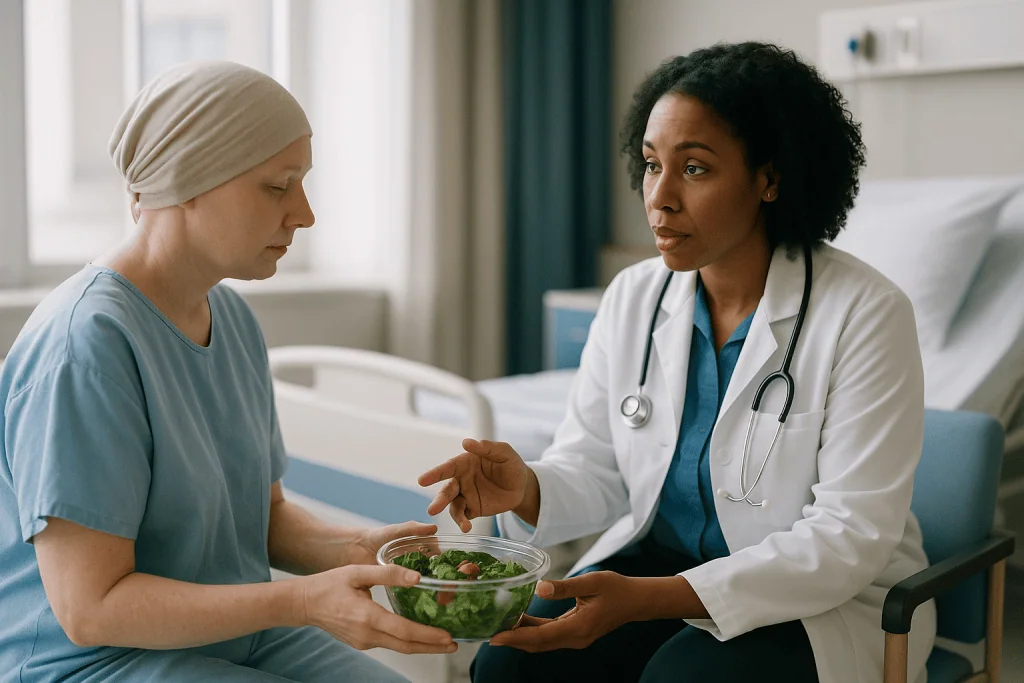
What does the evidence say? The strictest versions were built on reasoning rather than trial data, and studies that have compared rigid neutropenic diets with standard safe-food-handling advice have not demonstrated a clear reduction in infections from the stricter approach. Meanwhile, tight restriction has a cost: fewer calories, less fiber, less variety and less pleasure at a time when eating is already hard. For these reasons, a growing number of hematology teams now emphasize the handling rules described above and allow well-washed fresh produce.
This does not mean the concept is worthless. Certain very high-risk situations, such as the weeks after a stem cell transplant, may carry specific rules, and a team that has seen a particular infection in its unit may tighten advice for good local reasons. The point is that a neutropenic diet is a tool, not a law of nature.
So the honest answer to “is it still recommended?” is: sometimes, in some settings, in modified forms, and your team’s instruction is the one that applies to you. If you are given a restrictive list, it is reasonable to ask which items are considered essential and whether well-washed or cooked produce can be added back. If you are not given one, do not assume the center is being careless; it may be following the more current reading of the evidence.
Visiting someone with leukemia: the ground rules that protect without isolating
Isolation harms people. Loneliness during long treatment is associated with worse mood, poorer sleep and less motivation to eat and move, and no blood test measures that cost. So the goal is not to stop visitors; it is to make visits safe enough that they can keep happening.
The rules that matter most are simple and can be shared as a short text message before anyone arrives:
- Anyone with a cold, cough, sore throat, fever, vomiting, diarrhea, cold sores or a rash stays home, even if symptoms are mild. “Just a sniffle” is a genuine risk to someone with a neutrophil count of a few hundred.
- Anyone who has recently been exposed to chickenpox, shingles, flu, COVID-19 or a stomach bug should check with the patient’s team before visiting.
- Wash hands on arrival, before touching the patient and before handling food.
- Follow the unit’s rules on flowers, food gifts and children; these vary and exist for reasons.
- Keep visits short during the low-count window. Fatigue makes an hour of conversation feel like a workday.
Vaccination among close contacts is one of the most protective gifts a family can give. The National Cancer Institute advises that people with weakened immune systems generally should not receive live vaccines during treatment, which makes it more important that household members and regular visitors are up to date on flu and other recommended vaccines, so the circle around the patient is less likely to bring illness in. Ask the team which specific vaccines matter for your household.
Children need a plan, not a ban. A well child who washes hands, understands “no kisses on the face this month” and knows to say if they feel unwell can usually keep visiting, and their presence often does more for morale than anything on the medication chart. Ask the team how they want children’s visits handled during the lowest-count days.
Fatigue during leukemia treatment: why sleep alone doesn't fix it
Cancer-related fatigue is different from ordinary tiredness. Mayo Clinic describes it as a persistent exhaustion that is not proportional to recent activity and does not fully resolve with rest, and people who have it often say the hardest part is that others assume a good night’s sleep will sort it out. It will not, because the causes are layered: anemia (too few red cells to carry oxygen), the treatment itself, inflammation, poor intake, pain, disturbed sleep, low mood and simple deconditioning from weeks of reduced movement.
Two things follow. First, some causes are treatable, so fatigue should be reported rather than endured. A hemoglobin level that has drifted low may be corrected with a transfusion; an untreated infection, thyroid change or medication effect may be found; pain and nausea can be better controlled. Second, the counterintuitive evidence: gentle, regular physical activity is one of the best-supported measures for cancer fatigue. Mayo Clinic notes that staying active, even in short bouts, tends to reduce fatigue over time, while long stretches in bed make it worse.
Pacing is the skill to learn. Think of energy as a daily budget rather than a tank you can refill on demand. Spend it on what matters most to you, whether that is a short walk, a shower, a phone call or cooking one simple meal, and schedule rest before you crash rather than after. Many people find their best hours are predictable, often mid-morning, and plan around them.
Sleep hygiene still helps even if it is not the whole answer: consistent wake times, daylight exposure in the morning, limiting long daytime naps to short ones, and keeping screens out of the last hour before bed. If sleep is being wrecked by steroids, night sweats or anxiety, say so; each has options the team can discuss.
Who is treated intensively, and who is usually asked to wait?
One of the most confusing experiences for families is discovering that two people with “leukemia” are being handled completely differently: one is admitted for weeks of intensive chemotherapy, the other is sent home and told to come back in a few months. Both can be correct.
Acute leukemias are almost always treated promptly. The NHS notes that AML develops quickly and aggressively and usually needs treatment to begin soon after diagnosis. The intensity of that treatment, however, depends on the person as much as the disease. Teams weigh age, overall fitness, heart, lung, liver and kidney function, other illnesses and the genetic features of the leukemia cells. Someone judged fit enough may be offered intensive chemotherapy with the aim of achieving remission, meaning no detectable disease on standard tests, sometimes followed by a stem cell transplant. Someone judged less fit may be offered lower-intensity treatment, given largely as an outpatient, with a different balance of goals and side effects. Neither path is “giving up”; they are different clinical judgments about benefit and risk.
Chronic lymphocytic leukemia often follows the opposite pattern. Many people are diagnosed from a routine blood test with no symptoms, and the standard approach is active monitoring, sometimes called watch and wait: regular blood tests and check-ups, with treatment started only if the disease begins to cause problems. Starting earlier has not been shown to help, and it exposes people to side effects they do not yet need. Watch and wait is emotionally hard, and patients often say the waiting is worse than treatment, but it is a deliberate, evidence-based choice.
Who is asked to wait, then, is not about being deprioritized. It is about matching intensity to the disease’s behavior and the person’s capacity to tolerate treatment, a judgment that belongs to the treating team and that you are entitled to have explained in plain words.
Hospital, clinic or home: how the phases of treatment shape your week
The rules around food, visitors and activity are not fixed; they tighten and loosen with your blood counts and your setting. The table below summarizes typical patterns. It is a guide to the shape of things, not a substitute for your unit’s instructions.
| Phase | Where you usually are | Infection risk | Food and visitors | Energy and rest |
|---|---|---|---|---|
| Intensive induction (acute leukemias) | Hospital, often for several weeks (NHS) | Highest during the nadir | Unit food rules apply; visitors screened for illness; short visits | Fatigue and nausea peak; daily short walks encouraged where possible |
| Consolidation or further cycles | Mix of hospital admissions and home | Repeats with each cycle | Strict handling at home during low windows; relax as counts recover | Energy returns between cycles; plan important events for recovery weeks |
| Lower-intensity or oral treatment | Mostly home with clinic visits | Moderate, varies by drug | Standard safe handling; visitors avoid when sick | Steadier but often persistent fatigue; pacing matters |
| Active monitoring (many with CLL) | Home, periodic blood tests | Mildly raised versus general population | Normal diet with sensible hygiene; vaccinations as advised | Usually near normal; anxiety is the bigger burden |
| After stem cell transplant | Hospital, then close follow-up at home | Very high for months | Specific transplant-unit rules on food, pets, crowds | Prolonged recovery; graded return to activity |
Two patterns in the table deserve attention. The first is that risk is cyclical, not constant. Families often keep maximum restrictions for months because nobody told them the low window had passed, and that costs quality of life for no benefit. Ask when counts are expected to recover after each cycle and adjust accordingly.
The second is that the home phases are where most infections are actually caught, because that is where most of the time is spent and where supervision is lightest. A thermometer, a written list of when to call, and a bag packed for a possible admission turn a frightening midnight fever into a manageable one.
What the weeks after a chemotherapy cycle usually look like
People often expect the worst days to be the treatment days. They are usually not. The infusion itself may be tiring or nauseating, but the deeper trough comes afterward, when the blood counts hit bottom, and understanding that curve helps families plan.
In the first few days after a cycle, nausea, taste changes and steroid effects tend to dominate. Appetite drops, sleep is disturbed and mood can swing. This is the time to lean on small, frequent, bland meals and to accept help with cooking.
Then the counts fall. During the nadir, which your team will time for you, fever risk is highest, bruising and gum bleeding may appear as platelets drop, and breathlessness or dizziness can signal anemia. Some people need transfusions of red cells or platelets during this stretch. The NHS describes this period as one where infections need urgent treatment, which is why this is when the phone number for the unit should be taped to the fridge and the thermometer used at the first hint of feeling off.
As the marrow recovers, energy creeps back, mouth sores heal and the appetite returns, often with an enthusiasm that surprises people. This recovery window is the time to walk further, see friends, eat well and store up strength, because in many regimens the next cycle begins shortly after.
Across several cycles, fatigue tends to accumulate rather than reset fully, which is one more reason the movement and pacing habits described earlier matter. Hair loss, if it occurs, usually begins in the early weeks and regrowth typically starts after treatment ends. Skin becomes dry and sensitive; a plain, fragrance-free moisturizer and sun protection help. Peripheral neuropathy, meaning tingling or numbness in the hands and feet, can develop with some drugs and should always be reported early, because timing changes can limit it.
Anxiety, low mood and where support actually comes from
The mental load of treatment is rarely on the discharge summary, but almost everyone carries it. Waiting for blood results, watching a thermometer, feeling like a burden, losing the shape of a working week: these produce anxiety in people who have never been anxious and low mood in people who consider themselves resilient. This is not weakness. It is a predictable response to prolonged uncertainty and physical depletion.
What helps, according to the mainstream evidence, is less mysterious than the wellness industry implies. Information reduces fear, so ask the team to explain what each number on your blood results means and which ones actually matter. Structure reduces drift, so keep a loose routine even on hospital days: wake at a similar time, dress, eat at the table if you can. Movement lifts mood as well as fatigue. Connection counts, and it does not have to be in person; a scheduled daily call can be as steadying as a visit.
Practical support is medicine too. Most hematology services have access to social workers, psychologists or counselors, financial advisors and patient navigators, and asking for them is not a sign you are struggling more than others; it is using the service you are already entitled to. Peer support groups, in person or online, can be a lifeline, with one caution: other people’s timelines and complications are not yours, and comparison can raise anxiety as easily as it lowers it.
Say something if mood drops into persistent hopelessness, if you stop being able to enjoy anything, or if thoughts of not wanting to be here appear. Depression during cancer treatment is common and treatable, and hematology teams are used to hearing about it. Caregivers deserve the same attention; the person doing the shopping, the driving and the worrying is at real risk of burnout and should have someone asking how they are.
Palliative care during leukemia treatment is not the same as stopping treatment
Few words in medicine are more misunderstood. Many patients hear “palliative” and assume the team has given up. In fact, the World Health Organization defines palliative care as an approach that improves the quality of life of patients and families facing life-threatening illness through the prevention and relief of suffering, and states that it is applicable early in the course of illness, in conjunction with treatments intended to prolong life.
In leukemia, that means a palliative or supportive care specialist can be involved from the first cycle of intensive chemotherapy, working alongside the hematologist rather than instead of them. Their focus is symptoms: pain, nausea, mouth soreness, breathlessness, sleep, anxiety, and the tangled practical problems that make a long admission unbearable. Studies of people with acute leukemia receiving early supportive care alongside standard treatment have reported better quality of life and mood; the exact size of that benefit varies by study and setting, and your team can explain what is available where you are being treated.
It is also the discipline best placed to help with hard conversations. What matters most to you if treatment does not go as hoped? Who speaks for you if you cannot? Would you rather be at home or in hospital if things become difficult? These are questions worth answering while you are well enough to think clearly, and having them on record removes an enormous burden from family members later.
For some people, particularly those for whom intensive treatment is not appropriate, palliative care does become the main focus, with the goal of comfort, dignity and time spent as well as possible. That is not failure; it is a legitimate medical plan. But the more common reality is that supportive care runs quietly in parallel with active treatment, making the whole process more livable.
What people often get wrong about life during leukemia treatment
“There is a survival rate for leukemia.” There are many, and a single figure is almost meaningless. Outcomes differ enormously between acute and chronic types, between subtypes defined by the genetics of the leukemia cells, by age and fitness, and by response to the first phase of treatment. Registry statistics also describe people diagnosed years ago. The only number that applies to you is the one your hematologist can put in context for your specific situation, and it is fair to ask for it.
“AML gives you months, so treatment must start today.” The NHS is clear that AML develops quickly and usually needs prompt treatment, but “prompt” typically means days to allow tests that shape the treatment plan, not that any delay is catastrophic. Panic rarely improves decisions.
“An older person with leukemia who isn’t treated has a fixed amount of time.” This depends entirely on the type. Someone with slow-growing CLL under active monitoring may live for many years without treatment ever being needed. Untreated acute leukemia progresses over weeks to months. No general figure is honest; ask about your relative’s specific diagnosis.
“Sugar feeds the cancer, so cut it out.” Every cell uses glucose, and there is no evidence that avoiding sugar slows leukemia. Eating enough to protect weight and muscle matters far more.
“Rest as much as possible.” Mayo Clinic’s guidance on cancer fatigue points the other way: gentle activity reduces fatigue, and prolonged bed rest deepens it.
“No visitors until treatment ends.” Screening visitors for illness and hand hygiene is what protects; blanket bans mostly protect against loneliness’s opposite.
“Supplements will boost my immune system.” Some interact with chemotherapy or affect the liver. Clear anything, including herbal teas and high-dose vitamins, with the team first.
Questions to ask your care team
Consultations move fast and memory fails under stress. Bring a written list and a second pair of ears. These questions cover the daily-life ground that matters most, and none of them are naive.
- Which type and subtype of leukemia do I have, and what does that mean for the intensity and timing of treatment?
- When are my blood counts expected to be at their lowest after each cycle, and how will I know when they have recovered?
- What temperature or symptom should make me call you, and what number do I call at night and on weekends?
- Do you use a neutropenic diet here? If so, which restrictions are essential and which are flexible?
- Can I see a dietitian now, before I lose weight?
- What are your rules for visitors and children during my low-count days, and do they change between hospital and home?
- Which vaccines should my household members have, and which should I avoid during treatment?
- Is it safe for me to be around my pets, and what should I avoid doing (litter boxes, cages, cleaning up after them)?
- How much activity is safe for me right now, and can I be referred to a physiotherapist or exercise specialist?
- Is any of my fatigue coming from something fixable, such as anemia, thyroid changes, pain or medication?
- Who can I talk to about anxiety, money worries or practical help at home?
- Can supportive or palliative care be involved alongside my treatment for symptom control?
- What is the goal of this treatment plan, and how will we know whether it is working?
- If I want a second opinion, how do I arrange it without delaying care?
Ask for the answers in writing where possible. A one-page summary of your fever threshold, low-count window, food rules and contact numbers, stuck to the refrigerator, prevents more emergencies than any single medication.
When to call your doctor
During leukemia treatment, waiting to see whether something settles is often the wrong instinct. Infections can move from mild to dangerous in hours when neutrophil counts are low, and bleeding can escalate quickly when platelets are low. Your team would far rather hear from you unnecessarily than late.
Contact your care team immediately, using the emergency number they gave you, for any of the following:
- A temperature of 100.4°F (38°C) or higher, or feeling feverish, shivery or generally unwell even if the thermometer reads lower (National Cancer Institute).
- Chills, sweats, a new cough, sore throat, burning on urination, or redness, pain or swelling around a central line or port.
- Bleeding that does not stop after several minutes of pressure, blood in urine or stool, black stools, or many new bruises or tiny red or purple spots on the skin.
- Severe headache, sudden confusion, drowsiness that is hard to rouse, weakness on one side, or a seizure.
- Breathlessness at rest, chest pain, a racing or irregular heartbeat, or fainting.
- Persistent vomiting or diarrhea that stops you keeping fluids down, or signs of dehydration such as very dark urine and dizziness on standing.
- Mouth sores or pain so severe you cannot eat or drink.
- Any rash, especially a blistering one on one side of the body, or contact with someone who has chickenpox, shingles or measles.
Call in a non-emergency way within a day or so for new tingling or numbness, constipation lasting several days, low mood that is not lifting, or side effects that are making you consider skipping or changing a medicine. Never stop or alter a prescribed treatment without speaking to the prescribing clinician; most side effects have options.
If you cannot reach your team and someone is seriously unwell, call emergency services and tell the responders the person is having leukemia treatment and may have a low white cell count. That single sentence changes how quickly they are seen.
Frequently asked questions
What lifestyle changes are recommended for people with leukemia?
The changes with the best evidence are practical: careful food handling, consistent hand hygiene, gentle daily movement, pacing energy, keeping a thermometer handy, and asking unwell visitors to stay away during low-count periods. Eating enough protein and calories to protect weight matters more than any special diet. Avoid alcohol excess and smoking, and clear all supplements with your team first, because some interact with treatment.
What is the average survival rate for adults with leukemia?
There is no single meaningful figure, because leukemia is several diseases with very different courses. Outcomes vary by acute versus chronic type, genetic subtype, age, fitness and early response to treatment, and registry statistics describe people diagnosed years earlier. Your hematologist can explain the figures that apply to your specific diagnosis and put them in context, and it is reasonable to ask directly.
How quickly does AML progress?
AML develops quickly and aggressively, according to the NHS, and usually needs treatment to begin soon after diagnosis. In practice, teams typically use a few days to complete blood, marrow and genetic tests that shape the treatment plan, and that short window is normal. Symptoms such as fatigue, infections and bruising can worsen over weeks, which is why AML is treated as urgent rather than routine.
How long can an elderly person live with leukemia without treatment?
It depends entirely on the type. Chronic lymphocytic leukemia is often slow-growing, and many older people are monitored for years without needing treatment. Untreated acute leukemia progresses over weeks to months. Fitness, other illnesses and the specific subtype all change the picture, so no general number is honest. The treating team can discuss the realistic range for your relative and the options, including supportive care.
Is a neutropenic diet still recommended during leukemia treatment?
Sometimes, in modified forms, and practice varies between centers. Strict neutropenic diets have not been clearly shown to reduce infections compared with standard safe-food-handling advice, so many teams now focus on cooking thoroughly, chilling promptly, choosing pasteurized products and washing produce well. Transplant units may have stricter rules. Follow your own team’s instructions and ask which restrictions are essential.
Can children visit someone with leukemia?
Often yes, with a plan. A well child who washes hands, avoids kissing the face and understands to stay home with any cold, cough, fever or stomach upset can usually visit, and the boost to morale is real. Hospital units have their own rules for children’s visits, and the team may ask for extra caution during the lowest-count days, so check before each visit.
Why is fatigue during leukemia treatment so severe, and does it go away?
Cancer-related fatigue has many causes at once: anemia, the treatment itself, inflammation, poor intake, disturbed sleep and low mood. It is not proportional to activity and does not fully resolve with rest, according to Mayo Clinic. Some causes are treatable, so report it. Gentle regular movement helps most people, and energy usually improves between cycles and after treatment ends, though recovery can take months.
Can I exercise during leukemia treatment?
For most people, yes, in a gentle and graded way. Short walks, light stretching and simple strength work are generally encouraged because activity reduces fatigue and preserves muscle. Your team may ask you to avoid contact sports, swimming pools or heavy lifting when platelets are low or a central line is in place. Ask for a physiotherapy referral to set safe limits.
Can I keep my pets while having chemotherapy?
Usually yes, with precautions. Pets are good for mood and routine. The main risks come from feces, litter, cages, reptiles and scratches, so someone else should clean litter boxes and tanks, hands should be washed after handling animals, and any bite or scratch should be reported. Your team may advise extra caution after a stem cell transplant, so ask about your specific situation.
What food is unsafe during leukemia treatment?
The highest-risk items are those that can carry bacteria without being cooked: raw or undercooked meat, fish, shellfish and eggs, unpasteurized milk, soft cheeses and juices, raw sprouts, and anything left at room temperature for long periods. Buffets and salad bars are risky because of handling. Well-washed fruit and vegetables and thoroughly cooked foods are usually acceptable, subject to your team’s rules.
References
- NHS: Acute myeloid leukaemia, treatment
- World Health Organization: Palliative care fact sheet
- MedlinePlus: Leukemia
This article is for general information only and is not a substitute for professional medical advice. Please consult a qualified doctor about your individual situation.

More from the Blog
Radioactive Iodine After Thyroid Cancer Surgery: How the Treatment Day Unfolds
Radioactive iodine treatment after thyroid cancer surgery usually means swallowing a single capsule or liquid in a nuclear medicine unit, after one to two…
Autologous Stem Cell Transplant for Multiple Myeloma: Collection, Conditioning and Recovery
An autologous stem cell transplant for multiple myeloma uses a person's own blood-forming stem cells, collected after initial chemotherapy, to rescue the bone marrow…
What to Expect After a Neck Dissection: Numbness, Shoulder Function and How the Scar Settles
After a neck dissection, most people go home within a few days with a drain, a long incision, a stiff and often numb neck,…
What PSA Monitoring After Prostate Cancer Treatment Can and Cannot Tell You
After prostate cancer treatment, PSA tracks whether prostate cells are still active, but the expected level depends on the treatment: close to zero after…

When Targeted Therapy Stops Working: Resistance, Repeat Biopsies and the Next Options
When targeted therapy stops working, it usually means the cancer has found a way around the drug, a process called acquired resistance. The care…
Why Cystoscopy Surveillance Continues for Years After Bladder Cancer Treatment
Cystoscopy surveillance after bladder cancer continues for years because the disease has one of the highest recurrence rates of any solid tumor, and new…