

Daily Life With Huntington’s Disease: Nutrition, Swallowing Support and Routines That Help

Key Takeaways
- Huntington's disease affects an estimated 3 to 7 per 100,000 people of European ancestry and usually begins in a person's 30s or 40s, according to MedlinePlus Genetics.
- Unintended weight loss is common because constant movement and metabolic changes raise energy needs while chewing, swallowing and appetite decline, so dietitians usually advise more energy-dense food, not less.
- Swallowing difficulty develops in most people as the condition progresses, and early speech and language therapy assessment, upright posture, small bites and one texture at a time reduce the risk of inhaling food.
- No approved medicine slows the disease; VMAT2 inhibitors such as tetrabenazine reduce dopamine release to ease chorea and require mood monitoring, with all decisions resting with the prescriber.
- Each child of an affected parent has a 50 percent chance of inheriting the gene, which does not skip generations, and predictive testing is offered to consenting adults after genetic counseling.
- Alcohol does not cause Huntington's disease, but it worsens balance, mood and sleep and can interact with symptom medicines.
Daily life with Huntington's disease changes gradually as involuntary movements, thinking difficulties and mood changes affect eating, sleeping, planning and safety. Most people do best with a structured routine, energy-dense meals eaten slowly in a calm setting, early speech and language therapy for swallowing, regular physiotherapy, and a multidisciplinary team that reviews weight, mood and medicines. Every decision about treatment or feeding support belongs with the person and their treating team.
The kitchen clock says half past six, and dinner has been on the table for forty minutes. A daughter watches her father steer a fork toward his mouth, his arm swinging wide, then correcting. He coughs once on a sip of water. She has stopped saying “slow down” because it makes him angry, and she has started cutting his chicken smaller without asking. Nobody at the table would call this a medical appointment, yet it is exactly where daily life with Huntington’s disease is decided.
Families living with this condition learn quickly that the hardest parts are rarely the ones described in a leaflet. They are the missed calories, the choking scare, the argument over a shower at the wrong time of day, the exhaustion of a routine that no longer fits. Each of those has an evidence-based response.
This explainer walks through what the condition does to ordinary days, why eating and swallowing deserve early attention, and which routines the mainstream guidance supports, without pretending any of it is simple.
How does Huntington's affect daily life?
Huntington’s disease is an inherited condition in which a change in a single gene, called HTT, produces a protein that slowly damages nerve cells, particularly in the basal ganglia, the deep brain structures that help coordinate movement, thinking and emotion. Because those regions do so many jobs, the effects spill into almost every part of a day rather than staying in one neat box.
Movement changes are the most visible. Chorea, the medical term for involuntary, jerky or writhing movements, can make holding a cup, buttoning a shirt or walking through a doorway unpredictable. Muscles may also become stiff or slow, and balance becomes less reliable.
The thinking changes are quieter but often more disruptive. People describe losing the thread of a plan halfway through, struggling to switch between tasks, or needing far longer to organize a simple shopping trip. Mood and behavior shift too: irritability, low mood, anxiety and apathy (a loss of drive that is part of the disease, not a character flaw) are common, according to the Mayo Clinic.
Symptoms most often begin in a person’s 30s or 40s, MedlinePlus Genetics reports, though onset can be earlier or later, and the condition typically progresses over many years. What that means in practice is that daily life with Huntington’s disease is not one fixed picture. It is a moving target, and the routines that work this year may need adjusting next year.
Three areas tend to matter most for day-to-day wellbeing, and they anchor the rest of this article: keeping weight up, keeping swallowing safe, and keeping the day predictable enough that a tired brain can manage it.
What is it like living with Huntington's disease from one year to the next?
Clinicians often talk about early, middle and later stages, and the labels help as long as nobody treats them as a timetable. The NHS describes a condition that usually worsens gradually over years, with wide variation between people, even within one family.
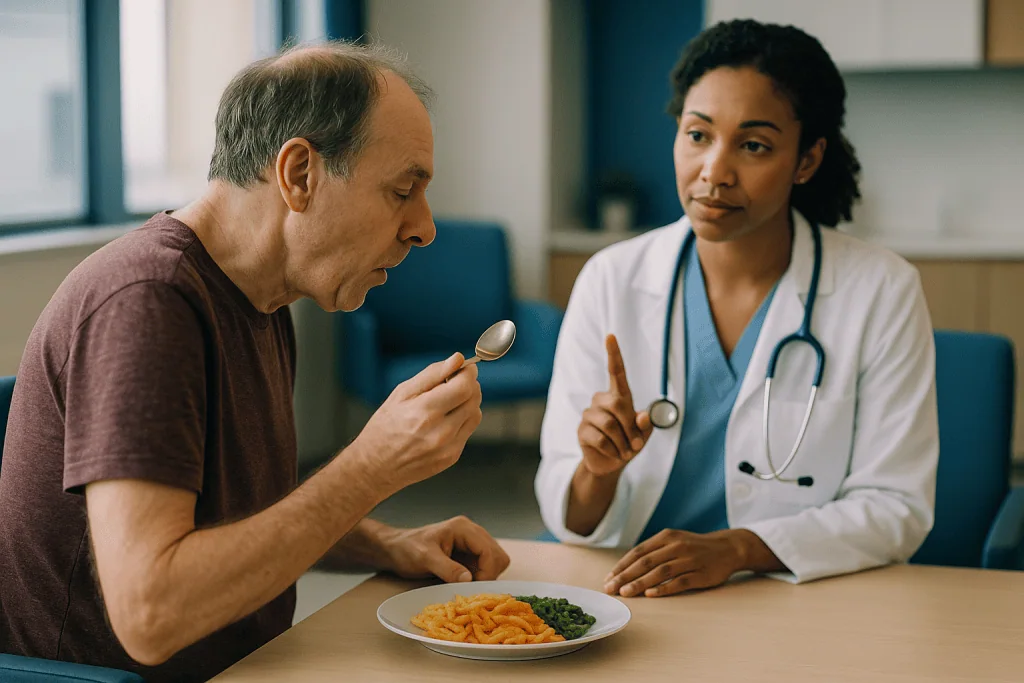
Early on, many people keep working, driving and cooking. The differences show up at the edges: fidgeting that others notice before the person does, a shorter fuse, a job that used to be automatic now needing a checklist. This is also the stage where families can quietly build good habits, because the person can still take part in every decision.
In the middle years, help becomes part of the routine. Meals take longer and may need softer textures. Walking is safer with a clear path and someone nearby. Handling money, medicines and appointments often shifts to a partner or adult child. Speech becomes less distinct, and frustration on both sides is normal.
Later, most people need support with all daily care. Chorea may lessen while stiffness and slowness increase. Eating and drinking safely becomes the central concern, and infections, especially chest infections linked to swallowing, are among the most common serious complications the Mayo Clinic lists.
Living with Huntington’s disease also means living with genetics. Each child of an affected parent has a 50 percent chance of inheriting the altered gene, MedlinePlus explains, so relatives are often managing their own uncertainty at the same time as caring for someone. Any honest account of daily life has to include that double weight.
Why do people with Huntington's disease lose weight?
Ask an experienced dietitian what worries them most about this condition and the answer is often not chorea but the scales. Unintended weight loss is common at every stage, the NHS and Mayo Clinic both note, and it tends to creep rather than crash.
Several forces push in the same direction. Constant involuntary movement burns energy the way a long walk does, all day, without a break. Changes in the brain regions that regulate metabolism appear to raise energy needs further. On the intake side, chewing becomes tiring, swallowing becomes slower, apathy and low mood blunt appetite, and the planning needed to shop and cook becomes harder. A person can be surrounded by food and still eat too little.
Weight matters because it is closely tied to strength, immune function and resilience against infection. It is also one of the easiest things to track at home. Weighing weekly on the same scales, at the same time of day, gives the care team a trend line that is far more useful than an occasional clinic reading.
The response is usually the opposite of standard healthy-eating advice. Rather than cutting fat and sugar, dietitians commonly recommend energy-dense choices: full-fat dairy, nut butters, olive oil stirred into soups, extra cheese, cream in porridge. Smaller meals eaten more often are easier to manage than three large plates, and drinks that carry calories, such as milk-based smoothies, do double duty.
A dietitian referral is appropriate early, before weight becomes a problem, rather than after. The NHS lists dietary advice as a core part of Huntington’s disease care, and the team can tailor targets to the individual.
Huntington's disease diet: which foods and textures help most
There is no special Huntington’s disease diet that changes the course of the condition. What the evidence supports is a practical one: enough energy, enough fluid, textures that suit the person’s swallowing, and foods that can be eaten independently for as long as possible.

Texture is the first lever. Soft, moist foods that hold together on a spoon, such as shepherd’s pie, risotto, scrambled eggs or stewed fruit with custard, are generally easier than dry, crumbly or stringy ones. Toast, crackers, tough meat and leafy salads are common culprits for coughing. Mixed textures, where thin liquid and solid pieces arrive together, such as cereal floating in milk or broth with chunks, can be especially tricky because the mouth has to manage two things at once.
Fluids need attention too. Thin drinks move fast, and a slowed swallow may not catch them. Some people are advised to thicken drinks, but only after assessment; thickening everyone’s tea is not good practice and can reduce fluid intake. Constipation is common with reduced mobility and some medicines, so fiber from soft fruits, vegetables and whole grains, alongside adequate fluid, has a place.
Supplements deserve a plain statement. No vitamin, mineral or nutritional supplement has been shown in trials to slow Huntington’s disease, and the NIH has funded large studies looking for exactly that. A daily multivitamin may be reasonable when intake is poor, but that is a conversation for the dietitian or doctor, not a shelf decision.
Alcohol does not cause the condition, but it worsens balance, judgment and sleep, and it can interact with medicines used for mood or chorea. Most teams suggest keeping it modest and discussing it openly.
Huntington's swallowing problems: what changes and what helps
Dysphagia, the medical word for difficulty swallowing, develops in most people with Huntington’s disease as it progresses. The reasons are mechanical and behavioral at once. The tongue, jaw and throat muscles that normally fire in a tight sequence become uncoordinated. At the same time, changes in impulse control can lead to fast eating, large mouthfuls and talking while chewing, which would challenge anyone’s swallow.
At the table, families often notice coughing or throat clearing during meals, a wet or gurgly voice afterward, food pocketed in the cheeks, or long chewing without swallowing. Chest infections that keep returning can be a sign that food or drink is slipping toward the lungs, sometimes silently.
The single most useful step is early referral to a speech and language therapist, who the NHS identifies as the specialist for swallowing as well as speech. Assessment may be a bedside observation or a videofluoroscopy, an X-ray video of swallowing that shows where food goes in real time. From that, the therapist matches textures and strategies to the person rather than guessing.
Several strategies are used widely:
- Sit fully upright with feet supported, and stay upright for a while after eating rather than lying down.
- Take small bites and sips, and put the fork down between mouthfuls.
- Finish one mouthful before the next; a verbal cue or a gentle hand on the wrist can help.
- Keep mealtimes calm: television off, one conversation, no rushing.
- Offer one texture at a time and avoid mixed consistencies.
- Use a spoon rather than a straw where advised, since straws can deliver liquid too fast.
These adjustments are not cosmetic. Aspiration pneumonia, a lung infection caused by inhaled food or fluid, is among the serious complications the Mayo Clinic lists, and swallowing support is one of the few places where a household routine directly affects that risk.
Which daily supports help at each stage? A summary table
Because needs shift over years, it helps to see the whole arc in one place. The table below summarizes the kinds of support the NHS and Mayo Clinic describe across the multidisciplinary team, from neurologists and nurses to dietitians, speech and language therapists, physiotherapists, occupational therapists and psychologists. It is a map, not a schedule; people move through it at their own pace.
| Stage | Eating and drinking | Movement and routine | Who usually helps |
|---|---|---|---|
| Early | Baseline weight and swallow assessment; energy-dense snacks added; alcohol and caffeine reviewed | Regular exercise; written schedules and phone reminders; home hazards such as rugs removed; driving reviewed | Neurologist, genetic counselor, dietitian, physiotherapist |
| Middle | Softer textures; smaller, more frequent meals; supervised mealtimes; drinks thickened only if assessed | Walking aids or a clear-path home layout; shower seat and grab rails; simplified tasks done one at a time; carer support arranged | Speech and language therapist, occupational therapist, community nurse, psychologist |
| Later | Full assistance with feeding; careful positioning; discussion of goals of care, including whether tube feeding fits the person’s wishes | Pressure care and repositioning; predictable daily rhythm; comfort-focused planning | Palliative care team alongside the existing specialists |
Two patterns in this table are worth naming. First, the eating column changes more than any other, which is why this article gives it so much space. Second, the “who helps” column grows rather than shrinks; nobody is handed off, new people are added. Families who meet the speech therapist or dietitian early tend to find the later conversations easier because the relationship already exists.
Palliative care in the final row is not a signal of giving up. It is a specialty focused on comfort and quality of life that can run alongside every other part of care, and many teams introduce it well before the later stage.
Daily routines that help with movement, chorea and falls
A living room can be arranged for someone with chorea the way a nursery is arranged for a toddler: fewer sharp corners, fewer things to trip on, more soft landings. Occupational therapists, who the NHS names as part of the care team, help families make those changes without turning the home into a clinic.
Falls are the practical priority. Loose rugs, trailing cables and cluttered hallways go first. Furniture with rounded edges and padded armrests reduces bruising from involuntary movements. In the bathroom, a shower seat, non-slip mat and grab rails turn one of the riskiest rooms into one of the safer ones. Good lighting matters more than people expect, especially at night.
Movement itself should not be avoided. Physiotherapy and regular exercise are encouraged by the NHS for maintaining strength, balance and mood, and people often feel steadier on the days they have been active. Walking, swimming with supervision, seated exercises and stretching all have a place; the physiotherapist tailors the mix. The aim is confidence, not performance.
Small equipment choices ease daily tasks. Cups with lids and two handles, plates with raised rims, non-slip mats under dishes and clothing with elastic waists or magnetic fastenings preserve independence longer. Some occupational therapists suggest weighted cutlery or cuffs to steady hands; the evidence is limited, so it is worth trying rather than assuming.
Driving is a sensitive subject. Changes in reaction time, attention and impulse control can affect safety before the person notices, and licensing rules vary by state. Most teams recommend raising it early with the neurologist and reviewing it regularly, rather than waiting for a near miss to force the conversation.
Sleep, mood and thinking: routines for the mind
The brain regions damaged in Huntington’s disease also manage how a person starts, sequences and finishes tasks. That is why a tidy weekly plan can do more for someone’s day than any single piece of equipment.
Predictability is the underlying principle. The same wake time, the same order of morning tasks, meals at regular hours and a wind-down routine at night reduce the number of decisions a tired brain has to make. Written checklists on the fridge, phone alarms for medicines, and one activity at a time rather than three help the person stay in charge of their own day. Occupational therapists and psychologists often help set this up.
Irritability has triggers, and families learn to spot them: hunger, fatigue, noise, being rushed, and being asked to switch tasks abruptly. Building in warning time (“we’ll leave in ten minutes”) and pairing hard tasks with a snack or rest often lowers the temperature. Arguing about whether a movement or an outburst was intentional rarely helps; treating it as a symptom usually does.
Depression is common and treatable, the Mayo Clinic notes, and it is not simply a reaction to the diagnosis; it is part of the disease process. Persistent low mood, loss of interest or thoughts of self-harm warrant prompt medical attention, and psychological therapies and medicines both have roles that the treating team can weigh.
Sleep often fragments as the condition progresses. Daylight in the morning, physical activity earlier in the day, limited caffeine after lunch and a cool, dark bedroom are the standard starting points. Involuntary movements usually ease during sleep, but disrupted sleep can worsen them the next day, which is another reason a steady rhythm pays back.
Who is usually referred for swallowing and nutrition support, and who is asked to wait?
In most specialist services, anyone with a confirmed diagnosis is offered baseline contact with a dietitian and a speech and language therapist, even when eating seems fine. The logic is simple: a recorded starting point makes later changes obvious, and the person can learn safe-eating habits while they are still easy to learn. Those with weight loss, coughing at meals or repeated chest infections are usually prioritized.
Who waits? People who carry the altered gene but have no symptoms do not need swallowing therapy or a special diet; ordinary healthy eating and regular activity are appropriate, and clinics typically offer monitoring rather than intervention. Children in affected families are not offered predictive genetic testing; in most systems, including the NHS, testing is available to adults who can consent after counseling.
Tube feeding is the most consequential “wait” decision. A gastrostomy is a feeding tube placed through the abdominal wall directly into the stomach. It is not a routine step in Huntington’s disease. Teams generally raise it only when eating and drinking by mouth have become unsafe or insufficient despite every texture and strategy, and even then the evidence on whether it lengthens or improves life in advanced neurodegenerative conditions is uncertain. Guidelines frame it as an individual decision that depends on the person’s own goals, ideally recorded in advance while they can still express them clearly.
Alternatives always exist: continued careful hand feeding for comfort and pleasure, texture modification, oral nutritional supplements recommended by the dietitian, and a focus on the foods the person most enjoys. None of these is a failure. The team’s job is to lay out the options neutrally; the decision rests with the person and those they trust.
How medicines fit into daily routines, and what they can and cannot do
No medicine currently approved slows, stops or reverses the underlying nerve damage in Huntington’s disease. What medicines can do is ease specific symptoms, and understanding how they work makes the daily routine around them more sensible.
For chorea, one class is called VMAT2 inhibitors, which includes tetrabenazine and deutetrabenazine. They reduce the amount of dopamine, a chemical messenger involved in movement, that nerve cells release, and this dampens involuntary movements in many people. Because lowered dopamine can also lower mood, the Mayo Clinic notes the importance of monitoring for depression when these are used. Certain antipsychotic medicines are sometimes prescribed for chorea or for severe irritability, working on the same messenger through a different route. Antidepressants, most often from the SSRI class, address low mood and anxiety.
Timelines are typically gradual: symptom medicines are introduced and adjusted over weeks, with the prescriber watching for benefit and side effects such as drowsiness, restlessness or worsened balance. Whether to start, change or stop any of them is a decision for the prescribing clinician, informed by how the person and family describe the day.
Practically, medicines become part of the swallowing conversation. Tablets can be hard to manage as dysphagia progresses. Pharmacists can advise on liquid forms or alternatives, and no tablet should be crushed or opened without that advice, since some are designed to release slowly.
On the research front, the NIH describes trials of treatments intended to lower the amount of harmful huntingtin protein the gene produces. These remain experimental. Anyone interested in a trial should ask their neurologist, who can explain eligibility and what participation would actually involve.
What the weeks after a diagnosis usually look like
Diagnosis typically comes in two parts. A neurologist examines movement, thinking and mood, and a blood test counts the number of CAG repeats in the HTT gene, a repeated stretch of genetic code. MedlinePlus Genetics explains that 36 or more repeats is associated with the condition, that people with 36 to 39 may or may not develop symptoms, and that 40 or more is consistently linked to it. Genetic counseling before and after the test is standard, because the result carries meaning for relatives as well as the person tested.
The following weeks are usually about assembling a team rather than starting treatment. Referrals to physiotherapy, occupational therapy, speech and language therapy and dietetics establish baselines. A psychologist or counselor may be offered; the NHS lists talking therapies among the supports available. Many services also introduce a specialist nurse who becomes the family’s first phone call.
Practical matters follow at the family’s own pace. Conversations about work, driving, finances and future care preferences are easier held early than under pressure. Advance care planning, the process of recording what someone would want if they could no longer decide for themselves, is one of the most protective steps a person can take, and it is entirely reversible if their views change.
Over the longer horizon, MedlinePlus Genetics describes a condition that progresses over 15–20 years from the appearance of symptoms, with considerable individual variation. That range is a population description, not a personal forecast, and it says nothing about the quality of those years. Much of what fills them is shaped by the routines discussed here.
What people often get wrong about daily life with Huntington's disease
Misunderstandings cluster around this condition, partly because it is rare, affecting an estimated 3 to 7 per 100,000 people of European ancestry according to MedlinePlus Genetics, and partly because its symptoms resemble other things. A few corrections, grounded in the mainstream evidence, save families real grief.
Alcohol does not cause it. Huntington’s disease is caused by an inherited gene change, full stop. The confusion arises because heavy drinking can produce unsteadiness, slurred speech and mood swings that look similar, and because someone in the early stages may drink more to cope. Alcohol can worsen symptoms and interact with medicines, but it never causes the disease.
It has not been stopped or eliminated. Despite headlines about gene research, no approved treatment yet changes the underlying course. Symptom control has improved; the biology has not been solved.
It is not only a movement disorder. Thinking and mood changes often begin first and disrupt daily life more than chorea does.
Apathy is not laziness. Loss of initiative is a recognized symptom of damage to specific brain circuits. Blame worsens everything; structure helps.
Weight loss is not a cue for a lighter diet. The usual advice is more energy, not less.
Thickened drinks are not for everyone. Texture changes should follow assessment, not assumption.
Exercise is not dangerous. The NHS encourages physical activity; the risk lies in an unsafe environment, not in moving.
The gene does not skip generations. Each child of an affected parent has a 50 percent chance of inheriting it, MedlinePlus states. A relative who never developed symptoms most likely did not carry the gene, or carried it in the lower repeat range where symptoms may not appear.
Questions to ask your care team
Appointments are short and the questions that matter tend to arrive in the car afterward. Writing them down in advance, and bringing a weight diary and a note of any coughing at meals, turns a rushed visit into a useful one. These are the questions clinicians most often wish families had asked sooner.
- Which stage would you say we are in now, and what changes should we watch for over the coming months?
- Can we have a baseline swallow assessment and a dietitian review now, even though eating seems fine?
- How should we weigh at home, and at what point should a change in weight prompt a call?
- Which food textures and drinks are safest right now, and do any need thickening?
- What exercise is safe and useful, and can a physiotherapist design a routine?
- Are any of the current medicines likely to affect mood, balance or swallowing, and what should we report?
- Are there tablets that must not be crushed, and are liquid forms available if swallowing worsens?
- Who do we call first if there is a choking episode, a chest infection or a sudden change in behavior?
- When would you raise the question of tube feeding, and how can we record preferences in advance?
- Is palliative care involvement appropriate now, alongside the current team?
- What support exists for family members who may be at risk, and how does predictive testing work for adults who want it?
- Are there clinical trials we could be considered for, and what would taking part actually involve?
None of these questions commits anyone to a course of action. They open the door to a shared plan, which is the only kind that survives contact with a real kitchen table. The answers will differ between people and between years, and a good team expects to be asked again.
When to call your doctor
Most days with Huntington’s disease do not need a clinician. Some do, and knowing which ones is part of running a safe household. Contact the care team promptly, or seek emergency help where the situation is severe, if any of the following occur.
- A choking episode where food or drink blocks breathing, even briefly, or repeated coughing and gagging at every meal.
- Signs of a chest infection: fever, a new or wet cough, breathlessness, chest pain or unusual drowsiness. Aspiration pneumonia can develop after inhaled food or fluid, and the Mayo Clinic lists pneumonia among the most serious complications.
- Rapid or unexplained weight loss, refusal of food and drink for more than a day, or signs of dehydration such as very dark urine, dizziness or confusion.
- A fall with a head injury, loss of consciousness, or a fall followed by pain that stops the person moving normally.
- Any expression of thoughts of self-harm or suicide, or a sudden deep withdrawal. Depression is part of the disease and can be treated; this needs urgent attention, not watchful waiting.
- Sudden confusion, agitation or a marked change in behavior over hours or days, which can signal infection, pain, dehydration or a medicine effect rather than disease progression.
- Inability to swallow prescribed medicines, or new stiffness, restlessness, high temperature or severe drowsiness after a medicine change.
For anything less acute, such as gradual changes in eating, sleep or mobility, a routine call to the specialist nurse or neurology team is the right route. Keep the team’s contact details, a current medicine list and a copy of any advance care plan somewhere every carer can find them. The decision about what to do next always sits with the treating clinicians, but they can only act on what they are told.
Family, carers and planning ahead when living with Huntington's disease
Huntington’s disease is often called a family disease, and the phrase is literal. The person with symptoms, the partner who becomes a carer, and the children who may carry the gene are all living with it at once, often in the same house, usually with different needs.
Carer strain is real and measurable, and it undermines the very routines that keep the person safe. Respite care, whether a few hours a week from a paid carer or a short stay in a supported setting, is not a luxury. Social workers and community nurses can explain what is available locally. Peer support through patient organizations gives carers a place to say the unsayable, and many report that it changes how they cope more than any leaflet.
Children and young relatives deserve honest, age-appropriate information. The NHS notes that the condition can occasionally begin before adulthood, but predictive testing is offered to adults who choose it after counseling, and there is no obligation to be tested. Genetic counselors help people think through timing, insurance, family planning and the emotional consequences of either result.
Planning ahead protects everyone. Advance care planning records what the person would want about hospital admission, tube feeding and comfort-focused care if they could no longer say. Power of attorney arrangements, made while the person has capacity, keep decisions in trusted hands. These conversations are hard once and then quietly reassuring for years.
The evidence points to the same conclusion from every direction: a structured day, enough food eaten safely, movement that is encouraged rather than feared, and a team that knows the family before a crisis. None of it changes the biology. All of it changes the days.
Frequently asked questions
How does Huntington's affect daily life?
It affects movement, thinking and mood together, so ordinary tasks such as eating, dressing, planning a day and sleeping all become harder over time. Involuntary movements make utensils and stairs unpredictable, slowed thinking makes multitasking difficult, and irritability or apathy strains relationships. Weight loss and swallowing problems become central concerns as the condition progresses. Structured routines, adapted meals and a multidisciplinary team are the mainstays of support.
What is it like living with Huntington's disease?
People describe a slow reshaping of ordinary life rather than a single dramatic change. Early on, most keep working and driving while noticing fidgeting, a shorter temper and tasks that need checklists. Later, meals take longer, walking needs a clear path and family members take over medicines and appointments. Living with the genetic aspect, including a 50 percent risk to each child, is part of the experience for the whole family.
Does alcohol cause Huntington's?
No. Huntington’s disease is caused by an inherited change in the HTT gene and nothing else. The confusion arises because heavy drinking can produce unsteadiness, slurred speech and mood changes that resemble early symptoms, and because some people drink more to cope. Alcohol can worsen balance, sleep and mood and may interact with medicines used for chorea or depression, so most care teams suggest keeping intake modest and discussing it openly.
Has a treatment been found that stops Huntington's disease?
Not yet. No approved treatment slows, halts or reverses the underlying nerve damage. Current medicines ease symptoms such as chorea, depression and irritability, and therapies from dietitians, speech therapists and physiotherapists improve safety and quality of life. Research funded by the NIH and others is testing approaches that aim to lower the harmful huntingtin protein, but these remain experimental and available only within clinical trials discussed with a neurologist.
What is a good Huntington's disease diet?
One that provides more energy than a standard healthy-eating plan, in textures that suit the person’s swallowing. Dietitians typically recommend soft, moist, energy-dense foods such as full-fat dairy, nut butters, eggs and stews, eaten as smaller meals more often, with calorie-carrying drinks between them. Dry, crumbly or mixed-texture foods are harder to manage. No supplement has been shown to slow the disease, so dietary choices aim at weight and safety.
Why do Huntington's swallowing problems happen, and what helps?
The muscles of the tongue, jaw and throat lose their tight coordination as the disease damages the brain regions controlling movement, and changes in impulse control lead to fast eating and large mouthfuls. Together these let food or fluid slip toward the lungs. A speech and language therapist assesses the swallow and matches textures and strategies, including upright posture, small bites, calm mealtimes and finishing one mouthful before the next.
What is Huntington's disease life expectancy after symptoms begin?
MedlinePlus Genetics describes a condition that typically progresses over 15–20 years from the appearance of symptoms, though the range between individuals is wide. This is a population description, not a personal forecast, and it says nothing about the quality of those years. Complications such as pneumonia linked to swallowing problems are among the most common serious events, which is why nutrition and swallowing care receive so much attention.
Should everyone with Huntington's have a feeding tube?
No. A gastrostomy tube is not a routine step. Teams usually raise it only when eating and drinking by mouth have become unsafe or insufficient despite every texture and strategy, and even then the evidence on whether it improves length or quality of life in advanced neurodegenerative conditions is uncertain. Guidelines treat it as an individual decision based on the person’s own goals, ideally recorded in an advance care plan.
Can exercise help someone with Huntington's?
Yes. The NHS encourages physical activity and physiotherapy to maintain strength, balance and mood, and many people feel steadier on active days. Walking, supervised swimming, seated exercises and stretching all have a place, tailored by a physiotherapist to the person’s stage. The risk in Huntington’s disease comes from an unsafe environment, such as loose rugs and poor lighting, rather than from moving, so home adaptations and exercise work together.
Can children inherit Huntington's if a parent has it?
Each child of an affected parent has a 50 percent chance of inheriting the altered gene, MedlinePlus explains, and the gene does not skip generations. Symptoms most often begin in adulthood, although the NHS notes onset can occasionally be earlier. Predictive genetic testing is offered to adults who choose it after counseling; children are not tested for adult-onset disease. Genetic counselors help families weigh timing and consequences.
References
- MedlinePlus Genetics: Huntington disease
- NHS: Huntington's disease
- NIH National Institute of Neurological Disorders and Stroke: Huntington's disease
- Cleveland Clinic: Huntington's disease
This article is for general information only and is not a substitute for professional medical advice. Please consult a qualified doctor about your individual situation.

More from the Blog

Narcolepsy in Teenagers and Students: How Treatment Plans Account for School and Exams
Narcolepsy in teenagers is a long-term neurological sleep disorder, not laziness or a mood problem, and it is usually managed with a combination of…

Physical, Occupational and Speech Therapy in Cerebral Palsy: What Each One Works On
In cerebral palsy, physical therapy works on large movements: posture, balance, sitting, standing, walking and joint range. Occupational therapy works on the hand and…

What Do Physical, Speech and Occupational Therapy Each Target in Huntington’s Disease?
Therapy for Huntington's disease divides the work by function. Physical therapy targets balance, walking, strength and fall prevention as involuntary movements and stiffness progress.…

Planning Delivery Around Spina Bifida Surgery: Why Families Are Referred Before Birth
Families are referred before birth because open spina bifida (myelomeningocele) needs surgical closure either in the womb, usually before 26 weeks, or within the…

Cognitive Disorders Treatment: How Neurologists Plan Care From Mild Impairment Onward
A cognitive disorders treatment plan is a staged, individualized program that a neurologist builds after confirming what kind of impairment is present and why.…

Who Is a Candidate for Vagus Nerve Stimulation When Seizures Resist Medication?
Candidates for vagus nerve stimulation are usually people with drug-resistant epilepsy, meaning seizures that continue despite adequate trials of at least two well-chosen, well-tolerated…