

Dental Bone Graft Warning Signs: Exposed Membrane, Persistent Swelling and When to Call
Key Takeaways
- Swelling that reverses direction and grows again after roughly day three is a more reliable warning than swelling that is simply large, according to recovery windows described by Cleveland Clinic and Mayo Clinic.
- A whitish or gray patch at the surgical site usually means the membrane covering the graft has become exposed, and early assessment by the surgeon protects more graft volume than waiting.
- A few loose graft granules in the first days are common; sustained loss over several days or granules alongside an opening in the gum suggests the seal over the graft has failed.
- A foul taste that returns within minutes of rinsing, or any pus at the gum edge, points to infection and is never an expected feature of healing.
- Swelling spreading into the neck, under the tongue or toward the eye, or any difficulty swallowing or breathing, is an emergency by NHS criteria and should not wait for a dental appointment.
- Full maturation of a dental bone graft is measured in months, commonly three to nine per Cleveland Clinic, so quiet weeks after the first fortnight are the treatment working, not stalling.
Dental bone graft failure signs include swelling or pain that worsens after the third day instead of easing, a membrane or grayish graft material visible through the gum, pus or a persistent foul taste, fever, and gum tissue pulling away from the site. Some early bleeding, bruising and a few loose granules are usually expected. Any worsening or new symptom warrants a same-day call to the surgical team.
Day four after the graft. You are standing at the bathroom mirror with your lip pulled down and your phone flashlight aimed into your mouth, trying to decide whether that pale patch near the stitches was there yesterday. Your cheek is puffier than it was on day two. The instruction sheet says “some swelling is normal.” It does not say how much, or for how long.
This is the strange middle stretch of oral surgery recovery. The anesthetic has long worn off, the surgeon’s reassuring voice is a memory, and every sensation invites a question. Most of those sensations turn out to be ordinary healing. A few are not, and the difference matters, because a graft that is quietly failing rarely announces itself with drama. It tends to whisper: a taste that will not rinse away, a swelling that plateaus and then creeps upward, a shiny sliver of white where there should be pink gum.
Knowing what to watch for, and when to stop watching and pick up the phone, is the whole point of what follows.
What a dental bone graft actually does inside the jaw
A dental bone graft is a procedure that places bone or a bone-like material into a part of the jaw that has thinned or lost height, usually so that an implant can later be anchored securely. Recognizing dental bone graft failure signs starts with understanding that the graft is not a finished piece of bone on the day it is placed. It is closer to scaffolding on a building site.
The material itself may come from your own body, from a donor, from an animal source that has been processed, or from a synthetic mineral. Whatever the origin, its job is the same: hold space, and give your own bone-forming cells a lattice to climb into. Over the following months, those cells gradually replace the graft with living bone. Cleveland Clinic describes this maturation as taking several months, often in the range of three to nine, before the site is ready for the next step.
Many grafts are covered with a membrane, a thin sheet, sometimes dissolvable and sometimes not, that acts like a garden cloth laid over freshly sown seed. It keeps fast-growing gum tissue from tumbling into the space before slower bone cells arrive. Above the membrane, the surgeon closes the gum with stitches. Below it, the graft sits in a bed of blood clot, which is the actual source of the cells and signals that make the whole process work.
Three things therefore have to go right at once: the clot must stay put, the membrane must stay covered, and the gum must stay sealed. Nearly every warning sign in this article traces back to one of those three layers being disturbed.
Why the first week looks worse than it is
The first several days after a graft are genuinely unpleasant for many people, and that unpleasantness is not, on its own, a warning. Surgery is a controlled injury. The body responds with inflammation, which is a fluid-and-cell rush to the area, and inflammation looks and feels like swelling, warmth, tenderness and stiffness.
Mayo Clinic lists swelling of the gums and face, bruising of the skin and gums, pain at the site and minor bleeding as expected experiences after implant-related surgery, and the same holds for grafting, which often precedes or accompanies implant placement. Bruising can drift downward with gravity, so a purple-yellow shadow along the jawline or neck on day three or four can startle people who expected it only near the mouth.
Swelling tends to build rather than appear all at once. Surgeons commonly warn patients that the second and third mornings look worse than the first, before the tide turns. Cleveland Clinic notes that most people begin feeling more like themselves within a week or two, and NHS guidance on wisdom tooth removal, a comparable oral surgery, suggests allowing up to two weeks for recovery, with swelling and discomfort easing across that window.
What you are looking for in this phase is direction, not intensity. A cheek that is large on day three but slightly smaller on day four is behaving. A cheek that is slightly smaller on day four and then larger again on day six is not. Keeping a quick note or photo each morning turns a fuzzy impression into a trend you can describe clearly to the surgical team if you need to call.
Dental bone graft failure signs: the pattern matters more than any single symptom
People searching for dental bone graft failure signs usually want a list they can tick off. The more honest answer is that clinicians rarely judge a graft on one finding. They look for a pattern: symptoms that reverse direction, symptoms that cluster, and symptoms that persist past the point where the tissues should have settled.
Reversal is the first pattern. Pain that eased for two days and then sharpened, swelling that shrank and then re-expanded, a site that stopped bleeding and later began to ooze again. Healing tissue does not normally backtrack without a reason, and the usual reasons are a lost clot, a breached membrane or a developing infection.
Clustering is the second. A single loose granule of graft material is common and rarely meaningful. A loose granule plus a bad taste plus a gum edge that has opened is a different story, because together they suggest the seal over the graft has failed and the material is being exposed to the mouth.
Persistence is the third. Cleveland Clinic frames the early recovery as a week or two. Tenderness that lingers modestly beyond that can still be ordinary, especially after larger grafts. But swelling that has not begun to recede at all by the end of the first week, or a taste of pus that lasts for days, is outside the expected script.
None of these patterns diagnoses failure on their own. Grafts can be partially disturbed and still succeed once the team intervenes early. That is precisely why the pattern matters: it tells you when to let the surgeon look, while there is still something to protect.
Exposed membrane after bone graft: what you may see and why it matters
A membrane exposure, sometimes called a dehiscence, means the gum edges that were stitched over the graft have separated, revealing the sheet underneath. It is among the most commonly discussed complications of grafting, and it deserves its own section because patients often mistake it for something harmless, or for something catastrophic, when it is usually neither.
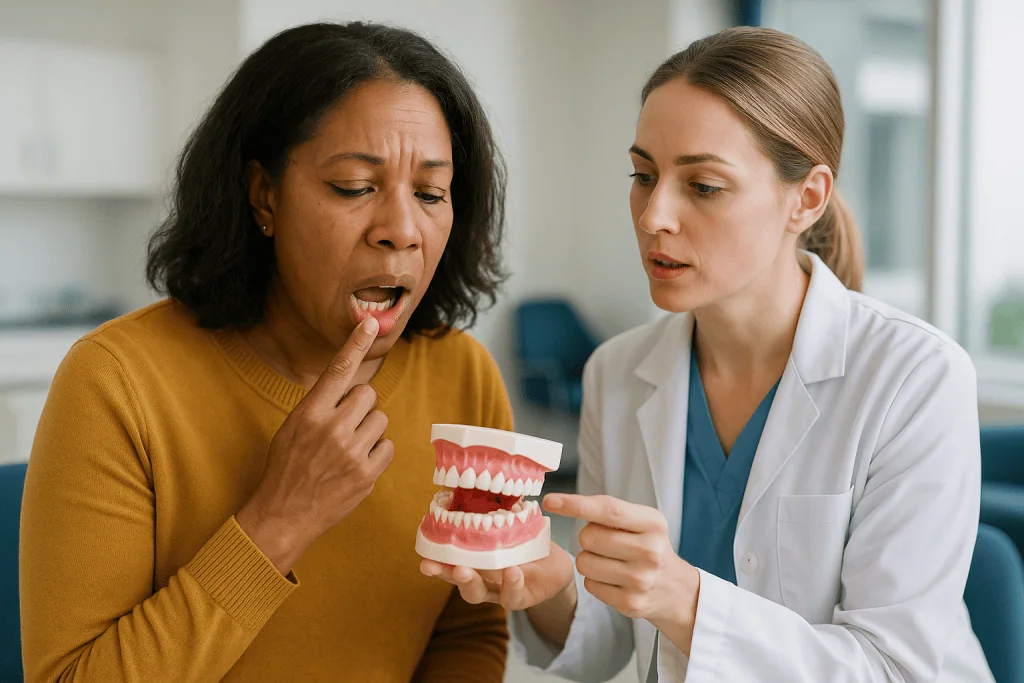
What you might see is a small area, often near the stitches, that looks whitish, grayish or slightly shiny rather than pink. Dissolvable membranes can appear as a pale, slightly fuzzy film. Non-dissolvable ones look smoother, sometimes almost like a tiny piece of plastic or fabric. If the exposure is larger, you may notice the graft particles themselves, which resemble coarse sand or tiny crumbs, sitting in the gap.
Why does it matter? The membrane’s job is to keep bacteria and gum cells out of the graft. Once it is exposed to saliva, that barrier is compromised. The membrane itself can become colonized by bacteria, and the graft beneath it may be partially lost. How much is lost depends heavily on how early the exposure is recognized and how it is managed, which is a decision for the surgeon, not for the mirror.
Two behaviors help. Do not probe, poke or attempt to push the gum edges back together, and do not pull at anything that looks loose. Do call the surgical team the same day you notice it, describe what you see as plainly as you can, and follow their instructions on cleaning the area, which may differ from what you were told at discharge. A small exposure caught early is a manageable event; the same exposure ignored for two weeks is a very different one.
Bone graft swelling: how long is too long?
The question of how long swelling should last is the one surgical teams hear most, and the answer has two parts: a rough timeline, and a rule about direction.
The timeline, drawn from Mayo Clinic’s description of post-surgical swelling and Cleveland Clinic’s one-to-two-week recovery window, runs roughly like this. Swelling appears within hours, builds for two to three days, plateaus, and then recedes. Most people notice clear improvement by the end of the first week and near-normal contours by the second, though larger grafts, sinus procedures and grafts placed alongside extractions can take longer to settle.
The rule about direction is more useful than the calendar. Swelling that is receding, however slowly, is doing what inflammation should. Swelling that stops receding and then grows again, especially after day three or four, is the classic signature of a collecting infection or a fluid pocket forming under the gum. Swelling that becomes firm, hot and shiny rather than soft and puffy points in the same direction.
Location matters too. Puffiness limited to the cheek or lip over the graft is expected. Swelling that tracks down toward the jawline and neck, up toward the eye, or across the floor of the mouth under the tongue is a sign the process may be spreading beyond the surgical site. The NHS lists swelling of the face or neck that makes it hard to swallow or breathe as a reason to seek urgent care for any dental infection, and that guidance applies here without exception.
If you find yourself wondering whether the swelling is “too long,” measure the direction first. If it has reversed, that alone justifies a call.
Pain that changes direction
Pain after a graft is expected, and the intensity in the first two or three days tells the surgeon very little about how the graft is doing. The trajectory tells them a great deal.
Ordinary post-surgical pain is worst early, often on the first night and the following day, and then softens steadily. It responds to the comfort measures your team recommended, it is centered on the surgical site, and it does not wake you from sleep once the first few nights have passed. Discomfort that follows this arc, even if it is stubborn, is doing what healing tissue does.
Pain that changes direction is different. Three shifts are worth noticing. The first is pain that eased and then returned with a new quality, often described as throbbing, deep or radiating toward the ear or temple. When this begins a few days after a graft placed into an extraction socket, one possibility the team will consider is a dry socket, which Cleveland Clinic describes as a painful condition where the protective blood clot is lost or fails to form, typically declaring itself in the first few days after an extraction.
The second shift is pain that spreads. Tenderness confined to one spot is expected; an ache that travels along the jaw, into the throat or across to the other side is not.
The third is pain out of proportion. If the surgical site hurts far more on day six than it did on day two, something has changed, and it is not the natural course of healing. Note when the shift happened, what it feels like, and whether anything else changed at the same time, such as a new taste or a visible gap. That description is exactly what the surgeon needs to hear.
Loose granules, bad taste or pus: telling ordinary from concerning
Few things unsettle a recovering patient like feeling grit against the tongue and realizing it is graft material. It helps to know what is common, what is borderline and what should prompt a call.
A few loose granules in the first days are common. The graft is packed into a space and covered, but the edges of that space are not hermetically sealed, and tiny particles can work their way out around the stitches, particularly after gentle rinsing. Cleveland Clinic notes that patients may see small fragments of grafting material, and this on its own does not mean the graft has failed. What matters is quantity and company. A steady stream of granules over several days, or granules alongside a visible opening in the gum, suggests the covering has given way.
Taste is a surprisingly good witness. A metallic taste from a little blood, or a faint medicinal taste from a rinse, is expected. A foul, sour or rotten taste that persists and returns within minutes of rinsing is not. It often signals that bacteria are breaking down tissue or graft material, or that pus is draining slowly from the site.
Pus itself is never an expected part of healing. It may appear as a yellowish or greenish fluid at the gum edge, a white bump near the stitches, or simply as that persistent bad taste with a matching odor others may notice. The NHS describes an unpleasant taste in the mouth and a discharge as features of dental infection, and either warrants same-day contact with the surgical team.
Resist the urge to squeeze, dab or dig. Rinse only as instructed, note what you observed and when, and let the team decide how to look.
Signs of bone graft infection that is spreading
Most graft-related infections stay local, and the surgical team can usually manage them at the site. Occasionally, infection moves beyond the graft into the surrounding soft tissue, and this is where signs of bone graft infection stop being a dental matter and become a medical one.
Fever is the first whole-body signal. A mild temperature in the first day or two after surgery can be part of the inflammatory response, but a fever that develops or rises after day three, particularly alongside chills or feeling generally unwell, points to infection rather than surgery. The NHS lists a high temperature among the features of a dental abscess that needs prompt attention.
Cellulitis, a spreading infection of the soft tissue under the skin, shows itself as redness and firm swelling that extends well past the surgical area, often warm to the touch and tender across a broad zone rather than a single point. When it involves the lower jaw, it can push swelling under the tongue and into the neck; when it involves the upper jaw, it can track toward the cheek and eye.
Function is the final and most urgent check. Difficulty opening the mouth beyond a narrow gap, trouble swallowing saliva, a muffled or changed voice, and any sensation of the airway narrowing are emergencies. The NHS is explicit that dental infection accompanied by difficulty breathing or swallowing, or swelling of the face or neck that is spreading, should be treated as urgent and assessed in an emergency setting, not left for the next available dental appointment.
These situations are uncommon. Knowing them by name means you will not talk yourself out of acting if one appears.
Who is usually offered a graft, and who is asked to wait
Grafting is typically suggested when the jaw does not have enough bone height or width to hold an implant stably, or when a tooth is being removed and the surgeon wants to preserve the socket’s shape for a future implant. Cleveland Clinic describes these situations, along with sinus lifts, which add bone beneath the sinus floor in the upper jaw, as the common reasons people are offered a graft.
Not everyone is offered one straight away, and understanding why a team might pause is useful, because the same factors that delay a graft also raise the chance of the warning signs described in this article.
Active gum disease or an untreated infection in the area is usually addressed first; grafting into an infected field invites the very complications the procedure is meant to avoid. Smoking is a major consideration. The CDC notes that tobacco use is strongly linked to gum disease and tooth loss, and surgeons widely regard it as a threat to graft healing because it impairs blood flow to the tissue and the clot the graft depends on. People who smoke are commonly asked to stop for a period before and after surgery, with the specifics set by their own team.
Uncontrolled diabetes, recent radiation to the jaw, certain medicines that affect bone turnover, and conditions or treatments that suppress immunity are all factors a surgeon will weigh, sometimes in consultation with the patient’s physician, before deciding whether and when to proceed. Mayo Clinic notes that a thorough medical history, including all medicines and supplements, is part of implant planning for exactly this reason.
Being asked to wait is not a rejection. It is the team stacking the odds toward the boring, uneventful recovery everyone wants.
Normal healing versus dental bone graft failure signs at a glance
A table cannot replace an examination, but it can help you sort what you are noticing into “expected,” “call today” and “seek urgent care.” The timelines below draw on the recovery windows described by Cleveland Clinic and Mayo Clinic and the red-flag guidance published by the NHS for dental infection.
| What you notice | Usually expected | Call the surgical team the same day | Seek urgent or emergency care |
|---|---|---|---|
| Swelling | Builds for two to three days, then recedes over one to two weeks | Stops shrinking and regrows after day three; becomes hard, hot or shiny | Spreads into the neck, under the tongue or toward the eye |
| Pain | Worst in the first days, then steadily easing | Eases, then returns sharper, throbbing or radiating | Severe pain with trouble opening the mouth or swallowing |
| Gum over the graft | Pink, slightly puffy, stitches intact | Whitish or gray membrane visible; edges pulling apart | Large open wound with heavy bleeding that will not slow |
| Graft granules | A few small particles in the first days | Continuous loss over several days or granules with a visible gap | Not applicable on its own |
| Taste and odor | Mild metallic taste from minor bleeding | Foul taste that returns after rinsing; pus or discharge | Foul taste plus fever and spreading swelling |
| Temperature | Feeling slightly warm in the first day or two | Fever developing or rising after day three | High fever with chills, confusion or feeling very unwell |
| Bleeding | Pink-tinged saliva for a day or two | Oozing that restarts after having stopped | Bleeding that soaks through gauze repeatedly and does not slow |
Two habits make this table more useful. First, judge trend over any single day: a symptom in the “expected” column that reverses direction has moved to the next column. Second, when a finding sits between two columns, choose the more cautious one. Surgical teams would far rather answer an unnecessary call than examine a graft that has been exposed for a week.
What the following weeks and months usually look like
Once the first two weeks are behind you, the graft enters a long, quiet phase that is easy to misunderstand because so little seems to be happening. Under the gum, a great deal is.
Cleveland Clinic describes the full maturation of a dental bone graft as taking several months, commonly three to nine and sometimes longer, before the site is dense enough to hold an implant. During this period, your own bone cells migrate into the scaffold, lay down new mineral, and slowly resorb the graft material. The gum above should look pink and healed within a few weeks, though the contour may feel slightly different from the surrounding tissue, and dissolvable stitches typically loosen and fall away on their own in the first week or two.
Mayo Clinic notes that the overall implant journey often stretches across many months precisely because grafting and healing cannot be rushed. Follow-up visits punctuate this stretch. The surgeon will check the soft tissue early, then usually assess bone maturation later with an examination and imaging before scheduling the next stage. Those visits are the right place to raise anything that has felt off, even if it seemed too minor for a phone call.
Late warning signs are subtler than early ones. A gum that thins and reveals a grayish shadow, a persistent tender spot months in, a small bump that drains intermittently, or a sensation that the ridge has “sunk” all deserve mention. Occasionally a graft heals but does not gain enough volume, and the team may discuss adding material before or during implant placement. That is a planning conversation, not a failure verdict.
Patience here is not passive. It is the treatment.
What people often get wrong
Recovery advice travels fast online, and some of what circulates about grafts is simply mistaken. A few corrections, grounded in what mainstream sources actually say.
“If granules come out, the graft has failed.” Not necessarily. Cleveland Clinic notes that seeing small fragments of graft material is common. The concern is sustained loss or loss accompanied by an opening in the gum, not the occasional particle.
“Swelling means infection.” Swelling in the first three days is the ordinary inflammatory response Mayo Clinic describes after implant-related surgery. Swelling that reverses direction or spreads is the finding that raises concern, not swelling itself.
“Vigorous rinsing keeps the area clean.” Forceful rinsing or spitting in the early days can dislodge the clot that the graft relies on, which is the same mechanism Cleveland Clinic links to dry socket after extractions. Gentle care as instructed by your team protects the site; scrubbing it does not.
“An exposed membrane can be left alone; it will cover itself.” Some small exposures do stabilize, but that judgment belongs to the surgeon who can see the site and knows which membrane was used. Waiting to see what happens is the choice most likely to cost graft volume.
“A cigarette or two will not matter.” The CDC links tobacco use directly to gum disease and tooth loss, and surgeons consistently regard smoking as one of the most controllable threats to graft healing because it restricts blood flow to the very tissue that must knit together.
“No pain means everything is fine.” Pain is one signal among several. A painless exposure or a painless persistent bad taste still deserves a call. The mouth is remarkably good at hiding problems that are visible only with a light and a mirror in trained hands.
Dental bone graft not healing: what the team may do next
When a graft is not healing as hoped, the next steps depend on what has gone wrong, how much of the graft is affected and how early it was caught. Understanding the range of options helps turn a frightening word like “failure” into a set of decisions your team will walk you through.
For a small membrane exposure without infection, the surgeon may choose to monitor closely, adjust your cleaning routine and let the tissue attempt to cover the area. For larger exposures, they may trim or remove the exposed portion of a non-dissolvable membrane to reduce the surface where bacteria can gather. In either case, the site is often reassessed at short intervals.
If infection is present, the team will typically clean the area and may prescribe an antibiotic, a medicine that acts against bacteria, with the choice, duration and timing decided by the prescribing clinician based on the individual situation. Draining any collection of pus may be part of that visit. Where the graft material itself is contaminated, some or all of it may need to be removed so the tissue can settle.
Once the site has healed, options usually include re-grafting after a period of rest, choosing an implant design or position that needs less bone, or considering alternatives to implants altogether, such as a fixed bridge or a removable prosthesis. Mayo Clinic describes graft healing and implant planning as staged processes that can take many months, and a setback often means adding a stage rather than abandoning the plan.
What no one can promise in advance is the outcome of any of these paths. What the team can offer is a clear explanation of why they favor one route, what it involves and what it asks of you.
Questions to ask your care team
The best time to ask about warning signs is before surgery, when you are not in pain and can write the answers down. The second-best time is at the first follow-up. Either way, the questions below tend to surface information that instruction sheets leave out.
- What type of graft material and membrane did you use, and will the membrane dissolve or need removing?
- If I see something white or gray at the site, what does it most likely mean with this particular membrane, and what do you want me to do?
- How much swelling do you expect for a graft of this size, and by what day should I see it clearly shrinking?
- Which of my symptoms should prompt a same-day call, and which should send me to an emergency department rather than waiting for you?
- How do I reach someone after hours or on weekends if I notice a change?
- How should I clean the area, and when does that routine change?
- Are there medicines or supplements I take that could affect healing, and have you discussed them with my physician?
- What is your plan if the graft does not mature as hoped, and what would that mean for the timeline?
A short conversation about the last question is worth having even if it feels pessimistic. Teams that have already explained their contingency plan tend to hear from patients earlier when something looks wrong, because the patient knows a problem is a detour rather than a dead end. Bring a list, bring a companion if you can, and ask for answers to be written down. Post-surgical memory is unreliable, and the mirror at day four is no place to be guessing what “normal” was supposed to look like.
When to call your doctor
Every decision about your graft rests with the team that placed it, because they alone know what material, what membrane and what closure they used. Your job is to notice change and report it promptly. Use these thresholds.
Call the surgical team the same day if you notice a whitish, gray or shiny patch at the site or gum edges pulling apart; swelling that stops receding and grows again, especially after the third day; pain that eases and then returns sharper, throbbing or radiating; a foul taste or odor that keeps returning after rinsing; any pus or discharge; continuous loss of graft granules over several days; bleeding that restarts after having stopped; or a fever that develops or rises after day three. If you cannot reach the team, contact your dentist or physician rather than waiting.
Seek urgent or emergency care without delay if swelling spreads into the neck, under the tongue or toward the eye; if you have difficulty swallowing your saliva, a changed or muffled voice, or any sense that breathing is becoming harder; if you cannot open your mouth more than a narrow gap; if bleeding soaks through gauze repeatedly and does not slow; or if a high fever is accompanied by chills, confusion or feeling very unwell. The NHS specifically identifies spreading facial or neck swelling and difficulty breathing or swallowing as emergency features of dental infection.
When in doubt, err toward calling. Surgeons expect these calls, and an exposure or infection recognized early leaves far more of the graft to protect than one discovered at a routine visit weeks later. The reassurance of hearing “that sounds normal, keep going” is itself a reasonable outcome of a phone call.
Frequently asked questions
What are the earliest dental bone graft failure signs?
The earliest signs are usually a change in direction: swelling or pain that had begun easing and then worsens, a bad taste that persists despite rinsing, or a pale, gray or shiny area appearing where the gum was closed. These often show up between the third and seventh day. None confirms failure on its own, but any of them justifies a same-day call so the surgeon can examine the site while intervention is still straightforward.
What does an exposed membrane after bone graft look like?
An exposed membrane typically appears as a small whitish, grayish or shiny patch at the gum edge or near the stitches, distinct from the surrounding pink tissue. Dissolvable membranes may look pale and slightly fuzzy; non-dissolvable ones look smoother, almost like fabric or thin plastic. Larger exposures may reveal sand-like graft particles. Do not probe or pull at it. Photograph it if you can and contact the surgical team the same day for guidance.
Bone graft swelling: how long is normal before I should worry?
Swelling usually builds for two to three days, plateaus, then recedes over the following one to two weeks, in line with the recovery windows described by Cleveland Clinic and Mayo Clinic. The concern is not duration alone but direction. Swelling that stops shrinking and grows again after day three, becomes hard, hot or shiny, or spreads toward the neck or eye should prompt a call the same day, regardless of how many days have passed.
What are the signs of bone graft infection?
Signs of infection include a foul taste or odor that keeps returning after rinsing, pus or discharge at the gum edge, swelling that regrows after initially improving, warmth and redness spreading beyond the site, and a fever that develops or rises after the third day. The NHS also lists difficulty swallowing or breathing and spreading facial or neck swelling as emergency features of dental infection. Any of the milder signs warrants same-day contact with your surgical team.
Is it normal for graft material to come out?
A few small granules in the first days after surgery are common and do not by themselves indicate failure; Cleveland Clinic notes patients may see small fragments of grafting material. What matters is quantity and context. Steady loss of particles over several days, or granules appearing alongside a visible gap in the gum or a bad taste, suggests the covering has given way and should be assessed by the surgeon promptly.
Can a dental bone graft not healing still be saved?
Sometimes, depending on the cause and how early it is recognized. A small membrane exposure without infection may be monitored and managed conservatively, while an infected or heavily exposed graft may need partial or complete removal followed by a period of healing before re-grafting is considered. No outcome can be promised in advance. The treating surgeon, who knows which materials were used, is the only person who can judge the realistic options.
Why does my bone graft hurt more on day five than day two?
Pain that returns or intensifies after initially easing is a change in direction, and healing tissue does not normally do that without a reason. Possibilities the team will consider include loss of the protective clot, which Cleveland Clinic describes as the mechanism behind dry socket, a membrane exposure, or a developing infection. Note when the change began and what the pain feels like, then contact the surgical team the same day.
Does smoking really affect whether a bone graft heals?
Yes, in the view of mainstream dental and public health sources. The CDC links tobacco use to gum disease and tooth loss, and surgeons regard smoking as a significant threat to graft healing because it reduces blood flow to the gum and jaw, which the clot and new bone depend on. Many teams ask patients to stop for a period before and after surgery. The specific advice should come from your own surgeon.
How long until a dental bone graft is fully healed?
The gum over the graft usually looks healed within a few weeks, but the bone beneath matures far more slowly. Cleveland Clinic describes full maturation as taking several months, commonly three to nine and sometimes longer, before the site is ready for an implant. Mayo Clinic likewise frames the overall implant process as spanning many months. Your surgeon will assess readiness with examination and imaging rather than by the calendar alone.
When should I go to the emergency department instead of calling my dentist?
Go directly to emergency care if swelling is spreading into your neck, under your tongue or toward your eye; if you have difficulty swallowing saliva, a muffled voice or any sense that breathing is harder; if you cannot open your mouth more than a narrow gap; if bleeding will not slow despite pressure; or if you have a high fever with chills or feel very unwell. The NHS identifies these as urgent features of dental infection.
References
- Cleveland Clinic – Dental Bone Graft
- NHS – Dental abscess
- Cleveland Clinic – Dry Socket
- NHS – Wisdom tooth removal
This article is for general information only and is not a substitute for professional medical advice. Please consult a qualified doctor about your individual situation.

More from the Blog

How Long Do Inlays and Onlays Last? Wear, Bonding Strength and When Replacement Is Discussed
Inlays and onlays usually last many years, and patient-facing sources place comparable restorations in roughly the five-to-fifteen-year range that Cleveland Clinic gives for crowns,…
3-on-6 Dental Implants: How This Full-Arch Alternative Differs From All-on-4
3-on-6 dental implants replace a full arch of teeth using six upright implants that support three separate ceramic bridges, while All-on-4 uses four implants,…

Who Needs Maxillofacial Prosthetics? Obturators and Facial Prostheses After Surgery Explained
Maxillofacial prosthetics treat openings and missing structures in the mouth, jaws and face left by cancer surgery, injury, infection or birth differences. An obturator…
What Happens in Dental Implant Surgery: Flap or Flapless, Drilling and Seating the Post
In dental implant surgery, the area is numbed, the jawbone is reached by lifting a small gum flap or through a small opening (flapless),…

What to Ask Before All On 4: Bridge Material, Bite Design and the Long-Term Maintenance Plan
Before a full-arch fixed bridge on four implants, ask what the bridge will be made of (acrylic on a metal frame, zirconia or metal-ceramic),…
Why Some Teeth Need a Root Canal or Core Build-Up Before a Dental Crown
A dental crown needs a solid tooth underneath to grip. When decay or an old filling has hollowed out much of the tooth, dentists…