

How Dentists Weigh a Sinus Lift Against Short Implants and Other Upper Jaw Alternatives

Key Takeaways
- The decision between a sinus lift and a short implant is driven chiefly by the millimeters of bone measured on a cone-beam CT between the ridge and the sinus floor.
- A systematic review of randomized trials found no statistically significant difference in implant survival between short implants and longer implants placed after sinus lift over one to five years, with fewer complications in the short-implant group.
- The Cochrane review treated implants of roughly 5 to 8.5 mm as short and suggested they may be preferable to sinus augmentation when about 4 to 9 mm of bone remains.
- Tearing of the sinus membrane is the most commonly reported complication during a sinus lift and is often repaired on the spot.
- When a sinus lift is staged separately, grafted bone typically needs roughly 4 to 12 months to mature before an implant can be placed, so the overall journey is substantially longer.
- Long-term implant failure is most often caused by peri-implantitis, bacterial bone loss around the implant, which hygiene, smoking status and maintenance visits influence more than implant length does.
Dentists choose between a sinus lift or short implants mainly by measuring how much bone remains under the sinus floor in the upper back jaw. A sinus lift adds graft material to create height for a standard implant; a short implant uses the bone already there. Systematic reviews report similar implant survival over several years, with fewer complications for short implants, so the decision rests on anatomy, health, and the treating team's judgment.
The X-ray goes up on the screen and there it is: a dark, cloud-shaped space sitting almost on top of the spot where a molar used to be. The dentist traces it with a pen and says the word most people have never heard in a dental chair: sinus. Then comes the real question. Lift it and graft, or fit something shorter and leave the sinus alone?
It is one of the most common forks in the road in modern implant dentistry, and one of the least understood by the people sitting in the chair. The phrase sinus lift or short implants gets typed into search engines thousands of times, usually late at night, usually after a consultation that felt rushed.
This explainer walks through what each option involves, what the published evidence actually says about how they compare, where the honest uncertainties are, and which questions are worth bringing to your next appointment. The final call belongs to you and the team treating you; the goal here is to make that conversation a fair one.
Why the upper back jaw is the hardest place to put an implant
Teeth are not just anchored in bone; they help keep it. Once an upper molar or premolar is lost, two things start happening at the same time, and both work against a future implant.
The first is shrinkage. The ridge of bone that held the tooth begins to remodel and thin, because it no longer receives chewing forces through a root. The second is quieter and comes from above. The maxillary sinus, the air-filled cavity behind each cheekbone, tends to expand downward into the space the roots once occupied, a process dentists call pneumatization. The result is a sandwich with very little filling: a shallow strip of bone with a sinus on top and the mouth below.
Bone quality adds to the problem. The back of the upper jaw is naturally more porous and honeycomb-like than the dense lower jaw, so an implant placed there has less solid material to grip. Mayo Clinic describes dental implant surgery as a staged process in which a titanium post must fuse with bone, a step called osseointegration, before it can carry a tooth, and notes that bone grafting is sometimes needed first when the jaw is too soft or thin.
Put these together and you have the classic dilemma. A standard implant of conventional length needs more vertical bone than many posterior upper jaws can offer. Either the bone has to be built up, which is where a sinus lift comes in, or the implant has to be redesigned to live within what remains, which is where short implants come in. Everything else in this article flows from that trade-off.
Sinus lift or short implants: what the two options actually are
A sinus lift, also called sinus augmentation or sinus floor elevation, is a bone-grafting procedure. The surgeon gently raises the thin membrane lining the floor of the maxillary sinus and places graft material into the space beneath it. Over months, that material is replaced or reinforced by the patient’s own bone, creating enough height for an implant of standard length. Cleveland Clinic describes it as a way to add bone between the jaw and the sinus so an implant has something to hold on to.
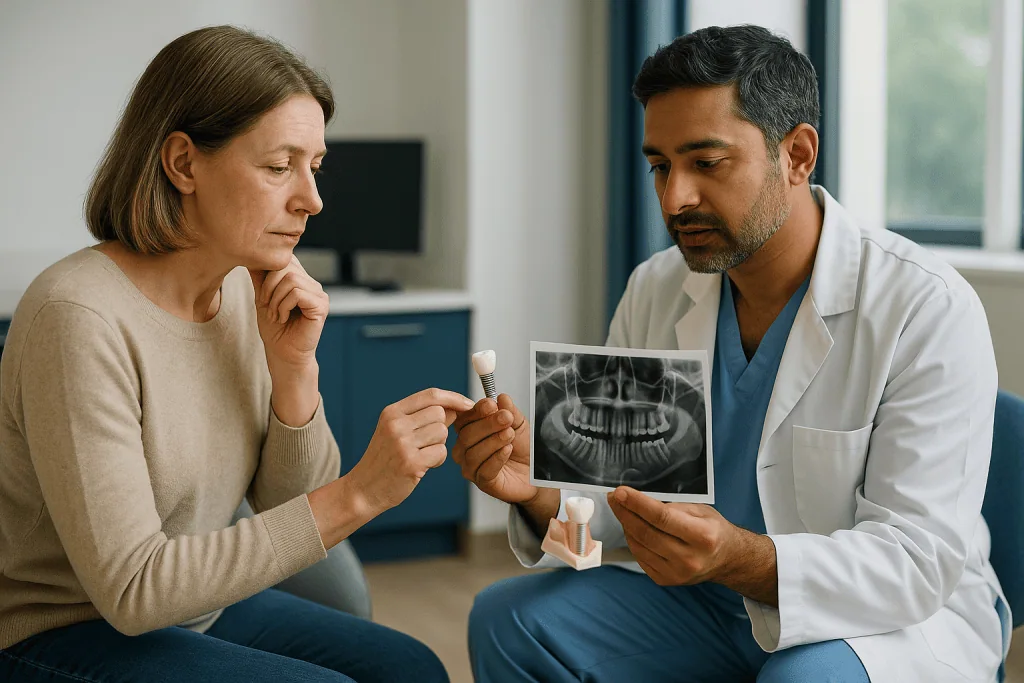
A short implant is exactly what it sounds like: a titanium post designed to work in less vertical bone. There is no single universal cut-off, but the Cochrane systematic review on sinus augmentation treated implants of roughly 5 to 8.5 mm as short, compared with conventional lengths above that. Short implants often compensate with a wider diameter or a thread design that increases surface contact with bone.
The two approaches answer the same problem from opposite directions. One changes the jaw to fit the implant; the other changes the implant to fit the jaw.
Which gets used depends on several measurements the team takes from a cone-beam CT scan, a three-dimensional X-ray that shows bone height, width and sinus shape in detail:
- How many millimeters of bone sit between the ridge and the sinus floor
- How wide the ridge is, since a short implant usually needs decent width
- Whether the sinus floor is flat or has bony partitions called septa
- How healthy the sinus lining itself looks
No scan number alone decides it. The same reading can lead two experienced clinicians to different, reasonable plans.
What happens during a sinus lift, step by step
There are two main techniques, and the one chosen is largely dictated by how much bone exists before surgery.
The lateral window, or open, approach is used when bone height is very limited. Under local anesthetic, sometimes with sedation, the surgeon makes an incision in the gum above the back teeth and creates a small window in the outer wall of the upper jaw. Through that window, the sinus membrane is carefully peeled upward with blunt instruments. Graft material is packed into the pocket created, the window is covered, and the gum is stitched closed. The implant may be placed at the same visit if enough native bone exists to hold it steady, or at a second surgery after healing.
The transcrestal, or closed, approach suits cases where only a modest amount of extra height is needed. Working through the implant site itself, the surgeon uses specially shaped instruments to tap the sinus floor upward a few millimeters and introduces graft material through the same narrow channel. The implant usually goes in at the same time. It is less invasive, but the surgeon cannot see the membrane directly, so it is reserved for smaller lifts.
Graft material comes from several sources: the patient’s own bone, processed donor bone, animal-derived mineral, or synthetic substitutes. Each has trade-offs the team will explain; none is universally superior.
Cleveland Clinic lists a healing window of roughly 4 to 12 months before the grafted site is ready for an implant when the two stages are separated. During that time the body does the real work, gradually replacing the scaffold with living bone. Patience, not the surgery itself, is often the hardest part.
How short implants work without a bone graft
The intuition most people have is that longer must be stronger. In orthopedic terms that is partly true, but implants do not behave like fence posts. Engineering studies and clinical reviews have repeatedly found that chewing forces concentrate in the top few millimeters of bone around the implant neck, not along its full length. Beyond a certain point, extra length adds little to how the implant carries load.

Short implants exploit this. They are usually wider, which increases the contact area at the ridge crest where stress is highest, and they are often designed with surface treatments that encourage bone cells to attach quickly. Some are joined together under a single multi-tooth restoration so that forces spread across more than one post, a strategy called splinting.
The appeal is obvious. There is no second surgical site, no graft to integrate, and a shorter overall journey from consultation to final tooth. The Cochrane review by Esposito and colleagues concluded that short implants may be a preferable alternative to sinus lift in jaws with roughly 4 to 9 mm of residual bone, chiefly because they avoid the additional procedure and its complications.
There are limits. A short implant still needs a minimum amount of bone to be placed at all, and it needs adequate ridge width. Very soft bone can make initial stability harder to achieve. The crown-to-implant ratio, meaning the visible tooth height compared with the buried post, is higher, which some clinicians watch closely, though reviews have not consistently linked it to failure.
Short implants are not a shortcut so much as a different answer. For the right jaw they are a well-supported one; for the wrong jaw they are not an option at all.
Who is usually offered a sinus lift, and who is usually asked to wait
Candidacy comes down to anatomy first, general health second, and habits a close third.
Anatomically, a sinus lift is typically considered when there is too little bone for even a short implant, when the surgeon prefers a conventional-length implant for a particular restoration, or when several adjacent teeth are missing and a larger platform is needed. Short implants tend to be favored when bone is limited but not critically so, when the ridge is wide enough, and when the person would rather avoid a second procedure.
Health factors apply to both. Mayo Clinic notes that people with uncontrolled chronic conditions, heavy smokers, and those who have had radiation to the head and neck need individual assessment before implant surgery of any kind. Medications that affect bone turnover or healing are reviewed by the prescribing clinician; no one should stop or alter them on their own.
Some people are asked to wait rather than told no:
- Active sinusitis or recent sinus surgery, until the lining has settled
- Untreated gum disease elsewhere in the mouth
- A tooth extracted very recently, since the socket is still remodeling
- Poorly controlled diabetes, pending a review with the physician managing it
- Current smoking, because tobacco impairs the blood supply bone needs to heal
Age by itself is rarely the deciding factor; bone biology and overall health matter more than the number on a birth certificate.
The honest answer to “am I a candidate” is usually “for which option, and after what preparation.” A good consultation ends with a plan that may include steps before surgery, not just the surgery itself.
Sinus lift vs short implants: what the evidence actually shows
This is the question that matters most, and the evidence is better than many people expect.
A systematic review by Thoma and colleagues, published in Clinical Oral Implants Research, pooled randomized trials comparing short implants with longer implants placed after sinus floor elevation. The authors found no statistically significant difference in implant survival between the two approaches over follow-up periods of roughly one to five years, while the sinus-lift group experienced more complications and longer treatment times. The Cochrane review on sinus augmentation reached a compatible conclusion, with the caveat that most trials were small and follow-up relatively short.
| Factor | Sinus lift with standard implant | Short implant |
|---|---|---|
| Extra surgery needed | Yes, grafting procedure | No |
| Typical time to final tooth | Longer; graft may need months to mature | Shorter; no graft stage |
| Main intraoperative risk | Sinus membrane tear | Limited initial stability in soft bone |
| Minimum bone required | Less, since bone is added | More; roughly 4–9 mm in reviewed trials |
| Reported survival at 1–5 years | Similar | Similar |
| Long-term data beyond 5 years | More extensive | Growing but thinner |
Two honest gaps remain. Long-term outcomes past a decade are better documented for sinus lifts simply because the technique is older. And trials tend to enroll healthy adults with straightforward anatomy, so results may not transfer neatly to someone with complex medical needs.
Read fairly, the evidence supports treating short implants as a legitimate first-line option where bone allows, and sinus lift as the established route where it does not. Neither is a compromise in the right setting.
How serious is sinus lift surgery? Risks in plain language
Most sinus lifts are outpatient procedures done under local anesthetic, often with sedation, and most people go home the same day. That said, it is real surgery near a real anatomical structure, and it deserves a clear-eyed look at what can go wrong.
The most frequently reported complication during the procedure is a tear in the sinus membrane, the delicate lining that the surgeon lifts. The Cochrane review identifies membrane perforation as the most common intraoperative problem. Small tears are often repaired on the spot with a collagen patch; larger ones may mean postponing the graft and trying again after healing.
After surgery, swelling, bruising of the cheek, mild bleeding from the nose, and a feeling of pressure are expected and usually fade over the first week or two. Infection of the graft or the sinus is less common but more serious, and is the reason follow-up visits matter. Rarely, graft material can migrate into the sinus, or a communication can form between mouth and sinus that needs closure.
Cleveland Clinic lists sinus infection, membrane damage and graft failure among the recognized risks and emphasizes that most are manageable when caught early. The NHS notes that sinusitis itself typically responds to simple measures and clears within weeks, which is reassuring context for the milder post-operative congestion many people experience.
Serious, then, in the sense that it is surgery with specific risks a person should understand. Not serious in the sense of being high-risk for a healthy adult in experienced hands. The weight each person gives to those risks is personal, and it is one of the strongest arguments for discussing alternatives rather than assuming a lift is inevitable.
Can dental implants mess with your sinuses?
Yes, occasionally, and knowing how helps you spot problems early.
Mayo Clinic lists sinus problems among the complications of dental implant surgery, specifically when an upper implant protrudes into a sinus cavity. This can happen if bone height was overestimated, if the implant was placed at an angle that carried it through the floor, or if bone around the implant later resorbs. A small protrusion with intact membrane often causes no symptoms at all; a larger one, or one with a torn lining, can set up chronic irritation or infection.
Grafted sinuses carry their own version of this risk. Graft particles that escape into the sinus can act as a foreign body. Infected graft material can seed a sinus infection that behaves differently from an ordinary cold-related one, often one-sided and slow to settle.
Symptoms that point toward sinus involvement rather than ordinary healing include:
- Persistent one-sided nasal blockage or discharge weeks after surgery
- A bad taste or smell that does not clear with normal hygiene
- Air or liquid passing between mouth and nose when drinking or blowing the nose
- Facial pressure that worsens rather than improves after the first fortnight
The NHS describes typical sinusitis as green or yellow discharge, facial pain or pressure, and reduced sense of smell, and advises seeing a doctor if symptoms are severe, keep returning, or do not improve after a reasonable period.
None of this means implants and sinuses cannot coexist. They do, in large numbers, every day. It means the sinus deserves respect in planning, which is precisely why thorough imaging comes before any upper-jaw implant, whether a lift is planned or not.
Other upper jaw alternatives beyond lifting or shortening
The title of this article names two options, but the full menu is longer, and a good consultation lays all of it out.
Tilted implants place conventional-length posts at an angle so they pass in front of the sinus rather than beneath it, anchoring in denser bone toward the front of the jaw. They are often used in full-arch cases, where a whole row of teeth is supported on a small number of implants, and they can let the team avoid grafting altogether.
Zygomatic implants are much longer posts anchored in the cheekbone itself, bypassing the upper jaw. They are reserved for severe bone loss, usually across the entire upper arch, and demand specialized surgical training. Pterygoid implants, placed in dense bone at the very back of the upper jaw, are another specialist option.
Non-implant routes remain perfectly valid. A fixed bridge uses neighboring teeth as supports and needs no surgery in the sinus area, though it does mean reshaping those teeth. A removable partial denture replaces the missing teeth without touching bone at all. And in some cases, particularly a single missing upper molar with a stable bite, dentists discuss leaving the gap, since not every missing back tooth needs replacing.
Each path has a different balance of invasiveness, durability, maintenance, and personal preference. What a person values, fewer surgeries, a fixed tooth, or the least intervention possible, should shape the recommendation. A plan that only ever mentions a sinus lift has not finished the conversation.
Sinus lift recovery time: what the following days and weeks usually look like
Recovery has two clocks. The one most people notice runs over about two weeks; the one that matters for the implant runs over months.
In the first 48 hours, expect swelling of the cheek, some bruising, and mild bleeding or pinkish discharge from the nose on the treated side. Cold packs applied in intervals help with swelling. The team will usually advise soft foods, no straws, and no vigorous rinsing while the stitches settle.
The single most repeated instruction after a sinus lift is this: do not blow your nose. Sneezing with the mouth open, avoiding heavy lifting, and skipping air travel or scuba diving for the period your surgeon specifies all serve the same purpose, which is to avoid pressure changes that could disturb the graft or the membrane. Cleveland Clinic lists these precautions among standard aftercare.
Days 3 to 7 usually bring steady improvement; stitches are typically removed or dissolve within a week or two, and most people are back to normal activity by then. Pain is generally manageable with the measures the prescribing clinician recommends; mechanism and timing are their call, not this article’s.
Then comes the long quiet stretch. Graft material matures over several months, and Cleveland Clinic cites a range of roughly 4 to 12 months before an implant can be placed when the stages are separate. If the implant went in at the same time as the lift, there is still a period of months before a crown is fitted while bone bonds to the post.
For short implants, the first week looks similar but shorter, there is no graft to protect, and the overall timeline to a finished tooth is typically several months rather than up to a year.
What is the number one reason dental implants fail?
Ask three clinicians and you may get three answers, but the answers cluster around a single theme: the bond between implant and bone either never forms, or forms and is later lost.
Early failure, within the first months, usually means osseointegration did not happen. Causes include infection at the surgical site, an implant placed without enough initial stability, excessive pressure from a temporary tooth before the bone was ready, or impaired healing from smoking or uncontrolled medical conditions. Mayo Clinic identifies infection, inadequate bone, and smoking among the factors that make implant failure more likely.
Late failure, after the tooth has been in use, is dominated by peri-implantitis. This is inflammation and progressive bone loss around an otherwise integrated implant, driven by bacterial plaque in much the same way gum disease destroys bone around natural teeth. It is the reason implant maintenance looks a lot like periodontal maintenance: professional cleaning, careful home hygiene, and regular checks.
Where does the sinus-lift-or-short-implant choice fit? The comparative reviews already discussed found similar survival for both, so the choice between them is not itself a major driver of failure. What raises risk in either case is the same list: smoking, poor plaque control, untreated gum disease, grinding or clenching that overloads the restoration, and skipping follow-up.
The practical lesson is counterintuitive but well supported. The procedure that gets the most attention, the surgery, is rarely what decides long-term success. The habits that follow it are. A person who stops smoking, keeps the area clean, and attends maintenance visits has changed their odds more than any choice of implant length could.
What people get wrong about sinus lift or short implants
Myths in this area are common because the anatomy is invisible and the vocabulary is unfamiliar. A few corrections, each grounded in the evidence above.
“A sinus lift is the gold standard; short implants are a compromise.” Randomized trials pooled in the Thoma review found similar survival over one to five years, with fewer complications in the short-implant arm. Short implants are a mainstream option where bone allows, not a fallback.
“Short implants mean the tooth will feel loose or weak.” Once integrated, an implant of any length is rigidly fixed in bone. The restoration on top feels the same to the person chewing.
“The sinus lift puts something inside my sinus.” The graft sits beneath the sinus membrane, in the space between the lifted lining and the jawbone. The air space of the sinus itself is not filled.
“If I had a sinus lift, I will have sinus problems for life.” Most post-operative congestion settles within weeks. Lasting sinus trouble is a recognized but uncommon complication, not an expected outcome.
“A scan will give one right answer.” Scans give measurements; clinicians give judgments. Two sound plans can follow from the same image, and asking why one was chosen is reasonable.
“Longer always lasts longer.” Load concentrates near the top of the implant. Width, bone quality, hygiene and bite forces influence longevity at least as much as length.
“The surgery is the risky part; afterward you are done.” Peri-implantitis, the main cause of late failure, is driven by what happens over years of daily cleaning and maintenance, not on the day of surgery.
Questions to ask your care team before you decide
A consultation about the upper back jaw should leave you with specific answers, not just a recommendation. These questions tend to surface the reasoning behind a plan.
- How many millimeters of bone do I have beneath the sinus at the planned site, and what is the ridge width?
- Given those numbers, is a short implant an option for me? If not, what specifically rules it out?
- If a sinus lift is proposed, which technique, open or transcrestal, and why that one?
- Would the implant be placed at the same time as the graft, or at a second surgery? What decides that?
- What graft material do you intend to use, and what are the alternatives?
- What is the realistic timeline from first surgery to final tooth under each option?
- Have you considered tilted implants, a bridge, or a removable option for this site, and why were they set aside?
- What is your plan if the sinus membrane tears during the procedure?
- Which of my medications or conditions affect healing, and do you want to speak with the clinician who prescribes them?
- What maintenance schedule do you recommend afterward, and what signs should prompt me to call before a scheduled visit?
Two further points are worth raising directly. Ask whether the clinician performs both procedures routinely, since comfort with a technique naturally shapes recommendations. And ask what they would consider a reason to pause, such as active smoking or untreated gum disease, so that any preparation steps are built into the plan rather than discovered later.
Writing the answers down is not excessive. The decision involves months of healing and a permanent change to your anatomy; it deserves the same notes you would take for any other surgery.
When to call your doctor
Most recoveries are uneventful, and ordinary swelling, bruising and mild nasal discharge in the first days are expected. Some signs are not ordinary and warrant a call to the surgical team or, if they are unavailable, urgent medical care.
Contact your care team promptly if you notice:
- Bleeding from the nose or mouth that is heavy or does not slow with gentle pressure
- Swelling or pain that worsens after the third day instead of improving
- Fever, or pus and a foul taste from the surgical site
- Air, fluid or food passing between your mouth and nose
- Small granules or graft material appearing in nasal discharge
- Loosening of stitches with the wound opening, or a visible gap
- Numbness of the lip, cheek or gum that persists beyond the anesthetic wearing off
- A new one-sided nasal blockage, facial pressure or discharge that lasts beyond two weeks
Seek emergency care without waiting if you have difficulty breathing, rapidly spreading swelling of the face or neck, swelling that makes swallowing hard, or a high fever with confusion or rigors. These are rare, but they are not symptoms to monitor overnight.
The NHS advises seeing a doctor for sinus symptoms that are severe, keep coming back, or do not improve after a reasonable interval; after sinus surgery, that threshold should be lower, and the surgical team should be the first call. Keep their after-hours number accessible from the day of the procedure.
Months later, a different set of signals matters: bleeding gums around the implant, a bad taste, a crown that feels different, or bone visibly receding on a routine X-ray. These point toward peri-implantitis, which is far easier to manage early than late. Every one of these decisions, from reassurance to intervention, sits with the clinicians who know your case.
Frequently asked questions
What is the difference in sinus lift vs short implants for the upper jaw?
A sinus lift adds graft material beneath the sinus membrane to create enough bone height for a standard-length implant, while a short implant is designed to work within the limited bone already present. Pooled randomized trials have reported similar implant survival over one to five years, with fewer complications and shorter treatment for short implants. Which is suitable depends on measured bone height and width, ridge quality, overall health, and the treating team’s assessment.
How serious is sinus lift surgery, really?
For a healthy adult it is a routine outpatient oral surgery usually done under local anesthetic with optional sedation, and most people go home the same day. It is still surgery near the maxillary sinus, so recognized risks include membrane tears, infection, graft failure, and temporary sinus congestion. Serious complications are uncommon and most are manageable when reported early, which is why follow-up visits and clear after-hours contact with the surgical team matter.
How much is a sinus lift for a tooth implant?
This article does not publish cost figures, because the amount varies enormously with the technique used, the graft material, whether the implant is placed at the same time, imaging, sedation, and the number of sites treated. The useful step is to request a written, itemized treatment plan from your dental team that lists each stage, and to ask whether a short implant or another alternative would change the plan before comparing anything.
Can dental implants mess with your sinuses?
They can, occasionally. Mayo Clinic lists sinus problems among implant complications when an upper implant extends into the sinus cavity, and grafted sinuses can become infected or irritated by displaced graft particles. Many small protrusions cause no symptoms. Persistent one-sided congestion, discharge, a bad taste, or air passing between mouth and nose after surgery should be reported to the treating team rather than waited out.
What is the number one reason dental implants fail?
Failure clusters around the bond between implant and bone. Early failures mean the implant never integrated, often because of infection, poor initial stability, premature loading or impaired healing from smoking. Late failures are dominated by peri-implantitis, plaque-driven inflammation and bone loss around the implant. Comparative reviews show similar survival for sinus lift and short implant approaches, so hygiene, smoking status and maintenance influence outcomes more than the choice between them.
What is the typical sinus lift recovery time?
Visible recovery, meaning swelling, bruising and mild nasal discharge, usually settles over one to two weeks, and most people return to normal activity within that period. The biological recovery is longer: when the implant is placed at a later stage, Cleveland Clinic cites roughly 4 to 12 months for the graft to mature first. Your surgeon will specify how long to avoid nose blowing, flying and strenuous activity.
Is an upper jaw bone graft for implants always necessary?
No. Grafting is needed only when the remaining bone cannot support any implant design the team considers appropriate. Short implants, tilted implants that pass in front of the sinus, and in severe cases zygomatic implants anchored in the cheekbone can all avoid a sinus graft. Non-implant options such as a bridge or removable denture avoid bone surgery entirely. A three-dimensional scan and an honest discussion of each route should come before any graft is scheduled.
Can a sinus lift and implant be done at the same time?
Often, yes, when enough native bone exists to hold the implant firmly while the graft matures around it. If bone is very scarce, the surgeon usually stages the procedures, grafting first and placing the implant months later once the site has firmed up. The transcrestal, or closed, technique almost always places the implant at the same visit. The decision rests on measured bone height and the stability achieved during surgery.
Do short implants last as long as regular implants?
Published trials pooled in systematic reviews show comparable survival for short and conventional-length implants over follow-up of roughly one to five years. Data beyond a decade are thinner for short implants simply because the designs are newer, and most trials enrolled healthy adults with straightforward anatomy. Longevity for any implant depends heavily on plaque control, smoking status, bite forces and regular maintenance, factors that matter at least as much as length.
Does smoking affect whether I can have a sinus lift or short implants?
Yes, for both. Tobacco reduces blood flow to healing tissue and is listed by Mayo Clinic among factors that increase implant failure risk; grafts are particularly sensitive because they depend on new blood vessels growing into the material. Many teams ask people to stop smoking before and after surgery, and some decline grafting in heavy smokers. Discuss support for stopping with your physician, who can advise on approaches suited to you.
References
This article is for general information only and is not a substitute for professional medical advice. Please consult a qualified doctor about your individual situation.

More from the Blog

What a CT Scan Shows Before Zygomatic Implants: Cheekbone Volume, Sinus Anatomy and the Path
A CT scan for zygomatic implants gives the surgical team a three-dimensional map of the upper jaw and cheekbones. It shows how much bone…

Preparing for All On 4: Imaging, Bite Records, Infection Control and What to Pause Beforehand
All on 4 preparation usually involves a medical and dental history review, a three-dimensional CBCT scan of the jaws, photographs and bite records that…

How Grinding and Erosion Lead to Full Mouth Reconstruction: Bite Collapse and Tooth Wear
Tooth wear bite collapse happens when years of grinding (bruxism) or acid erosion shorten the teeth enough that the jaws close too far, straining…

Who Is a Candidate for All On 6? Bone Volume, Bite Force and When Six Implants Are Advised
An all on 6 candidate is usually an adult missing most or all teeth in one jaw, with enough jawbone in the back of…
Why You Never Stop Blood Thinners Alone Before a Dental Bone Graft: What the Surgeon Checks
Stopping a blood thinner on your own before a dental bone graft is rarely advised. Most guidelines say routine dental surgery, including grafting, can…
Who Needs a Porcelain Crown? Cracked, Heavily Filled and Root-Treated Teeth Explained
A porcelain crown is usually considered when a tooth has lost too much sound structure for a filling to hold it together: a cracked…