

How Implantology Plans Treatment: Bone Volume, Bite and Timing Decide the Approach

Key Takeaways
- Bone height is measured down to the nerve canal in the lower jaw or the sinus floor in the upper jaw, and that distance often decides whether a graft comes first.
- An implant has no ligament cushion, so the full bite force passes into bone, which is why heavy bites and grinding habits lead to wider or additional implants rather than more bone.
- The 3/2 rule is a textbook spacing convention of roughly 3 mm between implants and about 1.5 to 2 mm from a natural tooth, meant to protect the sliver of bone and gum between them.
- Immediate placement into a fresh socket is reserved for intact, infection-free sockets with bone beyond the root tip; infected or collapsed sites are usually staged.
- Mayo Clinic and Cleveland Clinic describe bone healing onto an implant as taking several months, with Cleveland Clinic quoting roughly three to six months, longer after grafting.
- Peri-implantitis, the implant equivalent of gum disease, is driven by plaque and made more likely by smoking and prior periodontitis, so gum treatment usually precedes placement.
Implantology plans treatment by measuring three things before anything is placed: how much jawbone is available in height, width and density; how the bite loads that spot; and when the implant can safely go in relative to extraction and healing. Those findings decide whether grafting is needed, how many implants, their angle, and whether placement is immediate or delayed. The treating team makes each call case by case.
The molar came out on a Tuesday. By Thursday, a woman in her fifties was sitting in front of a screen, watching a dentist rotate a gray three-dimensional slice of her own jaw and tap a spot that looked, to her, like nothing at all. “That’s the problem,” he said. “There isn’t enough there yet.” She had expected a date for surgery. She left with a plan for a graft and a waiting period instead.
Scenes like this are how implantology plans treatment in practice. Very little of it happens in the surgical chair. Most of the deciding takes place earlier, with a scan, a ruler and a set of questions about bone, bite and time that most patients never hear spelled out.
This explainer walks through those questions in the order clinicians actually ask them, so that when a plan is laid out for you, the reasoning behind it is already familiar.
What actually happens when a dentist plans an implant
A dental implant is a small titanium or ceramic post placed into the jawbone to act as an artificial tooth root. The visible tooth, called a crown, attaches to it later through a connector known as an abutment. Planning is about making sure the post lands in bone that can hold it, at an angle that lets the crown sit where a natural tooth would.
The first visit is mostly gathering information. Expect a clinical examination of the gums and remaining teeth, impressions or a digital scan of both arches, and imaging. Mayo Clinic describes a comprehensive dental exam, a review of your medical history and a written treatment plan as the standard starting points. The imaging usually includes a cone beam CT, which is a low-dose three-dimensional X-ray that shows bone thickness and the position of nerves and sinuses in a way a flat X-ray cannot.
From those files the clinician builds a virtual model. The crown is designed first, in the position the bite needs, and the implant is then placed on screen to support it. This “top-down” approach sounds backwards, but it is the reason a well-planned implant looks and functions like a tooth rather than like a screw with a cap on it.
The plan that comes out of this stage answers a short list of questions. Is there enough bone, and where exactly? What will the bite do to this spot? Can the implant go in now, or must the site heal or be built up first? Everything else, from surgical guides to the choice of temporary tooth, follows from those answers.
Why bone volume is the first thing implantology measures
Bone volume means the height, width and density of jawbone at the intended site. An implant needs to be surrounded by bone on all sides to become stable, through a process called osseointegration in which living bone grows onto the implant surface. Cleveland Clinic describes this fusion as the step that gives an implant its long-term anchorage.

Height is measured from the crest of the ridge down to a structure the implant must not touch: the nerve canal in the lower jaw, or the floor of the sinus in the upper. Width is measured across the ridge, cheek side to tongue side. Density is judged from the scan and confirmed by feel during surgery; the front of the lower jaw is typically the densest region and the back of the upper jaw the softest.
Bone is lost quickly after a tooth comes out. The alveolar ridge, the bony rim that once held the tooth, begins to shrink because it no longer has a root to support. Mayo Clinic notes that soft or thin bone may need grafting before an implant can be placed. That is why the timing of the planning visit relative to the extraction matters so much.
The scan also reveals bone that is present but in the wrong place. A ridge can be tall enough yet lean so far toward the cheek that a straight implant would emerge through the gum in an unusable position. In these cases the plan may involve a shorter or angled implant, a graft to widen the ridge, or a decision to build the crown on a neighboring site instead.
How the bite decides implant number, angle and size
Occlusion is the way the upper and lower teeth meet when you close and chew. It is the second pillar of planning, and the one patients hear least about. An implant does not have the tiny cushion of ligament that surrounds a natural root, so it does not flex under load. Whatever force the bite delivers goes straight into bone.
Clinicians therefore look at what the implant will be chewing against. A single implant replacing a front tooth carries mainly shearing forces from biting into food. A molar carries heavy vertical loads, and a molar in someone who clenches or grinds, a habit called bruxism, carries far more. The plan often responds with a wider implant, two implants for a large space rather than one, or a crown shaped to keep contact light.
The opposing arch matters too. Chewing against a full denture loads an implant differently from chewing against natural teeth. Missing teeth elsewhere may have let neighbors drift or opposing teeth over-erupt into the gap, so the space available for a crown can be shorter or narrower than it looks. Sometimes a small amount of orthodontic movement or reshaping of the opposing tooth is written into the plan before any surgery.
Angle follows from bite. The implant is oriented so that the chewing force runs down its long axis rather than sideways, which is the direction bone tolerates least well. When anatomy forces an angle, the abutment can correct some of it, but there are limits, and this is one place where a compromise in planning shows up years later as a loosened screw or a worn crown.
Immediate vs delayed implant placement: how timing is chosen
Timing refers to when the implant is placed relative to tooth removal, and separately to when a crown is attached relative to placement. Both are planning decisions, and both trade speed against predictability.
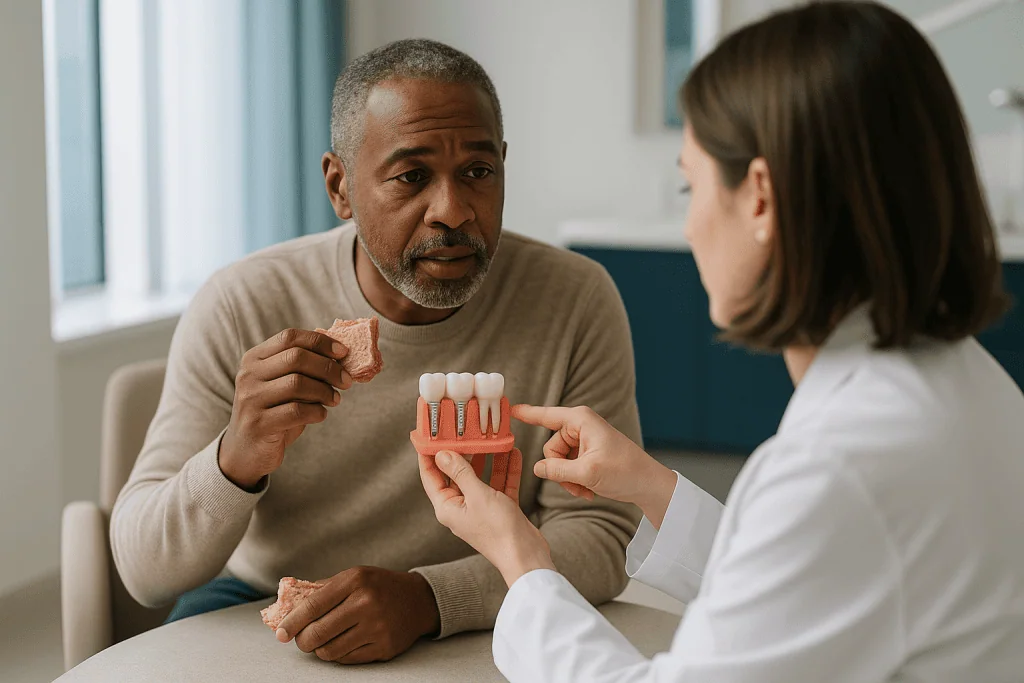
Immediate placement means the implant goes into the socket on the same day the tooth comes out. It preserves some bone contour and saves a surgical visit. It suits sockets with intact walls, no active infection and enough bone beyond the root tip to grip the implant. Early placement, after a few weeks of soft-tissue healing, is chosen when the gum needs to close over an infected site first. Delayed placement waits for the socket to fill with bone, which Mayo Clinic describes as taking several months, and is the standard route when bone is thin or a graft is needed.
The second timing question is loading. Conventional protocols leave the implant buried or covered with a small healing cap while osseointegration takes place. Cleveland Clinic and Mayo Clinic both describe this healing as lasting several months, and Cleveland Clinic gives a typical window of roughly three to six months, sometimes longer in softer bone or after grafting. Immediate loading, where a temporary crown is attached on the day of surgery, is reserved for implants that achieve firm initial stability and for bites that will not overload them.
The honest summary is that faster protocols exist, and they work well in carefully selected cases. Selection is the point. A clinician who recommends waiting is not being conservative for its own sake; the scan or the socket has usually shown a reason.
What is the 3/2 rule for implant placement?
The 3/2 rule is a spacing convention taught in implant training. It states that an implant should sit at least about 3 millimeters from a neighboring implant and at least about 1.5 to 2 millimeters from a natural tooth root. These are textbook guidelines rather than figures from a patient-facing health authority, and individual clinicians adjust them for implant diameter and anatomy.
The reasoning is biological. Bone around an implant remodels after placement, and a small amount of the crest is lost in the first year. If two implants are too close, their remodeling zones overlap and the thin sliver of bone between them can disappear, taking the gum tissue above it with it. The result is a flat, dark triangle where the pink gum “papilla” should be. Space from a natural tooth protects the tooth’s own blood supply and the ligament that holds it.
The rule also has a horizontal companion: a rim of bone, often quoted as at least a millimeter, is wanted on the cheek side and tongue side of the implant. Where that rim would be thinner, planning shifts toward a narrower implant or a graft to thicken the ridge.
Why does a patient need to know any of this? Because it explains decisions that can look puzzling. A gap that seems wide enough for two implants may be planned for one implant and a bridge-style crown instead. A single missing tooth between two crowded neighbors may be planned for a narrow-diameter implant. Spacing rules are the quiet arithmetic behind those choices, and asking your team to show you the measurements on the scan is a fair request.
Bone graft before dental implant: when the plan says build first
A bone graft is a procedure that adds bone or a bone-like material to a site so an implant can be placed later or at the same time. Mayo Clinic lists grafting as a possible step when the jaw is too soft or thin to support an implant, and notes that a transplanted bone site may need several months to grow enough new bone before an implant is placed.
Grafts come in several forms, and the plan names which is intended. Socket preservation fills the hole left by an extraction to slow ridge shrinkage. Ridge augmentation adds width or height to a ridge that has already collapsed. A sinus lift raises the membrane of the maxillary sinus, the air space above the upper back teeth, and packs graft material beneath it to create height where the sinus floor sits low. Each has its own healing period, and each adds at least one visit and often a second surgery.
Graft material may be your own bone taken from elsewhere in the jaw, processed donor bone, animal-derived bone mineral, or a synthetic substitute. Which one is chosen depends on how much volume is needed and how much of it must be new living bone rather than scaffold. Patients are entitled to know the source and to decline a category on personal or religious grounds; the plan can usually be adapted.
The alternative to grafting is sometimes a cleverer implant plan: shorter implants, angled implants that reach denser bone, or a design that anchors in the cheekbone. These avoid grafting but carry their own considerations, and the choice sits with the surgeon after weighing your scan, your bite and your preference for fewer procedures against a longer track record.
Who is usually a candidate, and who is asked to wait
Most adults with one or more missing teeth and generally good health are considered for implants. Mayo Clinic and Cleveland Clinic list the usual prerequisites: a jaw that has finished growing, enough bone or the ability to accept a graft, healthy gums, and a willingness to commit to several months of treatment and to lifelong oral hygiene.
Being asked to wait is common and is rarely a refusal. Adolescents wait until jaw growth is complete, because an implant does not move with the growing jaw and can end up sitting lower than the teeth around it. People with untreated gum disease wait until it is controlled, since the same bacteria that damage bone around teeth damage bone around implants. A fresh extraction site with infection waits for the gum to heal. Someone who smokes may be asked to stop or reduce, because smoking impairs healing and raises the risk of implant complications, as Cleveland Clinic notes.
A smaller group is advised against implants or referred for specialist review. This includes people who have had radiotherapy to the jaw, people on certain bone-modifying medicines discussed in the next section, and those whose medical condition makes surgery itself risky. Uncontrolled diabetes slows healing; well-controlled diabetes is generally not a barrier.
The question underneath all of this is whether the bone will heal onto the implant and stay there. Age by itself is not the deciding factor. A healthy eighty-year-old with dense bone may be a more straightforward case than a thirty-year-old with periodontitis and a heavy grinding habit. Candidacy is a judgment about biology, not a birthday.
How medical history and medicines change the implant plan
Your medical history reshapes the timeline more often than it cancels the treatment. The planning visit will ask about diabetes, blood thinners, bone medicines, autoimmune conditions, previous radiotherapy and smoking, and each answer nudges the plan.
Bisphosphonates and other antiresorptive medicines, prescribed for osteoporosis and for some cancers, slow the bone’s natural turnover. Because implant healing depends on that turnover, and because these drugs are linked in rare cases to a condition in which jawbone fails to heal after surgery, the team will ask how long you have taken them and by which route. Injectable or intravenous forms carry more concern than tablets. None of this means stopping the medicine; it means the dental team and the prescribing physician talk to each other and decide together.
Anticoagulants, which reduce clotting, are usually continued, with the surgical technique adapted to control bleeding. Stopping them without medical advice carries its own dangers and is not something a dental plan should ever ask you to do on your own.
Diabetes matters through blood sugar control rather than the diagnosis itself. Poorly controlled glucose impairs the small blood vessels and immune cells that healing relies on. Your team may ask for recent results from your physician before scheduling surgery.
Gum disease deserves its own line. The National Institute of Dental and Craniofacial Research describes periodontitis as an infection that destroys the bone supporting teeth. Around an implant the same process is called peri-implantitis. A plan that places an implant into a mouth with active periodontitis is building on unstable ground, so treatment of the gums typically comes first.
Bone, bite and timing side by side: how the approach is matched
The three planning factors rarely point the same way. A site may have good bone but sit under a heavy bite, or thin bone but a light load. The table below shows how common findings typically steer the approach. It is a guide to the reasoning, not a menu; the treating team weighs all three together.
| Finding on planning | What it usually means | Typical direction of the plan |
|---|---|---|
| Intact socket, good bone beyond root tip, no infection | Site can grip an implant now | Immediate placement considered; loading depends on stability |
| Thin ridge width, adequate height | Insufficient bone on cheek or tongue side | Narrow implant or ridge augmentation, then delayed placement |
| Short height under upper sinus | Sinus floor sits low | Sinus lift with graft, or shorter or angled implant |
| Heavy bite, grinding habit, molar site | High load on bone | Wider or additional implants, protective crown design, night guard discussed |
| Active gum disease | Bacterial threat to implant bone | Periodontal treatment first; placement deferred |
| Recent extraction with infection | Soft tissue needs to close | Early placement after gum healing, or delayed after bone fill |
| Multiple missing teeth in one arch | Loads shared across several posts | Fewer implants supporting a bridge, positions chosen for spread |
Two patterns are worth pulling out. First, bite problems are usually solved with design, not with more bone: wider posts, more posts, or a crown that shares load. Second, bone problems are usually solved with time, either waiting for natural fill or adding graft and waiting for it to mature. Timing is the currency in which most planning compromises are paid, and Mayo Clinic’s description of the whole process as spanning many months reflects exactly that.
What the weeks and months after placement usually look like
Once the plan is agreed, the shape of the following months is fairly predictable, even if the exact dates are not. Mayo Clinic describes the sequence as a series of stages with healing time between each: removal of a damaged tooth if needed, grafting if needed, implant placement, bone healing, abutment placement, and finally the crown.
The first days after placement are much like any minor oral surgery. Mayo Clinic lists swelling of the gums and face, bruising, minor bleeding and pain at the site as typical, and soft foods are advised while the wound settles. Most people return to normal activity within a few days. Stitches, if not the dissolving type, are removed at a short follow-up.
Then comes the quiet stretch. The implant sits under the gum or beneath a small healing cap while bone grows onto it, the several months Cleveland Clinic and Mayo Clinic describe. Nothing visible happens, which is exactly what should happen. A temporary tooth, either removable or bonded to neighbors, covers the gap if the site is visible. In immediate-loading cases a temporary crown is already in place and you are asked to keep it out of heavy chewing.
Next is a short procedure to expose the implant and fit the abutment, followed by a further couple of weeks for the gum to shape itself around it. Impressions or a scan are taken for the final crown, which is fitted at the last visit and checked against the bite.
After that the timeline becomes a maintenance schedule: professional cleaning and checks at intervals your team sets, and daily brushing and interdental cleaning at home. An implant that is planned well and cleaned poorly still loses bone.
Risks and alternatives, stated plainly
A good plan includes what could go wrong and what else could be done. Mayo Clinic groups the main risks as infection at the implant site, injury to surrounding teeth or blood vessels, nerve damage causing pain, numbness or tingling in the lip, chin or gum, and sinus problems when upper implants intrude into the sinus space. Most are uncommon, and careful imaging exists precisely to reduce them, but none can be reduced to zero.
Two longer-term risks deserve a plain mention. The first is failure of osseointegration, where bone does not fuse to the implant and it loosens; this usually shows up in the first months and typically means removal and, after healing, a second attempt or a different plan. The second is peri-implantitis, the gum-disease equivalent around an implant, which is driven by plaque and made more likely by smoking and by a history of periodontitis. It is treatable in its early stages and is the main reason maintenance visits are non-negotiable.
Alternatives should be laid out with the same neutrality. A fixed bridge uses the teeth either side of a gap as anchors and avoids surgery, at the cost of reshaping those teeth and placing extra load on them. A removable partial denture is the least invasive option and the least stable. For a full arch, a conventional denture, an implant-retained overdenture that clips onto a few implants, and a fixed implant-supported bridge sit along a spectrum of stability and complexity.
The NHS overview of dental treatments describes bridges, dentures and implants as the standard options for replacing teeth. Which one is right depends on bone, bite, health, budget of time and personal priorities, and the treating team should be willing to explain why they favor one over another for you specifically.
What people often get wrong about implant planning
Myth one: the newest procedure is the best procedure. Digital planning, printed surgical guides, same-day temporaries and implants anchored in the cheekbone are all genuine advances. Each also has a narrower set of ideal cases than marketing suggests. Evidence for immediate loading, for example, is strongest in well-selected patients with firm initial stability. “Newest” describes the calendar, not the outcome for your jaw.
Myth two: implants cannot get gum disease. They can, and the surrounding bone can be lost in the same way it is around teeth. Titanium does not decay, but the tissue holding it is living and vulnerable.
Myth three: everyone can have teeth in a day. Some people can, when the plan supports it. Many others are asked to wait for grafts to mature or gums to heal, and Mayo Clinic’s description of a process lasting months reflects the norm rather than the exception.
Myth four: more implants are always safer. Too many, too close, violate spacing rules and starve the bone between them. Planning for a full arch is as much about where not to place implants as where to place them.
Myth five: the worst part is the surgery. Patients frequently report that placement was less uncomfortable than they feared, and that the harder parts were the waiting, the temporary tooth, and the swelling after a sinus lift or larger graft. Knowing this in advance changes how the middle months feel.
Myth six: a failed implant means implants are not for you. A single early failure is often a healing problem at one site, and a fresh plan after the bone recovers is a routine conversation, not a verdict.
Questions to ask your care team before agreeing a plan
Planning is a conversation, and the most useful questions are the ones that make the reasoning visible. Bring these to the consultation and expect answers that refer to your scan and your bite, not to generalities.
- Can you show me on the scan where the implant will go, and how much bone is around it on each side?
- Is a graft part of this plan, and if so, what kind, from what source, and how does it change the timeline?
- Why this timing? What in my case favors immediate, early or delayed placement, and immediate or delayed loading?
- How will my bite load this implant, and what have you done in the design to manage that? Should I be using a night guard?
- How many implants, and why that number rather than more or fewer?
- Which of my medicines or conditions affects this plan, and have you spoken with my physician about them?
- What will I have in the gap during healing, and what can I not eat with it?
- What are the realistic complications for my anatomy specifically, and what would happen next if the implant did not integrate?
- What is the alternative to this plan, and why do you prefer this one for me?
- Who do I contact after hours if something feels wrong, and what maintenance schedule will I be asked to keep?
A team that welcomes these questions is showing you how it thinks. If an answer amounts to “trust us,” it is reasonable to ask again or to seek a second opinion before any bone is touched. The plan is yours to understand, and the decision to proceed remains a shared one between you and the clinicians treating you.
When to call your doctor
Some discomfort is expected after implant or graft surgery, and Mayo Clinic notes that swelling, bruising, minor bleeding and pain are common in the first days. Certain signs, though, mean the plan needs a clinician’s eyes sooner rather than later, and you should contact your surgical team or seek urgent care rather than wait for the next scheduled visit.
- Bleeding that does not slow with firm pressure on a clean gauze pad, or that restarts hours after surgery.
- Swelling or pain that worsens after the third day instead of easing, or swelling that spreads toward the eye, neck or floor of the mouth.
- Fever, feeling generally unwell, or a foul taste and discharge from the surgical site, which can indicate infection.
- Numbness or tingling of the lip, chin, tongue or gum that persists beyond the hours the local anesthetic was expected to last, since this may indicate nerve involvement.
- A sensation of air or fluid passing between mouth and nose, nosebleed, or pressure and congestion on one side after an upper implant or sinus lift.
- Difficulty swallowing or breathing, which is an emergency and warrants immediate emergency services.
- A temporary or healing cap that comes loose, or an implant that feels mobile or clicks when touched.
- A rash, hives or facial swelling after starting any prescribed medicine, which may signal an allergic reaction.
In the longer term, bleeding gums around an implant, a bad taste, pus, gum recession that exposes metal, or a crown that suddenly feels high in the bite are reasons to book a review rather than to wait for a routine check. Early peri-implantitis is far easier to manage than advanced bone loss. The team that planned your implant is the right first call; they know your scan, your bite and your timeline.
Frequently asked questions
What is the 3/2 rule for implant placement?
The 3/2 rule is a spacing convention taught in implant dentistry: keep roughly 3 mm of bone between two implants and about 1.5 to 2 mm between an implant and a natural tooth root. It exists because bone remodels after placement, and crowding can erase the thin bone and gum between neighbors. It is a textbook guideline that clinicians adapt to implant diameter and anatomy, not a fixed law.
What is the newest procedure for dental implants?
The newest approaches are mostly digital: three-dimensional planning from cone beam CT, printed surgical guides that steer the drill, same-day temporary teeth, and implants anchored in the cheekbone for jaws with very little bone. Each is a real advance with a specific set of suitable cases. Newer does not mean better for every jaw, and the treating team chooses based on your bone, bite and health rather than on novelty.
What do people wish they knew before dental implants?
Most commonly, three things: that the process is measured in months rather than weeks, with Mayo Clinic describing a series of stages separated by healing; that implants can develop gum disease and need the same cleaning and check-ups as teeth; and that grafting, sinus lifts and temporary teeth may be part of the plan. Knowing the timeline in advance makes the quiet middle stretch far easier to accept.
What is the worst part of a dental implant?
Placement itself is usually less uncomfortable than people expect, since it is done under local anesthesia and Mayo Clinic describes swelling, bruising and mild pain lasting a few days. Patients more often cite the waiting during bone healing, living with a temporary tooth, and the swelling after a sinus lift or larger graft as the harder parts. Your team can tell you which of these applies to your plan.
How does dental implant treatment planning decide between immediate and delayed placement?
The socket decides. Immediate placement suits an intact socket with no infection and enough bone beyond the root tip to grip the implant firmly. Early placement after a few weeks is chosen when gum needs to close over an infected site. Delayed placement waits several months for bone to fill in, and is standard when bone is thin or a graft is needed. Each option trades speed against predictability.
Do I need a bone graft before a dental implant?
Only if the scan shows too little bone in height, width or density at the intended site. Mayo Clinic notes that soft or thin jawbone may need grafting, and that a graft can take several months to mature before an implant is placed. Options include socket preservation, ridge augmentation and sinus lifts. Sometimes a shorter or angled implant avoids grafting altogether; your surgeon weighs both routes.
How long does the whole implant process take from planning to final crown?
Mayo Clinic describes the process as taking many months, because bone must heal onto the implant before the crown is attached, and grafting adds its own healing period. Cleveland Clinic quotes roughly three to six months for that fusion, sometimes longer. Immediate-loading protocols shorten the visible gap in selected cases but do not shorten the biology. Your team can give a range for your specific plan.
Can I have an implant if I have gum disease?
Usually not until the gum disease is treated and stable. The National Institute of Dental and Craniofacial Research describes periodontitis as an infection that destroys the bone supporting teeth, and the same bacteria attack bone around implants, causing peri-implantitis. Most plans place periodontal treatment first, then reassess bone and gum health before scheduling surgery. Controlled gum disease is not a permanent barrier.
Does a heavy bite or teeth grinding rule out implants?
No, but it changes the design. Because an implant cannot flex like a natural tooth, heavy forces pass straight into bone. Planners respond with wider implants, two implants for a large space instead of one, crowns shaped for light contact, and often a night guard. The bite is assessed at planning precisely so these protections can be built in rather than added after a problem appears.
Which medicines affect how implantology plans treatment?
Bone-modifying medicines such as bisphosphonates and other antiresorptives slow bone turnover and can complicate healing, so the team will ask about them and coordinate with your prescriber. Anticoagulants are usually continued with adapted surgical technique. Diabetes matters through blood sugar control rather than the diagnosis. Never stop or change a prescribed medicine for a dental procedure without the prescribing clinician’s guidance.
References
- Cleveland Clinic: Dental Implants
- NIH National Institute of Dental and Craniofacial Research: Periodontal (Gum) Disease
This article is for general information only and is not a substitute for professional medical advice. Please consult a qualified doctor about your individual situation.
Add us as a Preferred Source to see more of our trusted health content across Google Search, AI Overviews and Discover.

More from the Blog

How Dentists Weigh a Sinus Lift Against Short Implants and Other Upper Jaw Alternatives
Dentists choose between a sinus lift or short implants mainly by measuring how much bone remains under the sinus floor in the upper back…

What a CT Scan Shows Before Zygomatic Implants: Cheekbone Volume, Sinus Anatomy and the Path
A CT scan for zygomatic implants gives the surgical team a three-dimensional map of the upper jaw and cheekbones. It shows how much bone…

Preparing for All On 4: Imaging, Bite Records, Infection Control and What to Pause Beforehand
All on 4 preparation usually involves a medical and dental history review, a three-dimensional CBCT scan of the jaws, photographs and bite records that…

How Grinding and Erosion Lead to Full Mouth Reconstruction: Bite Collapse and Tooth Wear
Tooth wear bite collapse happens when years of grinding (bruxism) or acid erosion shorten the teeth enough that the jaws close too far, straining…

Who Is a Candidate for All On 6? Bone Volume, Bite Force and When Six Implants Are Advised
An all on 6 candidate is usually an adult missing most or all teeth in one jaw, with enough jawbone in the back of…
Why You Never Stop Blood Thinners Alone Before a Dental Bone Graft: What the Surgeon Checks
Stopping a blood thinner on your own before a dental bone graft is rarely advised. Most guidelines say routine dental surgery, including grafting, can…