

Does a Scoliosis Brace Straighten the Spine? What Bracing Realistically Aims to Do
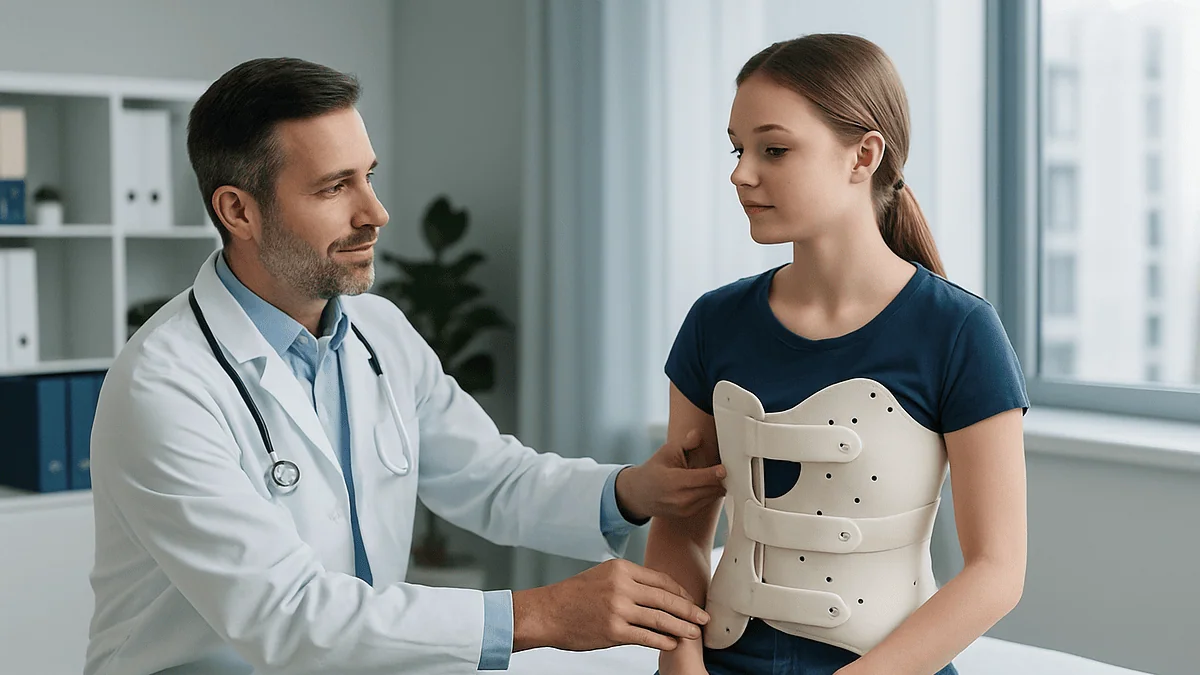
Key Takeaways
- Scoliosis is defined as a sideways spinal curve of 10 degrees or more on the Cobb angle, and moderate curves in growing children are the ones typically considered for bracing.
- In the BrAIST randomized trial, curves stayed below the 50-degree surgical threshold in 72 percent of braced adolescents versus 48 percent of those only observed, a difference large enough that the trial was stopped early.
- Wear time drove results in that trial: fewer than about six hours a day performed no better than no brace, while averaging nearly 13 hours or more was linked to success rates above 90 percent.
- In-brace X-rays often show the curve reduced, but the out-of-brace curve at skeletal maturity usually settles close to its starting size; stability, not straightness, is the measured goal.
- Bracing stops when growth stops, judged by markers such as a Risser grade of 4 to 5, height no longer changing, and, per Mayo Clinic, roughly two years after a girl's first period.
- Adults have no open growth plates, so a brace cannot modulate vertebral growth after adolescence; adult scoliosis is managed mainly through exercise, physiotherapy, symptom control and, for a minority, surgery.
A scoliosis brace is not designed to straighten the spine permanently. Its realistic aim is to stop a moderate curve from getting worse while a child is still growing, so that surgery may be avoided. Curves often look smaller on an X-ray taken in the brace, but that in-brace correction usually eases once bracing ends. Whether bracing is appropriate, and for how long, is a decision for the treating team.
The X-ray goes up on the screen and a thirteen-year-old leans forward, reading her own spine like a weather map. The curve is there, a gentle S where a straight line should be. Her mother asks the question everyone asks in that room: if she wears the brace, will it go away?
It is a fair question, and the answer deserves more honesty than most brochures and video thumbnails give it. People typing “scoliosis brace straighten spine” into a search bar are usually hoping for a yes. What the evidence supports is something quieter and, in its own way, more useful: a well-worn brace can hold a growing curve where it is, and holding is often the whole point.
This explainer walks through what bracing actually does inside the body, who is usually offered it, what the first weeks feel like, and where the hype outruns the data. Every figure here comes from mainstream medical sources, and every decision stays with the team looking after the person in the brace.
Does a scoliosis brace straighten the spine? The honest short version
Start with the word itself. “Straighten” implies a finished product: a spine that was curved and is now not. That is not the goal medical teams set when they prescribe a brace, and it is worth being clear about why before looking at any numbers.
Scoliosis is a sideways curve of the spine measured on an X-ray. The measurement is called the Cobb angle, which is simply the angle between the most tilted vertebra at the top of the curve and the most tilted one at the bottom. A curve of 10 degrees or more counts as scoliosis according to the Mayo Clinic. Most cases in teenagers have no identifiable cause and are labelled idiopathic, a word that just means “of unknown origin.”
A brace works from the outside in. It presses on the ribs and pelvis to nudge the curve toward center while the person is wearing it. On an X-ray taken in the brace, the Cobb angle often reads smaller than it did without the brace. That is the image many online videos use, and it is genuinely real. What the videos rarely show is the follow-up X-ray taken out of the brace after treatment ends, which typically settles back close to where the curve started, sometimes a little better, sometimes not.
So the realistic aim, in the language used by the NHS and Mayo Clinic, is to stop the curve from progressing during the years of fastest growth. If the curve is roughly the same size at skeletal maturity as it was at the start, the brace has done its job. A person can then live a full adult life with a stable, moderate curve and, in most cases, no operation. Framed that way, “the brace didn’t straighten it” and “the brace worked” can both be true at once.
How a scoliosis brace actually works: pressure, growth and time
Picture a young sapling tied to a stake. The tie does not make the trunk straight overnight; it stops the trunk from leaning further while the wood is still soft. A scoliosis brace relies on a similar logic, with two mechanisms working together.
The first is mechanical. Inside a rigid brace, an orthotist (the health professional who designs and fits braces) shapes firm pads to press against the outward bulge of the curve, usually over the ribs on one side and the waist or pelvis on the other. Opposite each pad is an open “relief” area with nowhere for the body to push back, so the trunk shifts toward that space. This is often called three-point pressure. The spine, connected to those ribs and that pelvis, follows.
The second mechanism is biological, and it is the reason bracing is only offered while a person is growing. Vertebrae grow from cartilage plates at their top and bottom, much like the growth plates in the long bones of the legs. On the inner side of a curve those plates are compressed and tend to grow more slowly; on the outer side they are stretched and grow faster, which is part of why an untreated curve can worsen during a growth spurt. By unloading the compressed side, a brace aims to even out that growth so the vertebrae do not become more wedge-shaped over time.
Neither mechanism does anything when the brace is off, which is why wearing time turns out to matter so much. And once the growth plates close in late adolescence, the second mechanism disappears entirely. Pressure on a mature spine can reposition it temporarily, but it cannot change how the bones grow, because they have stopped. That single fact explains most of what follows about who is braced, for how long, and why adults are usually offered something different.
What counts as success in bracing, and what the trial data actually show
Because the goal is holding rather than straightening, researchers define success in a way that surprises many families: a braced curve is counted as a success if it stays below the size at which surgery is usually discussed by the time growth finishes.
The most influential evidence comes from a randomized trial known as BrAIST, published in the New England Journal of Medicine and indexed on PubMed. It enrolled adolescents aged 10 to 15 with curves of 20 to 40 degrees and significant growth remaining, and compared bracing with watchful observation. Treatment was called a failure if the curve progressed to 50 degrees or more, the threshold commonly linked to surgical discussion.
The trial was stopped early because the difference was clear. Curves stayed under 50 degrees in 72 percent of the braced group compared with 48 percent of those simply observed. Notice what those figures do not say: they do not report how many spines became straight, because that was never the outcome being tested. A later Cochrane systematic review of bracing for adolescent idiopathic scoliosis drew on this and other studies and concluded that bracing does appear to curb curve progression, while grading the overall quality of evidence as low to very low and calling for better trials.
Two honest caveats belong here. First, 48 percent of unbraced curves in BrAIST also stayed below 50 degrees, so some children who wear a brace for years might have done fine without it; no one can yet reliably tell which ones in advance. Second, a Cobb angle can vary by a few degrees between two readings of the same X-ray, so a curve reported as “one degree better” or “two degrees worse” at a check-up is usually within the noise of measurement rather than a real change. Teams tend to look for a consistent trend across several visits before drawing conclusions.
Who is usually offered a scoliosis brace, and who is usually asked to wait
Three things drive the decision: how big the curve is, how much growth is left, and whether the curve has been getting worse. Bracing lives in the middle of all three.
On size, the Mayo Clinic describes braces as an option for children with moderate scoliosis whose bones are still growing. In practice, and in the BrAIST trial, that has meant curves roughly in the range of 20 to 40 degrees. Curves smaller than that are usually watched with repeat X-rays, because most never progress far enough to need treatment. Curves already well beyond 40 degrees in a growing child are more likely to be discussed in terms of surgery, since bracing has a weaker track record of holding very large curves.
On growth, clinicians estimate skeletal maturity rather than relying on birthdays. Two common tools are the Risser sign, a grade from 0 to 5 based on how much of the pelvic rim has turned to bone on the X-ray, and hand X-rays that show how close the finger bones are to finishing growth. A child with lots of growth remaining has more risk of progression and more potential benefit from bracing. A teenager near the end of growth has less of both.
On behavior of the curve, a documented increase between visits pushes teams toward action, while a curve that has sat still for a year may simply keep being observed.
Some people are usually asked to wait rather than start. That includes children with small curves, those whose curves have not changed across several visits, and those very near skeletal maturity, where a few months of watching costs little. Bracing decisions also differ for scoliosis caused by neuromuscular conditions or spinal malformations, and for very young children with early-onset curves, where casting and other approaches enter the conversation. None of these thresholds is a rule that applies to every child; they are the framework a treating team works within.
Types of scoliosis braces compared
Braces are described by the part of the trunk they enclose and by when they are worn. The acronyms are not as intimidating as they look: TLSO stands for thoracolumbosacral orthosis, meaning a support that spans the chest, lower back and pelvis, and CTLSO adds the neck (cervical) section. The table summarizes the main families in neutral terms; no single design has been shown in high-quality trials to be superior for everyone.
| Brace family | What it covers | Typical wear pattern | What the evidence and guidance say |
|---|---|---|---|
| Rigid underarm TLSO | Chest to pelvis, fits under clothing | Most of the day and night, often around 13 to 16 hours or more | The most studied type; the BrAIST trial used rigid TLSOs and showed reduced progression |
| Full-torso CTLSO with neck ring | Neck to pelvis | Most of the day | An older design, now used less often, mainly for curves high in the chest |
| Nighttime bending brace | Chest to pelvis, molded to hold the trunk bent against the curve | Sleeping hours only | Studied mainly in smaller observational series; evidence weaker than for full-time rigid braces |
| Flexible or elastic-strap brace | Straps and soft shell around the torso | Daytime, hours vary | Limited and mixed evidence; not shown to match rigid bracing in controlled studies |
Two things the table cannot show matter as much as design. Fit is one: a brace built from a careful body scan or cast, then adjusted at follow-up, applies pressure where the curve is and not where it is not. Wear time is the other, and it is where most of the difference between good and disappointing results seems to come from. The orthotist and prescribing clinician together decide which family suits a particular curve, and that choice is part of the treatment plan rather than a matter of consumer preference.
Can you straighten a spine with scoliosis? In-brace correction versus lasting change
The clearest way to separate hope from evidence is to talk about two different X-rays.
The first is taken a few weeks after fitting, with the brace on. Orthotists aim for a visible reduction in the Cobb angle on this image; a brace that does not move the curve at all is usually adjusted. This in-brace correction is real and is thought to be a marker of a well-made brace. It is also the image that fuels the idea that a plastic shell can straighten a spine, because the before-and-after looks dramatic.
The second X-ray is taken at the end of treatment, without the brace, once growth has finished. This one answers the question families actually care about. In most studies of full-time rigid bracing, the final out-of-brace curve sits close to the starting curve. Some people end a little better than they began, some a little worse, and a minority progress despite good compliance. What bracing reliably shifts is the proportion who reach the surgical range, not the average size of the curve at the finish line.
Why does the spine spring back? Because the pressure that repositioned it is gone, and the modest change in vertebral growth that bracing may encourage over several years is not large enough to erase a curve that was already established. A moderate curve involves rotated and slightly wedged vertebrae, tight tissues on one side and stretched ones on the other, and a brace addresses only part of that picture.
So can you straighten a spine with scoliosis? Not with a brace, in the permanent sense the word implies. Surgery can reduce and hold a curve substantially, which is why it is discussed for larger curves, and that carries its own risks and trade-offs. For a moderate curve in a growing child, the aim that the evidence supports is stability, and stability is a good outcome, not a consolation prize.
How long to wear a scoliosis brace each day, and why the hours matter so much
Ask an orthotist what predicts a good result and most will say the same thing before they mention brace design: hours on the body.
The Mayo Clinic notes that braces are typically worn between 13 and 16 hours a day and that effectiveness increases with the number of hours worn. The BrAIST trial built hidden temperature sensors into every brace to record actual wear rather than relying on diaries, and the pattern it found was strikingly dose-dependent. Adolescents who wore the brace for less than about six hours a day fared no better than those who wore no brace at all. Those who averaged nearly 13 hours or more had curves that stayed below 50 degrees in the large majority of cases, a rate the trial reported at over 90 percent.
That gap is the single most useful fact a family can take from this article. It also reframes an uncomfortable truth: many braces that “fail” were simply not worn enough to have a chance. The brace only works when it is on, and a spine that is out of the brace for most of the day is, for practical purposes, unbraced.
Prescriptions vary. Some teams ask for wear through the night and most of the day, coming off for sport, showering and physical education. Others prescribe nighttime-only designs for smaller or lower curves. The prescribing clinician sets the target hours for a given curve, and that number is part of the medical plan rather than a suggestion.
Practical details make the hours achievable. A thin, seamless cotton layer under the shell reduces sweat and chafing. Loose tops and higher waistbands hide the outline. Many teenagers find it easier to build wear time gradually over the first fortnight than to attempt full hours on day one, and orthotists usually plan for that. Wear that becomes routine, like brushing teeth, tends to hold up better than wear that requires a daily negotiation.
What the first weeks in a scoliosis brace usually look like
Between the decision and the routine sits an awkward, sometimes tearful stretch that no one should have to face without a map.
Fitting comes first. The orthotist takes a plaster cast or a digital scan of the trunk, sometimes with the person holding a corrected posture, and builds the shell from that. A fitting appointment follows, where straps are set, edges are trimmed and pads are positioned. Expect this visit to take time; a brace that is close but not quite right is adjusted on the spot, and small pressure points that seem trivial in the clinic become unbearable at 2 a.m.
The break-in period is next, and orthotists commonly spread it over one to two weeks, adding an hour or two at a time until the prescribed hours are reached. Skin under the pads goes pink, and that is expected; skin that stays red for a long time after the brace comes off, or that breaks, is a signal to call the orthotist for adjustment rather than to push through. Heat is the other early complaint, and it is a legitimate one in summer.
An X-ray in the brace is usually taken a few weeks after fitting to confirm the pads are moving the curve. If they are not, the brace goes back to the workshop.
Then the rhythm settles into check-ups. The NHS and Mayo Clinic describe follow-up for growing children with scoliosis at intervals of roughly four to six months, typically with an X-ray, so the team can track the Cobb angle over time and check the brace still fits a body that is growing and changing shape. Growth spurts often mean a new brace within a year or two.
Emotionally, the first weeks are often the hardest. Body image, the fear of being noticed at school and the loss of spontaneity all land at once. Many teams involve a nurse, psychologist or peer support group early, and asking for that support is a sign of taking the treatment seriously, not of struggling with it.
What are the disadvantages of a scoliosis brace? Scoliosis brace disadvantages, stated plainly
Any treatment worth taking seriously has costs that are not measured in money, and bracing has several. Families deserve to hear them before they start, not discover them in week three.
Discomfort is the most immediate. A rigid shell presses on ribs and hips by design, and early pressure sores, chafing and heat rash are common until the fit is refined. Skin checks each evening become part of the routine.
Daily life changes shape. Bending to tie shoes, slumping on a sofa and eating a large meal all feel different inside a hard shell. Some sports are done out of the brace, which trades wear hours for activity; teams generally encourage staying active because fitness and bone health matter, but the arithmetic of hours has to be managed.
The psychosocial load is real and often underestimated by adults. Adolescence is a period when standing out feels dangerous, and a brace can feel like a visible label. Studies of quality of life during bracing report measurable effects on body image and self-esteem in some teenagers, alongside many who adapt well. The Cochrane review noted that evidence on quality of life is limited, which is itself a disadvantage: families are making a years-long commitment with less information about the emotional side than about the X-rays.
There is also the uncertainty problem. Roughly half of untreated moderate curves in the BrAIST observation group stayed below the surgical range on their own, so some children endure years of bracing they may not have needed, and there is currently no reliable test to identify them beforehand. Genetic and imaging markers are being studied but are not established tools.
What bracing does not do is weaken the back in any lasting way when activity is maintained, despite a persistent belief to the contrary. Nor does it cause the curve to worsen. Those two fears, at least, the evidence does not support.
At what age do you stop bracing for scoliosis? When to stop a scoliosis brace
There is no birthday at which a brace comes off. Bracing stops when growth stops, and the treating team estimates that moment from the body rather than the calendar.
The Mayo Clinic describes the usual markers: braces are discontinued after the bones stop growing, which typically occurs about two years after a girl’s first period, when a boy needs to shave daily, and when height has stopped changing over successive visits. On X-ray, the team looks for a Risser grade of 4 or 5, meaning the pelvic rim has largely finished turning to bone, and for closed growth plates in the hand and wrist. Because girls generally reach skeletal maturity earlier than boys, bracing tends to end at a younger age in girls, but the range in both sexes is wide.
Stopping is often gradual. Many teams taper wear hours over several months rather than removing the brace overnight, partly so that a follow-up X-ray out of the brace can confirm the curve holds steady without support. If the out-of-brace curve is stable across a couple of visits, the brace is retired.
Several practical points follow. A teenager who started bracing late, with little growth left, may be in a brace for only a year or so, while a child braced at ten may wear one for five years or more. The length of treatment is set by biology, not by a fixed schedule.
Stopping the brace early against medical advice, a temptation that peaks around exam seasons and summer, removes protection during exactly the period when a final growth spurt can push a curve upward. The team can often accommodate specific events by adjusting hours; a conversation about that is far better than a quiet decision to leave the brace in the closet.
Once growth has finished, monitoring usually continues at longer intervals, because large curves can slowly progress in adulthood, though stable moderate curves often do not.
Is it too late to fix scoliosis as an adult? What a scoliosis brace for adults can and cannot do
Many adults discover, or rediscover, a curve in their thirties or fifties and go looking for the treatment they read about for teenagers. The honest answer has two parts.
The first part is about mechanism. The growth-modulating half of how bracing works depends on open growth plates, and an adult spine has none. A brace on an adult can reposition the trunk while it is worn and may support tired muscles, but it cannot change how the vertebrae are shaped, so it does not reduce the curve in any lasting way. The NHS is clear that back braces are not routinely recommended for adults with scoliosis for the purpose of correcting the curve. Some adults with pain are offered a soft support for short periods to help them stay active, and that is a comfort measure rather than a corrective one.
The second part is more encouraging. “Too late” assumes that fixing the angle is the goal, and for most adults it is not. Adult scoliosis is usually managed around symptoms: pain, stiffness, and in larger curves the effects of the trunk leaning forward or sideways. The mainstays described by MedlinePlus and the NHS are staying active, structured exercise and physiotherapy to strengthen the trunk and improve posture, pain management guided by a clinician, and, for a minority with severe or progressing curves or nerve compression, surgical options. Medicines used for pain in this setting work on inflammation or nerve signaling and are chosen by the prescribing clinician; they do not act on the curve itself.
Progression in adulthood is generally slow and is more likely with larger curves and with age-related disc and joint degeneration. A stable moderate curve that causes little trouble may simply be checked periodically.
So the question is better reframed. It is rarely too late to manage adult scoliosis well. It is, after growth, too late for a brace to do the job it does in children.
Do exercises, night braces and "corrective" braces do what the ads say? The evidence, graded
Search results for scoliosis are crowded with confident claims: braces that promise correction, exercise systems that promise reversal, devices marketed with dramatic before-and-after images. Grading each against the evidence is more useful than dismissing them wholesale.
Scoliosis-specific exercise programs, of which the best-known family originated in Germany and trains the person to actively de-rotate and elongate the trunk, are offered by physiotherapists in many countries. Small trials and observational studies suggest they may modestly slow progression or improve posture and pain in some adolescents, and international scoliosis societies include them as an option alongside bracing. Mainstream sources such as the Cleveland Clinic describe them as a supportive approach. What the evidence does not show is that exercise alone reliably prevents progression in curves that would otherwise reach surgical size, and no exercise program has been shown to straighten a structural curve. Grade: low-certainty evidence for benefit as an adjunct; not a substitute for bracing where bracing is indicated.
Nighttime bending braces have a real rationale: because they are worn lying down, they can bend the trunk further than a daytime brace could tolerate, and they are easier to live with. Their evidence base consists mostly of smaller, non-randomized series rather than trials of the size and design of BrAIST. Grade: plausible, with weaker evidence than full-time rigid bracing.
Flexible strap-based braces have produced mixed results in the studies available and have not matched rigid bracing in controlled comparisons. Grade: unproven as an equivalent.
Chiropractic manipulation, inversion tables, posture-correcting garments and dietary supplements have no reliable evidence of altering a scoliosis curve. Grade: not supported.
General exercise, from swimming to strength training, is encouraged for everyone with scoliosis, braced or not, for the same reasons it is encouraged for anyone. It will not close a curve, and it will not open one either.
What people often get wrong about scoliosis bracing
Several myths travel from waiting room to search engine and back. Correcting them saves families disappointment and, sometimes, unnecessary treatment.
The first is the one this article is built around: that the brace will straighten the spine. It aims to hold the curve, and holding it below the surgical range is the measured definition of success.
The second is that a brace that does not shrink the curve has failed. If the out-of-brace Cobb angle at skeletal maturity is close to where it began, the treatment achieved its purpose. Failure is defined by progression, not by the absence of improvement.
The third is that wearing the brace some of the time is better than nothing. The BrAIST sensor data showed that wear below a few hours a day produced results indistinguishable from observation. Half-hearted bracing is close to no bracing, with all of the burden and little of the benefit.
The fourth is that bracing weakens the back or makes the curve dependent on the shell. When people stay active outside the brace, studies have not found lasting muscle weakness, and curves do not worsen because of bracing.
The fifth is that scoliosis is caused by heavy backpacks, poor posture or sleeping position. Adolescent idiopathic scoliosis has no identified cause, and none of those habits produce a structural curve. They may cause backache, which is a separate problem.
The sixth is that a small curve found early can be “treated” so it never grows. Small curves are watched rather than braced precisely because most never progress; bracing them would expose many children to years of treatment for no gain.
The seventh is that adults can expect the same results as teenagers. Without growth, a brace cannot modulate the vertebrae, and adult management centers on symptoms.
The last is that bracing is a one-off decision. It is a years-long relationship with an orthotist and a clinician, revisited at every check-up as the body changes.
Questions to ask your care team about a scoliosis brace
The most useful appointments are the ones where the family arrives with questions written down. These are the ones orthopedic teams and orthotists say they wish they were asked more often.
- How large is the curve now, how much has it changed since the last X-ray, and how much growth do you estimate is left?
- What is the specific goal of bracing for this curve, and how will we know at each visit whether it is being met?
- Which type of brace are you recommending, and why that design rather than the alternatives for this particular curve pattern?
- How many hours a day are you prescribing, and which activities should be done in the brace or out of it?
- What happens if the in-brace X-ray shows little correction? Is the brace adjusted, remade or reconsidered?
- How often will we return for check-ups and X-rays, and how is X-ray exposure kept as low as possible over the years of treatment?
- What signs of skin trouble, pain or breathing discomfort should prompt a call between visits?
- Is there a role for scoliosis-specific physiotherapy alongside the brace, and what would it aim to add?
- What is the plan if the curve progresses despite good wear, and at what point would surgery be discussed?
- What support is available for the emotional side of wearing a brace, including peer groups or a psychologist?
- How will the decision to stop bracing be made, and will the brace be tapered or removed at once?
- Once bracing ends, what follow-up is planned into adulthood?
Bring the brace to appointments, along with a candid estimate of actual daily wear. Teams can only adjust a plan that reflects reality, and an honest “about nine hours” is far more useful than an optimistic “most of the day.” The person wearing the brace should be asked these questions directly too; teenagers who feel ownership of the plan tend to keep to it better than those who feel it is being done to them.
When to call your doctor during scoliosis bracing
Most of bracing is unremarkable maintenance: skin checks, strap adjustments and the slow accumulation of hours. A few situations warrant a prompt call to the treating team or orthotist rather than waiting for the next scheduled visit.
Contact the team soon if the skin under the brace develops an open sore, a blister, or redness that does not fade within a short time after the brace comes off, since these usually mean the fit needs changing. Do the same if a previously comfortable brace suddenly becomes painful or clearly does not fit, which often signals a growth spurt and the need for adjustment or a new shell. New numbness, tingling or pins-and-needles in the legs or feet, or new weakness, should be reported the same day; a brace should not press on nerves, and these symptoms can also point to a spinal problem unrelated to the brace that needs assessment.
Seek urgent medical care for any of the following: difficulty breathing or chest pain that comes on with the brace, loss of bladder or bowel control, sudden severe back pain, or a rapid visible change in the shape of the back or the level of the shoulders. These are not typical features of idiopathic scoliosis and need evaluation regardless of bracing.
Between visits, also call if wear hours are consistently falling well short of the prescription. That is not a confession to be avoided; it is exactly the information the team needs, and there are often practical fixes, from padding changes to revised schedules, that make the target achievable.
Finally, if something about the plan no longer makes sense to the family, ask for a conversation. Treatment decisions for scoliosis, including whether to continue, change or stop bracing and whether surgery should be discussed, belong with the treating team who know the individual curve, the growth remaining and the person inside the brace.
Frequently asked questions
Can you straighten a spine with scoliosis using a brace?
No, not in a lasting sense. A brace can reduce the curve on an X-ray while it is being worn, but the aim of bracing is to stop a moderate curve from progressing during growth, not to make the spine straight. When treatment ends, the out-of-brace curve usually returns close to its original size. Surgery is the only treatment shown to substantially and durably reduce a structural curve, and it is reserved for larger curves.
What are the disadvantages of a scoliosis brace?
The main disadvantages are physical discomfort, especially early on, with pressure marks, heat and skin irritation; restrictions on bending and some activities; and the emotional weight of wearing a visible device through adolescence. There is also uncertainty, since some curves that are braced would have stayed stable on their own and no test yet reliably identifies them. The evidence does not support fears that bracing weakens the back or worsens the curve.
Is it too late to fix scoliosis as an adult?
It is too late for a brace to change the curve, because bracing relies partly on open growth plates that adults no longer have. It is not too late to manage adult scoliosis well. Care usually focuses on staying active, physiotherapy to strengthen the trunk, pain management guided by a clinician, and periodic monitoring, with surgery considered only for severe or progressing curves or nerve problems. Decisions rest with the treating team.
At what age do you stop bracing for scoliosis?
There is no set age; bracing stops when the skeleton has finished growing. The Mayo Clinic describes typical markers as about two years after a girl’s first period, when a boy needs to shave daily, and when height has stopped changing, alongside X-ray signs such as a mature Risser grade. Girls usually reach this point earlier than boys. Many teams taper wear hours and confirm the curve is stable out of the brace before stopping.
How long to wear a scoliosis brace each day?
The prescribing clinician sets the hours, and the Mayo Clinic notes braces are typically worn 13 to 16 hours a day, with effectiveness increasing with wear time. The BrAIST trial found that wear below about six hours a day produced results similar to no brace, while averaging nearly 13 hours or more was linked to much better outcomes. Nighttime-only designs exist for selected curves, but their evidence base is weaker.
Will wearing a back brace only at night straighten my spine?
A nighttime brace will not straighten the spine, and neither will a daytime one. Night braces are molded to hold the trunk bent against the curve while lying down and aim, like all braces, to slow progression during growth. The studies supporting them are mostly smaller observational series rather than large randomized trials, so the evidence is weaker than for full-time rigid bracing. Whether a night brace suits a given curve is a decision for the treating team.
Does a scoliosis brace hurt?
It is often uncomfortable at first and should not be truly painful once fitted properly. Pressure pads are designed to push firmly on the ribs and pelvis, so pink skin after removal is expected, but redness that does not fade, blisters or sore spots mean the fit needs adjusting. Most orthotists build up wear time over one to two weeks. Sudden new pain in a previously comfortable brace usually signals growth and the need for a refit.
What happens if the curve keeps growing despite the brace?
The team first checks actual wear hours and brace fit, since under-wear and poor fit explain many apparent failures. If a well-worn, well-fitted brace still cannot hold the curve, options are re-discussed, and for curves approaching or passing roughly 50 degrees in a growing child, surgery becomes part of the conversation. Progression is a shared decision point with the treating team, not a verdict on the child’s effort.
Can exercises replace a scoliosis brace?
Current evidence does not support exercise as a substitute for bracing where bracing is indicated. Scoliosis-specific physiotherapy programs may modestly help posture, pain and possibly progression as an add-on, and general activity is encouraged for everyone with scoliosis, but no exercise program has been shown to straighten a structural curve or to match bracing in preventing curves from reaching surgical size. Ask the care team whether physiotherapy has a role alongside the brace.
Is a scoliosis brace for adults ever recommended?
Occasionally, but for comfort rather than correction. The NHS notes braces are not routinely recommended for adults, because without growth a brace cannot alter the shape of the vertebrae. Some adults with back pain are offered a soft support for short periods to help them stay active during a flare. Long-term reliance is generally discouraged in favor of strengthening exercise. The choice depends on symptoms and belongs with the treating clinician.
References
This article is for general information only and is not a substitute for professional medical advice. Please consult a qualified doctor about your individual situation.

More from the Blog

Can Exercise Replace a Scoliosis Brace? Bracing Myths Spine Specialists Correct
Exercise cannot replace a scoliosis brace for a growing child whose curve has reached the range where guidelines recommend bracing, usually about 25 to…

When Is Spine Surgery Actually Necessary? Red Flags, Failed Conservative Care and Nerve Damage
Spine surgery is usually necessary in three situations: urgent nerve compression with new bladder, bowel or leg weakness (a possible cauda equina syndrome); progressive…

Life After Spinal Fusion: Bending, Lifting, Desk Work and the Movements to Relearn
Life after spinal fusion usually means a few months of protected movement, then a gradual return to most ordinary activities. Bending, lifting and twisting…

Spinal Stenosis Surgery in Your Seventies: How Fitness, Not Age, Guides the Decision
Spinal stenosis surgery is not ruled out by age alone. Surgeons assess physical fitness, heart and lung health, frailty, bone quality and other medical…

Your First Schroth Assessment: X-Rays to Bring, What to Wear and What the Therapist Checks
For a first Schroth appointment, bring your most recent full-spine standing X-ray (the actual images or a digital copy, plus the radiologist's report with…
Spinal Compression Fractures Explained: When Kyphoplasty or Vertebroplasty Is Considered
Most spinal compression fractures are treated without surgery: short-term pain control, gradual return to movement, sometimes a brace, and treatment of the underlying osteoporosis.…