

When Is Scoliosis Surgery Recommended? Curve Size, Progression and Symptoms That Matter
Key Takeaways
- Surgery for adolescent idiopathic scoliosis is usually considered at a Cobb angle of about 45 to 50 degrees or more, especially when the curve is still progressing.
- A change of under about 5 degrees between X-rays may be measurement variation rather than true progression, so surgeons look for a consistent trend across several films.
- Bracing only works while bone is still growing; in a major trial, 72 percent of braced adolescents avoided progression to 50 degrees compared with 48 percent of those observed.
- Curves above roughly 50 degrees in the thoracic spine tend to keep worsening slowly through adult life, which is why they are treated differently from smaller curves.
- In adolescents, pain alone is rarely the reason for surgery; in adults, symptoms such as nerve compression and loss of balance usually matter more than the angle.
- Full recovery from spinal fusion is described by the NHS as taking up to about a year, with most adolescents returning to school within a few weeks.
Scoliosis surgery is usually recommended when a curve measures about 45 to 50 degrees or more on the Cobb angle, is still progressing, and is likely to keep worsening into adulthood. Doctors also weigh remaining growth, pain, breathing or nerve symptoms, and how the curve affects daily life. Smaller or stable curves are usually monitored or braced, and the final decision rests with the treating team.
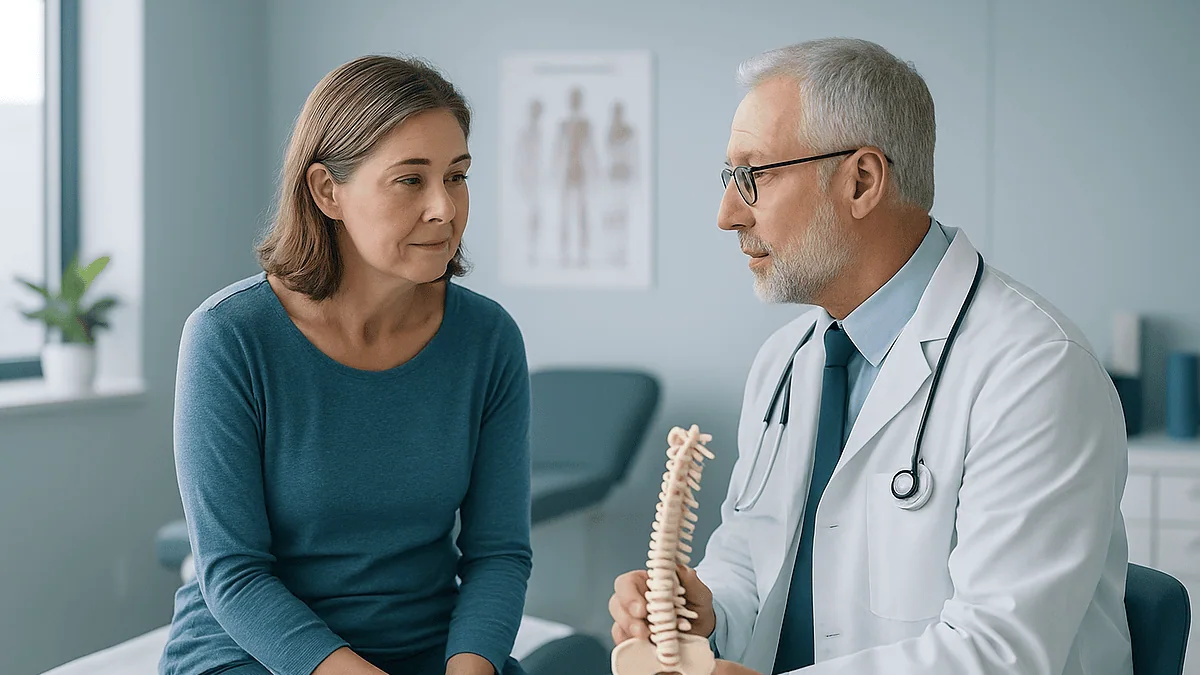
The clinic letter arrives, and one line jumps out: “curve now measures 47 degrees, discussed surgical options.” A parent reads it three times. A sixteen-year-old reads it once and goes quiet. Somewhere between those two reactions sits the question families carry into the next appointment: has this crossed a line, or is there still room to wait?
Answering “when is scoliosis surgery recommended” is less about a single magic number than people expect. Spine surgeons look at the angle, yes, but also at how fast it is changing, how much growing is left, and whether the curve is doing anything to the person beyond showing up on an X-ray. Two teenagers with identical measurements can reasonably be given different advice.
This explainer walks through the thresholds that actually guide the decision, what the operation involves, who is usually asked to wait, and the questions worth bringing to your care team.
When is scoliosis surgery recommended? The thresholds in plain language
Scoliosis is a sideways curvature of the spine, most often appearing during the growth spurt before puberty. Most curves never need an operation. The NHS notes that most children with scoliosis need no treatment at all beyond monitoring, because the curve stays mild, and that surgery is reserved for the minority whose curves are severe or clearly worsening.
The working rule across major reference sources is reasonably consistent. Curves below roughly 25 degrees in a growing child are usually watched with periodic X-rays. Curves between about 25 and 40 degrees in a child who is still growing are often treated with a brace, which aims to slow progression rather than reverse it. Surgery enters the conversation when a curve reaches about 45 to 50 degrees, particularly if it is still increasing, because curves of that size tend to keep progressing even after growth stops, according to the NIH’s National Institute of Arthritis and Musculoskeletal and Skin Diseases and the Mayo Clinic.
Three things usually have to line up before a surgeon recommends an operation:
- The curve is large, generally in the 45 to 50 degree range or above.
- The curve is progressing, or is predicted to progress based on age and growth stage.
- The benefit of stopping that progression outweighs the risks of surgery for that particular person.
Notice what is not on the list: a date on the calendar, a parent’s worry level, or how the back looks in a photograph. Appearance can matter to the person living with the curve, and surgeons do take it seriously, but it is weighed alongside the measurements rather than driving them. The rest of this article unpacks each of these factors, because the details change the answer more than the headline number does.
What the Cobb angle measures, and why 45 to 50 degrees is the line surgeons watch
The Cobb angle is the standard way to put a number on a scoliosis curve. A radiologist or surgeon identifies the most tilted vertebra at the top of the curve and the most tilted one at the bottom, draws a line along each, and measures the angle where those lines meet. A perfectly straight spine scores zero. Scoliosis is formally defined as a Cobb angle of 10 degrees or more, as the Johns Hopkins and Cleveland Clinic patient resources describe.
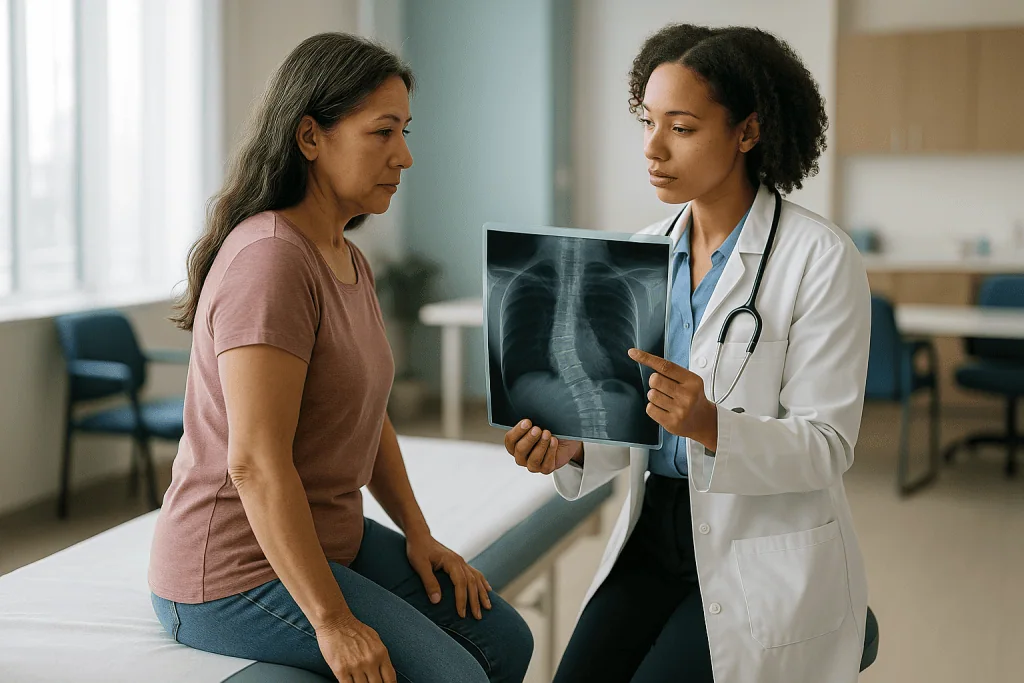
The number is useful but imperfect. Measurement error of around 5 degrees between readings is common, which is why a change from 32 to 35 degrees on consecutive X-rays may not mean the curve has truly moved. Surgeons look for consistent change across several films, not a single jump.
Why does 45 to 50 degrees carry so much weight? Two reasons appear repeatedly in the evidence summarized by the NIH and Mayo Clinic. First, curves in this range are less likely to be held in check by bracing, because a brace works by applying pressure to a spine that still has growth left to redirect, and large curves tend to overpower it. Second, curves above about 50 degrees in the chest region have a tendency to continue increasing slowly through adult life even after the skeleton matures, so the problem does not simply stop when growth does.
A curve in the lower back, called a lumbar curve, can cause trouble at somewhat smaller angles because it sits where the spine bears the most load and where back pain in later life tends to concentrate. A curve in the upper back, called a thoracic curve, has more room before it affects the chest cavity. This is one reason your surgeon’s threshold may be a little higher or lower than the figure you read online.
Scoliosis surgery age: why remaining growth changes the advice
Growth is the engine that drives most scoliosis progression. A curve in a nine-year-old with years of growing ahead behaves very differently from the same curve in a seventeen-year-old whose growth plates have nearly closed. That is why age, or more precisely skeletal maturity, matters as much as the angle itself.
Skeletal maturity is the point at which the bones have finished lengthening. Surgeons estimate it from several clues: the person’s age, whether menstruation has begun (growth typically slows within about two years afterward), and a scale read from the pelvis on an X-ray called the Risser sign, which grades the bony cap on the hip bone from 0 (lots of growth left) to 5 (growth complete). The Cleveland Clinic and Mayo Clinic both describe these as routine parts of a scoliosis assessment.
The practical consequences look like this:
- A 30-degree curve in a child who is Risser 0 has a meaningful chance of progressing and is a typical candidate for bracing and close follow-up.
- The same 30-degree curve in a teenager who is Risser 4 or 5 is far less likely to grow and is usually observed.
- A 48-degree curve in a child with substantial growth remaining is likely to keep worsening, which is why surgery is often recommended sooner rather than later in that situation.
Very young children are a special case. In early-onset scoliosis, meaning curves that appear before about age ten, surgeons try to avoid fusing the spine while the chest and lungs are still developing. Instead they may use growth-friendly techniques, discussed later, that control the curve while allowing the spine to lengthen. Standard fusion is generally delayed until closer to maturity in these children.
For adults, growth is no longer the question. The calculation shifts to pain, nerve symptoms, balance and the slow creep of large curves over decades, covered in its own section below.
How doctors judge whether a scoliosis curve is progressing
A single X-ray tells you where the curve is today. It cannot tell you where it is heading. Progression is judged by comparing films taken months apart, and the interval between them is tailored to risk. The NHS describes regular monitoring with X-rays every few months for children whose curves are being watched, with the gap lengthening once growth is nearly complete.
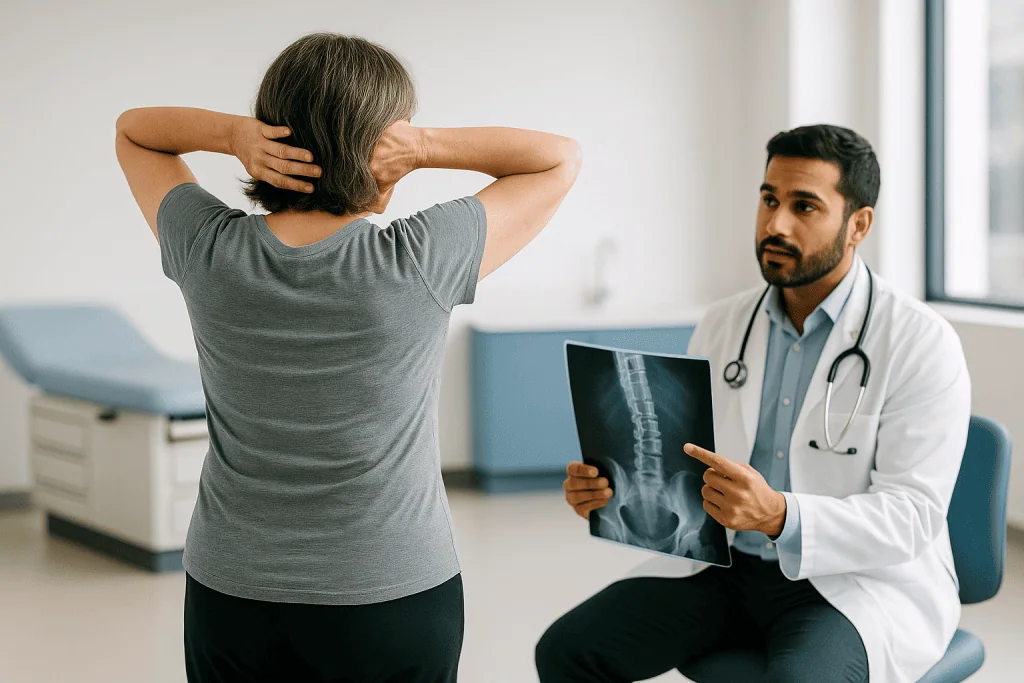
Surgeons generally consider a curve to be progressing when it has increased by more than the measurement error, usually taken as 5 degrees or more between visits, and when that trend holds up on repeated imaging. A curve that measures 28, then 29, then 27 is stable. One that measures 28, then 34, then 41 is moving, and the pace matters: a jump of 6 degrees in six months during a growth spurt is a very different signal from the same change spread over three years.
Several features raise the predicted risk of progression, and clinicians weigh them together rather than in isolation:
- A larger starting angle, since bigger curves tend to grow faster.
- More growth remaining, as described in the previous section.
- Curves in the thoracic region, which progress more often than purely lumbar ones in adolescents.
- Female sex, which carries a higher likelihood of progression in idiopathic scoliosis, according to the NIH and Mayo Clinic summaries.
Idiopathic means no identifiable cause, and it accounts for roughly 8 in 10 cases of scoliosis. Curves caused by a neuromuscular condition such as cerebral palsy or muscular dystrophy, or by a vertebra that formed abnormally before birth, follow their own patterns and are often more aggressive. The surgical threshold in those settings is set case by case rather than by the adolescent idiopathic rules.
Radiation exposure from repeated X-rays is a reasonable concern, and most centers now use lower-dose imaging protocols for scoliosis follow-up. It is a fair question to raise at any visit.
Which symptoms actually push the decision toward surgery, and which do not
Here is a point that surprises many families: in adolescents, pain alone is rarely the reason surgery is recommended. Mild back ache is common in teenagers with and without scoliosis, and operating on a moderate curve does not reliably resolve it. The decision in young people is driven mainly by curve size and progression, with symptoms as supporting evidence rather than the trigger.
That changes with severity and with age. Symptoms that genuinely shift the balance include:
- Reduced lung capacity from a large thoracic curve, usually above 70 degrees, where the ribcage rotates and compresses the chest. The NIH notes that very severe curves can affect breathing, and in those cases surgery may be recommended to protect lung function rather than to straighten the back.
- Nerve-related symptoms in adults, such as leg pain, numbness or weakness, which arise when the curved and degenerating spine narrows the channels nerves pass through.
- Loss of balance or a forward lean that makes standing upright for long periods exhausting, seen in adult degenerative scoliosis.
- Persistent pain that has not responded to a structured course of non-surgical treatment, again mainly in adults.
Visible asymmetry, a rib hump or uneven shoulders, is real and can weigh heavily on a young person. Surgeons do consider the psychological effect of appearance, and it can be part of a shared decision when the curve is already in the surgical range. On its own, though, cosmetic concern does not usually justify the risks of a spinal fusion for a curve that is small and stable.
Nerve symptoms in a child, such as new weakness, bladder or bowel changes, or a curve that appeared with unusual speed, are not typical of idiopathic scoliosis and prompt further investigation, often with MRI, before any treatment plan is set. These are covered again in the red-flag section at the end.
Who is usually offered scoliosis surgery, and who is usually asked to wait
Pulling the threads together, the table below summarizes the typical approach in adolescent idiopathic scoliosis. These are generalizations drawn from NIH, NHS and Mayo Clinic patient guidance; individual recommendations vary with curve location, growth stage and overall health.
| Cobb angle | Still growing | Growth complete |
|---|---|---|
| 10 to 25 degrees | Observation with periodic X-rays | Usually discharged or seen rarely |
| 25 to 40 degrees | Bracing often recommended, close follow-up | Observation; bracing has no role once growth ends |
| 40 to 50 degrees | Gray zone: bracing if time remains, surgery discussed if progressing | Observation or surgery depending on symptoms and trend |
| Over 50 degrees | Surgery usually recommended | Surgery often discussed because of lifelong progression risk |
People usually offered surgery, then, are growing adolescents with curves at or past 45 to 50 degrees, anyone with a documented progression into that range, children with neuromuscular curves that threaten sitting balance or breathing, and adults whose curves cause nerve compression, imbalance or pain that has outlasted non-surgical care.
People usually asked to wait, or to continue watching, include those with curves under 40 degrees that are stable, teenagers near skeletal maturity whose curves sit in the 40s and have stopped moving, and adults with large but asymptomatic curves who are functioning well. Waiting is an active choice, not neglect: it buys time to see whether the curve declares itself while avoiding an operation that may never be needed.
Medical factors can also delay or rule out surgery: uncontrolled heart or lung disease, severe osteoporosis, active infection, or nutrition and weight concerns that raise surgical risk. In those cases the team may recommend optimizing health first, or choose a non-surgical path altogether.
What actually happens during spinal fusion for scoliosis
The standard operation for a severe curve is a spinal fusion. In plain terms, the surgeon straightens the curved section as much as is safe, holds it in the corrected position with metal rods and screws, and then encourages the vertebrae in that section to grow together into a single solid piece of bone. Once fused, that segment can no longer bend, which is what stops the curve from progressing.
The sequence, as described by the NHS and Mayo Clinic, typically runs like this:
- The person is placed under general anesthesia, meaning fully asleep and unaware.
- Most adolescent fusions are done through an incision down the middle of the back, called a posterior approach. Some curves, particularly in the lower spine, are reached from the side or front.
- Screws are placed into the vertebrae along the curve, and rods are attached to them. The surgeon uses these to rotate and straighten the spine.
- Small pieces of bone, taken from the person’s own spine during the procedure or from a donor bank, are laid along the vertebrae to act as a scaffold for new bone growth.
- Nerve function is monitored throughout by a technician tracking electrical signals from the spinal cord to the legs, so that any change can be addressed immediately.
The NHS indicates the operation usually takes several hours. The rods and screws stay in place permanently in most people; they act as an internal splint while the bone fuses, a process that continues for months, and are not removed unless they cause a specific problem.
How many vertebrae are fused depends on the curve. Surgeons aim to include enough levels to control the curve while leaving as many mobile segments as possible, especially in the lower back, because fused levels transfer stress to the ones above and below. This trade-off between correction and flexibility is one of the most important things to discuss before surgery, and it is a legitimate reason two surgeons may propose slightly different plans for the same spine.
Are there alternatives to fusion? Observation, bracing and growth-friendly surgery
For most people with scoliosis, the alternative to surgery is simply not needing it. Observation, meaning scheduled check-ups with X-rays, is the right plan for the majority of curves. There is no evidence from mainstream sources that exercise, chiropractic adjustment, or special diets reverse a structural curve, though physical activity is encouraged for general fitness and back strength.
Bracing is the main active alternative in growing children with moderate curves. A brace does not straighten the spine; its goal is to keep the curve from reaching the surgical threshold before growth ends. The strongest evidence comes from a randomized and preference-cohort trial published in the New England Journal of Medicine, which found that 72 percent of braced adolescents avoided progression to 50 degrees compared with 48 percent of those observed only, and that the benefit rose with the number of hours the brace was worn each day. Those figures are from the trial itself, not a promise for any individual, and a brace works only while bone is still growing.
For young children with early-onset curves, surgeons may use growth-friendly implants rather than fusion. These are rods anchored above and below the curve that are lengthened periodically, either in short procedures or magnetically from outside the body, allowing the spine and chest to keep growing. Fusion is usually postponed until the child is older. The NIH and Mayo Clinic both describe these as options for selected children rather than a routine choice.
Vertebral body tethering is a newer approach in which a flexible cord is attached to the front of the spine to guide growth and gradually correct the curve, preserving motion. It is used in a narrow group of growing adolescents, and long-term evidence on how well correction holds is still being gathered. Mainstream sources describe it as an emerging option, not an established replacement for fusion, and candidacy is judged case by case.
Scoliosis surgery in adults: a different calculation
Adults arrive at the question from two directions. Some have carried an adolescent curve into adulthood without surgery. Others develop a new curve later in life as the discs and joints of the spine wear unevenly, a form called degenerative scoliosis that typically appears after about age 50 and most often sits in the lower back.
In adults, the Cobb angle is less decisive. The Cleveland Clinic and Mayo Clinic both describe adult decisions as resting mainly on symptoms: pain that limits daily life, leg pain or numbness from nerve compression, a sense of leaning forward or sideways that worsens through the day, and loss of function despite non-surgical care. A 55-degree curve in an adult who walks, works and sleeps comfortably is often simply monitored. A 35-degree degenerative curve with a pinched nerve and a limp may be a surgical conversation.
The reason large curves still matter in adults is the slow drift mentioned earlier. Curves above about 50 degrees, especially in the thoracic spine, tend to progress gradually over decades even without growth, which is why some adults with large curves and modest symptoms are offered surgery while they are younger and fitter rather than later.
Non-surgical management comes first in almost every adult case: a structured physical therapy program focused on core strength and posture, pain medicines by class as judged by the prescribing clinician, and sometimes targeted injections around irritated nerves to relieve symptoms for a period. The NHS and Mayo Clinic describe these as the usual starting point.
Adult surgery is more complex than adolescent surgery. Bones may be less dense, discs more worn, and more levels may need fusing to restore balance. Recovery is slower and the complication rate higher with age and medical conditions, which is why surgeons spend considerable time on fitness, bone health and realistic goals before committing.
Scoliosis surgery risks, explained without alarm or false comfort
Any honest answer to “when is scoliosis surgery recommended” has to include what is being risked, because the threshold exists precisely to make sure the benefit is worth it. Spinal fusion is a major operation, and the NHS and Mayo Clinic list its main risks in similar terms.
- Bleeding, sometimes enough to require a transfusion during or after surgery.
- Infection at the wound or around the implants, which can need antibiotics and occasionally further surgery.
- Nerve or spinal cord injury, which is uncommon with modern monitoring but is the most serious risk, and the one surgeons discuss most carefully.
- Failure of the bone to fuse, called pseudarthrosis, which can lead to pain and rod breakage months or years later.
- Implant problems such as a screw loosening or a rod breaking, sometimes requiring revision.
- Blood clots in the legs or lungs, more of a concern in adults and in anyone immobile after surgery.
- Anesthesia-related complications, which are low in healthy adolescents and rise with age and other conditions.
There are also longer-term trade-offs. A fused segment does not move, so people may notice reduced bending in the fused region. The segments above and below the fusion take on extra load and can wear faster over the years, which is one reason surgeons fuse as few levels as the curve allows.
Reputable sources do not publish a single overall complication percentage that applies across all ages and curve types, and this article will not invent one. What the evidence does support is that risks are lower in otherwise healthy adolescents with idiopathic curves and higher in adults, in people with neuromuscular conditions, and in revision operations. Ask your surgeon for the figures from their own setting and for how your specific health factors change them. A good team will answer directly rather than reassure vaguely.
Scoliosis surgery recovery time: what the following days and weeks usually look like
Recovery has a fairly predictable shape, even though the pace varies. The ranges below are typical for adolescent fusion as described by the NHS and Mayo Clinic; adults and people with complex curves often take longer.
The first few days. Most people are in hospital for several days, around a week in NHS descriptions. Pain is managed by the anesthesia and surgical teams, often with a combination of medicine classes chosen for the individual; the prescribing clinician sets all of that. Physical therapists get the person sitting, then standing, then walking short distances within the first day or two, because early movement reduces clot risk and speeds recovery. A drain or urinary catheter may be in place briefly.
Weeks one to six. Home, walking more each day, with bending, lifting and twisting restricted while the bone begins to knit. Many adolescents return to school on a part-time basis within a few weeks, as the NHS notes, though fatigue is common and afternoons may be short. Wound checks and a follow-up X-ray usually happen in this window.
Months two to six. Gentle activity expands. Swimming and cycling are often allowed before contact sports. Low-impact exercise is encouraged; running and sports with falls or collisions are generally held back until the surgeon confirms the fusion is solid.
Six months to a year. The NHS describes full recovery as taking up to about a year, by which point most activities, including many sports, are usually permitted. Some surgeons advise permanently avoiding a small number of high-impact pursuits; this is individual.
Emotionally, the first weeks can be harder than families expect. A teenager who was active may feel frustrated and low. Planning for that, with school support and a realistic social timetable, is as much a part of preparation as packing a hospital bag.
What people often get wrong about when scoliosis surgery is recommended
“Any curve over 40 degrees means surgery.” Not quite. Forty degrees in a nearly grown teenager who has been stable for a year is usually observed. The number matters alongside growth and trend, not instead of them.
“Surgery will fix the back pain.” For adolescents, surgery is done to stop progression, not to treat pain, and mild back ache often persists or recurs after fusion just as it does in people without scoliosis. In adults with nerve compression, pain relief is a realistic goal but never guaranteed.
“The spine will be completely straight afterward.” Surgeons aim for substantial, safe correction, not zero degrees. Pushing for total straightening raises nerve risk, so a residual curve is normal and expected.
“Bracing failed, so it was pointless.” A brace that keeps a curve from reaching the surgical range during growth has done its job. One that cannot hold a rapidly progressing curve has still provided information and often time. The trial evidence cited earlier shows bracing reduces, not eliminates, the chance of needing surgery.
“Exercise or manipulation can reverse the curve.” Mainstream sources find no evidence that these straighten a structural curve. Exercise is good for strength and mood and is encouraged, but it is not a substitute for monitoring.
“The rods will need to come out later.” In most people the implants stay permanently and cause no problems once the bone has fused.
“Scoliosis surgery is only for teenagers.” Adults are operated on too, for different reasons, with a different risk profile and a slower recovery.
“If the doctor says wait, they are not taking it seriously.” Watching a curve closely is a deliberate, evidence-based plan. The point of waiting is to avoid a major operation for a curve that may never need it, while keeping the option open if it does.
Questions to ask your care team before deciding
A surgical consultation can feel rushed, and the questions that matter most often surface in the car afterward. Taking a written list changes that. These are the ones that tend to shape the decision, and the answers should be specific to the person in the room.
- What is the current Cobb angle, how has it changed on each X-ray, and how confident are you that the change is real rather than measurement variation?
- How much growth is left, and what does that mean for the chance this curve keeps progressing if we do nothing?
- If we wait six months, what would you expect to see, and what finding at that visit would change your advice?
- Is bracing, a growth-friendly technique or tethering an option here, and if not, why not?
- Which vertebrae would be fused, and how much bending would be lost in daily life?
- What approach would you use, and what are the complication rates in your own practice for someone with this curve and this health history?
- How is the spinal cord monitored during the operation?
- What will pain management involve in hospital and at home, and who manages it?
- How long is the expected hospital stay, and when would school, work, driving and sport typically resume?
- What are the long-term considerations for the levels above and below the fusion?
- Who do we contact after discharge if something does not feel right, including evenings and weekends?
- Would you be comfortable with us seeking a second opinion, and is there anything you would want that surgeon to see?
A second opinion is routine in spinal surgery and no reasonable team is offended by the request. The aim is not to find someone who will say yes or no, but to hear the same facts explained a second way and check that the plan holds up.
When to call your doctor: red-flag signs before and after scoliosis surgery
Most of scoliosis care runs on scheduled appointments, but some situations should not wait for the next one. Contact your care team promptly, or seek emergency care, if any of the following occur.
Before surgery, or during observation:
- New weakness, numbness or tingling in the legs, or changes in walking or coordination.
- New problems controlling the bladder or bowel.
- A curve that appears to have changed noticeably over a few weeks rather than months.
- Severe or night-time back pain that wakes the person from sleep, which is unusual in idiopathic scoliosis.
- Breathlessness at rest or with mild activity in someone with a large thoracic curve.
- Unexplained fever, weight loss or fatigue alongside back pain.
After surgery:
- Fever, or redness, swelling, warmth or discharge at the wound, which can signal infection.
- Any new weakness, numbness or loss of bladder or bowel control, which needs urgent assessment.
- Pain that is suddenly much worse rather than gradually improving, or a feeling that something has shifted in the back.
- Calf pain or swelling, chest pain or sudden breathlessness, which can indicate a blood clot and are emergencies.
- Persistent vomiting, inability to keep fluids down, or a wound that opens.
- Low mood that deepens rather than lifts in the weeks after surgery, which is common and treatable and deserves a conversation.
None of these signs means something has definitely gone wrong, and the overwhelming majority of people recover without any of them. The point is that each is easier to address early. Your discharge paperwork should list who to call; if it does not, ask before leaving hospital.
Every decision described in this article, from whether to brace to whether and when to operate, belongs with the treating team who can see the X-rays, examine the person and weigh their whole health picture. This explainer is meant to make that conversation easier, not to replace it.
Frequently asked questions
What Cobb angle is needed for scoliosis surgery?
Surgery is generally considered at a Cobb angle of about 45 to 50 degrees or more, particularly if the curve is still progressing in a growing child. The exact threshold varies with the curve’s location, remaining growth and symptoms, and some adults with larger curves are observed if they have few symptoms. Your surgeon will weigh all of these together rather than acting on the number alone.
Is there a best age for scoliosis surgery?
There is no single best age. In adolescents, surgeons often prefer to operate once a severe curve is confirmed but while the person is young and healthy, since waiting allows further progression. In very young children, fusion is usually delayed to let the chest grow, using growth-friendly implants in the meantime. Adults are operated on when symptoms justify it, with fitness and bone health shaping timing.
Can scoliosis surgery be avoided if the curve is 40 degrees?
Often, yes. A 40-degree curve in someone close to skeletal maturity that has not moved on recent X-rays is usually monitored rather than operated on. A 40-degree curve in a child with years of growth left is at higher risk of progression and may be braced with close follow-up. The decision depends on growth stage and trend more than the figure itself.
How long is scoliosis surgery recovery time?
The NHS describes a hospital stay of around a week after spinal fusion, with return to school typically within a few weeks and full recovery taking up to about a year. Walking begins within the first day or two, bending and lifting are restricted for several weeks, and contact sports are usually held back until the fusion is confirmed solid. Adults often recover more slowly.
What are the main scoliosis surgery risks?
The main risks are bleeding, infection, nerve or spinal cord injury, failure of the bone to fuse, implant loosening or breakage, blood clots, and anesthesia complications. Serious nerve injury is uncommon with modern monitoring but remains the most important risk discussed. Risks are generally lower in healthy adolescents with idiopathic curves and higher in adults, neuromuscular cases and revision surgery. Ask your surgeon for figures from their own practice.
Does scoliosis surgery stop the curve from getting worse?
In the fused section, yes. Once the vertebrae have grown together into a solid block of bone, that segment can no longer bend or curve further, which is the purpose of the operation. Segments above and below the fusion remain mobile and can still change over time, and rarely a fusion fails to form, which is why follow-up X-rays continue for some time after surgery.
Will scoliosis surgery relieve back pain?
Not reliably, and in adolescents it is not the goal. Surgery in young people is done to halt progression, and mild back ache may persist afterward just as it does in teenagers without scoliosis. In adults with nerve compression or imbalance, pain relief is a realistic aim that many achieve, but no surgeon can promise it, and non-surgical treatment is tried first.
Can bracing prevent the need for scoliosis surgery?
It can reduce the chance. In a randomized trial published in the New England Journal of Medicine, 72 percent of braced adolescents avoided reaching the 50-degree surgical threshold compared with 48 percent of those only observed, with better results the more hours the brace was worn. Bracing works only while growth remains and is not effective once the skeleton has matured.
Is scoliosis surgery recommended for adults with old curves?
Sometimes. Adults with large curves, generally above about 50 degrees, may be offered surgery because such curves tend to progress slowly for life, or when pain, leg symptoms from nerve compression or loss of balance limit daily function despite physical therapy and other non-surgical care. Many adults with large but comfortable curves are simply monitored. The decision rests on symptoms and overall health.
Do the rods and screws stay in after scoliosis surgery?
In most people, yes, permanently. The implants act as an internal splint while the bone fuses over several months, and once the fusion is solid they carry little load. They are removed only if they cause a specific problem such as infection, irritation or breakage. Most people never need a second operation for the hardware itself.
References
This article is for general information only and is not a substitute for professional medical advice. Please consult a qualified doctor about your individual situation.

More from the Blog
Why Repeat X-Rays Matter During Scoliosis Bracing: Checking Fit, Growth and Curve Control
Repeat X-rays during scoliosis bracing let the care team measure the Cobb angle, check how well the brace is holding the curve, and track…

Who Is a Candidate for Nucleoplasty? Contained Disc Herniations and Who Needs Another Option
A nucleoplasty candidate is typically an adult with leg-dominant pain from a small, contained lumbar disc herniation, confirmed on MRI, whose symptoms have not…

Questions to Ask Before Spinal Stenosis Surgery: Levels, Fusion and the Recovery Plan
Before spinal stenosis surgery, ask your surgeon which spinal levels will be treated and why, whether a fusion is planned or decompression alone is…

Schroth Method Results: What Consistent Practice Can Realistically Change and What It Cannot
Consistent Schroth practice most reliably changes posture, trunk symmetry, breathing mechanics, muscle endurance, and how a person feels about their back. Small randomized trials…

When Does a Herniated Disc Need Surgery? Weakness, Persistent Sciatica and Time Limits
A herniated disc usually needs surgery only when a nerve is being damaged or when pain has outlasted a fair trial of nonsurgical care.…

Juvenile Scoliosis Between Ages Four and Ten: How Growth Drives the Curve and Shapes Care
Juvenile scoliosis is a sideways spinal curve first identified between ages four and ten. Because these children still have most of their growth ahead,…