

Questions to Ask Before Spinal Stenosis Surgery: Levels, Fusion and the Recovery Plan

Key Takeaways
- Decompression surgery is designed to relieve leg symptoms and walking limits from nerve pressure; the NHS notes that lower back pain itself may persist afterward.
- A spinal level is one pair of vertebrae and the disc between them, and surgeons treat the level that explains your symptoms and examination, not every narrowed level on the MRI.
- Fusion is added when a vertebra has slipped, the segment is unstable or extensive bone must be removed; mainstream evidence does not support adding it routinely for stenosis in a stable spine.
- Hospital stays after lumbar decompression are commonly 1–4 days and light work often resumes around 4–6 weeks, while fusion bone healing runs over many months.
- A dural tear during surgery is usually repaired on the spot, but a headache that worsens when upright or clear fluid from the wound afterward needs prompt assessment.
- New bladder or bowel changes, groin numbness or rapidly worsening leg weakness are emergencies whether they appear before or after the operation.
Before spinal stenosis surgery, ask your surgeon which spinal levels will be treated and why, whether a fusion is planned or decompression alone is enough, which risks apply to you specifically, what non-surgical options remain, and what a realistic recovery looks like for sleeping, wound care, driving and work. The final plan should come from your treating team, based on your imaging, examination and symptoms.
The consultation lasted twenty minutes. The surgeon drew two vertebrae on the back of a form, shaded the narrow gap between them, said the word “laminectomy” and then, almost in passing, “we may need to fuse that level.” You nodded. In the parking lot you realized you had no idea what you had agreed to.
That gap between nodding and understanding is where this guide lives. The right questions before spinal stenosis surgery are not about catching your surgeon out. They are about making sure the operation planned for your spine matches the problem you actually have, the symptoms that actually bother you, and the life you want to get back to afterward.
Three things decide most of that match: how many levels are involved, whether the bones will be joined together, and what the weeks after look like. The rest of this article takes each in turn, with the evidence where it exists and honesty where it does not.
How spinal stenosis surgery works: what actually happens in the operating room
Spinal stenosis is a narrowing of the canal that carries the spinal cord and nerve roots, usually caused by age-related thickening of bone, ligament and disc. The nerves get squeezed, and in the lower back that squeeze shows up as aching, tingling or heaviness in the legs that worsens with standing and eases when you sit or lean forward on a shopping cart. Surgery does one thing well: it makes room.
The most common operation is a laminectomy, the removal of part of the lamina, which is the bony roof over the back of the spinal canal. With the roof lifted, the surgeon can also trim thickened ligament and shave bone spurs that crowd the nerve openings, a step called foraminotomy. The Mayo Clinic describes these decompression procedures as the standard surgical approach when stenosis causes persistent nerve symptoms.
Sometimes removing that much bone leaves a segment less stable than the surgeon would like, or the vertebra was already slipping before the operation. In those cases the team may add a spinal fusion: the two vertebrae are joined with bone graft, often held by screws and rods, so that over months they heal into a single unit. A fusion trades motion at that level for stability.
Most of these procedures are done under general anesthesia through an incision in the back, either as an open operation or through smaller openings with a microscope or tubular retractors. The technique is a tool, not a verdict on quality; the right one depends on your anatomy and the surgeon’s training. What matters for you is understanding which structures will be removed, which will be left alone, and why.
Why asking questions before spinal stenosis surgery changes the plan
Spinal stenosis surgery is almost always elective. Outside a handful of emergencies, there is time to think, and the NHS explicitly frames lumbar decompression as an option considered after non-surgical measures have been tried and when symptoms significantly affect daily life. That makes it a shared decision, not a referral you simply accept.

The questions matter because the operation is targeted at a specific complaint. Decompression is designed to relieve pressure on nerves, which means it addresses leg symptoms: the pain, numbness and walking limits that the narrowing causes. It is not designed to treat the ache in the lower back itself, which often comes from the worn discs and joints around the narrowing. The NHS is careful to say the surgery aims to improve leg symptoms and walking, and that back pain may persist. Patients who walk in expecting a pain-free back and walk out with a better-walking but still-aching one often feel the operation failed when, by its own goals, it worked.
Asking “what symptom is this operation meant to fix?” before the day of surgery resets that expectation. So does asking which findings on your MRI the surgeon is treating. Imaging in people over 50 commonly shows narrowing at several levels, many of which cause nothing. A surgeon who can point to the exact level that explains your left-leg tingling, and explain how your examination confirms it, is describing a well-matched operation.
Finally, questions surface trade-offs. More levels, more bone removal and the addition of fusion each add something and cost something. The sections that follow lay those trade-offs out so you can ask about them specifically rather than in the abstract.
How many levels will be operated on, and why the number matters
A “level” is one pair of vertebrae with the disc between them. Surgeons label them by the bones involved, so L4-L5 is the level between the fourth and fifth lumbar vertebrae, the most common site of stenosis in the lower back. Your MRI report may list narrowing at two, three or four levels. The first question is simple: which of these are you planning to decompress?
The honest answer is rarely “all of them.” Not every narrowed level causes symptoms, and nerve pressure that produces nothing you can feel is not an automatic reason to operate. A thoughtful surgeon matches the level to the story: pain down the outside of the thigh and into the big toe points to one nerve root, pain in the back of the calf and sole to another. When the examination, the symptom map and the scan agree, the target is clear. When they do not, ask how the team resolved the disagreement.
The number matters for three reasons. Each additional level lengthens the operation and the time under anesthesia. It also increases the amount of tissue disturbed, which tends to mean more blood loss and a slower early recovery. And decompressing several adjacent levels removes more of the structures that keep the spine steady, which is one of the situations in which a surgeon may propose adding a fusion.
Useful follow-up questions include: “If you decompress two levels and not the third, what happens if the third becomes symptomatic later?” and “Would you treat a quieter level now to avoid a second operation, or wait and see?” Both are reasonable strategies. What you want is a reason, stated plainly, for the one chosen for you.
Laminectomy vs spinal fusion: which one, and why?
This is the question most people wish they had asked more carefully. Decompression alone restores space for the nerves and leaves the spine’s natural motion intact. Fusion adds a second goal: stopping movement at a level the surgeon believes is unstable or likely to become so.
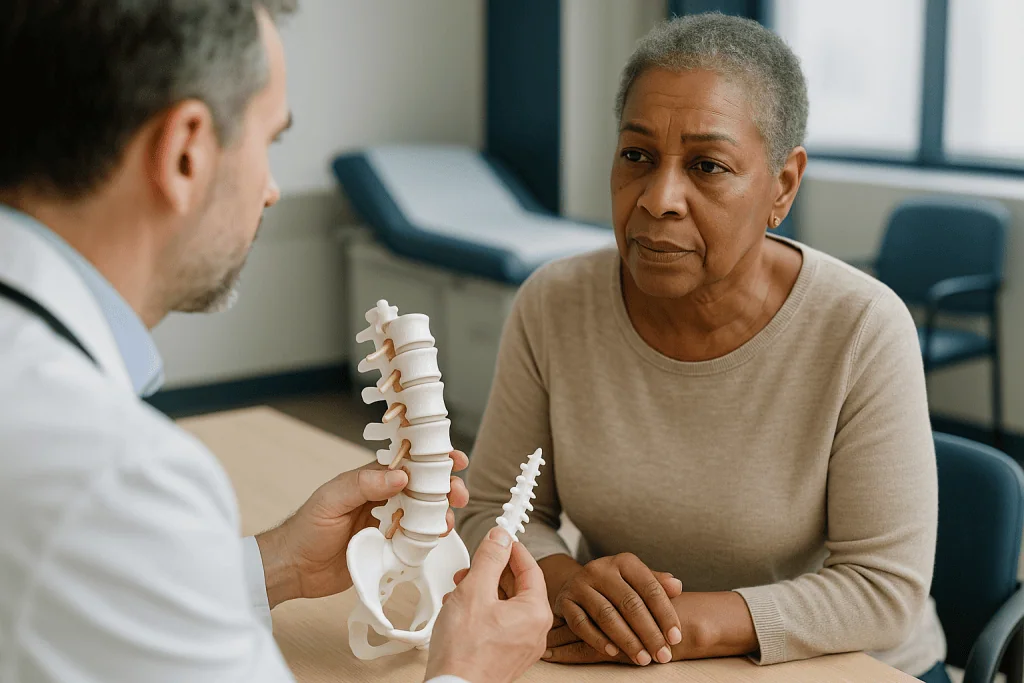
The Mayo Clinic notes that fusion is added in some laminectomies when a vertebra has slipped forward over the one below it (spondylolisthesis), when a large amount of bone must be removed, or when the segment is otherwise unstable. Outside those situations, the evidence summarized by major centers does not support routinely adding a fusion to a decompression for stenosis alone. That is the crux of your question: “Is there a specific reason my spine needs to be fused, or is it being added as a precaution?”
| Feature | Decompression alone (laminectomy) | Decompression with fusion |
|---|---|---|
| Main goal | Make room for nerves | Make room and stop motion at the level |
| Typical reason | Narrowing with a stable segment | Slipped vertebra, instability or extensive bone removal |
| Hardware | Usually none | Often screws, rods and bone graft |
| Hospital stay (NHS) | Commonly 1–4 days | Often at the longer end, or longer |
| Bone healing | Not required | Graft knits over months (MedlinePlus) |
| Longer-term concern | Narrowing can recur at the same or another level | Extra load on neighboring levels; graft may fail to unite |
Neither column is “better.” A fusion done for a genuinely unstable spine can prevent the slipping that would otherwise bring symptoms back. A fusion done without a clear indication adds months of healing, hardware and risk for no proven gain. Ask which column you are in and what finding on your scans put you there.
Who is usually offered spinal stenosis surgery, and who is asked to wait
Guideline-level summaries from the NHS and the Mayo Clinic converge on a familiar profile. Surgery is usually considered when leg symptoms from stenosis are persistent, limit how far you can walk or stand, have not improved after a sustained period of non-surgical care such as physical therapy and activity changes, and are explained by what the imaging shows. Progressive weakness in a leg or foot is a stronger reason to act, because nerves that stay compressed for long periods recover less predictably.
A much smaller group needs urgent surgery. New loss of bladder or bowel control, numbness around the groin and inner thighs, or rapidly worsening weakness can signal cauda equina syndrome, severe compression of the nerve bundle at the base of the spine. That is an emergency, not a scheduling question.
Many people are asked, reasonably, to wait. Symptoms that are mild or mainly back pain without leg involvement tend not to improve with decompression, so surgery offers little. Several medical conditions are usually optimized first: blood sugar that is not well controlled raises infection risk, and smoking is associated with poorer bone healing after fusion, so teams commonly ask people to stop in the weeks before. Blood-thinning medicines need a plan agreed with the prescriber; never adjust them yourself. Active infection anywhere in the body, uncontrolled heart or lung disease, and very low bone density that would not hold screws are all reasons a surgeon may defer or change the plan.
Waiting is not the same as being refused. Ask what would need to change for surgery to be offered, and what to watch for in the meantime. A good answer names specific targets and a timeframe for review.
What are the real risks of spinal stenosis surgery?
Every honest conversation about this operation includes the possibility that it does not help. The NHS lists persistent or recurrent symptoms among the recognized risks of lumbar decompression, alongside complications that are less common but more serious. Knowing the list lets you ask the right follow-up: not “is it safe?” but “how does my situation change these risks?”
The complications the NHS and Mayo Clinic describe fall into a few groups. Infection of the wound or deeper tissues is the most common surgical worry, and it is why diabetes control and wound care matter so much. A tear in the dura, the thin membrane that holds spinal fluid, can occur while bone is removed near the nerves; it is usually repaired during the operation, and sometimes a temporary drain is used while it seals. Nerve injury is uncommon but can cause new numbness, weakness or pain. Blood clots in the leg veins are a risk after any operation that involves lying still, which is why early walking is encouraged. Bleeding and reactions to anesthesia are general surgical risks.
Fusion carries its own additions. The bone graft may fail to unite, a problem called non-union or pseudarthrosis, which can require revision. Screws can loosen or sit close to a nerve. And because a fused level no longer moves, the levels above and below take more load over time, which may hasten wear there.
Questions worth asking: “Which of these are more likely for me, and why?” “How often do you need to go back in?” “What happens if a dural tear occurs?” You are not looking for reassurance. You are looking for a surgeon who answers specifically.
What are the alternatives to surgery for spinal stenosis?
Stenosis is slow. The Cleveland Clinic and Mayo Clinic both note that many people manage symptoms for years without an operation, and that the condition does not inevitably worsen. That makes the alternatives worth understanding, even if you have already decided.
Physical therapy is the backbone of non-surgical care. Because the spinal canal opens slightly when you bend forward and closes when you arch back, therapists teach flexion-based positioning and build the trunk and hip strength that lets you hold a more open posture while walking. Cycling and walking with a cart or poles are often tolerated far better than flat, upright walking, which is a clue to how much posture matters.
Medicines are used for symptom control, not to change the narrowing. Anti-inflammatory drugs and acetaminophen act on pain signaling; medicines originally developed for nerve pain or seizures are sometimes tried for the burning or tingling quality of nerve compression. Whether any of these suits you depends on your other conditions and belongs to your prescribing clinician.
Epidural steroid injections place an anti-inflammatory medicine around the irritated nerve roots. The Mayo Clinic describes them as offering temporary relief for some people, and notes that repeated injections carry their own risks. They are not a substitute for decompression when nerves are tightly compressed, but they can help someone bridge a period of waiting.
The question to ask is not “should I try all of these first?” but “which have I genuinely tried, for how long, and what did they change?” If the answer is that months of structured therapy and reasonable medicine use left you unable to walk to the mailbox, the alternatives have had their chance.
What does spinal stenosis surgery recovery time usually look like?
Recovery is the part people picture least accurately, in both directions. Some expect to be bedbound; others expect to be back at the gym in a fortnight. The NHS recovery guidance for lumbar decompression offers a more useful middle picture, and it is the reference for the timeframes below.
Most people are encouraged to get up and walk, with help, the same day or the day after surgery. Hospital stays after decompression are commonly 1–4 days, with fusion and multi-level operations tending toward the longer end. The first two weeks at home are about short, frequent walks, managing wound discomfort and avoiding bending, lifting and twisting. Stiffness and tiredness are normal; sharp new leg pain is not.
By about 4–6 weeks many people can return to light or desk-based work, according to the NHS. Driving returns when you can sit comfortably, turn to check mirrors and perform an emergency stop without hesitation, and only once you are no longer taking medicines that impair reaction time; your team will tell you when that is. Physically demanding jobs take longer, often several months.
Fusion runs on a slower clock. The bones themselves do not knit for months, and MedlinePlus notes that full recovery from spinal fusion can take many months to a year as the graft heals. Restrictions on bending and lifting usually last longer, and follow-up X-rays check that the fusion is progressing.
These are typical ranges from the cited sources, not promises. Age, fitness, the number of levels, whether a fusion was done and whether any complication occurred all move the dial. Ask your team to sketch your expected timeline against these ranges before the operation, so that week three feels like week three rather than like something going wrong.
How to sleep after back surgery
Nights are often the hardest part of the first fortnight. The incision aches when you turn, the muscles that were moved aside protest, and the habits of a lifetime push you toward positions your spine now resents. A few principles, consistent with the discharge guidance published by MedlinePlus, make it easier.
Two positions are generally comfortable and protect the back. Lying on your back with a pillow under your knees flattens the lumbar curve and takes tension off the incision. Lying on your side with a pillow between your knees keeps the pelvis level and stops the top leg from dragging the spine into a twist. Sleeping on your stomach arches the back and is usually discouraged until your team says otherwise.
Getting in and out of bed is where people hurt themselves. Use the log-roll: lie on your side near the edge, keep shoulders and hips moving together as a unit, lower your feet over the side while pushing up with your arms. Reverse it to lie down. Rolling as a single piece avoids the twisting that strains a healing back.
A firm mattress is easier to move on than a soft one; some people find a recliner more comfortable for the first few nights, especially after fusion, and that is fine if your team agrees. Keep the bedside clear, with water, a lamp and your phone within reach so you are not stretching.
If pain wakes you, note when and where it happens. Discomfort at the incision that eases with repositioning is expected. Pain that shoots down a leg, or numbness that is new, is something to tell your team, as the red-flag section explains.
What is the proper wound care for spinal surgery?
The incision is the one part of recovery you can see, and the part most likely to prompt an anxious phone call. MedlinePlus’s spine surgery discharge instructions give a clear framework, and your team’s written instructions take priority wherever they differ.
In the first days, keep the dressing clean and dry and change it only as instructed. Many incisions are closed with dissolving stitches under the skin and a layer of surgical glue or strips; others use staples or stitches that are removed at a follow-up visit. Ask which you have before you leave, so you know what you are looking at.
Showering is usually allowed after a short interval set by your team. Let water run over the wound rather than scrubbing it, and pat it dry with a clean towel. Baths, pools and hot tubs mean soaking, which softens the skin and invites bacteria; they wait until the incision is fully closed. Do not apply creams, oils or powders unless told to.
Look at the wound once a day. A thin line of pink along the edges and mild swelling are normal. Spreading redness, warmth, increasing pain, thick or cloudy drainage, a bad smell, edges that pull apart, or a fever are not, and they warrant a call that day. Clear, watery fluid leaking from the wound, especially with a headache that is worse when upright, can indicate spinal fluid and needs prompt assessment.
A small number of people go home with a drain, a thin tube that removes fluid from the operative site. If you do, you will be shown how to empty and record it. Keep the tubing secure and never pull on it. Questions about any of this belong on your pre-surgery list, not in a 2 a.m. search.
What is life like after spinal decompression surgery?
The honest answer is that it depends on what you were hoping for. People whose main complaint was the walking limit, the need to sit on every bench between the car and the store, often describe the change in terms of distance: a block became a mile. That is the symptom decompression is built to improve, and the NHS describes relief of leg symptoms and improved walking as its expected benefit.
Back pain is a different story. The worn joints and discs that caused the narrowing are still there, and many people continue to have some lower back ache, particularly after a long day or a poor night. This is not failure; it is the condition the operation was never aimed at. Building the strength around the spine, staying active and managing weight in a way that works for you all help with that residual ache, and a therapist can tailor a program.
Numbness may lag. Pain from a compressed nerve often improves quickly once the pressure is off, while sensation and strength can take months to return and sometimes do not fully recover if the nerve was compressed for a long time. Ask your surgeon which of your symptoms are likely to improve and which may linger.
Stenosis is degenerative, so the process continues elsewhere. Narrowing can develop at a level that was not operated on, and scar tissue or regrowth can occasionally narrow the operated level again. Most people do not need a second operation, but a plan for what to do if symptoms return is worth having.
Day to day, the aim is ordinary life: gardening, grandchildren, a walk that is a pleasure rather than a negotiation. Sensible lifting technique and regular movement are the maintenance plan, not a cage.
What people often get wrong about spinal stenosis surgery
Some of the most common beliefs about this operation are quietly wrong, and they shape disappointment more than any surgical detail does.
“It will fix my back pain.” Decompression is aimed at the nerves and the leg symptoms they produce. The NHS is explicit that back pain may continue afterward. If back pain is your dominant complaint, say so, because it changes whether surgery is the right tool at all.
“Fusion is stronger, so it must be better.” Fusion stabilizes a level that is unstable. For stenosis in a stable spine, the mainstream evidence summarized by the Mayo Clinic does not support adding it routinely. Stronger is not a goal in itself; it comes with longer healing and more load on neighboring levels.
“Minimally invasive means minor.” The incisions are smaller; the work inside is the same. Nerves are still being freed millimeters from the instruments, and the recovery timeline is shaped more by what was done than by how big the scar is.
“Rest is the safest recovery.” Early walking is encouraged precisely because lying still raises the risk of blood clots and leaves muscles weak. Rest from bending, lifting and twisting, yes. Rest from moving, no.
“The MRI shows how bad it is.” Narrowing on a scan is common in people with no symptoms. Surgeons treat the level that explains your examination and your story, not the most dramatic image.
“Surgery stops stenosis for good.” It relieves the narrowing that exists today. The underlying wear continues, and other levels can narrow later.
“I’m too old.” Age alone is not a barrier; overall health, fitness and the specific problem matter far more, and your team assesses those individually.
Questions to ask your care team before spinal stenosis surgery
Bring this list to the consultation, with a pen, and if possible someone who can take notes while you listen. Surgeons who do this work well expect these questions and answer them without defensiveness.
About the diagnosis
- Which level or levels are causing my symptoms, and how do my examination and MRI confirm that?
- Which of my symptoms do you expect this operation to improve, and which may not change?
- What have I not yet tried that could reasonably be tried first?
About the operation
- Exactly what will be removed, and what will be left?
- Are you planning a fusion? If so, what finding makes my spine unstable?
- If you treat two levels and not the third, what is the plan if the third becomes symptomatic?
- What happens during the operation if a dural tear or unexpected finding occurs?
About risks and track record
- Which complications are more likely for me given my health, and what are you doing to reduce them?
- How often do your patients need a second operation, and for what reasons?
- How will my blood-thinning or other regular medicines be handled, and who decides?
About recovery
- How long will I stay in hospital, and what should I be able to do on the day I go home?
- What restrictions apply, for how long, and when can I drive and return to my specific job?
- Will I have a drain, stitches or staples, and how do I care for the wound?
- Who do I call, at any hour, if something worries me?
You do not need every answer to be perfect. You need them to be specific, consistent with the evidence described in this article, and delivered by a team you trust to carry the plan through.
When to call your doctor: red flags before and after surgery
Most of recovery is uneventful, and most phone calls end with reassurance. A short list of signs should never wait for the next scheduled appointment. The NHS and MedlinePlus discharge guidance agree on the core warnings.
Seek emergency care immediately if you notice new difficulty controlling your bladder or bowels, new numbness around the groin, buttocks or inner thighs, or weakness in one or both legs that is getting worse over hours. These can signal cauda equina syndrome, severe compression of the nerve bundle at the base of the spine, and the window for treating it is short. The same urgency applies to chest pain, sudden breathlessness or coughing blood, which can indicate a clot that has traveled to the lungs.
Call your surgical team the same day for a fever, spreading redness, warmth or increasing pain at the incision, thick or cloudy discharge, a wound whose edges are separating, or clear watery fluid leaking from it. Call for a headache that is markedly worse when you sit or stand and better lying flat, which can indicate a spinal fluid leak. Call for a calf that becomes swollen, tender or warm on one side, a possible deep vein clot. Call if leg pain or numbness that had improved returns sharply, or if pain is not controlled by the plan you were given.
Before surgery, the emergency signs above apply just as strongly. A person waiting for an elective decompression who develops bladder changes or rapidly worsening weakness should go to an emergency department, not wait for the operation date.
Write the team’s contact number on the fridge and in your phone. The threshold for calling is low; a false alarm costs a few minutes, a missed complication can cost much more.
Frequently asked questions
What are the most important questions before spinal stenosis surgery?
Ask which levels will be treated and how your symptoms and scans confirm them, whether a fusion is planned and what makes your spine unstable, which symptoms the operation is expected to improve, what risks apply to you specifically, and what the recovery timeline and restrictions will be. Also ask who to call after hours. Specific, consistent answers matter more than reassurance; the decision rests with you and your treating team.
How long is spinal stenosis surgery recovery time?
According to NHS guidance on lumbar decompression, most people leave hospital within 1–4 days, walk from the first day, and can often return to light work around 4–6 weeks. Physically demanding work takes longer. If a fusion was done, MedlinePlus notes that the bone graft heals over many months, so restrictions last longer. These are typical ranges, and your own timeline depends on the number of levels, your health and any complications.
Laminectomy vs spinal fusion: how do I know which I need?
Laminectomy removes bone and ligament to free the nerves while keeping the level mobile. Fusion joins two vertebrae so they stop moving and is added when a vertebra has slipped forward, the segment is unstable or a large amount of bone must be removed. Ask your surgeon which specific finding on your scans or during the planned operation justifies fusion. Without such a finding, decompression alone is the usual approach.
How to sleep after back surgery?
Lie on your back with a pillow under your knees, or on your side with a pillow between your knees, and avoid sleeping on your stomach until your team says it is fine. Use the log-roll technique to get in and out of bed, keeping shoulders and hips moving together to avoid twisting. A firm mattress or, for some people, a recliner can be more comfortable in the first week or two.
How long does it take to recover from a lumbar drain procedure?
A lumbar drain is a thin tube placed in the lower spine to divert spinal fluid, sometimes used after a dural tear so the repair can seal. It usually stays in for a few days while you lie fairly flat, and the drain itself adds little to the longer-term recovery; what you recover from is the underlying spine operation. Your team sets the exact duration, activity rules and when you may sit up.
What is the proper wound care for spinal surgery?
Keep the dressing clean and dry, change it only as instructed, and shower by letting water run over the incision rather than scrubbing once your team allows it. Avoid baths, pools and hot tubs until the wound is fully closed, and do not apply creams unless told to. Check daily for spreading redness, warmth, discharge, separating edges or clear fluid, and call your team the same day if any appear or if you develop a fever.
What is life like after spinal decompression surgery?
Many people describe the main change as walking further and standing longer, because decompression targets the leg symptoms caused by nerve pressure. Lower back ache may continue, since the worn joints and discs remain, and numbness can take months to improve. Regular walking, strengthening the trunk and sensible lifting are the maintenance plan. Narrowing can develop at other levels later, so agree with your team on what to watch for.
Does spinal stenosis surgery help back pain or just leg pain?
It is aimed at leg pain, numbness and walking limits caused by compressed nerves. The NHS states clearly that back pain may persist after lumbar decompression, because the operation does not reverse the arthritis and disc wear that produced the narrowing. If back pain is your main complaint, tell your surgeon, because it changes whether surgery is the right tool and what you should expect from it.
Can spinal stenosis come back after surgery?
Yes. Stenosis is a degenerative process, so narrowing can develop at a level that was not operated on, and scar tissue or regrowth of bone can occasionally re-narrow the treated level. The NHS lists recurrent symptoms among recognized outcomes of decompression. Most people do not need further surgery, but it is worth asking your team what signs would prompt reassessment and how a second episode would be approached.
Do I need to stop my medicines before spinal stenosis surgery?
Do not change any prescribed medicine on your own. Blood thinners, diabetes medicines and some supplements may need adjusting before surgery, but the timing and plan must come from your surgical team and the clinician who prescribes them. Bring a full list of everything you take, including over-the-counter products, to your pre-operative assessment, and ask who is responsible for each decision and when it takes effect.
References
- NHS: Lumbar decompression surgery
- NHS: Lumbar decompression surgery – Recovery
- MedlinePlus: Spine surgery – discharge
- MedlinePlus: Spinal fusion
This article is for general information only and is not a substitute for professional medical advice. Please consult a qualified doctor about your individual situation.

More from the Blog

Schroth Method Results: What Consistent Practice Can Realistically Change and What It Cannot
Consistent Schroth practice most reliably changes posture, trunk symmetry, breathing mechanics, muscle endurance, and how a person feels about their back. Small randomized trials…

When Does a Herniated Disc Need Surgery? Weakness, Persistent Sciatica and Time Limits
A herniated disc usually needs surgery only when a nerve is being damaged or when pain has outlasted a fair trial of nonsurgical care.…

Juvenile Scoliosis Between Ages Four and Ten: How Growth Drives the Curve and Shapes Care
Juvenile scoliosis is a sideways spinal curve first identified between ages four and ten. Because these children still have most of their growth ahead,…

Is Leg Pain After a Disc Operation Normal? Pain That Fades, Pain That Returns and When to Call
Some leg pain after disc surgery is common and usually not a sign that anything has gone wrong. A nerve that has been compressed…

Is Soreness After Schroth Exercises Normal? What Is Expected and Which Symptoms to Report
Mild, dull muscle soreness after Schroth exercises is common, especially in the first few weeks, because the method asks underused trunk muscles to hold…
Endoscopic Disc Surgery vs Microdiscectomy: What the Smaller Incision Changes
Endoscopic disc surgery and microdiscectomy both remove the fragment of a herniated disc that is pressing on a spinal nerve. Microdiscectomy works through an…