

Eating With a Gastric Balloon: From Liquids to Regular Meals Under Dietitian Guidance

Key Takeaways
- Clear liquids can usually begin about six hours after balloon placement, with the liquid-only phase typically lasting through the first week before pureed and soft foods are introduced.
- Regular meals generally resume around three weeks after insertion, eaten over 20 to 30 minutes, with protein first and drinks kept about 30 minutes away from food.
- Nausea, cramping and vomiting affect roughly one third of people in the first days and usually settle within a few days; vomiting that persists after that is a signal to change texture, pace or volume, not a sign of success.
- Summaries cited by the Mayo Clinic report about 7% to 15% total body weight loss over six months with a balloon plus counseling, and 30% to 47% of excess weight, with wide individual variation.
- A gastric balloon is a temporary device, usually removed after a maximum of six months, and some regained weight afterward is common; continued dietitian follow-up after removal is linked with holding on to more of the loss.
- Blue or green urine, a sudden return of normal hunger, severe abdominal pain, or vomiting blood are red flags for deflation, migration, ulcer or perforation and need same-day medical contact.
Eating with a gastric balloon follows a staged plan: clear liquids for roughly the first day, full liquids through the first week, then pureed and soft foods, with regular meals typically resumed around three weeks after placement. Portions stay small, meals are eaten slowly, protein comes first, and drinks are separated from food. A dietitian individualizes each step, and the treating team sets the pace.
The morning after the procedure, the kitchen looks the same but the rules have changed. A mug of warm broth sits where the coffee used to be. The blender has been promoted from the back of the cupboard to the counter. And somewhere between the second and third sip, a feeling arrives that is hard to describe to anyone who has not had it: full, slightly pressured, after almost nothing at all.
That feeling is the whole point. Eating with a gastric balloon means relearning meals around a device that takes up room in the stomach, and the first few weeks are less about willpower than about technique: what texture, how much, how slowly, and in what order. Done well, the staged diet keeps you hydrated, keeps nausea manageable and builds habits that have to outlast the balloon itself.
This explainer walks through each stage, what the evidence says about results and side effects, and the questions worth asking your dietitian before you sit down to your first real meal.
How a gastric balloon changes the way you eat
An intragastric balloon is a soft silicone balloon placed into the stomach through the mouth and then filled with sterile salt water or air. It is positioned using an endoscope, a thin flexible tube with a camera, so there are no incisions. The NHS describes it as a temporary measure, usually removed after a maximum of six months (NHS, weight loss surgery types).
Once inflated, the balloon occupies a portion of the stomach’s volume. Stretch receptors in the stomach wall, the nerve endings that tell the brain the stomach is expanding, are triggered earlier in a meal, so fullness arrives after a smaller amount of food. The balloon also tends to slow the rate at which the stomach empties, which prolongs that full feeling between meals. Both effects are mechanical, not hormonal; this is a different mechanism from the class of medicines that mimic gut hormones, and a different one again from surgery that removes or reroutes part of the stomach.
What the balloon does not do is choose foods, set portion sizes or stop someone from drinking high-calorie liquids, which slide past it with little resistance. The programs that study balloons almost always pair the device with structured dietary counseling and follow-up, and the Mayo Clinic frames the balloon as a tool to support, not replace, a changed way of eating (Mayo Clinic, intragastric balloon).
That is why the diet progression matters so much. The staged move from liquids to regular meals protects the stomach while it adapts to a foreign object, limits early vomiting, and gives a dietitian room to coach the three habits that carry over after removal: slower eating, smaller plates and protein at the center of the meal.
Who a gastric balloon is usually for, and who is asked to wait
Selection sits with the treating team, but the broad outline is consistent across mainstream sources. The Mayo Clinic lists the balloon as an option for adults with a body mass index (BMI) of about 30 to 40 who are willing to commit to lifestyle changes and regular medical follow-up, and who have not had previous stomach or esophageal surgery (Mayo Clinic). BMI, a ratio of weight to height, is a screening measure rather than a verdict on health, and most teams look at waist measurement, metabolic conditions and eating history alongside it.

People are commonly asked to wait, or to consider other options, when any of the following apply:
- Previous surgery on the stomach, esophagus or bowel, which can change anatomy or raise the risk of the balloon causing a blockage
- A large hiatal hernia, where part of the stomach pushes up through the diaphragm
- Active stomach ulcers, inflammatory bowel disease or a bleeding disorder
- Pregnancy, or plans to become pregnant during the six months the balloon would be in place
- An untreated eating disorder, because the restriction a balloon imposes can worsen a disordered relationship with food
- Regular use of medicines that irritate the stomach lining, which the prescribing clinician would need to review first
Programs also screen for readiness. A pre-placement visit with a dietitian is standard: it covers current eating patterns, who does the cooking at home, access to protein-rich foods and whether a liquid-only week is realistic around work or caregiving. Someone who skips breakfast, eats once in the evening and drinks most of their calories is not a poor candidate, but the plan will need adjusting before the balloon goes in rather than after.
None of these points is a rule you can apply to yourself. They are the kinds of factors a care team weighs, and the decision to proceed, delay or choose a different route always rests with them in discussion with you.
Eating with a gastric balloon in the first week: clear liquids, then full liquids
The first week is the hardest, and knowing that in advance makes it easier. The Mayo Clinic notes that about one third of people experience pain and nausea soon after insertion, usually lasting only a few days, and that drinking small amounts of clear liquid can typically begin about six hours after the procedure (Mayo Clinic).
Clear liquids are anything you can see through at room temperature: water, diluted fruit juice without pulp, clear broth, sugar-free gelatin and weak herbal tea. The technique matters more than the menu. Dietitians usually ask for small sips every 10 to 15 minutes rather than a glass at once, no straws (they pull in air), and no carbonated drinks, which add gas to a stomach already under pressure. Very cold or very hot liquids can trigger cramping in the first days, so room temperature is often tolerated best.
Around day two or three, most plans move to full liquids. These are smooth, pourable and opaque: skim or low-fat milk, plain yogurt thinned with milk, strained cream soups, protein shakes without added sugar, and smooth fruit purees thinned to a drinkable consistency. The target shifts from hydration alone to hydration plus protein, because a week of broth and gelatin leaves muscles short of what they need. The liquid diet generally continues until the start of the second week (Mayo Clinic).
Anti-sickness medicines and acid-suppressing medicines are commonly prescribed for this phase. The first group blunts the nausea signal in the brain or the gut; the second lowers stomach acid so the lining is less irritated by the balloon rubbing against it. Whether, which and for how long are decisions for the prescribing clinician, and the dietitian will usually time the first protein-rich sips for when the medicine has had a chance to work.
Weeks two and three: pureed and soft foods
By the second week, most people can begin eating soft foods, and regular food usually becomes possible around three weeks after insertion (Mayo Clinic). The transition is gradual on purpose. Each new texture is a test of how the stomach, now sharing space with a balloon, handles something that needs to be broken down.
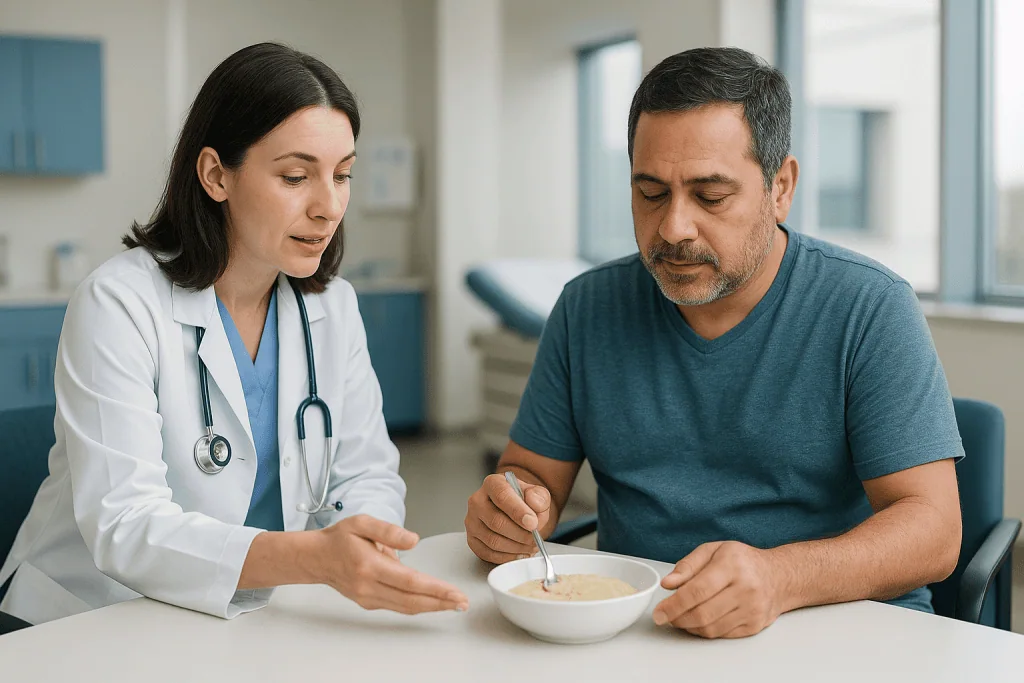
Pureed foods come first: the consistency of smooth hummus or thick applesauce, with no lumps. Blended lentil soup, mashed white fish with a little milk, scrambled egg whisked smooth, silken tofu, cottage cheese pushed through a sieve. The portion is small, often a few tablespoons at a time, eaten over 15 to 20 minutes with a teaspoon rather than a tablespoon. That is not a quirk; a smaller utensil physically slows the meal.
Soft foods follow once purees are comfortable: flaked fish, minced or slow-cooked chicken, soft-cooked vegetables without skins, well-cooked oatmeal, ripe banana, canned fruit in juice. Foods are introduced one at a time, a day or two apart, so that if something causes pain or vomiting it is obvious which food is responsible. Dietitians usually hold back on the common troublemakers in this phase: bread (it swells into a dense mass), rice, pasta, tough or dry meat, raw fibrous vegetables and anything fried.
Protein is prioritized at every meal because it protects muscle during rapid weight loss and because it is the most filling macronutrient per calorie. Fluids are separated from food, usually by about 30 minutes before and after eating, a long-standing principle in bariatric nutrition (MedlinePlus, diet after gastric bypass). With a balloon, drinking during a meal can push the stomach past comfortable and bring the food straight back up.
Vomiting more than occasionally during this phase is not a sign the balloon is working. It is a sign the texture, speed or volume needs to change, and your dietitian should hear about it.
Regular meals with a balloon: the dietitian's working rules
Around week three, the plate starts to look like ordinary food again. The difference is in the size of the plate, the pace of the meal and the sequence of what is on it. Most programs teach a small set of rules that are easier to remember than any list of allowed and forbidden foods.
Eat protein first. Fish, poultry, eggs, beans, lentils, tofu, yogurt or cheese take the first bites while hunger is highest. Vegetables come second. Starches, if there is room, come last and are often the first thing left on the plate.
Give a meal 20 to 30 minutes. The fullness signal from a stomach with a balloon in it arrives early but not instantly, and a fast eater can overshoot it before the brain registers anything. Putting the fork down between bites and chewing each mouthful until it is nearly liquid are the two habits dietitians return to most often.
Stop at the first sign of fullness, not at the plate being empty. With a balloon, that sign may be a sensation of pressure under the breastbone or a small burp. Pushing past it is what produces most of the vomiting people report in the regular-food phase.
Keep drinks and meals apart. Water, unsweetened tea and other calorie-free drinks between meals, aiming for steady intake across the day; nothing for about 30 minutes either side of eating.
Watch liquid calories. Smoothies, lattes, juices and alcohol pass the balloon easily and are the most common reason a diet feels disciplined but the scale does not move.
Many people settle into three small meals and one or two protein-based snacks. Portions are typically around a cup of food per meal in the regular phase, though the right amount varies, and a dietitian will adjust it against weight change, symptoms and blood tests at each follow-up.
Gastric balloon diet plan at a glance
Timings below are the typical ranges described by the Mayo Clinic for the weeks after placement (Mayo Clinic, intragastric balloon). Your own team may move faster or slower depending on how you tolerate each stage, and their schedule overrides this table.
| Stage | Typical timing | Textures and examples | Main focus |
|---|---|---|---|
| Clear liquids | From about 6 hours after placement, usually 1–3 days | Water, broth, diluted juice without pulp, sugar-free gelatin, weak tea | Hydration; small frequent sips; no straws or fizzy drinks |
| Full liquids | Remainder of week 1 | Milk, thinned yogurt, strained soups, unsweetened protein shakes | Protein intake while nausea settles |
| Pureed foods | Start of week 2 | Blended lentils, mashed fish, smooth scrambled egg, silken tofu | Introduce one food at a time; teaspoon portions |
| Soft foods | Later in week 2 into week 3 | Flaked fish, minced chicken, soft-cooked vegetables, oatmeal, ripe banana | Chewing thoroughly; avoiding bread, rice, tough meat |
| Regular meals | Around week 3 onward | Ordinary foods in small portions, protein first | 20–30 minute meals; drinks separated from food; liquid calories limited |
| Before removal | Final 1–2 days before the removal endoscopy | Usually clear liquids only, as instructed by the team | Empty stomach for safe removal |
Two patterns are worth noticing. The stages are front-loaded: most of the change happens in the first three weeks, and the following months are about practicing the regular-meal rules until they are automatic. And the plan ends where it began, with a short liquid phase before the balloon comes out, so the stomach is empty for the removal procedure. People who know this in advance tend to find the last week far less of a surprise.
How fast do you lose weight with a gastric balloon? Realistic gastric balloon weight loss results
The honest answer is: meaningfully, but less than with surgery, and mostly in the first few months. The Mayo Clinic summarizes available treatments as producing a loss of about 7% to 15% of body weight during the six months after balloon placement, with total excess weight loss ranging from 30% to 47% (Mayo Clinic). Excess weight is the amount above the upper end of the healthy BMI range, so a person who is 40 kilograms above that line and loses 14 kilograms has lost 35% of their excess weight.
Those are population averages drawn from study participants who also received dietary counseling, and individual results spread widely around them. Some people lose very little, often because liquid calories or grazing continued; a few lose more. No one can tell you in advance which group you will be in, and any program that quotes you a personal number is overpromising.
The pace is uneven. The first month usually shows the steepest drop, partly because intake is so limited during the liquid and puree phases and partly because the body sheds water as carbohydrate stores fall. From the second or third month onward, the rate slows as the stomach adapts to the balloon and fullness arrives a little later than it did in week two. This plateau is expected, and it is the point where dietitian follow-up earns its keep: reviewing portion creep, checking protein intake and spotting the snacks that have crept back in.
Weight is also only one outcome. Blood pressure, blood sugar in people with prediabetes or type 2 diabetes, joint pain and sleep quality are the measures many teams track alongside the scale, and improvements in those do not always move in step with kilograms lost. If your program measures only weight, it is worth asking what else they are watching.
Do people keep weight off after gastric balloon removal?
This is the question that deserves the most honest answer, because the device is temporary and the answer depends on what happens after it is gone. The NHS is direct that a gastric balloon is only a temporary measure and is usually removed after a maximum of six months (NHS, weight loss surgery types). Once the balloon is out, the mechanical fullness disappears within days. Appetite returns to something close to its pre-balloon level, and the stomach can again hold a full-sized meal.
What the evidence shows is that some of the weight lost during the balloon period is regained by many people in the year or two afterward, and that long-term follow-up data are thinner for balloons than for bariatric surgery, where outcomes have been tracked for well over a decade. Studies that followed people after removal generally found a partial return toward the starting weight, with wide variation; those who continued structured dietary support and regular follow-up tended to hold on to more of their loss than those who stopped at removal.
Mechanistically this makes sense. The balloon never changed hormone levels or absorption. Everything it achieved came from eating less, and eating less after removal depends on habits rather than hardware: the 20-minute meal, the protein-first plate, the separation of drinks from food, the awareness of liquid calories. Programs that plan for the period after removal as carefully as the period before it, with dietitian visits scheduled at one, three and six months afterward, are built around this reality.
Some teams also discuss what happens if weight returns, including a second balloon after an interval, medicines in the class that mimic gut hormones, or a surgical option. These are decisions for the treating team, made against the full picture of health, not just the scale.
Gastric balloon side effects and downsides: what to expect and what is rare
Most side effects cluster in the first week and fade. A minority are serious and need urgent attention. Knowing which is which is a practical part of eating with a gastric balloon, because food and fluids are usually what trigger or relieve the common ones.
Expected in the early days: nausea, cramping, a sense of pressure, belching and sometimes vomiting as the stomach contracts around the new object. The Mayo Clinic reports that these affect about a third of people and typically last a few days (Mayo Clinic). Acid reflux can persist longer, which is one reason acid-suppressing medicines are commonly prescribed for the duration of the balloon; the prescribing clinician decides whether and for how long.
Less common and more serious, as listed by the Mayo Clinic:
- Deflation of the balloon, which can let it pass into the intestine and cause a blockage that may need a procedure or surgery to remove
- Overinflation of a saline balloon, where the device gradually enlarges, producing worsening pain and vomiting
- Ulcers or, rarely, a hole (perforation) in the stomach wall from pressure or friction
- Acute pancreatitis, inflammation of the pancreas, thought to result from the balloon pressing on nearby tissue
Some saline-filled balloons contain a colored dye so that a leak becomes visible as a change in urine color, typically blue or green. If you notice this, or if hunger suddenly returns to normal after months of early fullness, the balloon may have deflated and the team needs to know the same day.
The non-medical downsides matter too. Six months of small, slow meals can be socially awkward. Some people find the constant awareness of fullness unpleasant rather than reassuring. And the dietary discipline required is real; the balloon makes overeating uncomfortable, not impossible. A frank conversation about these trade-offs before placement is part of good care.
How long does a gastric balloon stay in, and what eating looks like around removal
Six months is the usual figure. The NHS describes the balloon as removed after a maximum of six months (NHS, weight loss surgery types), and the Mayo Clinic describes a similar timeframe for the devices it discusses (Mayo Clinic). The limit exists because the balloon material slowly weakens in stomach acid; beyond that window the risk of deflation and migration rises.
Removal is a second endoscopy. The balloon is punctured, drained and withdrawn through the mouth under sedation, usually as a day procedure. For it to be done safely the stomach needs to be empty, so teams generally ask for clear liquids only for a day or two beforehand and nothing by mouth for a set number of hours before the appointment. These instructions are specific to your team and your sedation plan, and they take precedence over anything written here.
The days after removal bring a strange reversal. Meals that would have caused discomfort a week earlier are suddenly easy, and the early fullness that governed six months of eating is simply gone. Hunger can feel louder than it did before the balloon, partly by contrast and partly because the body’s weight-regulating hormones respond to weight loss by increasing appetite. This is normal physiology, not a failure of willpower, and it is the moment the habits built during the balloon period are tested.
Dietitians often recommend holding the balloon-era rules deliberately for the first weeks after removal: the same small plate, the same 20-minute meal, the same protein-first order, the same gap between drinks and food. Some people find it helps to keep using the smaller utensils for a month or two. Follow-up visits scheduled before removal, rather than arranged later if needed, are associated with better maintenance in most programs, and it is reasonable to ask for them to be booked in advance.
Is a gastric balloon an effective way to lose weight? Where it sits among the alternatives
Effective for what, and compared with what, are the questions a clinician would ask back. Against lifestyle change alone over six months, studies summarized by the Mayo Clinic show additional weight loss with a balloon plus counseling (Mayo Clinic). Against bariatric surgery, the balloon produces less weight loss and has far less long-term outcome data, but it avoids incisions, is reversible by design and carries a different risk profile.
The main alternatives, in neutral terms:
- Structured lifestyle programs: dietary counseling, physical activity and behavioral support without a device or medicine. Lower risk, generally smaller average weight loss, and the foundation of every other option.
- Weight-management medicines: several classes exist, including those that mimic gut hormones to reduce appetite and slow stomach emptying. They work for as long as they are taken, require a prescription and monitoring, and suitability is decided by the prescribing clinician.
- Bariatric surgery: the NHS lists gastric band, gastric bypass and sleeve gastrectomy as the main types (NHS, weight loss surgery types). Surgery produces the largest and most durable weight loss in the evidence base, alters anatomy permanently or semi-permanently, and carries surgical risks and lifelong nutritional follow-up (MedlinePlus, weight loss surgery).
Guidelines in the United Kingdom and United States generally position the balloon between intensive lifestyle treatment and surgery: an option for people who have not succeeded with lifestyle change alone, who do not meet criteria for surgery or do not want it, and who can commit to a program. Some teams also use it as a bridge, helping someone lose enough weight to lower the risk of a later operation.
Whether it is the right tool for you is not something an article can settle. It depends on your health conditions, your eating pattern, what you have already tried and what you can sustain, and that conversation belongs with your treating team.
What people often get wrong about eating with a gastric balloon
Misunderstandings about the balloon tend to be practical rather than medical, and most of them show up at the dinner table.
“The balloon does the work.” It makes overeating uncomfortable; it does not make it impossible, and it does nothing to stop calories arriving as liquid. Milkshakes, sweetened coffee drinks, juice and alcohol pass straight by. The people who lose least are often eating carefully and drinking freely.
“Vomiting means it’s working.” After the first few days, vomiting is a signal that a meal was too fast, too large, too dry or too soon. Repeated vomiting also raises the risk of dehydration and irritation of the esophagus, and it is one of the things a dietitian most wants to hear about.
“Liquids are the safe choice, so I’ll stay on them.” Staying liquid beyond the first week usually means too little protein and a slower return to normal eating. The progression to soft and regular foods is part of the plan, not an optional extra.
“I can’t drink with meals, so I’ll drink less overall.” The rule is about timing, not quantity. Fluids are separated from meals by about 30 minutes; across the day, steady intake is essential, especially while vomiting or nausea is a risk.
“Soft foods go down easier, so softer is always better.” Once the regular-meal phase begins, very soft, processed foods such as mashed potato, ice cream and white bread tend to be calorie-dense and leave the stomach quickly. Firmer whole foods that need chewing deliver more fullness per calorie.
“It works like surgery, just without the cutting.” Average weight loss is lower than with surgery, the effect ends at removal, and the long-term evidence is thinner (Mayo Clinic; NHS).
“Once it’s out, I’m done.” Removal is the midpoint of the program, not the end. The months after are where results are kept or lost.
Questions to ask your care team before and during the program
Good programs welcome questions, and the ones below tend to surface the details that matter most for daily eating. Take them to the pre-placement visit, and keep the list for follow-ups.
- Which stages will my diet move through, and how will we decide when I am ready for the next one? Is the schedule fixed or based on how I tolerate each texture?
- How many dietitian appointments are included while the balloon is in place, and how many after it is removed? Can they be booked now?
- What is my daily protein target during the liquid phase, and how will I reach it if I cannot tolerate shakes?
- What should I do on a day when I cannot keep fluids down? At what point does that become a call to the clinic rather than something to ride out?
- Which of my current medicines need reviewing before placement, and will any be given in a different form while I am on liquids? (The prescribing clinician makes these decisions.)
- Will I be given anti-sickness or acid-suppressing medicines routinely, and how will we know when they can stop?
- What signs would suggest the balloon has deflated or moved, and who do I contact out of hours?
- How will we track progress beyond the scale: blood pressure, blood tests, waist measurement, symptoms?
- What is the plan if I lose very little by the three-month point?
- What will the last week before removal look like, and what does the first month afterward involve?
- If weight returns after removal, what options would you consider, and how would we decide between them?
One more worth asking yourself rather than the team: who at home needs to understand the plan? Shared meals are where most of the slips happen, and a partner, parent or housemate who knows why dinner now takes 25 minutes and arrives on a side plate is a real asset.
When to call your doctor: red-flag signs with a gastric balloon
Most discomfort in the first days settles with sips, rest and the medicines your team has prescribed. Some symptoms do not fit that pattern and need same-day medical contact, or emergency care, because they can signal deflation, blockage, bleeding, perforation or pancreatitis (Mayo Clinic, intragastric balloon). Do not wait to see whether they pass.
Contact your care team the same day, or seek urgent care, if you notice any of the following:
- Vomiting that continues beyond the first few days, or inability to keep any fluids down for more than a day at any point
- Signs of dehydration: very dark urine, passing little urine, dizziness on standing, dry mouth, a racing heartbeat
- Severe or worsening abdominal pain, especially pain that spreads to the back or is accompanied by fever
- Vomiting blood or material that looks like coffee grounds, or black, tarry stools, which can indicate bleeding from an ulcer
- Urine that turns blue or green, or a sudden return of normal hunger after months of early fullness, both of which can indicate the balloon has deflated
- Inability to swallow saliva, or chest pain and shortness of breath
- Persistent bloating with no bowel movements and no passing of gas, which can suggest a blockage
For anything less dramatic but still worrying, such as reflux that is not controlled, weight loss that has stalled for several weeks, or a food group that reliably causes pain, a routine call to the dietitian or clinic is the right step. Keeping a short note of symptoms, what you ate and when makes that call far more useful.
The balloon is a temporary device under medical supervision. Every decision about adjusting your diet, changing or stopping a medicine, bringing removal forward or managing a complication belongs with the treating team, and the quickest way to a good outcome is to involve them early rather than late.
Frequently asked questions
What does a typical gastric balloon diet plan look like week by week?
Clear liquids for the first day or so, full liquids for the rest of week one, pureed foods from the start of week two, soft foods later in week two and into week three, then small regular meals from around week three onward. The Mayo Clinic describes this general timeline, but your dietitian adjusts each step to how you tolerate it, and the team’s schedule takes precedence.
How fast do you lose weight with a gastric balloon?
Most weight comes off in the first two to three months, when intake is lowest and the stomach has not yet adapted. Over the full six months, summaries cited by the Mayo Clinic report about 7% to 15% of total body weight lost on average. Individual results vary widely, and the rate usually slows into a plateau that dietitian follow-up is designed to address.
Do people keep weight off after a gastric balloon is removed?
Partly, and it depends heavily on habits. The balloon’s effect ends at removal, appetite returns, and studies show many people regain some weight in the following year or two. Those who continue structured dietary support after removal tend to maintain more of their loss. The NHS describes the balloon as a temporary measure, which is why the months after removal matter as much as the months before.
What are the main gastric balloon side effects and downsides?
Nausea, cramping, reflux and vomiting are common in the first days and usually settle. Rarer but serious problems listed by the Mayo Clinic include deflation with the balloon passing into the intestine, overinflation, stomach ulcers or perforation, and acute pancreatitis. Non-medical downsides include six months of small slow meals and the fact that liquid calories pass the balloon easily.
How long does a gastric balloon stay in?
Usually up to six months. The NHS states the balloon is removed after a maximum of six months, because the material weakens in stomach acid over time and the risk of deflation rises beyond that point. Removal is a second endoscopy under sedation, and the team will ask for clear liquids and then nothing by mouth for a set period beforehand so the stomach is empty.
Is putting a balloon in your stomach an effective way to lose weight?
It produces more weight loss than lifestyle change alone over six months, according to summaries cited by the Mayo Clinic, but less than bariatric surgery, and the effect ends when the balloon is removed. Long-term data are thinner than for surgery. Whether it is the right option depends on your health, eating pattern and what you have tried, which is a decision for your treating team.
Can I drink water with meals when I have a gastric balloon?
Dietitians usually ask you not to. Drinking during or immediately after eating adds volume to a stomach already partly occupied by the balloon and is a common cause of vomiting. The standard bariatric guidance is to leave about 30 minutes before and after meals without drinking, then sip steadily between meals so total fluid intake across the day stays adequate.
Why do I keep vomiting after eating with a gastric balloon?
After the first few days, vomiting usually means a meal was too large, eaten too quickly, too dry, or moved to a new texture too soon. Bread, rice, tough meat and drinking with meals are frequent triggers. Repeated vomiting is not expected and can cause dehydration, so tell your dietitian or care team, and seek urgent care if you cannot keep fluids down.
What happens if a gastric balloon deflates?
A deflated balloon can pass into the intestine and cause a blockage, which the Mayo Clinic lists as a serious risk that may need a procedure or surgery to resolve. Warning signs include urine turning blue or green, if the balloon contains dye, and a sudden return of normal hunger or the ability to eat full meals. Either should prompt same-day contact with your team.
Can I eat bread, rice or pasta with a gastric balloon?
Often not comfortably, especially in the first weeks. Bread and rice swell and form a dense mass that a balloon-occupied stomach handles poorly, so dietitians usually hold them back until regular meals are well established and then suggest small amounts eaten slowly. Many people find firmer protein and vegetables more satisfying per bite, and those tend to take priority on the plate.
References
- NHS: Weight loss surgery, types
- NHS: Weight loss surgery, overview
- MedlinePlus: Your diet after gastric bypass surgery
- MedlinePlus: Weight loss surgery
This article is for general information only and is not a substitute for professional medical advice. Please consult a qualified doctor about your individual situation.

More from the Blog

Can Metabolic Syndrome Be Reversed? What Realistic Progress Looks Like at Follow-Up Visits
Metabolic syndrome can often be reversed in the sense that matters clinically: when enough of its five measures return to a healthy range, a…

Laparoscopic vs Open Stomach Surgery: What Do the Small Incisions Change for Recovery?
Laparoscopic stomach surgery uses small incisions and a camera instead of one long cut, so the abdominal wall is disturbed far less. That usually…
How Do Surgical Staplers and Sizing Tubes Shape the Stomach in a Sleeve Gastrectomy?
In a sleeve gastrectomy, the surgeon passes a flexible sizing tube called a bougie down the esophagus into the stomach, then fires a surgical…

Which Tests Come Before a Sleeve Gastrectomy? Bloods, Imaging and the Anesthesia Review
Tests before sleeve gastrectomy typically include blood work (full blood count, kidney and liver function, glucose and HbA1c, lipids, iron and vitamin levels, clotting…
Gastric Band Slippage and Erosion: Warning Signs That Need Prompt Contact With Your Surgeon
Lap band slippage symptoms usually include new or worsening heartburn (especially at night), vomiting, sudden difficulty swallowing liquids or saliva, food intolerance that appears…

Questions to Ask at Your First Obesity Clinic Visit: Understanding the Plan You Are Offered
At a first obesity clinic visit, the most useful questions to ask your obesity doctor cover four areas: how your weight and health were…