

Febrile Seizures: What They Look Like and Whether They Can Be Prevented
Key Takeaways
- About 2% to 5% of children have at least one febrile seizure, almost always between 6 months and 5 years of age, with a peak between 12 and 18 months.
- Most febrile seizures last under five minutes and cause no lasting harm; the five-minute mark is when to call emergency services.
- Fever-reducing medicines do not prevent febrile seizures, so give them for comfort rather than as protection, and never blame yourself for a seizure that happened anyway.
- Roughly one in three children who has a febrile seizure will have another, most often within a year or two, and two in three never will.
- A 'complex' febrile seizure is one that lasts over 15 minutes, affects only one part of the body, or recurs within 24 hours, and it warrants a fuller evaluation.
- During a seizure, place the child on their side on a safe surface, time it, and never put anything in the mouth or try to restrain the movements.
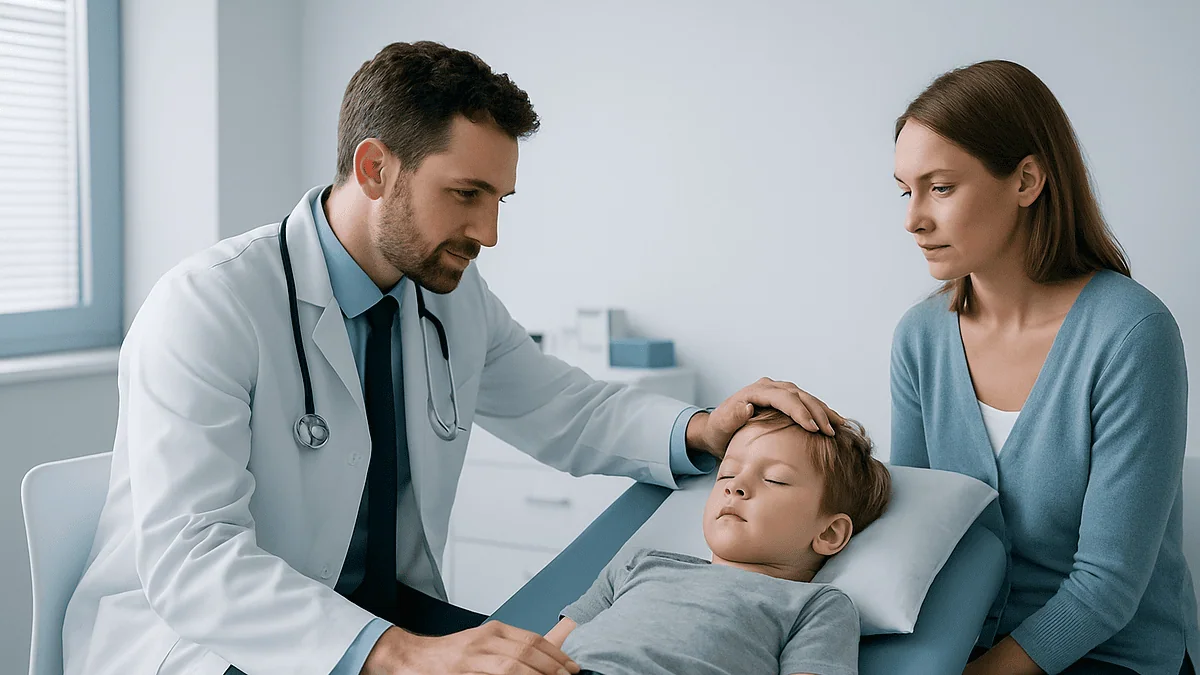
Febrile seizures are brief convulsions triggered by fever in children roughly 6 months to 5 years old. They look frightening, stiffening, rhythmic jerking, unresponsiveness, but most end within five minutes and cause no lasting harm. They cannot be reliably prevented: fever-reducing medicines do not lower the risk, and daily preventive medication is rarely recommended. Knowing first aid and recognizing when to seek help matters most.
It usually happens on an ordinary afternoon. A toddler who was a little warm and clingy at lunch is suddenly rigid on the living-room rug, eyes rolled back, arms and legs jerking in a rhythm no parent has ever seen before. Ninety seconds later it is over. The child is limp, drowsy, and breathing. The parent is not breathing at all.
Ask any pediatric emergency nurse what the most terrified families in the waiting room have in common, and febrile seizures come up fast. The event is short; the fear is not. What lingers afterward is a set of questions that the internet answers badly: Did I let the fever get too high? Should I have given medicine sooner? Will it happen again? Is there something I can do so it never does?
The honest answers are more reassuring than the search results suggest, and also more humbling. Some of the most intuitive prevention strategies simply do not work. Here is what the evidence actually shows.
What does a febrile seizure look like?
Most febrile seizures follow a recognizable script. The child loses consciousness, the body stiffens, and then the arms and legs begin to jerk in a steady rhythm. Eyes may roll upward or fix to one side. Breathing can look irregular, the lips may take on a bluish tint for a few seconds, and it is common for a child to wet themselves, drool, or vomit. Parents often describe a strange sound at the start, a cry or a gasp, as the muscles of the chest tighten.
The timing matters more than the drama. According to the NHS, most febrile seizures last less than five minutes, and the National Institute of Neurological Disorders and Stroke (NINDS) notes that many are over in one to two minutes. Afterward comes a period of deep sleepiness or confusion that can last up to an hour, which is the brain resetting, not a sign of damage.
Less typical presentations exist. Some children simply go limp and unresponsive rather than jerking. Others have twitching confined to one side of the body, or a seizure that stops and then restarts. These variations are what clinicians use to sort seizures into “simple” and “complex” categories, a distinction we will return to because it changes the follow-up, though rarely the immediate first aid.
One detail surprises many families: the seizure is sometimes the first sign that the child is sick at all. Mayo Clinic notes that febrile seizures frequently occur within the first day of a fever, and a parent may not have noticed the temperature climbing before the child collapses.
What triggers febrile seizures?
The trigger is fever, but not in the way most people assume. Ordinary childhood infections cause the vast majority of cases. Viral illnesses top the list, and the NINDS and Mayo Clinic both highlight roseola and influenza as common culprits, alongside ear infections, colds, and stomach bugs. Bacterial infections can also set one off, which is one reason clinicians look carefully for the source of the fever after a first seizure.
What the infection does is push a developing brain past a threshold it cannot yet hold. Between roughly 6 months and 5 years, the networks that keep electrical activity organized are still maturing. Fever changes the chemistry around neurons, and in a susceptible child that shift is enough to tip the whole system into synchronized, uncontrolled firing. Think of a crowd suddenly clapping in unison instead of a hall full of scattered conversation.
Here is where the intuition fails. Parents often believe the seizure happened because the fever got “too high.” The evidence does not support a simple height rule. Febrile seizures happen at modest temperatures as well as high ones, and Mayo Clinic lists a relatively low fever at the time of the first seizure as a factor associated with a higher chance of recurrence, not a lower one. A popular alternative theory holds that the speed of the temperature rise is what matters. That idea is plausible but has never been proven, and it is fair to say the research remains unsettled.
Fever itself is not a fault. It is part of a healthy immune response. The problem is a temporary mismatch between an ordinary fever and an immature brain, which is why the whole phenomenon has a shelf life.
Why do only some kids have febrile seizures?
Every child gets fevers. Only a small minority ever seize with one. The difference comes down largely to inheritance and age.
Genetics is the clearest factor. Mayo Clinic and the NINDS both report that children with a parent or sibling who had febrile seizures are more likely to have them. Researchers have identified several genes involved in how brain cells manage sodium and other charged particles, which govern how easily a neuron fires. A child who inherits a slightly more excitable version of that wiring is more vulnerable when fever changes the chemical environment. Several families describe the same pattern across generations: a grandfather who “had fits with fevers,” a mother who did, and now a toddler.
Age is the second lens. The window runs from about 6 months to 5 years, with a peak between 12 and 18 months according to Mayo Clinic. Younger infants and older children rarely have them, even with identical infections, because their brains sit on either side of the vulnerable developmental stage.
Beyond those two, the picture gets hazier. Some observational studies have reported associations between febrile seizures and low iron stores, prematurity, or developmental delays, but associations are not causes, and the findings are inconsistent. Boys are affected somewhat more often than girls in many series, though the reason is unclear.
What is not on the list is anything a parent did or failed to do. Feeding choices, room temperature, how quickly medicine was given, whether the child was bathed: none of these explains why one child seizes and another does not.
What are the chances of having a febrile seizure?
The numbers are more reassuring than the experience. The NINDS and Cleveland Clinic put the lifetime chance that a child will have at least one febrile seizure at about 2% to 5%, roughly one child in every 25 to 50. In a typical preschool classroom, that means one child, perhaps two, has been through this. Their parents felt exactly what you felt.
| Question | What the evidence shows | Source |
|---|---|---|
| How many children ever have one? | About 2% to 5% | NINDS; Cleveland Clinic |
| Typical age range | 6 months to 5 years | Mayo Clinic; NHS |
| Peak age | 12 to 18 months | Mayo Clinic |
| How long do most last? | Under 5 minutes; often 1 to 2 | NHS; NINDS |
| Chance of a second seizure | About 1 in 3 | NHS; NINDS |
| Lasting brain damage from a simple seizure | Not shown | Mayo Clinic; NINDS |
The recurrence figure deserves a second look. About one-third of children who have one febrile seizure will have another, which also means roughly two-thirds never will. Recurrence is more likely when the first seizure happened before 18 months, when there is a family history, or when the fever was low or brief before the seizure. Even then, “more likely” is a matter of probability, not destiny.
Knowing the odds does something practical. It lets a parent stop scanning every fever as an emergency and start treating it as what it usually is: an ordinary illness in a child who happens to have a temporary sensitivity.
Simple vs. complex febrile seizures: what's the difference?
Clinicians sort febrile seizures into two groups, and the sorting drives what happens next.
A simple febrile seizure involves the whole body, lasts less than 15 minutes, and does not happen again within the same 24-hour period. This is by far the more common type. Mayo Clinic and the NINDS describe simple febrile seizures as the pattern in the large majority of children, and it carries the most reassuring outlook.
A complex febrile seizure breaks at least one of those three rules. It may last longer than 15 minutes, affect only one side or one part of the body, or recur within 24 hours. Complex seizures prompt a closer look, not because they are usually dangerous in themselves, but because they occasionally signal something other than a straightforward fever response.
Why does 15 minutes matter? Prolonged seizure activity is harder on the body, raising the chance of breathing difficulty and, in rare cases, a seizure that does not stop on its own. Focal features, where only one limb or one side jerks, raise the question of whether a specific brain region is involved. Repetition within a day suggests the threshold has been pushed unusually low.
- Simple: generalized, under 15 minutes, once per illness
- Complex: prolonged, one-sided, or repeated within 24 hours
For families, the distinction should lower anxiety rather than raise it. A simple febrile seizure, even a second or third one, is a well-understood event with a well-documented benign course. A complex seizure means the child deserves a fuller evaluation, and the treating team decides what that evaluation involves. Neither category changes the first-aid steps in the moment.
Do febrile seizures cause brain damage or epilepsy?
This is the question underneath every other question, so it deserves a direct answer. There is no evidence that simple febrile seizures cause brain damage, lower intelligence, or lead to learning problems. The NINDS states plainly that the vast majority of febrile seizures are harmless, and Mayo Clinic concurs that they do not indicate epilepsy and do not cause lasting harm.
Follow-up studies of children with febrile seizures have compared them with siblings and classmates on measures of memory, attention, school performance, and behavior years later. The groups look the same. The brain is more resilient than a two-minute convulsion makes it appear.
Epilepsy is a separate matter, and the honest answer is nuanced. Epilepsy means recurrent seizures without fever. Children who have had febrile seizures do carry a slightly higher lifetime chance of developing it than children who never did, but the absolute risk remains small, and for simple febrile seizures it is only modestly above the general population. The increase is larger for children with complex seizures, pre-existing neurological differences, or a family history of epilepsy. Mayo Clinic frames this as a slightly increased risk rather than a likely outcome.
It helps to understand the direction of the relationship. Febrile seizures do not appear to cause epilepsy the way a fall causes a broken arm. Rather, some children have an underlying brain excitability that expresses itself first as febrile seizures and, in a minority, later as epilepsy. The febrile seizure is a marker, not a mechanism.
What this means for the family in the emergency department: the seizure that just happened is very unlikely to be the first chapter of a lifelong condition. It is much more likely to be a chapter that closes on its own before kindergarten.
Can fever-reducing medicine prevent febrile seizures?
This is the myth most worth busting, because it drives so much guilt. The reasoning seems airtight: fever triggers seizures, so lowering fever should prevent them. Give the medicine early and often, and the seizure never comes.
The evidence says otherwise. Both the NHS and Mayo Clinic state that fever-reducing medicines do not prevent febrile seizures, and controlled trials in which children with a history of febrile seizures were given scheduled fever-reducers during subsequent illnesses did not show a meaningful reduction in seizures compared with usual care. Children seized at similar rates whether or not the fever was being actively suppressed.
Why would that be? Part of the answer is timing. Many seizures occur so early in an illness that no one has yet realized the child is ill. Another part is that the height of the fever is not the whole story, as discussed earlier; something about the brain’s response to infection matters more than the thermometer reading. A medicine that shaves a degree off a temperature does not change the underlying excitability.
None of this means fever medicine is useless. It can make a miserable, achy child more comfortable, help them drink, and let them rest. Those are perfectly good reasons to use it, following the guidance of the child’s clinician and the product label. The point is to give it for comfort, not as a shield against seizures, and to stop blaming yourself when a seizure happens anyway.
A parent who did not medicate a fever did not cause a febrile seizure. A parent who did medicate one did not fail. The medicine was never going to stand in the way.
Do supplements or diet prevent febrile seizures?
Search for febrile seizure prevention and you will meet a cluster of studies on minerals, particularly iron and zinc. The headlines sound promising. The evidence beneath them is thinner than it looks.
The iron story starts with observation. Several studies, many from regions where iron deficiency is common, found that children who had febrile seizures were more likely to have low iron stores than children who did not. Iron is involved in the production of brain chemicals that regulate neuronal firing, so a biological mechanism is at least plausible. But other studies found no link, and observational data cannot separate cause from coincidence. Children with frequent infections may simply be more likely to have both fevers and low iron.
Zinc has followed a similar arc: some small studies report lower zinc levels in children with febrile seizures, a few small trials have tested supplementation, and results are mixed and short of definitive. No major guideline recommends supplementation to prevent febrile seizures. The NIH Office of Dietary Supplements is careful to note that supplementing a mineral a child is not deficient in does not produce extra benefit and can cause harm at high intakes.
Where does that leave a parent? If a child has confirmed iron deficiency, correcting it is worthwhile for many reasons, febrile seizures aside, and that decision belongs with the child’s clinician after testing. Giving supplements to a child with normal levels in the hope of preventing seizures is not supported by evidence.
No specific food, elimination diet, or “cooling” remedy has been shown to prevent febrile seizures either. The most nourishing thing a parent can offer during a fever is fluids and patience.
Is there a daily medicine to prevent febrile seizures?
Medicines that calm electrical activity in the brain do exist, and taken every day they can reduce how often febrile seizures recur. So why are they almost never prescribed for this purpose?
Because the trade-off is poor. The NINDS explains that for the large majority of children, the side effects of long-term preventive medication outweigh the benefits, given that febrile seizures are harmless in themselves. These medicines can cause drowsiness, behavioral changes, irritability, and effects on learning during exactly the years when a child’s brain is developing fastest. Paying that price daily to prevent an event that usually lasts two minutes and causes no lasting harm is not a bargain most clinicians or families would take.
A middle path is used in select situations. Some children with a history of prolonged or frequent febrile seizures are given a “rescue” medicine that a parent can administer at the start of a seizure to stop it if it runs long, or in some cases at the onset of a fever during a specific illness. These work quickly by dampening the brain’s excitability for a period of hours. They are prescribed for specific children after careful assessment, come with their own risks including sedation and breathing effects, and are always accompanied by training on when and how to use them.
The decision about whether any medicine is appropriate rests with the child’s treating team, weighing seizure history, age, family circumstances, and the child’s overall health. For most children with simple febrile seizures, that conversation ends with reassurance rather than a prescription.
What should I do during a febrile seizure?
You cannot prevent the seizure, but you can make it safer. The steps are simple enough to remember in the moment, and they matter more than any medicine.
First, look at the clock. Knowing how long the seizure lasted is the single most useful piece of information you can give a clinician, and the five-minute mark is when you call for emergency help. Second, get the child onto a soft, flat surface, away from furniture edges, stairs, or water. Lay them on their side so saliva or vomit drains out rather than in. Loosen anything tight around the neck.
Now the harder part: do not intervene. The NHS and Mayo Clinic are unanimous on this. Do not hold the child down or try to stop the movements. Do not put anything in the mouth, not a spoon, not a finger, not medicine; a child cannot swallow their tongue, but they can bite whatever you insert, and you can obstruct their airway. Do not try to cool them with a cold bath or shower during the seizure; it will not shorten it and risks injury.
- Note the start time
- Move to a safe surface, on their side
- Stay with them and watch their breathing
- Call emergency services if it passes five minutes
When it stops, the child will likely be very sleepy or confused. Keep them on their side, speak calmly, and let them rest. If you can, note what the seizure looked like: both sides or one, stiffening, jerking, eye movements. Your description will help the clinician more than you might think.
When should I see a doctor after a febrile seizure?
Every first febrile seizure should be evaluated by a clinician the same day, even if it was short and the child recovered fully. The goal is not to treat the seizure, which is already over, but to identify the infection behind the fever and confirm that nothing more serious is going on. Most children need only an examination. Some need tests to find the source of the fever. Brain scans and brainwave recordings are not routine after a simple febrile seizure.
Certain features mean calling emergency services immediately rather than waiting for a clinic appointment. According to the NHS and Mayo Clinic, these red flags include:
- A seizure lasting longer than five minutes
- A second seizure before the child has recovered from the first
- Breathing difficulty or a bluish color that does not clear within a few seconds of the seizure ending
- A stiff neck, a rash that does not fade when pressed, or a bulging soft spot on an infant’s head
- Extreme drowsiness or difficulty waking well after the seizure should have passed
- Repeated vomiting, or signs of dehydration
- Any seizure in a child younger than 6 months or older than 5 years
- A seizure after a head injury, or in a child who is not fully immunized or has a weakened immune system
Trust the instinct that something is not right. Clinicians would much rather see a child who turns out to be fine than miss one who is not. If your child has had febrile seizures before and this one followed the familiar pattern, ended quickly, and the child recovered normally, a same-day call to the child’s usual clinician is reasonable. If anything about it feels different, treat it as a first.
Will my child have another one?
Statistically, probably not, though the odds are not overwhelming. About one in three children who have a febrile seizure will have at least one more, according to the NHS and the NINDS. Most recurrences happen within a year or two of the first, during the same developmental window of vulnerability.
Certain factors nudge the probability upward. Mayo Clinic lists a first seizure before 18 months of age, a family history of febrile seizures, a relatively low fever at the time of the seizure, and a short interval between the fever starting and the seizure occurring. A child with none of these factors has a considerably lower chance of recurrence than the one-in-three average; a child with several has a higher one.
None of these factors is modifiable, which is frustrating. What a family can control is readiness. Knowing the first-aid steps cold, keeping a note of what previous seizures looked like and how long they lasted, and having a plan for who to call removes much of the panic from a second event. Many parents report that the second seizure, while still awful, was survivable in a way the first was not, simply because they knew what was happening.
Illness is worth managing sensibly but not obsessively. Comfort measures during fevers, plenty of fluids, and rest are appropriate. Constant temperature checks through the night, however, have not been shown to prevent recurrence and mainly deprive everyone of sleep. The seizure, if it comes, will come regardless of how closely the thermometer was watched.
At what age do kids outgrow febrile seizures?
Most children stop having febrile seizures by about age 5, and Mayo Clinic notes that they rarely occur after age 6. The reason is developmental. As the brain matures, the mechanisms that keep electrical activity organized strengthen, and the threshold at which a fever can disrupt them rises out of reach of ordinary infections.
The pattern in a typical family runs something like this. A first seizure somewhere between 12 and 24 months. Perhaps one or two more over the following year or two, usually with the bigger fevers of preschool illnesses. Then a gradual quieting, until one day the parent realizes the child had a high fever last month and nothing happened. By the start of school, the chapter is usually closed.
There are exceptions on both sides of the range. Febrile seizures in babies under 6 months are unusual and prompt closer investigation, as do seizures with fever in children well past age 6, because they may point to something other than a typical febrile seizure. A child whose seizures continue with fever into later childhood deserves evaluation by the treating team, but even here, most turn out to have a benign explanation.
The overwhelming majority of children who had febrile seizures as toddlers grow into school-age children, teenagers, and adults with no trace of the episodes beyond a family story. Many do not remember them at all. The parents remember. The children move on.
What can parents actually control?
Strip away the myths and the honest answer to “how to prevent febrile seizures” is: you mostly cannot, and that is not a failure. The two forces at work, a child’s inherited brain excitability and their developmental age, are beyond anyone’s reach. What remains is a shorter, more realistic list.
Reduce the number of infections where you sensibly can. Handwashing, keeping a sick child home, and following the childhood health schedule your clinician recommends all cut the number of fevers a child experiences, and fewer fevers means fewer chances for a seizure. This is prevention by arithmetic rather than by medicine.
Treat fevers for comfort, not for prevention. Offer fluids, light clothing, rest, and fever-reducing medicine when the child is uncomfortable, on the advice of your clinician. Let go of the idea that aggressive fever control is a protective wall; the evidence says it is not.
Master the first aid. Time it, protect the child, stay with them, do not restrain or put anything in the mouth, and call for help at five minutes or with any red flag. This is the part that genuinely changes outcomes, because prolonged or complicated seizures are the ones that carry risk, and prompt help is what addresses them.
Tell the people who care for your child. Grandparents, daycare staff, babysitters: anyone who might be present during a fever should know what a febrile seizure looks like and what to do. A calm adult who has been briefed is worth more than any supplement.
Finally, extend yourself some grace. The seizure was not caused by anything you did. The evidence is clear on that, even when the guilt is not.
Frequently asked questions
What triggers febrile seizures?
Fever from an ordinary infection is the trigger, most often viral illnesses such as roseola or influenza, but also ear infections, colds, and stomach bugs. The fever changes the chemical environment around brain cells, and in a susceptible young child that shift tips the brain into a brief burst of uncontrolled electrical activity. The seizure is not caused by the fever being unusually high; it can occur at modest temperatures, and sometimes before anyone notices the child is unwell.
Why do only some kids have febrile seizures?
Inheritance and age explain most of the difference. Children with a parent or sibling who had febrile seizures are more likely to have them, reflecting genes that influence how easily brain cells fire. The vulnerability is also confined to a developmental window of about 6 months to 5 years, while the brain’s regulatory networks are still maturing. Nothing a parent does or fails to do during a fever determines which children seize.
What are the chances of having a febrile seizure?
About 2% to 5% of children have at least one febrile seizure, according to the NINDS and Cleveland Clinic, or roughly one child in every 25 to 50. After a first seizure, about one in three children will have another, most often within a year or two. The chance of recurrence is higher when the first seizure occurred before 18 months, when there is a family history, or when the fever was low or very brief beforehand.
At what age do kids outgrow febrile seizures?
Most children stop having febrile seizures by about age 5, and they are rare after age 6. As the brain matures, the mechanisms that keep electrical activity organized become more robust, raising the threshold at which a fever can disrupt them. A child who continues to have seizures with fever well past age 6, or who has one before 6 months of age, should be evaluated more closely, but even in these cases a benign explanation is the most common finding.
Can giving fever medicine early prevent a febrile seizure?
No. Both the NHS and Mayo Clinic state that fever-reducing medicines do not prevent febrile seizures, and controlled studies in children with previous seizures found similar recurrence rates whether or not fever was actively lowered. Many seizures happen so early in an illness that no one has noticed the fever yet. Fever medicine is still worthwhile for comfort, on your clinician’s advice, but it should not be relied on as protection.
Do febrile seizures cause brain damage?
There is no evidence that simple febrile seizures cause brain damage, lower intelligence, or learning problems. Follow-up studies comparing children who had febrile seizures with their peers show no differences in memory, attention, or school performance years later. Children who have had febrile seizures carry a slightly higher lifetime chance of developing epilepsy than those who have not, but the absolute risk remains small, and the seizures appear to be a marker of underlying brain excitability rather than a cause.
What is the difference between a simple and a complex febrile seizure?
A simple febrile seizure affects the whole body, lasts less than 15 minutes, and does not recur within 24 hours; this is the common and most reassuring type. A complex febrile seizure lasts longer than 15 minutes, affects only one side or part of the body, or happens again within the same day. Complex seizures prompt a fuller evaluation by the treating team, though the first-aid steps in the moment are the same for both.
Should my child take daily medicine to prevent febrile seizures?
For most children, no. Medicines that calm brain activity can reduce recurrences, but the NINDS notes that their side effects, including drowsiness, behavior changes, and effects on learning, outweigh the benefits for a condition that is harmless in itself. In select cases, such as a history of prolonged seizures, a clinician may prescribe a rescue medicine to stop a seizure that runs long. That decision rests with the child’s treating team after careful assessment.
Can iron or zinc supplements prevent febrile seizures?
Current evidence does not support it. Some observational studies have linked low iron or zinc levels with febrile seizures, and a few small trials have tested supplements, but results are mixed and no major guideline recommends supplementation for this purpose. Correcting a confirmed deficiency is worthwhile for a child’s overall health and should be guided by a clinician after testing. Giving minerals to a child with normal levels has no proven benefit and can cause harm at high intakes.
What should I do if my child has a febrile seizure?
Note the time, move your child to a safe flat surface, and turn them onto their side so fluids drain from the mouth. Stay with them and watch their breathing. Do not restrain them, put anything in their mouth, or try to cool them in a bath. Call emergency services if the seizure lasts more than five minutes, if another begins before recovery, or if breathing difficulty, a stiff neck, an unusual rash, or extreme drowsiness follows. Every first seizure should be checked the same day.
References
- Febrile seizures (NHS)
- Febrile Seizures (National Institute of Neurological Disorders and Stroke, NIH)
- Febrile seizures (MedlinePlus Medical Encyclopedia)
- Febrile Seizures (Cleveland Clinic)
This article is for general information only and is not a substitute for professional medical advice. Please consult a qualified doctor about your individual situation.

More from the Blog

What a Pediatric Physical Therapy Session Looks Like: Play, Strength Work and Skill Practice
A pediatric physical therapy session usually blends structured play with strength work and repeated practice of movement skills such as rolling, sitting, walking or…
Cradle Cap, Baby Eczema and Diaper Rash: The Three Baby Skin Problems, Sorted
Cradle cap is a harmless, common form of seborrheic dermatitis that causes greasy yellow or white scales on a baby's scalp in the first…

Supporting a Child Emotionally Through Pediatric Plastic Surgery: Words and Routines
Supporting a child emotionally before surgery works best when honest, age-matched words are paired with steady routines. Tell younger children a day or two…
Tummy Time and Flat Head: How Much, How Early and When a Helmet Is Discussed
Tummy time can begin in the first days at home, in short supervised sessions of a few minutes, building toward roughly 30 minutes spread…
How Do Pediatric Ophthalmologists Choose Between Laser and Injection Treatment for ROP?
Pediatric ophthalmologists choose between laser and anti-VEGF injection for retinopathy of prematurity based mainly on where the disease sits in the retina, how aggressive…

How Pediatric Plastic Surgery Is Timed: Growth, Function and Why Some Repairs Are Staged
There is no single right age for pediatric plastic surgery. Surgeons time each operation around growth and function: cleft lip is commonly repaired at…