Quick answer
Febrile seizures are convulsions triggered by fever in young children, usually during a rapid rise in body temperature and often without an underlying brain disorder. Evaluation focuses on identifying the cause of the fever and ruling out other conditions, while treatment is directed at fever-related illness, seizure control when needed, and follow-up by pediatric specialists at Acibadem in Turkey.
What is febrile seizures?
A febrile seizure is a convulsion (a sudden episode of uncontrolled shaking or stiffening of the body) that happens in a young child during a fever. The word “febrile” simply means “related to fever.” Febrile seizures are among the most common neurological events in early childhood, and while they are frightening for parents to witness, in most cases they are brief, stop on their own, and do not cause lasting harm.
When people ask what is febrile seizures as a condition, the simplest answer is this: it is a seizure triggered by a rapid rise in body temperature in a child who does not have an infection of the brain itself and does not have another known cause of seizures, such as epilepsy (a condition in which a person has repeated seizures without a fever trigger). In medical coding, febrile seizures are classified under ICD-10 code R56.00.
Febrile seizures typically affect children between about 6 months and 5 years of age, with the highest frequency around 12 to 18 months. They are uncommon before 6 months and after 6 years. Boys are affected slightly more often than girls in many reports, and children who have a parent or sibling with a history of febrile seizures appear to be at higher risk, suggesting that genetics plays a role.
Doctors usually divide febrile seizures into two main types:
- Simple febrile seizuresthe most common type. These involve the whole body, last less than about 15 minutes (usually only a few minutes), and do not happen again within the same 24-hour period.
- Complex febrile seizuresthese last longer than 15 minutes, affect only one side or one part of the body, or occur more than once within 24 hours. Complex febrile seizures may prompt doctors to look more carefully for an underlying cause.
Symptoms of febrile seizures
Febrile seizures symptoms usually appear suddenly, often on the first day of an illness and sometimes before parents even realize the child has a fever. In many cases, the seizure is the first sign that the child is unwell.
During a typical febrile seizure, a child may show some or all of the following:
- Loss of consciousnessthe child does not respond when spoken to or touched.
- Stiffening of the bodythe arms, legs, and trunk may become rigid.
- Rhythmic jerking or twitchingoften involving both arms and legs.
- Eyes rolling back or a fixed, staring gaze.
- Irregular breathingbreathing may briefly appear labored, noisy, or paused.
- Changes in skin colorthe lips or face may look pale or slightly bluish for a short time.
- Drooling, foaming at the mouth, or clenched teeth.
- Loss of bladder or bowel control during the episode.
Most simple febrile seizures last only one to a few minutes. Afterward, children often go through a recovery phase sometimes called the postictal period (the time immediately after a seizure), during which they may be drowsy, confused, irritable, or unusually sleepy for minutes to an hour or so. This gradual return to normal is expected and, on its own, is not a sign of brain damage.
Symptoms can differ depending on the type of seizure:
- In a simple febrile seizure, the shaking involves both sides of the body, the episode is short, and the child returns to their usual self within a reasonable time.
- In a complex febrile seizure, the movements may be limited to one arm, one leg, or one side of the face; the seizure may last longer than 15 minutes; or a second seizure may occur within the same day. A longer period of weakness on one side after the seizure can also occur and should be evaluated by a doctor.
It is important to know that the height of the fever does not always match the risk. Some children seize with only a moderate temperature, and the speed at which the temperature rises is thought to matter as much as the peak temperature itself.
Causes and risk factors
Febrile seizures causes are not fully understood, but the central trigger is fever, most often fever caused by a common childhood infection. The developing brain of a young child appears to be more sensitive to sudden changes in body temperature, and in susceptible children this sensitivity can lower the threshold at which a seizure occurs.
Common situations associated with febrile seizures include:
- Viral infectionsordinary viral illnesses such as upper respiratory infections, ear infections, and roseola (a viral illness of infancy that causes high fever followed by a rash) are frequent triggers. Influenza (the flu) is also commonly associated with febrile seizures.
- Bacterial infectionsless often, bacterial infections such as ear or urinary tract infections can be the source of the fever.
- Fever after vaccinationsome childhood vaccines can cause a fever, and in a small number of children this fever can trigger a febrile seizure. Doctors emphasize that it is the fever, not the vaccine itself, that triggers the seizure, and the infections that vaccines prevent are generally far more likely to cause fever and seizures than the vaccines are.
Risk factors that make a febrile seizure more likely include:
- Young agemost febrile seizures occur between 6 months and 5 years, especially in the second year of life.
- Family historyhaving a parent or sibling who had febrile seizures increases a child’s risk, pointing to inherited susceptibility.
- A previous febrile seizureroughly one in three children who have had one febrile seizure will have another at some point, particularly if the first seizure occurred at a young age or with a relatively low fever.
- Rapid temperature risea quickly climbing fever appears to be a stronger trigger than a slowly developing one.
Importantly, febrile seizures are not caused by infections inside the brain. A seizure with fever that is caused by meningitis (infection of the membranes covering the brain) or encephalitis (infection of the brain tissue itself) is not classified as a febrile seizure, ruling out these serious infections is a key part of the medical evaluation.
Diagnosis
Febrile seizures diagnosis is primarily clinical, which means it is based on the doctor’s careful assessment of the child’s history and physical examination rather than on a single confirming test. The main goals of the evaluation are to confirm that the event was truly a febrile seizure, to find the source of the fever, and to rule out more serious conditions.
The evaluation usually includes:
- Detailed historythe doctor will ask exactly what happened before, during, and after the seizure: how long it lasted, whether it involved the whole body or one side, whether the child returned to normal afterward, recent illnesses, vaccinations, medications, and any family history of seizures.
- Physical and neurological examinationthe doctor examines the child from head to toe, looking for the source of the fever (such as an ear or throat infection) and checking that the nervous system is working normally.
- Checking for signs of brain infectionthe doctor looks for warning signs such as a stiff neck, a bulging soft spot (fontanelle) in infants, prolonged drowsiness, or an unusual rash. If meningitis is a concern, especially in infants under about 12 months, in children who have not been fully vaccinated, or when the examination is worrying: the doctor may recommend a lumbar puncture (a spinal tap, in which a small sample of the fluid around the spinal cord is taken with a thin needle and tested for infection).
For a typical simple febrile seizure in an otherwise healthy, fully vaccinated child who has recovered well, extensive testing is often unnecessary. Additional tests are ordered selectively:
- Blood and urine testsmay be done to identify the infection causing the fever or to check for problems such as low blood sugar or salt imbalances, particularly if the child has vomiting, diarrhea, or poor fluid intake.
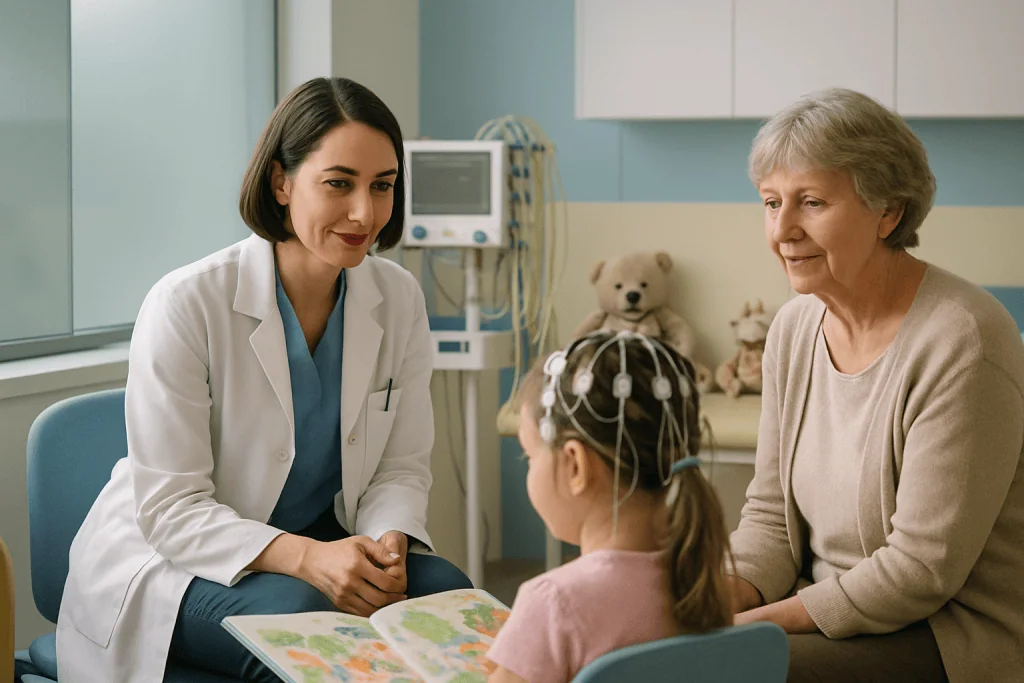
- Electroencephalogram (EEG)a painless test that records the brain’s electrical activity using small sensors on the scalp. An EEG is not needed after a typical simple febrile seizure, but it may be considered after complex febrile seizures or if the doctor suspects an underlying seizure disorder.
- Brain imaginga CT scan or MRI (detailed pictures of the brain) is not routinely required. Imaging may be considered when seizures are prolonged or focal (limited to one part of the body), when the neurological examination is abnormal, or when the child does not recover as expected.
The distinction between simple and complex febrile seizures guides how much testing is done. In many cases, once the doctor confirms a simple febrile seizure and finds an ordinary source of fever, no further neurological workup is needed.
Treatment options
Febrile seizures treatment focuses on three things: keeping the child safe during the seizure, treating the illness that caused the fever, and, only in selected cases, using medication to stop or prevent seizures. In pediatric practice, febrile seizures are typically managed by pediatricians, and at hospital groups such as Acibadem this care is provided through the pediatrics department. A general overview of how the condition is evaluated and managed is also available on the febrile seizures page.
First aid during a seizure
What parents do in the moment matters. Recommended steps include:
- Place the child on their side on a soft, flat surface, away from hard or sharp objects, to help keep the airway clear.
- Do not put anything in the child’s mouth: a child cannot swallow their tongue, and objects in the mouth can cause injury or choking.
- Do not restrain the child or try to stop the movements.
- Loosen tight clothing around the neck.
- Time the seizure. If it lasts longer than about 5 minutes, call emergency services.
- Stay with the child until they are fully awake and note what the seizure looked like, as this information helps the doctor.
Watchful waiting and fever care
Most febrile seizures end on their own within a few minutes and require no seizure-stopping medication. The main treatment afterward is care of the underlying illness. Doctors may recommend fever-reducing medicines such as acetaminophen or ibuprofen to keep the child comfortable. It is worth knowing that these medicines have not been shown to reliably prevent febrile seizures, they treat discomfort, not seizure risk, so parents should not blame themselves if a seizure occurs despite giving fever medicine. Aspirin should not be given to children because of the risk of Reye syndrome (a rare but serious illness affecting the liver and brain).
Medication for prolonged or recurrent seizures
If a seizure lasts longer than about 5 minutes, emergency treatment with a fast-acting anti-seizure medicine from the benzodiazepine family (medicines that calm excessive electrical activity in the brain) may be given by medical staff. For a small number of children who have had prolonged febrile seizures, the doctor may prescribe a rescue medication for parents to use at home if a long seizure happens again, along with clear instructions on when and how to use it.
Daily preventive anti-seizure medication is generally not recommended for typical febrile seizures. The potential side effects of long-term daily medication usually outweigh the benefits, because febrile seizures are typically harmless and children outgrow them. Your doctor may consider preventive strategies only in unusual circumstances, and this decision is made individually.
Procedures and surgery
There is no procedure or surgery for febrile seizures themselves, because the condition reflects a temporary, age-related sensitivity of the developing brain rather than a structural problem. Hospital observation may be recommended after a complex or prolonged seizure, after a first seizure in a very young infant, or when the source of the fever needs treatment, but most children with a simple febrile seizure can go home once they have been assessed and have recovered.
Living with febrile seizures / outlook
The outlook for children with febrile seizures is, in most cases, very reassuring. Simple febrile seizures are not known to cause brain damage, intellectual disability, or learning problems, and children who have them develop normally as a group. Most children outgrow febrile seizures by about age 5 to 6 as their brains mature.
Recurrence is common but usually harmless. Roughly one in three children who have one febrile seizure will have at least one more, most often within a year or two of the first. The risk of recurrence tends to be higher when the first seizure happened at a younger age, when the fever was relatively low at the time of the seizure, or when there is a family history of febrile seizures.
Many parents worry about epilepsy. The large majority of children with febrile seizures never develop epilepsy. The lifetime risk is only slightly higher than in the general population after a simple febrile seizure, and somewhat higher after complex febrile seizures or when other risk factors are present, such as a family history of epilepsy or delays in development before the seizure. Your child’s doctor can discuss the individual picture honestly, but no one can offer guarantees in either direction.
Practical points for daily life include:
- Learn and rehearse the first-aid steps described above so you feel prepared if a seizure recurs.
- Treat fevers to keep your child comfortable, while understanding that fever medicine does not reliably prevent seizures.
- Continue routine vaccinations unless your doctor advises otherwise; preventing infections generally reduces fever episodes.
- Inform caregivers, daycare staff, and teachers about the history so they know what to do if a seizure occurs.
- Keep regular follow-up visits so the doctor can track development and answer new questions as your child grows.
Frequently asked questions
What is a febrile seizure in simple terms?
A febrile seizure is a convulsion triggered by fever in a young child, usually between 6 months and 5 years of age, in whom the brain itself is not infected and there is no other known seizure disorder. It typically involves loss of consciousness with stiffening or jerking of the body, lasts a few minutes, and stops on its own. Although alarming to watch, a simple febrile seizure is usually harmless.
Are febrile seizures dangerous or a sign of brain damage?
In the great majority of cases, no. Simple febrile seizures have not been shown to cause brain damage or lasting harm, and affected children develop normally as a group. The main risks during a seizure are minor injuries from falling or striking objects, which is why safe positioning matters. Prolonged seizures and complex features deserve medical evaluation, but even these usually have a good outcome.
Do febrile seizures mean my child has epilepsy?
No. A febrile seizure is triggered by fever and is different from epilepsy, which involves repeated seizures without a fever trigger. Most children with febrile seizures never develop epilepsy. The risk is slightly increased compared with children who never had a febrile seizure, and somewhat higher after complex febrile seizures or when there is a family history of epilepsy, so your doctor may discuss follow-up in those situations.
Can febrile seizures be cured or prevented?
There is no cure needed in the usual sense, because children typically outgrow febrile seizures as the brain matures, most often by age 5 or 6. Prevention is difficult: fever-reducing medicines make children more comfortable but have not been shown to reliably prevent seizures, and daily anti-seizure medication is generally not recommended for typical cases because side effects usually outweigh benefits.
What should I do while my child is having a febrile seizure?
Stay calm, place your child on their side on a safe surface, remove nearby hard objects, and do not put anything in the mouth or restrain the movements. Time the seizure. Most stop within a few minutes on their own. If the seizure lasts longer than about 5 minutes, if breathing seems seriously affected, or if your child does not begin to recover afterward, call emergency services.
Will my child have another febrile seizure?
It is possible. Around one in three children who have had one febrile seizure will have another, usually within a year or two. Recurrence is more likely if the first seizure occurred at a young age, if the fever was relatively low when the seizure happened, or if close relatives have had febrile seizures. Recurrent simple febrile seizures do not change the generally good outlook.
How long does recovery take after a febrile seizure?
After the seizure ends, children often go through a short recovery phase of drowsiness, confusion, or irritability that typically lasts from a few minutes up to an hour or so. Most children then return to their usual behavior, apart from feeling unwell from the underlying illness. If drowsiness is prolonged, if your child is hard to wake, or if anything about the recovery worries you, seek medical assessment.
When to see a doctor
Any child who has a first seizure, with or without fever, should be evaluated by a doctor to confirm the diagnosis and identify the cause of the fever. Even after a diagnosis of febrile seizures has been made, some situations require urgent medical attention.
Call emergency services or go to the nearest emergency department if:
- The seizure lasts longer than 5 minutes or a second seizure begins shortly after the first.
- Your child has trouble breathing, or the lips or face stay bluish after the seizure ends.
- Your child does not wake up, is very hard to rouse, or remains unusually drowsy or confused well after the seizure.
- Only one side or one part of the body was involved, or your child has weakness of one side afterward.
- There are signs of possible brain infection: a stiff neck, severe headache, repeated vomiting, an unusual rash that does not fade when pressed, or a bulging soft spot in an infant.
- Your child is younger than 6 months, appears dehydrated, or was injured during the seizure.
- Your child seems severely ill, is inconsolable, or you are worried that something is seriously wrong, trust your instincts.
Even when none of these red flags is present, arrange a routine visit with your child’s pediatrician after any febrile seizure. The doctor can confirm the diagnosis, treat the underlying illness, explain what to expect, and help you prepare a simple plan in case a seizure happens again.
Medically reviewed by the Acıbadem International Medical Board September 3, 2026
See our medical review board →
Update history
- PublishedJune 14, 2026
- Medical review approvedSeptember 3, 2026
- Last content updateSeptember 2, 2026