

Fissure Sealant Appointment: How the Grooves Are Cleaned, Coated and Set in One Visit

Key Takeaways
- Some molar fissures are narrower than a single toothbrush bristle, which is why the floor of the groove stays uncleaned and decays first.
- The etching gel is a mild acid that roughens a microscopic layer of enamel so the resin can lock on; no sound tooth structure is drilled away.
- Resin sealants are fully hard the moment the curing light switches off, so normal eating can usually resume immediately.
- The CDC reports sealants protect against 80% of chewing-surface cavities for two years and 50% for up to four years, provided they stay in place.
- Moisture contamination during placement is the leading reason sealants fall off early, which is why keeping the tooth dry matters more than the brand of material.
- Trace BPA release from some resin sealants is far below everyday exposure from air or paper receipts, according to the CDC, and rinsing after curing reduces it further.
A fissure sealant procedure is a short, non-invasive dental visit in which the deep grooves on the chewing surface of a back tooth are cleaned, dried, lightly etched with a mild acid gel, painted with a thin liquid resin and hardened with a blue curing light. Nothing is drilled and no numbing is usually needed. Each tooth typically takes a few minutes, and most people can eat afterward.
Ten minutes before the appointment, a seven-year-old is running a fingertip along the bumpy top of a brand-new molar and asking whether the dentist is going to “fix” it. Nothing is wrong with the tooth. That is exactly why she is here. Her dentist has spotted the deep, knife-edge grooves on the first adult molars, the kind a toothbrush bristle is physically too wide to reach, and has suggested sealing them before anything gets a chance to go wrong.
The fissure sealant procedure is one of the few things in dentistry that is entirely about prevention. No drilling, no injection, no filling material packed into a hole. Instead, a thin plastic coating flows into the grooves and sets hard, turning a rough, food-trapping landscape into a smooth surface that brushing can actually clean.
This article walks through the appointment as it really unfolds: how the grooves are checked and cleaned, why the tooth is etched, what the light does, how long it all takes, and what to expect in the days and years afterward, including the honest downsides.
What is a fissure sealant procedure, in plain language?
Start with the word itself. A fissure is a narrow groove on the chewing surface of a molar or premolar; a pit is the small depression where several grooves meet. Together they form the crinkled map you can feel with your tongue on a back tooth. A fissure sealant is a thin coating, most often a plastic resin, that is flowed into those grooves and hardened so that food and bacteria can no longer settle at the bottom.
The fissure sealant procedure, then, is the appointment in which that coating is placed. It has four moves: clean the tooth, prepare the enamel so the sealant can grip, apply the liquid, set it hard. The whole sequence is done on a healthy or very early-stage tooth surface. Nothing is removed apart from plaque and debris, which is why the Cleveland Clinic describes sealants as painless and why numbing is not usually part of the visit.
It helps to picture the scale. Some molar fissures are narrower than a single toothbrush bristle, and they can run a millimeter or more deep. Toothpaste foam skims over the top; the floor of the groove stays untouched meal after meal. The CDC notes that sealants protect against 80% of cavities on these surfaces for two years and continue to protect against half of cavities for up to four years, which is a striking return for a coating you cannot feel once it has set.
The decision about whether a particular tooth benefits belongs to the dentist or dental therapist examining it. Grooves vary from shallow and self-cleaning to deep and hooked, and only a close look, sometimes with an X-ray, tells the two apart. What follows is the pathway once that decision has been made.
Why the grooves of back teeth decay first
Cavities are not random. They begin where bacteria can sit undisturbed in the presence of sugar, producing acid that dissolves enamel a little at a time. The Mayo Clinic describes this cycle plainly: plaque forms, acids strip minerals from the tooth’s hard outer surface, and tiny openings appear that widen if the process is not interrupted.
Fissures are the perfect hideout for that process. Their walls are steep and often converge at the bottom into a space too tight for a bristle, saliva flow is poor down there, and the enamel lining the base of a deep groove can be thinner than on the smooth sides of the tooth. Add the fact that first permanent molars usually erupt around age six, when brushing technique is still a work in progress, and it becomes clear why the CDC reports that school-age children without sealants have almost three times more first-molar cavities than children with them.
The mechanism a sealant uses is almost embarrassingly simple. It does not kill bacteria or strengthen enamel chemically the way fluoride does. It changes the shape of the surface. Once the resin fills the groove and sets, the tooth has a smooth, shallow contour instead of a crevice, so plaque cannot lodge and a toothbrush can sweep the entire chewing surface. Any bacteria already trapped beneath a well-bonded sealant are cut off from their food supply, which is why sealing a groove with very early, non-cavitated decay is considered acceptable practice in the StatPearls review of pit and fissure sealants.
Timing matters more than most parents realize. The highest-risk window for a molar is roughly the first few years after it appears, while it is still settling into the bite and its enamel is finishing its maturation. Sealing during that window addresses the problem at its most vulnerable moment.
Who is usually offered sealants, and who is asked to wait
Children are the classic candidates, and the timing follows the teeth rather than the calendar. The NHS notes that fissure sealants are usually applied to the permanent back teeth as soon as they start to come through, which typically means the first molars at around six to seven years and the second molars at eleven to fourteen. Premolars and, occasionally, baby molars may be sealed when a dentist judges the grooves deep enough and the decay risk high enough.
Adults are not excluded. A grown-up with deep fissures who keeps developing early decay on chewing surfaces, or whose saliva has been reduced by medication or medical treatment, may be offered sealing of unfilled molars. The evidence base is thinner for adults, and the StatPearls review makes clear that sealant decisions rest on individual caries risk, not age alone.
Several situations usually lead to a pause rather than a sealant:
- A tooth that is only partly through the gum, so the back edge cannot be kept dry, is often left until it has erupted further.
- A groove where decay has already broken through the enamel into the softer dentin beneath needs a filling, not a coating.
- A child who cannot yet stay still with the mouth open for a few minutes may be brought back when cooperation is easier, because moisture contamination is the main reason sealants fail.
- Teeth with very shallow, wide, self-cleaning grooves may simply not need one.
Fluoride remains the partner treatment rather than the alternative. Sealants protect the pits and fissures; fluoride varnish and fluoride toothpaste protect the smooth surfaces and between the teeth. Most preventive plans use both, and how they are combined for a given child is a judgment the dental team makes at the checkup.
Before the appointment: preparing a child for dental sealants
The most useful preparation is honest and brief. Children do well when they know three things: it will not hurt, they will need to keep their mouth open for a little while, and there will be a bright light that looks like a small torch. Avoid promising there will be no strange tastes or sensations; the etching gel has a slightly sour flavor if a drop reaches the tongue, and the rinse and air spray feel cold. Naming those in advance turns them from surprises into things the child was told to expect.
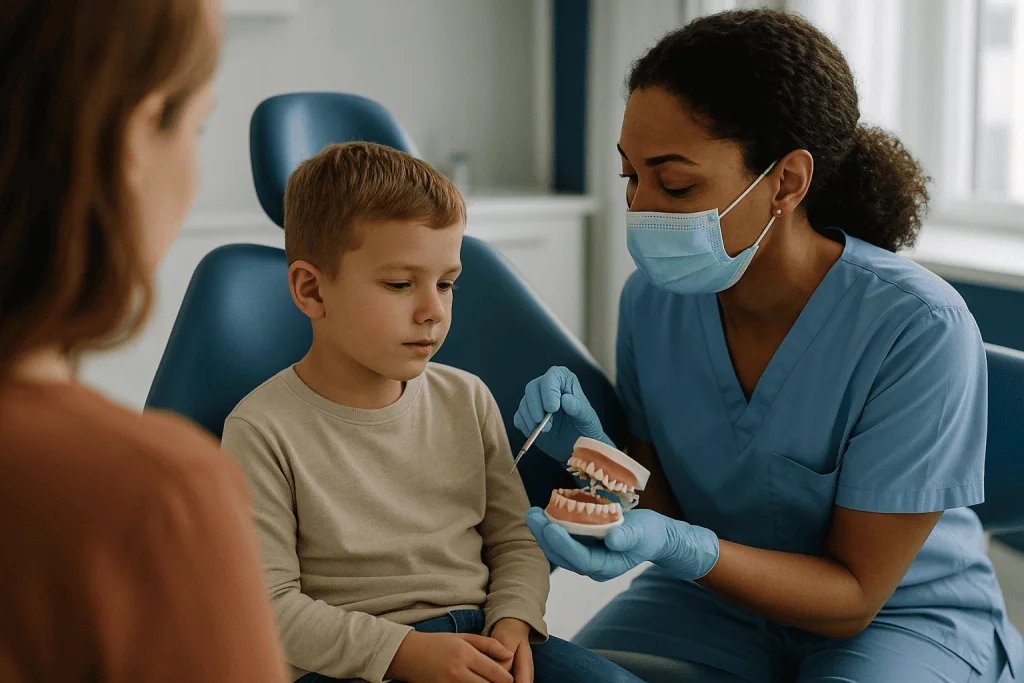
A normal meal beforehand is fine, and a thorough brushing helps, though the team will clean the tooth again regardless. Bringing a favorite small toy or planning a distraction such as counting ceiling tiles gives a restless child a job to do. Many practices are happy for a parent to sit within sight, and it is reasonable to ask how the room is set up.
For the appointment itself, expect a routine examination first. The dentist or therapist looks at each candidate tooth under good light, dries it, and may gently run a fine instrument over the grooves to check for softness or staining. If there is any doubt about whether a dark line is a stain or the start of a cavity, a small bitewing X-ray or a fiber-optic light may be used to look beneath the surface. This check is not a formality; sealing over an undetected cavity that has reached the dentin is the one genuine mistake the procedure can make, and the check is how it is avoided.
Nothing about this stage requires medicine. If a child is exceptionally anxious, the team may suggest a shorter introductory visit first, or simply seal one tooth and book the rest for another day. That pacing is a clinical decision made with the family, and it sacrifices nothing in the long run.
Step one: how the grooves are checked and cleaned
Once the tooth is judged suitable, cleaning begins. The goal is to remove every trace of plaque, food debris and the thin protein film that coats all teeth, because sealant bonds to enamel, not to whatever is sitting on top of it. A rotating brush or rubber cup on a slow handpiece is the usual tool, often with a pumice paste that has no fluoride or oil in it. Fluoride and flavoring oils can interfere with the etch that comes next, so the cleaning paste is deliberately plain.
Some clinicians prefer a fine air-abrasion spray or a gentle jet of air and water with tiny particles that scours the base of the groove more effectively than a brush can. Where the fissure is very narrow or hooked, a clinician may run an ultra-fine bur or explorer tip along it to open the entrance slightly. The StatPearls review describes this as a variation rather than a requirement, and it does not amount to drilling in the sense most people mean; no sound tooth structure is removed beyond a fraction of a millimeter at the groove’s mouth.
After cleaning, the tooth is rinsed thoroughly and dried with a stream of air. The dentist looks again. A groove that appeared stained sometimes turns out to be perfectly sound once debris is lifted from it, and a groove that looked innocent occasionally shows a chalky white line along its edge, the earliest visible sign of enamel losing minerals. Neither finding usually changes the plan; both are exactly the surfaces a sealant is designed for.
What the patient feels during this step is vibration, a gritty taste and the whistle of the suction tube. For most children the biggest challenge is the water, which is why a good assistant keeps the suction close and offers regular pauses to swallow.
Step two: keeping the tooth dry and etching the enamel
If the fissure sealant procedure has a single make-or-break moment, this is it. Sealant resin will not bond to wet enamel, and saliva that creeps onto the tooth between etching and coating is the leading cause of a sealant falling off early. So before anything else, the team isolates the tooth.
Isolation can be as simple as cotton rolls tucked beside the cheek and tongue with a suction tip resting nearby, or as thorough as a rubber dam, which is a thin sheet of latex or latex-free material stretched over a frame with a small hole that lets one tooth poke through. Some practices use a combined bite block and suction device that holds the mouth open, retracts the cheek and removes saliva all at once. The choice depends on the tooth’s position, the patient’s tolerance and the operator’s preference; none is inherently superior for every mouth.
Etching comes next. A gel or liquid containing a mild phosphoric acid is painted onto the chewing surface for a short period, typically well under a minute according to the StatPearls review. The acid does not damage the tooth in any meaningful way. It dissolves a microscopic layer of enamel, leaving a honeycomb of tiny pores and peaks that the liquid resin can flow into and lock around. Dentists call the result a frosty or chalky appearance, and it is a good sign: it means the surface is ready.
The gel is rinsed away for several seconds and the tooth is dried again until that matte white frost is visible everywhere the sealant will go. If the patient’s tongue touches the tooth at this point, or a bead of saliva reaches it, the surface is re-etched briefly and dried again. That extra step adds a minute and saves the sealant.
Step three: coating the grooves and setting the sealant
With the enamel dry and frosted, the sealant itself finally appears. Most modern products are resin-based, meaning a flowable plastic that stays liquid until a specific wavelength of blue light triggers it to harden. It arrives in a syringe with a fine tip or is carried on a small brush, and the clinician draws it along each groove, letting it run into the pits and settle by its own weight. A thin, even film is the aim; too much sealant creates a bump the opposite tooth will strike, too little leaves the floor of the groove exposed.
A tiny brush or explorer tip may be dragged through the liquid to burst air bubbles and coax it into the narrowest fissures. Then the curing light is brought close, held a few millimeters above the tooth, and switched on for a set number of seconds. The light looks bright blue, hums faintly and produces a little warmth but no pain. The StatPearls review gives typical curing times in the range of twenty to forty seconds per tooth depending on the product and lamp, and the sealant is fully hard the moment the light stops.
Some sealants are glass ionomer rather than resin. These set chemically without a light, release fluoride slowly into the surrounding enamel and are more forgiving of a slightly damp tooth, which is why they are sometimes chosen for partly erupted molars. Their trade-off, described in the Cochrane review, is that they tend to wear and chip sooner than resin.
After setting, the clinician runs an explorer over the surface to confirm it is smooth and firmly attached, checks that the sealant has not bridged onto the gum or a neighboring tooth, and asks the patient to bite together. Any high spot is trimmed with a fine polishing point in seconds. Then the cotton rolls or dam come out, and the tooth is done.
How long does a fissure seal take?
Shorter than almost anything else on a dental schedule. The NHS describes the application as quick and painless, and in practice a single tooth from cleaning to final bite check takes a handful of minutes once isolation is in place. Sealing all four first permanent molars in a cooperative child, including the examination beforehand, usually fits comfortably within a standard checkup slot.
Where the time goes is instructive:
- Examination and any X-ray: this is the longest variable, because a doubtful groove deserves a careful look.
- Cleaning and rinsing: a minute or two per tooth.
- Isolation: placing a rubber dam takes longer than tucking in cotton rolls, but it saves time later by preventing re-etches.
- Etching, rinsing, drying: well under a minute of gel contact, then several seconds of rinse and air.
- Applying and curing: the resin flows in seconds and hardens in twenty to forty seconds under the light, per the StatPearls review.
- Bite check and polish: a few seconds unless a high spot needs adjusting.
Several things stretch the appointment. A tooth that is only partly erupted may need a different isolation strategy. A young child who needs frequent breaks to swallow or rest the jaw will take longer, and a good clinician lets that happen rather than rushing and risking contamination. Occasionally saliva reaches an etched tooth and the surface has to be re-etched, adding a minute.
What does not happen is anything that requires healing time. There is no injection to wear off, no wound, no sore gum. A child sealed at nine in the morning can be back at a school desk by ten. The Cleveland Clinic and CDC both describe sealants as a same-visit treatment with no recovery period, which is why they are so often folded into routine checkups rather than booked as separate procedures.
Resin vs glass ionomer sealants: how the two materials compare
Most people never learn which material went onto their teeth, and in the majority of cases the dental team’s choice is the right one to leave with them. Still, the two families behave differently, and knowing why explains some of the instructions you may hear afterward.
| Feature | Resin-based sealant | Glass ionomer sealant |
|---|---|---|
| How it sets | Blue curing light hardens it in seconds | Chemical reaction, no light needed |
| Needs a completely dry tooth? | Yes, moisture is the main cause of failure | More tolerant of slight dampness |
| Fluoride release | Little or none in most formulations | Releases fluoride slowly into nearby enamel |
| Durability | Generally retained longer | Tends to wear and chip sooner |
| Typical use | Fully erupted molars and premolars | Partly erupted teeth, very young or hard-to-isolate patients |
| Evidence on decay prevention | Cochrane review: 11% to 51% fewer cavities at 24 months versus no sealant | Cochrane review: fewer studies, less certain results |
The Cochrane review by Ahovuo-Saloranta and colleagues, which pooled trials of sealants in children and adolescents, found moderate-quality evidence that resin sealants reduce chewing-surface decay compared with leaving teeth unsealed, with the size of the benefit varying widely between studies. Comparisons between resin and glass ionomer were inconclusive because the trials were small and used different methods.
In everyday terms, resin is the default when a tooth can be kept dry; glass ionomer is the pragmatic choice when it cannot. Some clinicians place a glass ionomer sealant on a half-erupted molar and replace it with resin once the tooth has come fully through. Whichever material is used, the two things that matter most are the same: a clean, dry surface at placement and a check at each routine visit afterward.
Can you eat after a fissure seal? The first days and weeks
Yes, and that surprises people. A resin sealant is fully hardened the instant the curing light switches off; there is no setting period to wait out. The Cleveland Clinic notes that normal eating and drinking can resume straight after the appointment. Because no anesthetic is used, there is also no numb lip or cheek to bite by accident, which is the usual reason for post-treatment eating advice after fillings.
Glass ionomer sealants are the exception in a small way. They set chemically over a longer period and some clinicians suggest avoiding very hard or sticky foods for the rest of the day while the material matures. If that applies, the team will say so before you leave.
The first hours occasionally bring a sensation of something new in the bite. A freshly placed sealant can feel slightly high, like a grain of rice between the teeth, until the opposing tooth wears it in or the dentist trims it. If the feeling is more than mild or persists beyond a couple of days, a quick adjustment appointment fixes it in minutes; there is no need to live with it.
Over the following weeks the sealant simply becomes part of the tooth. Brushing continues as normal, twice a day with fluoride toothpaste, because sealants protect only the grooves and not the sides of the tooth or the contact points between teeth. Flossing is unaffected.
Over months and years, the coating gradually wears at the edges and may chip, most often at the very back of the last molar where chewing forces concentrate. The CDC reports that sealants can remain in place for up to nine years, though partial loss is common well before that. Each checkup includes a quick look at every sealed tooth, and any gap is touched up with fresh material after a brief re-etch. Repair is simpler than the original placement and equally painless.
What are the downsides of using fissure sealants?
An honest explainer has to spend real time here, because sealants are sometimes described as though they have no drawbacks at all. They have a few, and knowing them makes the checkup conversation more useful.
The first is the one already mentioned: sealing over an undetected cavity. If decay has quietly reached the dentin beneath a groove and a sealant is placed on top, the lesion can progress unseen. Modern practice guards against this with careful drying, close inspection and, where doubt remains, an X-ray. The StatPearls review notes that sealing over early enamel-only lesions is acceptable, but deeper lesions need a filling.
The second is partial loss. A sealant that has chipped at one end leaves a ledge where plaque can collect, arguably worse than no sealant at all if it goes unnoticed. This is why sealed teeth are not a reason to skip checkups; they are a reason to keep them.
Third, bite interference. An overfilled groove can leave the tooth feeling high for a few days until it is adjusted. Fourth, the procedure demands cooperation and a dry field, which is why very young or anxious children are sometimes asked to wait.
The question most parents actually type into a search engine concerns bisphenol A, or BPA, a chemical used in making some plastics. Some resin sealants can release a trace amount for a few hours after placement. The CDC addresses this directly: the exposure is far below the amount a person takes in from ordinary sources such as breathing air or handling a paper receipt, and the agency continues to recommend sealants. Rinsing and wiping the sealant after curing, which most clinicians do anyway, reduces even that trace.
Allergic reaction to sealant materials is very rare but has been reported. Anyone with a known sensitivity to dental resins or latex should mention it before the visit so the team can choose materials accordingly.
How well do sealants actually work? What the evidence shows
The claim that sealants prevent decay is one of the better-supported statements in preventive dentistry, but the numbers deserve precision rather than enthusiasm.
The CDC’s figures come from pooled trial data: sealants protect against 80% of cavities on chewing surfaces for two years after placement and continue to protect against 50% of cavities for up to four years. Read carefully, that is a statement about relative reduction on the sealed surfaces, not a guarantee for any individual tooth, and it depends on the sealant staying in place.
The Cochrane systematic review reached a compatible but more cautious conclusion. Across trials comparing resin sealants with no treatment in children and adolescents, chewing-surface decay was reduced by between 11% and 51% at 24 months, with the range reflecting how different the study populations and baseline decay rates were. The authors graded the evidence as moderate quality and noted that benefit is largest where decay risk is highest. In a population with very little decay, a sealant has little to prevent; in a child who has already had cavities in baby teeth, it has a great deal.
Two practical points follow. First, retention is the hinge on which everything turns. A fully retained sealant does its job; a lost one does nothing, and studies consistently link failure to moisture during placement. Second, the evidence is strongest for permanent molars in children and adolescents. Data on premolars, baby teeth and adults are thinner, which does not mean sealants do not help those teeth, only that the size of the benefit is less certain.
The CDC also points out a population-level observation: school-age children without sealants have almost three times more first-molar cavities than children with them. That association reflects both the sealant’s effect and the fact that families who obtain sealants often have other protective habits. The trial data are what isolate the sealant’s own contribution.
What people often get wrong about the fissure sealant procedure
Myths cluster around sealants in a predictable way, partly because so few people remember having them placed.
“It is a small filling.” It is not. A filling replaces tooth structure that has been removed because of decay; a sealant is a coating on intact enamel. No sound tooth is drilled away in a standard fissure sealant procedure, and the etching gel dissolves only a microscopic layer to create grip.
“Sealed teeth cannot get cavities.” They can. The sealant covers the pits and fissures only. The smooth sides of the tooth and the tight contact points between neighboring molars are untouched and still rely on brushing, flossing and fluoride. The Mayo Clinic’s prevention advice remains fully in force for a sealed mouth.
“Once it is on, it is on for life.” Sealants wear and chip. The CDC’s upper figure of nine years is a maximum, not a typical span, and partial loss is common earlier. Checkups exist partly to spot and repair those gaps.
“Sealants replace fluoride.” They work by a different mechanism. Fluoride strengthens enamel chemically across the whole tooth; sealants change the shape of the chewing surface. The two are complementary, and most preventive programs, including the NHS approach, use both.
“Baby teeth do not need them because they fall out.” Baby molars stay until about age ten to twelve, and decay in them causes pain, infection and space loss for the permanent teeth behind. Sealing them is less common but is a legitimate option the dental team may raise for a high-risk child.
“The plastic is dangerous.” The BPA question is legitimate and has been studied. The CDC’s position, based on that evidence, is that any exposure is trivial compared with everyday sources and that the benefit of preventing decay clearly outweighs it.
“Adults are too old.” Age is not the criterion; groove depth and decay risk are.
Questions to ask your care team
A sealant appointment is short, and questions asked before the cotton rolls go in are far more useful than questions thought of on the drive home. These are the ones that tend to change the conversation.
- Which teeth are you suggesting we seal, and what about their grooves made you recommend it?
- Did you see any early decay in these grooves, and if so, how did you decide it was shallow enough to seal rather than fill?
- Will you take an X-ray first, or is the surface clear enough without one?
- Which type of sealant are you using, resin or glass ionomer, and why for this tooth?
- How will you keep the tooth dry, and what happens if my child cannot stay still long enough?
- Are there any teeth you want to wait on because they have not fully come through yet, and when should we check them again?
- How will you check the sealants at future visits, and what does a repair involve?
- Should we change anything about brushing, flossing or fluoride toothpaste at home?
- Is fluoride varnish also being recommended, and how does it fit with the sealants?
- My child has a known allergy to latex or to dental materials; does that affect your choice of products?
One question worth asking of yourself rather than the dentist: what is the overall decay risk in this mouth? Sealants deliver the most where risk is highest, and if a child has already had fillings in baby teeth, snacks frequently or lives without fluoridated water, the case for sealing is stronger. Where risk is low and grooves are shallow, a clinician may reasonably suggest watching and waiting. Either recommendation is a judgment made on the evidence in front of the team, and it is entirely appropriate to ask for the reasoning behind it.
When to call your doctor
Sealants are among the lowest-risk procedures in dentistry, and most people never need to make this call. Still, a few situations warrant contacting the dental practice rather than waiting for the next routine visit.
Call promptly if:
- The tooth feels noticeably high when biting for more than two or three days, or biting on it is uncomfortable. A high spot is a quick adjustment, and leaving it can strain the tooth or jaw.
- A piece of sealant has visibly chipped away, or the tongue finds a new rough edge or ledge on a sealed tooth. An exposed groove needs re-sealing to keep its protection.
- A sealed tooth becomes sensitive to sweet foods, hot or cold, or starts to ache. This can signal decay beneath or beside the sealant and should be examined.
- The gum next to the sealed tooth is red, swollen or sore beyond the first day, which may mean material has bonded onto the gum edge.
Seek urgent dental or medical care the same day if there is facial swelling, fever with tooth pain, difficulty swallowing or opening the mouth, or any sign of an allergic reaction such as hives, lip or tongue swelling, or breathing difficulty after the appointment. Allergic responses to sealant materials are very rare, but they are treated as emergencies when they occur.
For everything else, the routine checkup is the right place. Sealed teeth are inspected at each visit, worn edges are topped up, and any change in the groove beneath is caught early. The team that placed the sealant knows which material was used and how the tooth looked at the time, and every decision about repair, replacement or moving to a filling sits with them.
Frequently asked questions
How is fissure sealant applied?
The tooth is cleaned with a rotating brush and plain paste, isolated from saliva with cotton rolls or a rubber dam, and etched with a mild acid gel for well under a minute. After rinsing and drying, a liquid resin is painted into the grooves and hardened with a blue light for about twenty to forty seconds. The dentist then checks the bite and smooths any high spot. No drilling or numbing is involved.
How long does a fissure seal take?
Each tooth takes a few minutes once it is isolated, and sealing all four first molars usually fits within a routine checkup appointment. The NHS describes the application as quick and painless. Time is added mainly by the examination beforehand, by any X-ray needed to check a doubtful groove, and by breaks a young child may need. There is no recovery period afterward.
Can you eat after a fissure seal?
Yes. A resin sealant sets completely under the curing light, so you can eat and drink straight away, and because no anesthetic is used there is no numb lip to worry about. If a glass ionomer sealant was placed, the team may suggest avoiding very hard or sticky foods for the rest of the day while it matures. Any specific advice will be given before you leave.
What are the downsides of using fissure sealants?
The main risks are sealing over an undetected cavity, partial loss of the sealant creating a plaque-trapping ledge, and a temporarily high bite. Sealants also need a cooperative patient and a dry tooth, and they only protect the grooves, not the sides of the tooth. Trace BPA release from some resins has been studied; the CDC considers it far below everyday exposure. Allergic reactions are very rare.
Are dental sealants for kids only, or can adults have them?
Children are the usual candidates because their permanent molars erupt with deep, vulnerable grooves at ages when brushing is still developing. Adults with deep fissures and ongoing decay risk, including those with dry mouth from medication, may also be offered sealants on unfilled molars. The evidence is strongest for children and adolescents, but the deciding factors are groove shape and decay risk rather than age.
Does the fissure sealant procedure hurt?
No. The Cleveland Clinic and NHS both describe it as painless. Patients feel vibration during cleaning, a slightly sour taste if etching gel touches the tongue, cold from the rinse and air, and warmth from the light. No injection is needed because no tooth structure is removed. The hardest part for young children is usually keeping the mouth open and dry for a few minutes.
How long do fissure sealants last?
The CDC reports that sealants can remain in place for up to nine years, though wear and partial chipping are common earlier, especially on the back edge of the last molar. Protection depends on the sealant staying intact, so sealed teeth are checked at every routine visit and worn areas are topped up after a brief re-etch. Repair is quick and painless.
What are the possible fissure sealant side effects?
Side effects are uncommon and usually minor: a high feeling in the bite for a day or two, a strange taste from the etching gel, or mild gum irritation if material touched the gum edge. Sensitivity or pain in a sealed tooth is not expected and should be checked, because it may indicate decay beneath or beside the sealant. Allergic reactions to sealant materials are very rare but should be reported immediately.
Do sealants replace fluoride toothpaste or fluoride varnish?
No. Sealants and fluoride protect by different mechanisms. A sealant changes the shape of the chewing surface so plaque cannot lodge in the grooves, while fluoride strengthens enamel chemically across all surfaces, including the sides and contact points sealants do not cover. Most preventive plans use both, and twice-daily brushing with fluoride toothpaste continues unchanged after sealing.
Can a sealant be placed over a tooth that already has early decay?
Often yes, if the decay is confined to the enamel and has not formed a cavity. Sealing cuts the bacteria off from sugar and can halt progression, an approach described as acceptable in the StatPearls review. If decay has reached the softer dentin beneath, a filling is needed instead. Distinguishing the two is why dentists dry the tooth, inspect closely and sometimes take an X-ray first.
References
This article is for general information only and is not a substitute for professional medical advice. Please consult a qualified doctor about your individual situation.

More from the Blog
How a Dental Hygiene Cleaning Works: Scaling, Polishing and Gum Checks Step by Step
A professional dental cleaning usually has three parts: a gum check, in which the hygienist measures the space between gum and tooth in millimeters;…

Can Early Tooth Decay Be Treated Without a Filling? Fluoride, Sealants and Monitoring
Yes, in many cases. When decay is caught while it is still confined to the enamel and has not broken through the surface, dentists…

After Tooth Decay Treatment: Sensitivity, Chewing on the Numb Side and Daily Brushing
After cavity treatment care is mostly patience and protection. Avoid chewing on the numb side until feeling returns, usually within a few hours, keep…

Questions to Ask an Orthodontist Before Treatment: Options, Length and Retention
Before orthodontic treatment, ask what your diagnosis actually is, which options fit your bite and why, how long treatment is expected to take and…
Can Grinders Have Porcelain Veneers? Night Guards and What Bruxism Changes in Planning
Yes, many people who grind or clench their teeth can have porcelain veneers, but bruxism changes how the work is planned. Dentists usually look…

Managing TMJ Pain Safely: Heat, Medication Reviewed by Your Team and Physiotherapy
Most TMJ pain responds to conservative, reversible care: heat or cold as preferred, softer foods during flares, avoiding gum and clenching, and gentle jaw…