

Flying Home After a Craniotomy: How Long International Patients Usually Stay and Why

Key Takeaways
- Aircraft cabins are pressurized only to the equivalent of about 6,000 to 8,000 feet, enough to expand any air trapped inside the skull after surgery.
- There is no international guideline setting a fixed waiting period for flying after a craniotomy; surgeons typically want a follow-up scan showing trapped air has cleared and a healed, dry wound.
- A typical hospital stay after brain surgery is about 3 to 7 days, and international patients usually plan additional weeks nearby for wound review and imaging.
- Flights longer than about 4 hours are associated with increased blood clot risk, which stacks on top of the raised risk that follows any major operation.
- The bone flap is fixed with small titanium plates and screws from the day of surgery, so slow bone healing does not set the flight timeline and rarely triggers airport metal detectors.
- Clear fluid dripping from the nose or wound after a craniotomy can indicate a cerebrospinal fluid leak and is a reason to delay travel and contact the surgical team promptly.
Most surgical teams ask patients to avoid flying after craniotomy until a follow-up scan shows any trapped air has cleared, the wound has healed, and there is no sign of infection, swelling or fluid leak. There is no single guideline number; international patients often plan to stay near the hospital for at least two to several weeks, with the exact timing set by the treating neurosurgeon.
The suitcase is already half packed. A daughter has rebooked the return flight twice, and the patient, three days out of the neuro ward with a neat row of staples curving above one ear, wants to know one thing: when can we go home? The surgeon’s answer, delivered kindly, is the same one heard in recovery rooms around the world. Not yet. Let us look at the scan first.
Flying after craniotomy is one of those questions where the honest answer is longer than the headline. Cabin pressure, trapped air, wound healing, seizure risk and blood clots each pull on the timeline in their own way, and none of them cares about airline change fees.
This explainer walks through what the surgery leaves behind inside the skull, why altitude matters for a few weeks, who tends to be cleared sooner, and what the wait usually looks like. The final decision always belongs to the team who operated, but understanding the reasoning makes the waiting easier.
Why flying after craniotomy usually gets a "not yet" at first
A craniotomy is an operation in which a neurosurgeon removes a piece of the skull to reach the brain, then puts the bone back in place at the end. The term sounds dramatic, and the surgery is serious, but the piece that makes air travel tricky is surprisingly mundane: physics.
Three things change when an aircraft climbs. The cabin is pressurized, but only to the equivalent of roughly 6,000 to 8,000 feet above sea level, according to the CDC Yellow Book chapter on air travel. That lower pressure lets any trapped gas expand. Oxygen in the blood dips slightly for everyone on board. And passengers sit still for hours, which slows blood flow in the legs.
None of these matters much to a healthy traveler. After brain surgery, each one lands on tissue that is still healing. The skull has been opened and closed. Small pockets of air often remain inside. The lining around the brain has been stitched. Swelling from the operation itself typically peaks in the first days and then settles over the following weeks, as MedlinePlus describes in its overview of brain surgery recovery.
So the early “no” is not caution for its own sake. It reflects a short window during which the inside of the head is not yet in a steady state, and during which a scan can tell the team far more than a calendar can.
The good news hiding inside that answer is that the window closes. For most people the question is not whether they will fly home, but which week the surgeon becomes comfortable signing off.
What actually happens during a craniotomy, and why it matters at altitude
Understanding the steps helps explain the flight restrictions. According to Johns Hopkins Medicine, the surgeon first shaves a strip of hair and makes an incision in the scalp. A specialized drill creates small holes, and a saw connects them so that a section of bone, the bone flap, can be lifted away. Beneath it sits the dura, the tough outer membrane that wraps the brain. The dura is opened, the operation is performed, and then everything is closed in reverse order: the dura is stitched or patched, the bone flap is fixed back with small plates and screws, and the scalp is closed with sutures or staples.

Two consequences follow from that sequence. First, when the dura is opened, some air inevitably enters the space around the brain. Surgeons irrigate with fluid to displace it, but a small amount usually remains. Second, the seal created by the stitched dura and the reattached bone is watertight enough for everyday life almost immediately, yet it is still a fresh repair. It strengthens over weeks.
Cleveland Clinic notes that many patients stay in hospital for several days after a craniotomy, with the first night often spent in an intensive care or high-dependency unit for close monitoring. MedlinePlus gives a typical range of 3 to 7 days, depending on the reason for surgery and how the person recovers.
The scalp incision is usually checked and the staples or sutures removed at a clinic visit in the first couple of weeks. That visit is often the first natural checkpoint for the flying conversation, because the surgeon can inspect the wound and, where needed, review a follow-up scan on the same day.
Does flying increase intracranial pressure?
This is the question people type most often, and the honest answer has two halves. Intracranial pressure is the pressure inside the skull, generated by the brain, the blood within it and the cerebrospinal fluid that cushions it. For a healthy adult, the modest drop in cabin pressure does not meaningfully raise intracranial pressure. The skull is a closed box, and the contents are liquid and tissue, which do not expand the way gas does.
The concern after brain surgery is different. The lower cabin pressure reduces the oxygen dissolved in the blood, and the brain responds by widening its blood vessels to keep oxygen delivery steady. In an uninjured brain, this small increase in blood volume is absorbed without fuss. In a brain that is still swollen from surgery, or where a tumor or its cavity is still settling, there is less spare room, so even small shifts can matter.
The second half of the answer concerns gas rather than fluid. Air left inside the head after surgery obeys Boyle’s law: as outside pressure falls, the volume of a fixed amount of gas rises. That expansion is the specific reason neurosurgeons want trapped air gone before a flight, and it is covered in its own section below.
What does the evidence show? Published reports on commercial air travel in people with treated brain tumors are reassuring overall, with complications rare once the acute post-operative period has passed. That said, these are observational series, not trials, and the available literature is small. Teams therefore lean on physiology and on individual imaging rather than on a fixed rule.
The takeaway is measured: flying itself does not spike intracranial pressure in a recovered brain, but a freshly operated brain earns a short period of caution.
Pneumocephalus and air travel: the trapped air problem
Pneumocephalus is the medical word for air inside the skull. A small amount is expected after almost every craniotomy, because the dura was opened. It sits as a thin layer over the surface of the brain or as small bubbles in the surgical cavity, and it shows up clearly on a CT scan as black pockets against gray tissue.
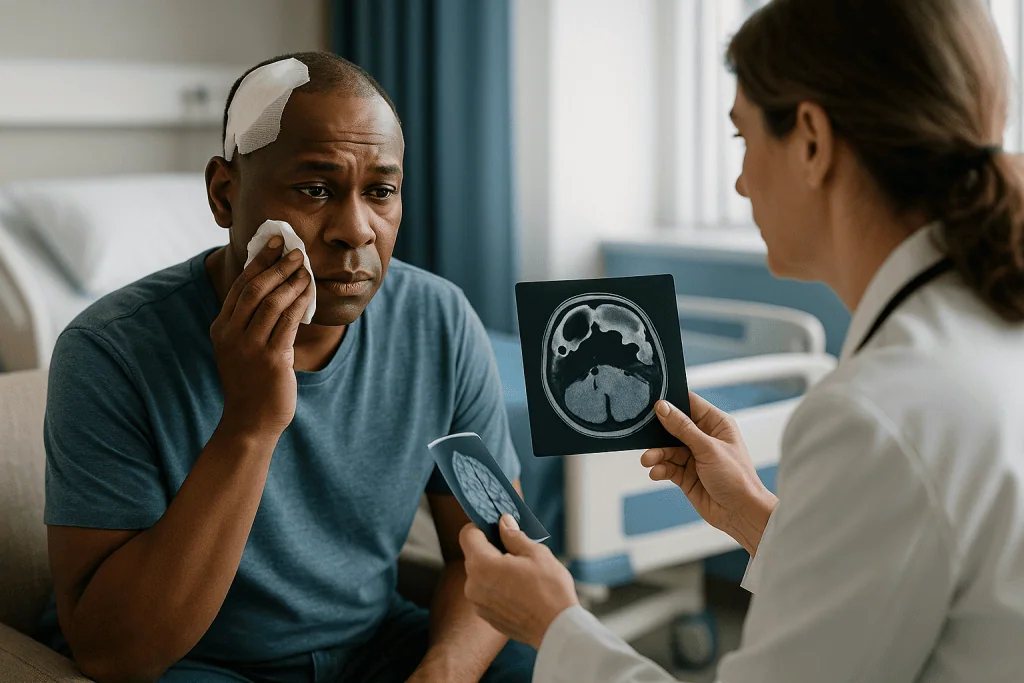
Left alone, the body reabsorbs this air. Oxygen and nitrogen dissolve into surrounding fluid and are carried off in the bloodstream. How quickly that happens depends on the volume of air, on whether the dural seal is complete, and on individual factors. For small volumes it is typically a matter of days to a couple of weeks; larger collections take longer, and the only way to know for certain is a repeat scan.
Why does altitude turn a harmless pocket into a concern? Consider a balloon. At sea level it holds a certain volume. Carry it to a cabin pressurized to the equivalent of 8,000 feet, roughly a 25 percent drop in ambient pressure, and it visibly swells. Air inside the skull does the same, and unlike a balloon it has nowhere to expand except into the space the brain occupies.
Tension pneumocephalus, the dangerous version in which expanding air compresses the brain, is rare. It is described mostly in case reports rather than in large series. Its rarity does not make it trivial, because the consequence of getting it wrong is severe, and the cost of avoiding it is only a few weeks of patience.
This is why many surgeons ask for one simple thing before approving a flight: a scan showing that the air has gone. Where the surgical approach involved the sinuses or the skull base, teams tend to be even more careful, because a persistent connection between air-filled spaces and the inside of the skull changes the calculation.
Who is usually cleared sooner, and who is usually asked to wait
No two craniotomies are the same, and surgeons weigh a cluster of factors rather than a single one. People who tend to be cleared earlier share a recognizable pattern. Their operation was relatively contained, for example a small tumor removed through a limited opening. Their follow-up scan showed little or no residual air and no unexpected fluid or bleeding. Their wound is dry and closed, they are eating, walking and sleeping normally, and they have had no seizures.
People who are usually asked to wait longer include those whose scan still shows air, particularly in larger volume or near the frontal sinuses. Anyone with a suspected cerebrospinal fluid leak, which can present as clear fluid from the nose or wound, is asked to stay until it is resolved, because a leak means the seal is incomplete and pressure changes could worsen it. People who developed post-operative swelling needing continued treatment, or who had a seizure after surgery, are often held until the picture stabilizes.
Planned next steps matter too. If radiotherapy or chemotherapy is due to start within weeks, the oncology and surgical teams usually want that plan settled before a long journey. Someone who had a craniotomy to treat a ruptured aneurysm or bleed may have a different set of vascular considerations than someone who had a benign tumor removed.
Age, other medical conditions such as heart or lung disease, and the length of the intended flight are all part of the conversation. A two-hour hop and a fourteen-hour intercontinental leg are not the same request.
None of this is a scorecard. It is a description of how surgeons think, so that the decision they hand back feels reasoned rather than arbitrary.
How long after brain surgery can you fly? What shapes the number
There is no international guideline that sets a fixed waiting period for flying after craniotomy. Different centers and different surgeons apply different thresholds, and published advice ranges from about two weeks for straightforward cases to six weeks or longer when the surgery was extensive or the recovery complicated. Because the evidence is thin, what follows is a summary of the factors that move the timeline rather than a promise about where any individual will land.
| Factor the team considers | Tends to shorten the wait | Tends to lengthen the wait |
|---|---|---|
| Air on follow-up CT | Cleared or minimal | Persistent, larger, or near sinuses |
| Wound and dural seal | Dry, healed, staples out | Any fluid leak, redness or gaping |
| Brain swelling | Settled, off swelling treatment | Ongoing, needs treatment |
| Seizures since surgery | None | Any, or medicines still being adjusted |
| Flight duration | Short haul | Long haul, multiple legs |
| Other conditions | Otherwise well | Heart or lung disease, clotting history |
| Next treatment | None pending | Radiotherapy or chemotherapy due soon |
In practice, international patients often budget for the hospital stay itself, which MedlinePlus puts at typically 3 to 7 days, followed by a period of local recovery long enough to include wound review, suture or staple removal and at least one follow-up scan. For many people that adds up to a total stay measured in weeks rather than days.
Booking a flexible or changeable return ticket, and choosing accommodation that can be extended, removes a great deal of pressure from the follow-up appointment.
What the first weeks after a craniotomy usually look like
The shape of recovery is fairly consistent even though the details vary. The first 24 to 48 hours are spent under close monitoring, often in an intensive care setting, as Cleveland Clinic and Johns Hopkins both describe. Nurses check pupils, limb strength and alertness at regular intervals. A head dressing is usually in place, and a drain may sit beneath the scalp for a day or two.
By the middle of the first week most people are walking the corridor, eating normally and starting to feel like themselves in short bursts. Fatigue is the dominant complaint. Headache is common and usually eases week by week. Discharge from hospital commonly falls within the 3 to 7 day range that MedlinePlus cites, sooner for some, later for others.
The second week is about the wound. Staples or sutures typically come out at a clinic visit around 7 to 14 days. Hair begins to grow back over the incision. Many surgeons order a CT or MRI in this period to confirm the surgical result and to check for residual air, fluid or bleeding.
Weeks three to six are the quiet grind. Energy returns unevenly. Concentration may be short. Johns Hopkins notes that full recovery from a craniotomy can take several weeks to a few months depending on the reason for surgery and the person’s overall health. Driving is generally restricted during this stretch, and most people are advised against heavy lifting or contact sports.
The skull itself heals on a much longer clock. The bone flap is held by small plates and screws from day one, so the head is protected, but the bony edges take months to knit and may never fuse completely in older adults. That slow healing is not what governs flying; the plates do the mechanical work. It is the soft tissue seal and the trapped air that set the flight timeline.
Blood clots, long flights and craniotomy recovery
Set the skull aside for a moment. The other major flight concern after any major operation is venous thromboembolism, the umbrella term for a clot in a deep leg vein and the more serious event in which part of it travels to the lung.
Surgery itself raises clot risk for several weeks because of tissue injury, inflammation and reduced mobility. Neurosurgical patients carry an added layer of risk because some spend longer in bed and because blood-thinning medicines, which are used routinely after many operations, are introduced more cautiously when there has been recent bleeding inside the head. Long-haul flying then adds its own contribution. The CDC Yellow Book notes that travel lasting more than about 4 hours is associated with an increased risk of clots, with risk rising further on longer journeys and in people who already have other risk factors.
The practical measures are simple and evidence-based. Move. Get up and walk the aisle every hour or two when it is safe to do so. When seated, flex and extend the ankles and knees regularly. Choose an aisle seat if possible. Stay hydrated and go easy on alcohol, which promotes dehydration and sleep in one position. Avoid crossing the legs for long stretches.
Properly fitted below-knee compression stockings are reasonable for travelers at raised risk and are generally considered low-harm. Whether a pharmacological blood thinner is appropriate around the flight is a decision only the neurosurgical team can make, because it depends on the individual balance between clot risk and bleeding risk inside a recently operated head.
Warning signs of a clot include a swollen, painful or warm calf, or sudden breathlessness and chest pain. Those symptoms in the days after a flight warrant urgent medical attention wherever the person happens to be.
Seizures, medicines and cabin fatigue after brain surgery
The brain surface is irritable after surgery, and some people are prescribed an anti-seizure medicine for a period afterward, even if they have never had a seizure. Whether that is done, for how long, and which class of medicine is used varies with the type of surgery and local practice. What matters for travel is continuity: missing doses because of time zones, delayed connections or luggage that went to the wrong city is a real and avoidable risk.
Sleep deprivation, dehydration and the general disruption of long-haul travel are all recognized triggers for seizures in susceptible people. That is one reason teams prefer that any medicine adjustments are finished, and the person has been stable on the final plan for a while, before a long journey.
Other medicines commonly in play in the early weeks include corticosteroids, a class used to reduce brain swelling, and pain relievers. Steroids are typically tapered down over days to weeks as swelling settles, and the taper is planned by the surgical team. Traveling mid-taper is possible but adds complexity, and many surgeons prefer the taper complete or nearly complete first. No reader should alter any of these medicines based on travel plans; the prescribing clinician sets the schedule.
Fatigue deserves its own mention. Recovering brains tire quickly, and a long flight is a marathon of low-grade sensory load: noise, dry air, lights, announcements, queues. Plan for it. Ask about airport assistance so that long walks and standing in lines are minimized. Build in rest days on either side of the journey. A companion who can carry bags, watch the clock for medicines and speak to staff if something goes wrong is not a luxury in this context.
Bring a short written summary from the surgical team, including the operation performed, the date relative to travel, current medicines by name, and a contact route for the team. Border and airline staff rarely ask for it, but a doctor at the other end will be grateful.
Practical flight-day planning: seating, security, oxygen and the metal plate question
Once the surgeon has approved travel, the remaining questions are logistical, and most have reassuring answers.
Will the plates and screws set off airport security? Almost never. The titanium plates and screws used to fix a bone flap are small, and titanium is only weakly detected by walk-through metal detectors. Body scanners may occasionally flag the area, in which case a brief explanation and a glance at the healing incision is usually enough. A short letter from the surgical team can smooth any conversation, though many people travel for years without ever being asked.
Do I need supplemental oxygen? For most people recovering from a craniotomy, no. Oxygen is considered when there is a coexisting lung or heart condition, or when the team has specific concerns about oxygen delivery to a still-vulnerable brain. If oxygen is needed, airlines require advance notice and medical paperwork, and the timeline for arranging it is often longer than people expect. Ask early.
Where should I sit? An aisle seat near the front makes it easier to walk regularly and to reach the lavatory without climbing over others. Avoid bulkhead seats if you rely on having a bag within reach, as those require overhead stowage during takeoff and landing.
What about the ears? The pressure change during descent can be uncomfortable for anyone, and people whose surgery involved the ear or skull base are sometimes given specific instructions about avoiding forceful ear-clearing maneuvers. Ask before you fly.
Pack medicines in cabin baggage, never checked, with a few extra days’ supply in case of delay. Keep the surgical summary and any scan reports, ideally on a memory stick or a secure cloud folder as well as on paper, in the same bag. Sunglasses and a soft hat help with light sensitivity and protect the scalp, and a travel pillow that avoids pressure on the incision makes a long sit far more tolerable.
Arranging follow-up before you leave the country
The flight home is a hand-off, not an ending. The most common problem international patients describe is not something that happened at altitude; it is arriving home with no one to see, no one who has read the operation notes, and a pathology result still pending abroad.
Before leaving, ask the surgical team for a complete written discharge summary: the diagnosis, the operation performed, any implants placed, complications if any, the current medicine list with the planned taper or duration, and clear instructions on what follow-up is needed and when. Ask for copies of the imaging in a standard format and for the pathology report, or a firm plan for how it will be sent once finalized. Pathology on brain tissue can take one to several weeks, and the result often shapes what happens next.
Identify a neurosurgeon or neurologist at home who will take over care, and if possible have the two teams communicate directly. Many surgical departments are willing to email a colleague or take a call. Where radiotherapy or chemotherapy is planned, the timing of the first appointment at home should be settled before the flight, because delays at this stage carry consequences.
Ask what to do, and whom to contact, if something goes wrong in the first weeks after arrival. A named contact and a functioning email address or telephone number at the operating center is worth more than any general reassurance.
Finally, consider what the primary care physician at home needs. They will be the person managing wound checks, general health, and the paperwork that comes with recovery, and they may never have seen a post-craniotomy patient. A concise, plain-language cover letter from the surgical team, written for a generalist, is a kindness that pays off repeatedly.
What people often get wrong about flying after craniotomy
“The cabin is pressurized, so nothing changes.” Pressurized does not mean sea level. Cabins are typically held at the equivalent of 6,000 to 8,000 feet, per the CDC Yellow Book, which is enough to expand trapped gas by a meaningful fraction and to lower blood oxygen slightly.
“Once the staples are out, I am fine to fly.” Staple removal shows that the skin has healed. It says nothing about air inside the skull or about the dural seal. Those need imaging and a surgeon’s judgment.
“Flying will make the tumor grow.” There is no evidence that commercial air travel promotes tumor growth. The concerns about flying after brain surgery are about pressure, trapped air, swelling and clots, not about the biology of the tumor itself.
“My skull will take a year to heal, so I cannot fly for a year.” The bone edges do take many months to knit, but the bone flap is fixed with plates and screws from the day of surgery and the head is protected. Bone healing is not what sets the flight timeline; the soft tissue seal and trapped air are.
“If I feel fine, the scan is a formality.” Residual air and small fluid collections are usually silent. Feeling well is necessary but not sufficient.
“A short domestic flight is completely different from a long one.” Shorter is easier, mainly because clot risk and fatigue scale with duration. The pressure change on ascent, however, is roughly the same for a one-hour flight as for a twelve-hour one. Air trapped in the skull expands either way.
“Roller coasters, diving and flying are all the same kind of risk.” They are not. Flying is a slow, modest pressure change. Scuba diving involves far larger pressure swings and is generally restricted for much longer. Roller coasters add rapid acceleration and jolting rather than pressure change, and teams usually advise waiting until healing is well advanced. Ask about each activity separately.
Questions to ask your care team before booking the flight
Surgeons are used to the flight question and generally welcome it, provided it comes with enough detail to give a useful answer. These prompts help structure the conversation.
- Was any air left inside my head at the end of surgery, and do you want a scan to confirm it has cleared before I fly?
- Did the operation involve the sinuses or the skull base in a way that changes the usual advice?
- Is there any sign of a cerebrospinal fluid leak, and what should I watch for after I leave?
- Which of my current medicines do you expect to still be taking when I travel, and will any of them be changing around that time?
- Given my other health conditions, do you have any concerns about oxygen levels on a long flight?
- Would you consider compression stockings or any clot-prevention measure for my journey, and does my recent surgery change that decision?
- What is the shortest flight duration you would be comfortable with, and does a connecting itinerary change your answer?
- Who should I contact if something happens in transit or in the first week at home?
- What written documents will I receive, and when will the pathology report be ready?
- Are there activities besides flying, such as driving, swimming, exercise or air travel to high-altitude destinations, that you want me to avoid, and for how long?
Write down the answers, or ask a companion to. Post-operative memory is unreliable in the first weeks, and the details matter.
One more question is worth asking directly: if the follow-up scan is not clean, what happens then? Knowing in advance that the answer is usually “wait another week or two and rescan” removes a lot of the dread from that appointment.
When to call your doctor: red-flag signs during recovery and after the flight
Most recoveries are uneventful, but a few symptoms should never be watched and waited on. Whether they arise in the hotel near the hospital, at 35,000 feet, or in the first weeks at home, they warrant urgent contact with the surgical team or the nearest emergency service.
- A new or rapidly worsening headache, especially if it is the worst headache the person has ever had, or is accompanied by vomiting.
- Increasing drowsiness, confusion, or difficulty waking the person.
- Any seizure, whether a first seizure or a return of seizures in someone who had been free of them.
- New weakness, numbness or clumsiness in the face, arm or leg, or new trouble with speech or vision.
- Clear or watery fluid dripping from the nose or leaking from the wound, particularly when leaning forward, which can indicate a cerebrospinal fluid leak.
- Fever, chills, or a wound that becomes red, swollen, hot, increasingly painful or begins to ooze.
- A stiff neck with fever or sensitivity to light.
- A painful, swollen or warm calf, or sudden shortness of breath or chest pain, which can signal a blood clot.
Onboard, cabin crew are trained to contact ground-based medical support and can divert or arrange assistance on landing. Do not wait for the destination if symptoms are severe.
Less urgent but still worth a call within a day or two: persistent nausea, a wound that looks different from the day before, new fluid swelling under the scalp, or a general sense that recovery has stalled or reversed. Recovering patients are often reluctant to bother a busy team. Surgeons would far rather hear about a false alarm than learn about a real problem late. When in doubt, call.
Frequently asked questions
How long after brain surgery can you fly?
It depends on the individual, and no guideline fixes a number. Surgeons commonly wait until a follow-up scan shows trapped air has cleared, the wound has healed and any swelling has settled, which for many people means a period of weeks rather than days after discharge. Straightforward operations may be cleared sooner; extensive surgery, fluid leaks or seizures usually extend the wait. The treating neurosurgeon makes the final call.
Does flying increase intracranial pressure after a craniotomy?
Not meaningfully in a recovered brain. The modest drop in cabin pressure causes a slight fall in blood oxygen and mild widening of brain blood vessels, which a healthy brain absorbs easily. In the first weeks after surgery, when swelling is still settling and small pockets of air may remain, there is less reserve, which is why teams prefer imaging confirmation before approving travel.
What is pneumocephalus and why does it matter for air travel?
Pneumocephalus means air inside the skull. A small amount is expected after most craniotomies because the brain’s outer membrane was opened. The body reabsorbs it over days to weeks. At cruising altitude, lower cabin pressure makes gas expand, and air trapped in the head can press on the brain. This is the main reason surgeons want a scan showing the air has cleared before you fly.
What precautions should I take after a craniotomy before flying?
Get explicit clearance from the surgical team, ideally after a follow-up scan and wound check. Keep all medicines in cabin baggage with a spare supply, carry a written surgical summary, book an aisle seat, walk regularly and do ankle exercises to reduce clot risk, stay hydrated and limit alcohol. Travel with a companion if possible and arrange follow-up at home before you leave.
How long does it take for the skull to heal after a craniotomy?
The bone edges take many months to knit, and in older adults fusion may never be complete. That is less alarming than it sounds, because the bone flap is held firmly by small plates and screws from the day of surgery, so the head is protected throughout. Skull healing is not what determines when you can fly; the soft tissue seal and any trapped air are the deciding factors.
Can you fly with a brain tumor?
Many people with treated or stable brain tumors fly without problems, and there is no evidence that air travel makes a tumor grow. The concerns are about swelling, seizures and recent surgery rather than the tumor itself. Anyone with a known brain tumor should discuss travel plans with their neurology or neurosurgery team, particularly if they have had recent symptoms, treatment changes or an operation.
Will the metal plate from my craniotomy set off airport security?
Almost never. The plates and screws used to fix the bone flap are small and usually made of titanium, which walk-through detectors rarely pick up. Body scanners occasionally flag the area, and a brief explanation typically resolves it. A short letter from the surgical team can help but is seldom needed. Many people travel for years without being asked.
What surgery can you not fly after?
Restrictions apply to any operation that leaves gas trapped in a closed space, such as brain, eye, ear, sinus, chest and some abdominal surgeries, because cabin pressure changes make gas expand. Major surgery of any kind also raises blood clot risk for several weeks. The waiting period varies widely by procedure and by individual recovery, so the operating team’s advice always takes precedence over general rules.
What does craniotomy recovery time usually look like?
Hospital stays typically run about 3 to 7 days. Staples or sutures usually come out within one to two weeks. Fatigue, mild headache and reduced concentration are common for several weeks. Full recovery can take several weeks to a few months depending on the reason for surgery and overall health. Driving, heavy lifting and contact sports are usually restricted during this period.
Should I wear compression stockings on the flight home after brain surgery?
Properly fitted below-knee compression stockings are a reasonable, low-harm measure for travelers at raised clot risk, and recent major surgery counts. Ask the surgical team whether they recommend them for your journey. Whether any blood-thinning medicine is appropriate is a separate decision that only the neurosurgeon can make, because recent surgery inside the head changes the balance of clot and bleeding risk.
This article is for general information only and is not a substitute for professional medical advice. Please consult a qualified doctor about your individual situation.

More from the Blog

How Long Before Preventive Migraine Treatment Shows Results? What Follow-Up Visits Assess
Preventive migraine treatment usually needs a fair trial before anyone can judge it. Most oral preventives are assessed after roughly two to three months…

Trigeminal Neuralgia Surgery Recovery: The First Days, Incision Care and Returning to Work
Recovery after microvascular decompression usually means a hospital stay of a few days, then several weeks at home while a small incision behind the…

What to Gather Before a Motor Neuron Disease Consultation: EMG Results, Scans and Medications
Before a motor neuron disease consultation, gather the actual EMG and nerve conduction reports (not just the summary letter), any MRI of the brain…

Cerebrovascular Disease Follow-Up: What Is Normal and When to Call Your Neurology Team
After a stroke or TIA, lingering fatigue, mild headaches that ease with rest and slow, uneven improvement in strength or speech are usually part…
Multiple Sclerosis and Pregnancy Planning: How Neurologists Adjust Treatment Around It
Multiple sclerosis and pregnancy planning usually starts months before conception. Neurologists review which disease-modifying therapy someone takes, because some are continued in pregnancy while…

How a Vagus Nerve Stimulator Works: Mild Electrical Pulses, Cycles and the Handheld Magnet
A vagus nerve stimulator works by sending mild, timed electrical pulses from a small battery-powered generator implanted under the skin of the chest, along…