

Folliculitis vs Acne: How Dermatologists Tell Them Apart and Why the Treatments Differ
Key Takeaways
- Blackheads and whiteheads are the single most reliable sign of acne; folliculitis does not produce them because the follicle is inflamed rather than clogged.
- Folliculitis bumps tend to be uniform in size and centered on a hair, while acne shows lesions at mixed stages centered on the pore opening.
- Bumps on the buttocks, thighs, or scalp are far more likely to be folliculitis, since acne follows the oil-gland map of the face, chest, and upper back.
- So-called fungal acne is pityrosporum folliculitis, a yeast overgrowth that itches, clusters on the upper trunk, and can worsen on antibiotic acne regimens.
- The NHS gives a typical course of around 7 to 10 days for folliculitis to improve, compared with 2 to 3 months before acne treatments are judged.
- Long antibiotic courses for acne can allow gram-negative folliculitis to develop around the nose and mouth, which is one reason clinicians limit their duration.
Folliculitis and acne both produce red bumps and pustules, but they are different conditions. Acne involves clogged pores with blackheads or whiteheads, oil, and inflammation, mostly on the face, chest, and back. Folliculitis is inflammation of hair follicles, often from bacteria, yeast, shaving, or friction, and lacks comedones. Because the causes differ, dermatologists treat them differently, so an examination matters.
She had been treating “breakouts” on her upper back for eight months. Two different over-the-counter acne washes, a stiffer pillowcase routine, less chocolate. Nothing moved. When she finally saw a dermatologist, the exam took less than a minute before the question came: “Do you shower straight after the gym, or do you drive home first?” The answer, it turned out, mattered more than any cleanser.
That story plays out in clinics every week, in both directions. People scrub at folliculitis with acne products that dry the skin and change nothing, while others assume a stubborn crop of chin bumps is a shaving problem when it is hormonal acne that would respond to a completely different plan. The folliculitis vs acne question is one of the most common reasons a dermatologist sees a patient who has already spent months self-treating.
The two conditions look alike at arm’s length. Up close, and with the right questions, they separate quickly. This article explains how clinicians tell them apart, why the treatments diverge, and what to watch for while you wait for an appointment.
Folliculitis vs acne: why the mix-up is so common
Both conditions start in the same piece of anatomy. A hair follicle is the tiny tube in the skin from which a hair grows, and each follicle has an oil gland attached to it. When that unit becomes inflamed, the skin produces the same limited vocabulary: a red bump, sometimes a white or yellow tip of pus, sometimes tenderness. From across a room, or in a bathroom mirror, a folliculitis pustule and an inflamed acne pimple can be indistinguishable.
The overlap goes further. Both can appear on the back, shoulders, and chest. Both can flare with sweat and tight clothing. Both can leave dark marks after they settle, particularly on deeper skin tones. Mayo Clinic describes folliculitis as clusters of small bumps or pimples around hair follicles, which is close to how many people would describe acne.
What separates them is not the bump itself but everything around it: whether blackheads and whiteheads are also present, where the bumps sit, what has been touching the skin, and how the person’s history reads. A dermatologist is essentially reading those surrounding clues rather than the single lesion in front of them.
There is a practical reason to get this right early. Acne treatments work by slowing oil production and unclogging pores over weeks to months. Folliculitis treatments usually target a specific trigger, whether that is a bacterium, a yeast, a razor, or a hot tub. Applying one plan to the other condition is not dangerous in most cases, but it wastes time, irritates skin, and delays relief. That delay is why the question deserves a proper look rather than a guess.
What actually happens inside a pore when acne forms
Acne is a disease of the pilosebaceous unit, which is the combined structure of a hair follicle and its oil gland. According to MedlinePlus, four things line up to produce it: the gland makes too much sebum (skin oil), dead skin cells shed abnormally and stick together inside the pore, a bacterium called Cutibacterium acnes multiplies in the trapped oil, and the immune system responds with inflammation.
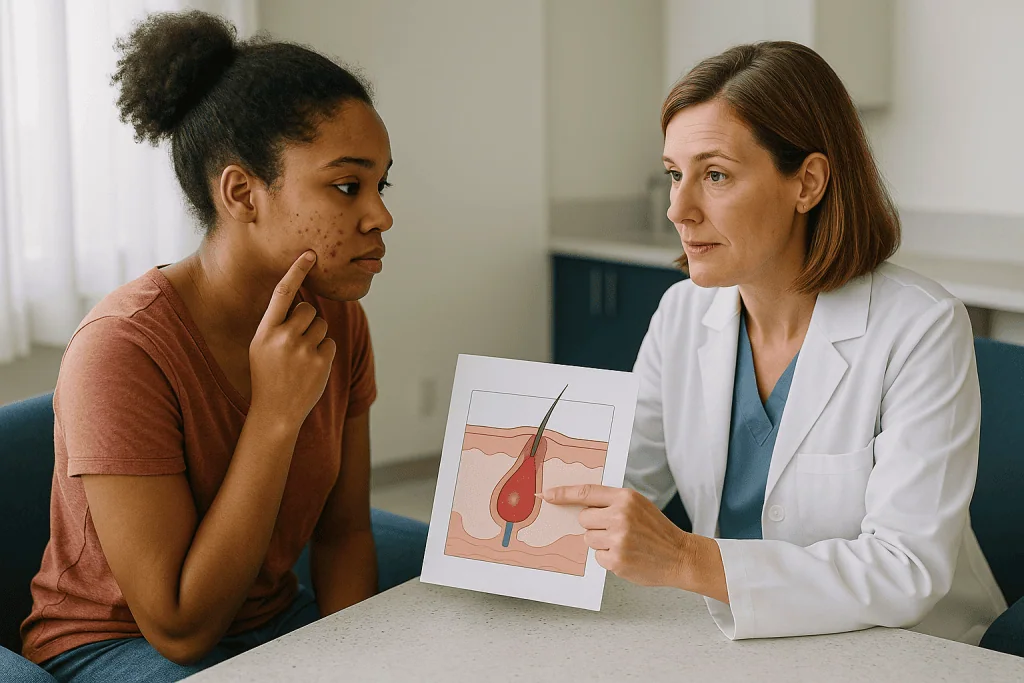
The earliest visible result is a comedo, the medical term for a clogged pore. An open comedo is a blackhead, dark because the trapped material has oxidized at the surface, not because it is dirty. A closed comedo is a whitehead, a small skin-colored bump with no opening. These non-inflamed lesions are the signature of acne. Mayo Clinic lists them alongside papules, pustules, nodules, and cysts as the range of acne lesions, but the comedones are the ones that matter most for diagnosis, because folliculitis does not make them.
Hormones drive the process. Androgens, the group of hormones that includes testosterone, enlarge the oil glands and increase sebum output, which is why acne typically begins around puberty. The NHS notes that acne is most common in people between the ages of 11 and 30. Genetics, certain medicines, and some cosmetics can contribute.
The key point for the folliculitis vs acne question is that acne is a slow, structural problem. The pore is blocked from within by oil and cells before any bacteria or inflammation appear. Treatments therefore aim at the blockage and the oil, which is why they take weeks to show results.
What actually happens in folliculitis
Folliculitis means inflammation of the hair follicle, and the word describes an event rather than a single disease. MedlinePlus explains that the follicle becomes inflamed when it is damaged or infected, most commonly by the bacterium Staphylococcus aureus, which normally lives on skin without causing trouble. When the follicle’s surface is breached, the bacteria move in and the body responds with a small, pus-filled bump centered on a hair.
The list of triggers is long. Mayo Clinic groups them into infectious causes, meaning bacteria, fungi, or viruses, and non-infectious causes, meaning friction, shaving, waxing, occlusion from tight clothing or heavy ointments, and blockage from sweat. A few named varieties come up often in clinic:
- Bacterial folliculitis, the everyday staph version, often after shaving or sweating under clothing.
- Hot tub folliculitis, caused by Pseudomonas aeruginosa in poorly maintained warm water, appearing on skin that was covered by a swimsuit.
- Pityrosporum folliculitis, a yeast overgrowth often called “fungal acne,” which is not acne at all.
- Pseudofolliculitis barbae, or razor bumps, where curled hairs grow back into the skin and cause inflammation without infection.
- Gram-negative folliculitis, which can develop in people using long-term antibiotics for acne, when different bacteria replace the usual ones.
Unlike acne, folliculitis is not built on a clogged pore. The follicle is usually open. The problem is an insult from outside or an organism that has gained entry. That is why the bumps tend to appear together, often after a recognizable event, and why they can settle within days once the trigger is removed. Cleveland Clinic notes that mild folliculitis often improves on its own with simple self-care.
How to tell folliculitis from acne: what dermatologists look at first
Ask a dermatologist how to tell folliculitis from acne and most will say the same thing: look for comedones. If there are blackheads or whiteheads mixed in with the red bumps, the diagnosis is almost always acne. If every lesion is a uniform red bump or pustule with a hair at its center and there is not a single comedo in sight, folliculitis climbs to the top of the list.

Uniformity is the second clue. Acne lesions are typically at different stages at the same time, some just forming, some inflamed, some healing, some scarring. Folliculitis lesions tend to be “monomorphic,” a term meaning they all look alike, because they often arose from a single trigger at roughly the same moment. A sudden crop of identical pustules the morning after a long car journey in damp clothing tells its own story.
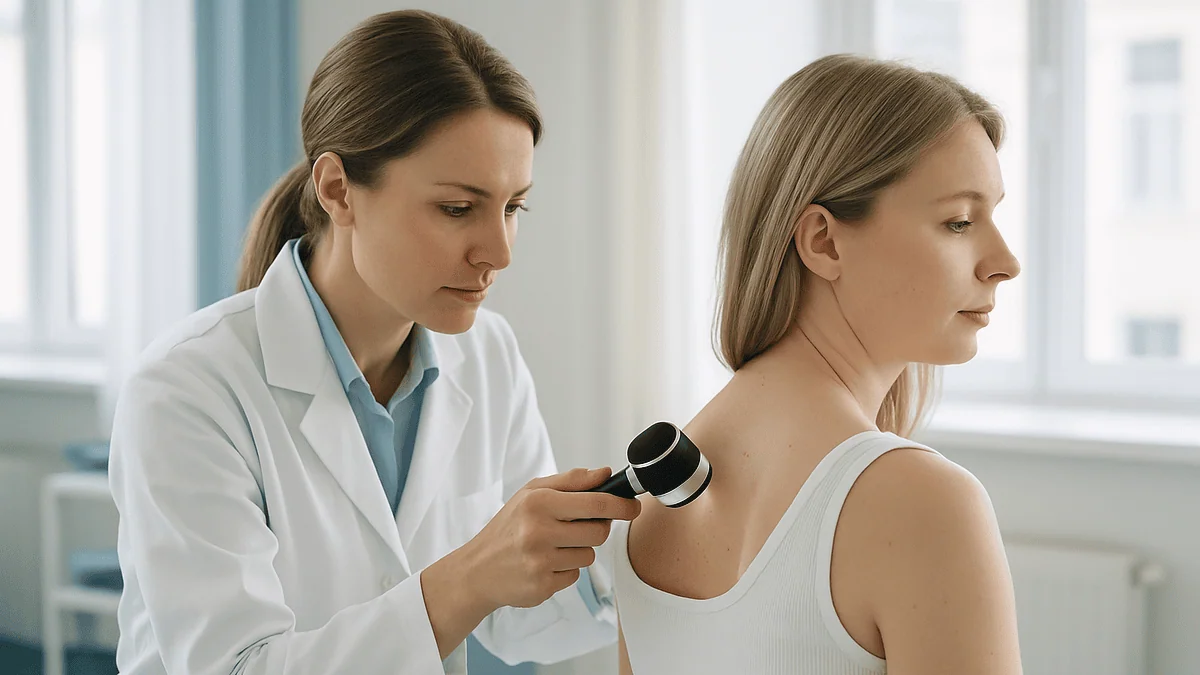
Third comes the hair. A dermatoscope, a handheld magnifier with polarized light, lets the clinician see whether a hair shaft emerges from the middle of each bump. Folliculitis is centered on the hair. Acne lesions are centered on the pore opening and frequently occur where hair is sparse or fine.
The history fills in the rest. Clinicians ask about shaving and waxing, hot tubs and pools, gym habits, occupational exposure to oils, tight or synthetic clothing, recent antibiotic courses, and whether anything else in the household has changed. They ask about itch, because folliculitis, particularly the yeast form, tends to itch, while acne is more often tender or painless.
None of these clues works alone. Together they usually settle the question within the first consultation, sometimes before any test is considered.
Folliculitis or acne? Location and pattern clues that shift the odds
Where bumps appear is not proof of anything, but it shifts the probabilities in a way clinicians rely on heavily.
Acne favors areas dense in large oil glands: the face, particularly the forehead, nose, and chin; the upper chest; the upper back and shoulders. It rarely appears on the thighs, buttocks, scalp, or forearms. When a patient describes “acne” on the buttocks or the backs of the thighs, a dermatologist will usually reframe the conversation toward folliculitis, since those areas are prone to friction, sweating, and occlusion from sitting and from clothing.
Folliculitis follows hair and friction rather than oil. The beard area in people who shave, the scalp under hats and helmets, the neck under collars, the buttocks and thighs, the legs after waxing, and, in hot tub folliculitis, the trunk where a swimsuit held contaminated water against the skin. Mayo Clinic notes that hot tub folliculitis often appears where the swimsuit covered.
Distribution also hints at the organism. Pityrosporum folliculitis, the yeast type, clusters on the upper back, chest, shoulders, and along the hairline and forehead, often in warm, humid conditions or after sweating in occlusive workout clothing. Gram-negative folliculitis tends to appear around the nose and mouth in someone already using acne antibiotics.
Symmetry matters less than people expect. Both conditions can be symmetrical. What clinicians weigh is whether the pattern matches an oil-gland map, which suggests acne, or a hair-and-friction map, which suggests folliculitis. A person with classic comedonal acne on the face and a separate crop of itchy uniform pustules on the shoulders after a heat wave may in fact have both, and the treatment plan will need to address each.
Fungal acne vs acne: why pityrosporum folliculitis fools so many people
“Fungal acne” is a social-media label for pityrosporum folliculitis, sometimes called Malassezia folliculitis. Malassezia is a yeast that lives on nearly everyone’s skin without causing problems. In warm, sweaty, or occluded conditions, or after courses of antibiotics that suppress competing bacteria, it can multiply inside follicles and trigger inflammation.
The name is misleading. It is not acne, does not involve clogged pores, and does not respond to the treatments that work for acne. Several features push a dermatologist toward the yeast diagnosis:
- Itch is prominent, often more than tenderness.
- The bumps are small, dome-shaped, and remarkably uniform in size.
- They cluster on the upper back, chest, shoulders, and forehead rather than the lower face.
- Flares follow heat, humidity, sweating, or heavy moisturizers, and often worsen rather than improve on antibiotic acne regimens, because removing bacteria leaves more room for yeast.
Comparing fungal acne vs acne on the skin alone can be hard, so a clinician may take a gentle scraping and examine it under the microscope with a potassium hydroxide preparation, a simple test that dissolves skin cells and leaves yeast visible. A quick response to an antifungal approach can also confirm the suspicion in hindsight.
The practical lesson is that a “breakout” that itches, sits high on the trunk, and has ignored months of acne care deserves a second look for yeast. People sometimes spend a year escalating acne products, each one drying the skin further, when the actual driver was a fungus that thrives in the very conditions their routine was creating. The treating clinician decides whether an antifungal is appropriate; the patient’s job is to describe the itch and the pattern honestly.
Folliculitis vs acne at a glance: a side-by-side comparison
The table below gathers the distinguishing features clinicians weigh. No single row decides the case; the pattern across rows does.
| Feature | Acne | Folliculitis |
|---|---|---|
| Core problem | Clogged pore with excess oil and abnormal cell shedding | Inflamed follicle from infection, friction, or blockage |
| Blackheads or whiteheads | Present, often the first lesions | Absent |
| Appearance of bumps | Mixed stages: comedones, papules, pustules, nodules | Uniform pustules or papules, each around a hair |
| Typical sites | Face, upper chest, upper back | Beard, scalp, neck, buttocks, thighs, trunk under clothing |
| Main sensation | Tender or painless | Itchy, burning, or sore |
| Onset | Gradual, over months, often from puberty | Often sudden, after an identifiable trigger |
| Common triggers | Hormones, genetics, some medicines and cosmetics | Shaving, waxing, hot tubs, sweat, tight clothing, antibiotics |
| Usual organism | Cutibacterium acnes | Staphylococcus aureus, Pseudomonas, Malassezia yeast, or none |
| Treatment direction | Unclog pores, reduce oil, calm inflammation over weeks | Remove trigger; treat the specific organism if present |
| Typical course | Chronic and relapsing; treatments judged over 2 to 3 months (NHS) | Mild cases often settle within 7 to 10 days (NHS) |
Two rows deserve emphasis. The comedone row is the closest thing to a deciding feature the exam offers. The timeline row explains why frustration builds: acne treatment is measured in months, and people who apply that patience to folliculitis endure weeks of an easily corrected trigger, while people who expect folliculitis-speed results from acne care abandon effective regimens too early.
The table also shows why “both” is a legitimate answer. Someone can have hormonal acne on the jaw and shaving-related folliculitis on the neck, and the clinician will name and treat each separately.
Which tests a dermatologist might order, and why most people need none
For the majority of people, the folliculitis vs acne question is answered by looking and asking. Both MedlinePlus and Mayo Clinic describe the diagnosis of each condition as primarily clinical, meaning based on the examination and history rather than laboratory results. Tests come into play when the picture is atypical, the problem keeps recurring, or the first treatment plan has failed.
A bacterial swab and culture is the most common. The clinician gently opens a fresh pustule, collects the contents on a swab, and sends it to a laboratory that grows and identifies any organism, then checks which antibiotics it responds to. This is particularly useful when folliculitis has not responded to initial care, when gram-negative folliculitis is suspected in someone on long-term acne antibiotics, or when resistant staph is a concern.
A potassium hydroxide preparation, described earlier, checks for yeast in suspected pityrosporum folliculitis. It takes minutes and can be done in the clinic.
Dermoscopy is not a laboratory test but an examination tool, and it is increasingly routine. Seeing a hair shaft piercing each lesion, or spotting tiny comedones the naked eye missed, can settle the question without a swab.
A skin biopsy, which removes a small sample for examination under a microscope, is uncommon here. It is reserved for cases where the lesions do not behave like either condition, where a rarer type of folliculitis is suspected, or where something other than a follicular disorder is possible.
Blood tests are not part of diagnosing folliculitis. In acne, a clinician may consider hormone testing only when there are separate signs of a hormonal disorder, such as irregular periods or excess hair growth, and that decision belongs to the treating team.
Why acne treatment targets oil, pores and inflammation
Because acne is built on a clogged, oily pore, its treatments aim at the blockage rather than at killing bacteria alone. The NHS and Mayo Clinic describe several classes that a clinician may combine depending on severity and skin type.
Topical retinoids, which are vitamin A derivatives applied to the skin, normalize the way cells shed inside the pore so that comedones form less readily. They work slowly and can cause dryness or irritation early on. Benzoyl peroxide reduces Cutibacterium acnes on the skin and has a mild pore-clearing effect; it is also used alongside antibiotics to reduce the risk of resistance. Topical or oral antibiotics reduce bacteria and inflammation and are generally used for limited periods for the same reason. Hormonal approaches, such as certain combined oral contraceptives or anti-androgen medicines, address the oil-gland stimulation in people for whom that is appropriate. For severe or scarring acne, an oral retinoid may be considered under specialist supervision, with monitoring.
The shared theme is patience. The NHS notes that most acne treatments take two to three months to show their effect, and that regimens are often continued for longer to maintain control. Judging a plan after two weeks is one of the most common reasons effective treatments are abandoned.
Which option, in what combination, and for how long, are decisions for the prescribing clinician, who weighs lesion type, scarring risk, skin tone, pregnancy plans, and other medicines. What matters for this comparison is that none of these approaches is designed to remove a razor, a hot tub, or a yeast. Point them at folliculitis and, at best, the skin becomes dry and the bumps remain.
Why folliculitis treatment starts with the trigger
Folliculitis treatment begins by asking what insulted the follicle, because removing that insult is often enough. Mayo Clinic and Cleveland Clinic both note that mild cases frequently improve with self-care measures alone: warm compresses to ease discomfort, gentle cleansing, loose breathable clothing, showering promptly after sweating, and a pause from shaving or waxing the affected area while it settles.
When an organism is clearly involved, treatment is matched to it. For bacterial folliculitis that persists, a clinician may prescribe a topical antibiotic or antiseptic, and for more widespread or deeper infection an oral antibiotic, chosen according to the likely or cultured bacterium. For pityrosporum folliculitis, antibiotics are not the answer and can worsen matters; antifungal preparations, topical or oral, are used instead. Hot tub folliculitis usually resolves on its own once exposure stops, though the clinician will assess whether treatment is needed.
Non-infectious forms follow the same logic. Razor bumps improve when the hair is allowed to grow, when shaving technique changes, or, for persistent cases, when a clinician discusses hair-removal options such as laser treatment that reduce the ingrowing hairs driving the inflammation. Friction folliculitis on the thighs or buttocks responds to fabric and moisture changes more than to any cream.
Timelines are usually short. The NHS notes that folliculitis often gets better in around 7 to 10 days. That speed is a diagnostic clue in itself: if identical-looking bumps have persisted unchanged through months of trigger removal, the treating team may revisit whether the diagnosis is right.
As with acne, the specific choice, whether to prescribe at all, and the duration of any course rest with the clinician who has examined the skin.
Who is usually treated straight away, and who is asked to watch and wait
Dermatologists do not treat every follicular bump with a prescription, and understanding who is usually asked to wait helps set expectations.
For folliculitis, a watch-and-wait approach is common when the eruption is mild, superficial, recently appeared, and linked to an obvious trigger. Cleveland Clinic notes that many mild cases clear without medical treatment. A person with a few itchy pustules on the thighs after a week of long, sweaty commutes will often be advised on clothing and washing and asked to return only if things persist. Earlier treatment is usually considered when lesions are deep, painful, or spreading; when the person has diabetes, a weakened immune system, or a history of recurrent skin infections; when the beard or scalp is involved and hair loss is a concern; or when the pattern suggests yeast or an unusual organism.
For acne, the calculation differs because the condition is chronic and can scar. Clinicians rarely suggest waiting for moderate to severe inflammatory acne, since scarring risk accumulates. The NHS advises that even mild acne warrants medical advice if it is affecting mood or self-esteem. Mild comedonal acne in a young adolescent may reasonably start with over-the-counter measures and review.
Some people are asked to wait for a different reason: the picture is unclear. When comedones are absent but the distribution suggests acne, or when itch is present but a swab is pending, a clinician may hold off on a targeted prescription until the test returns rather than guess. That pause is deliberate, not neglect.
Pregnancy, breastfeeding, other medicines, and skin tone all shape what is offered and when. Those judgments sit with the treating team, who can weigh benefits against the risks specific to the individual.
What the following days and weeks usually look like
The two conditions run on different clocks, and knowing which clock you are on prevents a great deal of frustration.
After a folliculitis diagnosis, the first days are about trigger removal. Pustules typically stop appearing within a few days once shaving pauses, clothing loosens, or the hot tub is avoided, and existing lesions dry and flatten. The NHS gives a typical course of around 7 to 10 days for improvement. Itch tends to fade first, then redness. Darker marks may linger for weeks, especially on deeper skin tones, and these are not a sign of ongoing infection. If new pustules keep appearing beyond the second week despite the changes, the treating team will usually want to reassess, take a swab, or consider yeast.
After an acne diagnosis, the first weeks can feel discouraging. Topical retinoids commonly cause dryness, peeling, and sometimes a temporary increase in visible lesions as clogged pores clear. Mayo Clinic notes that acne treatments can take weeks to months to work. The NHS advises allowing 2 to 3 months before judging a regimen. Improvement usually shows first as fewer new lesions, then as fewer comedones, with existing inflamed spots healing over several weeks. Marks and early scarring fade slowly and may need separate attention later.
For people with both conditions, the timelines run in parallel. The folliculitis may be settled within a fortnight while the acne plan is barely under way, and it is easy to mistake the ongoing acne for treatment failure.
Follow-up intervals are set by the clinician. Reporting side effects, new triggers, or lack of change at the scheduled review, rather than stopping treatment unilaterally, gives the team the information it needs to adjust.
What people often get wrong about folliculitis on the face and body
Several persistent myths send people down the wrong path.
“Bumps on the body are body acne.” Acne does occur on the chest and back, but bumps on the buttocks, thighs, or scalp are far more often folliculitis. Location deserves the same weight people give to appearance.
“It’s caused by dirt.” Neither condition is a hygiene failure. Blackheads are dark from oxidation, not grime, and folliculitis is driven by organisms that live on clean skin or by mechanical irritation. Aggressive scrubbing damages follicles and can make both worse.
“Antibiotics fix any infected bump.” Pityrosporum folliculitis is a yeast problem, and antibiotics can worsen it by clearing the bacteria that keep yeast in check. Long antibiotic courses for acne can also set up gram-negative folliculitis. This is one reason clinicians limit antibiotic duration and pair them with other agents.
“Folliculitis on the face is just acne with a different name.” Folliculitis on the face is real and common in the beard area, along the hairline under hats and helmets, and around the nose in people on acne antibiotics. The absence of comedones and the presence of a hair in each bump separate it from acne.
“Popping speeds things up.” Squeezing either type of lesion pushes contents deeper, increases inflammation, and raises the risk of scarring and darker marks. Mayo Clinic advises against picking at either condition.
“Diet is the main driver.” Evidence on diet and acne is mixed; some studies link high-glycemic diets and certain dairy to acne severity, but the effect is modest and individual. Diet has no established role in folliculitis. Neither condition is fixed by eliminating chocolate.
“If a treatment hasn’t worked in two weeks, it has failed.” True for many folliculitis measures, misleading for acne, where the NHS advises allowing 2 to 3 months.
Questions to ask your care team
A consultation goes further when the patient arrives with specific questions. These are the ones dermatologists most often wish people had asked.
- Which condition do you think this is, and what did you see that pointed you there? Ask whether comedones were present and whether the bumps were centered on hairs.
- Could I have both? If so, which lesions belong to which, and how will I know which treatment is working?
- Is there a trigger I can remove? Shaving method, workout clothing, hot tub use, occlusive products, or a medicine I am already taking.
- Do I need a swab or a scraping now, or is that something you would consider if the first plan does not work?
- How long should I give this plan before we judge it, and what does “working” look like at that point? For acne, ask what the NHS-cited 2 to 3 month window means for your particular regimen.
- What side effects are common in the first weeks, and which ones mean I should contact you rather than push through?
- If I am on an antibiotic, for how long, and what is the plan to step down or stop it? Ask what signs would suggest yeast or gram-negative folliculitis developing.
- Will this leave marks or scars, and is there anything I should do now to reduce that risk, particularly given my skin tone?
- Are there interactions with my other medicines, or considerations if I am pregnant, planning pregnancy, or breastfeeding?
- What should I do about shaving, hair removal, or sun exposure while this settles?
- When should I come back, and what should prompt me to come back sooner?
Bringing a short list of products currently on the skin, including body washes, hair products, and anything used at the gym, saves time. Photographs of the skin on a bad day are useful too, since flares rarely cooperate with appointment schedules. None of these questions challenges the clinician’s judgment; they simply make the shared decision better informed.
When to call your doctor
Most folliculitis and most acne can be managed without urgency, but some signs mean the picture has changed and a clinician should look promptly.
Call your doctor, or seek same-day care, if:
- A bump becomes large, hard, hot, and intensely painful, or several merge into a swollen area. This may be a boil or carbuncle, a deeper infection that MedlinePlus notes can require drainage and medical treatment.
- Redness spreads rapidly beyond the bumps, streaks outward, or the skin feels warm over a widening area. Spreading skin infection needs assessment.
- You develop fever, chills, or feel generally unwell alongside the skin changes.
- You have diabetes, a weakened immune system, or are on medicines that suppress immunity, and any follicular infection appears or worsens.
- Lesions on the scalp or beard are accompanied by hair loss, scaling, or scarring.
- Folliculitis has not improved after roughly a week of removing the trigger and following self-care, which the NHS gives as a reasonable point to seek advice, or keeps returning in the same place.
- Acne is leaving scars or dark marks, is causing distress, or has not responded to treatment at the review point your clinician set.
- You develop a widespread rash, mouth sores, severe headache, visual changes, or joint pain after starting a new acne or antibiotic medicine. Some acne medicines carry specific warnings that your prescriber will have explained.
- You are pregnant or could be, and are using any prescription skin treatment.
A short paragraph on the everyday version: itchy, uniform bumps after a sweaty week that begin fading once you change clothing and shower routines are not an emergency. Dozens of new pustules with fever, or a single lesion growing hot and hard by the hour, are. When in doubt, a phone call to the treating team is never the wrong move, and the decision about examination, testing, or treatment rests with them.
Frequently asked questions
How can I tell folliculitis from acne at home?
Look for blackheads or whiteheads: if they are present among the red bumps, acne is far more likely. Folliculitis produces uniform pustules, each around a hair, often itchy and often after a trigger such as shaving, sweating in tight clothing, or a hot tub. Location helps too, since buttocks and thighs favor folliculitis. Home observation narrows the odds but does not replace an examination, especially if bumps persist.
Is folliculitis or acne more likely on the buttocks and thighs?
Folliculitis. Acne concentrates where oil glands are largest, meaning the face, upper chest, and upper back. The buttocks and thighs are prone to friction, sweating, and occlusion from sitting and clothing, which irritate follicles and let skin bacteria enter. What people call “butt acne” is usually friction or bacterial folliculitis, and it often improves with fabric and washing changes rather than acne products.
What is fungal acne, and is it really acne?
It is not acne. Fungal acne is a popular name for pityrosporum folliculitis, an overgrowth of Malassezia yeast inside hair follicles. It produces small, itchy, uniform bumps on the upper back, chest, shoulders, and forehead, often after heat, sweat, or antibiotic courses. Because it involves yeast rather than clogged pores, acne treatments do not help and antibiotics can make it worse. A clinician can confirm it with a simple scraping.
Can you have folliculitis and acne at the same time?
Yes, and it is common. Someone may have hormonal acne with comedones on the jaw and chin alongside shaving-related folliculitis on the neck, or acne on the face with yeast folliculitis on the shoulders after workouts. A dermatologist will identify which lesions belong to each condition and treat them separately, since the plans differ. Progress is then judged on two different timelines.
How long does folliculitis take to go away compared with acne?
Folliculitis is usually short-lived. The NHS notes it often gets better in around 7 to 10 days, particularly once the trigger is removed. Acne runs on a much longer clock, with the NHS advising 2 to 3 months before judging whether a treatment is working. If uniform bumps have persisted for months despite trigger removal, the diagnosis may need revisiting with your clinician.
Why do acne antibiotics sometimes make bumps worse?
Two mechanisms explain it. Antibiotics suppress skin bacteria, which can allow Malassezia yeast to overgrow and cause itchy pityrosporum folliculitis on the trunk. Long courses can also let different bacteria take over, producing gram-negative folliculitis around the nose and mouth. Both look like worsening acne but need different treatment. This is why prescribers limit antibiotic duration and combine them with other agents; report any new itchy or uniform bumps to your treating team.
Does folliculitis on the face look different from acne?
It can, with close inspection. Facial folliculitis concentrates in the beard area of people who shave, along the hairline under hats or helmets, and around the nose in those on acne antibiotics. The bumps are uniform, each centered on a hair, and comedones are absent. Acne on the face shows blackheads and whiteheads alongside inflamed spots at different stages. Itch points toward folliculitis; tenderness alone is less discriminating.
Will a dermatologist need to do tests to tell them apart?
Usually not. Both conditions are diagnosed mainly by examination and history, often aided by a dermatoscope to check for comedones or a hair in each lesion. Tests are reserved for unclear or stubborn cases: a swab and culture to identify bacteria and their antibiotic sensitivity, a potassium hydroxide scraping to detect yeast, and rarely a small skin biopsy. Blood tests are not part of diagnosing folliculitis.
Can hot tubs cause bumps that look like acne?
Yes. Hot tub folliculitis is caused by Pseudomonas aeruginosa bacteria in inadequately maintained warm water. Itchy red bumps and pustules appear within days of exposure, typically on skin that was covered by a swimsuit where contaminated water was held against the body. It is often mistaken for a sudden acne flare on the trunk. Most cases settle once exposure stops, but a clinician should assess anyone who feels unwell or whose rash spreads.
Should I stop my acne treatment if I think I actually have folliculitis?
No, not without speaking to the prescriber. Stopping or changing a prescribed regimen on your own can undo weeks of progress if acne is present, and self-diagnosis of folliculitis is often wrong. Contact your treating team, describe the itch, pattern, and timing of the new bumps, and let them examine the skin. They may adjust the plan, add a test, or reassure you that what you see is an expected early phase of treatment.
References
This article is for general information only and is not a substitute for professional medical advice. Please consult a qualified doctor about your individual situation.

More from the Blog
Is Coconut Oil Good for Your Skin? Where It Helps, Where It Clogs
Coconut oil moisturizes dry body skin well: small clinical trials found virgin coconut oil hydrated as effectively as mineral oil and improved mild-to-moderate eczema…
What a Scalp Injection Session for Alopecia Areata Involves: Comfort, Timing and Repeat Visits
Alopecia areata scalp injections are corticosteroid shots placed just under the skin of a bald patch to calm the immune attack on hair follicles.…
Hyperpigmentation: Types, Causes and the Treatment Ladder Dermatologists Use
Hyperpigmentation is a patch or spot of skin that has become darker than the surrounding skin because pigment cells have produced or deposited extra…
What Regrowth After Alopecia Areata Treatment Usually Looks Like: Fine, Pale Hairs First
Regrowth after alopecia areata treatment usually begins as a soft fuzz of fine, short hairs that are pale or white, appearing inside the patch…
Does Laser Hair Removal Hurt? Honest Answers Before a First Session
Yes, laser hair removal usually causes brief, tolerable discomfort, most people compare each pulse to a rubber band snapping against warm skin. Pain varies…
Face Taping and Face Yoga: Do the Viral Wrinkle Hacks Work?
Face yoga has weak but real evidence: one small 2018 study with no control group found slightly fuller cheeks and a modest drop in…