

Forehead Breakouts: Why Acne and Small Bumps Cluster There and What Helps Clear Them
Key Takeaways
- Sebaceous glands are larger and more crowded in the T-zone, which is why the forehead breaks out before the cheeks in the same person.
- Pomade acne shows as many small comedones along the hairline and temples and tracks closely with oily hair products and fringes.
- A crop of uniform, itchy bumps with no blackheads is more likely folliculitis, sometimes yeast-driven, and does not respond to standard acne products.
- Face mapping has no supporting evidence; the only well-documented internal link is hormonal, such as PCOS in adults with severe or cycle-linked acne.
- Benzoyl peroxide, retinoids and antibiotics typically need around 6 weeks before improvement is visible, according to NHS guidance.
- A hot, rapidly spreading swollen patch, fever, or eyelid swelling turns a forehead spot into a same-day problem.
Forehead breakouts are most often ordinary acne: oil glands in the T-zone are dense there, and pores block with oil and dead skin, then inflame. Hair products, fringes, hats, sweat and friction add to it, and hormones and stress drive flares. Small uniform itchy bumps may instead be folliculitis. Forehead breakouts are not an emergency unless fever or rapidly spreading redness appear.
You lean in to the bathroom mirror, lift your fringe and there they are again: a scatter of small bumps along the hairline, two angry red spots above one eyebrow, and a rough, bumpy texture that catches the light in a way the rest of your face does not. Cheeks clear. Chin clear. Forehead, once more, busy.
If you have just typed “why is my forehead breaking out” into a search box, you are in good company. Acne is among the most common skin conditions on earth, and the forehead, with its tight arrangement of oil glands and its daily contact with hair, hands, helmets and hats, is one of the first places it shows. The pattern is not random.
This article walks through what usually causes forehead spots, what else can masquerade as acne, how a clinician sorts one from the other, and which simple measures the evidence actually supports. It will not diagnose you; it will help you ask better questions.
Why is my forehead breaking out? The short answer
In most people, forehead breakouts are acne vulgaris, the everyday form of acne. The skin of the forehead belongs to the T-zone, the strip across the forehead, nose and chin where sebaceous glands (the glands that make skin oil, called sebum) are largest and most crowded. When a pore fills with sebum and dead skin cells, a comedone forms: a blackhead if open to the air, a whitehead if closed. Bacteria that live normally in the pore multiply in that trapped oil, the immune system responds, and the comedone becomes a red papule or a pus-filled pustule.
Three everyday forces push the forehead ahead of the cheeks. The first is what touches it: fringes, styling products, hat bands, headphone straps and sweaty helmets. The second is hormones, which switch sebum production up from puberty onward and swing with the menstrual cycle. The third is habit, such as resting a forehead on a hand or picking at spots.
Not every forehead bump is acne. A crop of small, same-sized, itchy bumps along the hairline is a classic picture of folliculitis, inflammation of the hair follicle, which may be caused by bacteria or by a yeast called Malassezia and responds to different treatment. Forehead spots are not an emergency. The exceptions are a spot that becomes a hot, swollen, rapidly spreading area, especially with fever, which needs same-day care.
Why is my forehead breaking out when the rest of my face is clear?
Think of the forehead as the oiliest, most handled strip of skin you own. Sebaceous glands are attached to hair follicles, and the forehead carries thousands of fine vellus (peach-fuzz) follicles, each with a gland. Glands in the T-zone are not only more numerous but larger, which is why the forehead and nose shine by mid-afternoon while the cheeks stay matte.
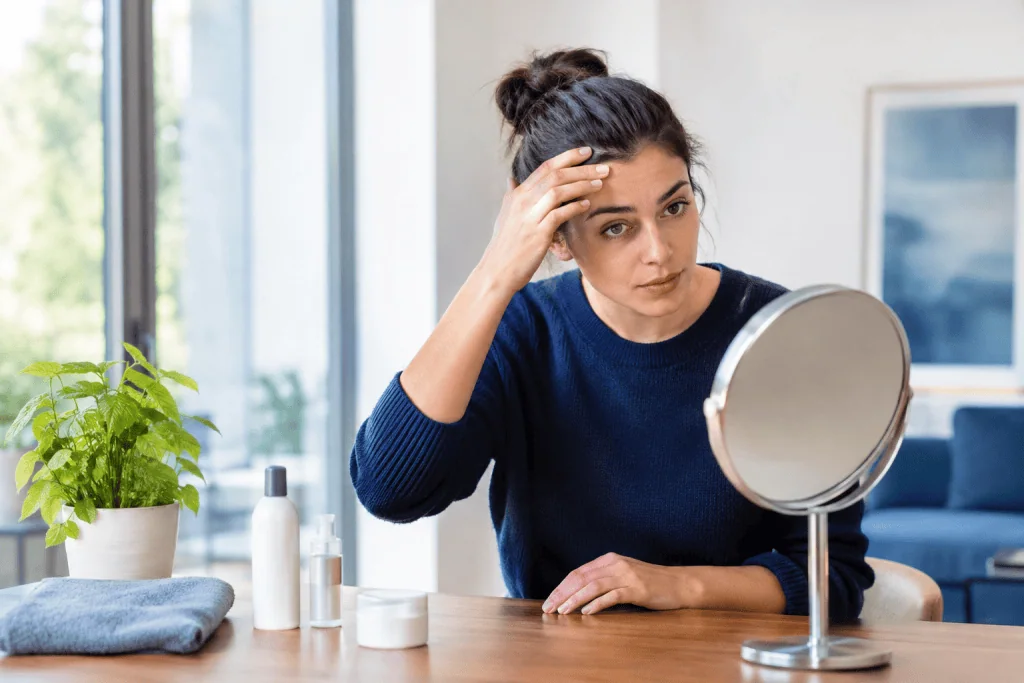
The hairline adds a second layer. Scalp sebum migrates downward, and whatever you put on your hair follows it: conditioner residue, leave-in creams, waxes, oils and dry shampoo settle along the hairline and across the forehead through the day and overnight on the pillow. Dermatologists have a name for the resulting spray of small comedones at the hairline and temples, pomade acne.
Then there is contact. A fringe holds heat and oil against the skin. Helmets, caps, sweatbands and tight hats trap sweat and rub, a pattern called acne mechanica. Hands rest on foreheads during long meetings. None of this is unhygienic, and the NHS is clear that acne is not caused by dirty skin; the problem sits inside the pore, not on top of it. Those local factors simply explain why one patch of face stays stubborn while the rest clears.
What causes breakouts on forehead most often: ordinary acne
Acne vulgaris follows a sequence that is well described by the NHS and the National Institute of Arthritis and Musculoskeletal and Skin Diseases (NIAMS). Androgens, the group of hormones that includes testosterone and that both sexes produce, make the sebaceous glands enlarge and secrete more sebum. At the same time, the cells lining the pore shed abnormally and clump, so the follicle narrows. Oil backs up behind the plug and a comedone forms.
Inside that plugged pore, a bacterium called Cutibacterium acnes (older texts call it Propionibacterium acnes) finds an ideal, low-oxygen, oil-rich home and multiplies. Its by-products irritate the pore wall and draw in immune cells. The result is the familiar ladder of lesions: whitehead, blackhead, red papule, pustule and, in deeper cases, nodules and cysts that sit under the skin and can scar.
How common is this? The NHS notes that acne is most frequent in girls between 14 and 17 and in boys between 16 and 19, that most people have it on and off for several years, and that around 3% of adults over 35 still have it. The Global Burden of Disease study, published in 2014 using data from 2010, ranked acne as the eighth most prevalent disease worldwide. In other words, a breaking-out forehead is far closer to the rule than the exception during the teenage years and early twenties.
Hair products, hats, helmets and friction
A good rule when forehead spots appear suddenly is to ask what has changed above the eyebrows. New shampoo or conditioner, a switch to a heavier styling wax, growing out a fringe, a new bike helmet, or a season of sweaty caps often line up neatly with the first bumps.

Pomade acne has a distinctive look: many small, closed comedones and a few inflamed spots, concentrated along the hairline, the temples and the upper forehead, usually without the deep, painful nodules of hormonal acne. Oily hair products and thick leave-in creams are the usual culprits, because they are designed to coat and linger. Mineral oil, lanolin and heavy silicones sit on skin in the same way.
Acne mechanica, the friction type, follows the shape of whatever rubs. A band of spots exactly where a helmet strap or hat brim sits, worse in hot weather or after training, is the tell. Sweat alone does not block pores, but trapped sweat, heat and repeated pressure together make the pore lining more likely to plug.
Pillowcases and phone screens are smaller contributors than social media suggests, though a pillowcase does collect hair product overnight. Mainstream guidance, including the NHS acne pages, keeps the advice simple: choose hair and skin products labeled non-comedogenic (formulated not to block pores), keep hair products off the forehead, wash after sweating, and loosen or clean headgear that sits on the skin.
Hormones, stress and sleep: why forehead acne flares in waves
Hormones set the baseline level of oil production, and they fluctuate. Many women notice forehead and jawline spots in the week before a period, when the balance between estrogen and androgens shifts and sebum rises. The NHS lists the menstrual cycle, pregnancy and polycystic ovary syndrome (PCOS, a condition in which the ovaries produce higher androgen levels) as recognized triggers. Starting or stopping hormonal contraception can also change acne in either direction over a few months; that decision belongs with the prescribing clinician.
Stress does not create acne from nothing, but it can worsen existing acne. The proposed mechanism involves stress hormones, including cortisol and a related signaling molecule called CRH, acting directly on sebaceous glands and on inflammation. The clinical evidence is modest and mostly observational, so the honest statement is that stress is a plausible amplifier rather than a root cause.
Sleep is linked in a similar indirect way: short sleep raises stress hormones and lowers the threshold for inflammation. Some medicines are also known to provoke acne-like eruptions, among them corticosteroids, lithium and some anti-epileptic drugs. If spots began after a new prescription, mention it to the prescriber; never stop a medicine on your own.
Diet is the most argued-about trigger. Reviews cited by NIAMS and Harvard Health point to a possible link between high-glycemic diets and dairy and worse acne in some people, but the studies are inconsistent and not strong enough to recommend cutting whole food groups.
Small uniform bumps along the hairline: folliculitis rather than acne
Here is the look-alike worth knowing. Folliculitis is inflammation of individual hair follicles, and on the forehead it presents as many tiny bumps of almost identical size, often pink or skin-colored, sometimes with a pinpoint of pus at the center, frequently itchy and often in a band along the hairline. Comedones, the blackheads and whiteheads that define acne, are usually absent.
Two versions matter on the forehead. Bacterial folliculitis, typically caused by Staphylococcus aureus, tends to follow shaving, sweating under headgear or a scrape, and produces tender pustules. Malassezia folliculitis, often called fungal acne although it is not acne, is driven by a yeast that lives harmlessly on everyone’s skin but overgrows in hot, humid, oily conditions. MedlinePlus describes folliculitis as common and usually mild, with recurrence when the conditions that favor it return.
Why does the distinction matter? Standard acne treatments do not touch yeast, and some oily acne products can feed it, so a reader who has been dutifully applying anti-acne creams for months without result may simply have the wrong diagnosis. Clues that point toward Malassezia folliculitis include itching, a sudden crop after a tropical holiday or heavy sweating, a monotonous uniform bump size and spread onto the upper chest and back. A clinician can confirm it with a simple skin scraping examined under a microscope, after which antifungal treatment is usually prescribed.
Less common forehead bumps that deserve a check
A handful of other conditions can set up on the forehead and be mistaken for acne. None is dangerous in itself, but each has a different treatment, which is reason enough to get a confident diagnosis when bumps linger.
- Rosacea: persistent central-face redness with small papules and pustules but no comedones, usually beginning after 30, flushing with heat, alcohol or spicy food. The NHS describes it as a long-term condition that is managed rather than resolved, and typical acne products can aggravate it.
- Contact dermatitis: an itchy, scaly or weeping rash in the exact shape of a hat band, helmet pad or where a hair product touched, sometimes with tiny blisters. The pattern and the itch give it away.
- Milia: firm, white, pinhead-sized cysts of trapped keratin that do not redden and cannot be squeezed; harmless and often clear on their own.
- Sebaceous hyperplasia: soft, yellowish, dome-shaped bumps with a central dimple, enlarged oil glands seen more in middle age; benign and cosmetic.
- Keratosis pilaris and closed-comedone-dominant acne: rough, sandpaper texture, more skin-colored than red.
The summary table below puts the main possibilities side by side. It is a guide to the conversation with a clinician, not a self-diagnosis tool.
| Cause | Typical features on the forehead | Usual next step |
|---|---|---|
| Acne vulgaris | Mix of blackheads, whiteheads, red papules, pustules; may have deeper nodules | Over-the-counter measures first; prescription if moderate or scarring |
| Pomade or friction acne | Many small comedones along hairline, temples, under hat lines | Change products or headgear; review in 6–8 weeks |
| Malassezia folliculitis | Uniform itchy small bumps, no comedones, worse with sweat and humidity | Clinician confirms; antifungal treatment |
| Bacterial folliculitis | Tender pustules around hairs after shaving or sweating | Hygiene measures; topical or oral antibiotic if persistent |
| Rosacea | Persistent redness, flushing, papules, no comedones, adult onset | Clinical diagnosis; rosacea-specific treatment |
| Contact dermatitis | Itchy rash matching contact area, scale or blisters | Remove trigger; patch testing if unclear |
How a clinician tells forehead acne apart from its look-alikes
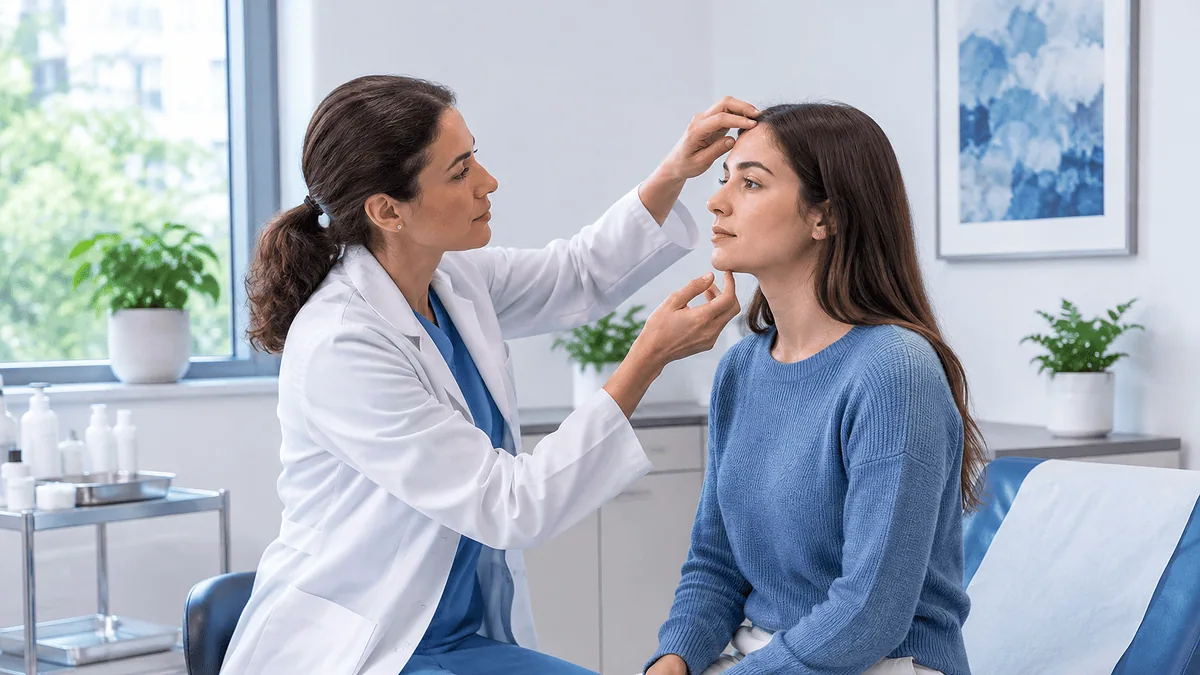
Good news first: the diagnosis is almost always made by looking. A clinician will ask when the bumps started, whether they itch or hurt, what you use on your hair and skin, what you wear on your head, how the spots track with your cycle, and what medicines you take. Then they examine the forehead in good light and usually the chest and back too, because the distribution tells a story.
Comedones are the deciding clue for acne: if blackheads and whiteheads are present, the diagnosis is acne vulgaris or one of its mechanical or product-driven subtypes. No comedones plus uniform itchy bumps points to folliculitis. No comedones plus background redness, flushing and adult onset points to rosacea. A rash that respects the outline of a hat band points to contact dermatitis.
Tests are needed only occasionally. A skin scraping with potassium hydroxide, a simple bedside test, can show Malassezia yeast under the microscope. A swab of a pustule can identify bacteria if folliculitis keeps returning or looks unusual. Blood tests for hormone levels are reserved for adults, especially women, whose acne is severe, sudden, or paired with irregular periods, excess facial hair or hair thinning, which can suggest PCOS or another endocrine cause. Patch testing identifies the specific ingredient in contact dermatitis.
Severity is graded on how many lesions there are and whether nodules and scarring exist, and that grade, rather than the location on the forehead, determines treatment.
What is reasonable to do at home for forehead breakouts
Mainstream guidance from the NHS and NIAMS supports a short list of measures, and the list is deliberately gentle, because scrubbing and drying are two of the fastest ways to make acne angrier.
- Wash the forehead no more than twice a day with a mild cleanser and lukewarm water; hot water and harsh soap strip the barrier and increase irritation.
- Keep hair product away from the skin: apply it from mid-length to ends, wash hair regularly if it is oily, and keep a fringe off the forehead when you can, especially at night.
- Choose moisturizers, sunscreen and makeup labeled non-comedogenic or oil-free, and remove makeup fully before bed.
- Shower or at least rinse the forehead soon after sweating, and clean the inner pads of helmets and the bands of hats.
- Stop touching: hands on forehead, picking, and squeezing all add bacteria and trauma.
- Over-the-counter products containing benzoyl peroxide, salicylic acid or adapalene (a retinoid, a vitamin A derivative that keeps pores from plugging) are the first-line options the NHS names for mild acne; introduce one at a time and expect dryness in the first weeks.
Patience is the hardest part of home care. The NHS states that benzoyl peroxide usually needs a 6-week course before most spots clear, and new topical treatments generally take 6 to 8 weeks to show their effect. Judging a product at day ten is the most common reason people give up on something that was starting to work. Is it okay to pop forehead pimples? The evidence-based answer is no: squeezing pushes material deeper, spreads bacteria and raises the risk of a dark mark or a pitted scar that outlasts the spot by months.
Will forehead acne go away? Treatments, mechanisms and realistic timelines
For most people, yes, acne settles as hormones steady. The NHS notes that symptoms often improve by the mid-20s, while acknowledging that a minority continue into adult life. That is a group pattern, not a personal forecast; what shortens the wait is matching treatment to the type and severity of acne and sticking with it.
Prescription treatment builds on the same mechanisms as over-the-counter care. Topical retinoids normalize the shedding of cells inside the pore so comedones stop forming; they work slowly, with the NHS quoting around 6 weeks before improvement is visible, and they make skin more sun-sensitive. Topical antibiotics reduce C. acnes and inflammation and are usually paired with benzoyl peroxide to limit bacterial resistance. Azelaic acid is an alternative with antibacterial and anti-comedonal actions. Oral antibiotics of the tetracycline class are used for moderate inflammatory acne for a limited course of months; the NHS states improvement is usually noticed around 6 weeks in.
For women whose acne tracks with the cycle, combined hormonal contraception or an anti-androgen medicine such as spironolactone may be considered by the prescriber. Oral isotretinoin, a powerful retinoid, is reserved for severe, scarring or treatment-resistant acne, requires specialist supervision and careful monitoring, and must not be used in pregnancy because of the risk of birth defects.
All of these are decisions for the prescribing clinician, who weighs pattern, severity, scarring risk, pregnancy plans and side effects. Treatment also keeps going after the forehead clears, often for months, because stopping early is a common reason acne returns.
What people often get wrong about forehead acne
“Forehead spots mean a problem with my liver or digestion.” This comes from face mapping, an idea borrowed from traditional Chinese medicine and Ayurveda that assigns each facial zone to an internal organ. No controlled study has shown that forehead acne reflects the state of any organ. The forehead breaks out because of local oil glands, hair contact and friction, as described by NIAMS and the NHS. The one internal link with real evidence is hormonal: acne that is severe, adult-onset or paired with irregular periods can be a sign of PCOS, which a clinician can assess.
“My forehead is dirty, so I should scrub harder.” Acne begins inside the pore, below the reach of any scrub. The NHS explicitly states that acne is not caused by poor hygiene, and over-washing often worsens it.
“Sunbathing clears spots.” A tan temporarily disguises redness, but ultraviolet light thickens the outer skin layer, which can block pores further, and it darkens the marks spots leave behind. Many acne treatments also increase sun sensitivity.
“If a product does not work in two weeks, it does not work.” Most acne treatments need 6 to 8 weeks by NHS guidance.
“Toothpaste dries out a pimple.” It irritates skin and can cause a chemical burn; there is no evidence it shortens a spot.
“Chocolate and greasy food cause acne.” The evidence links some high-glycemic and dairy-heavy diets to worse acne in some people, but it is inconsistent and does not implicate chocolate or fried food specifically.
When to see a doctor about forehead breakouts
Most forehead breakouts can be handled at home for a couple of months. Seek a routine appointment when any of the following apply:
- Over-the-counter measures have been used consistently for 6 to 8 weeks with no improvement.
- You have painful nodules or cysts under the skin, or you are already seeing pitted scars or dark marks.
- The breakouts are affecting your mood, sleep or willingness to socialize; the NHS recognizes the mental health impact of acne as a reason for treatment in itself.
- You are an adult woman with new or worsening acne alongside irregular periods, excess facial or body hair, or hair thinning on the scalp.
- The bumps itch, are uniform in size and do not respond to acne products, which raises the possibility of folliculitis or another diagnosis.
- You are pregnant, planning pregnancy or breastfeeding and want treatment, because some acne medicines are unsafe at those times and the pathway differs.
- A child under about 8 develops true acne, which is unusual and merits a check for hormonal causes.
Red-flag signs that need same-day care, not a routine slot: a spot or patch that becomes hot, very swollen and tender and spreads quickly across the forehead or toward the eye; fever or feeling generally unwell with such a patch; swelling of the eyelid or around the eye; or a rash with blisters that follows a stripe or band on one side of the forehead with burning pain, which can indicate shingles affecting the nerve near the eye. These are uncommon, but they are the situations where waiting is the wrong call.
Frequently asked questions
What causes breakouts on the forehead most often?
Ordinary acne is the most common cause. The forehead has many large oil glands, so pores plug with sebum and dead skin, then inflame. Hair products, fringes, hats and helmet friction add local triggers, and hormones and stress drive flares. Uniform itchy bumps without blackheads may instead be folliculitis, which needs a different treatment.
How do I stop forehead pimples?
Keep hair products off the skin, choose non-comedogenic skincare, wash gently twice a day, rinse after sweating and avoid picking. Over-the-counter benzoyl peroxide, salicylic acid or adapalene are first-line options the NHS names for mild acne; give any product 6 to 8 weeks. If that fails or spots are painful or scarring, a clinician can prescribe stronger treatment.
Will forehead acne go away on its own?
Usually, over time. The NHS notes most people have acne on and off for several years and that it often improves by the mid-20s, though about 3% of adults over 35 still have it. Those are group patterns, not a personal timeline. Treatment shortens the active phase and, more importantly, lowers the risk of permanent scarring.
What organ is linked to forehead acne?
None, according to current evidence. The idea that the forehead maps to the liver or gut comes from traditional face mapping and has not held up in clinical studies. Forehead acne reflects local oil glands, hair contact and friction. The one internal factor with real evidence is hormonal, which is why severe adult acne with irregular periods prompts a hormone check.
Is it okay to pop forehead pimples?
No. Squeezing pushes oil and bacteria deeper into the pore, increases inflammation and raises the chance of a dark mark or a pitted scar that lasts far longer than the spot. If a large, painful cyst needs draining, a clinician can do it with sterile technique or inject it to settle inflammation. At home, a warm compress and patience are the safer options.
Why do I get small bumps on my forehead that are not pimples?
Small, uniform, often itchy bumps without blackheads are typical of folliculitis, inflammation of the hair follicles caused by bacteria or by Malassezia yeast. Other possibilities include milia, tiny white keratin cysts, and closed comedones, which look like skin-colored bumps. A clinician can tell them apart by examination and, if needed, a simple skin scraping.
Can my hair products cause acne on my forehead?
Yes. Oily or heavy styling products, conditioners and leave-in creams migrate onto the hairline and forehead, plugging pores in a pattern dermatologists call pomade acne. Switching to lighter, non-comedogenic products, applying them away from the scalp and keeping a fringe off the skin usually brings improvement within one to two months.
Does stress cause forehead breakouts?
Stress does not create acne by itself, but it can worsen existing acne. Stress hormones appear to increase oil production and inflammation in the skin, and poor sleep works the same way. The evidence is mostly observational, so stress is best thought of as an amplifier. Managing it helps, but it rarely replaces treatment of the acne itself.
How long does it take for forehead acne treatment to work?
Longer than most people expect. The NHS states that benzoyl peroxide usually needs a 6-week course, topical retinoids take around 6 weeks to show improvement and oral antibiotics are usually noticeable after about 6 weeks, with courses lasting several months. Stopping early is a common reason breakouts return, so decisions about timing belong with the prescriber.
Can forehead acne be a sign of a hormone problem?
Sometimes, especially in adults. Acne that is severe, begins or worsens after the teenage years, flares with the menstrual cycle, or comes with irregular periods, excess facial hair or scalp hair thinning can point to polycystic ovary syndrome or another endocrine cause. A clinician can assess this with history, examination and, where indicated, blood tests.
References
This article is for general information only and is not a substitute for professional medical advice. Please consult a qualified doctor about your individual situation.
Add us as a Preferred Source to see more of our trusted health content across Google Search, AI Overviews and Discover.

More from the Blog
How Rosacea Treatment Is Matched to Your Pattern: Flushing, Redness, Bumps and Thickened Skin
Rosacea treatment is matched to the features a person actually has rather than to the diagnosis alone. Flushing and persistent redness are managed with…
Itchy Armpits Without a Rash: Sweat, Shaving, Skin Products and Other Triggers
Itchy armpits without a rash are most often caused by sweat trapped in a warm fold, friction, shaving regrowth, dry skin, or irritation from…
Are Chiggers Contagious? How the Bites Happen, How Long They Itch and What Calms Them
No. Chiggers are not contagious. The bites come from larval mites picked up in grass, leaf litter or brush, not from another person. A…
Why Blood Tests or a Skin Biopsy Come Before Biologic and Systemic Psoriasis Treatment
Before biologic or systemic psoriasis treatment, clinicians order blood tests and occasionally a skin biopsy for two reasons: to confirm the diagnosis when it…
Rash on the Legs or Arms: What the Pattern Suggests, Likely Causes and When to Worry
A rash on the legs or arms is most often eczema, contact dermatitis, insect bites, folliculitis, hives or a fungal infection, and the pattern…

Poison Sumac Rash: What It Looks Like, Why It Blisters and How Long It Lasts
A poison sumac rash is an allergic skin reaction to urushiol, the oily resin in the plant's sap. It usually appears 12 to 72…