

Gum Recession Surgery Recovery: The Graft Site Week by Week and When Brushing Resumes

Key Takeaways
- Soreness and swelling after a gum graft usually peak on days two and three and ease over the first week, so a rough third day does not mean something has gone wrong.
- When tissue is taken from the palate, that donor site is often more uncomfortable than the graft itself, and a palatal stent is designed to protect it.
- Brushing the grafted area is typically paused for one to two weeks while every other tooth is brushed normally; the site is kept clean with gentle rinsing rather than bristles.
- Most people return to work and routine within one to two weeks, but the graft keeps maturing for several weeks to a few months, so the final look is assessed at around three months, not two weeks.
- The strongest evidence for helping a graft heal is about removing obstacles, above all smoking and plaque, rather than any supplement or rinse marketed as an accelerator.
- A graft replaces lost tissue but not the cause of the loss, so heavy brushing, untreated gum disease, or grinding can wear it away again without long-term maintenance.
Gum graft recovery usually follows a predictable arc: soreness and swelling are worst in the first two to three days, most people return to normal routines within one to two weeks, and the graft site continues to mature for several weeks to a few months. Brushing the grafted area is typically paused for one to two weeks; the rest of the mouth is brushed as usual. Your periodontist sets the exact timing.
The night before her appointment, Dana ran her tongue along the lower front tooth that had been bothering her for a year. Not painful, exactly, but longer than its neighbors, with a thin band of root showing where gum used to be. She had read the consent form twice. What she really wanted was a calendar: which day would hurt most, when the stitches would go, and when she could finally brush that spot again without flinching.
That calendar is what this article tries to give you. A gum graft is small in surgical terms and large in daily-life terms, because it lives in a place you cannot rest, splint, or forget about. Every sip and every word passes over it.
The gum graft recovery timeline below moves week by week through both sites involved, the graft itself and the palate it often comes from, and pauses on the questions people ask most: the worst days, the return to real food, and the return of the toothbrush.
What gum recession surgery actually does
Gum recession is the slow retreat of gum tissue away from the tooth, exposing root surface that was never meant to meet air, cold water, or a toothbrush. The root has no enamel, so exposed roots often feel sensitive and can wear or decay more easily. Cleveland Clinic notes that recession is common and tends to progress if the cause, whether gum disease, aggressive brushing, tooth position, or a thin natural gum type, is not addressed.
Gum recession surgery, usually called gum grafting, adds tissue back where it has been lost. A periodontist, a dentist who specializes in the gums and the bone that anchors teeth, lifts a small flap at the recession site, positions a piece of donor tissue over the exposed root, and secures it with fine sutures. The donor tissue may come from the roof of your own mouth, from a nearby stretch of your own gum, or from processed donor tissue supplied by a tissue bank.
What happens next is the part patients rarely hear explained. In the first hours the graft is held alive only by a thin film of plasma seeping from the underlying bed. Over the first few days, tiny new blood vessels grow into it from the surrounding gum, a process called revascularization. Only after that does the graft truly become part of you. This is why the first week is treated so carefully: the tissue is a transplant waiting for a blood supply, and pressure, suction, or movement can disturb it before that supply arrives.
The aims of the operation are to cover or protect the root, thicken the gum so recession is less likely to return, and reduce sensitivity. Cleveland Clinic describes these as the usual goals; how much root coverage is achieved varies with the type of recession, the tooth, and the technique, and your periodontist should discuss realistic expectations for your specific site before you agree to proceed.
The main types of gum graft, side by side
Not all grafts are the same, and the type chosen shapes your recovery, particularly whether you will have one healing site or two. Cleveland Clinic outlines three broad approaches, and a fourth option, donor tissue, is widely used alongside them.
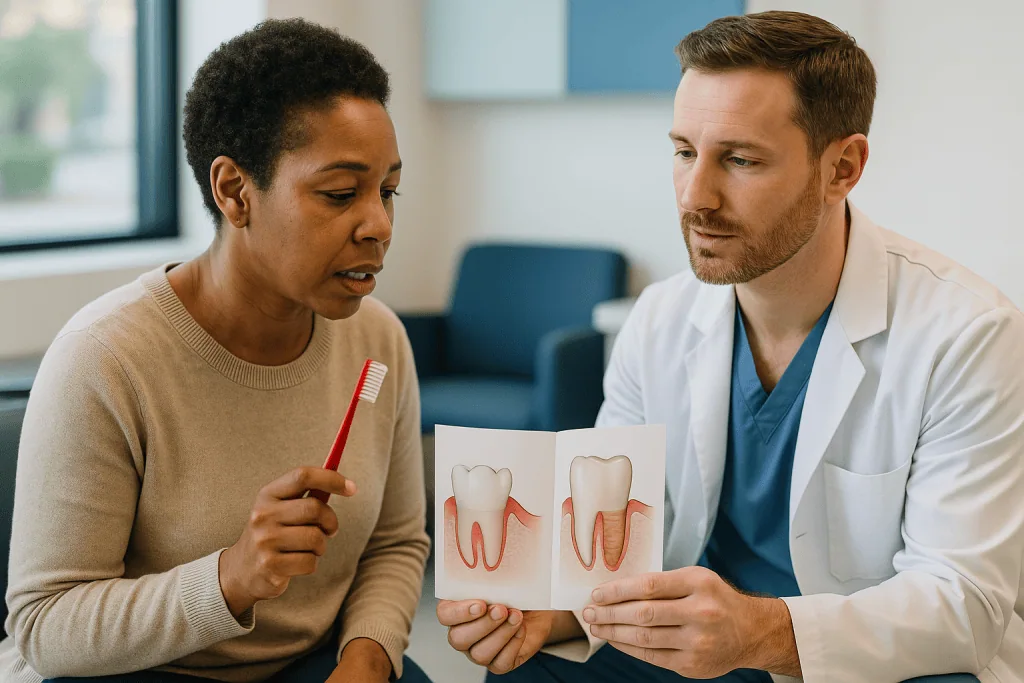
| Graft type | Where the tissue comes from | Typical use | What it means for recovery |
|---|---|---|---|
| Connective tissue graft | Under the surface layer of the palate, through a small incision | Covering exposed roots, the most commonly performed graft | Two sites heal; palate incision usually closed with sutures |
| Free gingival graft | Surface layer of the palate, removed directly | Thickening thin gum, often where little coverage is needed | Two sites; open palate wound is often the sorer one |
| Pedicle (lateral) graft | Gum next to the affected tooth, left attached at one end | Sites with plenty of healthy gum nearby | One site; no palate wound |
| Allograft or other donor tissue | Processed human or animal tissue from a tissue bank | Multiple teeth, or when the patient prefers to avoid a palate wound | One site; no second wound |
The palate, or roof of the mouth, is used because its tissue is tough, keratinized, and matches the gum well. Keratinized tissue is the firm, pale pink gum that resists friction; the softer, redder tissue of the cheek lining does not. Cleveland Clinic points out that patients often find the palate donor site more uncomfortable than the graft itself, which surprises many people who focused their worry on the tooth.
Choice of technique rests with the treating team and depends on how many teeth are involved, how much tissue is available, the depth of recession, and your own preferences about a second wound. There is no universally superior option; each has trade-offs your periodontist can lay out for you.
Who a gum graft is usually for, and who is asked to wait
A graft is usually considered when recession is causing a problem or is likely to cause one: persistent root sensitivity, root decay or wear, a gum edge so thin it keeps receding, or a change in appearance that troubles the patient. Mayo Clinic lists gum grafting among the surgical treatments for advanced periodontitis, the bacterial infection of the tissues around teeth that destroys gum and bone. The CDC estimates that nearly half of adults aged 30 and older in the United States have some form of periodontal disease, so recession from that cause is far from rare.
Recession also affects people with excellent gum health. Years of vigorous scrubbing with a stiff brush, teeth that sit slightly outside the bony ridge, tongue or lip piercings, and orthodontic tooth movement can all thin the gum. Cleveland Clinic and the NHS both emphasize that identifying and controlling the cause matters as much as the repair, because a graft placed over an untreated cause can recede again.
Some people are asked to wait. Active gum infection is usually treated first with professional cleaning and improved home care, because grafting into an inflamed, plaque-laden environment is unlikely to hold. Smokers are often asked to stop or reduce before surgery; the NHS notes that smoking impairs gum healing and worsens gum disease. Poorly controlled diabetes, certain medicines that affect clotting or healing, and pregnancy may also lead a periodontist to postpone or adjust the plan.
Alternatives exist. Mild recession without symptoms may simply be monitored with photographs and measurements at regular visits. Sensitivity can sometimes be managed with desensitizing toothpaste or in-office treatments, and root surfaces can be protected with tooth-colored filling material. Whether to graft, wait, or manage another way is a shared decision between you and the treating team, weighed against how fast the recession is moving and how much it bothers you.
Is a gum graft considered major surgery? What the day looks like
People search this question a lot, and the honest answer is that it depends on your definition. In surgical terms a gum graft is minor: it is performed in a dental chair under local anesthetic, usually takes an hour or so, and you go home the same day. Cleveland Clinic describes it as an outpatient procedure, and general anesthesia is not typical, though some practices offer sedation for anxious patients. In lived-experience terms, it is more disruptive than a filling and less than a wisdom tooth extraction for most people.

On the day, the periodontist numbs both the recession site and, if used, the palate. You will feel pressure and hear the small sounds of instruments, but not sharp pain. The donor tissue is harvested first or the pedicle prepared, the recipient bed is made, and the graft is positioned and sutured. Some clinicians place a protective dressing over the graft, a putty-like material that shields it from the tongue and food. If your palate was used, you may be fitted with a palatal stent, a thin acrylic plate like a retainer that covers the roof of the mouth and keeps pressure off the wound.
Before you leave you should receive written instructions covering bleeding, swelling, diet, hygiene, and who to contact after hours. Pain relief is usually discussed at this point. Two classes are commonly involved: non-steroidal anti-inflammatory drugs, which reduce the inflammatory chemicals that drive swelling and soreness, and acetaminophen, which acts centrally on pain perception. Which of these suits you, and whether an antiseptic mouth rinse or antibiotic is appropriate, is a decision for the prescribing clinician based on your medical history and current medicines.
Arrange a ride home if you have had sedation, and plan a quiet afternoon regardless. The numbness fades over a few hours, and that is when the real recovery begins.
Gum graft recovery timeline: the first 24 hours
The first day is about protection and stillness. As the local anesthetic wears off, the graft site typically feels tender and tight, and the palate, if used, feels raw in the way a burned roof of the mouth does. Cleveland Clinic advises expecting some oozing, swelling, and discomfort in this early period.
Bleeding is normally light. A pink tinge to saliva is expected; a steady flow is not. If the palate site seeps, firm pressure with a damp gauze or clean tea bag for a sustained period usually settles it, and the stent, if you have one, provides constant gentle compression. The graft site itself should not be pressed.
The biggest job on day one is to avoid disturbing the clot and the delicate plasma film that is feeding the graft. That means no rinsing, no spitting forcefully, no drinking through a straw, no poking with the tongue, and no lifting the lip to check. The suction created by straws and forceful spitting can shift a graft that is, at this point, held mainly by sutures and surface tension.
Cold helps. A wrapped ice pack held against the cheek in intervals limits swelling by narrowing blood vessels in the area. Keeping your head elevated on an extra pillow that night does the same job by gravity. Food should be cool or lukewarm, soft, and chewed on the other side of the mouth; yogurt, smoothies eaten with a spoon, and cool soups are the usual first choices. Hot drinks are best avoided because heat dilates vessels and can restart oozing.
Take any pain medicine as your clinician directed rather than waiting for pain to build, and rest. Talking is fine but keep it gentle; the lip and cheek muscles pull on a lower front graft more than people realize.
What are the worst days after a gum graft?
Most people name days two and three. This is not a quirk of gum surgery but of surgery in general: inflammation, the body’s repair response, ramps up over the first 48 to 72 hours and then begins to recede. Cleveland Clinic notes that swelling and discomfort after grafting are typically greatest in the first few days before easing over the first week.
What that feels like varies by site. The graft area is usually more swollen than painful, with the lip or cheek feeling puffy and the sutures noticeable to the tongue. The palate is often the site people underestimate. A free gingival graft leaves an open wound that must heal from the edges inward, and it can feel like a persistent scald every time you swallow. A connective tissue graft, harvested through a closed incision, is generally kinder to the palate, though it still aches.
Bruising may appear on the skin over the site, particularly with lower grafts, and can look worse than it feels. Some stiffness when opening the mouth is common. A slight temperature elevation on day two can accompany normal healing, though a fever that climbs or persists is a reason to call, covered later in this article.
Two things make these days easier. The first is staying ahead of pain with whatever regimen your clinician advised, because inflammation-driven soreness is far easier to hold down than to chase. The second is honest expectation: knowing that day three often feels worse than day one prevents the sinking suspicion that something has gone wrong. By day four or five, most people notice a distinct turn, with swelling softening and the palate less raw.
Bad taste and a whitish or grayish film over the wound also often appear now. That film is fibrin, the protein mesh of a healing clot, and it is a normal stage, not infection.
Gum graft healing stages: days 4 to 14
The second half of week one is when the graft starts to earn its keep. New capillaries have grown into the tissue, and it shifts from pale or slightly gray to a healthier pink as blood flow establishes. Cleveland Clinic describes most people being able to return to work and normal daily routines within one to two weeks, and by day five or six many have already done so, with lingering care around food and hygiene.
Swelling continues to fall. Bruising, if present, fades through yellow-green. The palate wound, if open, is filling in from its edges and may look like a shallow crater with a whitish center; it is usually much less sore by day seven. The stent, if you were given one, can typically be worn less, mainly at meals, though follow your periodontist’s instruction on this.
Sutures behave differently depending on type. Dissolvable sutures loosen and fall away on their own over roughly one to two weeks, and finding a small thread on your tongue is expected. Non-dissolving sutures are removed at a follow-up visit in the same window. Do not pull at loose ends; a dangling suture that still anchors one edge of the graft is doing its job until it is cut.
The end of week two is usually the first significant checkpoint. Your periodontist will look for a graft that is pink, firmly attached, and free of the dull red, swollen edges that suggest infection. This is also when many clinicians lift the brushing restriction at the site and relax the soft-diet advice, both covered in their own sections below.
Do not judge the result yet. At two weeks the graft often looks thick, bulky, and slightly mismatched in color. That is expected. Contour and color take months to settle, and a graft that looks overbuilt now frequently looks natural later.
How long does a gum graft take to heal? Weeks 3 to 12
Surface healing and true healing are not the same thing, which is why this question gets two different answers from the same clinician. The surface layer, or epithelium, has usually covered both sites by about two weeks. Beneath it, the graft is still remodeling: collagen fibers reorganize, the tissue firms, and the boundary between old gum and new blurs. Cleveland Clinic notes that complete healing of the graft site can take several weeks to a few months.
During weeks three to six, the graft typically shrinks a little as swelling resolves and the tissue contracts. Color continues to blend, though palate-derived tissue can remain slightly paler than neighboring gum for a long time, and in some people permanently. The palate itself is usually fully covered by new surface tissue by around three to four weeks, and the stent is generally retired by then.
Sensitivity often changes in this period. Some people notice the tooth is less sensitive to cold almost immediately because the root is covered; others notice a temporary increase while the graft edge settles against the tooth. Both patterns are commonly reported, and neither predicts the final result.
By around three months, the tissue is mature enough that your periodontist can assess the outcome: how much root has been covered, how thick and firm the new gum is, and whether the edge sits stably. This is the visit where measurements are usually compared with the pre-surgery photographs. Final contour can continue to refine for up to a year in some cases, particularly with connective tissue grafts, which is why clinicians are reluctant to declare a result early.
Follow-up schedules vary. A typical pattern involves checks at one to two weeks, around six weeks, and around three months, with a longer-term review folded into routine dental visits.
When can I brush after gum graft surgery?
This is the question in the title, and it deserves an unambiguous framework even though the exact day is set by your periodontist. The rule most clinicians follow, and the one Cleveland Clinic describes, is this: do not brush or floss the grafted area until you are told you can, typically for one to two weeks, while brushing everything else normally from the first evening.
The reasoning is mechanical. A toothbrush applies exactly the kind of shearing pressure that can lift a graft off its bed before blood vessels have anchored it. The rest of your mouth, however, needs plaque control more than ever, because bacteria near a healing wound raise the risk of infection. Brush the other teeth with a soft brush, keeping the bristles well clear of the surgical site, and floss the untreated areas as usual.
In place of brushing, the graft site is usually kept clean chemically rather than mechanically. Many periodontists prescribe an antiseptic mouth rinse containing chlorhexidine, an agent that binds to tooth and gum surfaces and suppresses plaque bacteria for hours. It can stain teeth and alter taste temporarily, which is why it is used for a limited period. Whether you use it, and for how long, is the prescriber’s decision. Gentle warm saltwater rinses are often suggested after the first day; let the liquid roll over the site rather than swishing hard.
When clearance comes, the return is gradual. Start with an extra-soft brush and light strokes that roll from the gum toward the tooth rather than scrubbing across the gum line. Avoid electric brushes on the site until your periodontist approves, since the vibration and pressure are harder to control. Flossing at the site usually follows a week or two later. This gentle technique is worth keeping for life, because heavy brushing is one of the causes of recession in the first place.
What to eat after gum graft surgery, and when normal eating returns
Diet after a graft follows three principles: nothing hot, nothing hard, and nothing that lodges. Cleveland Clinic advises soft, cool foods in the first days and a gradual return to a normal diet as comfort allows, with most people eating fairly normally by about two weeks.
Temperature matters early because heat increases blood flow and can provoke oozing at the palate. Texture matters throughout the first week because chewing anything firm risks pressing food against the graft or scraping the palate wound. Small particles such as seeds, nuts, popcorn hulls, and crusty bread are the classic offenders because they lodge at the site and are hard to remove without disturbing it.
| Phase | Usually fine | Usually avoided |
|---|---|---|
| Days 1 to 3 | Yogurt, smoothies by spoon, cool soups, applesauce, mashed potato, scrambled eggs cooled | Anything hot, crunchy, spicy, acidic, or sipped through a straw; alcohol |
| Days 4 to 7 | Soft pasta, well-cooked fish, oatmeal, soft fruit, lukewarm foods chewed on the other side | Chips, nuts, seeds, crusty bread, raw vegetables, sticky sweets |
| Week 2 onward | Gradual return to regular textures as the periodontist advises | Very hard or sharp foods at the site until cleared |
Protein and vitamin C are the nutrients most often mentioned in wound healing because they supply the building blocks for collagen, though a normal varied diet provides both and there is no good evidence that supplements above dietary needs speed gum graft healing. Staying well hydrated matters more than any single food.
Alcohol is usually avoided for the first several days because it can irritate wounds and interact with pain medicines. Spicy and acidic foods are avoided for comfort rather than safety. Chew on the opposite side, rinse gently after eating once rinsing is permitted, and expect to feel oddly hungry in week one, since eating slowly and cautiously often means eating less.
What helps gum grafts heal faster? Separating evidence from hope
People want an accelerator, and the honest answer is that the strongest levers are about removing obstacles rather than adding boosters. Nothing sold over a counter reliably speeds a gum graft, but several things reliably slow one.
Smoking sits at the top. Nicotine constricts the small vessels the graft depends on, and tobacco smoke impairs the immune cells that clear bacteria and rebuild tissue. The NHS identifies smoking as a major factor in poor gum health and healing, and periodontists commonly ask patients to stop before surgery and stay stopped through the maturation period. Vaping is not a proven safe substitute, and the suction involved is itself a hazard in the first week.
Plaque control around the site is the second lever. A graft heals into whatever environment surrounds it, and bacterial load nearby feeds inflammation that can loosen the tissue. This is why brushing the rest of the mouth and using any prescribed rinse exactly as directed matter so much.
Blood sugar control matters for people with diabetes, since elevated glucose impairs wound healing and immune function; Mayo Clinic lists diabetes among the conditions that worsen periodontal outcomes. Adequate sleep and general nutrition support healing in the ordinary way they support any wound.
What about the rest? Salt water rinses are soothing and help keep the site clean, but they do not speed tissue growth. Herbal rinses, oil pulling, and vitamin or collagen supplements have not been shown in good-quality trials to improve gum graft outcomes, and some can irritate a fresh wound. Cold compresses limit swelling in the first two days but do nothing after that. If a product promises to cut healing time, treat the claim with the same skepticism you would apply to any wound-healing miracle.
The most useful accelerator, in the end, is patience: not checking, not poking, and not rushing the diet or brushing schedule your periodontist set.
What people often get wrong about gum graft recovery
The graft is the sore part. Usually not. Cleveland Clinic and countless patient accounts agree that the palate donor site, when one is used, is the more uncomfortable wound. Planning your soft foods and your stent around the roof of your mouth is more realistic than focusing on the tooth.
A white or gray graft means it is dying. A whitish film over a healing wound is fibrin and is expected. A graft can also look pale in the first days before blood vessels grow in. A graft that turns dark, dusky, or comes away in one piece is a different matter and warrants a call, but the everyday pallor of early healing is not that.
You must stop brushing your whole mouth. The opposite. Only the graft site is off limits; neglecting the other teeth raises infection risk at the very time you want it lowest.
Rinsing vigorously keeps it clean. Forceful swishing and spitting create pressure changes that can shift a graft in week one. Gentle rolling of liquid over the site is the technique.
The two-week result is the final result. Grafts look bulky and mismatched early and refine over months. Judging the outcome before about three months, when the treating team usually assesses it, leads to unnecessary worry.
Once healed, the recession will not come back. A graft addresses lost tissue, not the habit or condition that removed it. Continued heavy brushing, uncontrolled gum disease, or untreated grinding can wear away a graft as they wore away the original gum. Mayo Clinic frames long-term periodontal maintenance as ongoing rather than a single fix.
It is only cosmetic. Root coverage protects against decay and wear and often reduces sensitivity; appearance is one reason among several that a graft may be advised.
Questions to ask your care team before and after a gum graft
Recovery goes more smoothly when you leave the consultation knowing what to expect, and the follow-up visits knowing what to watch. These questions are meant to open a conversation with your periodontist, not to be answered here, because the answers depend on your mouth and your health history.
- Which type of graft are you recommending for me, and why that one over the alternatives?
- Will tissue come from my palate, and if so, will I have a stent or dressing to protect it?
- What does root coverage typically look like for recession of my depth and pattern, and what would you consider a good result?
- Are there causes of my recession, such as brushing technique, grinding, or tooth position, that need addressing so the graft lasts?
- Should I stop or adjust any of my current medicines or supplements before surgery, and who will coordinate that with my physician?
- What pain-relief plan do you suggest for me, and what should I do if it is not enough?
- Exactly when may I brush the site, floss it, and use an electric brush again?
- How long should I stay on soft foods, and which foods do you most want me to avoid?
- Are the sutures dissolvable, and when will you check them?
- What signs would you want me to call about, and how do I reach someone after hours or on a weekend?
- When will you assess the final result, and how will you measure it against where we started?
- How often should I return for periodontal maintenance afterward?
Write the answers down or ask for them in writing. Anesthetic, nerves, and the sheer number of instructions on surgery day make even careful listeners forget details by the time they get home. If anything in your written instructions conflicts with something you read online, including this article, follow your team’s instructions.
When to call your doctor after gum graft surgery
Most gum graft recoveries are uneventful, and the discomfort described above is expected. Some signs are not, and they warrant a same-day call to your periodontist or, where noted, urgent care.
Seek care promptly if you notice:
- Bleeding that does not stop with firm, sustained pressure, or that restarts heavily after the first day
- Swelling that keeps increasing after day three, or that spreads to the neck, floor of the mouth, or eye
- Fever that climbs or persists beyond the first couple of days
- Increasing pain after day three, rather than the gradual easing most people experience
- Pus, a foul taste or smell, or dull red, tender edges at either wound
- A graft that turns dark or dusky, lifts visibly, or comes away
- Sutures that have all come out early, leaving the graft edge loose
- Numbness of the lip, chin, or tongue that persists well after the anesthetic should have worn off
- A rash, facial swelling, or breathing difficulty after taking a prescribed medicine, which is an emergency
Difficulty swallowing or breathing, or swelling that makes it hard to open the mouth, should be treated as an emergency rather than waiting for office hours. These are rare after gum grafting, but they are the reason your team gave you an after-hours number.
Less urgent but still worth a call: a stent that no longer fits or rubs, a dressing that has come off within the first few days, or simply uncertainty about whether what you are seeing is normal. Periodontists would far rather look at a graft that turns out to be fine than hear about a problem a week late. Cleveland Clinic and the NHS both encourage patients to contact their dental team with any concern during healing rather than trying to judge it alone.
Every decision about medicines, wound care, and next steps sits with your treating team, who know your history and can see the site. This article describes what is typical; they determine what is right for you.
Frequently asked questions
What are the worst days after a gum graft?
Days two and three are usually the most uncomfortable. Inflammation peaks around 48 to 72 hours after surgery and then subsides, so swelling, tightness, and palate soreness tend to be at their height then. Cleveland Clinic notes discomfort is greatest in the first few days and eases across the first week. Staying ahead of pain with the regimen your clinician advised and expecting this pattern makes those days easier.
Is a gum graft considered major surgery?
Clinically it is minor surgery: performed under local anesthetic in a dental chair, usually within about an hour, with same-day discharge, as Cleveland Clinic describes. In daily-life terms it is more disruptive than a filling because the wound sits where you eat and speak. Most people manage with rest, soft food, and over-the-counter or prescribed pain relief decided by their periodontist, and return to routine within one to two weeks.
How long after a gum graft can I eat normally?
Most people are back to a fairly normal diet by about two weeks, according to Cleveland Clinic guidance, though the exact timing is set by your periodontist. The first three days call for cool, soft foods; days four to seven allow soft, lukewarm meals chewed on the other side; hard, sharp, or seedy foods are usually the last to return. Follow your team’s written instructions if they differ.
What helps gum grafts heal faster?
The evidence supports removing obstacles rather than adding boosters. Not smoking, keeping the rest of the mouth clean, using any prescribed rinse as directed, controlling blood sugar if you have diabetes, and avoiding suction, heat, and prodding in the first week all matter. Supplements, herbal rinses, and oil pulling have not been shown in good-quality studies to speed gum graft healing, and some can irritate the wound.
When can I brush after gum graft surgery?
Brushing the grafted site is usually paused for one to two weeks, until your periodontist clears it, per Cleveland Clinic guidance. The rest of your mouth should be brushed normally from the first evening with a soft brush kept clear of the site. When cleared, start with an extra-soft brush and light rolling strokes, and wait for approval before using an electric brush or flossing at the site.
How long does a gum graft take to heal completely?
Surface healing usually takes about two weeks, but Cleveland Clinic notes complete healing of the graft site can take several weeks to a few months. During that time the graft shrinks slightly, firms up, and blends in color. Periodontists typically assess the result at around three months, and subtle refinement of contour can continue for up to a year with some graft types.
What are the gum graft healing stages I should expect to see?
Day one brings light oozing and tightness; days two and three bring peak swelling and often a whitish fibrin film over the wound, which is normal. By days four to seven the graft turns a healthier pink as blood vessels grow in. Sutures dissolve or are removed at one to two weeks. From week three the tissue contracts, firms, and blends, with the palate fully covered by around three to four weeks.
Why does the roof of my mouth hurt more than the graft?
Because the palate donor site is often the larger, more exposed wound. A free gingival graft leaves an open area that heals from the edges inward, and even a connective tissue graft, taken through a closed incision, leaves an ache. Cleveland Clinic notes patients frequently find the palate more uncomfortable than the graft. A palatal stent, cool soft foods, and avoiding heat and sharp textures all help.
Can a gum graft fail, and what does that look like?
Grafts can occasionally fail to integrate, usually because their blood supply was disrupted by infection, movement, smoking, or pressure in the first week. Warning signs include a graft that turns dark or dusky rather than pink, lifts visibly from the tooth, or comes away, along with increasing pain, pus, or a foul taste. A pale or whitish appearance in the first days is normal. Call your periodontist promptly about any of these concerns.
Will my gums recede again after a graft?
They can, if the original cause is not controlled. A graft restores lost tissue but does not change brushing habits, gum disease, tooth position, or grinding. Mayo Clinic describes periodontal care as ongoing maintenance rather than a one-time repair. Gentle brushing technique, regular professional cleanings, treatment of any active gum disease, and a night guard if you grind are the usual ways to protect the result.
References
- Gum Recession: Cleveland Clinic
- Gum Disease: NHS
- Periodontal (Gum) Disease: NIH National Institute of Dental and Craniofacial Research
- About Periodontal (Gum) Disease: CDC
This article is for general information only and is not a substitute for professional medical advice. Please consult a qualified doctor about your individual situation.

More from the Blog
How Periodontal Disease Develops Below the Gumline and Why SRP Deep Cleaning Is Planned
Periodontal disease begins when bacterial plaque collects along the gumline, inflames the gums (gingivitis) and, if it persists, spreads below the gum to destroy…
Before Clear Aligners Start: Digital Scans, Cavities to Treat and the Aligner Plan
Before starting clear aligners, an orthodontist or dentist usually completes a full dental exam, X-rays, photographs and a digital scan of both jaws. Any…

Canker Sore vs Cold Sore: How to Tell Them Apart in Ten Seconds
Location is the fastest clue. Canker sores are shallow, round ulcers with a white or yellow center that form inside the mouth, on the…
Is a Dental Spa Right for Anxious Patients? Comfort Care Without Cutting Corners
A dental spa can suit many anxious patients when the comfort features sit on top of standard clinical care rather than replacing it. Warm…
Simple vs Surgical Tooth Extraction: How the Two Procedures and Recoveries Differ
A simple extraction removes a tooth that is fully visible above the gum, using an elevator and forceps, and usually heals within days. A…

Root Canal Recovery: What the First Days Feel Like and When to Check In
Most people recover from a root canal within a few days. Mild soreness or tenderness when biting typically peaks in the first 24 to…