

Gynaecomastia Treatment as an International Patient: Stay Length, Garments and Flying Home

Key Takeaways
- The CDC's Yellow Book advises waiting around ten days before flying after chest or abdominal surgery because of clot risk, and male breast reduction is chest-wall surgery.
- NHS guidance places return to work at one to two weeks and holds strenuous exercise for around six weeks after male breast reduction.
- A drain still in place or non-dissolvable stitches awaiting removal effectively fix your earliest departure date unless a clinician at home has agreed to manage them.
- The compression garment should feel firm and even; a ridge or a garment that digs in can create the contour problems it is meant to prevent.
- Flights longer than about four hours carry the increased clot risk described by the CDC, so tell your surgeon the true duration of your journey including connections.
- Pubertal gynaecomastia usually resolves within six months to two years without surgery, according to the Mayo Clinic, which is why teenagers are typically asked to wait.
After gynaecomastia surgery abroad, most surgical teams ask patients to remain nearby for at least one to two weeks so wounds, drains and early complications can be checked in person. Public health guidance suggests waiting around ten days before flying after chest surgery because of clot risk. Your surgeon sets the exact date based on your healing, so treat these figures as typical ranges, not promises.
He has the flight booked, the compression vest folded in the suitcase, and a hotel reserved for exactly nine nights. What he does not have is a clear answer to the one question that keeps him up: is nine nights enough? Friends online say they flew home on day four. A forum post warns of a seroma that appeared on day twelve. Somewhere in between sits the truth.
That gap is the real subject of this article. When people search for gynaecomastia surgery abroad, how long to stay is rarely about the operation itself, which is usually brief. It is about the days afterwards, when swelling peaks, drains come out, stitches are checked and a body that has just been operated on is asked to sit in a pressurised cabin for hours.
What follows is a guideline-level walk through that period: what the surgery does, why the garment matters, what public health bodies say about flying, and which warning signs should send you back to a clinician rather than to an airport.
Gynaecomastia surgery abroad: how long to stay before it is safe to leave?
Start with the honest answer: there is no single number written in any guideline. What exists instead are two separate timelines that happen to overlap, and your surgeon has to satisfy both before signing you off.
The first is surgical. Gynaecomastia is enlarged breast tissue in men, and male breast reduction removes that tissue through liposuction, a small incision, or both. The NHS describes the early recovery as one to two weeks before most people return to work, with bruising and swelling settling over several weeks after that. During the first of those weeks, a surgeon wants to see the wounds at least once, remove any drain, and confirm that no fluid is collecting under the skin.
The second timeline is about travel. The CDC’s Yellow Book, which guides clinicians on travel medicine, notes that flying soon after surgery raises the risk of blood clots and suggests waiting around ten days after chest or abdominal procedures. Male breast reduction is chest-wall surgery, so that figure is the one most teams work from.
Put those together and the usual pattern is a stay of roughly ten to fourteen days, with the earliest departure decided at a follow-up visit rather than at booking. Some patients with small liposuction-only procedures are cleared sooner; others with larger excisions, drains or slow-settling swelling are asked to wait longer. The number on your itinerary is a plan. The number that matters is the one your treating team gives you after looking at the wound.
What actually happens during male breast reduction surgery
Understanding the mechanics makes every later decision, from garment to flight, easier to follow.
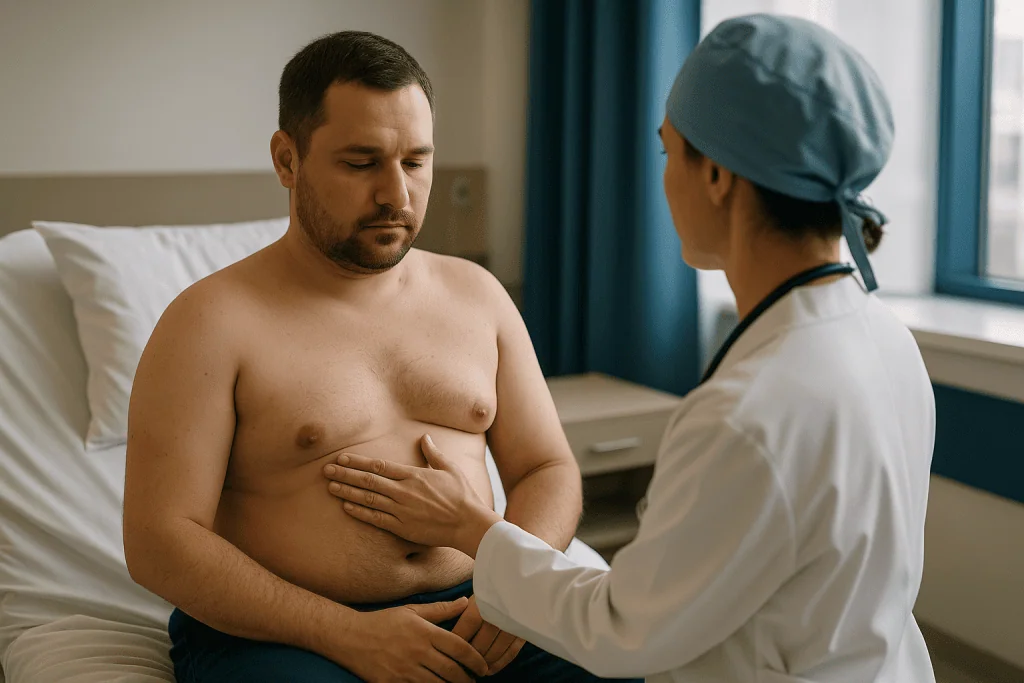
Male breast tissue has two components. One is glandular tissue, the firm, rubbery disc that sits behind the nipple and is true breast gland. The other is fat. Most gynaecomastia is a mix of both, which is why surgeons often combine two techniques in one session, as described by the Mayo Clinic and the NHS.
Liposuction uses a thin hollow tube called a cannula, inserted through incisions a few millimetres long, to break up and suction out fat. On its own, it works best when the enlargement is mostly fatty and the skin is elastic enough to shrink back.
Excision means cutting tissue out directly. For glandular tissue, the surgeon typically makes a curved incision along the edge of the areola, the darker skin around the nipple, and removes the gland through it. When there is a lot of excess skin, longer incisions may be needed and the nipple may be repositioned.
The operation is usually done under general anaesthetic, sometimes local anaesthetic with sedation, and often takes around one to two hours according to NHS guidance. Many people go home the same day; some stay one night. Before the wounds are closed, the surgeon may place a thin drain, a soft tube that carries away fluid and blood that would otherwise pool, and then applies dressings and a compression garment. Everything that follows in recovery is about protecting the flat space the surgeon has just created.
Who is usually offered surgery, and who is usually asked to wait
Surgeons are selective for good reasons, and knowing why helps you read your own situation honestly.
Gynaecomastia has causes. The Mayo Clinic lists hormonal shifts of puberty, ageing, certain medicines (including some used for prostate conditions, heart disease and mental health), anabolic steroids, alcohol misuse, and underlying conditions of the liver, kidneys, thyroid or testes. Cleveland Clinic makes the same point: before anyone operates, a clinician should look for something treatable behind the enlargement.
That is why teenagers are usually asked to wait. Pubertal gynaecomastia is common and, according to the Mayo Clinic, most cases regress without treatment within six months to two years. Removing tissue that would have shrunk on its own exposes a young person to surgical risk for little benefit.
Adults are commonly offered surgery when the tissue has been stable for a year or more, when a reversible cause has been addressed and the tissue has not resolved, and when general health allows a general anaesthetic. Surgeons also weigh body weight: if the enlargement is mainly fat that tracks with overall weight, it is sometimes described as pseudogynaecomastia, and weight change may be discussed first. This is a clinical consideration, not a judgement.
People are usually asked to pause when they smoke, since nicotine impairs wound healing; when they use anabolic steroids, which can drive regrowth; when they have an uncontrolled medical condition; or when a suspicious lump or one-sided change has not yet been evaluated. Breast cancer in men is rare, but MedlinePlus notes that a hard, fixed or one-sided lump needs assessment before any cosmetic plan. The decision, in every case, rests with the treating team.
A typical timeline for gynaecomastia surgery abroad, how long to stay and why
The table below sets out what commonly happens in the first two weeks. It is a composite of NHS recovery guidance and CDC travel advice, not a schedule you will be handed. Individual plans vary widely.
| Period | What usually happens | Why it shapes your stay |
|---|---|---|
| Day of surgery | Operation, garment applied, discharge same day or after one night | Someone should be with you for the first 24 hours after general anaesthetic |
| Days 1–3 | Peak soreness and swelling; drains, if used, are often removed | Bleeding and haematoma risk is highest now, so proximity to the team matters |
| Days 4–7 | First wound check; dressings changed; gentle walking encouraged | Infection and seroma tend to show in this window |
| Days 7–14 | Stitches checked or removed if not dissolvable; clearance discussion | Aligns with the roughly ten-day post-surgery flying interval described by the CDC |
| Weeks 2–6 | Return to desk work; garment continues; swelling settles; no heavy lifting | Usually at home, with remote or local follow-up arranged |
Two things stand out. First, the medical reasons to stay are concentrated in the first week, when bleeding, infection and fluid collections are most likely to appear and easiest to fix in person. Second, the flying interval is not about the wound alone; it reflects clot risk from immobility after surgery, which is why a person who feels fine on day five is still generally asked to wait.
If your surgeon’s timeline is shorter or longer than this table, that is not a red flag in itself. Ask what factors moved it, and make sure you understand who you would contact if something changed after you leave.
Compression vest after gynecomastia surgery: what it does and how long it is worn
The garment is the part of recovery people underestimate most, and the part that most often travels badly.
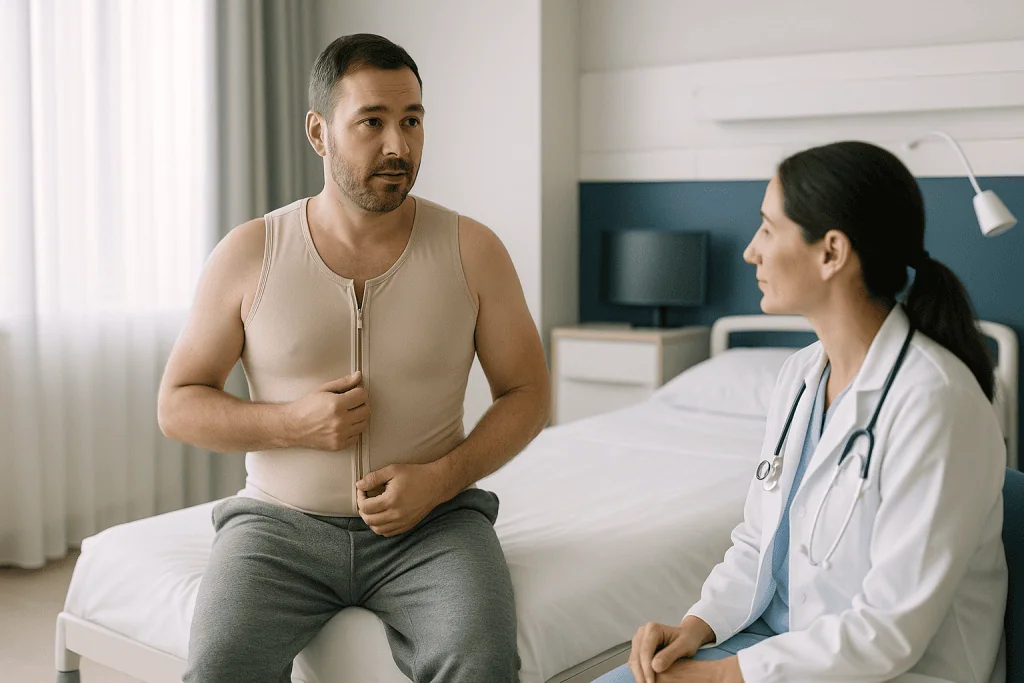
A compression vest is a tight, stretchy top, sometimes with zips or hook fastenings, worn over the chest after surgery. It does three jobs. It presses the skin down onto the chest wall so the two surfaces heal together, which is what gives a flat result rather than a loose pocket. It limits the space where blood or tissue fluid could collect, reducing the chance of a haematoma (a pool of blood) or seroma (a pool of clear fluid). And it reduces swelling by gently squeezing fluid back toward the lymphatic system, the network of vessels that drains excess fluid from tissues.
How long is it worn? NHS guidance on male breast reduction describes wearing an elastic compression garment for several weeks after the operation, with the surgeon advising when it can be removed. Many teams distinguish between an early phase of near-continuous wear and a later phase of daytime-only wear, but the split is set individually.
Practical points that repeat in every clinic corridor: the vest should feel firm, not painful, and should not fold or roll into a ridge at the edges, since a ridge can leave a groove in healing tissue. It should be removed only as instructed, usually for showering once the surgeon allows. Having two identical garments lets one be washed while the other is worn. Under airport scanners the vest is simply clothing; carrying a short letter from the surgeon describing recent surgery can smooth any questions.
One more thing: a vest that suddenly feels much tighter on one side is not a sizing problem. It is a sign to contact the team.
When can you fly after gynecomastia surgery?
Flying after gynecomastia surgery raises two distinct concerns, and it helps to separate them.
The first is the wound. Cabin pressure at cruising altitude is lower than at sea level, which can slightly increase swelling in freshly operated tissue. Sitting still for hours with arms tucked in also tends to make the chest feel tighter. Neither is dangerous in itself, but both are more comfortable once the early swelling has peaked and begun to settle, which the NHS places in the first one to two weeks.
The second is blood clots, and this is the one that drives the guidance. Surgery, especially under general anaesthetic, temporarily makes blood more likely to clot. Long periods of sitting slow blood flow in the leg veins. Combine the two and the risk of deep vein thrombosis, a clot in a deep leg vein, rises. If part of that clot breaks off and travels to the lungs, it becomes a pulmonary embolism, which can be life-threatening. The CDC’s Yellow Book identifies recent surgery as a risk factor for travel-related clots and describes flights longer than about four hours as the ones associated with increased risk.
The CDC also advises that people who have had chest or abdominal surgery generally wait around ten days before flying. Surgeons often treat this as a minimum rather than a target, extending it when drains were left in longer, when excision was extensive, or when a person has other clot risk factors such as obesity, a previous clot, or hormone therapy.
Short domestic hops and long-haul overnight flights are not the same journey. Tell your surgeon the actual duration, connections and layovers so the advice matches the trip you are really taking.
Clot prevention on the journey home
Once you are cleared to travel, a handful of low-effort habits reduce clot risk, and all of them are drawn from mainstream travel-medicine guidance rather than folklore.
Movement is the core of it. The NHS and CDC both recommend getting up and walking the aisle at regular intervals on long flights and, while seated, flexing and circling the ankles and tightening the calf muscles for a minute or two every half hour or so. The calf muscles act as a pump that pushes blood back toward the heart; still legs mean stagnant blood.
Position matters. Choosing an aisle seat makes standing easier. Avoid crossing the legs for long stretches and avoid stowing bags under the seat in front in a way that stops you stretching your legs.
Hydration is sensible for general comfort. The CDC notes that alcohol and sedatives are best avoided because they increase immobility and dehydration, which is a poor combination in someone already at higher risk.
Graduated compression stockings, the knee-length medical stockings that are tighter at the ankle than at the knee, are recommended by the CDC for travellers at increased clot risk on longer flights. They are different from the chest garment and are fitted by size; a clinician or pharmacist can advise on correct fitting.
Some patients with additional risk factors are prescribed a short course of an anticoagulant, a medicine that reduces the blood’s ability to clot. Whether that is appropriate, and for how long, is entirely a decision for the surgical team based on your individual risk; it is not something to add or skip on your own.
Keep your arms relaxed rather than braced across the chest, and lift cabin bags only as your surgeon has permitted, which in the first weeks usually means not at all.
Drains, dressings and stitches: what travels with you
The physical leftovers of surgery are a practical part of the stay-length calculation, and international patients often discover this only when the discharge sheet arrives.
Drains are thin flexible tubes that exit through a small opening near the incision and lead to a collection bulb or bag. Not everyone has one; liposuction-only procedures often do not. When used, they are typically removed within the first few days once output drops, according to NHS and Mayo Clinic descriptions of the procedure. A drain still in place is one of the clearest reasons a surgeon will not clear a flight: it needs daily emptying and measuring, and removal is a clinical act.
Stitches come in two kinds. Dissolvable sutures break down on their own over weeks and need no removal. Non-dissolvable sutures, and any surgical clips, are removed in person, often between about one and two weeks. If your surgeon uses the second kind, the removal appointment effectively sets your earliest departure date unless a clinician at home has agreed to do it.
Dressings vary from simple waterproof strips over each incision to adhesive tape that stays on for a week or more. Ask which type you have, whether you may shower with it, and what a normal dressing looks like versus one that is soaked through.
Before you leave, request a written summary: what was done, what was removed, whether a drain or non-dissolvable sutures were used, what garment schedule was set, and a named contact for questions. A clinician at home who has never met you can act far faster with that page in hand than with a verbal account. Keep a copy on your phone as well as on paper.
Gynecomastia surgery recovery time: the first six weeks at home
Landing at home is not the end of recovery; it is the point where you become the person who notices changes first. Here is what that stretch usually looks like, using NHS recovery guidance as the frame.
Weeks one to two. Bruising is at its most colourful. The chest feels tight, numb in patches, and sore when reaching overhead. Most people with desk-based work return within one to two weeks, per NHS guidance; physically demanding jobs take longer. The garment is worn as instructed. Short walks several times a day are encouraged, both for clot prevention and because they help swelling drain.
Weeks two to four. Swelling begins to settle unevenly, which means one side may look different from the other for a while. Numbness around the nipple often persists; the NHS notes that sensation changes can take months to improve and occasionally do not fully return. Firm ridges or lumps under the skin are commonly scar tissue forming and softening, but any new, tender or enlarging lump should be reported rather than assumed.
Weeks four to six. Many surgeons allow a gradual return to lower-body and light exercise, with strenuous activity, contact sports and heavy chest work usually held back for around six weeks according to the NHS. Scars are typically red and raised at this stage and will fade over many months.
Beyond six weeks. The final contour continues to refine as residual swelling resolves; the NHS advises that it can take up to about six months to see the settled result. Photographs taken in the same light each month are more useful than daily mirror checks, which tend to amplify normal fluctuations.
What are the risks of gynaecomastia surgery?
Any honest explainer has to sit with the risks, and being abroad changes how some of them are managed rather than whether they occur.
The NHS and Mayo Clinic list the recognised complications of male breast reduction in neutral terms. Bleeding into the tissue, forming a haematoma, is most likely in the first few days and may require a return to theatre to drain it. A seroma, the collection of clear fluid, can appear over the first weeks and is sometimes drained with a needle in clinic. Infection shows as increasing redness, warmth, pain or discharge and is treated with antibiotics chosen by the clinician. Wound healing problems are more likely in smokers.
Contour issues are the most common longer-term concern: unevenness between sides, a dent where too much tissue was removed, residual fullness where too little was, or loose skin that did not retract as hoped. Some of these settle as swelling resolves; some persist and may be discussed for revision, which is a separate decision made after the tissue has fully healed.
Sensation changes in the nipple and surrounding skin are common early and usually improve, but permanent numbness or altered sensation is a recognised outcome. Rarely, reduced blood supply can damage the nipple itself. Scarring varies with skin type and technique; people prone to raised scars should raise this in advance.
General anaesthetic carries its own small risks, and the clot risk discussed earlier applies to any surgery followed by travel.
None of these figures are quoted as percentages here because published rates vary widely between studies and techniques; your surgeon should be able to describe their own approach to each. The point of the list is not alarm but preparation: knowing what a complication looks like is what makes an early phone call possible.
Non-surgical options and why the cause matters
Surgery is not the first step for everyone, and a good pre-operative conversation should have covered the alternatives before a flight was ever considered.
The most important alternative is time and cause-finding. The Mayo Clinic and Cleveland Clinic both describe an initial assessment that includes a medical history, examination, and often blood tests of hormone, liver, kidney and thyroid function, sometimes with imaging of the breast. If a medicine is the likely driver, the prescribing clinician may consider whether an alternative exists; this is their decision, weighed against the reason the medicine was started, and it should never be changed by the patient alone. If a hormonal or medical condition is found, treating that condition is the priority, and the breast tissue may soften or shrink once the cause is controlled.
For pubertal cases, as noted, watchful waiting is standard because most resolve within six months to two years according to the Mayo Clinic.
Medicines that act on oestrogen signalling, a class known as selective oestrogen receptor modulators, have been used in some adults with recent-onset, painful gynaecomastia. The Mayo Clinic notes these are approved for other conditions and their use here is off-label, with evidence limited and benefit most plausible when the tissue is new rather than long-standing and fibrous. This is a specialist decision, not a routine option.
Weight change, exercise and reducing alcohol help when fat is the main component, but they do not remove glandular tissue, which is why some people who have worked hard on fitness still have a firm disc behind the nipple.
Choosing not to treat at all is legitimate. Gynaecomastia is not itself dangerous, and the decision to operate is about distress and function, weighed against the risks above, with the treating team.
What people often get wrong
Recovery forums are full of confident advice, some of it costly. These are the misunderstandings that come up most.
“I feel fine on day three, so I can fly.” Feeling well is not the same as being past the window of highest bleeding and clot risk. The CDC’s roughly ten-day interval after chest surgery reflects physiology, not comfort.
“Tighter garment, flatter result.” Compression should be firm and even. A garment that digs in or leaves deep grooves can restrict blood flow to healing skin and create the very contour problems it is meant to prevent. NHS guidance describes the garment as supportive, not punishing.
“It was only liposuction, so there is nothing to check.” Liposuction still creates a raw space under the skin where fluid can collect, and swelling can mask unevenness for weeks.
“Lumps mean the gland is growing back.” Firm areas in the first weeks are commonly scar tissue and settling fat. True regrowth is possible if a driver such as anabolic steroid use continues, but it does not happen in a fortnight. Report new lumps; do not assume their meaning either way.
“Chest exercises will speed up the flat look.” Working the pectoral muscles early raises blood pressure in the operated area and risks bleeding. The NHS advises holding strenuous exercise for around six weeks.
“The scar I see at two weeks is the scar I will have.” Scars are typically at their reddest and most raised in the early months and fade over a year or more.
“Numbness means something went wrong.” Altered sensation around the nipple is expected early. Persistent numbness is a recognised outcome, but early numbness on its own is not a complication.
Questions to ask your care team
A ten-minute conversation before surgery saves days of second-guessing afterwards. Bring these written down; answers should be specific to you, not generic.
- Which technique are you planning for me, liposuction, excision or both, and why does my tissue suit that approach?
- Will I have a drain, and if so, what usually determines when it comes out?
- Are my stitches dissolvable? If not, when and where will they be removed?
- What is the earliest day you would consider clearing me to fly, and what would make you extend it?
- How long is my flight, in your view, in terms of clot risk, and do you consider me at increased risk for any reason?
- Would you recommend compression stockings or any clot-prevention medicine for the journey, and who decides?
- What is my compression garment schedule, and when can I first remove it to shower?
- What does a normal wound look like at day three, day seven and day fourteen, and what would you want to see a photo of immediately?
- Who do I contact, and how, if I have a concern after I leave, including out of hours and across time zones?
- Have you sent a summary of my operation that a clinician at home could act on?
- What activity restrictions apply in the first two weeks, and then up to six weeks?
- If a complication such as a seroma appears after I return home, what is the plan?
Notice that most of these questions are about logistics and contingencies rather than outcomes. That is deliberate. No surgeon can promise a result, but every surgeon should be able to tell you exactly what happens if things do not go to plan and how far away help will be when you need it.
When to call your doctor
Most recovery days are uneventful. The skill is in recognising the few that are not, especially when the team that operated on you is in another country.
Contact your surgical team, or seek urgent local care if you cannot reach them, for any of the following, which the NHS and Mayo Clinic describe as signs of possible complication:
- Sudden swelling, tightness or bruising on one side that is clearly different from the other, especially in the first few days, which can indicate bleeding under the skin.
- Increasing rather than decreasing pain, or pain that is not eased by the measures your team advised.
- Spreading redness, warmth, foul-smelling discharge or pus from an incision, or a wound edge that opens.
- Fever or feeling generally unwell with chills.
- Skin over the chest or nipple that turns pale, dusky or dark, which can suggest compromised blood supply.
Seek emergency care immediately, wherever you are, for signs of a blood clot or its complications, as described by the NHS and CDC:
- Pain, swelling, warmth or redness in one calf or thigh.
- Sudden shortness of breath, sharp chest pain that worsens with breathing, a racing heartbeat, or coughing up blood.
- Fainting, confusion, or lips or fingertips turning blue.
Emergency numbers differ between countries. Before you travel, find out what the local emergency number is and where the nearest emergency department sits relative to your accommodation.
A final rule of thumb for international patients: if you are debating whether something is worth a message, send the message with a photograph. Teams would far rather reassure you about a normal bruise than hear about a haematoma after you have boarded. Every decision about how to respond, and whether to delay your journey, belongs with the clinicians looking after you.
Frequently asked questions
How long should I stay abroad after gynaecomastia surgery?
Most surgeons ask international patients to stay roughly ten to fourteen days, but the date is set at a follow-up visit, not at booking. That window covers the first wound check, drain and stitch removal where needed, and the roughly ten-day post-surgery flying interval described in CDC travel guidance. Larger excisions, lingering drains or slow-settling swelling can extend it.
Is flying after gynecomastia surgery dangerous?
Flying too soon raises the risk of blood clots because surgery and long periods of sitting both slow and thicken blood flow in the leg veins. The CDC suggests waiting around ten days after chest surgery and notes flights over about four hours carry the increased risk. Once cleared, walking the aisle, ankle exercises, hydration and any stockings or medicine your team advises reduce that risk.
How long do I wear a compression vest after gynecomastia surgery?
NHS guidance describes wearing a compression garment for several weeks, with the surgeon deciding when it can come off. Many teams set an early phase of near-continuous wear followed by daytime-only wear, but the exact schedule is individual. The vest presses skin onto the chest wall, limits fluid collection and reduces swelling, so removing it early can affect the result.
What is the typical gynecomastia surgery recovery time?
The NHS describes one to two weeks before most people return to desk work, around six weeks before strenuous exercise, and up to about six months for swelling to fully settle and the final contour to appear. Bruising fades over the first few weeks, numbness around the nipple often lasts longer, and scars remain red and raised for months before fading.
Can I have male breast reduction abroad and get stitches removed at home?
Sometimes, but only if a clinician at home has agreed in advance and your surgeon has provided a written summary of the operation and closure method. Dissolvable stitches need no removal. Non-dissolvable sutures or clips are usually taken out between about one and two weeks, and without a confirmed plan that appointment effectively sets your earliest departure.
What are the signs of a blood clot after surgery?
A clot in the leg typically causes pain, swelling, warmth or redness in one calf or thigh. If it travels to the lungs it can cause sudden breathlessness, sharp chest pain that worsens with breathing, a fast heartbeat, or coughing up blood. The NHS and CDC treat these as emergencies requiring immediate care, wherever you are at the time.
Why do surgeons ask teenagers to wait before gynaecomastia surgery?
Because pubertal gynaecomastia usually resolves on its own. The Mayo Clinic notes most cases regress without treatment within six months to two years. Operating during that period exposes a young person to anaesthetic and surgical risk for tissue that may have disappeared anyway. Surgeons generally want the enlargement to be stable for a year or more before considering surgery.
Does gynaecomastia surgery remove fat or gland?
Usually both. Fat is removed with liposuction through incisions a few millimetres long, while the firm glandular disc behind the nipple is excised through a curved incision at the edge of the areola. The mix depends on which component dominates in your case and on how elastic the skin is, which is why your surgeon examines the tissue before choosing a technique.
What can I do on the flight home to reduce clot risk?
Move regularly: walk the aisle when permitted and flex and circle the ankles every half hour or so while seated. Choose an aisle seat if possible, avoid crossing your legs for long periods, drink water, and avoid alcohol and sedatives. Graduated compression stockings are recommended by the CDC for travellers at increased risk; your team will advise on any medicine.
Will gynaecomastia come back after surgery?
Removed glandular tissue does not regrow, but enlargement can recur if a driver continues, such as anabolic steroid use, significant weight gain, alcohol misuse or a medicine that affects hormones. Firm lumps in the first weeks are usually scar tissue settling rather than regrowth, but any new or enlarging lump should be reported to your surgical team rather than assumed.
References
This article is for general information only and is not a substitute for professional medical advice. Please consult a qualified doctor about your individual situation.

More from the Blog

Breast Lift Scars and Daily Life After Mastopexy: Sleeping, Sports Bras and Sun Protection
Breast lift scars are permanent, but they usually change a great deal. Most fade from raised and pink to flat, pale lines over roughly…

Healing After Nipple Reconstruction: Protective Dressings, Bras to Avoid and the First Weeks
Nipple reconstruction recovery is usually gentler than earlier breast surgery. Most people wear a protective dressing or shield for the first weeks, choose soft…

Breast Fat Transfer vs Implants: Volume, Feel, Scars and Which Goals Each Option Suits
Fat transfer moves your own fat, taken by liposuction, into the breast for a modest, soft increase with only tiny needle-entry scars, but part…

Why Ultrasound or Mammography Comes Before Accessory Breast Surgery: Confirming the Tissue
Ultrasound, and sometimes mammography, comes before accessory breast surgery because a lump in the armpit or along the chest wall is not always breast…

Is Capsulectomy Needed With Breast Prosthesis Removal? How Surgeons Decide What Comes Out
Capsulectomy is not automatically required with breast prosthesis removal. Surgeons usually remove the capsule when it is thickened, calcified, ruptured silicone is present, or…

Local or General Anesthesia for Gynecomastia Surgery? What Shapes the Choice and Recovery
Gynecomastia surgery can be done under local anesthesia with or without sedation, or under general anesthesia. The choice depends mainly on how much glandular…