

Hair Loss in Women: The Patterns, the Hormones and the Tests Worth Asking For

Key Takeaways
- Losing 50 to 100 hairs a day is normal; what matters is whether shedding has increased and whether it has lasted more than six months.
- Telogen effluvium shedding appears about three months after its trigger, which is why the cause is often forgotten and shampoo takes the blame.
- Female pattern hair loss widens the central part while usually sparing the frontal hairline, and it is inherited from both parents, not just the mother's side.
- Hormone blood tests are only informative when thinning comes with irregular periods, acne or excess facial hair; otherwise ferritin and TSH are the tests most likely to change management.
- Topical minoxidil is the only regulator-approved medicine for female pattern hair loss and the only one backed by multiple randomized trials; oral forms and anti-androgens are off-label with weaker evidence.
- High-dose biotin supplements have no proven benefit in people without deficiency and can distort laboratory tests, including the troponin test used for heart attacks.
Hair loss in women most often comes from one of two causes: a temporary shedding phase called telogen effluvium, triggered by illness, childbirth, rapid weight loss or severe stress, or a gradual widening of the part known as female pattern hair loss, which is partly hormonal and genetic. Blood tests for thyroid function, iron stores and, when periods are irregular, androgens help a clinician tell them apart and choose evidence-based treatment.
The videos all start the same way: a woman holds a hairbrush up to the camera, pulls out a palm-sized cloud of hair, and asks whether this is normal. As of September 2026, that question is being asked more loudly than usual. Two things are driving it. People losing weight quickly on injectable weight-loss medicines are reporting handfuls of shedding a few months in, and a tablet originally approved for blood pressure is circulating online as an off-label “hair pill”. Hair loss in women has rarely had this much attention, or this much misinformation.
Underneath the noise, the medicine is reassuringly orderly. Hair falls out in recognizable patterns, and each pattern points toward a cause. A widening part says one thing; smooth round patches say another; a receding hairline with thinning eyebrows says something that should not wait.
This guide walks through those patterns, the hormones and deficiencies that sit behind them, and the short list of blood tests actually worth requesting, so your next appointment starts from evidence rather than from a comment thread.
Why am I suddenly losing so much hair as a female?
Start with the shower drain, because that is where most people first panic. Shedding 50 to 100 hairs a day is normal, according to the NHS and Mayo Clinic, and a woman with long hair sees every one of them. The question is not whether hair is falling out but whether more of it is falling out than usual, and for how long.
Each follicle runs its own cycle. A growth phase (anagen) lasts two to six years, a brief transition (catagen) follows, then a resting phase (telogen) of roughly three months before the hair drops and a new one pushes through. At any moment about 85 to 90 percent of scalp hairs are growing and the rest are resting.
Telogen effluvium is the medical name for what happens when a shock to the body shoves a much larger share of follicles into rest at the same time. Three months later, those hairs release together. The triggers are familiar: a high fever, surgery, childbirth, a crash diet, a bereavement, a new medicine, a bout of COVID-19. The three-month delay is the cruel part, because by the time the shedding starts, the trigger is often forgotten and something innocent, usually a shampoo, takes the blame.
Classic telogen effluvium is diffuse, meaning the whole scalp thins slightly rather than any one area going bare. The hairline stays put. Hairs come away with a small white bulb at the root. Most episodes settle within six months once the trigger has passed, and the fine new hairs that appear along the hairline a few months later are the proof. When shedding persists beyond six months, or the part keeps widening, the picture is usually something else, and that is where testing earns its place.
What changed recently in the hair loss in women conversation
Three developments explain the current surge in searches, and each deserves a sober reading.

First, weight-loss medicines. Over the past two to three years, hair shedding has climbed the list of side effects people report while using injectable medicines for weight loss. The medicines themselves are not known to attack follicles. Mayo Clinic has long listed rapid weight loss as a recognized cause of temporary hair loss, and the shedding seen in trial participants appears to track the speed and size of the weight lost rather than any direct drug effect. In other words, this is telogen effluvium with a modern trigger. It is also a reason not to stop a prescribed medicine on your own; the conversation belongs with the prescriber.
Second, the “hair pill”. Minoxidil has existed as a tablet for high blood pressure for decades and as a topical liquid or foam approved for hair loss in women. Since 2022, low-dose oral minoxidil for hair loss has gone viral, helped by sympathetic news coverage. The oral form is not approved for this use anywhere, which makes it off-label, and the supporting evidence is still largely observational case series rather than large randomized trials. More on the grading below.
Third, biotin. The NIH Office of Dietary Supplements fact sheet carries the US Food and Drug Administration warnings, first issued in 2017 and updated in 2019, that high-dose biotin supplements can interfere with laboratory tests, including the troponin test used to diagnose heart attacks. Biotin remains one of the most heavily marketed hair supplements despite no evidence of benefit in people who are not deficient, and deficiency is rare.
None of these items changes the fundamentals of diagnosis. They do change what patients walk in asking about.
Female pattern hair loss: the widening part, not a bald spot
Ask a woman with pattern hair loss when she noticed it, and the answer is often a photograph: sunlight on the crown, a part that looked twice as wide as it used to. Female pattern hair loss, also called androgenetic alopecia, is a hereditary condition in which follicles gradually shrink, a process called miniaturization, so that each new hair grows finer and shorter than the last.
Cleveland Clinic estimates that more than half of women will experience noticeable hair loss at some point, and pattern loss accounts for the largest share. It can begin in the twenties, but it accelerates after menopause, when the hormonal environment shifts in a direction that favors miniaturization.
The distribution is what separates it from the male version. Men recede at the temples and thin at the crown. Women usually keep their frontal hairline and lose density along the central part, which spreads outward in a shape dermatologists compare to a Christmas tree: narrow at the front, broad toward the crown. Clinicians often stage it on the Ludwig scale, a three-grade scoring system from mild part widening to a diffuse crown that shows scalp through the hair.
Shedding is usually modest. Instead of hair in the drain, the complaint is a ponytail that has shrunk to a fraction of its old circumference, or hair that no longer holds a style. Hormones play a role, which is why the next section matters, but a woman with pattern hair loss frequently has entirely normal hormone levels. The follicles themselves are simply more sensitive to ordinary amounts of androgen, and that sensitivity is inherited from both sides of the family, not just the mother’s.
Hormonal hair loss in women: androgens, thyroid and menopause
Hormones get blamed for almost everything, so it helps to be specific about which ones actually move hair.
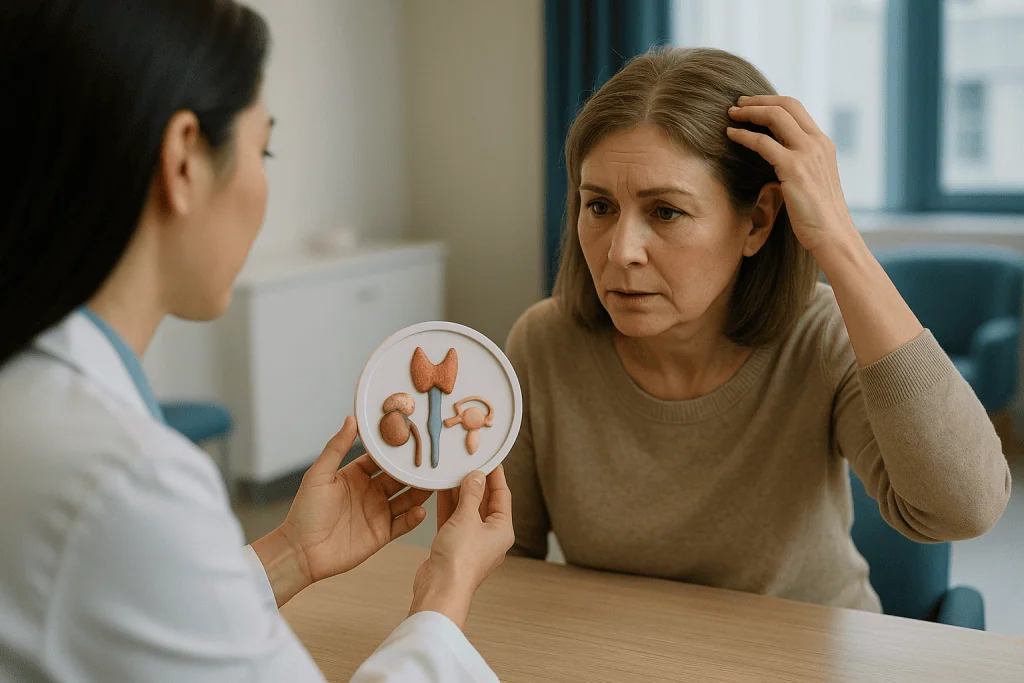
Androgens come first. These are the so-called male hormones, chiefly testosterone, that women also produce in smaller amounts. An enzyme in the follicle converts testosterone into a more potent form, dihydrotestosterone, which shortens the growth phase in genetically susceptible follicles. Polycystic ovary syndrome, a common condition in which the ovaries produce excess androgens, is the clearest example: women with it often see scalp thinning alongside acne, irregular periods and excess hair on the face or body. The combination is the clue. Scalp thinning on its own rarely signals an androgen problem.
Thyroid hormone is the second lever. Both an underactive and an overactive thyroid cause diffuse shedding, because thyroid hormone sets the pace of the hair cycle along with everything else. Cleveland Clinic and the NHS both list thyroid disease among the standard causes to exclude, and a thyroid-stimulating hormone (TSH) test is the simplest way to do it. Hair often recovers once the thyroid is controlled, though it lags by months.
Estrogen is the third. It lengthens the growth phase, which is why hair feels fuller in pregnancy. When estrogen falls, around menopause or after childbirth, that protective effect lifts and any underlying androgen sensitivity becomes visible. Harvard Health notes that thinning becomes far more common after menopause for exactly this reason.
The evidence for all of this is a mix of observational data and mechanistic studies rather than large randomized trials, and one sign demands urgency: rapid hair loss arriving with a deepening voice, new facial hair or an enlarging clitoris. That pattern points to a potential androgen-secreting tumor and needs prompt medical assessment.
Postpartum shedding, contraception changes and other hormone shifts
The most predictable hormonal hair loss in women arrives about three months after a baby does. During pregnancy, high estrogen keeps follicles in growth longer than usual, so hair thickens. After delivery, estrogen drops sharply, the held-over hairs enter rest together, and roughly two to four months later they fall. New mothers describe clumps in the shower and hair wrapped around the baby’s fingers.
This is textbook telogen effluvium, and it is temporary. The NHS and Cleveland Clinic both describe recovery within six to twelve months without treatment. Fine regrowth along the hairline, sometimes called baby hairs, usually appears by the time the baby is sitting up. Breastfeeding does not meaningfully worsen or prolong it; the timing is set by the estrogen fall, not by feeding.
Hormonal contraception is a subtler story. Starting, stopping or switching a combined pill, an implant or a hormonal coil can trigger a shedding episode a few months later, again through a shift in the hormonal baseline. Some progestins, the synthetic progesterone-like component, have mild androgenic activity and may nudge pattern loss along in a woman who is already predisposed, while others have the opposite effect. That does not mean a woman should stop her contraception because her hair is thinning. The choice of method involves far more than hair, and it belongs in a conversation with the prescriber.
Perimenopause, the several years of fluctuating hormones before periods stop, can produce both shedding episodes and the first signs of pattern loss at the same time, which is confusing for patients and clinicians alike. A careful history, with attention to cycle changes, night sweats and the timeline of thinning, usually untangles it.
Sudden hair loss in women after rapid weight loss or crash diets
Hair is a luxury the body cuts first. When calories or protein fall short, the body redirects resources toward organs that keep you alive and lets follicles idle. Shedding follows three to four months later, by which point the diet may already be over and the scale may be showing a result the hair does not reflect.
Bariatric surgery offers the clearest data. Shedding after surgery is so common that many programs warn patients to expect it between the third and sixth month, and it tends to coincide with the period of fastest weight loss. Iron, zinc and protein deficiencies, all common after surgery, can prolong it, which is why post-surgical nutrition monitoring is routine.
Injectable weight-loss medicines have brought the same phenomenon to a much wider group. In clinical trials, hair loss was reported more often among people taking the medicine than among those taking placebo, though it remained an uncommon side effect overall and was generally temporary. The best current explanation is speed: losing a large amount of weight within months is itself the trigger, regardless of how it is achieved. Mayo Clinic lists both significant weight loss and inadequate protein intake among causes of hair loss.
Two practical points follow. Protein intake deserves attention during any rapid weight loss, since hair is made almost entirely of a protein called keratin and falls behind quickly when intake drops. And shedding is not a reason to stop a prescribed medicine abruptly. Regaining weight brings its own health costs, and the shedding usually settles as weight stabilizes. Raising it with the prescriber allows a check for iron and thyroid problems that can masquerade as diet-related loss.
Which vitamin deficiency causes hair loss?
Supplement aisles would have you believe the answer is “all of them”. The honest answer is shorter, and iron sits at the top.
Iron deficiency is the most common nutritional contributor to hair loss in women, largely because menstruation drains iron every month and heavy periods drain it faster. Ferritin, a protein that stores iron, is measured in blood as a proxy for the body’s iron reserves, and it falls before anemia appears. The NIH Office of Dietary Supplements notes that iron deficiency is especially common in women of reproductive age. The link between low ferritin and shedding is supported mainly by observational studies, and the results are inconsistent; some clinicians aim for ferritin levels above the standard laboratory cut-off in women with hair loss, but that higher target has not been proven in randomized trials.
Vitamin D comes next. Low levels show up more often in women with pattern hair loss and alopecia areata than in comparison groups, again in observational data. Whether correcting the deficiency improves hair is unproven, though correcting it has other benefits.
Zinc deficiency causes hair loss but is rare in people eating a varied diet. Biotin deficiency is rarer still, and the NIH fact sheet is explicit that supplements have not been shown to help people with normal levels. Excess can harm as well: too much vitamin A or selenium, usually from supplements, is a recognized cause of shedding.
The practical rule is to test rather than guess. A supplement taken without a deficiency adds nothing to hair and, in biotin’s case, can distort blood tests a doctor relies on.
Alopecia areata and scarring hair loss: the patterns that should not wait
Most hair loss in women is slow or self-limiting. A smaller group of conditions is neither, and recognizing them early is the single most useful thing this article can do.
Alopecia areata is an autoimmune condition in which the immune system attacks hair follicles, producing smooth, round, coin-sized patches of complete loss, sometimes with short broken hairs at the edge that taper toward the root. Nails may show fine pitting. It affects roughly 2 percent of people over a lifetime, often starts young, and frequently regrows within a year on its own, though it can recur or, less commonly, progress to the whole scalp. Since 2022, immune-targeting tablets have been approved for severe cases; they are specialist-prescribed, and candidacy is a dermatologist’s decision.
Scarring alopecias are the group that permanently destroys follicles, replacing them with scar tissue. Frontal fibrosing alopecia, increasingly diagnosed in women after menopause, pushes the hairline back in a band and often thins or removes the eyebrows first. Lichen planopilaris causes itching, burning and redness around follicles. Central centrifugal cicatricial alopecia begins at the crown and spreads outward, and is the most common scarring type in Black women. Once a follicle has scarred, no treatment regrows it; the aim is to halt progression, which makes months of delay costly.
Clues that separate these from ordinary shedding include a scalp that hurts, itches or burns, visible redness or scaling, loss of the follicle openings so the skin looks shiny and smooth, patches with sharp borders, and eyebrow or hairline involvement. Any of these warrants a dermatology referral and, often, a small scalp biopsy to confirm the diagnosis.
Traction, heat and styling: what your shampoo can and cannot do
Here is a quick experiment. Pick up a fallen hair and look at the end that was in the scalp. A tiny white bulb means it shed from the root, which is a hair-cycle event. No bulb, and a frayed or blunt end, means it broke along the shaft, which is a styling event. The two look identical in the brush and have completely different causes.
Breakage comes from chemical relaxers, bleach, high-heat tools and rough handling. It leaves hair short and uneven, especially at the crown and around the face, but the follicle is fine and the hair returns to full length once the damage stops. Shampoo is almost never the cause of true hair loss, and no shampoo has been shown in trials to regrow it, whatever the label promises. Washing frequency does not matter either; hairs that are ready to shed will fall whether you wash daily or weekly, and washing less just means they accumulate and come out in alarming clumps on wash day.
Traction alopecia is the exception where styling causes real root loss. Years of tight braids, ponytails, buns, extensions or weaves pull follicles constantly, and the loss shows up along the hairline and temples, sometimes with small bumps or broken hairs at the edges. Caught early, loosening the style allows regrowth. Left for years, the pulling can scar follicles, and the loss becomes permanent. Dermatologists treat persistent tenderness or a receding edge in someone who wears tight styles as a reason to change habits now rather than later.
A gentle routine, a wide-tooth comb on wet hair and low-heat drying are sensible for everyone, but they protect the shaft, not the follicle.
Hair loss in women: the tests worth asking for
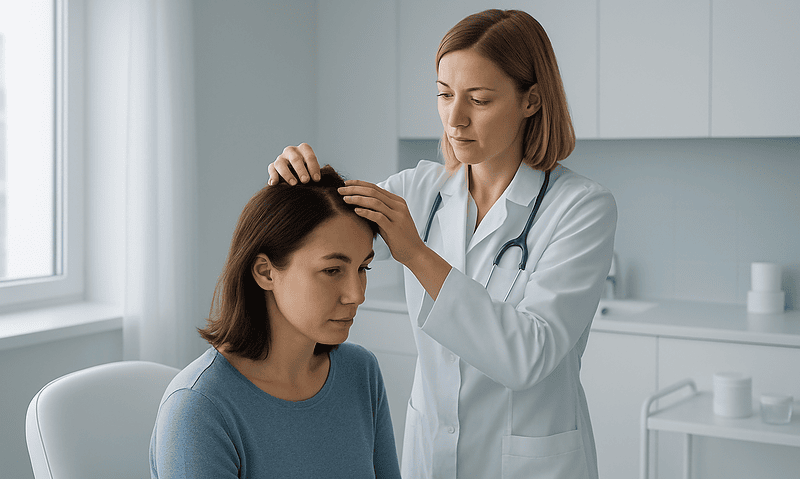
A good consultation begins with a history and a scalp examination, not a blood draw. Clinicians look at the distribution, check for scaling or scarring, and often perform a gentle pull test, in which a small bundle of hairs is tugged to see how many release. Many dermatologists now use a handheld magnifier called a dermatoscope to examine follicles and hair-shaft diameter, a technique known as trichoscopy. Blood tests then confirm or exclude the treatable contributors.
| Test | What it checks | When it earns its place |
|---|---|---|
| Full blood count | Anemia and general health | Almost everyone with new or persistent shedding |
| Ferritin | Iron stores before anemia develops | Any woman who menstruates, especially with heavy periods or a restricted diet |
| Thyroid-stimulating hormone (TSH) | Underactive or overactive thyroid | Diffuse shedding, fatigue, weight or temperature changes |
| Vitamin D | Deficiency linked to several hair conditions in observational data | Limited sun exposure, darker skin, or alopecia areata |
| Total testosterone and DHEA-S | Androgen excess, as in polycystic ovary syndrome | Irregular periods, acne or excess facial or body hair alongside thinning |
| Zinc | Deficiency | Restrictive or very low-calorie diets, bariatric surgery |
| Scalp biopsy | Scarring versus non-scarring loss under the microscope | Patches, scalp symptoms, or diagnosis in doubt |
Two caveats keep this list honest. Hormone tests are not useful without hormonal symptoms; a woman with regular periods and a widening part will almost always have normal androgen levels, and testing them adds anxiety, not information. And high-dose biotin supplements should be stopped, with the clinician’s knowledge, for several days before blood tests, because they can produce falsely high or low results on several assays. Which tests are ordered, and how the results are interpreted, is a decision for the clinician who has examined your scalp.
Can thinning hair grow back?
Yes, often, and the deciding factor is whether the follicle is still alive.
After telogen effluvium, follicles are intact and merely resting. Regrowth is the rule, not the exception. Because scalp hair grows about one centimeter a month, a woman who sheds heavily in March will notice short new hairs by summer and feel her ponytail recover by the following spring. The hair that fell was always going to be replaced; the shock only synchronized the timing.
In female pattern hair loss, follicles are shrunken rather than dead. Treatment can coax miniaturized follicles to produce thicker, longer hairs and slow further shrinking, and randomized trials of topical minoxidil show measurable increases in hair density over six to twelve months. The improvement is partial, it is slow, and it depends on continuing treatment; stop, and the follicles drift back toward their genetic program within months. Nobody should expect the hair of a decade ago. A part that stops widening and a ponytail that stops shrinking is a realistic win.
Alopecia areata frequently regrows on its own, sometimes white at first before pigment returns. Traction alopecia regrows if the pulling stops before scarring sets in. Scarring alopecias do not regrow in scarred areas, which is why early diagnosis is everything.
Measuring progress needs discipline, because the eye adapts to gradual change. A photograph of the part and the crown in the same light, from the same angle, once a month, tells the truth better than a mirror. Many dermatologists ask for exactly this. And a burst of shedding in the first weeks of a new treatment is common and expected; it reflects resting hairs being pushed out by new growth, not failure.
What the evidence actually says about treatments for hair loss in women
Evidence comes in grades, and hair loss treatments span all of them. Here is where each sits, in plain terms.
Strong evidence (multiple randomized trials): topical minoxidil for female pattern hair loss. It is the only medicine approved by regulators in the US and UK for this condition in women, and Mayo Clinic and the NHS describe it as the standard first-line option. Trials show increased hair counts compared with placebo in the majority of users over six to twelve months. It does not work for everyone, requires indefinite use, and can cause scalp irritation or unwanted facial hair if it migrates.
Moderate to low evidence (small trials and observational studies): low-dose oral minoxidil, which is off-label and supported mostly by case series with few randomized comparisons; anti-androgen tablets such as spironolactone, also off-label in this setting, with small trials suggesting benefit in some women; low-level laser devices, which have small randomized trials showing modest gains; and platelet-rich plasma injections, where trials are small, methods vary widely and results are inconsistent. For every off-label option, the decision rests with the treating clinician, who weighs individual risks, including the fact that anti-androgens must not be used in pregnancy.
Weak evidence or none: supplements in women without a measured deficiency, specialist shampoos, and most topical botanicals. Correcting a proven deficiency is sensible; supplementing on speculation is not.
Surgical: hair transplantation works for stable pattern loss with a dense donor area, but many women thin diffusely across the whole scalp, which limits candidacy. Assessment by a dermatologist comes before any surgical conversation.
What matters most, in this writer’s view, is sequence: find and treat the reversible contributors first, then discuss the approved option, and only then consider the lower-evidence add-ons with a clinician who can monitor them.
What is the best natural remedy for hair loss?
The most effective natural remedy is boring: eat enough protein and iron, correct any deficiency a blood test reveals, and handle hair gently. Everything else sold under the “natural” banner rests on far thinner ground.
Rosemary oil is the current favorite online, and it has one frequently cited study behind it: a small trial in which rosemary oil performed comparably to a topical minoxidil solution over six months. One study, modest in size, with limitations in design, is a reason for curiosity rather than confidence, and it has not been replicated at scale. Essential oils can also cause contact dermatitis, which inflames the scalp and worsens shedding.
Pumpkin seed oil, saw palmetto and caffeine shampoos each have one or two small studies, mostly in men, with inconsistent results. Scalp massage has a tiny study suggesting slightly thicker hair after months of daily practice; it is pleasant and harmless, which is more than can be said for some supplements. Onion juice, castor oil and apple cider vinegar have no meaningful trial evidence at all.
Diet deserves a more serious word. Hair is almost entirely keratin, a protein, and women on very low-protein or very low-calorie diets reliably shed. Vegetarian and vegan diets can be perfectly adequate but need attention to iron and zinc, which are less easily absorbed from plant sources. The NIH iron fact sheet is a useful reference for food sources.
If a natural approach appeals, the evidence-respecting path is to use it alongside, not instead of, a proper diagnosis. Six months spent on rosemary oil while a thyroid problem or scarring alopecia goes unrecognized is six months lost.
Common myths about hair loss in women, corrected
Viral claims about hair loss in women tend to be half-right, which makes them durable. A few corrections.
“It’s your shampoo.” Shampoo sits on the scalp for a minute and rinses away. It can irritate or dry the shaft, but it does not reach the follicle in a way that stops growth. Blame falls on shampoo mostly because of the three-month lag between a real trigger and the shedding it causes.
“Hair loss comes from your mother’s side.” Pattern hair loss is influenced by many genes inherited from both parents. A father who went bald young is just as relevant as a mother who did not.
“Cutting hair makes it grow back thicker.” A haircut removes dead protein above the skin. It cannot signal the follicle to change anything. Short hair looks fuller because the ends are blunt and the weight is less, which is a styling effect worth using but not a biological one.
“Hats and daily washing cause hair loss.” Neither does. Hats would need to be tight enough to cause traction for years. Washing simply dislodges hairs that were already detached.
“Everyone with thinning hair should take biotin.” Biotin deficiency is rare, supplements have not been shown to help people with normal levels, and high doses can distort laboratory tests, including those used in emergency cardiac care.
“Shedding when you start treatment means it’s failing.” A temporary increase in shedding in the first weeks of topical treatment is expected and usually signals that resting hairs are being replaced by new growth.
“Stress alone can’t make hair fall out.” Severe or prolonged stress is a well-documented trigger of telogen effluvium. Everyday stress is not; a major life event can be.
When to see a doctor about hair loss in women
Most shedding settles on its own, but some patterns deserve an appointment promptly, and a few deserve one urgently.
Book a routine appointment if shedding has lasted more than six months, if your part has visibly widened or your ponytail has thinned, if hair loss arrived alongside fatigue, weight change, feeling cold or heavy periods, or if you want a clear diagnosis before trying any treatment. A primary care clinician can take the history, examine the scalp and arrange the blood tests described above.
Ask for a dermatology referral, sooner rather than later, if you notice any of these red flags:
- Smooth, round, completely bald patches, or patches with sharp borders
- A scalp that itches, burns, hurts or shows redness, scaling or pustules
- A receding hairline, especially with thinning or missing eyebrows
- Skin in the thinned area that looks shiny and smooth, without visible follicle openings
- Hair loss in a child
- Tenderness or recession at the hairline in someone who wears tight styles
Seek prompt medical assessment, within days, if rapid hair loss comes with a deepening voice, new coarse facial or body hair, severe acne or a sudden change in periods, because that combination can signal a hormone-producing tumor that needs investigation.
Two more rules protect you. Never stop or change a prescribed medicine because you suspect it is causing shedding; raise it with the prescriber, who can weigh alternatives and timing. And treat every treatment decision, including off-label tablets, supplements and procedures, as one to make with the clinician who has examined your scalp and seen your results, not with a video. Bring your photographs, a list of medicines and supplements, and the dates of any illness, surgery, birth or weight change in the past year. That timeline is often the diagnosis.
Frequently asked questions
Why am I suddenly losing so much hair as a female?
Sudden heavy shedding in women is most often telogen effluvium, a temporary phase in which a shock such as illness, surgery, childbirth, rapid weight loss or severe stress pushes many follicles into rest at once. The hairs fall about three months later. It usually settles within six months, but a check of thyroid function and iron stores is worthwhile if it continues.
What is the difference between female pattern hair loss and shedding?
Shedding (telogen effluvium) is diffuse, comes on over weeks, and resolves once the trigger passes. Female pattern hair loss is gradual, concentrates along the central part, and is driven by follicle sensitivity to androgens plus genetics. Shedding produces hair in the drain; pattern loss produces a widening part and a thinner ponytail with relatively little visible fallout.
Which vitamin deficiency causes hair loss?
Iron deficiency is the most common nutritional contributor in women, measured by a ferritin blood test, though the evidence linking it to hair loss is observational. Low vitamin D is associated with several hair conditions, and zinc deficiency causes shedding but is rare on a varied diet. Biotin deficiency is very rare, and supplements do not help people with normal levels.
Can hair grow back after thinning?
Often, yes. After telogen effluvium, follicles are intact and regrowth is expected within six to twelve months. In female pattern hair loss, follicles are shrunken rather than dead, and treatment can thicken hairs and slow further loss, though gains are partial and depend on continued use. Scarred follicles do not regrow, which is why early diagnosis matters.
Is hormonal hair loss in women reversible?
It depends on the hormone. Shedding from thyroid disease or the estrogen drop after childbirth generally recovers once the hormone shift settles or is treated. Pattern loss linked to androgen sensitivity is a long-term condition that can be managed and slowed but tends to progress without ongoing treatment. A clinician can tell which is which from the history and a scalp examination.
What is the best natural remedy for hair loss?
The best-supported natural approach is adequate protein and iron intake and correcting any measured deficiency. Rosemary oil has one small trial suggesting benefit comparable to topical minoxidil, but it has not been replicated at scale, and essential oils can irritate the scalp. Other popular remedies, including onion juice and castor oil, have no meaningful trial evidence.
Does menopause cause hair loss in women?
Menopause does not cause hair loss directly, but the fall in estrogen removes a hormone that lengthens the hair growth phase, so underlying pattern hair loss often becomes visible or accelerates after midlife. Thinning becomes markedly more common after menopause. Frontal fibrosing alopecia, a scarring condition affecting the hairline and eyebrows, is also more frequent in postmenopausal women.
What blood tests should I ask for with hair loss?
A full blood count, ferritin for iron stores and thyroid-stimulating hormone cover the most common treatable contributors. Vitamin D is reasonable, especially with limited sun exposure. Androgen tests such as total testosterone and DHEA-S are useful only when thinning comes with irregular periods, acne or excess facial hair. The clinician who examines your scalp decides the final list.
Can weight-loss injections cause hair loss?
Hair shedding has been reported more often among people using injectable weight-loss medicines than among those on placebo, though it remains uncommon. The likely mechanism is rapid weight loss itself, a long-recognized trigger of temporary shedding, rather than a direct effect on follicles. It is not a reason to stop a prescribed medicine on your own; discuss it with the prescriber.
When should I see a dermatologist about hair loss?
See a dermatologist if you have smooth bald patches, a scalp that itches, burns or looks red or scaly, a receding hairline with eyebrow thinning, or thinned skin that looks shiny without visible follicle openings. These can indicate alopecia areata or scarring conditions where early treatment preserves hair. Seek prompt assessment if rapid loss comes with a deepening voice or new facial hair.
References
This article is for general information only and is not a substitute for professional medical advice. Please consult a qualified doctor about your individual situation.

More from the Blog
Hair Breakage vs Hair Loss: How to Tell Which One You Have
Hair breakage and hair loss differ at the root. Broken hairs are short fragments with no bulb at the end, snapped along the shaft…

Minoxidil for Women: What to Expect, the Shedding Phase and Realistic Results
Minoxidil is the only topical medicine with regulatory approval for female pattern hair loss, and it works by prolonging the growth phase of thinning…
Thinning Hair: The Early Signs and the Options Before It Becomes Obvious
Thinning hair usually begins quietly: a wider part, a thinner ponytail, more scalp showing under bright light, or shedding that lasts longer than three…
Grey Hair: Why It Happens, Whether Stress Causes It and What the Reversal Studies Found
Grey hair appears when pigment-making cells in the hair follicle, called melanocytes, run down and their stem cell reserve is depleted, mostly because of…
Rice Water, Hair Oiling and Castor Oil: The Viral Hair Growth Rituals, Fact-Checked
Rice water for hair has no randomized trial evidence that it makes hair grow faster or thicker. Small laboratory work suggests its starch and…

Ketoconazole Shampoo: Dandruff, Fungus and the Hair-Loss Claim Examined
Ketoconazole shampoo is an antifungal medicated shampoo used to treat dandruff, seborrheic dermatitis of the scalp and some fungal skin infections, where randomized trials…