

How a Labiaplasty Is Performed: Marking, Tissue Removal and Dissolvable Stitches Explained

Key Takeaways
- The NHS describes labiaplasty as an operation of about one to two hours, usually done as a day case with the person going home the same day.
- Surgeons mark the planned new edge before injecting local anesthetic, because the fluid distorts the tissue and would make the lines unreliable.
- Trim technique removes the natural free edge of the labia minora; wedge technique removes a V-shaped section from the middle and preserves the edge, and neither is proven superior in high-quality trials.
- The NHS states most dissolvable stitches disappear within one to two weeks, though some types take several months, so stray threads at the edge are common and should not be pulled.
- CDC infection-prevention guidance advises against shaving the surgical site with a razor at home; any hair removal should be done with clippers by the team immediately before surgery.
- The NHS advises avoiding sex and tampons for about six weeks after labiaplasty and states the procedure is not usually performed on anyone under 18 because the labia are still developing.
Labiaplasty is usually performed as a day-case operation under local anesthesia, sometimes with sedation or a general anesthetic. The surgeon marks the planned new edge on the labia minora, removes excess tissue using either a trim (edge) or wedge technique, controls bleeding, and closes the wound in layers with fine dissolvable stitches that fall away over weeks. The operation typically takes one to two hours, and healing continues for about six weeks.
She has rehearsed the question in the car park. Not the big one about whether to go ahead, but the small, practical one she cannot find a straight answer to online: what does the surgeon actually do? The search results are full of glossy before-and-after galleries and very little about scalpels, markers and thread. She wants to know how is labiaplasty performed before she decides whether it is right for her, and she wants it explained the way a friend who happened to be a nurse might explain it.
That is a fair thing to want. Labiaplasty is a short operation, but it is a real one, with anesthesia, a wound, stitches and a recovery period that reaches into daily life for weeks. The details matter, because they shape everything from how you plan time off to what you should expect to see when you first look in a mirror.
This guide walks through the procedure step by step, in the order it happens: consultation, marking, tissue removal, closure and the weeks after. It sticks to what mainstream medical sources describe, and it leaves the decision where it belongs, with you and your care team.
How is labiaplasty performed? What actually happens in the room
Strip away the marketing and labiaplasty is a sequence of five ordinary surgical steps, each with a clear purpose.
First comes positioning and numbing. You lie on your back with your legs supported, much like a gynecological exam, and the surgical area is cleaned with antiseptic. Depending on what you and the anesthesia team have agreed, you are either awake with the area numbed by local anesthetic, lightly sedated, or fully asleep under a general anesthetic.
Second, the surgeon marks. Using a skin marker, they draw the planned line where the new edge of the labia minora will sit, checking both sides for symmetry and confirming that enough tissue will be left behind. The NHS describes the operation as taking about one to two hours, and a surprising share of that time is spent here, before anything is cut, because the marking is the plan for everything that follows.
Third, tissue is removed along those marks. Most surgeons use one of two approaches: trimming the free edge, or removing a wedge from the middle so the natural edge is preserved. Small blood vessels are sealed as the surgeon goes.
Fourth, the wound is closed. Fine dissolvable sutures bring the tissue layers together, usually in a deep layer and a surface layer, so the edge heals thin and smooth rather than bunched.
Fifth, you recover. A light dressing or a pad is placed, you spend a short time in a recovery area, and most people go home the same day, according to both NHS and Cleveland Clinic guidance.
Each of those steps deserves a closer look, because the choices made within them are what separate one operation from another.
Labia minora, labia majora and clitoral hood: what the surgeon is working with
A little anatomy makes the rest of this article far easier to follow.
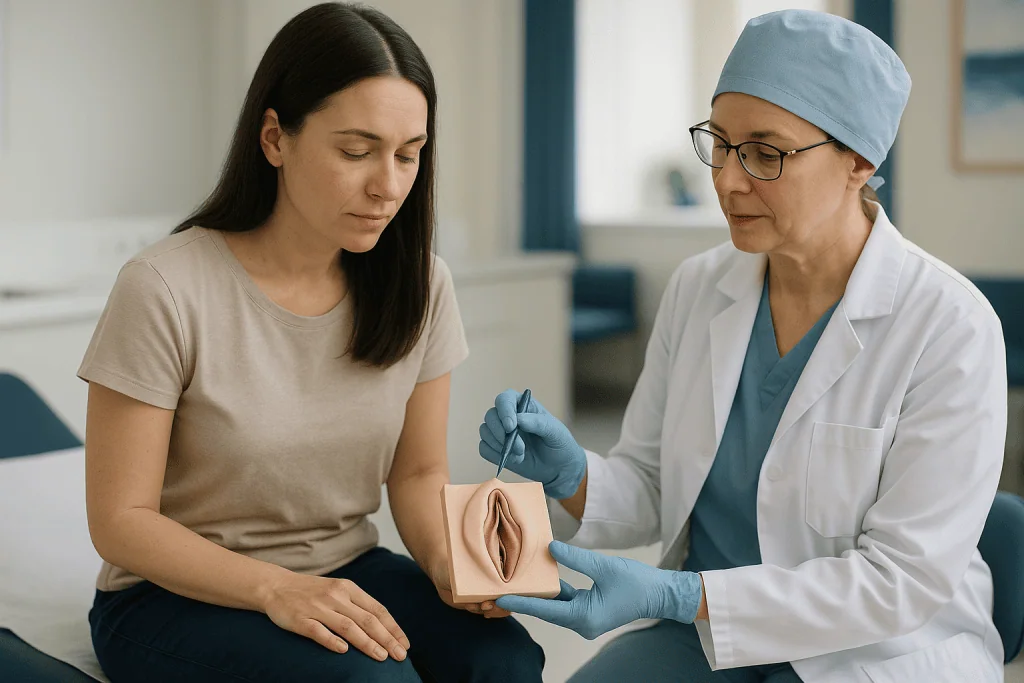
The vulva is the external genital area. The labia majora are the outer folds, covered with skin and hair, which contain fatty tissue. The labia minora are the inner folds, hairless and made of thin, elastic, richly supplied tissue that stretches from the clitoris at the top to below the vaginal opening. The clitoral hood is the fold of skin that covers the clitoris, and it is continuous with the upper part of the labia minora.
When people say labiaplasty without qualification, they almost always mean reduction of the labia minora. That is the operation this article describes. Procedures on the labia majora exist, and so does clitoral hood reduction, which some surgeons perform in the same sitting when redundant hood skin would otherwise look out of proportion after the inner labia are reduced. Those are separate decisions and should be discussed as such.
Two facts about the labia minora shape how the surgery is done. They are asymmetric in most people, with one side commonly longer or thicker than the other, so a surgeon rarely removes the same amount from both sides. And they are extremely variable in size and shape across healthy adults; the NHS is explicit that labia come in a wide range of normal shapes and sizes, and that variation on its own is not a medical problem.
The tissue also matters for healing. Because it is thin and well supplied with blood, it swells quickly after surgery, bruises easily, and can bleed more than its size suggests. That is why hemostasis, the medical word for stopping bleeding, is a deliberate part of the operation and not an afterthought.
Who usually considers labiaplasty, and who is usually asked to wait
Two broad groups sit in the consultation chair. The first describes physical symptoms: chafing when cycling or running, discomfort in fitted clothing, tugging or pinching during sex, or difficulty keeping the area clean and dry. The second describes appearance and how it affects confidence. Many people describe both, and neither is treated as more legitimate than the other by a good surgical team, though the discussion about likely benefit differs.
Who is usually asked to wait, or to reconsider, is just as important.
Age is the clearest example. The NHS states that labiaplasty is not usually performed on anyone under 18, because the labia continue to develop into adulthood and what looks prominent at 15 may look entirely different at 20. Some surgeons prefer to see stable development for a period beyond that.
Pregnancy and childbirth are a common reason for pause. Tissue changes during pregnancy and vaginal delivery can alter the result, so a surgeon may suggest waiting if a pregnancy is planned in the near future. This is a judgement call, not a rule, and worth raising honestly.
Active infection or skin disease in the area, such as a current yeast infection, herpes flare or an inflammatory condition like lichen sclerosus, needs treatment or assessment first.
Expectations matter too. If someone is seeking a specific look copied from an image, or hopes surgery will repair a relationship or resolve broader distress about their body, responsible teams slow down. The NHS advises that people considering cosmetic genital surgery should be offered the chance to talk through their reasons, and sometimes to speak with a counsellor or psychologist, before any date is set. That is not a hurdle; it is part of the care.
Do I shave before labiaplasty, and what else happens before surgery?
Do not shave the surgical area with a razor at home. It is one of the most common questions and the answer is refreshingly clear. Razors leave micro-cuts in the skin that bacteria can colonize, and CDC guidance on preventing surgical site infection advises against hair removal at the operative site unless it will interfere with the surgery, in which case it should be done with clippers immediately before the operation, not with a razor the night before. If your team wants hair removed, they will do it themselves or tell you exactly how. For labia minora surgery, hair is usually not in the way at all.
The consultation before the day covers more ground than most people expect. The surgeon examines you, often with a mirror so you can point to what bothers you, and asks about symptoms, sexual health, past pregnancies, medications and bleeding history. Medical photographs are usually taken with consent for planning and records.
You will be asked about anything that affects bleeding or healing. Smoking impairs wound healing and most teams ask you to stop for a period before and after surgery. Certain supplements and medicines, including some blood-thinning classes, may need adjusting, but only on the instruction of the prescribing clinician; never stop or change a medicine on your own.
Consent should feel like a conversation, not a signature. You should hear the technique the surgeon plans, why they prefer it for your anatomy, the realistic amount of reduction, the scar position, the risks, and what happens if healing does not go to plan.
Practical preparation is simple: arrange someone to take you home, buy loose cotton underwear and a supply of sanitary pads, and plan time off. The NHS suggests most people need a few days away from work.
Anesthesia for labiaplasty: local, sedation or general
Labiaplasty can be done fully awake, and many are. Understanding why some people choose otherwise helps you have a useful conversation with the anesthesia team.
Local anesthesia means numbing medicine is injected into the tissue of the labia. You feel the initial sting of the injections, then pressure and movement but no sharp pain. Johns Hopkins describes local anesthesia as suitable for minor procedures on a small area, which describes labiaplasty well. The advantages are quick recovery, no grogginess, and the ability to sit up and give feedback on symmetry if the surgeon asks. The disadvantage is that lying still and aware during intimate surgery is not for everyone.
Sedation, sometimes called twilight anesthesia, adds a medicine through a vein that makes you drowsy and relaxed while the local anesthetic does the work of blocking pain. You may remember very little.
General anesthesia means you are fully unconscious with your breathing monitored and supported by an anesthesiologist. It is the option most people picture when they hear the word surgery, and it is routinely used for labiaplasty when a clitoral hood reduction or other procedure is combined, when the person strongly prefers to be asleep, or when the surgeon judges it safer for the individual.
None of these is inherently better. Each carries its own small risks, which the anesthesia team will explain: local anesthetic can rarely cause a reaction, sedation and general anesthesia carry risks related to breathing, nausea and, uncommonly, more serious events. Your general health, other medical conditions and preferences all feed into the recommendation. Local anesthetic is usually injected even when you are asleep, because it reduces pain in the first hours after waking.
Marking: why the surgeon draws before cutting
If one step in this operation deserves more respect than it gets, it is the marking. Tissue that is removed cannot be put back. Tissue that is left can, in principle, be revised later. That asymmetry of risk is why experienced surgeons spend real time with a marker before touching a blade.
Marking is done after you are positioned and the area is cleaned, but usually before local anesthetic is injected, because the fluid distorts the tissue and would make the lines unreliable. Some surgeons mark with you standing or sitting first, then confirm lying down, since the labia hang differently in each position.
The surgeon gently stretches each labium and draws the line where the new free edge will sit. Several things guide that line. The first is symmetry: the two sides are compared repeatedly, and because they usually start out unequal, the marks will not be mirror images of each other. The second is proportion: how the reduced inner labia will sit relative to the outer labia and the clitoral hood. The third is preservation. The labia minora contain sensory nerve endings and contribute to lubrication and protection of the vaginal opening, so the aim is a reduction, not a removal, and the marks deliberately leave a margin of healthy tissue.
You may be asked to look with a mirror and confirm before anesthesia, particularly if you are having the procedure awake. Speak up if something looks different from what you discussed.
Marks for a trim technique run along the edge. Marks for a wedge technique form a V or diamond shape on the front and back surfaces of the labium, meeting at the edge, outlining the piece to be removed from the middle. Which of those you see drawn depends on the technique, which is the next question.
Trim vs wedge labiaplasty: how do the two techniques differ?
Most labiaplasties fall into one of two families, and the difference is easier to picture than to describe.
The trim technique, also called edge resection or linear technique, removes the outer margin of the labium along its length, rather like trimming a hem. The darker, often more textured natural edge is removed and a new edge is created along the suture line.
The wedge technique removes a V-shaped section from the thickest part of the labium and then brings the upper and lower edges together. The natural free edge, with its own color and texture, is preserved; the labium is simply shorter because a piece has been taken from its middle. Variations exist, including extended wedges that also address the clitoral hood.
| Feature | Trim (edge) technique | Wedge technique |
|---|---|---|
| What is removed | The free edge along the length of the labium | A V-shaped section from the central portion |
| Natural edge | Replaced by a new suture-line edge | Preserved |
| Scar position | Along the new edge | A line running from edge inward, across the labium |
| Common reasons a surgeon may choose it | Person wishes to remove a darker or irregular edge; very long labia | Person wishes to keep natural edge; thicker central redundancy |
| Points discussed at consent | Risk of a scalloped or stiff edge if closure is uneven | Risk the wedge closure separates during healing; need for good blood supply to the flaps |
Neither technique is proven superior in high-quality trials; the evidence base consists largely of surgeon case series, which is why this article makes no claim about which gives better results. What the evidence does support is matching technique to anatomy and to what bothers you. If the edge itself is the concern, a wedge will not address it. If you value keeping your natural edge, a trim will remove it. That single conversation is worth more than any gallery.
Tissue removal step by step, and how bleeding is controlled
With the marks confirmed and the area numb, the removal itself is measured rather than dramatic.
The surgeon steadies the labium, often with a fine forceps or a temporary holding stitch, and cuts along the marked line. The cutting instrument varies. A scalpel or fine scissors is traditional. Some surgeons use a radiofrequency device or a surgical laser, which seal small vessels as they cut; these are tools for the same job, and mainstream sources do not show that any one of them produces a better outcome, so treat claims about a particular device with caution.
In a trim procedure the excess edge comes away as a strip. In a wedge procedure the V-shaped piece is lifted out, and the surgeon takes care to keep the remaining flaps of tissue thick enough to retain their blood supply, since a flap that is starved of blood will not heal.
Bleeding is dealt with as it appears. The labia minora are vascular, and the surgeon pauses to seal vessels with brief touches of electrocautery, a device that uses heat to close a bleeding point, or by tying them. Local anesthetic often contains a medicine that constricts vessels, which also reduces bleeding, and a well-performed labiaplasty loses very little blood overall.
The surgeon then compares the two sides, typically by gently laying them alongside each other, and makes small adjustments. Perfect symmetry is not the goal, because it is not natural and was not present to begin with, but the two sides should be in reasonable balance.
If a clitoral hood reduction has been agreed, redundant folds of hood skin are removed at this stage, usually as narrow strips along the sides, keeping well clear of the clitoris itself. Only after the surgeon is satisfied with shape, balance and a dry field does closure begin.
Labiaplasty dissolvable stitches: what they are and when they go
Dissolvable stitches, also called absorbable sutures, are threads made from materials your body breaks down over time, so they never need to be removed. That single fact removes one of the more dreaded parts of recovery, because taking stitches out of this area would be uncomfortable and impractical.
Closure after labiaplasty usually happens in layers. A deeper layer of fine absorbable stitches brings the internal tissue together and takes the tension off the surface. A superficial layer then closes the skin edge. Surgeons place these as interrupted (individual) stitches, as a continuous running stitch, or as a combination, and the thread is very fine, often finer than a hair.
The NHS explains that most dissolvable stitches disappear within one to two weeks, although some types take several months to be fully absorbed. Your surgeon will tell you which they used. What that means in practice is that you may see small knots or threads at the edge for a while, some of which loosen and fall away, and some of which are absorbed unseen. A stray thread poking out is common and not an emergency, though you should not pull it.
Because the surface stitches are so fine and the tissue swells, the suture line can look bumpy, dark or irregular in the first two weeks. The Cleveland Clinic notes that swelling and bruising are expected in the early phase and settle over the following weeks. Judge the edge in months, not days.
A few surgeons use surgical glue in addition to stitches, or rarely a small number of non-absorbable stitches that require removal. Ask, so that you know what you are looking at.
Once closure is complete, the area is cleaned, a soft pad is placed, and you are taken to recovery. The operation itself, marking to final stitch, sits comfortably within the one to two hours the NHS describes.
Labiaplasty recovery time: what the first days and weeks usually look like
The honest word for the first few days is uncomfortable rather than agonizing, though everyone is different.
The first 24 to 72 hours are dominated by swelling and soreness. The labia can look alarmingly puffy and bruised; this is expected in tissue this vascular. Ice packs wrapped in cloth, applied over underwear in short spells, help, as does lying with a pillow under the hips. Most people manage discomfort with over-the-counter pain relievers of the kind the surgical team advises; if a prescription medicine is provided, take it exactly as the prescribing clinician directs and ask them, not the internet, about adjustments. Spotting is normal. Passing urine may sting, and pouring lukewarm water over the area while you go, then patting dry, takes the edge off.
By the end of the first week, swelling usually begins to recede and many people return to desk work; the NHS suggests a few days off is typical. Loose clothing, cotton underwear and a pad rather than a tampon protect the wound. Showering is generally allowed from the day after surgery, with baths avoided until the team says otherwise.
Weeks two to four bring steadier improvement. Stitches are falling away or being absorbed. Gentle walking is encouraged from the start, but running, cycling, swimming and anything that puts pressure or friction on the area waits for the surgeon’s clearance.
The NHS advises avoiding sex and tampons for about six weeks. That figure is a typical range, not a promise, and your team may adjust it based on how your wound looks at follow-up.
The final appearance takes longer. Residual swelling can linger and scars soften and fade over months, so the mirror at week two is not a verdict on the result.
Labiaplasty risks and complications in plain clinical terms
Every operation carries risk, and this one has a specific set worth knowing before consent, not after.
Bleeding is the most common early problem. A small collection of blood under the wound, called a hematoma, can form in the first day or two and may need draining. Spotting is normal; steady bleeding that soaks pads is not.
Infection is uncommon but possible because the area is warm and close to the urethra and anus. The CDC describes surgical site infection as a wound that becomes increasingly red, warm, swollen and painful, sometimes with pus or fever, typically appearing within the first weeks. Good hygiene, pads rather than tampons, and keeping the area dry lower the risk.
Wound breakdown, where the stitched edge separates, is more of a concern with wedge closures because a line of tissue must heal across the labium. Small separations often heal on their own; larger ones may need a revision.
Asymmetry, scarring and over-reduction sit together as the outcome risks. Because tissue cannot be replaced, taking too much can leave the vaginal opening less protected, cause dryness, or produce a tight, pulling sensation. This is precisely why careful marking matters.
Changes in sensation, either reduced or heightened sensitivity, can occur and usually settle, though rarely they persist. Pain with sex, scar tenderness, and dissatisfaction with appearance are all recognized outcomes that the NHS lists.
Anesthesia carries its own small risks, discussed separately by the anesthesia team.
Alternatives deserve equal airtime. For chafing, changes in clothing, cycling shorts with a chamois, and barrier creams help some people. For distress about appearance, psychological support can be more effective than surgery. Doing nothing is a legitimate choice, and a good team will say so.
What people often get wrong about labiaplasty
Myths cluster around intimate surgery, and a few of them lead people to poor decisions.
Myth: there is a normal size, and mine is outside it. The NHS is direct that labia vary widely and that prominent inner labia are a normal variation, not a deformity. Surgery is a choice about preference or symptoms, not a correction of an abnormality.
Myth: labiaplasty tightens the vagina or improves sexual pleasure. It does neither. It reshapes external tissue only. Some people report less discomfort during sex because tugging is reduced, but the operation does not change the vaginal canal or guarantee any change in sensation; sensation can, rarely, be reduced.
Myth: it is a quick fix with almost no recovery. The operation is short, but the NHS describes days off work, weeks of swelling and about six weeks before sex and tampons. Underestimating this is the most common regret in the first fortnight.
Myth: laser or radiofrequency surgery is scarless. Every cutting tool creates a wound, and every wound heals with a scar. Scars in this area tend to soften and hide well, but no device makes them disappear, and mainstream evidence does not show one tool outperforming another.
Myth: what I see at two weeks is the result. Swollen, bruised, uneven tissue with visible knots is the norm early on. The Cleveland Clinic notes that swelling takes weeks to settle and the final appearance emerges over months.
Myth: more removal is a better result. Over-reduction is one of the harder problems to fix. A conservative reduction that keeps you comfortable and protected is the goal most surgical teams work toward.
Myth: it is fine at any age. The NHS states it is not usually performed under 18 because the tissue is still developing.
Questions to ask your care team before labiaplasty
A good consultation should leave you able to describe your own operation in a sentence. If you cannot, ask more. These questions tend to surface the answers that matter.
- Which technique are you recommending for me, trim or wedge, and why does my anatomy suit it?
- Will you remove the natural edge, or preserve it? Can you show me on a diagram where the scar will sit?
- Roughly how much tissue do you plan to remove, and how much will you deliberately leave?
- Do you also recommend addressing the clitoral hood, and what are the added risks if so?
- What type of anesthesia do you suggest, who provides it, and what are its specific risks for me?
- What kind of stitches will you use, how long do they take to dissolve, and what should I do if one sticks out?
- What does your typical recovery timeline look like for work, exercise, bathing and sex, and how will you decide when I am ready?
- How often do you see bleeding, wound separation or infection, and how do you handle them?
- If I am unhappy with symmetry or shape, what is your approach to revision, and when would you consider it?
- How will this affect future pregnancy or childbirth, and should I wait if I plan a pregnancy?
- Is there anything about my medical history, medications or smoking that you want changed before surgery?
- Who do I call out of hours if something worries me in the first week?
Write the answers down. It is entirely reasonable to take them away, sit with them for a few weeks, and come back. A team that welcomes that pause is telling you something reassuring about how they practice. A team that pressures you toward a date is telling you something too.
When to call your doctor after labiaplasty
Most of what you notice in the first two weeks, swelling, bruising, spotting, stinging when you urinate, tenderness and stray threads, is expected. Some signs are not, and they should prompt a phone call to your surgical team the same day, or a visit to urgent care or an emergency department if the team cannot be reached.
Seek care promptly if you have:
- Bleeding that soaks through a pad in an hour or continues steadily rather than spotting
- Rapidly increasing swelling on one side, especially with a firm, tense, very painful lump, which can indicate a hematoma
- Spreading redness, increasing warmth, worsening pain after the first few days, or pus or a foul-smelling discharge from the wound, which the CDC lists as signs of surgical site infection
- Fever, chills, or feeling generally unwell
- Separation of the wound edges, or tissue that looks dark, grey or black
- Inability to pass urine, or severe pain when trying
- Pain that is escalating instead of easing, or pain not controlled by the medicines your team advised
- Signs of a reaction to a medicine such as rash, swelling of the face or lips, or difficulty breathing (call emergency services)
- Calf pain, leg swelling, chest pain or breathlessness, which are rare after this surgery but require emergency assessment
You do not need to be certain something is wrong to call. Surgical teams would far rather hear from you about a change that turns out to be normal than miss an early infection or bleed. Keep the out-of-hours number your team gives you somewhere you can find it, and if you are ever in doubt about whether a symptom is serious, treat it as serious until a clinician tells you otherwise.
Frequently asked questions
Is labiaplasty painful?
Most people describe the first few days as sore and swollen rather than severely painful, with stinging when passing urine and discomfort when sitting. During the operation you feel no sharp pain because the area is numbed, whether you are awake or asleep. Cold packs over underwear, resting with hips raised, loose clothing and the pain relief plan your surgical team provides usually keep it manageable. Pain that worsens after day three should be reported.
What age is best for labiaplasty?
There is no single best age, but the NHS states labiaplasty is not usually performed on anyone under 18 because the labia continue to develop into adulthood. Adults of any age can be assessed. Surgeons weigh general health, plans for pregnancy, skin condition and reasons for surgery more than the number itself. Some teams prefer a period of stable development beyond 18 before operating.
Do I shave before labiaplasty?
No. Do not shave or wax the area yourself before surgery. CDC surgical infection-prevention guidance advises against razor hair removal at the operative site because tiny nicks allow bacteria to colonize the skin. If hair is in the way, the surgical team removes it with clippers immediately before the operation. For labia minora surgery, hair usually does not interfere at all, so nothing needs to be done.
How much does labiaplasty cost?
This guide does not publish price figures, because costs vary with technique, anesthesia type, facility, combined procedures and where you live, and quoting a number would mislead more than inform. Ask the surgical team for a complete written estimate that itemizes surgeon, anesthesia, facility and follow-up, and confirm what happens financially if a revision is needed. Cosmetic labiaplasty is generally not covered by public or private insurance.
How long does labiaplasty recovery take?
The NHS describes a few days off work, a couple of weeks of noticeable swelling and bruising, and about six weeks before resuming sex and tampon use. Gentle walking starts immediately; running, cycling and swimming wait for your surgeon’s clearance. Final appearance, including scar softening and the last of the swelling, takes months. These are typical ranges tied to guidance, not guarantees, and your team may adjust them.
What is the difference between trim and wedge labiaplasty?
Trim, or edge, labiaplasty removes the outer margin of the labia minora along its length, creating a new edge along the suture line. Wedge labiaplasty removes a V-shaped section from the thickest part and stitches the remaining edges together, preserving the natural edge. Trim addresses edge color or texture; wedge keeps it. Current evidence does not show one technique to be superior, so the choice depends on anatomy and preference.
How long do labiaplasty dissolvable stitches take to dissolve?
The NHS explains that most dissolvable stitches disappear within one to two weeks, though some types can take several months to be fully absorbed. Your surgeon can tell you which material they used. Small knots or loose threads at the edge are common while this happens and should not be pulled. If a stitch is irritating or the wound edge opens, contact your surgical team.
Will I be awake during labiaplasty?
You might be, if you and your team choose local anesthesia, which numbs the area while you remain aware. Many people prefer sedation, which makes you drowsy and largely unaware, or general anesthesia, which puts you fully to sleep and is common when a clitoral hood reduction is combined. Johns Hopkins describes local anesthesia as suitable for minor procedures on a small area. Your health and preference guide the decision.
Does labiaplasty affect sensation or sex?
Labiaplasty reshapes external tissue only and does not tighten the vagina or change the vaginal canal. Some people report less discomfort during sex because tugging or pinching is reduced. Changes in sensation, reduced or heightened, can occur and usually settle, though rarely they persist. The NHS lists pain with sex and altered sensation among recognized risks. The NHS advises waiting about six weeks before resuming sex.
Can labiaplasty be done before having children?
Yes, but many surgeons suggest waiting if a pregnancy is planned soon, because pregnancy and vaginal childbirth change the tissue and can alter the result. It is a judgement call rather than a rule, and it does not prevent later vaginal delivery. Discuss your family plans openly at consultation so the team can advise on timing and on what a future pregnancy might mean for the appearance.
References
This article is for general information only and is not a substitute for professional medical advice. Please consult a qualified doctor about your individual situation.

More from the Blog

Reverse Tummy Tuck Recovery: Supportive Garments, Incision Care and Returning to Lifting
Reverse tummy tuck recovery usually runs about six weeks, with most people back to desk work within roughly four to six weeks and back…

Mini vs Full Tummy Tuck: The Real Differences in Scars, Muscle Repair and Recovery
A mini tummy tuck removes loose skin below the navel through a shorter incision and usually skips or limits abdominal muscle repair, so recovery…

Can You Have a Mommy Makeover After a C-Section? What the Old Scar Means for Your Plan
Yes. A mommy makeover, most often a tummy tuck combined with breast surgery and sometimes liposuction, can usually be planned after a cesarean once…
Do You Need a Buttock Lift or a BBL? Loose Skin vs Missing Volume Explained
A buttock lift removes and tightens excess, sagging skin and repositions the tissue underneath, while a BBL (Brazilian butt lift) adds volume by transferring…

Tummy Tuck vs Liposuction: Which Addresses What: a Calm Decision Guide
Liposuction removes localized pockets of fat beneath the skin but does not tighten loose skin or repair separated abdominal muscles. A tummy tuck (abdominoplasty)…

Body Contouring After Bariatric Surgery: Nutrition, Healing and What Surgeons Check First
Body contouring after bariatric surgery is a group of plastic surgery operations that remove excess skin and fat once weight has stabilized, usually a…