

How a Urinary Tract Infection Can Reach the Kidneys and How Prompt Care Prevents It

Key Takeaways
- Nearly all kidney infections begin as bladder infections, with bacteria climbing the ureters, so treating a bladder infection early removes the main route of spread.
- The NHS notes that kidney infection symptoms often develop quickly, over a few hours or days, and most people feel completely better after about two weeks of treatment.
- Fever, chills and pain in the side or lower back, rather than cloudy or smelly urine, are the features that point from the bladder toward the kidneys.
- A negative urine dipstick does not rule out a kidney infection, because some bacteria do not produce nitrite and a blocked kidney may not shed bacteria into sampled urine.
- Anything that slows urine flow, including pregnancy, kidney stones, an enlarged prostate, a catheter or incomplete bladder emptying, raises the chance that a UTI reaches the kidneys.
- Kidney scarring from infection is best documented in young children with vesicoureteral reflux; in adults with a normal tract, a single promptly treated kidney infection rarely causes lasting damage.
A urinary tract infection usually starts in the bladder, and the bacteria can climb the ureters, the tubes that link bladder and kidneys, to cause a kidney infection (pyelonephritis). This is more likely when a bladder infection goes untreated, urine flow is blocked, or during pregnancy. Prompt assessment and clinician-directed antibiotics clear the bacteria before they ascend, lowering the risk of kidney infection, scarring and sepsis.
The first sign was ordinary enough: a burning sting each time she used the bathroom, and a nagging urge to go again ten minutes later. She drank more water, assumed it would settle, and got on with her week. By the fourth evening she was shivering under two blankets with an ache in her lower back that no change of position could ease.
That shift, from an irritating bladder problem to feeling genuinely unwell, is the question behind a search like “how uti spreads to kidneys”. Most urinary tract infections stay put. Some do not, and the difference is rarely luck alone; it depends on anatomy, timing and whether the infection was treated before the bacteria moved upward.
This explainer follows the bacteria along their route, separates a bladder infection from a kidney infection, and lays out what prompt care actually changes. Every clinical decision belongs to the team looking after you; the aim here is to help you recognize when that conversation needs to happen sooner rather than later.
How a UTI spreads to the kidneys: the route bacteria actually take
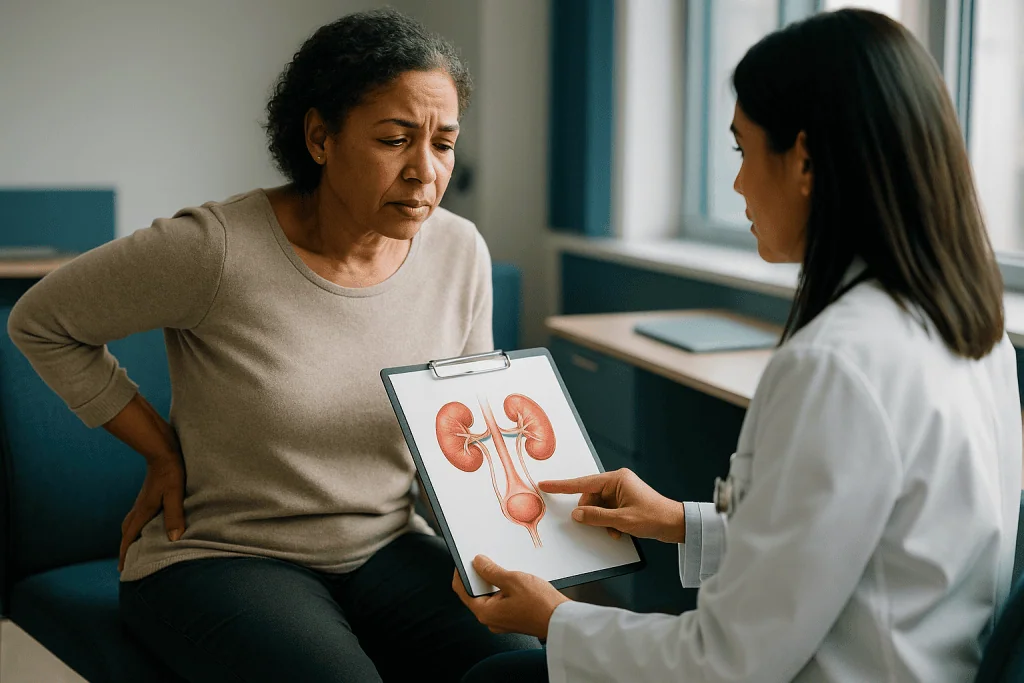
The urinary tract is a closed plumbing system. Two kidneys filter the blood and make urine; two narrow tubes called ureters carry that urine down to the bladder; the urethra carries it out of the body. Under normal conditions, urine flows one way and bacteria are flushed out before they can settle.
Most urinary tract infections (UTIs) begin when bacteria from the bowel, overwhelmingly Escherichia coli, reach the opening of the urethra and move up into the bladder. Mayo Clinic describes this ascending route as the usual way the tract becomes infected. Once in the bladder, the bacteria use hair-like surface structures called fimbriae to stick to the bladder lining, which keeps them from being washed away. An infection confined to the bladder is called cystitis.
The kidneys sit a further step up. If bacteria continue climbing through the ureters, they enter the renal pelvis, the funnel-shaped collecting chamber at the center of each kidney, and from there the filtering tissue itself. That upper tract infection is pyelonephritis, the medical name for a kidney infection. The kidney responds with intense inflammation, which is why the illness feels so different from a bladder infection: fever, chills and deep flank pain rather than just stinging and urgency.
A second, far less common route exists. Bacteria circulating in the bloodstream from an infection elsewhere can seed the kidney directly. Mayo Clinic notes this is unusual and tends to occur in people who are already seriously ill or have an artificial heart valve or joint. For almost everyone reading this, the practical story is the ascending one: what starts low can climb, and the time it takes to climb is the window in which prompt care works.
Kidney infection vs UTI: what changes once the kidneys are involved
Strictly speaking, a kidney infection is a type of UTI; the term covers infection anywhere in the tract. In everyday use, though, “UTI” usually means a bladder infection, and the distinction matters because the two are managed differently and carry different risks.
A bladder infection is uncomfortable but, in a healthy adult, rarely dangerous. The NHS notes that mild cases can sometimes settle within a few days even without antibiotics. A kidney infection is a systemic illness. The organ is inflamed, the body mounts a fever response, and the infection sits close to a rich blood supply, which is why Mayo Clinic lists blood poisoning (sepsis) among its possible complications. Treatment is more intensive, lasts longer and sometimes requires hospital admission.
| Feature | Bladder infection (cystitis) | Kidney infection (pyelonephritis) |
|---|---|---|
| Where the bacteria are | Bladder lining | Renal pelvis and kidney tissue |
| Typical pattern reported | Burning, urgency, frequency, lower-abdominal discomfort | Fever, chills, flank or back pain, nausea, feeling generally unwell, often with bladder symptoms too |
| Onset | Gradual over a day or two | NHS: often develops quickly over a few hours or days |
| Usual care setting | Primary care, sometimes telephone assessment | Same-day clinical review; hospital for some |
| Typical course length (NHS) | Short antibiotic course | Longer course, often 7–14 days; most feel completely better in about two weeks |
| Potential lasting harm | Uncommon | Kidney scarring, sepsis, pregnancy complications |
The table is a guide to what clinicians weigh, not a self-diagnosis tool. Plenty of people with a kidney infection have no obvious bladder symptoms at all, and some bladder infections cause a low fever. Where there is doubt, the examination and urine testing settle it.
Can a UTI spread to the kidneys if it is left untreated, and how fast?
Yes, it can, though it is worth being precise about what the evidence shows. The ascending route is the main way kidney infections happen, and an untreated bladder infection is the usual starting point. That does not mean every untreated UTI ends in the kidneys. The NHS describes mild cystitis that clears on its own in some people, and the bladder’s own defenses, chiefly the washing effect of regular urination, often win.
Timing is the uncertain part. Some people describe a week or more of bladder symptoms before fever and back pain arrive; others develop a kidney infection with almost no warning. The NHS states that kidney infection symptoms often develop quickly, over a few hours or days. No guideline offers a safe number of days to wait, because the speed depends on how much urine is flowing, whether anything is blocking it, how virulent the bacterial strain is and how the immune system responds.
Picture the ureters as two downhill streams. Steady flow keeps the water clear. Anything that slows or reverses that flow, a kidney stone, an enlarged prostate, a pregnancy pressing on the ureters, or a bladder that does not empty fully, gives bacteria the standing water they need to climb. People with these conditions are not simply at higher risk; the infection can reach the kidneys sooner.
This is the logic behind “prompt care”. The intervention is not dramatic. A urine sample, a clinical assessment and, where indicated, an antibiotic course started early interrupt the climb while the bacteria are still in the bladder. Waiting to see whether symptoms resolve is a reasonable choice for some people and a risky one for others, and the sections below explain who falls where.
Who is most at risk of a UTI reaching the kidneys
Anatomy comes first. The female urethra is much shorter than the male urethra and sits close to the anus, so bacteria have a shorter journey to the bladder. Mayo Clinic lists female anatomy as the leading risk factor for kidney infection, and most pyelonephritis in otherwise healthy adults occurs in women.

Pregnancy adds a second layer. Hormonal changes relax the muscular walls of the ureters, and the growing uterus presses on them, so urine drains more slowly and bacteria climb more easily. Guideline bodies treat any UTI in pregnancy as needing prompt treatment, partly because Mayo Clinic links kidney infection during pregnancy to higher rates of preterm birth and low birth weight.
Anything that blocks or slows urine flow raises risk for anyone. Kidney stones, an enlarged prostate, strictures (narrowings) of the urethra and tumors all qualify. So do conditions that stop the bladder emptying properly, including nerve damage from diabetes, multiple sclerosis or spinal injury. Urinary catheters give bacteria a direct highway into the bladder and are a common cause of kidney infection in hospitals and care homes.
In young children, the issue is often vesicoureteral reflux, a condition in which urine flows backward from the bladder up the ureters toward the kidneys. Mayo Clinic notes this backflow lets bacteria reach the kidneys easily and is a reason children’s UTIs are investigated and treated carefully.
A weakened immune system, whether from diabetes, HIV, chemotherapy or medicines taken after a transplant, blunts the body’s ability to contain bacteria in the bladder. Older adults face a mix of these factors at once, and they may not mount a fever or describe pain in the usual way. For every group above, the threshold for early assessment is lower, and the decision about how urgently to be seen rests with the clinical team.
Who needs same-day assessment, and who is usually managed at home
Not every twinge of bladder discomfort needs an emergency visit, and guidelines are clear about where the lines sit. The distinction turns on two questions: is this likely to be confined to the bladder, and does this person have a reason to expect it to climb?
Otherwise healthy, non-pregnant women with classic bladder symptoms and no fever or back pain are the group most often managed in primary care, sometimes by telephone. The NHS advises that a clinician may suggest waiting to see whether symptoms settle before starting antibiotics, with a prescription held in reserve. That approach is a shared decision made with a clinician, not a default to adopt alone, and it depends on being able to return quickly if things change.
Same-day review is the usual advice for anyone with fever, chills, flank pain, vomiting or confusion alongside urinary symptoms, because those features point to the kidneys. It is also the standard for groups the NHS flags specifically: people who are pregnant, men, children, anyone with a catheter, and people with diabetes, kidney disease, a weakened immune system or a known blockage in the urinary tract. Bladder symptoms that return within weeks of a treated infection, or that have not improved within a few days of starting treatment, belong in the same category.
Hospital admission is reserved for a smaller group. Mayo Clinic and the NHS describe it for people who cannot keep fluids or tablets down, who are severely unwell or showing signs of sepsis, who are pregnant with a kidney infection, or whose infection is not responding to oral treatment. In hospital, antibiotics can be given into a vein and fluids replaced while imaging looks for an abscess or obstruction.
If you are unsure which group you belong to, that uncertainty is itself a reason to call. A short conversation with a clinician is cheaper in every sense than a delayed kidney infection.
Kidney infection symptoms: what clinicians look for
Clinicians assessing a possible kidney infection are listening for a pattern rather than a single symptom. The NHS and Mayo Clinic describe a cluster: a high temperature with shivering or chills, pain in the side or lower back (the flank) that may be felt on one side only, nausea or vomiting, and a general sense of being unwell. Bladder symptoms, burning, urgency and frequency, are often present as well, though not always.
Flank pain deserves a closer look because people often mistake it for a pulled muscle. Infection-related kidney pain usually sits just below the ribs, toward the back, and is typically dull, constant and tender to a tap over the area; the examining clinician checks exactly that. Muscle pain, by contrast, tends to change with movement.
Urine itself gives clues. Cloudy or foul-smelling urine and visible blood are common in both bladder and kidney infections and do not on their own locate the problem.
Two groups present differently, and this is where diagnoses are most often delayed. Older adults may have no fever at all; new confusion, unsteadiness, loss of appetite or a sudden decline in function can be the only sign. Young children may simply have a fever, irritability, poor feeding or vomiting, with nothing that points to the urinary tract. In both cases, guidelines advise clinicians to test the urine when the cause of illness is unclear, precisely because the usual symptom pattern is missing.
None of this is a checklist to score yourself against. Its value is in knowing that fever plus back pain, or an unexplained decline in someone vulnerable, is the point at which a kidney infection enters the clinician’s differential and a urine sample becomes urgent.
Do all kidney infections show up in urine tests?
No, and this is one of the more useful things to understand before a consultation. Urine testing is central to diagnosing a kidney infection, but it has well-recognized blind spots, which is why clinicians treat the result as one piece of evidence alongside examination and, when needed, blood tests and imaging.
The first test is usually a dipstick, a strip that changes color in response to white blood cells, nitrites and blood. Nitrites appear because many bacteria convert the urine’s natural nitrates into nitrites; a positive result strongly suggests infection. The catch is that some bacteria do not perform that conversion, so nitrite can be negative despite a genuine infection. White cells can likewise be absent early, or diluted by heavy fluid intake.
The second test is a urine culture, in which the sample is grown in a laboratory to identify the organism and determine which antibiotics it is sensitive to. Results typically take a couple of days. A culture can come back negative if antibiotics were started before the sample was taken, if the bacteria are of a type that does not grow on standard media, or if an infected kidney is drained by a ureter that is blocked, so its urine never reaches the bladder to be sampled.
That last scenario is why imaging matters. Mayo Clinic describes ultrasound or CT scanning when a kidney infection is severe, is not improving on treatment, or occurs in someone with a known structural problem, to look for stones, obstruction or an abscess. Blood tests add information about inflammation, kidney function and whether bacteria have entered the bloodstream.
The practical message: a normal dipstick does not rule out a kidney infection in someone with fever and flank pain, and clinicians know this. Ask what the test showed and what the plan is if it does not fit the picture.
What are the common causes of kidney pain, and when is it infection?
Kidney pain is a frequent search and a frequently misread sensation. The kidneys sit high and toward the back, just under the lower ribs, so pain from them is felt in the flank rather than the front of the abdomen where most people picture them. Several conditions produce pain in that region, and infection is only one.
Kidney stones are the classic cause of severe kidney pain. The pain tends to come in intense waves as the stone moves down the ureter, often spreading toward the groin, and is frequently accompanied by blood in the urine and nausea. A stone can also block urine flow, and a blocked, infected kidney is a medical emergency because the infection cannot drain.
Infection, the subject of this article, usually produces a steadier, duller ache with fever and chills. Blockage from other causes, including an enlarged prostate or a stricture, can stretch the kidney (hydronephrosis) and cause a similar dull pain. Polycystic kidney disease, an inherited condition in which fluid-filled cysts enlarge the kidneys, causes chronic flank discomfort and occasionally sharp pain when a cyst bleeds or becomes infected. Less commonly, a kidney tumor, a blood clot in the kidney’s vein, or injury after a fall or impact is responsible.
Many people who search “kidney pain” turn out to have something else entirely. Muscle strain in the lower back is far more common than any kidney problem and is the usual explanation for pain that worsens with bending or twisting. Shingles can cause one-sided flank pain before the rash appears. Gallbladder and bowel problems occasionally refer pain to the same area.
Clinicians separate these by asking about fever, urinary symptoms and the character of the pain, then testing the urine and, where needed, imaging the kidneys. Flank pain with fever is treated as infection until proven otherwise; flank pain with waves of agony is treated as a possible stone. Both warrant prompt assessment rather than watchful waiting.
How prompt care stops a UTI from spreading to the kidneys: what treatment involves
The treatment of a UTI is straightforward in principle: identify that bacteria are present, choose an antibiotic they are sensitive to, and keep urine flowing. The value of doing it promptly is that the bacteria are still in the bladder, where they are easier to clear and where the consequences of a day’s delay are smaller.
Antibiotics work by interfering with processes the bacteria depend on, such as building their cell wall or copying their DNA, while leaving human cells largely alone. For a bladder infection, prescribers often choose agents that concentrate in urine. Some of those agents reach kidney tissue poorly, which is one reason a suspected kidney infection usually calls for a different class, such as a cephalosporin or, in selected cases, a fluoroquinolone, and for a longer course. The NHS describes kidney infection courses commonly lasting 7–14 days, compared with short courses for uncomplicated cystitis. Which drug, at what dose and for how long are decisions for the prescribing clinician, guided by the urine culture, local resistance patterns, pregnancy status and kidney function.
Timing matters within the course as well. Clinicians generally start treatment on clinical suspicion before culture results return, then adjust if the laboratory shows the organism is resistant. Finishing the prescribed course, even once symptoms have faded, reduces the chance of a relapse from surviving bacteria.
Supportive care runs alongside. Drinking enough fluid to keep urine pale helps flush the tract; pain relief from the acetaminophen or anti-inflammatory classes eases fever and discomfort, though anti-inflammatories are sometimes avoided when kidney function is a concern. Rest helps. In hospital, intravenous antibiotics and fluids are used for people who are vomiting, dehydrated or seriously ill, and any blockage found on imaging is relieved, because an obstructed, infected kidney cannot clear.
What prompt care does not involve is anything exotic. The gain comes from starting the ordinary steps early.
What the following days and weeks usually look like
For a bladder infection treated early, improvement is usually quick. The NHS notes that symptoms typically begin to ease within a day or two of starting antibiotics, and many people feel back to normal before the course ends. The remaining tablets still matter; stopping early is a common reason infections return.
A kidney infection follows a slower arc. The NHS states that most people start to feel better within a few days of beginning treatment and feel completely better after about two weeks. The fever usually settles first, often within the first couple of days; the flank ache and tiredness linger longer. Feeling washed out for a week or two after the infection clears is common and not by itself a sign that something is wrong.
The early days are also when the plan can change. If fever is not settling or pain is worsening after the first couple of days of treatment, clinicians look for three things: a resistant organism (the culture result guides a switch), a blockage preventing drainage, or an abscess (a pocket of pus) that may need to be drained. Imaging is the usual next step. This is why it helps to know, before leaving the consultation, who to contact if you are not improving.
Follow-up varies. Many people need no repeat testing once well. Pregnant women are usually re-tested to confirm the bacteria have cleared, and children, men and people with recurrent kidney infections are often referred for imaging of the urinary tract to look for structural causes. Anyone found to have stones, reflux or an enlarged prostate will have a separate conversation about managing that underlying problem.
Everyday life resumes gradually. Work and exercise can restart as energy returns; there is no fixed waiting period. Sexual activity is a matter of comfort rather than medical restriction once symptoms have gone. Any return of symptoms in the weeks afterward should be reported rather than waited out.
Untreated UTI and kidney damage: what the evidence actually shows
Search results on this topic range from reassuring to alarming, so it is worth stating plainly what mainstream evidence supports. Three complications are well documented, and all are considerably less likely when infection is treated promptly.
The first is kidney scarring. Intense inflammation can leave patches of scar tissue where filtering units have been destroyed. Mayo Clinic lists scarring among the complications of kidney infection, and the risk is best established in young children, particularly those with vesicoureteral reflux and repeated infections, where scarring in a growing kidney can contribute to high blood pressure and reduced kidney function later. In adults with a normal urinary tract, a single promptly treated kidney infection rarely leaves measurable lasting damage; the concern rises with repeated or severe episodes and with obstruction.
The second is sepsis. Because the kidneys receive a large share of the body’s blood flow, bacteria can pass from infected tissue into the bloodstream. Mayo Clinic describes this as a potentially life-threatening complication, and it is the main reason fever with flank pain is treated as urgent. Sepsis is more common in older adults, people with catheters or obstruction, and those with weakened immunity.
The third is pregnancy complication. Kidney infection during pregnancy is associated with preterm labor and low birth weight, which is why even symptom-free bacteria in the urine are routinely screened for and treated during antenatal care.
Rarer outcomes include a kidney abscess and, in people with diabetes, a gas-forming infection that destroys kidney tissue. Chronic kidney disease resulting purely from infection in an adult with an otherwise healthy tract is uncommon; where it does occur, there is usually a structural cause, repeated infections or long delays in treatment behind it.
The honest summary is that the kidneys are resilient, that scarring and sepsis are real but largely preventable, and that the preventable part rests on timely assessment.
Recurrent UTIs: what the evidence says about protecting your kidneys
Some people get one bladder infection in a decade; others get several a year. Repeated infections mean repeated opportunities for bacteria to climb, so prevention is a legitimate part of protecting the kidneys. The evidence for individual measures is uneven, and it helps to know which is which.
Hydration has reasonable support. Drinking enough to keep urine pale increases flow and flushing, and the NHS and Mayo Clinic both include it in their advice. Not holding urine for long periods, and emptying the bladder fully, follow the same logic. Urinating after sexual intercourse is widely recommended; the mechanism is plausible, though the research behind it is weaker than its popularity suggests.
Cranberry products have been studied extensively with mixed results. The NIH Office of Dietary Supplements summarizes the evidence as uncertain: some trials suggest a modest reduction in recurrent infections in certain groups, others show no benefit, and cranberry does nothing for an infection that has already started. D-mannose, a sugar that may stop bacteria sticking to the bladder wall, has a similar status: promising mechanism, limited high-quality trials.
After menopause, falling estrogen changes the vaginal environment in ways that favor bladder infections. Guidelines recognize that topical vaginal estrogen prescribed by a clinician can reduce recurrences in some women; whether it is appropriate is an individual decision.
For people with frequent, culture-proven infections, prescribers sometimes discuss a low-dose preventive antibiotic taken either continuously or around a known trigger. That trade-off, fewer infections against resistance and side effects, is a prescribing decision and nothing to self-initiate.
The measure with the strongest effect on kidney risk is also the least glamorous: finding and fixing a structural cause. Stones, reflux, incomplete emptying and catheters account for a large share of kidney infections, and imaging in people with recurrent episodes exists to find them.
What people often get wrong about UTIs and kidney infections
“Cloudy urine means my kidneys are infected.” Cloudiness, odor and even visible blood occur with simple bladder infections and say nothing about location. The features that point to the kidneys are fever, chills and flank pain.
“If I drink enough water the infection will flush out.” Fluids help, and the NHS notes mild cystitis sometimes clears without treatment. Water does not reach bacteria that have attached to the bladder wall or climbed the ureters, and it is no substitute for assessment in anyone with fever, pregnancy, a catheter or other risk factors.
“A negative dipstick means it is not an infection.” Some bacteria do not produce the nitrite the strip detects, and an obstructed kidney may not shed bacteria into sampled urine. Clinicians interpret the strip alongside the whole picture.
“Antibiotics worked, so I can stop when I feel fine.” Feeling better often arrives days before the bacteria are cleared. Stopping early is a common route to relapse and resistance.
“Men don’t get UTIs.” They do, less often, and because the longer male urethra makes infection less likely, a UTI in a man prompts a look for an underlying cause, often the prostate.
“Kidney pain is always in the lower back.” The kidneys sit under the lower ribs; pain that is mainly in the low back and worse with movement is far more often muscular.
“Once you’ve had a kidney infection your kidneys are damaged for life.” In adults with a normal tract, a single treated episode rarely leaves lasting damage. The scarring risk is concentrated in young children with reflux and in people with repeated or obstructed infections.
“Cranberry juice treats a UTI.” The NIH summarizes the prevention evidence as mixed and finds no role in treating an established infection.
Questions to ask your care team
Consultations for urinary infections are often brief, and the most useful questions are the ones that clarify the plan if things do not go smoothly. Write down the answers; fever makes memory unreliable.
- Based on my symptoms and examination, do you think this is confined to the bladder or has it involved the kidneys?
- Was a urine culture sent, when will the result be available, and will someone contact me if the bacteria turn out to be resistant to the antibiotic I have started?
- How many days should I expect before I start to feel better, and what specifically should prompt me to call back sooner?
- Are there features in my history, such as pregnancy, diabetes, kidney stones, prostate enlargement or a catheter, that change how urgently this needs to be followed up?
- Do I need imaging of my kidneys now or after I recover, and what would it be looking for?
- Is this the right moment to take over-the-counter pain relief, and are there classes I should avoid because of my kidneys or other medicines?
- Should I be re-tested after finishing the course to confirm the infection has cleared?
- If this is my second or third infection in a year, what investigations or preventive options are worth discussing?
- Who do I contact out of hours if my fever climbs, I start vomiting or I feel much worse?
Two questions people hesitate to ask deserve asking. First, whether you can keep fluids and tablets down; if the honest answer is no, oral treatment may not be realistic and the team needs to know. Second, whether a trusted person can check on you over the next day or two, particularly if you live alone, are older or have a condition that masks fever. Kidney infections can worsen quickly, and a second pair of eyes is part of safe home care.
When to call your doctor
Most bladder infections are uncomplicated, and most kidney infections respond to treatment started in time. The purpose of this section is to make the exceptions easy to recognize, because the difference between a good outcome and a serious one often comes down to a phone call made a day earlier.
Contact your doctor the same day if urinary symptoms are accompanied by a fever or shivering, pain in your side or lower back, or nausea or vomiting; if you are pregnant and have any urinary symptoms; if you are a man, have a catheter, have diabetes, kidney disease or a weakened immune system; if symptoms have returned within weeks of a treated infection; or if bladder symptoms have not started to improve within a few days of beginning treatment.
Seek emergency care without waiting if any of the following develop, whether or not you have already started antibiotics:
- A very high fever, or a temperature that keeps climbing despite treatment
- Shaking chills with a racing heartbeat or fast breathing
- New confusion, drowsiness, slurred speech or difficulty staying awake
- Inability to keep fluids down, or passing very little urine over a day
- Severe pain in the side or back that is worsening, or pain that comes in intense waves
- Skin that is mottled, bluish, very pale or cold and clammy
- Feeling faint, dizzy on standing, or a sense that something is seriously wrong
These are recognized warning signs of sepsis or an obstructed, infected kidney, both of which need hospital assessment. In an older adult or a young child, a sudden change in behavior, unusual sleepiness or refusal to eat or drink should be treated with the same urgency even without fever.
Call rather than second-guess. Clinicians would rather assess ten people who turn out to have simple cystitis than miss one whose infection has reached the kidneys. Every decision about testing, treatment and admission rests with the team that examines you.
Frequently asked questions
Can a UTI spread to the kidneys even if I have started antibiotics?
It can, usually when the bacteria are resistant to the chosen antibiotic or when a blockage stops the kidney draining. That is why clinicians send a urine culture and ask you to report fever, flank pain or lack of improvement within the first few days. If symptoms worsen on treatment, contact your care team rather than waiting for the course to finish.
Kidney infection vs UTI: how can I tell which one I have?
You usually cannot tell with certainty at home, which is the point of being examined. Bladder infections typically cause burning, urgency and frequency without fever. Fever, chills, nausea and pain in the side or back suggest the kidneys. Because some kidney infections have no bladder symptoms, clinicians rely on examination, urine testing and sometimes blood tests or imaging.
What are the symptoms of a bladder infection?
People with a bladder infection commonly describe burning when passing urine, needing to go often and urgently, passing small amounts, discomfort low in the abdomen, and cloudy or strong-smelling urine, sometimes with visible blood. These features are useful for knowing when to seek assessment, not for self-diagnosis; other conditions overlap, and a urine test confirms the picture.
Do all kidney infections show up in urine tests?
No. A dipstick can be negative when the bacteria involved do not produce nitrite, when urine is very dilute, or early in the illness. A culture can be negative if antibiotics were started beforehand or the infected kidney is obstructed. Clinicians who suspect a kidney infection on clinical grounds may add blood tests and imaging rather than relying on urine results alone.
What are the common causes of kidney pain?
Kidney stones, kidney infection, blockage of urine flow and polycystic kidney disease are the main kidney-related causes, all felt in the flank under the lower ribs. Far more often, pain in that region is muscular. Flank pain with fever is treated as infection until proven otherwise, and pain in intense waves suggests a stone; both need prompt assessment.
How long does an untreated UTI take to reach the kidneys?
There is no reliable number. Some bladder infections never spread, while others reach the kidneys within days, and the NHS notes kidney infection symptoms can develop over a few hours. Speed depends on urine flow, blockage, the bacterial strain and immunity. Guidelines therefore focus on risk factors and warning signs rather than a safe waiting period.
Can untreated UTI cause permanent kidney damage?
It can, though the risk is uneven. Kidney scarring is best documented in young children with urinary reflux and repeated infections. In adults with a normal urinary tract, a single promptly treated kidney infection rarely leaves lasting damage; the concern rises with repeated, severe or obstructed infections, and with sepsis. Early treatment is the main protective factor.
What are some interesting facts about urinary tract infections?
The bacteria responsible are almost always the body’s own gut Escherichia coli, which use hair-like fimbriae to cling to the bladder wall. The female urethra is only a few centimeters long, which is the main reason UTIs are far more common in women. And the NIH summarizes decades of cranberry trials as mixed, with no role in treating an established infection.
Why do pregnant women need a UTI treated so quickly?
Pregnancy hormones relax the ureters and the growing uterus presses on them, so urine drains more slowly and bacteria climb more easily. Mayo Clinic links kidney infection in pregnancy to preterm birth and low birth weight. Antenatal care therefore screens for bacteria in the urine and treats even symptom-free cases, with the choice of antibiotic made by the prescribing clinician.
Will I need a scan after a kidney infection?
Not always. Imaging is usually suggested when the infection is severe, is not improving within the first days of treatment, recurs, or occurs in a child, a man or someone with known kidney stones or structural problems. The scan looks for blockage, reflux, stones or an abscess. Whether you need one is decided by your treating team based on your history.
References
- NHS: Kidney infection
- NHS: Urinary tract infections (UTIs)
- MedlinePlus: Urinary Tract Infections
- NIH NIDDK: Your Kidneys and How They Work
This article is for general information only and is not a substitute for professional medical advice. Please consult a qualified doctor about your individual situation.
Add us as a Preferred Source to see more of our trusted health content across Google Search, AI Overviews and Discover.

More from the Blog

Is Swelling After a Vasectomy Normal? Hematoma Signs and When to Call Your Urologist
Mild swelling after vasectomy is expected and usually settles within a few days, along with light bruising and a dull ache. A scrotum that…

How Long Do International Patients Stay in Istanbul After Robotic Prostate Surgery?
Most international patients remain near the surgical center for roughly one to two weeks after robotic prostate surgery, because the urinary catheter is usually…

Can You Travel While on Hemodialysis? Arranging Sessions Abroad and Carrying Records
Yes, most people on hemodialysis can travel, including abroad, provided their condition is stable and sessions are booked in advance at a unit near…

A Parent’s Guide to Orchiopexy Day: What to Pack, the First Night and Comfort Measures
Orchiopexy is a short day-case operation that moves an undescended testicle into the scrotum and secures it there. Parents usually arrive early with a…

Is Pain After ESWL Normal? Bruising vs a Blocked Ureter and When to Contact Your Urologist
Some pain after ESWL is expected. Most people feel a bruised, tender ache over the treated flank for a few days, and cramping colic…

Supporting a Child Through Vesicoureteral Reflux Treatment: A Parent’s Practical Guide
Vesicoureteral reflux (VUR) means urine flows backward from the bladder toward the kidneys. Most children are managed by watching for infections, keeping bladder and…