

How Long Do International Patients Stay in Istanbul After Robotic Prostate Surgery?

Key Takeaways
- The urinary catheter, typically left in for about one to two weeks after robotic prostatectomy, is the main factor that sets the earliest sensible travel date, not the hospital discharge day.
- The hospital stay itself is commonly only a day or two; most of the time an international patient spends near the center is in local accommodation waiting for catheter removal and a review.
- The CDC lists recent surgery as a risk factor for travel-related blood clots and notes that journeys over about four hours raise risk further, which is why flight duration shapes clearance timing.
- Lifting restrictions after prostatectomy commonly last around four to six weeks, so handling luggage on the return journey needs a companion, porter or checked bag.
- PSA monitoring, pelvic floor training and erectile recovery continue for months after surgery and should be handed to a named home clinician before departure.
- Early urinary leakage after catheter removal is expected while the sphincter adapts, and the NHS describes gradual improvement over months with pelvic floor exercises.
Most international patients remain near the surgical center for roughly one to two weeks after robotic prostate surgery, because the urinary catheter is usually removed about one to two weeks after the operation and surgeons generally want to check wound healing and bladder control before a long journey home. The exact length is set by the treating team, not by a calendar, and can be longer if complications occur.
The return ticket is the problem. A man in his early sixties sits at a kitchen table with a surgical consent form on one side and a flight booking page on the other, trying to work out which date to type into the box. His surgeon has explained the operation. Nobody has yet told him, in plain terms, how many nights he should expect to spend in a foreign city once the operation is over.
It is one of the most common questions people ask before robotic prostate surgery, and one of the least well answered online. Search for a robotic prostate surgery Istanbul stay and you will find confident numbers with no source behind them. The honest answer has fewer digits and more conditions: it depends on a catheter, a wound check, a flight time and, above all, on the judgment of the team that operated.
This explainer walks through what actually sets the clock, what the recovery weeks usually look like, and which questions are worth asking before anyone books a seat home.
How long do international patients stay in Istanbul after robotic prostate surgery?
There is no official number, and any article that gives you one without a reason is guessing. What exists instead is a chain of medical milestones that most surgical teams want to see before a patient travels a long distance, and those milestones happen to cluster in the first one to two weeks.
The first milestone is discharge from the hospital itself. After a robotic radical prostatectomy, the operation that removes the whole prostate gland through small keyhole incisions using surgeon-controlled instruments, most people go home or to nearby accommodation after a short inpatient stay, commonly a day or two according to the Mayo Clinic’s description of the procedure. That is the hospital stay, not the city stay, and the two are often confused.
The second milestone is catheter removal. A urinary catheter, a soft tube that drains the bladder while the new join between bladder and urethra heals, is typically left in place for about one to two weeks, as both the Mayo Clinic and MedlinePlus describe. Few surgeons are comfortable sending a patient across continents with that tube still in, so catheter removal usually marks the earliest sensible departure point for a robotic prostate surgery Istanbul stay.
The third milestone is a short period after catheter removal in which the team checks that the bladder empties, that leakage is manageable and that no fever or wound problem is brewing. Add those three together and the common pattern becomes clear: a few days in hospital, a week or so in local accommodation, then review and, if all is well, clearance to travel.
Stays can run longer. A urine leak at the surgical join, an infection, or a clot concern can each add days or weeks. The treating team decides, and a flexible or changeable ticket is a practical hedge against a timeline that medicine cannot promise in advance.
What actually happens during robotic prostate surgery
The word “robotic” worries people who picture a machine operating on its own. It does not. The surgeon sits at a console a few feet from the patient and controls instruments that pass through five or six small incisions in the lower abdomen. A magnified three-dimensional camera shows the pelvis in detail; the instruments translate hand movements into small, tremor-filtered motions inside the body.
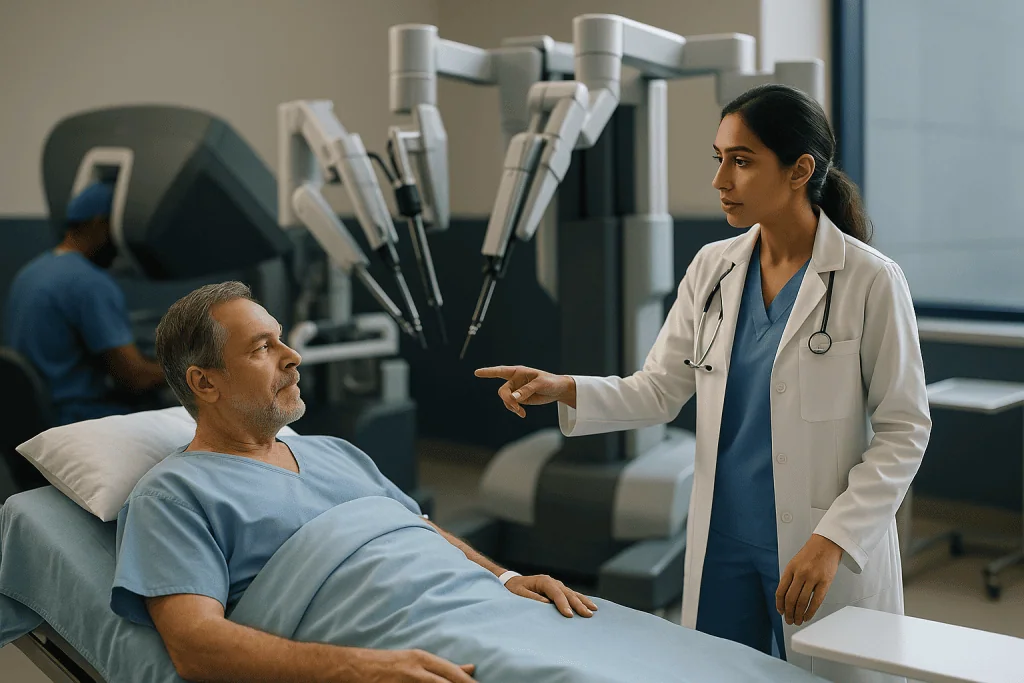
The goal of the operation is the same as in open surgery: remove the entire prostate gland and the seminal vesicles, the small glands beside it, and then reconnect the bladder neck to the urethra, the tube that carries urine out. That reconnection is called the anastomosis, and it is the reason the catheter stays in afterward; the stitched join needs time to seal.
Where cancer location allows, surgeons try to preserve the neurovascular bundles, the nerves that run along each side of the prostate and help control erections. The NHS and the Mayo Clinic both describe this nerve-sparing approach as something that may be possible for some patients and not others, depending on where the tumor sits. It is a judgment made partly before and partly during the operation.
Under general anesthesia the procedure commonly lasts a few hours. Patients usually wake with the catheter in place, sometimes a small drain near an incision, and a feeling of bloating from the gas used to inflate the abdomen during surgery. Shoulder-tip discomfort from that gas is common and settles over a day or two.
Evidence comparing robotic and open prostatectomy has generally found smaller incisions, less blood loss and a shorter hospital stay with the robotic approach, while long-term cancer control and functional outcomes depend more on the surgeon’s experience and the patient’s disease than on the platform itself. That nuance matters when reading marketing material that treats the robot as the whole story.
Who is usually offered robotic prostate surgery, and who is asked to wait
Radical prostatectomy, by any technique, is typically offered to men whose prostate cancer appears confined to the gland and who are fit enough for a general anesthetic and a recovery of several weeks. The NHS describes it as an option mainly for localized disease, sometimes also for cancer that has only just begun to spread beyond the prostate, where it may be combined with other treatments.
Fitness for surgery is assessed broadly. Heart and lung function, kidney function, diabetes control, bleeding risk and body weight all feed into the decision, because the robotic approach requires a steep head-down position for a prolonged period, which raises pressure in the chest and head. People with severe glaucoma, significant heart failure or certain previous abdominal operations may be steered toward a different technique or a different treatment altogether.
Some men are asked to wait, and waiting is not the same as being refused. Active surveillance, a structured program of PSA blood tests, imaging and periodic biopsies, is a recognized pathway for low-risk cancers, and the Mayo Clinic and NHS both describe it as a legitimate first choice rather than a fallback. Men on blood thinners may need a planned pause under their cardiologist’s direction before any operation. A recent urinary infection, an uncontrolled medical condition or a very recent biopsy can also push the date back by weeks.
For an international patient, one more factor belongs on this list: the ability to stay long enough. A surgeon who learns that a patient must fly home three days after the operation has a legitimate reason to pause and reconsider, because the post-operative plan would be built on sand. The treating team weighs all of this; the patient’s job is to give them the full picture, including travel constraints.
Why the catheter sets the clock for a robotic prostate surgery Istanbul stay
If one thing explains the length of an international patient’s stay, it is the catheter. Understanding why makes the whole timeline feel less arbitrary.

During the operation the bladder is detached from the prostate and then sewn to the urethra. That join is watertight on the table, but tissue swells, stitches loosen slightly as healing begins, and urine under pressure could seep through a seam before it has sealed. The catheter solves this by keeping the bladder nearly empty and by acting as an internal splint across the join. The Mayo Clinic notes that the catheter typically stays in for one to two weeks; MedlinePlus’s discharge guidance gives a similar range and describes caring for the drainage bag at home during that period.
Removing it is quick and usually done in clinic, sometimes after a scan of the join to confirm no leak. What follows is the part that often surprises people: the first hours and days without the tube are when urinary leakage is most noticeable, because the external sphincter muscle, the ring that holds urine back, is learning to work without the prostate’s help. Pads are standard. Most teams want to see a patient pass urine, check that the bladder empties on a quick ultrasound, and make sure there is no retention before clearing travel.
This is why a departure the day after catheter removal is rarely advised. A patient who cannot pass urine after removal may need the tube replaced for a few more days. A patient who has a long flight the same evening would be dealing with that problem in an airport.
Practically, the catheter decides two dates: the earliest day the team will consider clearing travel, and the day around which accommodation and companion plans should be built.
Hospital stay after prostatectomy: what the first 48 hours look like
The inpatient phase after robotic prostatectomy is shorter than many people expect, and shorter than after open surgery. MedlinePlus and the Mayo Clinic describe a typical hospital stay of around one to a few days, with the exact length depending on pain control, mobility and whether the bowels have started working.
On the day of surgery, the priorities are breathing exercises, sips of fluid and getting out of bed with help, usually within hours. Early walking is not optional encouragement; it is a recognized way to reduce the risk of deep vein thrombosis, a clot in the leg veins, and to help the bowel recover. Compression stockings or pneumatic calf devices are common, and many centers give an injectable anticoagulant, a medicine that thins the blood, for a period after surgery. Whether that continues after discharge, and for how long, is a decision for the surgical team based on individual risk.
By the next morning, most patients are eating light meals, walking the corridor several times a day and managing pain with oral medication. The small drain, if one was placed, is often removed before discharge. Nurses teach catheter care: how to empty the bag, how to switch between a leg bag by day and a larger bag at night, and how to keep the tube and the skin around it clean.
Discharge usually comes with written instructions, an emergency contact number and a date for catheter removal. For an international patient this is the moment to confirm, in writing, where to go and whom to call out of hours. A companion who has watched the catheter teaching session is worth more than any leaflet.
Fatigue in the first days is normal and often underestimated. Planning a hotel room, not a tourist itinerary, for the week that follows is the realistic approach.
Recovery after robotic prostatectomy: the hotel phase, days 3 to 14
Once discharged, an international patient enters a phase that no guideline names but every surgical team recognizes: well enough to leave the ward, not yet ready for an airport. It usually lasts about a week, bridging discharge and catheter removal.
Daily life in this window is deliberately quiet. Walking several times a day, gradually increasing distance, is the main activity. MedlinePlus advises avoiding heavy lifting and strenuous exercise for several weeks after radical prostatectomy, and that applies with extra force to anyone who will soon be hauling luggage. Showers are typically allowed; baths and swimming are usually not until wounds are closed and the catheter is out.
Common experiences in this period include bladder spasms, sudden cramping sensations as the bladder reacts to the catheter; small amounts of blood-tinged urine, especially after walking; mild constipation from reduced activity and pain medication; and bruising around the incisions. None of these is alarming on its own. A clinician can prescribe medicines for spasms if needed, and fluids, fiber and walking address most constipation.
Diet matters more than people expect. Straining on the toilet puts pressure on the surgical join, so avoiding constipation is part of protecting the anastomosis, not just a comfort issue.
Accommodation choices make a practical difference. A room with an elevator, a walk-in shower and a short route to the clinic reduces the day-to-day burden. A companion who can fetch supplies and notice a fever is a safety measure, not a luxury.
Catheter removal around the end of this phase marks a shift. Leakage usually peaks in the first days without the tube and improves over weeks to months as pelvic floor muscles strengthen. Teams often teach pelvic floor exercises before surgery for this reason, and the hotel phase is a good time to practice the technique, even with the catheter still in.
A typical post-surgery timeline at a glance
The table below condenses the milestones that shape how long a person stays near the surgical center. Every range is a typical pattern drawn from the referenced sources, not a schedule any team can promise; individual plans vary, and the treating surgeon’s instructions override anything written here.
| Milestone | Typical timing | What it usually means for travel |
|---|---|---|
| Hospital discharge | About 1 to a few days after surgery (Mayo Clinic, MedlinePlus) | Move to nearby accommodation, not an airport |
| Catheter removal | About 1–2 weeks after surgery (Mayo Clinic, MedlinePlus) | Earliest point most teams consider travel clearance |
| Post-removal check | Same day to a few days after removal | Confirms bladder empties, no fever, wounds healing |
| Return to light daily activity | Within a few weeks (MedlinePlus) | Walking and desk work; no heavy lifting |
| Lifting restrictions ease | Around 4–6 weeks (MedlinePlus) | Luggage handling becomes safer |
| First PSA blood test | Commonly several weeks to a few months after surgery (NHS, Mayo Clinic) | Usually done at home with results shared with the surgical team |
| Continence improvement | Progressive over weeks to months (NHS) | Pads often still needed on the journey home |
Two things stand out. First, the window between discharge and catheter removal is where most of the “extra” nights abroad come from, and it is driven by tissue healing rather than by anything a patient can accelerate. Second, almost everything after the second week, from PSA monitoring to continence and erectile recovery, can be followed at home, provided a named local clinician and a clear communication route back to the surgical team have been arranged in advance.
Patients who understand this structure tend to plan better. They book accommodation for the full first phase, keep return travel flexible and spend their energy on arranging follow-up rather than on counting days.
Flying after prostate surgery: when is it considered safe?
No major guideline sets a single mandatory waiting period for flying after a robotic prostatectomy. What guidelines do offer is a set of principles, and surgeons apply them to each patient.
The first principle is that recent major surgery raises the risk of venous thromboembolism, a clot in a deep vein that can travel to the lungs. The CDC lists recent surgery among the factors that increase clot risk during travel, and notes that journeys longer than about four hours raise that risk further through prolonged immobility. The weeks after pelvic surgery are a particularly sensitive period, which is why surgeons care about flight duration, not just the date.
The second principle is physiological readiness. A patient should be able to walk the length of an airport, stand in a queue, lift nothing heavier than a small bag and manage toileting independently. With a catheter in place, a long-haul flight is awkward and rarely advised; after removal, leakage must be manageable with pads for the journey’s duration.
The third principle is that a complication on an aircraft is a complication without a surgeon. Teams therefore want enough days after catheter removal to be confident that urinary retention, fever or wound infection is not developing.
Put together, the common practice is clearance after catheter removal and a satisfactory check, which places most international departures somewhere in the second week or later. Shorter flights may be approved earlier than intercontinental ones. Cabin pressure itself is not the main issue; immobility and distance from care are.
Airlines may ask for a fit-to-fly letter after recent surgery, and some travel insurers require one. Requesting that letter before discharge, and confirming the airline’s policy in advance, avoids a scramble at the gate. The decision on timing sits with the treating team, and it is reasonable to ask them directly what they would consider too early.
Lowering clot risk on the journey home
Clot prevention after pelvic surgery is partly medical and partly behavioral, and the behavioral part is entirely within a traveler’s control.
The CDC’s travel guidance is straightforward: on journeys longer than about four hours, get up and walk when it is safe to do so, flex and extend the ankles and calf muscles while seated, avoid crossing the legs for long stretches, and choose an aisle seat if possible so that moving is easy. These actions keep blood flowing in the deep calf veins, where travel-related clots most often begin.
Hydration helps because dehydration thickens the blood slightly; alcohol and sedatives work against this and also blunt the urge to move. Loose clothing matters at the waist in particular after abdominal surgery, where tight bands press on healing incisions.
Graduated compression stockings, the knee-length kind that squeeze most at the ankle, are commonly suggested for travelers at higher clot risk. Whether they are appropriate, and whether an injectable anticoagulant, a blood-thinning medicine sometimes continued for a period after prostate surgery, should cover the journey, is a prescribing decision. A patient should neither stop nor extend such a medicine on their own; the surgical team decides based on individual risk, and the instructions should be written down before departure.
Warning signs of a clot can appear during or after travel: swelling, pain or warmth in one calf; sudden breathlessness; chest pain that worsens on breathing in; or coughing up blood. The CDC advises seeking medical care immediately for any of these.
Luggage deserves a sentence of its own. Hauling a suitcase into an overhead locker in the second week after surgery is a lifting task that many instructions forbid for several weeks. A companion, a porter or a checked bag is the practical answer, and it is worth planning before the trip rather than negotiating at the gate.
Arranging follow-up before you leave
Robotic prostatectomy is one operation but a long relationship. The parts of recovery that happen after the second week, and many of them stretch across months, need a plan that works from another country.
The central test is PSA, prostate-specific antigen, a protein in the blood that the prostate produces. After the gland is removed, PSA is expected to fall to a very low or undetectable level, and the NHS and Mayo Clinic describe regular PSA testing after surgery as the main way the team monitors for any return of cancer. The first test is commonly several weeks to a few months after the operation. It can be done by a home physician, but the result needs to reach the surgical team, and the patient needs to know what the plan is if it is higher than expected.
Pathology is the second item. The removed prostate goes to a laboratory, and the report, which describes the tumor’s grade, extent and whether the margins were clear, often takes days to weeks. Patients should ask how they will receive it and who will explain it. That report may change the follow-up plan, including whether radiotherapy or hormone therapy is discussed later.
Functional recovery is the third item. Urinary leakage improves over months for most men, and the NHS describes pelvic floor exercises as a core part of regaining control. Erectile function, if nerves were spared, can take many months to recover, and treatments exist that a home urologist can discuss. Both need a local clinician willing to take over.
Before leaving, a patient should have a copy of the operative note, the discharge summary, the pathology report or a plan for receiving it, a medication list, and a named contact at the surgical center. Those documents turn a distant operation into continuous care rather than an isolated event.
Risks and complications that can extend a stay
Most robotic prostatectomies proceed without serious complication, but the possibility of one is precisely why surgeons resist rigid departure dates. Knowing the main risks makes a longer stay easier to accept if it happens.
Urine leak at the anastomosis is the complication most tied to the timeline. If a scan before catheter removal shows contrast escaping the join, the catheter stays in longer, sometimes by a week or more. There is no shortcut; the join simply needs more time.
Urinary retention after catheter removal, when the bladder cannot empty, can require the tube to be replaced for several days. Infection, either of the urine or of an incision, is treated with antibiotics chosen by the clinician, and a fever in the first fortnight is always assessed rather than watched.
Bleeding significant enough to need transfusion is uncommon with the robotic approach, which the Mayo Clinic and Johns Hopkins both note is associated with less blood loss than open surgery, but it remains possible. Lymphocele, a collection of lymph fluid in the pelvis after lymph node removal, can cause swelling or discomfort and occasionally needs drainage. Deep vein thrombosis and pulmonary embolism, covered earlier, are the complications most relevant to flying.
Longer-term effects are not stay-extenders but belong in any honest account: urinary incontinence that persists in some men, erectile dysfunction that depends heavily on nerve preservation and age, and narrowing of the urethra at the join, which may need a minor procedure later. The NHS and Mayo Clinic describe each of these as recognized possibilities rather than rare surprises.
An international patient should ask one specific question before surgery: if a complication keeps me here an extra two weeks, how does that work? The answer, covering accommodation, a companion’s plans and communication with insurers or employers, is part of informed consent in all but name.
Alternatives to robotic surgery worth asking about
Surgery is one of several recognized treatments for localized prostate cancer, and the NHS lists the main ones side by side without ranking them: active surveillance, radical prostatectomy, external beam radiotherapy and brachytherapy. Each carries a different pattern of side effects and a different follow-up burden, which matters particularly for someone weighing a stay abroad.
Active surveillance, regular PSA tests, scans and biopsies without immediate treatment, is appropriate for many low-risk cancers and avoids surgical side effects entirely, at the cost of ongoing monitoring and the possibility of treatment later.
External beam radiotherapy delivers focused radiation over a course of daily sessions spread across several weeks; it does not require an anesthetic or a catheter, but the session count means a long stay if done away from home. Brachytherapy, in which small radioactive seeds or temporary sources are placed inside the prostate, can be delivered in one or a few sessions. Both carry risks of bowel and urinary irritation and, over time, erectile dysfunction, with a different timing profile from surgery.
Hormone therapy, which lowers testosterone to slow cancer growth, is often combined with radiotherapy for higher-risk disease rather than used alone for localized cancer. Open and laparoscopic prostatectomy remain valid techniques; the Mayo Clinic describes the robotic approach as the most common form of keyhole prostatectomy, not as a replacement for surgical judgment.
Newer focal therapies such as high-intensity focused ultrasound or cryotherapy treat only part of the gland. The NHS notes that long-term evidence for these is still limited compared with established treatments, so they are generally offered within specialist settings or trials.
None of this is a recommendation. It is a reminder that the right question is not “robotic surgery or nothing?” but “which pathway fits my cancer, my health and my life, including where I will be living during recovery?”
What people often get wrong about recovering abroad
Several beliefs circulate among people planning surgery away from home. Most are understandable; some are risky.
The first is that the hospital stay is the whole stay. Discharge after one or two nights sounds like a green light to travel, but the catheter, typically in place for one to two weeks, is the real gatekeeper. People who book flights around the discharge date routinely end up rebooking.
The second is that robotic means painless and quick. Smaller incisions do reduce pain and blood loss compared with open surgery, but the internal operation is identical: the prostate is removed and the bladder is reattached. Fatigue, bladder spasms and the weeks of lifting restriction apply regardless of the platform.
The third is that a good surgeon makes the follow-up unnecessary. PSA monitoring continues for years, and continence and erectile recovery need support at home. The operation is a beginning.
The fourth is that flying is unsafe because of cabin pressure. The concern is immobility and distance from care, which is why flight duration and the days since catheter removal matter more than altitude.
The fifth is that leakage after catheter removal means something went wrong. Early incontinence is expected while the sphincter adapts; the NHS describes gradual improvement over months with pelvic floor exercises. Packing pads for the journey is planning, not pessimism.
The sixth is that an injectable blood thinner can be dropped once a patient feels fine. The duration is set by the prescribing clinician on the basis of clot risk, and a long flight is one of the factors they weigh. Changing it without discussion removes a safety net at exactly the wrong moment.
The last is that a fixed, published number of days exists. It does not. The ranges in this article are typical patterns drawn from major medical sources; the actual plan is written by the team holding the scalpel.
Questions to ask your care team
A short, specific list of questions produces better answers than a general “what should I expect?” These are the ones most relevant to someone recovering away from home.
- How many nights do you expect me to stay in hospital, and what would keep me longer?
- When do you plan to remove the catheter, and will you scan the join first?
- How many days after catheter removal do you usually want to review a patient before clearing a long flight?
- If I cannot pass urine after removal, what happens, and where do I go out of hours?
- Will I be prescribed an injectable blood thinner, for how long, and should it cover my flight?
- Do you recommend compression stockings for the journey, and for how long after?
- What lifting limit applies to me, and for how many weeks? Does that include my suitcase?
- How will I receive the pathology report, and who will explain it to me?
- When should my first PSA test be done, who should order it, and how do I send you the result?
- Was nerve-sparing possible, and what does that mean for erectile recovery and treatment options at home?
- Who should I contact if I develop a fever, heavy bleeding or calf pain after I return?
- Can you provide a fit-to-fly letter, and what should it state for my airline?
- Which local clinician will take over continence support and medication prescriptions?
Write the answers down or ask for them in the discharge summary. A companion in the room helps, because people under the weight of a cancer diagnosis often remember less of a conversation than they believe. The surgical team expects these questions; a clear plan for the weeks after departure is part of their job, and asking for it is part of yours.
When to call your doctor
Recovery has a normal amount of discomfort, and it also has a small set of signs that should never be waited out, whether a patient is still near the surgical center or already home. MedlinePlus’s discharge guidance for radical prostatectomy and the CDC’s travel clot advice together give a clear picture.
Seek urgent medical care, by emergency services if needed, for: sudden shortness of breath, chest pain that worsens on breathing in, or coughing up blood, which can indicate a clot in the lungs; swelling, pain, redness or warmth in one calf or thigh, which can indicate a deep vein clot; heavy bleeding in the urine with clots that block flow, or bleeding that soaks through dressings; inability to pass urine for several hours after catheter removal, with a painful, swollen lower abdomen; or a catheter that stops draining and cannot be unblocked by the method you were taught.
Contact the surgical team or a local doctor the same day for: a fever, chills or shaking; increasing redness, warmth, swelling or discharge from an incision; pain that is getting worse rather than better; persistent nausea or vomiting; severe or increasing abdominal bloating; or cloudy, foul-smelling urine with burning, which can signal infection.
Less urgent but worth a call: leakage that is not improving at all after several weeks, difficulty starting the urinary stream that develops after initially good flow, or new concerns about erectile recovery.
Patients abroad should keep the center’s emergency number, their discharge summary and their medication list together, on paper and on a phone, and should tell any local clinician that they have had recent pelvic surgery. Once home, the same red flags apply, and a local emergency department should be told about the operation and its date. The treating team makes every decision about what happens next; the patient’s role is to raise the alarm early.
Frequently asked questions
How long is the hospital stay after prostatectomy done robotically?
Most people are discharged about one to a few days after robotic prostatectomy, according to the Mayo Clinic and MedlinePlus. The stay depends on pain control, walking, bowel function and the absence of fever or bleeding. Discharge does not mean readiness to fly; the catheter usually remains in place for one to two weeks, and that interval is what shapes how long an international patient stays nearby.
When does catheter removal after prostatectomy usually happen?
The catheter is typically removed about one to two weeks after surgery, once the join between bladder and urethra has had time to seal. Some surgeons scan the join first to confirm there is no leak. If a leak is seen, the catheter stays longer. Removal is quick and done in clinic, after which the team usually checks that the bladder empties properly before considering travel.
Is flying after prostate surgery dangerous?
Flying is not forbidden, but recent major surgery raises the risk of deep vein clots, and the CDC notes that journeys longer than about four hours raise it further. Surgeons therefore generally clear travel after catheter removal and a satisfactory check, with precautions such as walking regularly during the flight, calf exercises, hydration and sometimes compression stockings or a prescribed blood thinner. The treating team decides timing.
What does recovery after robotic prostatectomy feel like in the first two weeks?
Expect fatigue, bloating and shoulder discomfort from surgical gas in the first days, then bladder spasms, mild blood-tinged urine and bruising around incisions while the catheter is in. Walking several times a day is encouraged; heavy lifting is not. After catheter removal, urinary leakage is common and improves over weeks to months. Pain is usually manageable with oral medication prescribed by the team.
Can I leave the day after my catheter comes out?
Most teams prefer a short observation window after catheter removal to confirm the bladder empties, leakage is manageable and no infection is developing, because urinary retention sometimes requires the tube to be replaced for a few days. A long flight the same day would leave a patient managing that problem in transit. Ask the surgeon how many days they want before clearing your specific journey.
What follow-up do I need after returning home?
A PSA blood test is usually done several weeks to a few months after surgery and then at intervals for years, with results sent to the surgical team. A home urologist or physician should take over pelvic floor support, continence care and erectile recovery treatments. Patients should leave with the operative note, discharge summary, medication list, pathology plan and a named contact at the surgical center.
Does robotic surgery reduce how long I need to stay?
The robotic approach is associated with smaller incisions, less blood loss and a shorter hospital stay than open surgery, as the Mayo Clinic and Johns Hopkins describe. It does not change the healing time of the bladder-urethra join, so the catheter period, and therefore the stay near the center, is similar. The main gain is comfort and early mobility rather than a shorter overall timeline.
What should I pack for the journey home?
Pads for urinary leakage, loose clothing without a tight waistband, any prescribed medications with the prescription and discharge letter, compression stockings if recommended, a water bottle, and copies of medical records. Choose an aisle seat so moving is easy. Arrange for someone else to handle luggage, since lifting restrictions commonly last four to six weeks after surgery.
Will urinary leakage stop before I fly?
Usually not completely. Leakage tends to be most noticeable in the first days after catheter removal and improves gradually over weeks to months as the pelvic floor strengthens, according to the NHS. Pads are standard on the journey, and this is expected rather than a sign of a problem. Persistent leakage that does not improve at all over several weeks should be discussed with a clinician.
What happens if I get a complication after I am already home?
Contact a local doctor or emergency department and tell them the operation and its date; the discharge summary makes this faster. Red flags such as breathlessness, calf swelling, heavy bleeding, fever or inability to pass urine need same-day care. Then inform the surgical team using the contact details provided at discharge so that they can advise the local clinicians. Keep both numbers accessible.
References
This article is for general information only and is not a substitute for professional medical advice. Please consult a qualified doctor about your individual situation.
Add us as a Preferred Source to see more of our trusted health content across Google Search, AI Overviews and Discover.

More from the Blog

Can You Travel While on Hemodialysis? Arranging Sessions Abroad and Carrying Records
Yes, most people on hemodialysis can travel, including abroad, provided their condition is stable and sessions are booked in advance at a unit near…

A Parent’s Guide to Orchiopexy Day: What to Pack, the First Night and Comfort Measures
Orchiopexy is a short day-case operation that moves an undescended testicle into the scrotum and secures it there. Parents usually arrive early with a…

Is Pain After ESWL Normal? Bruising vs a Blocked Ureter and When to Contact Your Urologist
Some pain after ESWL is expected. Most people feel a bruised, tender ache over the treated flank for a few days, and cramping colic…

Supporting a Child Through Vesicoureteral Reflux Treatment: A Parent’s Practical Guide
Vesicoureteral reflux (VUR) means urine flows backward from the bladder toward the kidneys. Most children are managed by watching for infections, keeping bladder and…

Phosphate Binders and Vitamin D in Kidney Bone Disease: How the Medicine Plan Is Set
In kidney bone disease, the medicine plan is set from repeated blood tests rather than symptoms. Phosphate binders are taken with food to trap…

The Four Types of Prostatitis: How Urologists Identify Each and Why Treatment Differs
The four types of prostatitis, under the NIH classification, are acute bacterial prostatitis (type I), chronic bacterial prostatitis (type II), chronic prostatitis/chronic pelvic pain…