

How Brachioplasty (Arm Lift) Surgery Is Performed: Incision Length, Removal and Closure
Key Takeaways
- A standard brachioplasty incision runs from the armpit to near the elbow along the inner or back of the upper arm; a limited version hides in the armpit fold and an extended version continues onto the chest wall.
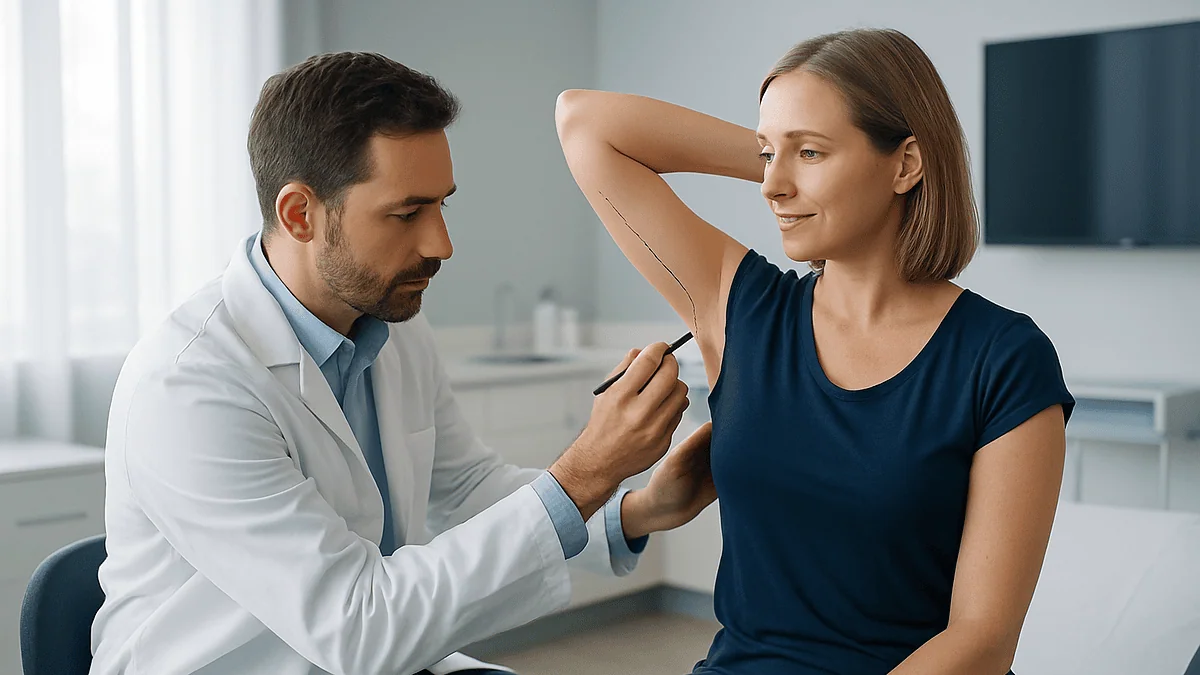
- Surgeons mark the skin while the patient is upright because loose skin spreads and looks smaller when a person is lying down.
- Liposuction is often done before the skin is cut to thin the remaining tissue and protect the small vessels and lymphatics that keep the wound edges alive.
- The wound is closed in layers, with deep absorbable stitches carrying the tension so the skin scar is less likely to widen as the arm moves.
- The NHS puts the operation at about two hours, with discharge the same day or after one night, roughly two weeks off work and four to six weeks before strenuous activity.
- Scars stay red and firm for months and take a year or longer to mature, and protecting them from sun is the most evidence-supported step for their appearance.
Arm lift surgery (brachioplasty) is done under general anesthesia or sedation. The surgeon marks the loose skin, makes an incision along the inner or back surface of the upper arm, often from elbow to armpit, removes the excess skin and some fat, may use liposuction to thin remaining tissue, then closes the wound in layers with sutures. Incision length depends on how much skin must be removed. Most people go home the same day or after one night.
The moment usually arrives in front of a mirror, arm raised to wave or to reach a high shelf. The skin along the underside of the upper arm swings a beat after the arm stops. It has been like that since the weight came off, or since the years added up, and no number of triceps dips has changed it.
Searching “how is arm lift surgery done” tends to follow. The answers online are often either glossy or vague: a photograph, a promise, a single line about “removing excess skin.” What people actually want to know is more practical. Where exactly does the incision go? How long is it? What is taken out, what is left, and how is the arm put back together?
This explainer walks through the operation in the order it happens, from the pen marks on the skin to the last suture, with the evidence behind each step and honest notes about what remains uncertain.
How is arm lift surgery done? The short version
Brachioplasty is a body-contouring operation that removes loose skin and fat from the upper arm. The core idea is simple: skin that has lost its ability to snap back is cut away, and the edges of what remains are brought together so the arm sits closer to the underlying muscle.
In practice the operation has four movements. First, the surgeon draws on the arm while the patient is awake and standing or sitting, because skin hangs differently when someone is lying flat. Second, once anesthesia has taken effect, an incision is made along a line that usually runs from the inner elbow toward the armpit. Third, a wedge of skin and the fat directly beneath it is lifted off the arm and removed; liposuction is often used at the same time to thin the tissue that stays. Fourth, the wound is closed in layers, deep stitches first, then the skin.
Mayo Clinic describes the procedure as typically taking a few hours and being performed under general anesthesia or intravenous sedation with local anesthetic, depending on the extent of work planned. The NHS notes that an arm lift is usually carried out under general anesthetic and that people may go home the same day or stay one night.
Everything else in this article is detail hanging off that frame. The length of the incision, whether a drain is used, how much fat is removed and how long the arm stays wrapped afterward all depend on how much skin has to go, where it sits, and the judgment of the operating team. Those decisions belong to the surgeon and the patient in consultation, not to any article.
Why loose upper-arm skin does not respond to exercise
The frustration that leads people to this operation usually has a clear mechanism behind it. Skin is a living fabric made of collagen and elastin fibers. Collagen gives it strength; elastin lets it stretch and return. When the arm carries more volume for a long time, whether from weight gain or from the natural fat distribution of midlife, those fibers are stretched. Some elastin fibers fracture. Collagen remodels into a longer, looser weave.
Lose the volume, and the skin does not always follow. The Cleveland Clinic and Mayo Clinic both describe this as the reason loose skin persists after significant weight loss: the envelope is now larger than what it contains. Sun exposure, smoking and age accelerate the loss of elasticity because they damage the same fibers.
Exercise strengthens the triceps and can add muscle bulk that partially fills the space, and for some people that is enough. Muscle cannot shorten skin, though. A sleeve that has stretched two sizes stays two sizes larger no matter how firm the arm inside it becomes. That is why the operation is fundamentally a skin operation, with fat removal as a supporting step rather than the main event.
Understanding this also explains why surgeons divide patients by what predominates. Someone whose arm is mostly excess fat with good skin recoil may be better served by liposuction alone. Someone with a large fold of thin, crepey skin and little fat needs the skin excision, and no amount of suction would help. Most people sit somewhere in between, which is why the two techniques are so often combined.
Who is brachioplasty usually for, and who is asked to wait
Mayo Clinic frames the typical candidate as an adult with significant loose skin on the underside of the upper arm, at a stable weight, who does not smoke and has no medical condition that would impair healing. Each of those items is a clinical judgment, not a checklist for self-selection, and the treating team makes the final call.
Stable weight matters because the operation removes a fixed amount of skin. If someone loses another substantial amount afterward, new laxity can appear. After bariatric surgery, teams generally wait until weight has plateaued for a period of months and nutritional status has recovered, because protein and micronutrient deficits slow wound healing.
Smoking is taken seriously. Nicotine narrows small blood vessels, and the skin edges of an arm lift depend on those vessels to survive. Mayo Clinic notes that smokers are usually asked to stop before and after surgery; the NHS gives similar advice for all cosmetic operations. This is not moralizing. It is about whether the wound edge stays pink.
People commonly asked to wait or reconsider include those with:
- Weight that is still changing, or plans for further weight loss.
- Uncontrolled diabetes or other conditions that impair circulation or healing.
- A history of lymphedema or prior lymph node surgery in the armpit, because the incision passes near lymphatic channels.
- Expectations that the arm will look as if no surgery took place; a visible scar is certain.
There is no single “best age.” Skin quality, health and weight stability count for more than the number on a birth certificate, and a healthy person in their sixties may be a more straightforward candidate than a younger person with unstable weight.
Arm lift incision types and where the scar sits
Incision length is the question people ask most, and the honest answer is that it is proportional to the problem. Surgeons broadly describe three patterns, though they blend into one another in practice.
| Technique | Where the incision runs | Usually chosen when |
|---|---|---|
| Limited (mini) brachioplasty | Hidden in the armpit fold; sometimes a short extension onto the inner arm | Laxity is confined to the upper third of the arm near the armpit |
| Standard brachioplasty | From the armpit to just above or at the elbow, on the inner arm or slightly toward the back | Loose skin extends along most of the upper arm; the most common pattern |
| Extended brachioplasty | Standard incision continued through the armpit onto the side of the chest wall | Excess skin continues under the arm onto the torso, often after major weight loss |
Mayo Clinic describes the incision as typically placed on the back or inner side of the arm, extending from the underarm to just above the elbow, with the exact position chosen by the surgeon. The two placements trade different things. An incision along the inner arm is hidden when the arm rests against the body but visible when arms are raised. One set further toward the back of the arm is less visible from the front but more visible from behind. Neither is invisible.
Some surgeons also use a zigzag or wavy line rather than a straight one, especially across the armpit, so the healing scar does not tighten into a tight band that restricts arm movement. A scar that runs straight across a joint tends to contract; breaking the line lets it stretch.
On the day: marking, consent and anesthesia
The most important part of an arm lift happens before anyone is asleep. With the patient upright and the arm held out to the side, the surgeon pinches the loose skin between thumb and fingers to judge how much can be removed while still allowing the wound to close without tension. Those pinch tests become a pattern of pen marks: the line where the incision will go, and the line to which the skin edge will be brought.
Marking upright matters because gravity changes everything. Lying down, the excess skin spreads out over the arm and looks smaller than it is. Marks made in that position risk leaving loose skin behind or, worse, planning a removal that turns out too generous once the patient stands.
Consent is reviewed at the same visit or shortly before. The NHS guidance on cosmetic surgery describes what a proper consent conversation should cover: the intended benefit, the specific risks, the alternatives including doing nothing, the expected scar and the recovery. The NHS also advises a cooling-off period between the first consultation and the operation so the decision is not rushed.
Anesthesia is then chosen for the plan. General anesthesia, in which the patient is fully unconscious and breathing is supported, is common for standard and extended arm lifts. Intravenous sedation with local anesthetic infiltrated into the arm is sometimes used for shorter procedures. The NHS describes general anesthesia as a controlled state of unconsciousness produced and monitored by an anesthetist throughout, with the drugs and their amounts entirely the anesthetist’s decision based on the patient’s health and the operation planned.
Step by step in the operating room: how is arm lift surgery done
Once anesthesia is established, the arm is positioned out to the side on a padded board and the skin is cleaned with antiseptic. Many surgeons first inject a dilute solution of salt water, local anesthetic and a small amount of a vessel-constricting agent into the fat layer. This is called tumescent infiltration, and it does two things: it reduces bleeding by squeezing small vessels shut, and it firms the tissue so instruments move through it more easily.
Liposuction often comes next, when it is part of the plan. A thin hollow tube called a cannula is passed through small openings and moved back and forth to suction fat from beneath the skin that will remain. Thinning this layer lets the remaining skin drape more smoothly and, importantly, preserves the network of tiny lymphatic and blood vessels that run through the fat, which reduces swelling and the risk of the wound edges losing their blood supply.
The incision follows the marked line. The surgeon cuts through skin and the fat beneath it down to the layer of tough connective tissue over the muscle, called the fascia, but not into the muscle itself. The wedge of skin between the two marked lines is lifted away and removed. A careful surgeon checks the pinch again at this stage: it is far easier to trim a little more than to replace what has been cut.
Bleeding points are sealed with cautery, a small electrical instrument that heats tissue to close vessels. The wound bed is inspected for any leaking vessels before closure begins, because blood collecting under the skin afterward, called a hematoma, is one of the more common early complications and often traces back to a vessel missed at this moment.
Closure: layers, sutures, drains and dressings
Closure is where the scar is decided. The wound is brought together in layers rather than with a single row of skin stitches, because a wound held only at the surface tends to spread into a wide, flat scar as the arm moves.
The deepest layer is often anchored to the fascia near the armpit, which helps keep the scar from drifting down the arm as swelling settles. The next layer, the fat and the fibrous tissue just under the skin, is closed with absorbable sutures that the body breaks down over weeks to months. These take the tension. The skin itself is then closed with fine sutures, either absorbable stitches placed just under the surface so nothing shows, or removable stitches taken out at a follow-up visit, or surgical glue and adhesive strips. Each option has trade-offs, and the choice is the surgeon’s.
Drains are small soft tubes left in the wound and connected to a collection bulb. They remove fluid that would otherwise pool under the skin. Not every surgeon uses them; those who do usually remove them within days once output falls. Mayo Clinic notes that drains may be placed and that instructions on emptying and recording the fluid are given before discharge.
Finally the arm is dressed and wrapped in a compression garment or elastic bandage from hand toward shoulder. Compression limits swelling, supports the healing tissue and reduces the space where fluid can gather. MedlinePlus advises keeping surgical dressings clean and dry and following the team’s instructions on when and how to change them, rather than improvising.
How long does an arm lift take, and will you stay overnight?
Operating time varies with the pattern. The NHS states that an arm lift takes about two hours, and Mayo Clinic gives a range that depends on the extent of tissue removed and whether liposuction is included. A limited armpit-only procedure on one side can be considerably shorter; an extended brachioplasty onto the chest wall, done on both arms, sits toward the longer end. The clock also includes anesthesia induction and emergence, positioning and the final dressing, so the time a family member waits is longer than the incision-to-closure interval.
Both arms are almost always done in the same session so they heal symmetrically and the person is not left one-handed for two separate recoveries.
Whether you stay the night depends on the length of the operation, your general health and the anesthetic used. The NHS notes that people having an arm lift may go home the same day or stay in hospital for one night. Mayo Clinic describes the operation as usually done on an outpatient basis. A longer combined procedure, a history of nausea after anesthesia, or living alone may tip the decision toward an overnight stay. Someone else must drive you home and ideally stay with you for the first night after general anesthesia; the NHS is explicit that judgment and coordination remain impaired for 24 hours afterward.
Before discharge the team typically checks that pain is controlled with what has been prescribed, that you can pass urine, that the dressings are dry, and that you understand how to care for drains if you have them. Decisions about pain medicine are the prescribing clinician’s, based on your history.
Is arm lift surgery painful? What the first week actually feels like
Pain after brachioplasty is real but, for most people, described more as tightness and soreness than sharp pain. The skin has been pulled snug over the arm, so straightening the elbow fully or lifting the arm stretches the wound and stings. Areas that were liposuctioned often feel bruised, as if the arm has been squeezed hard, and may be numb or tingly for weeks because small sensory nerves in the fat were disturbed.
The first two to three days are usually the most uncomfortable. Mayo Clinic notes that pain, swelling and bruising are expected in the early period and that the team will discuss pain management before discharge. The medicines used are decided by the prescribing clinician. In general terms, teams aim to combine approaches with different mechanisms, such as anti-inflammatory action and central pain modulation, so that stronger medicines can be tapered quickly. Whatever is prescribed, the timeline and any changes belong to the clinician who knows your history.
Practical measures do a lot of the work. Keeping the arms elevated on pillows above heart level while resting reduces throbbing. Wearing the compression garment as instructed limits swelling, and swelling is a major driver of pain. Short, frequent walks around the house improve circulation and mood.
Numbness along the inner arm and forearm deserves a mention because it alarms people. A sensory nerve runs close to the surgical field, and stretching or bruising it during surgery is common. Sensation often returns over weeks to months; occasionally a patch stays permanently numb, and the treating team should discuss that possibility before surgery.
Brachioplasty recovery time, week by week
Recovery has a recognizable shape, though individual timelines vary and the treating team’s instructions override any general outline.
In the first week, the arms stay wrapped or in compression. Drains, if used, usually come out within a few days once fluid output drops. Showering guidance depends on the dressing type. Movement is encouraged for the legs and body; the arms should not be raised above shoulder height. The NHS notes that most people need about two weeks off work, longer for physically demanding jobs.
Weeks two to four bring the first follow-up visits. Removable stitches, if used, come out. Bruising fades from purple to yellow. Mayo Clinic advises avoiding lifting the arms above shoulder level and avoiding heavy lifting for a period the surgeon specifies; the NHS advises avoiding strenuous exercise and stretching for four to six weeks. Driving is usually possible once the arms can turn a wheel comfortably and no sedating medicine is being taken, a decision to confirm with the team.
Weeks four to eight are when most people return to full daily activity and gradually reintroduce exercise as advised. Swelling continues to settle; the arms may look slightly different from each other for a while.
The scar has its own, much longer timeline. Mayo Clinic and the NHS both describe scars as red or dark and firm for months before softening and fading, a process that can take a year or more. Protecting the scar from sun is the single most evidence-supported thing a person can do for its appearance, because ultraviolet light darkens immature scar tissue.
How risky is an arm lift? Complications in plain language
Every operation carries risk, and brachioplasty has a particular profile because it involves a long incision in a mobile area with a rich lymphatic supply. Mayo Clinic and the NHS list the following as recognized risks, and a good consent conversation covers each.
- Scarring: unavoidable. In some people the scar widens, thickens or becomes raised (hypertrophic or keloid), which is more common in people with darker skin tones and anyone with a personal history of poor scarring.
- Fluid collections: a seroma is clear fluid pooling under the skin; a hematoma is blood. Small collections may resolve alone; larger ones may need drainage.
- Wound healing problems: the edges may separate, especially near the elbow or armpit where tension is highest, or a section of skin may lose blood supply.
- Infection: redness, warmth and discharge at the wound.
- Numbness or nerve irritation: along the inner arm and forearm, usually temporary, sometimes permanent.
- Asymmetry or contour irregularity: the two arms may not match perfectly, and revision surgery is sometimes discussed.
- Lymphedema: swelling of the arm from disrupted lymph drainage, uncommon but important.
- Anesthesia risks and blood clots: shared with all surgery. The NHS describes serious anesthetic complications as rare and lists deep vein thrombosis as a risk of any operation, especially when mobility is reduced afterward.
Percentages for these events vary widely between studies and depend on the technique, the population and how outcomes are defined, so this article does not quote a single figure. The most useful question to put to a surgeon is not “what is the risk” in the abstract, but “in your practice, how do you reduce each of these, and what happens if one occurs.”
Alternatives to brachioplasty: what the evidence supports
Surgery is one option among several, and neutral alternatives deserve a fair hearing.
Liposuction alone suits people whose main issue is fat rather than skin, and whose skin still has enough elasticity to shrink after the volume beneath it is removed. Mayo Clinic notes that liposuction may be recommended instead of, or alongside, an arm lift depending on skin quality. Remove fat from an arm with poor skin recoil, however, and the skin may hang more, not less.
Weight stability and strength training remain the foundation for anyone still losing weight or considering surgery later. Building the triceps and deltoid adds shape and fills some of the loose envelope, and being at a stable weight makes any later operation more predictable.
Non-surgical skin-tightening devices using radiofrequency, ultrasound or laser energy heat the deeper skin layers to stimulate collagen. Mainstream sources such as Cleveland Clinic describe these as producing modest tightening in people with mild laxity. The evidence does not support them for the large folds that lead most people to consider brachioplasty, and results vary. They are not equivalent to skin removal, and claims that they can replace surgery in significant laxity are not supported by current evidence.
Doing nothing is also an alternative, and the NHS cosmetic surgery guidance explicitly frames it as one. Loose upper-arm skin is not a medical hazard for most people. It is a matter of appearance, comfort and sometimes chafing or rashes in the skin fold. Whether those concerns are worth a permanent scar and a recovery is a personal decision, made with the treating team and without pressure from anyone else.
What people often get wrong about arm lifts
“The scar is hidden.” It is not. It can be placed where it is less noticeable in some positions, but a standard brachioplasty scar runs most of the length of the upper arm and is visible whenever the arm is raised or turned. Anyone told otherwise should ask to see photographs of scars at one year in patients with similar skin tone.
“There is a best age.” There is not. Candidacy rests on skin quality, health, weight stability and realistic expectations. Mayo Clinic’s description of a suitable candidate does not include an age.
“It removes fat, so it is like weight loss.” The amount of tissue removed is measured in the size of a skin flap, not in the scale reading. This is a contouring operation, not a weight-loss one, and the NHS is clear that cosmetic procedures should not be viewed as a substitute for weight management.
“I can find the average cost online and budget from it.” Costs vary with technique, anesthesia type, facility, geography and follow-up care, and a headline figure rarely reflects the full package. This article does not publish prices. The useful step is to ask the treating team for a written, itemized estimate that includes revision policy and follow-up.
“Compression garments are optional.” Most surgeons regard them as part of the operation, not an accessory. They limit swelling and seroma.
“Exercise will fix it if I try harder.” Muscle cannot shorten stretched skin. Effort is not the missing variable; elasticity is.
“Once healed, it lasts forever regardless.” The result holds best at a stable weight. Significant weight change, and ordinary aging, continue to affect the skin.
Questions to ask your care team before an arm lift
A good consultation leaves you with fewer questions than you arrived with. These are worth taking in writing.
- Which incision pattern do you recommend for my arms, and why that one rather than a shorter or longer version?
- Where exactly will the scar sit, and can I see one-year photographs of scars on people with skin similar to mine?
- Will liposuction be part of the operation, and what will it change about the result and the recovery?
- Which type of anesthesia do you plan, and who will be giving it?
- Do you use drains? If so, how long do they usually stay, and how will I manage them at home?
- What kind of sutures will close the skin, and will any need removing?
- How long should I plan to be off work for my specific job, and when can I lift my arms overhead, drive and exercise?
- What wound problems do you see most often, and what is your plan if a wound edge opens or a fluid collection forms?
- What is your policy on revision if the arms are asymmetric or the scar is unsatisfactory?
- How should I prepare: weight stability, smoking, current medicines and supplements, and anything that needs to change before surgery?
- Who do I call out of hours if something worries me, and what number?
The NHS also recommends confirming the surgeon’s registration and specialty, checking that the facility is appropriately regulated, and taking time between consultation and decision. None of this is about distrust. It is about the fact that a permanent change to your body deserves the same diligence as any other major decision, and the team that answers patiently is the team that will be there afterward.
When to call your doctor after arm lift surgery
Most recoveries are uneventful, and a certain amount of swelling, bruising, tightness and numbness is expected. Some signs, however, should prompt a same-day call to the surgical team, and a few warrant emergency care.
Contact your team promptly if you notice:
- Spreading redness, increasing warmth or new swelling around the incision, or a wound that begins to gape or leak cloudy or foul-smelling fluid. MedlinePlus lists these as signs of possible surgical wound infection.
- One arm becoming markedly larger, tighter or more painful than the other, especially quickly, which can indicate blood or fluid collecting under the skin.
- Fever, or feeling generally unwell in a way that is worsening rather than settling.
- Skin near the wound turning dusky, purple or black, which can signal a compromised blood supply.
- Pain that escalates instead of easing after the first few days, or that is not controlled by what has been prescribed.
- Numbness or weakness in the hand that is new or getting worse.
Seek emergency care immediately for chest pain, sudden shortness of breath, coughing up blood, or a swollen, painful calf. MedlinePlus and Mayo Clinic describe these as possible signs of a blood clot in the leg that has travelled to the lungs, a recognized complication after any surgery, particularly when movement has been limited.
Also seek urgent help for heavy bleeding that soaks through dressings and does not stop with firm pressure, or for any sudden confusion, fainting or a rapid heartbeat.
When unsure, call. Surgical teams would far rather hear about a concern that turns out to be nothing than discover a problem late. The decision about what needs to be seen, and when, sits with the clinicians who know your operation.
Frequently asked questions
How painful is an arm lift procedure?
Most people describe the first few days as tight, sore and bruised rather than sharply painful, with the worst discomfort in the first two to three days. Straightening the elbow and raising the arm stretches the wound and stings. Elevation, compression and short walks help, and the medicines used are decided by the prescribing clinician based on your history. Numbness along the inner arm is common and usually improves over weeks to months.
What is the average cost of an arm lift?
There is no single reliable figure, because cost depends on the incision pattern, whether liposuction is included, the anesthesia type, the facility, the region and the follow-up package. This magazine does not publish prices. The practical step is to ask the treating team for a written, itemized estimate that spells out what is included, what happens if a revision is needed, and how follow-up visits are covered.
What's the best age for an arm lift?
There is no best age. Suitability rests on skin quality, overall health, a stable weight and realistic expectations rather than a birth date. Mayo Clinic’s description of a suitable candidate focuses on those factors. A healthy person in their sixties with stable weight may be a more straightforward candidate than someone younger who is still losing weight or smokes. The treating team makes the assessment.
How risky is an arm lift?
It carries the general risks of surgery, such as bleeding, infection, anesthesia complications and blood clots, plus risks specific to a long arm incision: visible or widened scarring, fluid collections, wound-edge separation, numbness along the inner arm, asymmetry and, uncommonly, lymphedema. Published complication rates vary widely with technique and population, so no single percentage is quoted here. Ask your surgeon how each risk is reduced in their practice.
What are the different arm lift incision types?
Three broad patterns exist. A limited or mini brachioplasty hides the incision in the armpit fold for laxity near the top of the arm. A standard brachioplasty runs from armpit to near the elbow along the inner or back of the arm. An extended brachioplasty continues through the armpit onto the side of the chest for skin excess that spills onto the torso, common after major weight loss.
How long is brachioplasty recovery time?
The NHS suggests about two weeks off work and four to six weeks avoiding strenuous exercise and stretching. Mayo Clinic advises keeping the arms below shoulder level and avoiding heavy lifting for a period your surgeon specifies. Swelling settles over weeks to a few months. The scar takes a year or more to fade and soften. Individual timelines vary and your team’s instructions take precedence.
Will arm lift scars fade?
Scars mature rather than disappear. They are typically red or dark, raised and firm for several months, then gradually flatten, soften and lighten over a year or longer. Some people develop wider or thickened scars, more often with darker skin tones or a history of poor scarring. Sun protection is the most evidence-supported step for scar appearance. Ask to see one-year photographs before deciding.
Is liposuction always part of an arm lift?
No. Liposuction is added when fat as well as skin contributes to the fullness, or to thin the tissue that stays so the skin drapes smoothly. In someone with thin, crepey skin and little fat, the operation may be skin excision alone. In someone with good skin recoil and mostly fat, liposuction alone may be suggested instead of an arm lift. The surgeon decides based on examination.
Do I have to stay in hospital after an arm lift?
Often not. The NHS notes that people may go home the same day or stay one night, and Mayo Clinic describes the operation as usually outpatient. Longer combined procedures, a history of anesthesia-related nausea or living alone can tip the decision toward an overnight stay. After general anesthesia someone else must drive you home, and an adult should stay with you for the first night.
What happens if a wound opens after an arm lift?
Small separations, most often near the elbow or armpit where tension is highest, are usually managed with wound care and dressings while the area heals from the base upward, which can take weeks. Larger openings or any sign of infection, such as spreading redness, warmth or cloudy discharge, need prompt review by the surgical team. Do not treat an opening at home without instructions; call the team.
References
This article is for general information only and is not a substitute for professional medical advice. Please consult a qualified doctor about your individual situation.

More from the Blog
Pectoral Augmentation Recovery: When Chest Training Can Restart Without Risking the Implant
After pectoral augmentation, surgeons typically ask patients to avoid direct chest training for roughly six to eight weeks. Gentle walking usually starts within a…

Tumescent vs Traditional Liposuction: What the Diluted Anesthetic Changes for Patients
Tumescent liposuction infiltrates the fat layer with a large volume of very dilute local anesthetic, a blood-vessel-constricting agent and saline before fat is suctioned,…

Mini vs Full Arm Lift: Short-Scar Brachioplasty and When Only a Full Incision Will Do
A mini arm lift, also called a short-scar brachioplasty, removes a limited amount of loose upper-arm skin through an incision hidden in the armpit…

Why Thigh Lift Incisions Heal Slowly Near the Groin and Which Signs Need a Call
Thigh lift incisions near the groin heal slowly because the skin there is thin, constantly moving, warm, moist and under tension every time you…

Which Concerns Can Aesthetic Genital Surgery Address? Comfort, Anatomy and Candidacy
Aesthetic genital surgery most often addresses physical discomfort from labial tissue that chafes, pulls or twists during exercise, sex or in fitted clothing; visible…

Who Is a Candidate for J Plasma? Mild Loose Skin vs Cases That Need a Surgical Lift
A typical J Plasma candidate has mild to moderate loose skin with reasonable elasticity, a stable weight, and is already planning liposuction in the…