

How Dimple Creation Surgery Is Done: The Inside-the-Cheek Incision and Anchoring Suture

Key Takeaways
- A surgical dimple is created by a scar tether between the underside of the skin and the buccinator muscle, not by carving the cheek.
- The entire procedure is performed through an incision inside the mouth, so there is no external scar on the face.
- A newly created dimple is usually visible at rest and looks deeper than intended for several weeks before it softens into a smile-only indentation.
- The buccal branches of the facial nerve and the parotid saliva duct run close to the dimple site, which is why nerve weakness and saliva leakage appear on every risk list.
- No device, suction tool or exercise has mainstream medical evidence for creating a lasting dimple, because surface pressure cannot form the internal tether the effect requires.
- Reversing a matured dimpleplasty is less predictable than creating one, which is why surgeons encourage a reflection period before consenting.
Dimpleplasty is a short outpatient procedure, usually done under local anesthesia, in which a surgeon marks the desired spot on the cheek, makes a small incision on the inside of the mouth, removes a tiny core of soft tissue beneath the skin, and places an anchoring suture that tethers the underside of the skin to the cheek muscle so the skin folds inward when you smile.
She had practiced the smile in a bathroom mirror for years, pressing a fingertip into each cheek to see what a dimple might look like. Now she was sitting on an exam table with a surgical marker hovering near her face, asking the question most people ask far too late in the process: what, exactly, is about to happen in there?
It is a fair question, because dimple creation surgery is small in scale but not small in detail. Everything happens through the lining of the mouth. Nothing is cut on the outside of the face. And the whole effect depends on a single stitch placed in a very specific layer of tissue.
If you have been searching for how dimpleplasty is done, this explainer walks through the anatomy, the incision, the anchoring suture, the weeks that follow, and the honest limits of what the evidence can tell you.
What a dimpleplasty actually is, in plain language
A dimple is a small indentation in the cheek that appears, or deepens, when a person smiles. In people born with dimples, the usual explanation is a variation in the buccinator, the flat cheek muscle that helps you chew and whistle. A split or short band in that muscle tugs the overlying skin inward each time the face moves, and the skin dips into the gap.
Dimpleplasty, also called dimple creation surgery, is an elective cosmetic procedure that imitates that anatomy on purpose. Cleveland Clinic describes it as a minor operation, most often performed under local anesthesia in an office or outpatient setting, that creates a permanent or long-lasting indentation in one or both cheeks.
The idea is straightforward. A surgeon creates a small area of scar between the skin and the muscle so that, when the muscle contracts, the skin is pulled inward at that one point. The scar is deliberate and internal. The outside of the cheek is never incised.
Three words come up repeatedly in any honest explanation, so it helps to define them once. The mucosa is the moist lining inside the cheek. The dermis is the deeper, tougher layer of skin beneath the surface you can see. An anchoring suture is a stitch that ties one layer of tissue to another so they heal together.
Everything else in this article is a variation on how those three pieces are brought into contact, and what happens in the body when they are.
How is dimpleplasty done, step by step?
Techniques differ from surgeon to surgeon, but the published descriptions and mainstream patient resources such as Cleveland Clinic outline a common sequence.

First comes marking. Sitting upright, you smile while the surgeon identifies the point on the cheek where a dimple would fall naturally. That mark is checked against the other side of the face and confirmed with you in a mirror before anything else happens.
Second is anesthesia. A local anesthetic, a medicine that numbs a small area, is injected into the cheek from inside the mouth. Most people remain awake. Sedation is sometimes offered, and that decision belongs to you and the surgical team.
Third is the incision. Working through the open mouth, the surgeon makes a small cut in the mucosa directly beneath the external mark. Some surgeons make a straight line; others remove a small oval or circle of lining.
Fourth is tissue removal. A tiny core of soft tissue, sometimes including a sliver of buccinator muscle, is taken out from just under the dermis. This creates the pocket that will become the dimple.
Fifth is the anchoring suture. A stitch is passed through the underside of the skin, through the muscle layer, and back through the mucosa, then tied so the skin is drawn inward toward the cheek. That single knot is what produces the indentation.
Finally the mucosal opening is closed, usually with a stitch that dissolves on its own. Cleveland Clinic notes the entire process typically takes well under an hour.
Why the incision is made inside the cheek
People are often surprised that a procedure changing the outside of the face leaves no mark on the outside of the face. The reason is practical anatomy rather than cleverness.
The buccinator sits only a few millimeters beneath the mucosa. Approaching it from inside the mouth means the surgeon reaches the target layer with the shortest possible path and without crossing the skin at all. Any external cut on the cheek would heal as a visible line, and a line is the opposite of what someone asking for a dimple wants.
The mouth’s lining also heals differently from skin. Oral mucosa is bathed in saliva, has a rich blood supply, and turns over rapidly. MedlinePlus and NHS guidance on wound care describe how small mucosal wounds tend to close quickly and leave little visible trace, which is why dental and oral surgeons routinely operate there.
There is a trade-off, and it deserves plain acknowledgment. The mouth is not sterile. Every incision inside it is exposed to bacteria from the moment it is made, which is why surgeons emphasize rinsing and gentle oral hygiene afterward, and why infection sits near the top of every risk discussion. The inside approach is chosen not because it is risk-free but because a hidden incision with a manageable infection risk is generally preferred over a visible external scar.
One more consequence follows from the internal approach: because the surgeon cannot see the cheek from the outside while working through the mouth, the pre-operative marking has to be precise. The dimple ends up wherever the stitch is placed, not wherever it was imagined.
The anchoring suture: the stitch that does the work
If you remember one thing about how dimpleplasty is done, make it this: the dimple is not carved, it is tethered.
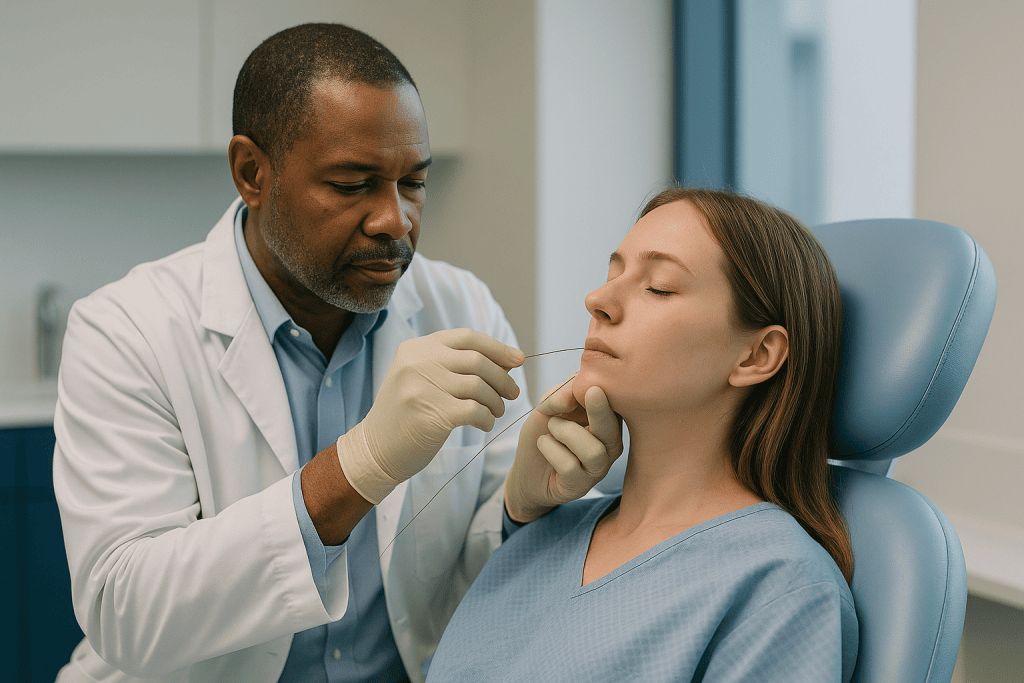
Removing a core of tissue alone would not create a lasting indentation. Soft tissue is elastic and the pocket would simply fill in as it heals. What gives the dimple its shape is the anchoring suture, which pulls the underside of the dermis down toward the buccinator and holds those two layers in contact while scar tissue forms between them.
The mechanism works like this. Scar is the body’s glue. When two raw tissue surfaces are held together for long enough, fibroblasts, the cells that build connective tissue, lay down collagen fibers across the gap. Once that bridge matures, the skin and muscle are permanently linked at one small point. Each time the buccinator contracts in a smile, it drags that point of skin inward.
Surgeons choose between absorbable sutures, which the body breaks down over weeks, and permanent sutures, which remain. Either can work, because the goal of the stitch is temporary: to hold the layers together only until the scar can take over. The published surgical literature describes several variations, including differences in how many passes the needle makes and how tightly the knot is tied.
Tension matters. A knot tied too loosely may fail before the scar forms, and the dimple fades. A knot tied too tightly can produce a deep, puckered indentation visible even when the face is at rest. Judging that middle ground is a matter of surgical experience rather than a fixed measurement, which is one reason results vary between individuals.
What lies under the cheek that the surgeon must avoid
The cheek looks like a simple slab of soft tissue. It is closer to a crowded intersection. Several structures run through the same few centimeters where a dimple is placed, and knowing them explains most of the safety rules around the procedure.
The buccinator is the target. Sitting just beneath the oral lining, it is the muscle the anchoring suture ties into.
The buccal fat pad is a soft cushion of fat lying just outside the buccinator. It gives the mid-cheek its roundness. Removing too much tissue during a dimpleplasty can encroach on it, which is why surgeons take a small core rather than a generous one.
The parotid duct is a small tube that carries saliva from the parotid gland, in front of the ear, into the mouth. It opens on the inside of the cheek at about the level of the upper second molar. An incision placed too high or too far back risks injuring it, which can cause saliva to leak into the cheek tissue.
Branches of the facial nerve run across the cheek to power the muscles of expression. The buccal branches lie in roughly the same region as the dimple. Cleveland Clinic lists facial nerve injury among the recognized, though uncommon, risks of the procedure. Damage can weaken part of the smile.
Finally, the facial artery and vein pass nearby. Nicking them causes bleeding and bruising rather than lasting harm in most cases, but it is why a purple cheek for several days is a normal post-operative finding.
A surgeon working from inside the mouth cannot see any of this directly. Anatomy knowledge and careful, shallow dissection are the safeguards.
Where does the dimple go? Marking, landmarks and symmetry
Ask a room of people to point to where a dimple belongs and most fingers land in roughly the same place, yet ask surgeons and they will tell you the margin for error is a few millimeters.
Natural dimples usually appear lateral to the corner of the mouth and slightly above it, on the fullest part of the cheek during a smile. A widely referenced surgical landmark places the dimple where a horizontal line drawn from the corner of the mouth crosses a vertical line dropped from the outer corner of the eye. Many surgeons use this as a starting point and then adjust while the patient smiles, because faces are not geometrically identical.
Marking is done with you sitting up, not lying down. Gravity changes cheek position, and a mark placed on a reclined face can look wrong once you stand. You are typically asked to smile, relax, and smile again while the surgeon confirms the spot and checks both sides against each other.
Symmetry deserves realistic expectations. Human faces are asymmetric to begin with. A dimple placed at the mirror-image coordinate on each side may still look uneven if one cheek is fuller or one side of the mouth lifts higher when you smile. Surgeons often place marks that look slightly off when the face is at rest precisely so they match during the expression that matters.
Single-dimple requests are handled the same way, but with an extra conversation: the surgeon will want to know whether you have any natural dimple, faint or otherwise, on the opposite cheek that should be matched rather than ignored.
Who dimpleplasty is usually for, and who is usually asked to wait
Because dimpleplasty is purely cosmetic, the question of who is a candidate is less about medical necessity and more about safety, timing, and expectations.
Adults in good general health who understand what the procedure can and cannot do make up most candidates. Mayo Clinic and the NHS both emphasize that any cosmetic operation should follow a consultation where the surgeon explains the procedure, its risks, and realistic outcomes, and where the patient has time to reflect before committing.
Several situations commonly prompt a surgeon to pause or decline.
- Active oral infection, untreated dental disease, or gum inflammation, because the incision sits in the same environment.
- Conditions that impair healing, such as poorly controlled diabetes, or treatments that suppress the immune system.
- A history of abnormal scarring, since the result depends on scar forming predictably in one small place.
- Smoking, which reduces blood flow to healing tissue and is associated with higher wound complication rates across many surgical fields.
- Uncertainty about the decision, or pressure from someone else to have the procedure.
Age is handled carefully. Cheek fullness changes substantially through adolescence and again with aging, and a dimple placed on a face that is still changing may migrate or look different years later. Many surgeons prefer to operate only on adults, and the NHS cautions against cosmetic procedures being undertaken lightly by anyone under eighteen.
Body dysmorphic disorder, a condition in which a person is preoccupied with perceived flaws that others barely notice, is a recognized reason for referral to mental health support rather than surgery. A reputable surgeon will ask about motivation, and that conversation is a sign of good care rather than an obstacle.
How painful is dimpleplasty?
People searching for how painful dimpleplasty is tend to fear the surgery itself. In practice, the operation is usually the least uncomfortable part.
Local anesthetic, injected from inside the mouth, numbs the cheek before any cutting begins. The injection itself produces a brief sting and pressure, similar to what most people experience at a dental appointment. Once the medicine takes effect, patients typically report tugging and pressure but not sharp pain during the incision and suturing.
Discomfort tends to arrive after the numbness fades, generally within a few hours. Cleveland Clinic describes the expected experience as mild to moderate soreness, swelling, and bruising in the cheek over the first several days, with the inside of the mouth feeling tender when chewing or opening wide. The tightness of the anchoring suture can also give a sensation of the cheek being pulled inward, which fades as tissue relaxes.
Pain management is usually simple. Surgeons commonly advise cold compresses on the outside of the cheek, soft foods, and salt-water rinses to keep the incision clean. Over-the-counter pain relievers may be suggested; which one, and how it is used, is a decision for your treating team, particularly if you take other medicines or have kidney, liver, or stomach conditions.
Pain that worsens after the third or fourth day rather than improving is not typical and warrants a call to the surgeon, since it can signal infection or a collection of fluid.
A useful comparison is the removal of a small oral lesion or a straightforward dental extraction: an uncomfortable week, not a debilitating one, for most people.
Dimpleplasty recovery time: what the first days and weeks look like
The single most common source of post-operative worry is a dimple that looks wrong in the first week. Understanding the timeline prevents most of that anxiety.
Immediately after surgery, the dimple is present even when your face is at rest. It often appears deeper and more puckered than intended. This is expected. The anchoring suture is holding the skin firmly against the muscle, and the surrounding tissue is swollen.
Over the first several days, swelling and bruising peak and then begin to subside. Cleveland Clinic describes most people returning to ordinary activities within a few days, with soft foods and careful oral hygiene during that window.
Across the following weeks, the resting indentation gradually softens. As the suture loses tension or dissolves and scar tissue matures, the dimple becomes what surgeons call dynamic: present when you smile, faint or absent at rest. Cleveland Clinic and published surgical reports describe this transition taking several weeks to a few months, and the final appearance is usually judged only after that period.
| Stage | What is typical | What you can usually do |
|---|---|---|
| Day of surgery | Numbness, then soreness; dimple visible at rest | Rest, cold compress, soft foods |
| First week | Swelling and bruising peak then ease | Gentle rinses, return to light routine |
| Weeks two to six | Resting dimple softens; incision healed | Normal diet as comfort allows |
| Several months | Dimple mostly dynamic; scar matured | Final assessment with surgeon |
Timelines vary by individual, technique, and suture type. Your surgeon’s instructions take precedence over any general range.
Is dimpleplasty permanent? Natural versus surgical dimples
Is dimpleplasty permanent? The honest answer is that it is designed to be, and it usually is, but not always in the way people imagine.
A natural dimple exists because of muscle anatomy present from birth. It changes with facial fat, so many children with deep dimples find them fainter in adulthood as cheek fullness shifts. A surgical dimple exists because of a scar bridge between skin and muscle. That scar is permanent tissue, but its visual effect depends on the same variables: how much fat surrounds it, how tightly the scar formed, and how the face ages.
| Feature | Natural dimple | Surgical dimple |
|---|---|---|
| Cause | Variation in buccinator muscle | Scar tether between dermis and muscle |
| Present at rest? | Usually faint or absent | Often visible early, fades toward dynamic |
| Changes with weight? | Yes, can soften with fuller cheeks | Yes, same principle |
| Symmetry | Frequently uneven | Planned, but exact match not guaranteed |
| Can it disappear? | Can fade with age | Can fade if scar bridge is weak or fails |
Cleveland Clinic describes surgically created dimples as permanent in most cases, while noting that some patients see the effect diminish. The reasons are mechanical: a suture that loosens before the scar matures, a small core of tissue that fills back in, or later weight gain that pads over the indentation.
Revision is possible when a dimple fades, typically by repeating the anchoring step, and that conversation belongs with the original surgeon, who knows what was done.
What are the downsides of dimpleplasty? Side effects and risks
Every honest answer to what the downsides of dimpleplasty are starts with the same fact: this is real surgery on the face, inside a non-sterile environment, near a nerve that controls expression. The risks are uncommon but not hypothetical.
Cleveland Clinic and general cosmetic surgery guidance from Mayo Clinic identify the following recognized complications.
- Bleeding and bruising, usually minor and self-limiting, occasionally forming a hematoma, a collection of blood under the skin, that may need drainage.
- Infection at the incision, more likely because the mouth harbors bacteria; signs include worsening pain, redness, pus, or fever.
- Asymmetry, where the two dimples differ in depth, position, or shape. Some difference is common; a marked difference may prompt revision.
- Over-correction, a dimple that remains deep and puckered at rest well beyond the expected settling period.
- Under-correction or loss, where the dimple fades as the suture releases before scar forms.
- Facial nerve injury, rare but serious, causing weakness in part of the smile that may be temporary or lasting.
- Parotid duct injury, causing saliva to collect in the cheek.
- Scarring inside the mouth that feels lumpy to the tongue or occasionally causes tightness.
- Numbness or altered sensation in the cheek, usually temporary.
Published figures for how often each occurs come mostly from small surgical case series rather than large registries, so any percentage you encounter online should be treated cautiously. The mainstream summary is that most complications are minor and manageable, while a small number, particularly nerve injury and persistent asymmetry, are difficult to reverse. That imbalance, low frequency but high consequence for a purely cosmetic goal, is the core of an informed decision.
Alternatives to dimpleplasty, and whether the procedure can be reversed
Because the goal is aesthetic, the alternatives are as much about preference as medicine.
Doing nothing is a legitimate option and the one most people ultimately choose. Dimples are a minority trait, and their absence is not a condition.
Makeup can simulate a dimple temporarily with shading, which some people find a useful way to test whether they like the look on their own face before consulting a surgeon.
Non-surgical dimple methods promoted online, including suction devices, pressing tools, and exercises, lack evidence. There is no mainstream medical source describing a device or exercise that creates a lasting dimple, and the anatomy explains why: a dimple requires a structural link between skin and muscle, which pressure on the surface does not produce. Sustained pressure can, however, bruise or injure the skin.
Reversal of a completed dimpleplasty is possible but not simple. Early on, if a permanent suture was used and the result is unwanted, it can sometimes be removed before scar has fully formed, releasing the tether. Later, once scar has matured, reversal means surgically dividing the scar bridge and often placing tissue or fat in the space to prevent it re-forming. The outcome of reversal is less predictable than the original procedure, and a faint indentation may persist.
This asymmetry between how easy it is to create a dimple and how hard it is to undo one is worth sitting with before consenting. Surgeons routinely suggest a waiting period between consultation and procedure for exactly this reason, and the NHS advises taking time to reflect before any cosmetic operation.
What people often get wrong about dimple creation surgery
Cosmetic procedures attract confident myths. These are the ones surgeons hear most, corrected against what the evidence actually supports.
The dimple should look right immediately. It usually looks wrong immediately. A deep, constant indentation in the first weeks is the expected appearance of a tight anchoring suture and swollen tissue, not a mistake. Judgment is deferred until the resting dimple softens.
It is not real surgery. Any procedure that involves an incision, tissue removal, and a suture placed near the facial nerve is surgery, regardless of how long it takes or whether you are awake.
You can create dimples with a device or exercise. No credible medical source supports this. The mechanism of a dimple is a structural tether beneath the skin, which surface pressure cannot create.
Both sides will match exactly. Natural dimples are frequently uneven, and surgical ones follow the same rule. Faces are asymmetric, and a small difference is normal rather than a complication.
Single dimples are unnatural. Some people are born with one dimple, and surgeons create single dimples on request. Paired dimples are more commonly requested, but neither is more correct.
Weight change will not affect it. Both natural and surgical dimples soften when cheeks gain fullness and deepen when fat is lost, because the tether is fixed but the padding around it is not.
Any faded dimple was done badly. Fading can follow a technically sound procedure if the scar bridge does not form robustly. It is a recognized outcome, not necessarily an error, and it is usually correctable.
Questions to ask your care team before dimpleplasty
A good consultation is a conversation, not a sales pitch. The NHS and Mayo Clinic both encourage patients considering cosmetic procedures to ask about the surgeon’s training, the specifics of the technique, and what happens if something goes wrong. These questions, adapted to dimple creation, help you get to the substance.
- What is your training and how often do you perform this specific procedure?
- Will you use an absorbable or permanent suture, and why do you prefer that choice for me?
- How do you decide where to place the dimple, and can we confirm the marking together in a mirror while I smile?
- How deep will the dimple look at rest in the first weeks, and when do you expect it to settle?
- What happens if the dimple fades or the two sides look uneven, and is revision included in your care?
- What is your approach if I decide I want it reversed?
- Which structures in my cheek are you working near, and how do you avoid them?
- What signs after surgery should prompt me to contact you the same day?
- Do any of my medicines, supplements, or health conditions change my risk or need to be adjusted beforehand?
- Where would I be seen if a complication occurred out of hours?
Write the answers down. A surgeon who welcomes these questions and gives specific, unhurried answers is offering you the most useful information available, and one who deflects them is also telling you something.
You are entitled to time. If you feel pressure to decide on the day, that pressure is a reason to leave and think, not a reason to sign.
When to call your doctor after dimple surgery
Most recoveries are uneventful: a sore, bruised cheek that improves day by day. A small number are not, and because the incision sits inside the mouth, problems can develop out of sight. Knowing which signs matter lets you act early.
Contact your surgeon or seek care promptly if you notice any of the following, drawn from MedlinePlus guidance on surgical wound infection and from Cleveland Clinic’s description of dimpleplasty complications.
- Pain that increases after the first few days rather than easing, or pain not controlled by the measures your team advised.
- Spreading redness, warmth, or firm swelling of the cheek, especially if one side is clearly worse than the other.
- Pus, a foul taste, or discharge from the incision inside your mouth.
- Fever, chills, or feeling generally unwell.
- Bleeding from the incision that does not stop with gentle pressure, or a rapidly enlarging, tense swelling that could indicate a hematoma.
- New weakness on one side of the face, difficulty closing the mouth fully, or an asymmetric smile that was not present before surgery.
- A soft swelling in the cheek that fills after eating, which can suggest saliva leaking from an injured duct.
- The incision reopening, or a suture end that is causing persistent irritation.
Seek emergency care for difficulty breathing or swallowing, swelling that is spreading rapidly toward the neck, or an allergic reaction such as hives or facial swelling after any medicine.
Do not attempt to treat a suspected infection on your own or adjust any prescribed medicine without speaking to the prescribing clinician. Your treating team knows exactly what was done in your cheek and is the right first call.
Frequently asked questions
How is dimpleplasty done?
The surgeon marks the cheek while you smile, numbs the area with local anesthetic injected from inside the mouth, makes a small incision in the cheek lining, removes a tiny core of soft tissue beneath the skin, and ties an anchoring suture that pulls the skin toward the cheek muscle. The lining is then closed with a dissolving stitch.
How painful is dimpleplasty?
The procedure itself is usually not painful because of local anesthetic, though the numbing injection stings briefly. Afterward, most people describe mild to moderate soreness, swelling and bruising for several days, with tenderness when chewing. Pain that worsens after the first few days is not typical and should prompt a call to your surgeon.
What are the downsides of dimpleplasty?
Recognized downsides include bleeding, infection inside the mouth, asymmetry between sides, a dimple that stays too deep or fades entirely, altered cheek sensation, and rarely injury to the facial nerve or saliva duct. Reversal is harder than creation. Because the goal is cosmetic, even uncommon complications carry weight in the decision.
Is dimpleplasty permanent?
It is designed to be permanent because it relies on a scar bridge between skin and muscle, and mainstream sources describe most results as lasting. Some dimples fade if the suture loosens before scar forms or if cheek fullness later increases. Fading can usually be addressed by repeating the anchoring step.
What is the dimpleplasty recovery time?
Most people return to routine activities within a few days, with swelling and bruising easing over the first week. The dimple typically looks deep and constant at first and softens into a smile-only indentation over several weeks to a few months. Your surgeon’s instructions and follow-up schedule take precedence over general ranges.
Is having 1 or 2 dimples rare?
Dimples of any kind occur in a minority of people and are considered an inherited trait, though the genetics are not fully mapped. Paired dimples are more commonly described than a single one, so a lone dimple is somewhat less usual. No mainstream medical source provides a reliable population percentage for either pattern.
What are the common dimpleplasty side effects in the first week?
Swelling, bruising, cheek soreness, and a sensation of the cheek being pulled inward are expected. The dimple usually looks deeper than planned at rest. Some numbness around the site is common and typically temporary. Redness, pus, fever or worsening pain are not routine side effects and should be reported.
Does dimple surgery leave a visible scar?
Not on the outside of the face. The only incision is in the moist lining inside the cheek, which heals with little visible trace. The dimple itself is a form of internal scar, and that is the intended result. Occasionally the inner scar feels slightly lumpy to the tongue.
Can dimpleplasty be reversed?
Sometimes, but it is less predictable than the original procedure. Early on, a permanent suture may be removed before scar forms. Later, reversal requires dividing the mature scar bridge, and a faint indentation can persist. This is why surgeons advise reflecting carefully before consenting.
Can I create dimples without surgery?
There is no credible medical evidence that devices, suction tools or facial exercises create a lasting dimple. A dimple depends on an internal tether between skin and muscle, which surface pressure cannot form. Makeup shading offers a harmless temporary way to preview the look.
References
- NHS: Cosmetic procedures
- MedlinePlus: Plastic and Cosmetic Surgery
- MedlinePlus: Surgical wound infection – treatment
This article is for general information only and is not a substitute for professional medical advice. Please consult a qualified doctor about your individual situation.

More from the Blog

Facial Implant Risks Explained: Shifting, Infection and Bone Changes Under the Implant
Facial implant complications are uncommon but real. The problems most often reported are implant shifting or asymmetry, infection around the implant, bleeding or a…

Numb Scalp After a Forehead Lift: What Is Normal, What Usually Returns and When to Call
Numbness of the forehead and scalp is one of the most common experiences after a forehead lift, because the sensory nerves that supply that…

Why Surgeons Wait a Year Before Revision Rhinoplasty: Swelling, Healing and the Right Timing
Most surgeons ask patients to wait roughly 12 months before revision rhinoplasty because that is how long the nose typically takes to finish healing.…

Cheek Augmentation Recovery: Swelling Stages, Sleeping Upright and When Contours Emerge
Cheek augmentation recovery follows a fairly predictable arc: swelling and bruising usually peak within the first two to three days, ease noticeably over two…

What Age Is Right for Otoplasty? Ear Growth, Timing and Readiness in Children and Adults
Otoplasty, surgery to reshape or set back prominent ears, is usually considered from about age five, when the outer ear has reached most of…

How Cheek Augmentation Surgery Is Done: Implant Placement Through the Mouth or Lower Eyelid
Cheek implant surgery places a shaped, solid implant over the cheekbone through a small incision either inside the mouth, above the upper gum, or…