

Numb Scalp After a Forehead Lift: What Is Normal, What Usually Returns and When to Call

Key Takeaways
- The supraorbital and supratrochlear nerves, which exit the skull just above the inner eyebrows and run up over the scalp, sit exactly where a forehead lift operates, so some temporary numbness is close to universal.
- Mainstream guidance describes sensation returning over weeks to months rather than days, and the top of the head, farthest from the nerve origin, is often the last area to recover.
- Coronal incisions across the scalp carry the highest historical risk of lasting numbness behind the scar, while endoscopic and temporal approaches are designed to lift rather than divide the main nerve branches.
- Tingling, itching and brief electric zaps in a numb zone usually signal nerves reconnecting, whereas worsening burning pain or new weakness of the eyebrow point to different problems that need assessment.
- Numb scalp cannot warn you about heat or pressure, so hair dryers, heated styling tools, hot showers, strong sun and scratching are the commonest sources of avoidable injury during recovery.
- Appearance typically recovers ahead of sensation: swelling and bruising largely settle within a few weeks, but a numb or tingling crown can persist long after you look fully healed.
Numbness of the forehead and scalp is one of the most common experiences after a forehead lift, because the sensory nerves that supply that skin are stretched, bruised or divided during surgery. For most people sensation improves over weeks to months, often with tingling or itching along the way. A small number keep a patch of reduced feeling, so any numbness that spreads, worsens or comes with weakness or pain needs a call to the surgical team.
You reach up to scratch an itch behind your hairline and your fingers land on skin that feels like it belongs to someone else. Not painful, exactly. Just absent, as if a thin sheet of cardboard sits between the comb and your scalp. Ten days ago you had a forehead lift, and nobody quite prepared you for how odd this part would feel.
Numbness after forehead lift surgery is not a sign that something went wrong. It is the expected consequence of operating in a small region crowded with sensory nerves. Yet it is also the symptom people search about at two in the morning, because a numb head is disconcerting in a way that bruising is not. Bruising fades visibly. Numbness asks you to trust a process you cannot see.
This explainer sets out what the evidence says about why the scalp goes numb, what usually comes back and roughly when, which sensations are reassuring, and which ones deserve a phone call rather than patience.
Why does numbness after forehead lift surgery happen at all?
A forehead lift, also called a brow lift, is an operation that raises the eyebrows and softens forehead creases by repositioning the skin and the layer of muscle and connective tissue beneath it. Whatever the technique, the surgeon must work between the skin and the bone of the forehead, and that is precisely where the nerves that give the forehead and front of the scalp their feeling run.
Sensory nerves are the wiring that carries touch, temperature and pain messages from skin to brain. When tissue is lifted off the bone, those nerves are stretched. When incisions are made, small branches are cut. When swelling builds in the days afterward, nerves that were merely handled can be squeezed. Any of the three interrupts the signal, and skin that sends no signal feels numb.
The Mayo Clinic lists skin sensation changes among the recognized effects of a brow lift, describing numbness on the forehead or top of the scalp that can be temporary or, less often, lasting. That framing matters. Numbness is not a complication in the sense of an unexpected mishap; it is a built-in trade-off of moving tissue in this territory.
Think of the nerves as fine electrical cable buried just under a lawn. Rolling the turf back to re-lay it will inevitably tug, kink or nick some of the cable. Most of the wiring recovers because the nerve fiber’s outer sheath is intact and the inner fiber can regrow along it. The variable is how much handling the individual nerve received, which is why two people with the same operation can describe very different sensations at week three.
Which nerves are involved, and where the numb patch usually sits
Two nerves do most of the sensory work across the forehead. The supraorbital nerve emerges from a small notch or hole in the bone just above the inner half of each eyebrow and fans upward to supply the forehead and the scalp as far back as the crown. The supratrochlear nerve exits a little closer to the nose and supplies the central forehead and the skin between the brows. Both are branches of the trigeminal nerve, the large nerve that carries sensation from the whole face.
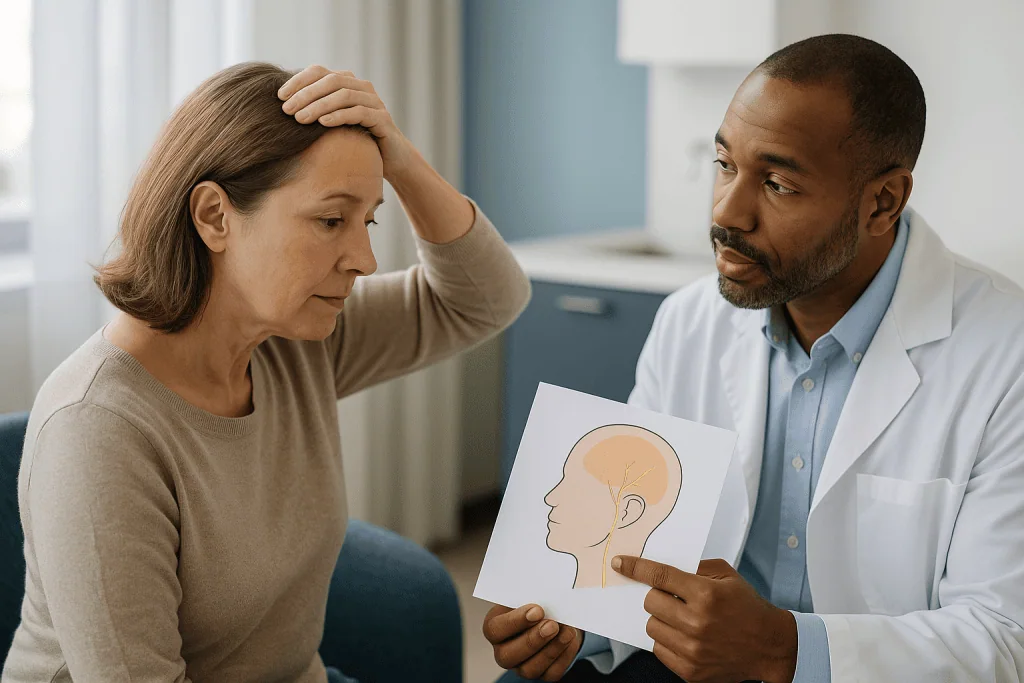
This anatomy explains the classic pattern people report. Numbness after a forehead lift is usually strongest in a band from the brows up toward the hairline and on the top of the head, often more marked on one side than the other. It rarely involves the cheeks or the nose, because those areas are supplied by different branches that a brow lift does not disturb.
Two features of the supraorbital nerve make it vulnerable. First, it has a deep branch that runs close to the bone surface exactly where the surgeon frees the tissue. Second, in some people the nerve leaves the skull through a fully enclosed bony hole rather than an open notch, which limits how much it can slide when tissue above it is pulled. Surgeons plan incision placement and dissection depth around these branches, but variation between individuals means the nerve cannot always be fully spared.
Knowing the map helps you interpret your own experience. A numb strip along the top of the head after an incision in the hairline is the expected territory of the supraorbital nerve. Numbness spreading down the cheek, or a droop of the brow itself, points to something different and is worth mentioning at your next check.
Forehead numb after brow lift: how long does it usually last?
The honest answer is a range, not a date. The Mayo Clinic notes that sensation changes after a brow lift generally ease over weeks to months, and its facelift guidance describes a similar course for facial numbness, with feeling typically returning over several weeks or months rather than days. The NHS, describing cosmetic facial surgery, gives the same broad message: numbness is common and usually improves gradually.
Within that range, three phases are common. In the first one to two weeks, the numbness is at its most complete. Swelling is peaking, incisions are fresh and the nerves are effectively silenced. Between roughly weeks two and eight, many people notice the first flickers: a pins-and-needles feeling, a patch that itches with nothing to scratch, or a strange sensation when water from the shower hits the scalp. Over the following months the numb zone tends to shrink from the edges inward.
Why the wide spread? Recovery depends on how each nerve was affected. A nerve that was only stretched or compressed by swelling can recover as soon as the swelling settles. A nerve whose inner fibers were disrupted but whose sheath survived must regrow along that sheath, which is slow. The figure quoted in surgical teaching is roughly a millimeter a day, which works out to about an inch a month. A nerve regrowing from the brow to the crown therefore has several inches to travel, and it is not unusual for the top of the head to be the last place to wake up.
Nobody can promise a personal timeline. Your surgical team can, however, tell you which technique was used and how close the dissection came to the nerve exits, which gives a reasonable sense of what to expect.
Who is usually offered a forehead lift, and who is asked to wait
A forehead lift is generally considered for adults whose eyebrows have descended enough to crowd the upper eyelids, deepen horizontal forehead lines or create a persistently tired or stern expression that does not match how they feel. The Mayo Clinic describes it as an option when a low or sagging brow contributes to these changes, and it is sometimes combined with eyelid surgery when heavy brows and excess eyelid skin occur together.

Candidacy is not only about the brow. Surgeons look at overall health, because any operation under anesthesia carries risk. They ask about smoking, since nicotine narrows small blood vessels and impairs the healing of lifted skin. They review medicines and supplements that affect bleeding, and they ask about conditions that slow wound repair, such as poorly controlled diabetes. These conversations sit with the surgical team and the prescribing clinician; the article you are reading cannot substitute for them.
Some people are usually asked to wait or to reconsider. Those actively smoking are often asked to stop for a defined period before and after surgery. Those with unrealistic expectations, such as hoping a lift will remove all forehead creases or change the shape of the eyes, benefit from a franker conversation first. Anyone with a recent illness, an unstable medical condition or a scalp skin condition in the operative area may be advised to defer. Existing nerve problems in the face, or a history of prior forehead surgery, may change the risk discussion because scar tissue alters how nerves lie.
Non-surgical alternatives exist and are worth asking about. Muscle-relaxing injections can lift the brow tail modestly for a few months, and eyelid surgery alone addresses excess lid skin without touching the forehead nerves. Each carries its own trade-offs, and the right choice depends on the anatomy in front of the surgeon, not on a general article.
Do different brow lift techniques change the numbness risk?
Yes, and this is one of the most useful things to understand before surgery. The technique determines where the incision sits and how much tissue is freed, and both influence how the supraorbital and supratrochlear nerves are treated. The table below summarizes the main approaches in neutral terms. It describes typical patterns, not guarantees, and your own surgeon’s judgement about your anatomy takes priority.
| Technique | Where the incision sits | Typical sensory effect | Points to ask about |
|---|---|---|---|
| Coronal | Ear to ear across the top of the scalp, behind the hairline | Historically the highest rate of lasting scalp numbness behind the incision, because nerve branches running backward are divided | Hairline position, permanence of numbness at the crown |
| Endoscopic | Several short incisions within the hair, camera-guided | Numbness is common early but tends to be less extensive because nerves are visualized and lifted rather than cut | Whether the deep supraorbital branch can be seen and protected |
| Hairline (pretrichial) | Along the front edge of the hair | Forehead sensation often preserved; skin behind the scar may stay numb | Scar visibility, high hairline concerns |
| Temporal (lateral) | Short incisions in the hair at the temples | Limited to the outer brow; central forehead nerves usually untouched | Only lifts the brow tail |
| Direct or mid-forehead | Within an existing forehead crease or just above the brow | Incision can cross small nerve branches near the brow; numbness tends to be local | Scar placement, suitability for deep creases |
The Mayo Clinic’s overview describes the coronal, endoscopic and hairline approaches and notes that the choice depends on hairline height, skin quality and the goal of the lift. No technique eliminates numbness. Endoscopic methods were developed partly to reduce the long numb strip that follows a coronal incision, and that logic is sound, but how a nerve behaves in one person is never fully predictable.
How do nerves regenerate after surgery, and why does it feel so strange?
A nerve fiber is a long, thin extension of a nerve cell, wrapped in a protective sheath the way a wire is wrapped in insulation. When the fiber inside is injured but the sheath survives, the segment beyond the injury withers and the body clears it away. The healthy stump then sends out fresh sprouts that grow along the empty sheath, seeking the skin they once served. That is regeneration, and it is slow, steady and imperfect.
MedlinePlus describes numbness and tingling as symptoms of interrupted nerve signaling and notes that they frequently accompany nerve injury and recovery. The tingling is the interesting part. As new fibers grow and reconnect, they fire erratically before they settle into normal patterns. The brain receives static, and it interprets static as pins and needles, buzzing, itching, brief electric zaps or a crawling sensation. Odd as it feels, this phase usually means the wiring is being re-laid.
Several recovery quirks are common and worth knowing in advance. Sensation often returns unevenly, so one side of the forehead may feel normal while the other lags by weeks. Touch usually returns before fine discrimination, so you may feel pressure from a hat before you can tell whether the fabric is rough or smooth. Temperature perception can be exaggerated for a while, making warm water feel hot. Some people describe a shooting sensation when they press the skin near the brow; this is the regrowing nerve being tapped, a sign familiar to anyone who has recovered from a wrist or ankle nerve injury.
Regeneration cannot be hurried by supplements or devices. No mainstream evidence supports over-the-counter nerve products for surgical numbness, and anyone considering them should raise it with their surgical team rather than experiment. Time, protection of the skin and patience remain the treatment.
The first days and weeks: what recovery from a forehead lift usually looks like
Recovery has a rhythm, and knowing the beats makes the numbness less alarming. The Mayo Clinic’s brow lift guidance describes a loose dressing for the first day or so, sometimes a small drain, and follow-up visits for removal of stitches or clips within roughly the first two weeks. Swelling and bruising peak early and then decline, often drifting downward into the eyelids and cheeks before they clear.
Days one to three are usually the most uncomfortable, not because of the numbness but because of tightness and swelling. The forehead feels stretched, the scalp feels heavy, and the eyelids may puff. Cold compresses and keeping the head elevated are standard advice. Pain relief, if prescribed, is a matter for the prescribing clinician; this article deliberately gives no information about medicines beyond noting that the team will discuss what is appropriate.
Days four to ten bring the itch. Incisions begin to heal, scabs form, and the numb skin around them itches without offering the satisfaction of a scratch. Most people can return to desk work within about a week to ten days, according to the Mayo Clinic, while avoiding heavy exertion for longer.
Weeks two to six are when the first tingles typically appear and the swelling largely resolves. Many people feel presentable in public by this point with hair styled over incisions, although residual puffiness can linger. Between roughly six weeks and six months the forehead settles into its new position, scars soften, and numbness continues to recede unevenly. Sensation can keep improving well beyond six months; the Mayo Clinic notes that final results take time to emerge and that sensation changes may persist for many months in some people. If your course is broadly following this arc, patience is reasonable. If it is not, the team would rather hear from you than have you wait.
Scalp itching after brow lift: why the itching and tingling can be reassuring
Few things test patience like an itch on skin you cannot feel. It is one of the most frequent complaints in the second and third weeks, and it deserves a plain explanation rather than a shrug.
Itching in the healing zone has two overlapping sources. The first is ordinary wound healing: as incisions knit, the body releases chemical messengers that irritate itch fibers in the surrounding skin. The second is nerve recovery. As sensory nerves regrow, they misfire, and the brain often reads that misfiring as itch. MedlinePlus groups tingling and altered sensation together as expressions of the same underlying process, a nerve that is signaling but not yet signaling correctly.
Reassuring as this is, scratching numb skin is a genuine hazard. Without normal feedback you cannot tell how hard your nails are digging, and the skin over a recent incision is fragile. People have opened healing wounds, or created small sores, without noticing until they saw blood. Practical ways to cope include pressing gently with a flat fingertip rather than scratching, keeping nails short, using cool compresses if the team permits them, and patting rather than rubbing when washing hair. If itching is severe, sleep-disturbing or accompanied by redness and warmth, ask the surgical team; they can distinguish healing itch from irritation or early infection.
The same caution applies to everyday heat. A hair dryer on a numb scalp can burn skin before you feel it, as can a heated styling tool, a hot shower aimed at the crown or strong sun on a part line you would normally cover. A hat outdoors, cooler dryer settings and testing water on the hand first are simple habits until sensation returns. None of this is dramatic. It is the kind of common sense that only becomes obvious once someone points out that the usual warning system is temporarily switched off.
Is permanent numbness a common side effect? What the evidence actually shows
People searching this question are usually hoping for a single percentage. The honest position is that mainstream patient guidance does not offer one, and this article will not invent one. The Mayo Clinic states that a brow lift can cause numbness that is temporary or permanent, and separately notes for facelift surgery that some loss of sensation may last for a long time or, in a minority, indefinitely. The NHS describes numbness after cosmetic facial surgery as common and usually temporary, while acknowledging that it can persist.
Reading between those statements, a clearer picture emerges. Most people recover most of their sensation. A minority retain a permanent patch, most often a strip of scalp behind a coronal incision or a smaller zone at the crown where the longest nerve fibers would have had the farthest to regrow. Permanent loss of feeling across the entire forehead is uncommon with modern techniques, because surgeons now identify and preserve the main nerve trunks rather than dividing them.
Several factors shift the odds within an individual. Technique matters most, as the table above outlines. Anatomy matters, since a nerve exiting through an enclosed bony hole is easier to stretch than one exiting an open notch. Revision surgery, previous scalp scars and smoking all reduce the tissue’s capacity to heal. Age plays a modest role because nerve regeneration slows with the decades.
Where a patch of numbness does persist, most people describe it as a curiosity rather than a disability. Hair grows normally through numb scalp, and the skin still bleeds and heals if injured; it simply does not report the injury. The practical implications are the safety points already covered. Anyone with lasting numbness that bothers them should say so at follow-up; the team can document its extent and confirm it is stable rather than changing.
How long does it take to look normal after a brow lift?
Looking normal and feeling normal run on different clocks, and separating them prevents needless worry. Appearance usually recovers first. The Mayo Clinic describes bruising and swelling that are most pronounced in the first days and largely settle within a few weeks, with incisions healing over roughly the first two weeks and scars continuing to fade for months. Many people feel comfortable in social settings by two to three weeks, particularly when incisions sit inside the hair.
Sensation lags. As the earlier sections explain, nerve recovery runs on weeks to months, so it is entirely typical to look recovered while still feeling a numb crown or a tingling brow. Friends will tell you the swelling is gone long before your scalp agrees.
Some appearance changes during recovery are misread as permanent. The brow often looks over-lifted or startled at first, because surgeons position it slightly high to allow for the gentle descent that follows as swelling resolves and tissues relax. The forehead can look shiny or oddly smooth while it is swollen. Small dents or ridges along incision lines, a frequent search query, usually reflect swelling, suture fixation points or temporary contour irregularities while deeper tissue settles, and most soften with time. If a dent persists beyond several months or deepens, it merits a review rather than a guess.
Hair around incisions may thin temporarily, a phenomenon called shock loss, in which follicles disturbed by surgery pause growth for a few months before resuming. Permanent hair loss along a scar is possible and should be discussed at follow-up.
Final appearance, according to the Mayo Clinic, takes months to emerge as swelling fully resolves and scars mature. Judging the result at three weeks is judging an unfinished picture. Judging sensation at three weeks is even less fair.
Nerve damage after brow lift: when numbness is more than a nuisance
Numbness involves sensory nerves. The more consequential concern after forehead surgery involves a motor nerve, the frontal branch of the facial nerve, which powers the muscle that raises the eyebrow. A motor nerve carries instructions from brain to muscle rather than sensation from skin to brain, and injury to it looks quite different from a numb patch.
The frontal branch runs across the temple in a thin layer of tissue on its way to the forehead muscle. Every brow lift technique that works in the temple must navigate it. If it is bruised or stretched, the eyebrow on that side may sit lower and move less when you try to raise it, and the forehead on that side may stay smooth while the other wrinkles. The Mayo Clinic lists facial nerve injury with resulting weakness among the recognized risks of a brow lift and describes it as usually temporary but occasionally lasting.
The distinction to hold onto is feeling versus movement. Reduced feeling with normal movement is the common, expected sensory pattern. Reduced movement is the less common motor pattern and always warrants specific assessment, because the team will want to document it, monitor recovery and consider whether any intervention is needed. Most stretch injuries to the frontal branch recover over weeks to months, along the same slow regeneration timeline as sensory nerves; complete division is rare and is a different conversation.
Two other patterns deserve mention. Pain that is burning, electric or triggered by light touch, rather than the dull tightness of ordinary healing, can indicate an irritated nerve and is worth reporting so it can be assessed early. Numbness or tingling that spreads into the cheek, jaw or beyond the face, or that involves an arm or leg, is outside the territory a brow lift can affect and needs urgent evaluation as a separate medical issue rather than a surgical side effect.
What people often get wrong about numbness after a forehead lift
Myths about surgical numbness circulate freely, and several cause real anxiety or real harm. Correcting them is part of honest preparation.
“If it is still numb at six weeks, it is permanent.” Not so. Sensory recovery routinely continues for many months, and the top of the head, farthest from the nerve origin, is often the last area to recover. The Mayo Clinic frames sensation changes as easing over weeks to months, with some people improving well beyond that.
“Tingling means the nerve is being damaged.” The opposite is usually true. Tingling, itching and brief zaps are the characteristic signature of nerves reconnecting. Persistent burning pain is a different matter and should be reported.
“A good surgeon can prevent numbness entirely.” Careful technique reduces the extent and duration of numbness, particularly by preserving the deep supraorbital branch, but the nerves live exactly where the surgery happens. Some temporary numbness is close to universal.
“Massage or supplements speed up nerve regrowth.” Nerves regrow at their own biological pace. Gentle massage may be recommended for scar softening once incisions are healed, but only on the team’s advice, and no over-the-counter product has mainstream evidence for hastening sensory recovery after surgery.
“Numb skin cannot be injured.” It can be injured more easily, because you will not feel the warning. Burns from styling tools and sores from scratching are the two commonest avoidable problems.
“Numbness and a droopy brow are the same problem.” They involve different nerves. Numbness is sensory. A brow that will not lift is motor and needs its own assessment.
“Everyone’s recovery follows the same schedule.” Technique, anatomy, age and smoking status all shift the timeline. Comparing your week three to someone else’s on a forum is comparing different operations on different bodies.
Questions to ask your care team about numbness before and after surgery
The most reassuring conversations about numbness happen before the operation, when expectations can be set, and again at follow-up, when your own pattern can be interpreted. Arriving with specific questions turns a rushed visit into a useful one. The team’s answers, not this article, should guide your decisions.
Before surgery, consider asking:
- Which technique are you planning for me, and how does that choice affect where the incisions sit and which nerves are near them?
- Based on my anatomy, which areas of my forehead and scalp are most likely to be numb afterward, and for roughly how long?
- How do you identify and protect the supraorbital and supratrochlear nerves during the procedure?
- What is your approach to the frontal branch of the facial nerve in the temple?
- Does my medical history, smoking status or any previous surgery change the risk of lasting numbness?
- What non-surgical alternatives would you consider for my goals, and what are their trade-offs?
After surgery, useful questions include:
- Is the pattern of numbness I am describing what you would expect from my operation?
- Which sensations should I treat as normal recovery, and which should prompt a call between appointments?
- How should I protect numb skin while washing, drying and styling my hair?
- When is it safe to begin any scar care you recommend, and how should I do it?
- At what point would you consider persisting numbness or weakness worth a further assessment?
- How will you document my sensation at each visit so we can track whether it is improving?
Write the answers down or bring someone who will. Recovery advice given in the anesthetic haze of the first visit rarely survives intact to week three, when the itch begins and the questions return.
When to call your doctor about numbness after a forehead lift
Most numbness after a forehead lift needs observation, not action. Certain features, however, mark the point where waiting is the wrong choice and a call to the surgical team, or urgent care if the team cannot be reached, is the right one.
Contact your surgical team promptly if you notice any of the following:
- Numbness or tingling that is spreading to new areas, particularly the cheek, jaw, neck, arm or leg, or that appears suddenly on a previously normal side of the face.
- New weakness in the forehead or eyebrow, an eyebrow that will not lift, or difficulty closing the eye on one side.
- Burning, shooting or electric pain that is worsening rather than settling, or pain that light touch provokes.
- Rapidly increasing swelling on one side, a firm expanding lump under the skin, or a forehead that feels tight and tense after having settled, which can indicate bleeding under the flap.
- Redness spreading from an incision, warmth, thick discharge, an unpleasant smell, a fever or a wound that has opened.
- Any change in vision, severe headache, confusion, drooping of the mouth or slurred speech, which are not brow lift side effects and require emergency assessment.
- Skin over a numb area that looks dusky, pale or blistered, or a burn or sore you did not feel happening.
A short list of what generally does not need an urgent call helps too: stable numbness that is slowly shrinking, intermittent tingling or itching, a startled-looking brow in the first weeks, and small ridges along healing incisions. Mention these at scheduled follow-up so they can be documented.
When uncertain, call. Surgical teams would far rather answer a question about a harmless tingle than hear later about a problem that grew while a patient hesitated. Every judgement about whether a symptom is expected or significant belongs with the clinicians who know your operation, your anatomy and your history.
Frequently asked questions
Is permanent numbness a common side effect of a facelift or forehead lift?
Permanent numbness is possible but affects a minority; most people regain most sensation over months. Mainstream guidance from the Mayo Clinic describes numbness after brow and facelift surgery as usually temporary, while acknowledging that a patch of reduced feeling can persist, most often behind a scalp incision or at the crown. Technique, individual nerve anatomy, prior surgery and smoking all influence the likelihood. No reliable single percentage exists in patient guidance, so treat any quoted figure with caution.
How long does brow lift numbness last: is there a typical range?
Typically weeks to months, with wide individual variation. Numbness is usually most complete in the first two weeks, tingling and patchy return commonly begin between weeks two and eight, and improvement continues for many months afterward. The Mayo Clinic frames sensation changes as easing over weeks to months rather than on a fixed schedule. The top of the scalp often recovers last because regrowing nerve fibers must travel farthest to reach it.
How long does it take for nerves to regenerate after a facelift or brow lift?
Slowly and steadily; the figure quoted in surgical teaching is roughly a millimeter a day, about an inch a month. Nerves that were only stretched or compressed by swelling recover sooner, once swelling subsides. Nerves whose inner fibers were disrupted must regrow along their sheath from the injury point to the skin, which explains why sensation returns unevenly and why areas far from the brow, such as the crown, lag behind.
What are the worst days of recovery after a forehead lift?
For most people, the first three days are the most uncomfortable, dominated by tightness, swelling and heaviness rather than by numbness itself. Days four to ten bring the itch phase, when healing incisions and recovering nerves both provoke itching on skin you cannot properly feel. Bruising usually peaks and then drifts into the eyelids before clearing. Numbness is rarely the worst part; it is the most persistent part, outlasting the discomfort by weeks.
How long does it take to look normal after a brow lift?
Many people feel presentable within two to three weeks once bruising and most swelling settle, particularly when incisions are hidden in the hair. The Mayo Clinic notes incisions heal over roughly the first two weeks, while scars fade and the final brow position emerges over months. A slightly startled look early on is expected, because the brow is set a little high to allow for settling. Sensation typically takes longer to normalize than appearance.
Why is my forehead numb after brow lift surgery on only one side?
One-sided numbness is common and usually reflects how each nerve was handled during surgery rather than a problem. The supraorbital nerve exits through an open notch in some people and a closed bony hole in others, sometimes differing between the two sides, which changes how much it can stretch. Asymmetric swelling also compresses one side more. Mention the pattern at follow-up so the team can confirm it matches your operation and track its recovery.
Is scalp itching after brow lift a sign of infection or of healing?
Usually healing. Itching arises from chemical messengers released as incisions knit and from misfiring sensory nerves as they regrow, both normal processes. Infection looks different: spreading redness, warmth, thick discharge, an unpleasant smell or fever alongside the itch. Because numb skin gives no feedback, avoid scratching, which can open a healing wound unnoticed; press gently with a flat fingertip instead. If itching is severe or accompanied by any infection signs, contact your surgical team.
Can nerve damage after brow lift affect movement as well as feeling?
Yes, and the distinction matters. Numbness involves sensory nerves and is expected. Weakness involves the frontal branch of the facial nerve, which powers the muscle that raises the eyebrow, and shows as a brow that sits lower or will not lift on one side. The Mayo Clinic lists this among recognized brow lift risks, usually temporary but occasionally lasting. Any new weakness should be reported promptly so it can be documented and monitored.
Can numbness after a forehead lift be prevented?
It can be reduced but not reliably eliminated, because the sensory nerves run exactly where the surgery takes place. Techniques that visualize and preserve the main nerve trunks, such as endoscopic and temporal approaches, tend to produce less extensive or shorter-lived numbness than a coronal incision that divides branches running backward over the scalp. Individual anatomy still varies. Ask your surgeon which technique is planned and how the nerves will be protected.
What should I avoid doing while my scalp is still numb?
Anything that relies on feeling to prevent injury. Keep hair dryers and styling tools on cooler settings and away from numb areas, test shower water on your hand before it hits your head, wear a hat in strong sun, keep nails short and avoid scratching. Follow your team’s specific advice on hair washing and scar care timing. These habits matter until sensation returns, because burns and sores on numb skin are the commonest avoidable problems.
References
This article is for general information only and is not a substitute for professional medical advice. Please consult a qualified doctor about your individual situation.

More from the Blog

How Dimple Creation Surgery Is Done: The Inside-the-Cheek Incision and Anchoring Suture
Dimpleplasty is a short outpatient procedure, usually done under local anesthesia, in which a surgeon marks the desired spot on the cheek, makes a…

Facial Implant Risks Explained: Shifting, Infection and Bone Changes Under the Implant
Facial implant complications are uncommon but real. The problems most often reported are implant shifting or asymmetry, infection around the implant, bleeding or a…

Why Surgeons Wait a Year Before Revision Rhinoplasty: Swelling, Healing and the Right Timing
Most surgeons ask patients to wait roughly 12 months before revision rhinoplasty because that is how long the nose typically takes to finish healing.…

Cheek Augmentation Recovery: Swelling Stages, Sleeping Upright and When Contours Emerge
Cheek augmentation recovery follows a fairly predictable arc: swelling and bruising usually peak within the first two to three days, ease noticeably over two…

What Age Is Right for Otoplasty? Ear Growth, Timing and Readiness in Children and Adults
Otoplasty, surgery to reshape or set back prominent ears, is usually considered from about age five, when the outer ear has reached most of…
How Cheek Augmentation Surgery Is Done: Implant Placement Through the Mouth or Lower Eyelid
Cheek implant surgery places a shaped, solid implant over the cheekbone through a small incision either inside the mouth, above the upper gum, or…