Forehead Lift
A forehead lift, or brow lift, elevates sagging brows and smooths forehead lines for a more refreshed facial appearance. It is tailored to facial anatomy and aesthetic goals.
Quick answer
A forehead lift, also called a brow lift, is a surgical procedure that raises sagging eyebrows, repositions the tissues of the upper face and softens forehead and frown lines. It is performed through small incisions hidden in the scalp or placed along the hairline, usually under general anaesthesia or sedation, and suits people whose low brow position creates a tired, heavy or hooded appearance.
Considering a Brow Lift: Understanding the Decision
A brow lift, also called a forehead lift, is a surgical procedure that raises sagging eyebrows, repositions the soft tissues of the upper face and softens the lines that run across the forehead and between the brows. It is designed for people whose brow position has dropped enough to create a tired, heavy or stern expression that no longer matches how they feel. The aim is not to change who you are; it is to restore a more open, rested upper face while preserving natural movement.
The upper third of the face carries much of your expression. The position of the brows, the contour of the forehead and the lines between the eyebrows can make you appear attentive and rested, or tense, fatigued and older than you feel. For most people this change develops slowly. The eyebrows begin to sit lower, the skin of the forehead becomes heavier, and horizontal forehead lines or vertical frown lines deepen. Many people compensate without realising it, constantly raising the forehead muscle to keep the brows up, which etches the horizontal lines further and produces a sense of forehead fatigue by the end of the day.
There is a common point of confusion worth naming early. Some people who believe they need upper eyelid surgery actually have a low brow. When the brow descends, it pushes skin down over the upper eyelid and creates a hooded look even when the eyelid itself is normal. Distinguishing the two is one of the most important tasks of the consultation, because operating on the wrong structure gives a poor result.
If you are an international patient weighing this procedure up, the decision usually involves more than the operation itself. You are likely thinking about safety, communication with the surgical team, how the plan is made, how long recovery takes, when you can travel again and, perhaps most of all, whether the result will suit your face rather than follow a standard formula.
At Acibadem, a brow lift is planned as a personalised facial procedure within the Plastic, Reconstructive & Aesthetic Surgery department. The surgical plan is based on your anatomy, skin quality, hairline position, eyebrow shape, eyelid condition, facial proportions and the degree of change you actually want. For some patients a forehead lift is performed on its own. For others it is considered together with eyelid surgery, facelift surgery, skin resurfacing or non-surgical treatments, depending on what is medically appropriate and aesthetically balanced.
The most important first step is a careful consultation. A well-planned brow lift requires more than raising the eyebrows. It means understanding why the brow has descended, how the forehead muscles contribute to your lines and expression, how the eyelids are affected, and what degree of correction will look natural. A refined result depends on precision, restraint and clear communication between you and your surgeon.
What Is a Forehead Lift?
A forehead lift is a surgical procedure that elevates sagging eyebrows, repositions the deeper tissues of the forehead and softens lines in the upper face. It can improve horizontal forehead creases, heaviness above the eyes, deep lines between the eyebrows and the tired or stern expression caused by brow descent. Depending on the technique, the incisions may be hidden entirely within the hair-bearing scalp, placed along the hairline, or limited to the temple region. The choice of incision is not cosmetic detail: it determines how the forehead height changes, where any scar sits and how much correction is possible.
Although the procedure is aesthetic, it can have functional relevance for some patients. A low brow can add weight over the upper eyelids, narrowing the upper visual field or forcing constant forehead muscle effort to see comfortably. Patients in this situation often describe forehead heaviness, brow strain by evening, or lines that deepen because of the continuous compensation. Repositioning the brow addresses the underlying mechanical cause rather than the surface symptom.
What does a brow lift actually do?
A brow lift releases the tissues that anchor the brow in its descended position, moves the brow and forehead soft tissue upward to a more balanced level, and secures them there so the correction holds as healing progresses. In some techniques the surgeon also weakens the muscles that pull the brows inward and downward, which softens the vertical frown lines between the eyebrows. What the operation does not do is treat the skin surface itself: it changes position and support, not texture. That distinction matters when deciding whether surgery, skin treatments or a combination will best address your specific concern. A secondary effect many patients value is the change above the eyes, when hooding is caused partly by brow descent, lifting the brow decompresses the upper eyelid area and the eyes look more open without any eyelid incision at all.
Are a forehead lift, brow lift and eyebrow lift the same procedure?
In most clinical settings, an eyebrow lift, a brow lift and a forehead lift describe the same operation viewed from slightly different angles. “Forehead lift” emphasises the repositioning of the whole forehead unit; “brow lift” emphasises the eyebrows themselves. The practical differences lie in emphasis and extent. Some patients mainly need elevation of the outer brow to correct lateral hooding over the eyes. Others need correction across the entire brow and forehead. Some benefit most from adjustment of the glabellar muscles that create deep frown lines. The name matters less than the plan: a good surgeon defines which part of the brow needs to move, by how much, and through which approach, based on your anatomy rather than a label.
Who May Need a Forehead Lift?
Patients who consider a forehead lift often describe looking tired, sad, angry or older even when they feel well. They may notice that the eyebrows sit lower than they used to, that the upper eyelids appear heavy, or that eye makeup has become harder to apply because excess skin crowds the eyelid. Some people catch themselves lifting their brows in every photograph or throughout conversation. Others are bothered by deep horizontal forehead lines or vertical frown lines that no longer improve adequately with non-surgical treatments.
Typical concerns that lead to a brow lift consultation include:
- Sagging eyebrows, across the whole brow or mainly at the outer end
- Heaviness or hooding above the eyes
- Deep horizontal forehead creases
- Vertical or angled frown lines between the eyebrows
- Noticeable asymmetry between the two brows
- A crowded upper eyelid appearance despite normal eyelids
- An expression that reads as tense, stern or fatigued at rest
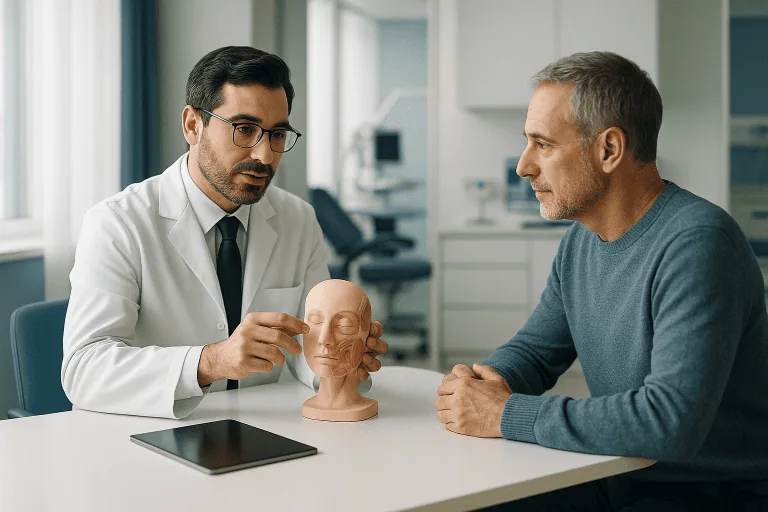
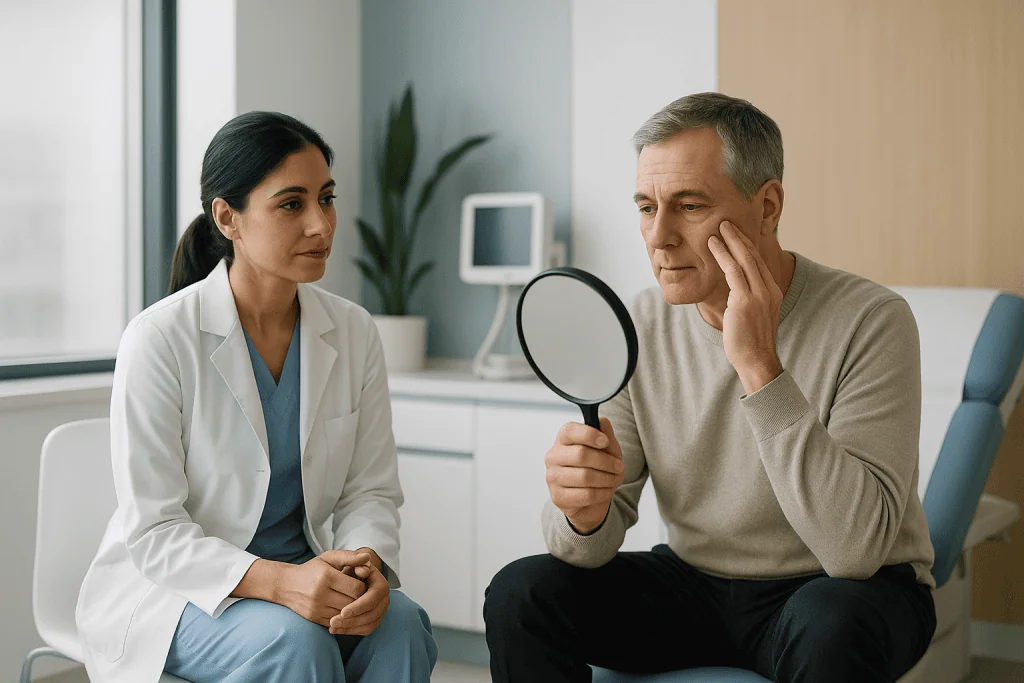
Diagnosis begins with a detailed facial assessment. The surgeon evaluates brow position at rest and during expression, forehead height, hairline shape, scalp laxity, eyelid skin, eyelid muscle tone, facial symmetry and skin quality. Photographs are usually taken for planning and documentation. The surgeon may gently lift the brow manually during the consultation to show how different degrees of elevation would affect the upper eyelids and overall expression. This simple manoeuvre is one of the most useful tests in the whole process, because it separates true brow descent from problems caused mainly by excess eyelid skin or by eyelid ptosis, where the lid itself droops.
Medical evaluation matters just as much. You will be asked about previous facial surgery, eye conditions, dry eye symptoms, thyroid disease, neurological conditions, scarring tendencies, medications, allergies, smoking and general health. Blood tests, an anaesthesia evaluation and additional assessments may be recommended before surgery. Any change to regular medication before an operation is a decision for the prescribing doctor, never something to manage on your own. For international patients, parts of this evaluation can often be coordinated before travel, with the final in-person assessment completed after arrival.
Not every patient with forehead lines or brow heaviness needs surgery. Some people are better suited to injectable treatments, skin treatments, eyelid surgery or a combined approach. A forehead lift is generally the right tool when brow descent is significant enough that repositioning the underlying tissues will give a more effective and more durable correction than surface-level treatments alone.
Is the problem your brow or your eyelid?
The answer determines the operation, and getting it wrong is the most common planning error in upper-face surgery. Three separate problems can produce a similar heavy-eyed look: brow ptosis (the brow has descended), dermatochalasis (there is genuinely excess upper eyelid skin) and eyelid ptosis (the lid margin itself sits too low over the eye). If the brow is low and only eyelid skin is removed, the heaviness persists and the eyelid may be left under tension; the brow can even be pulled lower. If the eyelid is the true problem, a brow lift alone will disappoint. Many patients have a combination, and the most balanced plan may include both a brow lift and upper blepharoplasty, or one of the two, staged or combined, depending on the examination findings.
What a Forehead Lift Can Address
The most common indication is brow ptosis, drooping of the eyebrows. It may involve the entire brow or be more pronounced at the outer third, and it develops through a mixture of ageing, genetics, sun exposure, skin laxity, changes in the fat that supports the brow, and years of muscle activity. Because the outer brow has weaker support than the inner brow, lateral descent and outer hooding often appear first.
The procedure also addresses forehead rhytids: the horizontal lines and creases across the forehead. These are largely produced by repeated contraction of the frontalis muscle, especially in people who unconsciously raise the brows to compensate for brow heaviness. By repositioning the brow, the operation reduces the need for that constant contraction, which can soften the lines over time.
Glabellar frown lines, the vertical or angled lines between the eyebrows, are another target. They are driven by specific small muscles that pull the brows inward and downward. During certain brow lift techniques the surgeon can weaken or adjust these muscles to reduce the depth of frown lines and the stern expression they create at rest.
Forehead lift surgery can also improve upper eyelid crowding caused by low brow position. This is the distinction described above, and it is worth repeating in practical terms: when the brow is low, lifting it decompresses the eyelid area, and in some patients that alone is enough. In others, the best plan combines the brow lift with upper blepharoplasty so that both the position problem and the skin excess are corrected in proportion.
Patients with brow asymmetry may benefit as well, although perfect symmetry is not a realistic target, no natural face is perfectly symmetrical. The goal is to improve balance and reduce obvious differences while keeping expression natural. For patients with previous trauma, facial nerve weakness or prior surgery, planning is more complex and needs genuinely individualised assessment.
Does a forehead lift completely remove etched forehead lines?
No, and it is important to understand why before you commit to surgery. A forehead lift reduces the muscle activity that creates and deepens the lines, so dynamic creases usually soften noticeably. But lines that have become etched into the skin over years are structural changes in the skin itself, and repositioning the tissues beneath them cannot fully erase them. Moderately etched lines typically become shallower and less prominent; deeply etched lines usually persist in a softened form. Patients who want further improvement of the skin surface may be offered complementary treatments such as laser resurfacing, chemical peels or medical skincare once healing allows. A surgeon who is honest about this limit is protecting you from disappointment, not underselling the operation.
Brow Lift Techniques
Modern brow lift surgery is not one operation but a family of approaches. The right one depends on your forehead height, hairline position and density, the pattern of brow descent, skin thickness, and how much correction is needed. Each technique below is in current use; none is universally “best”.
Endoscopic brow lift
An endoscopic brow lift uses several small incisions hidden behind the hairline and a slender camera that lets the surgeon see and adjust the deeper tissue layers through those small openings. The brow and forehead tissues are released from their attachments, repositioned upward and secured in a higher, more balanced position. Because the incisions sit within the hair-bearing scalp, visible scarring is minimised, and the approach allows direct treatment of the frown-line muscles between the brows when needed. It is commonly selected for patients whose hairline position, forehead height and tissue characteristics suit a limited-incision approach.
Hairline (pretrichial) forehead lift
A hairline forehead lift places the incision along the front edge of the hairline or within its natural irregularities. Its defining advantage is control of forehead height: the brows can be elevated without pushing the hairline backward, which makes it useful for patients who already have a high or long forehead. It also allows the surgeon to remove a measured amount of forehead skin where that is appropriate. The incision is planned to sit as discreetly as possible, though final scar quality always varies with individual healing and hair characteristics: a point worth discussing frankly at consultation.
Temporal or lateral brow lift
A temporal brow lift uses incisions in the hair-bearing skin of the temples to lift mainly the outer brow. It suits patients whose central forehead does not need significant elevation but whose outer brow has descended, creating hooding at the outer corner of the eyes. Because it is more limited in scope, it involves shorter incisions and a correspondingly limited zone of correction. It is frequently combined with upper eyelid surgery when the eyelid area needs additional refinement beyond what brow repositioning alone provides.
Coronal brow lift
The coronal approach uses a longer incision placed further back in the scalp, giving the surgeon broad, direct access to the entire forehead. It is chosen less often today than limited-incision techniques, but it remains appropriate in selected patients, for example, where extensive correction or direct access across the whole forehead is needed and the hairline and hair density can conceal the incision. Its trade-offs, including a longer scar and a greater effect on scalp sensation, are part of the selection discussion.
How is the right technique chosen?
The technique is chosen by matching your anatomy to each approach’s strengths, not by preference for a single method. Key variables are forehead height (a high forehead argues for a hairline approach; a lower one tolerates scalp incisions), the pattern of descent (outer brow only versus the whole brow), whether the frown-line muscles need treatment, hair density and hairstyle, scarring tendency, and any previous surgery. A surgeon who offers only one technique for every face is applying a formula; a surgeon who explains why a particular approach fits your forehead is planning properly.
How Eyebrow Lift Surgery Is Performed, Step by Step
Eyebrow lift surgery follows a structured pathway from planning through to discharge, and understanding the sequence removes much of the uncertainty:
- Consultation and surgical plan. The surgeon reviews your concerns and photographs, examines the upper face, and explains which technique fits your anatomy, including incision placement, the expected degree of elevation, whether the central or outer brow needs more adjustment, and whether combined procedures should be considered.
- Preoperative preparation. You receive instructions covering medications, supplements, smoking, alcohol, skincare and fasting. Decisions about pausing any prescription medicine rest with the prescribing physician. Smoking impairs healing, so stopping well before and after surgery is standard advice. A pre-anaesthesia evaluation determines the safest anaesthesia plan.
- Markings. On the day of surgery, markings are made while you are upright, so the natural brow position, hairline and facial symmetry can be assessed accurately, gravity changes everything once you lie down.
- Anaesthesia. The operation is performed under general anaesthesia or local anaesthesia with sedation, depending on the technique, your preference and medical considerations.
- Incisions and repositioning. Through the planned incisions, the brow and forehead tissues are released, repositioned and secured at the new level. Where indicated, the frown-line muscles are adjusted at the same time.
- Closure and dressing. Incisions are closed with sutures or staples depending on location, and a light dressing or head wrap may be applied.
- Recovery and discharge. You are monitored as anaesthesia wears off. Some patients return to their accommodation the same day; others stay overnight, depending on the extent of surgery, the anaesthesia used, overall health and any combined procedures.
Most brow lift operations are completed within a few hours, with the exact duration depending on the technique and whether other procedures are performed at the same time.
The technology used supports accuracy and safety rather than spectacle. High-resolution clinical photography documents the face from multiple angles and underpins the plan. Endoscopic visualisation, when used, lets the surgeon see tissue layers clearly through small incisions. Modern anaesthesia monitoring tracks vital functions throughout the operation. In some patients, imaging or an ophthalmological evaluation is recommended before surgery if there are eye-related symptoms or complex anatomy.
Recovery After a Brow Lift
Recovery is usually manageable, but it rewards patience and careful adherence to instructions. Swelling, bruising, tightness, scalp numbness and mild discomfort are common in the early days. The forehead may feel firm or oddly elevated at first: the final brow position settles gradually as swelling resolves and tissues adapt, so do not judge the result in the first weeks. You will usually be advised to keep your head elevated, use cold compresses as directed, avoid strenuous activity, and attend follow-up visits for wound checks and removal of sutures or staples where needed. Discomfort is generally controllable with a straightforward plan; the guide on what patients can expect from pain control after surgery explains how this is typically organised.
Most patients resume light daily activities within several days, although visible bruising and swelling last longer. Many people feel comfortable returning to remote work or quiet social activities within one to two weeks, depending on bruising and personal comfort. Exercise, heavy lifting and anything that raises blood pressure are usually restricted for several weeks. Refinement continues over months as tissues soften and scars mature.
| Time Period | What Patients Can Expect |
|---|---|
| Day 1 | Mild to moderate swelling, tightness and discomfort are common. A dressing may be in place, and patients are advised to rest with the head elevated. |
| First week | Bruising and swelling may peak and then begin to improve. Patients usually attend follow-up visits, and light walking is encouraged. |
| First month | Most visible bruising has usually improved, and many patients return to normal social and work activities. Strenuous exercise is still limited until cleared by the surgeon. |
| Two to three months | Tightness and numbness gradually decrease. The brow position begins to look settled, and incision areas continue to mature. |
| Longer term | Scars continue to fade and tissues soften over several months. Final refinement develops gradually, influenced by ageing, skin quality, lifestyle and genetics. |
If you are travelling for surgery, two practical guides are worth reading before you plan your return: when it is safe to fly home after surgery and warning signs you should report before flying home. Your surgical team confirms the appropriate timing in your specific case.
Brow Lift Before and After: How to Judge Results
Brow lift before and after photographs are one of the most useful research tools available to you, provided you read them critically. Look for results where the brow sits at a natural height for that person’s face, where the outer brow is gently supported rather than sharply arched, and where the forehead still moves. An overcorrected brow produces a permanently surprised or startled look; a well-judged one simply makes the person look rested. Pay attention to the eyes as well as the brows: the most convincing results show a less crowded upper eyelid without any change to the eye shape itself.
Be aware of how easily eyebrow lift before after galleries can mislead. Differences in lighting, camera angle, head tilt and expression between the two photographs can exaggerate a result. A common distortion is a “before” photo taken with the frontalis relaxed and an “after” taken weeks later with residual swelling still supporting the brow. The most honest comparisons use standardised lighting and angles, a neutral expression in both images, and an “after” taken months after surgery, once swelling has fully settled.
How long does an eyebrow lift last?
The results of an eyebrow lift are long-lasting because the operation repositions the deeper supporting tissues rather than treating the surface: this is precisely why it outlasts injectable and skin-based treatments. But no operation stops the clock. Ageing continues from the new, higher starting point: skin elasticity keeps changing, and gravity, sun exposure, smoking and genetics all influence how the result evolves. Most patients enjoy a durable improvement measured in years rather than months, and some never seek further treatment. Protecting the result is partly in your hands, consistent sun protection, not smoking and stable general health all help the correction hold.
What Can You Do Instead of a Brow Lift?
Not everyone with a heavy brow or forehead lines needs surgery, and a responsible consultation always covers the alternatives. The right choice depends on whether your problem is muscle activity, skin quality, brow position, eyelid skin, or a combination.
- Injectable muscle-relaxing treatments can soften dynamic forehead and frown lines and modestly reshape brow position when used skilfully. Effects are temporary and require repeat treatment.
- Skin resurfacinglaser treatments, chemical peels and medical skincare, improves texture and etched lines but does not move the brow.
- Upper blepharoplasty removes excess eyelid skin and is the correct operation when the eyelid, not the brow, is the true problem.
- Filler-based and thread-based approaches are offered in some settings; their effects on brow position are limited and temporary compared with surgical repositioning.
The honest summary: non-surgical options work best when brow descent is mild or when the main issue is the skin surface. Once the brow itself has descended significantly, only surgical repositioning provides a structural, durable correction, everything else manages the symptom.
Does forehead Botox lift the eyebrows?
Not in the way most people assume, and sometimes the opposite. Injections in the forehead relax the frontalis, which is the very muscle that lifts the brows. Treating the forehead alone can therefore allow the brows to settle slightly lower, particularly in people who were unconsciously using the frontalis to hold a heavy brow up. What injectors call a “chemical brow lift” works differently: by relaxing the muscles that pull the brows down, the frontalis gains a small mechanical advantage and the brow, usually the outer brow, rises modestly. The effect is subtle and temporary. If the manual lift test at consultation shows genuine brow descent, injectables will not reproduce what surgical repositioning achieves.
How Much Does a Brow Lift Cost?
There is no single meaningful answer, because the cost of a brow lift is built from variables that differ between patients even at the same institution. The main drivers are the technique (an endoscopic lift, a hairline lift and a temporal lift involve different operating times and equipment), the type of anaesthesia, whether the operation is performed in a full hospital setting or an outpatient facility, whether other procedures such as eyelid surgery are combined in the same session, the surgeon’s assessment of complexity, and what the quoted package actually includes, preoperative tests, the hospital stay if one is needed, dressings, follow-up visits and postoperative reviews.
When you compare quotations, compare their contents, not just their totals. A figure that excludes anaesthesia, follow-up or a possible overnight stay is not comparable with one that includes them. The patient decision checklist of questions to ask before surgery is a useful framework for pinning down exactly what any quotation covers before you make comparisons.
Why Acting Early Matters
A forehead lift is not an emergency procedure, but timing still matters. When brow descent is mild, some patients do well with non-surgical treatments or a limited surgical approach. If sagging progresses significantly, the upper eyelid area becomes more crowded, forehead lines deepen, and the surgical plan may need to address more complex tissue changes. Early consultation does not necessarily mean early surgery; it means understanding the cause of the concern and choosing the right time and strategy deliberately rather than by default.
Delaying evaluation can also lead to the wrong procedure being chosen. A patient convinced they need upper eyelid surgery may in fact have significant brow descent. If eyelid skin is removed without correcting brow position when the brow is the real problem, the result is less balanced and the heaviness persists. Careful assessment identifies whether the brow, the eyelid, the skin or a combination is responsible, before anything irreversible is done.
There are practical reasons to plan ahead, especially if you are travelling for treatment. A forehead lift requires time for preoperative evaluation, the operation itself, early recovery and follow-up before you return home. Allow enough time for swelling to improve and for the surgical team to confirm that healing is progressing appropriately before long-distance travel. Rushed decision-making raises anxiety and leaves too little room to understand the procedure and its recovery.
In functional cases, where brow heaviness contributes to visual field restriction, headaches from chronic forehead muscle use or eyelid fatigue, timely evaluation can shorten the period of ongoing discomfort. A surgeon may request additional testing or an ophthalmological assessment if symptoms suggest vision is affected, and the plan should then weigh function as well as appearance.
Benefits of a Forehead Lift
The benefits you can realistically expect depend on your anatomy, the technique used and how you heal, but they commonly include the following:
| Benefit | What It Means for You |
|---|---|
| Elevated brow position | A low or heavy brow is repositioned to create a more open upper face while maintaining natural expression. |
| Reduced forehead heaviness | Less need to raise the forehead muscles constantly, which helps reduce a tired or strained appearance and the fatigue that comes with it. |
| Softer forehead and frown lines | Lines caused by repeated muscle activity become less prominent, although deeply etched creases may still need additional skin treatments. |
| Improved upper eyelid appearance | Where hooding is partly caused by brow descent, lifting the brow makes the eyelid area look less crowded. |
| More balanced facial proportions | A tailored lift improves the relationship between forehead, brows, eyes and midface without an overcorrected look. |
| Longer-lasting correction than many non-surgical options | Because the procedure repositions deeper tissues, results generally outlast treatments that only relax muscles or improve the skin surface. |
Risks and Factors That Influence Your Result
A successful forehead lift is measured not by how far the brow moves but by how naturally the upper face fits the rest of the face afterward. Anatomy, skin elasticity, hairline position, bone structure, brow shape, the degree of asymmetry and any coexisting eyelid concerns all influence the outcome. A conservative, individualised plan is nearly always preferable to maximal elevation, which produces an artificial, surprised appearance that is difficult to reverse.
Skin quality plays a large role. Good elasticity allows smoother contour and better tissue adaptation. Significant sun damage, deeply etched lines or thin skin do not rule out surgery, brow repositioning still helps, but complementary treatments such as laser-based resurfacing, chemical peels, injectables or medical skincare may be needed to improve surface texture, where appropriate.
Hairline and hairstyle shape the plan. Incision placement must account for a high forehead, a low hairline, thinning hair, previous hair transplantation or a tendency toward visible scarring. For men, planning must consider male-pattern hair loss and whether scalp incisions could become visible in future. For women, the density and direction of hair growth around the hairline may steer the choice of technique. Patients with thinning brows sometimes ask about restoring brow hair itself: a different problem addressed by eyebrow transplant, not by lifting.
Eye health affects planning as well. Dry eye symptoms, previous eyelid surgery, contact lens intolerance, thyroid eye disease and eyelid laxity all require particular care, because a brow lift changes the relationship between brow and eyelids. Any underlying eye condition should be discussed before surgery, and in some cases an ophthalmological evaluation is requested before proceeding.
General health and lifestyle influence healing. Smoking, uncontrolled diabetes, certain autoimmune conditions, blood-thinning medication and poor nutrition can increase the risk of delayed healing or complications. Be open about your medical history so the team can reduce avoidable risks. Following postoperative instructions matters equally: elevating the head, avoiding strenuous activity, protecting incisions, attending follow-up visits and reporting unusual symptoms early all support a safer recovery.
Expectations are the final factor. A forehead lift can refresh the upper face, but it does not stop ageing, does not create perfect symmetry, does not replace skin treatments and may not fully remove deep wrinkles fixed in the skin. The most satisfying outcomes come from a patient and surgeon who share a precise understanding of what the operation can and cannot accomplish.
As with any surgery, a forehead lift carries risks. These include bleeding, infection, poor scarring, asymmetry, temporary or persistent numbness, hair thinning near incisions, changes in scalp sensation, delayed healing, undercorrection or overcorrection, and the possibility of revision surgery. Serious complications are uncommon but real. Careful surgical planning, appropriate patient selection, qualified anaesthesia care and close postoperative follow-up all reduce, but never eliminate, these risks.
Forehead Lift Surgery at Acibadem
At Acibadem, forehead lift surgery is performed in a full hospital setting rather than an isolated clinic, and it is planned as part of the whole face. The evaluation covers eyelid anatomy, forehead height, hairline position, skin quality, facial symmetry and, critically, the degree of change you actually want, because the same brow height does not suit every face. A higher arch flatters one person and looks unnatural on another. Some patients want a subtle change that simply reads as “less tired”; others need more meaningful correction because the brow is driving eyelid hooding.
The hospital-based structure means related specialties are available when they are clinically relevant. Although the operation itself sits within plastic, reconstructive and aesthetic surgery, patients with eye symptoms, previous surgery or coexisting medical conditions may also be assessed by anaesthesiology, ophthalmology, dermatology or internal medicine before a final surgical decision is made. For a patient undergoing surgery away from home, that breadth of preoperative assessment is a practical safeguard, not a luxury.
The surgical infrastructure supports the limited-incision techniques described above: endoscopic visualisation where appropriate, high-quality clinical photography for planning, contemporary anaesthesia monitoring throughout the procedure, and structured postoperative care designed to identify concerns early rather than after they escalate.
Communication is treated as part of clinical safety. Acibadem International provides assistance in multiple languages, so that consultations, consent discussions, discharge instructions and follow-up planning are conducted in a language the patient genuinely understands: a detail that matters more in aesthetic surgery than almost anywhere else, because the plan depends on the patient describing precisely what they want changed and what they want left alone.
Planning Surgery Away From Home
If you are travelling for a forehead lift, build the trip around the surgery rather than fitting the surgery into a trip. Arrive early enough for the final in-person assessment, preoperative tests and the anaesthesia evaluation to be completed without pressure; the right arrival window depends on the technique planned and is confirmed with the surgical team when your operation is scheduled.
Plan your stay with early healing in mind. The recommended length depends on the technique, whether procedures are combined and the surgeon’s assessment of your healing: it is confirmed individually, not taken from a template. Before departure you should have had your wound checks, understood your discharge instructions, and been cleared for the flight itself; long-haul travel too soon after surgery carries its own considerations, covered in the flying-home guidance linked in the recovery section above.
Finally, arrive at the consultation with your questions written down: what technique is proposed and why, what the alternatives are, what the recovery restrictions will be, what follow-up looks like once you are home, and what happens in the unlikely event a revision is needed. Patients who ask precise questions get precise plans.
A Considered Decision
A forehead lift is an effective option when sagging brows, forehead heaviness, upper eyelid crowding or a persistently tired expression no longer reflect how you feel. The best results come from accurate diagnosis, technique selection matched to your anatomy, and expectations set honestly against what the operation can deliver. For some patients a brow lift alone is the right answer; for others the most balanced plan includes eyelid surgery or skin treatments alongside it, and for some, surgery is not yet needed at all.
Take the time to understand why your brow has changed, which structure is truly responsible, and what each option, surgical and non-surgical, can and cannot do. A decision made with that understanding, in your own time and with your questions answered, is the strongest predictor of being glad you made it.
Preparation
- Before a forehead lift, the plastic surgeon evaluates facial structure, skin quality, hairline position, and medical history. Patients may need blood tests and anesthesia assessment. Smoking, alcohol, and blood-thinning medicines are usually stopped as advised before surgery.
Aftercare
- After surgery, swelling, bruising, and tightness are common and gradually improve. Patients should keep the head elevated, avoid strenuous activity, and follow wound-care instructions. Stitches or clips are removed according to the surgeon’s plan, and follow-up visits monitor healing.
Frequently Asked Questions
What affects the cost of a forehead lift?
The final cost depends on the technique used, surgeon and hospital factors, anaesthesia, pre-operative tests, whether other procedures are combined, aftercare needs and travel-related services. A specialist evaluation is needed for a personalised quote.
How can I get a personalised quote from Acibadem?
You can request a free consultation by sharing photos, medical history, previous facial procedures and your aesthetic goals. The clinical team can review suitability and provide a tailored treatment plan and quote.
Are travel and accommodation included in the package?
Package inclusions vary. International patient services may help coordinate airport transfers, hotel options, interpreter support and hospital appointments, but you should confirm exactly what is included before booking.
Can a forehead lift be combined with eyelid surgery or a facelift?
Yes, combination treatment may be considered when it is medically appropriate and aligned with the patient’s goals. Combining procedures can change operating time, recovery planning, anaesthesia needs and total cost.
Does a lower quote mean the same level of care?
Not necessarily. It is important to compare surgeon credentials, hospital accreditation, anaesthesia safety, aftercare, revision policies and what the quote includes rather than comparing cost alone.
Medically reviewed by the Acıbadem International Medical Board September 13, 2026
See our medical review board →
Update history
- PublishedJune 8, 2026
- Medical review approvedSeptember 13, 2026
- Last content updateSeptember 12, 2026
References1
- Forehead lift medlineplus.gov
Trusted care for international patients
From the Acibadem Blog

Numb Scalp After a Forehead Lift: What Is Normal, What Usually Returns and When to Call
Numbness of the forehead and scalp is one of the most common experiences after a forehead lift, because the sensory nerves that supply that…
Who Is a Candidate for a Forehead Lift? Brow Position, Hairline Height and Skin Quality
A forehead lift candidate is usually a healthy adult whose eyebrows have dropped low enough to crowd the upper eyelids or create a tired…

What Does Forehead Lift Recovery Involve? Stitches or Clips, Swelling and Return to Work
Forehead lift recovery time usually runs one to two weeks for the visible phase. Patient education from Mayo Clinic and MedlinePlus describes swelling and…
Doctors Performing This Treatment


Aesthetic Plastic & Reconstructive Surgery
Prof. Mehmet Veli Karaaltın, MD

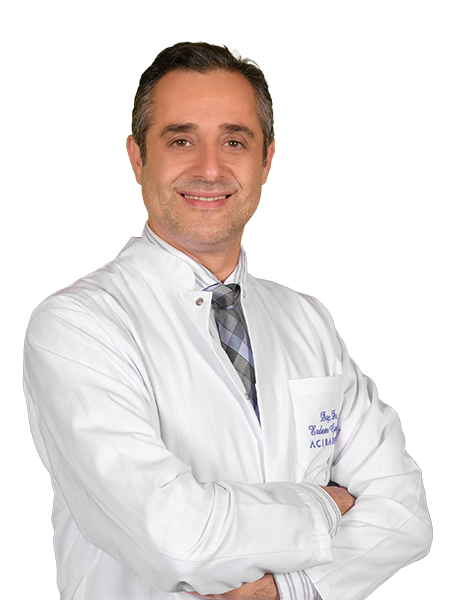
Aesthetic Plastic & Reconstructive Surgery
Assoc. Prof. Erdem Güven, MD

Aesthetic Plastic & Reconstructive Surgery
Assoc. Prof. Ahmet Küçükçelebi, MD
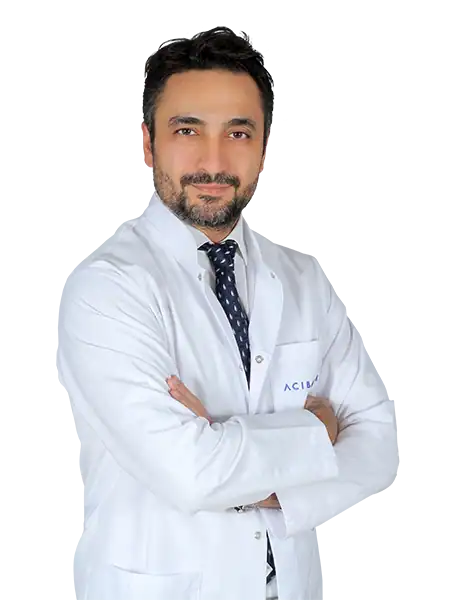
Aesthetic Plastic & Reconstructive Surgery
Assoc. Prof. Mehmet Altıparmak, MD

Aesthetic Plastic & Reconstructive Surgery