

Forehead Lift for Men: Hairline, Brow Shape and Why the Plan Differs for Male Faces
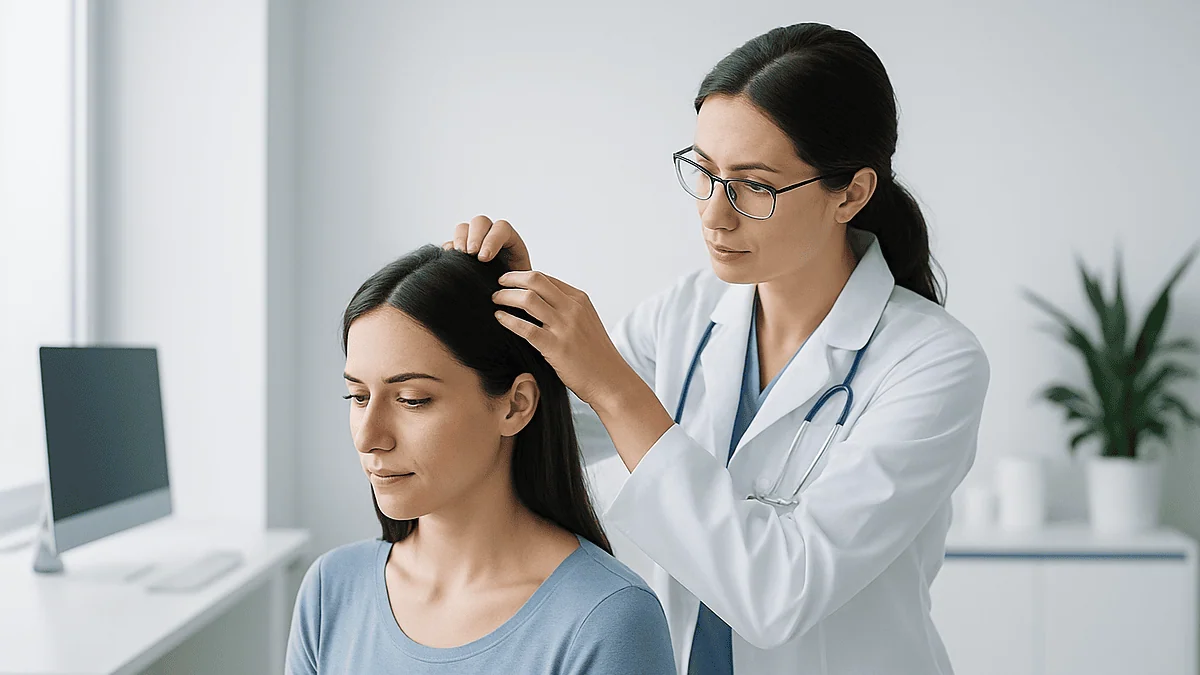
Key Takeaways
- A male brow naturally sits at or just below the orbital rim and is relatively flat, so a lift planned for a female arch can feminize a man's face or leave him looking startled.
- Because MedlinePlus reports that more than half of men over fifty have some pattern hair loss, incision placement for a forehead lift in men is planned around the hairline expected in ten years, not the one present today.
- Direct brow lifts, hidden in the upper edge of the eyebrow, and lifts through existing forehead creases exist specifically for men with minimal scalp hair or a shaved head.
- Upper eyelid surgery performed on a man whose real problem is a fallen brow can make the brow look heavier, which is why surgeons assess brow position before agreeing to operate on the lids.
- Botulinum toxin weakens frown muscles for roughly three months or somewhat longer per treatment according to the Mayo Clinic, but it cannot reposition tissue that has physically descended.
- Sutures are typically removed within about one to two weeks and desk work resumes around that time according to Mayo Clinic guidance, yet scalp numbness and final brow position can take months to settle.
A forehead lift for men lifts sagging brows and softens deep forehead lines by repositioning the tissue beneath the skin, but the plan usually differs from the female version. Surgeons typically aim for a flatter, lower brow, choose incisions that will stay hidden if the hairline recedes, and lift more conservatively to avoid a startled look. Suitability, technique and timing are decided with the treating surgical team.
He noticed it in a video call, not a mirror. Every time he concentrated, his forehead folded into three deep horizontal lines and his eyebrows dropped low enough to shadow his eyes. Colleagues kept asking if he was tired. He wasn’t. He was fifty-two, in good health, and simply carrying the weight of a brow that had slid a few millimeters south over two decades.
That small distance is what a forehead lift for men is designed to address. Yet when he started reading, almost everything he found described the procedure as if the patient were a woman: high, arched brows, incisions tucked behind a dense hairline, before-and-after photos of faces nothing like his. His hairline had been retreating since his thirties. A high arch would look wrong on him. He wanted to know what the plan looks like when the face is male.
That is the question this article answers, using published clinical descriptions rather than marketing, and leaving every decision where it belongs: with the surgeon who examines the actual face.
Why a forehead lift for men is not a smaller version of the female procedure
Start with where the eyebrow sits. On most male faces the brow rests at, or slightly below, the orbital rim, which is the bony ridge you can feel above the eye socket. On most female faces it sits above that ridge and arches toward the outer third. Surgeons describe a well-positioned male brow as relatively flat, heavier and lower, and a lift that ignores this can feminize a face or give it a permanently surprised expression.
Skin and soft tissue add a second difference. Male forehead skin is generally thicker and the underlying frontalis muscle, the broad sheet that raises the eyebrows, is bulkier. Thick tissue is harder to move and more likely to drift back toward its starting position, so the fixation method, the way the lifted tissue is anchored in its new place, matters more than it does in thinner skin. Male foreheads also tend to be taller, and many have some degree of frontal bossing, a gentle forward curve of the bone above the brow.
Then there is the hairline. MedlinePlus notes that more than half of men over fifty have some degree of male pattern hair loss, and the same encyclopedia entry on forehead lifts describes hairline position as a factor that changes how the incision is placed. An incision hidden in dense hair today can become a visible line across a bare scalp a decade later. Surgeons planning a forehead lift for a man therefore think about the hairline of the future, not just the present.
Put together, these three differences, brow height, tissue thickness and hairline behavior, are why the male plan is usually more conservative in how far the brow moves, more deliberate about where the scar goes and more focused on brow shape than on brow height.
What actually happens during a brow lift for men
The procedure has one mechanical goal: separate the forehead’s soft tissue from the bone beneath, move it upward and outward by a controlled amount, and hold it there while it heals in the new position. Everything else is a variation on how that separation, movement and fixation are achieved.
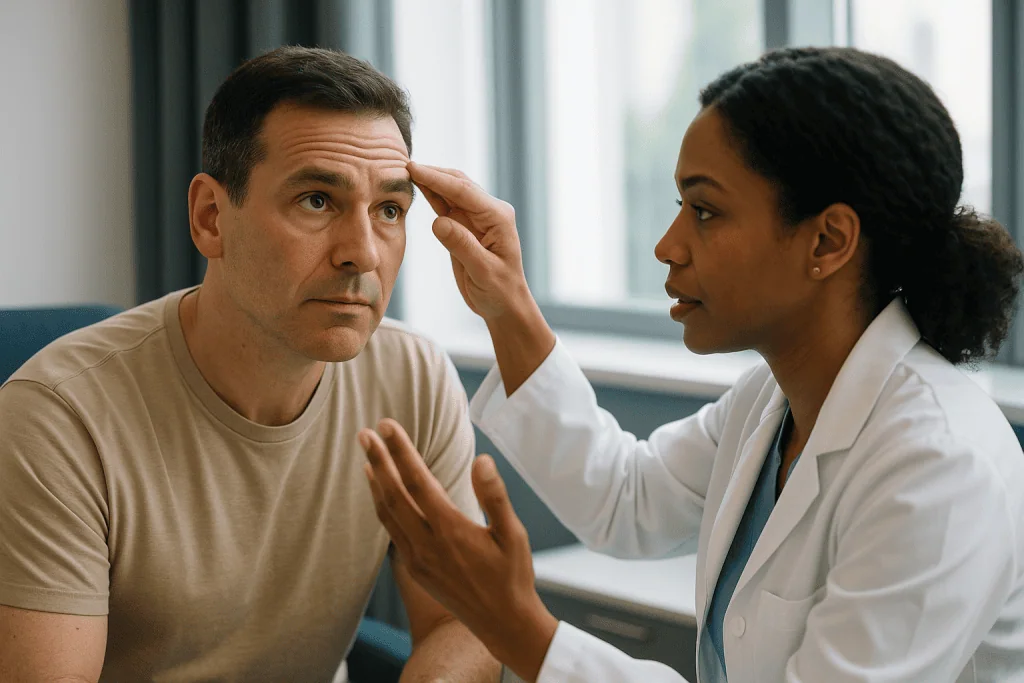
According to the Mayo Clinic’s description of brow lift surgery, the operation is usually performed under general anesthesia or intravenous sedation with local anesthetic, meaning either fully asleep or deeply relaxed with the area numbed. The surgeon makes incisions whose location depends on the technique chosen (more on those choices in the next two sections), then works beneath the skin to free the tissue from the bone. Where deep frown lines are a concern, the surgeon may partially release or weaken the corrugator and procerus muscles, the small muscles between the brows that pull them down and inward when you frown. Weakening them reduces the vertical crease many men develop between the eyes.
Once the tissue is mobile, it is repositioned and secured. Fixation can involve sutures anchored to the deeper layer of the scalp, small absorbable devices seated in the bone, or the removal of a thin strip of skin at the incision so the closure itself holds the lift. MedlinePlus describes the whole operation as typically taking around one to two hours, though the actual duration depends on the technique and whether other procedures are combined.
What the operation does not do is equally useful to understand. It does not remove excess upper eyelid skin, which is a separate procedure called blepharoplasty. It does not change the bone. It does not stop the brow from continuing to age. It resets the position and shape of soft tissue, and the surgeon’s judgment about how far to reset it is where the male-specific planning lives.
Endoscopic brow lift for men: when the small-incision approach fits
An endoscopic brow lift uses a thin tube with a camera and light, inserted through several short incisions behind the hairline, so the surgeon can release and lift the tissue while watching on a screen rather than opening the whole forehead. The Mayo Clinic lists it as one of the standard brow lift techniques, and its appeal is obvious: shorter scars, less numbness of the scalp behind the incision, and often a quicker return to normal activity.
For men, its suitability depends almost entirely on the hairline and the height of the forehead. Endoscopic incisions must sit within hair to stay hidden, and the surgeon must be able to reach the brow from that starting point. A man with a stable hairline and a forehead of average height is often a good anatomical candidate. A man whose hairline has receded well back, or who has a very tall forehead, presents two problems: the incisions may end up far from the brow, which makes the lift less precise, and hair that thins further may eventually expose them.
The endoscopic method also raises the hairline slightly, because the tissue is pulled upward and the excess is redistributed backward rather than removed. On a woman with a low hairline this is often welcome. On a man already concerned about a rising hairline it can be exactly the wrong direction.
There is one more consideration specific to heavier male tissue. Because the endoscopic technique relies on fixation devices or sutures rather than removing skin, its hold depends on that fixation resisting the downward pull of thick soft tissue. Published descriptions of the technique note that outcomes depend on adequate release and secure fixation, and surgeons vary in how they achieve this. A man asking about the endoscopic option is really asking two questions: does my hairline permit it, and how will the lift be held.
Brow lift men hairline: where the incision goes when the hair is receding
Incision placement is the decision that most separates male planning from female planning, so it helps to know the main options and why each one suits a particular hairline.
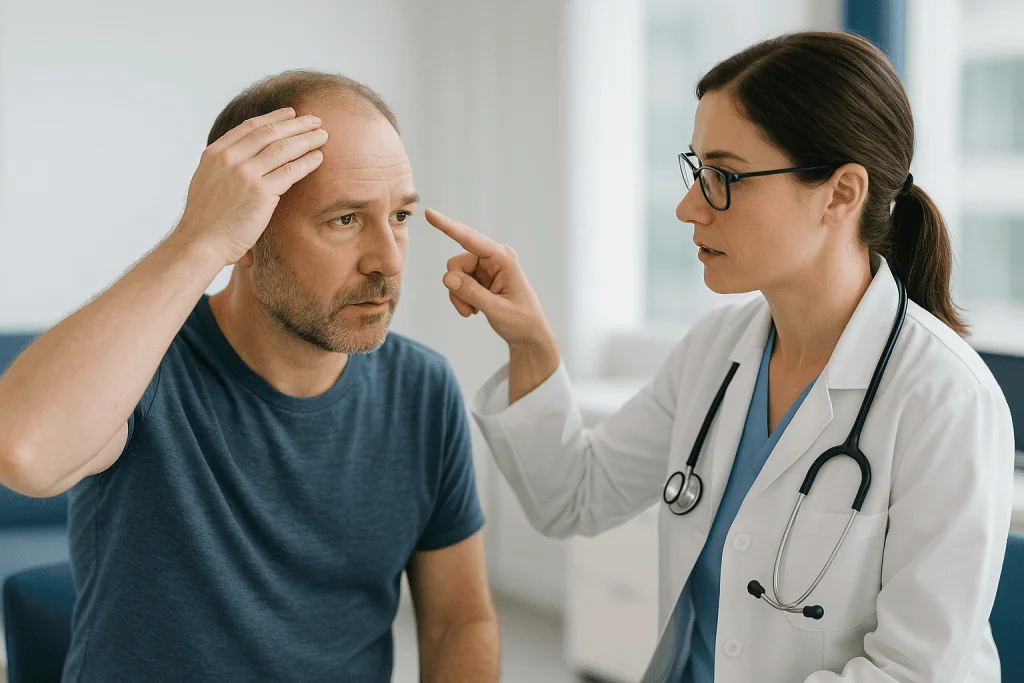
A coronal incision runs across the top of the scalp from ear to ear, well behind the hairline. It gives the surgeon direct access to the whole forehead and allows removal of a strip of scalp, which is a strong way to hold thick tissue. Its weakness in men is exposure: if the hair over that line thins or the scalp is later shaved, a long scar becomes visible. It also lengthens the forehead, because scalp is removed from behind the hairline.
A pretrichial or hairline incision runs along the front edge of the hair, sometimes in a fine irregular line so it blends better. Because skin is removed from the forehead side rather than the scalp side, this approach can shorten a tall forehead or at least avoid lengthening it. For a man with a high but stable hairline this is often attractive. Its risk is that a hairline scar is only invisible while hair grows right up to it, so a hairline that continues to recede can leave the line stranded on bare skin.
A direct brow lift places the incision immediately above the eyebrow, hidden in the top edge of the hair of the brow itself. It is the most reliable option for men with very sparse scalp hair or a shaved head, and it gives precise control over the outer brow. The trade-off is a scar on the face rather than the scalp, which some men find acceptable and others do not. Thick, low male eyebrows tend to camouflage it better than fine brows.
Finally, incisions can sometimes be placed within an existing deep forehead crease in older men with heavily lined skin. No option is universally right. The surgeon’s job is to match the incision to the hairline you are likely to have in ten years, not the one you have today.
Brow shape matters more than brow height on a male face
Most people picture a brow lift as pulling the eyebrows up. On a man, the more useful way to think about it is which part of the brow is lifted, by how much, and what shape results.
The medial brow, the inner end near the nose, is usually left almost where it is in men. Lifting it produces the raised-inner-brow appearance associated with worry or surprise, and on a male face that look is especially noticeable. Surgeons treating a deep frown crease will weaken the muscles between the brows rather than hoist the inner brow upward.
The lateral brow, the outer third above the temple, is where most age-related descent happens in both sexes, and it is where a male lift usually concentrates. A modest lift here opens the outer eye and reduces the hooding of skin over the outer lid without changing the overall flat line of the brow. This is often achieved with a temporal lift, a limited procedure through short incisions in the hair at the temples that addresses only the outer brow.
Symmetry deserves a word. Almost everyone has one brow slightly higher than the other, and lifting both by the same amount preserves the difference. A careful surgeon measures each side and may lift them unequally so the result is more balanced. Men should expect to be photographed and measured before surgery for exactly this reason.
The central message from published clinical descriptions is restraint. A brow moved a few millimeters can change how rested a man looks; a brow moved a centimeter can change who he looks like. The Mayo Clinic’s patient guidance frames the goal as improving the appearance of the forehead and brow, not transforming it, and that framing is even more apt for male faces where the natural position is low to begin with.
Who a forehead lift for men usually suits, and who is usually asked to wait
The clearest candidates are men whose main complaint is a heavy or low brow, often with deep horizontal forehead lines or a stubborn frown crease, whose eyebrows sit below the orbital rim and whose upper eyelids look hooded mainly because the brow has dropped rather than because the lid skin itself is loose. The Mayo Clinic describes the typical concern as a sagging brow that contributes to a tired or angry appearance, and that matches what men most often report.
General health carries as much weight as anatomy. Surgeons routinely ask that blood pressure, diabetes and any bleeding tendency be well controlled before elective surgery. Smoking impairs healing and raises the risk of skin and scalp problems after any lift, and most surgical teams ask patients to stop for a period before and after; the exact timing is set by the treating team. Blood-thinning medicines, including some over-the-counter pain relievers and supplements, are usually reviewed by the surgeon and the prescribing clinician together, and no one should stop a prescribed medicine on their own initiative.
Men are commonly asked to wait, or offered a different approach, in a few situations. If the hairline is actively receding, some surgeons prefer to see where it settles or to choose an incision that does not depend on hair. If upper eyelid skin is the real problem, eyelid surgery may be recommended first or instead. If expectations center on looking like someone else, or on fixing a life situation rather than a brow, a thoughtful surgeon will pause the conversation. The NHS guidance on cosmetic procedures is direct about this: take time, be sure of your reasons, and do not proceed under pressure.
Age alone is rarely the deciding factor. A man in his forties with early lateral brow descent and a man in his late sixties with a heavy forehead may both be reasonable candidates, provided health and expectations line up.
Forehead lift, eyelid surgery or botulinum toxin: what each one actually changes
Men often arrive asking about a forehead lift when what bothers them is really the eyes, or vice versa. The table below sets out, in neutral terms, what each common option addresses and what it does not. The durations quoted are typical ranges drawn from Mayo Clinic patient descriptions and are not guarantees.
| Option | What it changes | What it does not change | Typical duration of effect | Hairline considerations |
|---|---|---|---|---|
| Forehead (brow) lift | Brow position and shape, horizontal forehead lines, frown crease when muscles are released | Loose upper eyelid skin, under-eye bags, bone shape | Long-lasting; aging continues and results are not permanent (Mayo Clinic) | Incision must be planned around current and future hairline |
| Upper eyelid surgery (blepharoplasty) | Excess skin and fat of the upper lid | Brow position; can make a low brow look lower if done alone | Long-lasting; skin continues to age | None |
| Botulinum toxin injections | Softens lines made by muscle movement, can slightly lift the outer brow | Sagging tissue, fixed creases, heavy brow | Roughly three months or somewhat longer per treatment (Mayo Clinic) | None |
| Temporal (lateral) lift | Outer third of the brow only | Central forehead lines, frown crease | Long-lasting | Short incisions in temple hair |
| Direct brow lift | Brow position with precise control | Forehead lines above the incision | Long-lasting | Independent of scalp hair; scar sits above the brow |
Two patterns are worth drawing out. First, upper eyelid surgery performed on a man whose real problem is a fallen brow can remove skin that the brow was resting on, leaving the brow looking even heavier; surgeons frequently examine the brow before agreeing to operate on the lid. Second, botulinum toxin is a useful way to preview whether reducing frown-muscle activity changes how a man feels about his face, but it cannot reproduce the tissue repositioning of surgery. Which combination, if any, is right is a judgment made in the examination room.
Male brow lift recovery: what the first days and weeks usually look like
The first forty-eight hours are about swelling and pressure. Most men wake with a light dressing or a compressive wrap around the head, and MedlinePlus advises keeping the head elevated, including during sleep, for the first few days to limit swelling. Bruising tends to drift downward from the forehead into the upper eyelids over two or three days, which surprises people who expected it to stay where the surgery was. Discomfort is usually described as tightness and a dull ache rather than sharp pain, and the surgical team will prescribe or recommend pain relief appropriate to the individual; the specifics are theirs to set.
Numbness across the scalp behind the incision is common, particularly after coronal or endoscopic approaches, because the sensory nerves that run upward from above the eyes are stretched or irritated. Itching or tingling as sensation returns is expected. The Mayo Clinic notes that this numbness generally improves over weeks to months, though a small area can remain altered.
Sutures or clips are typically removed within about one to two weeks according to Mayo Clinic guidance, and many men return to desk work around the ten-day to two-week mark, once bruising can be concealed or has faded enough to be unremarkable. Strenuous exercise, heavy lifting and anything that raises blood pressure into the head are usually restricted for several weeks; MedlinePlus advises avoiding vigorous activity until the surgeon clears it, because early exertion raises the risk of bleeding under the skin.
Swelling settles in stages. The visible puffiness largely resolves within a few weeks, but the final position of the brow and the softening of the incision continue to change for months. Men with short haircuts should expect to plan around the incision being visible for a while, either by growing hair slightly longer beforehand or accepting a period where it shows.
Scars, hair growth and the shaved-head question
Scar visibility is the single practical issue that men raise most, and it deserves a plain answer: every incision leaves a permanent mark, and the goal of planning is to place that mark where hair, a brow or a natural crease will hide it for the rest of a man’s life.
Incisions within the scalp heal as fine lines that hair grows around, but not through. A small strip of hair loss along the incision, sometimes called incisional alopecia, can occur if hair follicles at the wound edge are damaged by tension or the technique used. Surgeons reduce this by angling the cut parallel to the direction the hair grows and by avoiding excessive pull on the closure. MedlinePlus lists hair loss along the incision among the recognized complications of forehead lift surgery, and it can be temporary or lasting.
For men who shave their heads, or who suspect they may in future, the calculus changes. A coronal or endoscopic scar that would be invisible under hair becomes a line on smooth skin. This is why the direct brow lift, with its incision hidden in the upper edge of the eyebrow, or a lift performed through an existing deep forehead crease, is often discussed for men with minimal scalp hair. Some men choose to accept a visible scalp scar because they prefer the result the coronal approach offers; that is a legitimate decision as long as it is made knowingly.
Hair itself is usually shaved only along the incision, or not at all, depending on the surgeon’s preference. Hair transplantation and brow lift can be combined or sequenced in men who want both, but that is an individual plan rather than a standard pathway.
The most honest guidance is to ask the surgeon to show, on your own head, exactly where each proposed incision would run and how it would look with the haircut you actually wear.
Risks and what the evidence actually says about them
Brow lift surgery is generally considered safe when performed by an appropriately trained surgeon, but every operation carries risks and the male anatomy shifts a few of them. The lists below reflect the complications described in Mayo Clinic and MedlinePlus patient information.
- Bleeding beneath the skin, called a hematoma, which can collect under the forehead flap in the first day or two and may need to be drained. Thicker male tissue and larger scalp vessels make meticulous control of bleeding especially relevant.
- Infection at the incision, uncommon but possible, usually appearing as increasing redness, warmth or discharge.
- Numbness or altered sensation of the scalp and forehead, often temporary, occasionally persistent, from stretching of the supraorbital and supratrochlear nerves that run upward from above the eyes.
- Weakness of the muscles that raise the brow if the frontal branch of the facial nerve, which runs across the temple, is bruised during dissection. This is usually temporary but can be permanent in a small number of cases.
- Asymmetry, where one brow ends up higher than the other, sometimes correctable with a smaller revision.
- Hair loss along the incision and visible or widened scars, particularly under tension.
- Over-elevation producing a surprised or feminized appearance, the risk most specific to male planning and the reason conservative lifting is emphasized.
- Recurrence of brow descent over time as tissue continues to age.
General anesthetic risks apply as they do to any operation and are assessed by the anesthesia team based on individual health. Smoking, poorly controlled blood pressure and blood-thinning medicines raise the likelihood of bleeding and healing problems, which is why pre-operative assessment is more than a formality.
Published patient guidance does not offer reliable percentage rates for these complications across the general population, and this article will not invent them. What a man can reasonably ask is how often his own surgeon sees each problem and how it is managed when it happens.
Will a forehead lift change how I look, or just how tired I look?
This is the question behind most male hesitation, and the honest answer is that it depends almost entirely on how much the brow is moved and where.
A conservative lateral lift of a few millimeters, with the inner brow left in place and frown muscles softened, generally reads as looking rested rather than looking different. The eyes seem more open because less skin is folding over the outer lid, the horizontal lines are shallower because the frontalis muscle no longer has to work constantly to hold the brow up, and the frown crease is less deep. Friends often cannot say what changed.
A larger lift, or one that raises the inner brow, produces a different result. The eyebrows sit above the orbital rim, the forehead lengthens visibly, and the expression at rest shifts toward surprise. On a woman this can look elegant. On a man it tends to look unfamiliar, and it is the outcome men most fear when they picture a brow lift. Surgeons who operate regularly on male faces plan specifically against it.
The frontalis point deserves a closer look because it explains a common surprise. Many men with a low brow have been unconsciously raising it for years, which is what carves the horizontal lines. After surgery the muscle relaxes, so the lines soften even though no line was directly treated. In the first weeks, however, the brow can look slightly higher than its eventual position because swelling adds volume and the tissue has not yet settled; the Mayo Clinic notes that final results take time to appear. Judging the result at two weeks is a reliable way to worry unnecessarily.
What the operation cannot change is skin texture, sun damage, bone shape or the fundamental structure of the face. A man expecting to look like a younger version of himself is more likely to be pleased than one expecting to look like a different person.
Non-surgical options for men and what they realistically achieve
Surgery is not the only route, and for some men it is not the right first step. The non-surgical options work by different mechanisms and it helps to understand what each one is physically doing.
Botulinum toxin injections temporarily block the signal between nerve and muscle, weakening the small muscles that pull the brow down and inward. The Mayo Clinic describes effects beginning within a few days and typically lasting around three months, sometimes longer, before the muscle recovers and treatment is repeated if wanted. Injected thoughtfully, this can soften the frown crease and let the outer brow rise a millimeter or two because the muscles opposing the frontalis are quieter. It cannot lift tissue that has physically descended, and it cannot remove fixed creases that remain when the face is at rest. The NHS lists these injections among regulated cosmetic procedures and stresses that they should be given by a trained practitioner; any decision about them belongs with a qualified clinician.
Dermal fillers add volume beneath the skin. In the temple and brow region they can support a hollowed outer brow so it appears less sunken, but they do not reposition the brow itself.
Energy-based skin tightening using radiofrequency or focused ultrasound heats the deeper skin layers to stimulate collagen. Evidence for meaningful brow elevation with these devices is limited and variable, and published patient guidance does not support presenting them as an equivalent to surgery. They may modestly improve skin firmness in some people.
A practical way many surgeons use these options is as a trial. A man unsure whether reducing frown activity will change how he feels about his face can try injections first; if he likes the softened expression but still sees a heavy brow at rest, that points toward the surgical conversation. If injections alone satisfy him, the question is answered without an incision.
What people often get wrong about a forehead lift for men
Misconceptions cluster around a few themes, and correcting them changes what men ask for.
The myth that a brow lift always raises the eyebrows. On a male face the goal is frequently to restore shape and open the outer eye, not to lift the whole brow. A good male result often leaves the eyebrows sitting close to where they were, with the outer third slightly higher and the skin between brow and lid less crowded.
The myth that eyelid surgery does the same job. Removing upper lid skin does nothing for a fallen brow and can make it look heavier by taking away the skin that was disguising the descent. Surgeons check brow position before agreeing to operate on the lids.
The myth that a receding hairline rules out surgery. It rules out certain incisions, not the operation. Direct brow lifts and lifts through forehead creases exist precisely for men with little scalp hair.
The myth that results are permanent. The Mayo Clinic is explicit that a brow lift cannot stop aging, and tissue continues to descend afterward. The lift resets the clock; it does not stop it.
The myth that injections are a weaker version of the same thing. Botulinum toxin changes muscle activity; surgery changes tissue position. They act on different problems and one cannot substitute for the other.
The myth that the surprised look is inevitable. That appearance results from over-elevation, particularly of the inner brow. It is a planning outcome, not an inherent property of the operation, and men should hear their surgeon explain how it will be avoided.
The myth that recovery is measured in days. Returning to a desk within about two weeks is typical, but numbness, incision maturation and final brow position take months to settle according to both Mayo Clinic and MedlinePlus descriptions. Anyone promising a finished result in a fortnight is describing bruising, not healing.
Questions to ask your care team before agreeing to a brow lift
A consultation is more useful when the questions are specific to male anatomy rather than generic. These are the ones that tend to produce the most revealing answers.
- Where exactly would each proposed incision run on my head, and how would it look with the haircut I wear now and the hairline I am likely to have in ten years?
- Which part of my brow are you planning to lift, by roughly how much, and how will you avoid raising the inner brow?
- How will the lifted tissue be held in place, and how does that choice account for thicker male skin?
- Do I need eyelid surgery as well, instead, or not at all, and how did you decide?
- Would you treat the frown muscles during the operation, and what does that change about my expression?
- What is your experience with brow lifts specifically on men, and can I see results on male faces with a hairline similar to mine?
- Which complications do you see most often in your own practice, and how are they handled?
- How will my regular medicines and any supplements be managed around surgery, and who coordinates that with my usual doctor?
- What does the first week look like day by day, and when would you expect me to return to work, exercise and shaving my head if I do?
- How long should I expect numbness, and what would make you concerned about it?
- If the result is asymmetric or under-corrected, what is the plan?
- What would make you advise me not to have this operation?
The NHS guidance on cosmetic surgery encourages patients to check that the surgeon holds appropriate qualifications and registration, to have a cooling-off period after the consultation, and to be wary of any pressure to decide quickly. A surgeon who welcomes the last question on that list, about reasons not to operate, is usually one worth listening to.
When to call your doctor after a forehead lift
Most recovery is uneventful, but a few signs mean the surgical team should hear from you promptly rather than at the next scheduled visit. Both MedlinePlus and the Mayo Clinic describe these as the situations that need same-day attention.
- Swelling that increases rapidly on one side, is tense and painful, or is accompanied by a feeling of pressure, which can indicate bleeding under the skin (a hematoma) that may need to be drained.
- Bleeding from the incision that soaks through dressings and does not slow with gentle pressure.
- Fever, or an incision that becomes increasingly red, hot, swollen or begins to leak cloudy fluid, which can signal infection.
- Pain that worsens after the first two or three days rather than gradually improving, or pain not controlled by the plan the team gave you.
- Sudden change in vision, severe eye pain, or an eyelid that will not close, which is uncommon but needs urgent assessment.
- Inability to raise one eyebrow that was not present immediately after surgery, or new drooping of the eyelid.
- Shortness of breath, chest pain, or pain and swelling in one calf, which are general post-operative warning signs of a blood clot and warrant emergency care regardless of the operation.
- Any allergic-type reaction such as a spreading rash, facial swelling or difficulty breathing.
Numbness, mild itching, bruising drifting into the eyelids and a feeling of tightness across the forehead are expected in the early weeks and do not by themselves need an urgent call, though they are always worth mentioning at follow-up. When in doubt, the surgical team would rather be contacted about something that turns out to be normal than miss something that is not. Keep the after-hours number they gave you where you can find it, and use it.
Frequently asked questions
Is a brow lift for men different from one for women?
Yes, in three main ways. Surgeons usually aim for a flatter, lower brow position in men rather than an arch, lift more conservatively to avoid a surprised look, and choose incisions that will remain hidden even if the hairline continues to recede. Thicker male skin and heavier forehead muscle also affect how the lifted tissue is anchored. The operation itself uses the same basic techniques; the planning is what changes.
Can I have a forehead lift if my hairline is receding?
Usually yes, but the incision choice changes. Incisions hidden behind the hairline may become visible if hair continues to thin, so surgeons often consider a hairline incision, a direct brow lift placed within the upper edge of the eyebrow, or an incision in a deep forehead crease. Some surgeons prefer to wait if the hairline is changing quickly. The decision rests with the treating surgeon after examining your scalp and discussing your likely future hairline.
How long does male brow lift recovery take?
Mayo Clinic patient guidance describes sutures or clips being removed within roughly one to two weeks, with many people returning to non-strenuous work around that time once bruising has faded. Vigorous exercise is generally restricted for several weeks. Scalp numbness, incision softening and the final position of the brow can continue to change over months. These are typical ranges, not promises, and your surgical team will set your own timeline.
What is an endoscopic brow lift for men and is it always the best option?
An endoscopic brow lift uses a small camera through several short incisions behind the hairline to release and lift forehead tissue. It suits men with a stable hairline and average forehead height. It is less suitable when the hairline has receded far back, because the incisions may end up too distant from the brow and may later be exposed by further hair loss. It also tends to raise the hairline slightly, which some men wish to avoid.
Will a brow lift make me look surprised or feminine?
It should not if planned for a male face. That appearance results from over-elevation, especially of the inner brow, or from creating an arch. Surgeons experienced with men typically lift the outer third of the brow modestly, leave the inner brow near its natural position and soften frown muscles instead of hoisting them. Asking the surgeon to explain exactly how much movement is planned and where is the most direct way to address this concern.
Do I need eyelid surgery instead of a brow lift?
It depends on whether the hooding over your eyes comes from loose eyelid skin or from a brow that has dropped onto the lid. Removing lid skin when the brow is the real problem can make the brow look heavier. Some men need one procedure, some both, and some neither. A surgeon assesses this by gently lifting the brow during examination to see how the eyelid changes, then discusses the options.
Can botulinum toxin replace a forehead lift?
No, because it works differently. The injections temporarily weaken the muscles that pull the brow down and inward, softening frown lines and sometimes letting the outer brow rise slightly, with effects the Mayo Clinic describes as lasting around three months or somewhat longer. They cannot lift tissue that has physically sagged or remove creases present at rest. Some men use injections as a trial before deciding about surgery, in discussion with a qualified clinician.
Will the scar show if I shave my head?
A scar placed within scalp hair becomes visible on a shaved head, so men who shave or expect to should raise this before surgery. Options that do not rely on scalp hair include a direct brow lift, with the incision hidden in the upper edge of the eyebrow, or an incision within an existing deep forehead crease. All incisions leave a permanent mark; the planning goal is to put it where your actual grooming habits will hide it.
How long do brow lift results last for men?
Results are long-lasting but not permanent. The Mayo Clinic notes that a brow lift cannot stop the aging process, and forehead tissue continues to descend gradually afterward. Heavier male soft tissue may place more downward pull on the lifted position, which is why the method of anchoring the tissue matters. Sun protection, not smoking and good general health support the result, but no specific duration can be promised for any individual.
What are the main risks of a forehead lift in men?
Patient information from the Mayo Clinic and MedlinePlus lists bleeding under the skin, infection, temporary or occasionally lasting numbness of the scalp, weakness of the muscles that raise the brow, asymmetry, hair loss along the incision, visible scarring and the possibility of over-elevation. Smoking, high blood pressure and blood-thinning medicines increase bleeding and healing risks. Reliable population-wide percentages are not published, so asking your surgeon about their own experience is the most useful approach.
References
- MedlinePlus Medical Encyclopedia: Forehead lift
- MedlinePlus Medical Encyclopedia: Male pattern baldness
- NHS: Cosmetic procedures
This article is for general information only and is not a substitute for professional medical advice. Please consult a qualified doctor about your individual situation.

More from the Blog

Is Genioplasty Painful? General Anesthesia, Chin Tightness and What Helps in the First Days
Genioplasty is usually described as uncomfortable rather than severely painful. Because it is performed under general anesthesia, nothing is felt during the operation itself.…

Lip Lift vs Corner Lip Lift vs Italian Lip Lift: How the Incision Patterns Differ
The main types of lip lift differ by where the surgeon places the cut. A standard subnasal lip lift removes a strip of skin…

How Sliding Genioplasty Is Performed: The Osteotomy, Repositioning and Plate Fixation
A sliding genioplasty procedure reshapes the chin by cutting the lower front part of the jawbone through an incision inside the mouth, sliding the…
When Can You Wear Contacts and Makeup After Blepharoplasty? Eye Care in the First Weeks
Most surgeons ask patients to keep makeup off the eyelids until incisions have sealed and any stitches are out, which Mayo Clinic places at…

What to Ask a Rhinoplasty Surgeon at Your First Consultation: Twelve Questions That Matter
The most useful questions to ask a rhinoplasty surgeon cover four areas: their training and how often they perform nose surgery, what change is…
Does Thicker Skin Slow Ethnic Rhinoplasty Recovery? Swelling Timelines Explained
Thicker nasal skin does tend to hold swelling longer after rhinoplasty, especially at the tip, because the deeper soft tissue layer retains fluid and…